Transcript
Speaker: Well, hello everybody and welcome to this new episode of Pep Talk, the persuasive evangelism podcast from Solace. Welcome if you've been with us for the last, well, almost 200 episodes of this, and welcome if it's your first time tuning in or downloading. Now, Pep Talk is a programme about Christians sharing the wonderful and liberating message of Christ with the world. And it's always done through the lens of a brilliant guest with something significant to tell us about what they've been up to.
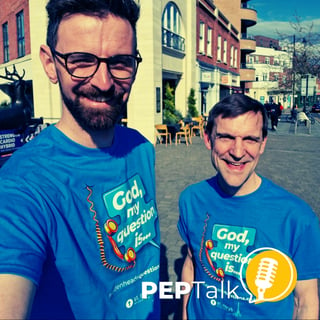
Speaker: Well, in the question that co-hosts share this week is the illustrious Simon Wenham. Simon, how are you? I'm very well, thank you. I'm not sure about illustrious, but that's very kind. I like to chuck in an adjective and then watch your reaction.
Speaker: um and Our guest this week is Jeremy Fowler, whose biography, as you'll see in a few minutes, is quite remarkable. um Jeremy, welcome and thanks for joining us today on Pep Talk. tell us, where are you in the world and what would you be doing right now if you weren't online chatting to us? Thanks very much, guys. ah Very glad to be on the show. and yeah I'm based in Oxford. um ah so I sometimes describe my life as being spending about a month year in ah Iraqi Kurdistan, so one foot in Tukhuk, one foot on the Kali Road, and both are very Kurdish places to have your feet.
Speaker: and Tell us about your your background. You mentioned that you spent quite a lot of time both now and you actually lived in Iraqi Kurdistan for quite a while. But go get behind that. What's your background before that, before we ask about some of these more exotic and interesting things? Well, it's funny, actually. I did once, once ah many months upon a time, many moons ago, study history.
Speaker: um And it was seen as a bit of a dossier subject. You know, we're the guys who rolled out of bed and didn't have... I actually don't think I had any compulsory lectures in three years of of um of a history degree. yeah um yeah But I didn't tend to think that I would directly use my history. um And as it turns out, it's proved to be incredibly ah an incredibly important skill because um yeah we lived for 11 years in Iraqi Kurdistan, and there was um ah ah some of the folklore. There was this sort of the legend of a man called Kambalan,
Speaker: who was the first American to go and set up home among the Kurds of Iraq. Arrived in Iraq in 1923, bought a village. He was a farmer's son from California, Roger Cumberland. They called him Camberlan. um And he learned Kurdish. He loved the people. who was very well-respected among the local people. Brought fresh water into the the town of Duhuk, for which he's still famous. um But mounting there was mounting opposition to only ah maybe one, two, three locals who actually became a followers of Jesus from a Muslim background. And two guys visited his house in June 1938. And after some friendly conversation, they pulled a a weapon on him and shot him.
Speaker: He lay there ah injured on his on his floor. And then 10 hours later, he died in in the military hospital in Mosul. So Roger Cumberland is a much talked about figure. um I put him on Wikipedia.
Speaker: I'm making a documentary about him. I've been asked to write a biography of him, which is what what i what I tend to have. you know What would I be doing if i wasn't on this podcast? so I'd be looking at photos and an archive um letters from Roger Cumberland. Yeah, that that that that is a story that just has to be told. um It's an inspiring story of courage and and pioneer um gospel labouring in a tough um frontier place. um And the Kurds find him fascinating as well. So I'm i'm in touch with...
Speaker: the family of Roger Cumberland. I'm in touch with the family of the killer as well. And I seek to ah to to get to know them, to to share with them in their joys and sorrows and share good news with all and sundry in this story.
Speaker: Wow, that sounds absolutely fascinating. i'm I'm afraid I should confess that I'm also a historian by background. I'd love to hear, can you say a little bit more about how you ended up in Kurdistan? What what were you actually doing there?
Speaker: ah So I i um did a few things there, but I but i i set up a company, actually. i ah People often think, um I mean, m Kurds will tend to think I was some sort of spy, you know, um that makes for some interesting conversation. Even if you say, well, I was actually there, you can check out my work on the Kurdish dictionary. I was, ah you know, i taught English and things like that. But they're often thinking, yeah, but who was he really working for, you know? Yeah.
Speaker: So and the the Kurdish word for a spy is a siho a porcupine. So there we go. Whatever I say, I think it was a porcupine. um But yeah, no, I genuinely set up a um a language consultancy which taught some English and then helped develop a Kurdish dictionary called the Kurdish wiktionary, ku.wiktionary.org. We added about 45,000, did about 45,000 edits to that. And that helped us to um bring clarity to the most important words in the world, namely spiritual vocabulary, words that the the Bible translation was going on while we were there.
Speaker: They published the New Testament in Burdini Kurdish. um and We wanted to make those words understandable to readers of the Bible, to preachers of the Bible. um and so yeah that That was um a lot a lot of my work. I taught some history there as well for a private university. Actually, it was the Englishman teaching Kurdish history, which I absolutely loved. and I had to sort of keep a few pages ahead of them in the in the textbook, but also studying what we find about the Kurds in Herodotus and Xenophon. and
Speaker: um So it was a real eye-opener for me and really got me into Kurdish history. And now that's you know coming to a a real ah you know action point with um with writing this biography.
Speaker: um Even if it's a Dosser subject, Simon, I'm still getting over the fact that Simon's PhD is in a quote-unquote Dosser subject, which will go into the Solus archives and be repeated many times. So thank you just for that point alone before you got into the really serious and important matters. But So you was it 11 years? You said you were in Iraq? right um Yeah, that's right.
Speaker: We went out with three children. The Lord gave us a fourth um while we were there. and And so they grew up with Kurdistan as home. So then you all came back to the UK and you arrived back in multinational, multicultural, multireligious Britain with it all going on all around you. What did living i immersed in another culture teach you? Key points, are what what did that teach you about relating yeah as as friends, but also relating the gospel to people who come from very different backgrounds that that we meet in our shops, our high streets, week in, week out.
Speaker: Yeah. um I wrote an article called something like Engaging Shop and Restaurant Communities. And it's meant to be a deliberately, um there's a sort of oxymoron there because we tend to think of ah a shop as a place for a speedy transaction.
Speaker: um rather than a community. But actually, these ethnic restaurants and shops are an outflow of their community. you know They sell some of the local goods, foods and so on. They apprentice young people behind the till um and those sort of things. that that that they can be a place of of socializing, you know just turning up and chatting to people at the at the shop for any particular ah you know ethnicity, nationality.
Speaker: um So yeah, we should really even sacrifice some money by so by so by by shopping at local shops rather than the cheaper out-of-town supermarket or online, I think is ah is a good thing.
Speaker: And we can be friendly. I think a little bit of knowledge I would i would talk to encourage people not to ask the question, where are you from? i once did that, actually. i was I was at a petrol station, and I went to the to the till to the to to pay for my fuel. And I said to the guy, he looked Kurdish, actually. I said, where are you from?
Speaker: and he looked at me and he said, well, I'm Kurdish from Syria, and I used to live in Belgium, and now I live in Britain. And that was like a a slap on the cheek to me. Not not that he was aggro with me, but I thought, it's a really hard question to answer sometimes.
Speaker: But if you're talking, you know, people have sort of, you know, very mixed heritage in terms of where where they're from, I even experienced that moving around quite a bit um as ah as a as a lab.
Speaker: But ah languages are something that's much more written into our identity in a positive sense than where are Where are you from is can often be seen as a xenophobic question.
Speaker: But you know i often ask people who look Middle East and i I have a guess at their ethnicity and say, do do you speak other languages like Arabic or Kurdish? you know If you give them a couple of choices, it's less sort of invasive, if you like. um If they happen to not like Kurds, you know give them a couple of choices so they don't feel they've been immediately labeled as Kurdish or Afghan or something. you know And if you are if you ask, oh, so do you speak Kurmanji or Sarani? They'll often respond, oh, yeah.
Speaker: know, how how do you know about our languages? You know, said, oh, well, I just, I've met Kurds. I, you know, um I have Kurdish friends or my barber's Kurdish. or I'm fascinated by by Kurdistan. I feel really sorry for the way that um you've had such a hard time politically in the Middle East, you know, show some sympathy, I think is a really important thing. But yeah, just be positive about people's, um even if you're bad at languages, say I'm terrible at languages, but, you know, can you teach me how to say hello in in your language, you know?
Speaker: that's I think people feel honored by that because for every 500 cold, formal transactions they have, they might have had one friendly conversation with some white white man who actually and doesn't think like an individualist, but is actually friendly to to others, you know?
Speaker: Thank you. Yeah, that's really interesting. I think particularly as someone who obviously goes to barbershops and I've often um had occurred at doing the haircut and and I think I would actually, I often do strike up conversations, but I do also think in transactional terms, I'm here just to get a haircut and get out. um I think the problem, I think, with with many Christians and and I'm sure Muslims as well, is we can be in sort of our own separate bubbles quite a lot. And yeah I think some people may be thinking, actually, I don't have many points of contact. I wondered if you could say, could you say a little bit about how many Kurds are actually in the UK, if you know, and then are there certain ways that we can be less transactional and and increase those points of contact? You've mentioned a few already. Yeah. I mean, okay, so in Oxford, which would be fairly typical of of UK cities, I think more than 1% of the population of Oxford is Kurdish.
Speaker: Now, statistics would be very hard. Hard statistics would be very hard to come by ah ah on this. um And people keep arriving. you know lots of um Lots of Kurds are coming um through legal and illegal routes. um ah but but But even if you say, okay, so there's...
Speaker: you know, at least 1000 and a half Kurds in Oxford, what are those numbers mean anyway, because most of the Kurds really are working in service industry jobs. So if you imagine, let's say, stereotypically, there were a number of Japanese, or Chinese people, but they were typically working in IT and science jobs, you wouldn't see them, they're just stuck there behind the computer. Whereas Kurds who are typically tailors, kebab men,
Speaker: um and and barbers. You meet them as soon as your trousers need tailoring, um or you you know you need a haircut, or you want some fast food, um or even some quality Lebanese sandwiches. you know Like in Oxford, some of those really good quality Syrian Lebanese type places are run by Syrian Kurds. They're very good at that kind of street food, actually.
Speaker: um so yeah so but Nationwide, um I estimate there's 300,000 maybe, i mean 350,000 Kurds around the UK from those four nations, Turkey, Iran, Iraq, and Syria.
Speaker: um But yeah, the overwhelming overwhelmingly barbershops are run by Iraqi Kurds around, even though they may say Turkish barber, that's that's a brand name, you know the hot towel experience and so on. They even sometimes ah you know set your ears alight. um I don't know if health and safety put their paddle in on that one. but's excellent Yes, I've had my ears i've had my ears set alight. Marvelous experience.
Speaker: Did you know that as well as the Pep Talk podcast, Solas also does live events in person in churches all around the country, equipping and encouraging Christians to get a little bit better at sharing their faith. And we've worked from the south of England to the highlands of the islands of Scotland and all kinds of places in between.
Speaker: If you'd like us to come to your church and do a confident Christianity event, get in touch with us through the website. And now, back to the program. If you could help us with a really difficult, suppose, hot-button issue, which is how should Christians in this country respond to, not just Kurds in particular, but you know Islam more broadly? Because many people say Islam is a economic and political threat.
Speaker: Other people say, no, God's brought a mission field to our doorstep. You've said, i noticed um you should even be willing to spend a bit more money to go to the local community shop from someone that's run by someone from an ethnic minority. Whereas I know some people on the political right would say, you know, boycott this that this this incoming menace sort of idea. What would be a genuinely Christian response to Islam in our country? And how can we steer through that with wise and biblical principles that are honorable before God and before other people?
Speaker: Well, yeah, thanks for asking that. Firstly, these stories about criminality on our high streets have moved from the right wing media into the BBC and have become major BBC stories.
Speaker: um ah Obviously, we should not be prejudiced. We should not assume that just because there's a lot of cash in hand and tax dodging and there's money laundering going on, um we shouldn't assume people are guilty.
Speaker: um yeah you know We should assume they're innocent before before guilty. And and we we won't necessarily know what's going on um in these shops. But even if a lot of the stats and the stories are true, and they are very sad stories about um you know the threatening of ah of of local officials that are seeking to you know police and tax these these premises, that those are very sad stories. But I often refer to John Wesley in this. Okay, so in May 1742, John Wesley was in Newcastle, and he was really shocked. He wrote in his journal, I was surprised, so much drunkenness, cursing and swearing, even from the mouths of little children. and that's sad when you when you hear kids, you know, swearing using bad language.
Speaker: do i I never remember to have seen and heard before like this in so small a compass of time. But then look how he went on. Did he say, I'm going to retreat to Oxford, where where where I'm from? This is what John Wesley said.
Speaker: Surely this place, Newcastle-upon-Tyne, is ripe for him who came not to call the righteous, but sinners to repentance. And so even in the case of, um i mean, Kurds themselves tell me about criminality and corruption um that goes on. And so they're very aware of it themselves. um But surely that's all the more reason to speak to people about a savior who not just rules over us from bufar from afar, but has come in as a servant to forgive us our sins, to to cleanse us,
Speaker: by dwelling within us um in the person of the Holy Spirit, surely you know this is the good news that that criminal gangs need to hear. So let let's let's let's preach the gospel. um And happy to say more about good conversation starters, because you know that that's the sort of the heavy artillery, if you like, you know proclaiming Christ.
Speaker: You've set me up very nicely for the next question, actually, which is, yeah what sort of approach do you suggest to to build up those conversations? I was thinking that many Muslims know the Quran very well. So, for example, do you argue from the Bible as a way of ah commending Christianity, or do you take more of an apologetics approach where you take a step back and say these are the reasons that we believe Christianity from outside the Bible? What what sorts of approaches do you think are best?
Speaker: i mean i I'll perhaps try and talk particularly about um you know our Kurdish friends that that we get to know in our towns um around the UK.
Speaker: um You can ask ah a Kurd, um and and obviously you should... you should be aware that that some are more educated, others are but just, you know, just they're doing a job, not not particularly deep thinkers. i I do find that a lot of okay, so there's a bit of a stereotype that you think people have gone to university are going to be more deep thinkers. But here's here's the thing, okay.
Speaker: If you work at a a street kitchen, or as a barber, you're thinking all day. You're not so busy. You're doing manual work, which gives you a lot of time for discussion and for thinking. some of these guys, I think there are one falafel maker. He's a very philosophical falafel maker because he has so many hours each day to think through big issues. And he listens to political stuff on his headphones while he's working. So as a starter for 10, you could ask them, what do you think of the second caliph, Omar Khadr?
Speaker: Ibn al-Khatub. There's a bit of a mouthful, but see if you can remember that. okay Omar, common name among Muslims, boy's name um the second caliph, um so the second successor to Muhammad, um because he is known, um' just looking at Wikipedia here, during his reign, the caliphate expanded at an unprecedented rate, um and and basically they conquered what we call Kurdistan and Persia, Iran.
Speaker: And you could say, well, they they might be very loyal to Islam and say, well, you know, under God's blessing, the world of Dar al-Islam expanded greatly. But of course, the problem with Dar al-Islam is that outside Dar al-Islam is Dar al-Harb, the house of Islam and the house of war. If you're not in the Dar al-Islam, you're in the Dar al-Harb, the house of war. So there's a sort of foundational problem with the expansion of of of of Islam, which, you know, Christianity expanded very differently through people laying down their lives, through people selling their property and giving to the poor, not by pillaging other people.
Speaker: So you you could you could say, you know, I know a lot of Kurds, have very bad feelings about Omar, the way he conquered Kurdistan. That appeals to their sense of autonomy as Kurds. um and Many of them would would have yeah they'd say that was a pretty pretty bloody period in our history.
Speaker: um and I'd say that a lot of Kurds are quite conflicted because they seem to hold two things at the same time. they' They're loyal to Islam, they they fast during Ramadan, they maybe go to the mosque,
Speaker: and They want their children brought up as Muslims. And yet they also feel that that Islam has conquered Kurdistan, both 634 to during ah Omar's But then that has happened in 2014, in terms of um ISIS coming, we were living in Kurdistan when ISIS were on the rampage.
Speaker: And, ah and it was a, you know, a time with many Kurdish lives lost resisting and the ISIS fighters. ah And so that attempt to impose ah Islam as political power and to establish a you know a global caliphate is is is very contemporary to to the Kurdish experience and one which Kurds feel angry and and overwhelmingly feel very uncomfortable with.
Speaker: um so So those are issues that they they might want to discuss. um But but ah another way of approaching that is that ah you you can show people, I'll hopefully include in the in the links, a page where i I point people to Bible apps for a mobile phone in different Kurdish dialects. So the Bible is not completed in print form in all the dialects, far from it.
Speaker: um But they're about to print the Kurmanji Northern Kurdish ah Bible this this this summer, this autumn. It's kind to going to be launched, which is very exciting. It's kind of a talking point, actually.
Speaker: But the thing is, the way that Islam and Christianity have spread is very different. And on my shelves, I have a book called Translating the Message by Lamin Sanna, an African ex-Muslim who compared Islamic mission with Christian mission. In short... Islamic mission tends to subjugate local languages and cultures, imposes Islam as the language of worship, and doesn't do a great deal to develop local languages. Christianity, on the on the other hand, transcends culture, and the emphasis is on people hearing the word of God in their mother tongue, in their heart language. And Christianity tends to exalt local cultures. This is a big issue for Persians and Kurds and many others who have found that their language has not been developed under the rule of Islam.
Speaker: Whereas Christianity is ah is freeing Kurds to be more Kurdish, to worship in their own language. And and I regularly just pick up a psalm and and read it from my mobile phone with with Kurds. And almost you know across the board, that their hearts are warmed by this. They they often say, did you write that? you know And I say, no, actually, that was well that was King David. That's an ancient an ancient poem um in from the the Holy Book of Zebur.
Speaker: ah So they they really love hearing this in in in their in their mother tongue. So I think there's a difference between Islam there and Christianity and the way that it exalts ah the beauty of ah of the word of God in the vernacular language. So that that's a big talking point.
Speaker: It's really interesting because that that strikes into quite a a kind of a methodological point, doesn't it? That um sometimes if you were to have a discussion with a Muslim, you could just run into a, as you mentioned earlier, Jesus died for us on the cross. No, he didn't. Yes, he did. And you just end up with a log jam on a quiche. But there's ah as a side way in which in that case is through... Kurdish identity in politics. like We have a very similar thing in the West that if you say to someone, would you like to talk about Jesus? The answer might be no, but people do want to talk about a host of other issues that lead to him. exactly Justice, the environment, you know relationships, all sorts of things.
Speaker: Are there any other ways into sharing the gospel with Kurds that might be that slightly indirect approach that might fascinate them and draw to a conversation that might lead to Christ in a helpful way. There are other ways that you could, I mean, imagine you're sitting in your barber's chair and the conversation's going well.
Speaker: What might be some great conversational ways into gospel-related themes? Well, one of them I've already mentioned, you say say to a Kurd, have you heard of of Camberlan, Roger Camberlan, whose house is being restored in centre of Tohuk? If you look at my social media, and I'll try and link the video I made as a commemoration, 88 years since his death.
Speaker: And in that I talk briefly about his life and his death. And then I read Psalm 103, beautiful Psalm um about the fatherhood of God. As far as the East is from the West so far, has he removed our transgressions from us? It actually sounds quite Islamic, a lot of Psalm 103. And yet,
Speaker: By proclaiming God as our Father and the one who definitively removes sin, not just sweeps it under the carpet, but removes sin, it points forward to the cross of Christ. So Psalm 103 is a great way. There's nothing there which Muslims going say, oh, no, that's been changed. We we can't accept that.
Speaker: But actually, it undermines their whole process. view of that that we don't need someone to pay for our sins. And and it proclaims God as Father, as I'm as i'm saying. So so that's one one way in. Another is the whole issue of the environment, which I've done a lot on social media on. And yeah, I have a ah I have a business card with ah with a hashtag on it, ah hashtag Kurdistan, not Plastikistan.
Speaker: And I created that as ah as ah as a to try and get the conversation going on how Kurds themselves, although they've been badly treated by Arabs, Turks and Persians, they are their own worst enemies by the way that they are ruining their their environment, massive overuse of single use plastic is filling their their fields, their rivers, their drains, where when when it rains, the water's got nowhere to go.
Speaker: and and it is just causing devastation in in Kurdistan. And you know, they're tarmacking the the fields. um And so you can see how, yeah where's the water going to go? They don't have enough trees to absorb help absorb the water. And this is causing terrible flooding, and which is a ah biblical picture of judgment. um So Kurdistan, not Plastikistan, because if they're waterproofing the the ah the farmland, and they're filling their drains with plastic, and they're using all this single use plastic, they don't need to.
Speaker: it's ah It's a picture of a world gone wrong where we're not ruling well over the animals who are eating all this plastic, the rivers and and the ground. We need a new Adam to put us in right relationship with God to get back to the old ways of stewarding ah the water and the land well. um So that's one talking point as well, which I've done ah done some some writing on.
Speaker: um Yeah, and that's the back door into Islam, i would say. That's very interesting. it's It's a similar approach to Have You Ever Wondered, which is a book that Solas produces, which is looking at the sort of cultural questions and then drawing back to to Jesus in in in different ways. So it it sounds ah it's good to hear you're doing a very, very similar thing. and ah As we draw to an end, I wondered if, are there any examples of conversations you've had with people that have led them coming to faith? Are there any particular ones that you can think of?
Speaker: ah Well, there's one with a taxi driver that I sometimes refer to where um he he he asked me, this is in Kurdistan, which is better, you know Britain or Kurdistan. And I said to him, Well, I have three daughters.
Speaker: and I was going to then talk about how I don't like the the sexual chaos of of the Western world, you know the anything goes, hookup culture, the sexualization of children, those sort of things. But he didn't let me get onto that. He said, oh, so you're a Muslim then?
Speaker: Well, I just told him I had three daughters. why what does the How does that make me a Muslim? you know But in his in his mind, if what first and foremost, when you think about the well-being of your children, not things like money and so on.
Speaker: Now, i'm not saying everything is right about the Islamic view of women, but at a basic level of being concerned for sexual purity, um for yeah the the well-being of your children, protecting them from harmful ah you know dogma about sexuality, which that they are exposed to.
Speaker: that That was a very interesting conversation. and I think we can usefully be saying things like, How do you find it being a parent here? don Don't you find it worrying the way that they promote all this LGBT ideology um to young people?
Speaker: And they will overwhelmingly agree with you on that. and And that can be a doorway into talking about God's concern for building strong families where husband and wife are loyal to each other, create a good ah home and a context for for bringing up a children. and you know That's the basic foundation ah stone of society is the family. and and Muslims will respect you for saying that. um and They'll be more willing to listen to our message if they see that we're people who who who who are honorable people um and and and have a strong family ethic.
Speaker: Absolutely. and i just love your point about just trying to find those points of contact that people have culturally. And so although you've been speaking about the Kurds, as you say, there may be different ways of talking about people's history, their identity, or something like climate change might be a way of discussing faith and leading to more fruitful conversations.
Speaker: I also just loved your point about not being so transactional in how we live. I think I'm often guilty of just sort of going from A to B and not thinking about the conversations along the way. And and also your point about actually in some cultural contexts, for example, barbershop might be a center where you often do have ah more substantial conversations. Yeah.
Speaker: And finally, just your reminder as well that actually we shouldn't assume that because someone is a Muslim, they're the same type of Muslim. I loved your point about the philosophical falafel maker and ah perhaps challenging what we think about the people serving us. and and in fact, there may be a great openness to discussing topics like this.
Speaker: But I'm afraid that's ah it for this episode of Pep Talk. And thank you so much again, Jeremy, for sharing all of that with us. ah Do tune in again in another couple of weeks for another inspiring guest on the Pep Talk from Solas. Thank you again for listening.