Transcript
Speaker: Welcome to All In Adams, the official podcast Adams County Government, where we're all in for our residents, our employees, and our community. So whether you live here, work here, or you just want to know more about what makes Adams County a great place to be, thanks for tuning in. We're all in, Adams.
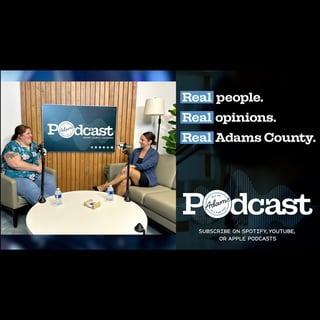
Speaker: Hello and welcome to this episode of the All in Adams podcast. My name is Chris Hopper. I'm the communications director for the district attorney's office here in Adams County. And today I'm joined by district attorney, Brian Mason. Brian, how are you? I'm well, Chris. How are you? Good. Thank you. um I know we have a couple of topics we want to get into, but first let's talk a little bit about your background as district attorney and then tell people a little bit about our office as well. Sure. So I'm from Colorado. i was born in Germany. My dad was stationed there in the Air Force, but we moved back to Colorado when I was two. So I grew up in Aurora and we moved across town to Littleton when I was in middle school. So I went to Heritage High School, um graduated from high school. I went to college in Ohio at a small liberal arts school called Kenyon.
Speaker: Then I went to Washington, D.C. and served there for four years in in some different roles and in the federal government. And then came home and went to the University of Colorado for law school.
Speaker: And i honestly didn't go to law school expecting to be a lawyer. um But I got recruited to join the district attorney's office and started in December of 2006.
Speaker: And that's been almost 20 years ago now. So I've been at the DA's office ah for just about 20 years. I ran for district attorney in 2020 and was elected and then sworn in as the district attorney in January of 2021.
Speaker: So Brian, tell people a little bit about our office, who we serve, what we do on a daily basis. So the district attorney's office is the chief law enforcement agency for what's called the 17th Judicial District. And that's kind of a mouthful. But in Colorado, we have 23 judicial districts, and those are drawn along county lines.
Speaker: So the 17th Judicial District includes Adams and Broomfield counties. And the District Attorney's Office is the DA for that whole district and for both of those counties. At the DA's office, we have multiple functions. One of our main functions is to prosecute criminal cases. So when somebody commits a crime, you call 911 or you call the police department. The police department will investigate a case And then they bring evidence from that investigation to our office. And my team and what we call our intake department will review evidence and then make a decision on on whether to charge someone with a crime.
Speaker: And if so, what? What those charges should be. And they, of course, have to follow the law. And we have to have lots of different things to to charge a case. We have to be able to prove identity of the suspect. We have to be able to prove the act that they have allegedly done. We have to prove, often in most cases, we have to prove what the mental state is. So those are different legal questions that our team reviews when police bring evidence to the office. And then if a case is filed, that proceeds through the criminal justice system.
Speaker: So if a defendant is charged with a crime, he or she is entitled to counsel, and they often have either ah a private lawyer or the public defender's office, and then the case proceeds through a court process and sometimes results in a jury trial where jurors will come in from the community and listen to the evidence that the prosecution team puts on, and then they make a decision.
Speaker: So it's a a very large function in terms of volume. People often, ah well, often in in public settings ask people to guess how many cases do you think we have at the DA's office right now?
Speaker: And... Typically, someone will raise their hand and say 100 or 500. or five hundred And the answer is 30,000 cases. ah We oversee 30,000 criminal cases. And that's everything from um driving under the influence DUI cases ah to first degree murder.
Speaker: So there you talked about all those sort of day to day functions that we have. But as the elected DA, you sort of have to look big picture on a lot of things. And throughout the year, you spend a lot of time at the Colorado State Capitol advocating for laws that will strengthen and improve the criminal justice system. What are some of the things that you've been working on and and are going to be working on moving forward?
Speaker: Thank you for that question. So yeah, as my in my role, I have lots of different roles as the district attorney. First of all, I'm the um essentially the CEO of the largest public law office in our community. I oversee a staff of 257 employees.
Speaker: um two hundred and fifty seven employees We have million dollars budget, and and that takes up a lot of my time I also have a legal function. I oversee these criminal cases and supervise a team of lawyers and and professional staff and get involved in many of those cases, certainly not all 30,000, but I'm personally involved in all of our homicide cases and officer-involved shootings and cases of that nature.
Speaker: but I'm also deeply involved in the community that I serve. I've been elected to this position. I live in Adams County, and this is the community that I have chosen to serve now for 20 years. And part of my role as the DA is to advocate for laws at the state legislature to keep our community safe and to make the criminal justice system better.
Speaker: Those are really the two pillars upon which I've built my administration as the DA, to to keep our community safe and to make the community and to make the criminal justice system better.
Speaker: And in terms of public policy priorities at the legislature, I've worked on a number of different things. When I first took office and in 2021, the fentanyl crisis was ravishing Colorado. And we had a particularly horrific case here in Adams County in Commerce City where five people died from fentanyl poisoning in one incident in a and a party at ah at ah an apartment in Commerce City.
Speaker: That at the time was the largest single number of deaths from fentanyl poisoning of anywhere in the country, and it made national news. And so I became a ah leader, both statewide and and and nationally, on addressing the fentanyl crisis.
Speaker: In Colorado at that time, we did not have a statute that allowed me to hold accountable a drug dealer who was dealing fentanyl leading to someone's death.
Speaker: And in the case that I just described, the folks that that died that day didn't know they were ingesting fentanyl at all. And so I advocated at the state legislature for what's called ah distribution of fentanyl causing death so that I and my fellow district attorneys across Colorado would have that tool to hold accountable drug dealers who were distributing this poison into our community and leading to people's death.
Speaker: And the legislature, to their great credit, um passed that bill. We also, couple years into my term, were facing a pretty major public policy and public safety problem when it came to motor vehicle theft.
Speaker: Colorado at the time, this was in about 2023, had the unfortunate distinction of having the highest number of motor vehicle thefts per capita of any state in the union.
Speaker: And that was really impacting Adams and Broomfield counties. So we looked at the law and I went to the legislature with my fellow district attorneys to explain part of what was causing that problem.
Speaker: At the time in Colorado, The charge that I could charge with ah a motor vehicle thief when they stole a car depended how much the car was worth.
Speaker: So if a thief stole a 2022 BMW, I could charge them with a felony. But if they stole 2005 Accord, was misdemeanor. two thousand and five honda accord it was a misdemeanor And essentially a slap on the wrist. And we had motor vehicle thieves, in in some cases, rings of motor vehicle thieves who were stealing cars, getting minor slaps on the wrist with misdemeanor charges,
Speaker: Literally, in some cases, getting booked in jail on one day, bonding out the same day and going out and stealing more cars. So we worked very hard at the legislature to change that. And and again, to their credit, they they accepted our recommendations. And now in the state of Colorado, if somebody steals a car, no matter how much that car is worth, it's a felony.
Speaker: And that's ah dramatically decreased our motor vehicle thefts. And, you know, I'm proud of that change because as the law had been written, the folks who were having their cars stolen were people who couldn't afford to replace them.
Speaker: And we couldn't get justice for them. And now we can. And it has also, as I said, led to a dramatic decrease in motor vehicle theft. So those are two examples of things I've advocated for at the legislature. In this most recent session, we worked very hard to address the growing problem of human trafficking.
Speaker: Human trafficking is a horrific crime and it is happening here in Colorado. ah Lots of people don't want to believe that or don't think that that really happens here. They think it happens elsewhere and um unfortunately is happening here and it's becoming a bigger and bigger problem. And so I advocated to strengthen our laws at the legislature on that topic this year.
Speaker: And we were successful in one bill and still have some more work to do in another one in the years to come. So one of those big picture projects is the Family Justice Center. That's something that's going to be opening in Adams and Broomfield counties coming up hopefully later this year.
Speaker: Tell us a little bit about what a Family Justice Center is, because I'm sure a lot of people who are listening have heard about it and where that project stands currently. Sure. So right now, a survivor or victim of domestic violence When they have been abused and when they are seeking services after having been abused, they have to go all over the place to the various different people and organizations who provide services um after ah ah someone's been victimized of domestic violence. We did some research on this. A hypothetical victim in Commerce City, which is, of course, part of Adams County, when when she has been abused. and I say she, domestic violence can happen to men and women, but the vast majority, according to our statistics, are women.
Speaker: when When a victim's been abused, she has to travel more than 300 miles to get to all of the places she may have to go to get services. So that includes perhaps a sexual assault examination um at a hospital, and only certain hospitals do that, which means... often driving to Aurora to the University of Colorado Hospital.
Speaker: It means perhaps driving to Westminster to get human services um help. It means driving to Brighton um if they're involved in the criminal justice system and the case is reported because that's where our courthouse is.
Speaker: ah It could be going all over the Denver metro area for help with um family law or child custody. And the most dangerous time in the life of a ah victim of domestic violence is when she's trying to get out.
Speaker: And so when we put all these barriers on victims to get services, it literally increases their risk in and being harmed further.
Speaker: And so you asked, what is a Family Justice Center? A Family Justice Center is a one-stop shop for victims and survivors of domestic violence, sexual assault, human trafficking, and even elder abuse to come into the doors of a ah single brick-and-mortar building or space and get access to all of these services in one place.
Speaker: And this was started in the early 2000s. The very first Family Justice Center ah was built in San Diego. And there are about 150 of them nationwide, which for a country of our size, of the United States, 300 million plus people, 150 isn't that many.
Speaker: But in every single community that has a family justice center, they have seen, this is a staggering statistic, every single community with a family justice center has seen their domestic violence homicides go down.
Speaker: And so we've been working now for five and a half years um during my time as the district attorney to bring a family justice center to the 17th Judicial District, to Adams and Broomfield Counties.
Speaker: And we are on the cusp of achieving that goal. We're hoping to open later this fall, possibly as early as October. And I'm really proud of this work and really hopeful that once we open, we'll be able to serve victims and survivors in ways that they've never been served before and hopefully, quite literally, save lives.
Speaker: And you said five and a half years. That gives some indication as how heavy of a lift a project like this is and how much work that goes on behind the scenes. um Tell us a little bit about that. Just how many people are involved, stakeholders, advocates, um different agencies. There's just a big group of people who are working on this. That's right. We've been working with our stakeholders and partners and and community partners um for five and a half years. When I first took office, and we started internally. I created what's called our special victims unit within the office to work.
Speaker: exclusively focus on domestic violence, sexual assault, and human trafficking cases. We then created what's called the Domestic Violence High Risk Team, um which brings together partners from throughout Adams and Broomfield counties be it law enforcement or victim advocates, nonprofit organizations that do amazing work with domestic violence victims, partners like that to examine cases as they come in and to rush services um to victims and survivors right away. Those were the building blocks for what will eventually be our Family Justice Center. And then we started
Speaker: very deliberately about three years ago, bringing everybody together in the community who believes in this concept and believes in this vision. And ah we spent days and days together with over 100 talking about what a family justice center is, what our needs are here in this community, and then split up into committees and working groups. um And again, this includes city managers and city counselors and volunteers and victim advocates and members of law enforcement and amazing members of our nonprofit communities, um all of whom have come together and worked for
Speaker: literally years to open this family justice center. And again, we're on the cusp of actually realizing this goal and hope to do it later this year. Brian, before we wrap, is there anything else that you'd like to tell people that is sort of a priority item for you right now or something that's top of mind for you as the district attorney in Adams County? So my my main goal as the DA, again, is to keep our community safe and to make the criminal justice system better.
Speaker: I worry a lot about juvenile violent crime. um Crime overall at the moment is is down, but juvenile violent crime is up. And so that worries me. Talk to your kids about um fentanyl.
Speaker: Talk to your kids about never ingesting something if they don't know what it is. um Talk to your kids about access to guns and gun safety. Kids are hurting one another.
Speaker: in ways that I haven't seen before. And that as the DA really, really worries me and continues to be a priority. Well, thank you for being here today, Brian. And thank you for the work you do on a daily basis. We appreciate it. Thank you for the opportunity. It's great to be here. And thank you for listening to this edition of All in Adams. We'll see you next time.
Speaker: That's a wrap for this episode of All In Adams. Thank you for joining us as we explore the people, programs, and the policies that make Adams County a great place to live, work, and thrive.
Speaker: If you enjoyed the show, be sure to subscribe and share with your friends, neighbors, and colleagues. Have a topic you'd like us to cover? Let us know. We're All In for bringing you the stories that matter most.
Speaker: Until next time, take care of each other and stay connected with us on Facebook, Instagram, Nextdoor, and x We're all in, Adams, and we're all in for you.