Transcript
Speaker: So our guest today is Lisa Randall, the writer and performer behind Sister Sophia Kicks the Habit. Here from her Toronto company, The Universe Over 60, Lisa, welcome to Podcast 13.
Speaker: Thank you, Vanessa. Thank you, Ian. It's great to have you here. Why don't you start by introducing us to Sister Sophia and her worldview? but We're excited for the show. Can't wait for it to be in the venue and to get to know her better. But maybe you can give us a little bit of an introduction for those who are listening ahead of coming.
Speaker: I'd love to. Thank you for asking. So Sister Sophia, she is a sister, a nun, who is in her 70s, late 60s perhaps, and she has had a life of devotion. She went into the monastery, into the convent, took her vows as a very young woman, probably around 18 or 19 years old. And so her worldview comes out of a time and another era, really,
Speaker: This is happening, obviously the show is being done in 2026 here, but it's kind of a generic time frame. So a time frame when people were going into the convent in greater numbers, a time frame when maybe families were larger and many people, several people might go from a family and become religious people.
Speaker: And so Sister Sophia's worldview has always been very devout, very obedient. And she has done as she has been told over decades, and which which includes being moved, being moved across the country, being moved and and going to where she is needed, because that is the motto of the Sisters of Service, going to where you're needed and where the need is not already being met.
Speaker: But her worldview suddenly changes when she loses her very best friend, Sister Beatrice, because Sister Beatrice was a little bit of a lightning rod for her. She's kind of the one that kept her grounded and kept her clear about her faith and clear about her devotion, she was wobbly.
Speaker: There's no question about it. Sister Sophia was a wobbly person in her own faith, which is a very human experience for people of faith, people, atheists. We wobble in our belief sets very often, and many of us believe that questioning is a good way to to actually clarify what we think.
Speaker: And so the scene takes place when she's moving worldviews, actually. So this question nails it, in fact, because this is the night of the dark night of her soul. She's lost her best friend. She hasn't been able to sleep in three nights.
Speaker: And she's kind of hallucinating a little bit. And her perceptions are changing because she hasn't had sleep. She doesn't really know what to do with herself because she's lost her anchor in faith in by way of her best friend, Sister Beatrice.
Speaker: And so she embarks on another night, another sleepless night. And this is her dark night of the soul, which also does have levity because she enters into a conversation with God.
Speaker: and speaks to him directly for the duration of the show. and It's done in a very humorous way, but this is ah this is a show about a nun, yes, but it's also a show about a woman questioning her life choices, questioning everything she's done, questioning her her blind faith, and asking for things.
Speaker: So her worldview is actually changing. Her expectations around what she's given her entire life to have been sort of turned on their head this particular night. And so that's what makes it a little bit more important than any other night, because this is the night where she comes into a reckoning with her own belief system. And her worldview does change.
Speaker: It does change. It does change. And it changes through her emotional journey, through the questions that she asks. And through her own humor and her realization of of what really is important to her and her, also her role as a woman in a highly patriarchal system, she gets into that more from a feminist lens than she does the patriarchy approach.
Speaker: It sounds like this is going to resonate with a wide variety of people. it's It sounds to me as if ah the show came from a deeply personal place.
Speaker: I believe you've had two aunts who were nuns. One of them, Closter, I believe. And you wondered what they might say under a kind of, you know, if they were to have a truth serum, and you know, what to what honesty would come out then?
Speaker: And how did their lives find their way into the show? Okay, yes. Well, first of all, I should say that this show is very humorous. And I would have to say from my experience with my nun ads that nuns have really good senses of humor. i can believe that.
Speaker: but My 98-year-old aunt, my Aunt Paula, Sister Paula. She is very funny. She's a funny, funny person. and And I've gone to visit her over the last 15 years at the mother house in a small town.
Speaker: in Ontario, and I've gotten to know the other sisters, and so when I go up there, i usually stay up up there a couple of nights. And when I started going there, it was really kind of full. It was full of nuns.
Speaker: And over the last 15 years, this number has seriously dwindled, and I've known many people. You know, obviously, that people die. That's the the journey that we're all on.
Speaker: But there just aren't any more nuns entering the vocation. And I wonder what this feels like when you donate or give your entire life over to a vocation and you care so deeply that you give your entire life and you see that it's dying.
Speaker: And I personally would have strong feelings about that, yeah about any kind of a relationship that comes to an end and go through some usually questioning, a little loss, grieving, maybe hackiness, freedom. You know, there's a whole range of things that we might feel. And at any given time, we all feel usually multiple emotions at the same time anyway.
Speaker: And they've given themselves over, they've taken a vow of obedience, which doesn't equal voicing your opinion. And so, as I've gotten to know my aunt over these years more and again, I've i just developed a really strong empathy for her.
Speaker: And I and had a lot of interest, you know, and I'm i'm not a practicing Catholic, but through my interest in her, she asked me one day, so do you want to become a nun? And I thought, you know, like 63. No, i'm I have a life partner and a child, but...
Speaker: I'm really interested in the fact that I went through my own personal losses, a divorce, etc. And many of my family members live out west, and I found myself going and visiting my aunt Nunn.
Speaker: And I took great comfort in this, even though I'm not a whole nother faith, per se. A kind of faith, absolutely. Definitely a faith in other human beings as well. But I'm driven by my empathy and some of the stories that my mother's shared with me, some of the competences that she's had with each of them when they've shared some of their experiences in their lives. And the aunt that was a cloistered nun, the first time I met her, she was behind bars because they were not allowed to have physical contact.
Speaker: No hugging even of family members. Okay. And I find this really sad. And I find it, I'm going to say, unnecessary to remove yourself when we're living in a human body.
Speaker: and And so this is the thing that really struck me. How can you have a life of devotion of this nature? And reconciled living in a human body. And then the other aunt was a ah teacher. And um she moved around quite a bit. Very different experiences. Yes.
Speaker: And, you know, I think there was us some isolation then and some loneliness. I remember when my aunt, who's still living in this small town, was moved from Edmonton because the house closed down that she was in in Edmonton. And when she moved here, she expressed directly.
Speaker: None of my friends are here. Yeah. And so, you know, they have to close convents down. There just aren't any nuns anymore. And this is part of their vow of obedience. You know, they need to be obedient and go where they're sent and and they're not able to look after themselves anymore.
Speaker: But I will say that this play is full of humor because this particular sister, Sophia, She has some very, I'd say, unconventional ideas, and she's giving air to them. And and so that is really where I wanted to go with it, to...
Speaker: Yeah. I mean, we've talked about two different Don's, but it's ultimately a solo show. Sister Sophia is an individual and it's busy. You've got a songs, there's a lot of physical comedy, dance, audience interaction. As much as we've been, you've been highlighting like the the the philosophical thinking behind what do you do and reflecting upon a life of devotion.
Speaker: It's not something that is, you know, looking back in ah in a morose way. All of the all the content that I know that I've seen in preparation definitely positions it as ah ah a comedy and a humorous look in in this way, all fit within, you know that fringe hour for it and you're a singer and a musician as as well as a writer there's a lot you know we've talked about your aunts but also a lot of those elements of you in it how does that all ultimately come together like what is the experience the audience is going to have by coming to this show
Speaker: Well, I truly hope they enjoy the humor. There's serious parts, but definitely this is a sister who likes to tell a joke. This is her, i guess it's kind of maybe her superpower. This is her joy, you know, telling is is her humor, is her joy.
Speaker: But this show began on the page. It began as a written project. And it started with one monologue. And I thought, I kind of like this character. And so I just kept writing monologues.
Speaker: And the physical comedy comes that comes and fits and starts. It's not full of large elements of it, but it's definitely they're transitional or they're bits and pieces when external elements to Sister Sophia's action interrupt her.
Speaker: She has reactions to it. She also has reactions to her own. physical body and how she's experiencing it and misunderstandings that she may have with God. i mean, she's she's doing most of the talking and she's very concerned at a certain point in the play that there's a real big misunderstanding going on.
Speaker: And so bringing songs into it, there are a couple of points in this show where It was just a natural build to to move into an area of song. And one of the songs was written by ah a musical theater composer friend of mine.
Speaker: And one is an acapella song I wrote quite a few years ago, and it's called Flesh and Blood, which is kind of one of the themes that emerges throughout this play. We are flesh and blood. And so that's one song. One of the songs is The Vatican Rag that was written by Tom Lehrer.
Speaker: And so many people know this song, and it was irresistible to not have it in there. And, of course, the wonderful Tom Lehrer made all of his music free in the public domain. and His generosity is unbelievable, and also a true a true person giving of his art and knowing that he wanted it to live on without, unencumbered by copyright things.
Speaker: And then another song, I took off i took the the wonderful, beautiful song Ave Maria, which predated its use in the church. It was actually a love song.
Speaker: true Prior to that being sort of adopted as Ave Maria. There were other lyrics before that. And so I thought, I think I'm going to write some lyrics for this that fit in with this show. And so I did. in the but Yeah, it a lot of fun.
Speaker: Wonderful. ah Do you know what? You got me thinking. you You've stirred things in me here because I want to see the show so badly. But you got me thinking when you said there are not that many more nuns.
Speaker: And I am i have ah feminist inclinations myself. And I like to be up to date with what's happening in the world when it comes to, um you know, how we are going to age and how we're going to spend the, you know, the final years of our lives. um I am a child free by choice person myself. and I've noticed that there are many, there's been a a rise in the women's communes.
Speaker: Now they are happening pretty much in every country all around the world. That you have these ladies that get together. Sometimes it starts as a group of friends.
Speaker: Sometimes they are just essentially, if they are now established. Because like you said, people people pass. So these established communes hold ah interviews for the next person that comes along. And they're very organized.
Speaker: And there's been interviews now coming out of of these ah this groups and it looks so peaceful. And I wonder if this isn't a ah new way of taking the best of what that was, you know, of the convent, of what your aunts might have experienced when they had this this group of friends that meant everything for them.
Speaker: and keep them going. And women are going back to that. Maybe they're picking the best parts of it to say, we still would like that, you know, to go back to that. Absolutely. Absolutely. Well, this brings things to mind in that this might not be such a new idea. There there is a group called the Beguines, and they were self-elected sisters that were not under the auspices of the Pope or the Catholic Church.
Speaker: And they were spiritual in nature. And they were completely self-governed, self-guided. And they were considered heretical, of course, because they weren't under the Pope, but they were just women doing their practice, living together, supporting each other.
Speaker: Even the modern day retreat, which is very popular for women to go on, and and probably for men too, But I'm more aware of women's retreats because I've run them as well as been an avid participant. So you get this micro community for like a very limited time frame of a week where you're, and I think people are all, you know, hungering for this kind of connection, especially as family sizes are much smaller. Where can you live in communities?
Speaker: Yeah, no, absolutely. i think it's really important for me to say that we rehearsed the show in a community space in a women's co-op in downtown Toronto. Nice.
Speaker: Oh, that's brilliant. I love that. It's like that was your that was your audience. Well, that's the director. The director lives in a particular... And, um you know, I mean, it's all about, you know, mutual support. They they dev divide, you know, this is co-op living, so they' they're not like sharing their...
Speaker: living quarters together, much like you're probably talking about, Vanessa, but it's the next best thing. Yeah. I think that, honestly, I genuinely think that it's one of the, it's a valid thing to explore, and I do believe that this play is going to bring this type of questions up as well, and others. you know i feel like the the show holds kind of like a balance between the sacred, the profane at the same time, and You say, you know, you want to welcome the believer, the atheist, the agnostic and the curious.
Speaker: All, you know, all are welcome. So what were the challenges you encounter when you're writing this show? us I know you started in the page and, you know, you kept on being monologues. Did you ever feel like this show is not for everybody or oh this might not go down very well?
Speaker: Well, i I started sharing it pretty early on with people and I got a really positive response. I started with the comedic pieces. That's just what flowed out of me first. And then i started to move towards some more serious ones. And I do have quite a few more monologues than made it into the show.
Speaker: but I really selected the ones that I thought... I didn't want to upset people or push people away or judge anybody else's religious inclinations, but what i thought was important, and this character exercised it, because characters have a way of just finding their way out of you, you know. um the Her interest and her tendency in what she was doing from the very beginning was questioning.
Speaker: And she's doing it in a lighthearted manner, you know, and she's also, you know, excusing herself and also going, oh dear, I shouldn't really be saying this. And she's saying that throughout it, but she goes back and continues her questioning. So this vow of obedience doesn't necessarily make a lot of room for questioning. And so I really do believe in questioning in everyday life.
Speaker: And so no matter what you believe, I think it's important. I think that should be places where you can do it respectfully and you know, within the bounds of, um you know, not not a destructive approach, but simply being able to have a dialogue, you know. She's asking for dialogue with God, and because that's one of her That's one of her requests throughout this evening.
Speaker: yeah Bringing it to the Fringe is definitely a place where that type of conversation can happen. There's work of all types and from from different places and different points of view. And this is your debut at the Edinburgh Fringe. It's it's how to life and in other fringes around the world. It's going immediately after your run in Edinburgh to... to all the way west so that you are i don't envy the jet lag that you have there but with it being your edinburgh friend's debut and you know you have uh their company is celebrating stories of someone over 60 looking at the universe over 60 what are you hoping that edinburgh takes away from sister sophia
Speaker: Well, first of all, this is this is kind of like a dream come true. And and I mean, it's part of my MA in theater, dance and performance at York University and AMPD. And when I entered into the learning program, I actually didn't realize that Venue 13 was run by York Theater. And so when I learned that, and I think it was December of 2025, I got really excited because this is a dream come true, being able to play theater.
Speaker: and present at the Edinburgh Fringe. I'm just elated to be able to do it. um I'm just really looking forward to going out there and doing promotion during the day. But what I hope that the audiences that come to see Sister Sophia get out of it is some laughter, some enjoyment. and i want to bring levity to what can be some very difficult life decisions that some people may face.
Speaker: But I want them to enjoy it and be amused. And and maybe, you know, i'd like I'd like them to empathize with Sister Sophia and the struggles that she's going through. I think Sister Sophia well he will resonate with a lot of people based on what we've heard so far. Lisa, thank you. Thank you for being here.
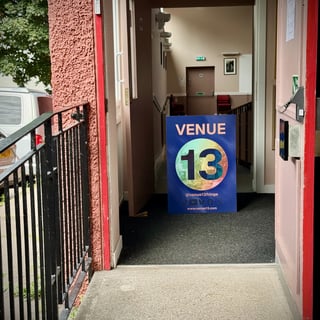
Speaker: For the audience, Sister Sofia Kicks the Habit plays at Venue 13 at 4.15 on several dates this August. Tickets are £12, £10 concessions with fringe friends, two for one and droop discounts for 10 or more.
Speaker: All the links, all the information will be in the show notes and tickets are at Venue13.com. Now, Lisa, I understand that you have brought us the audience a little treat. You will leave us with a taste of the show, is that right?
Speaker: I absolutely would love to. Yes. Thank you, Lisa. We'll tip it over to that. ah We'll be able to include, actually, I think, the Vatican rag. got We've got a copy of that in the store, so we'll make sure that's in there. Thanks to Tom Lear for his foresight and making that possible.
Speaker: And we'll see you in Scotland, Lisa. Fantastic. Thank you, Ian. Thank you, Vanessa. I really appreciate your um your interest in Sister Sophia. I'm looking forward to it very much.
Speaker: You feed my soul, but it takes a toll You leave me empty, but you make me whole You can't be seen, but you leave your mark Faith is blind, but it lights the dark I wonder if it's hard
Speaker: You keep me eye on you, keep me here.
Speaker: I've been waiting for you all these years
Speaker: And now, as promised, we were able to locate the Vatican rack by Tom Mir. ah As he has put it in the public domain, we'll include it here ah so you can experience that as well.
Speaker: Another big news story of the year concerned the ecumenical council in Rome known as Vatican twoi
Speaker: Among the things they did in an attempt to make the church more commercial...
Speaker: was to introduce the vernacular into portions of the Mass to replace Latin and to widen somewhat the range of music permissible in the liturgy. But I feel that if they really want to sell the product in in this secular age, what they ought to do is to redo some of the liturgical music in popular song forms.
Speaker: I have a modest example here.
Speaker: It's called the Vatican rag.
Speaker: First you get down on your knees, fiddle with your rosaries, bow your head with great respect and genuflect, genuflect, genuflect.
Speaker: Do whatever steps you want if you have cleared them with the pontiff. Everybody say his own, Kyrie eleison, doing the Vatican right.
Speaker: Get in line in that processional, step into that small confessional. They're the guy who's got religion, I'll tell you if your sin's original. If it is, try playing it safer, drink the wine and chew the wafer.
Speaker: Two, four, six, eight, time to transubstantiate. So get down upon your knees, fiddle with your rosaries, bow your head with great respect and genuflect, genuflect, genuflect.
Speaker: Make a cross on your abdomen When in Rome do like a Roman Ave Maria Gee, it's good to see you Getting ecstatic and sort of dramatic And doing the Vatican right
Speaker: Thanks for listening to this week's episode. If you enjoyed our conversation, be sure to hit subscribe so you never miss an update. You can find us wherever you get your podcasts. We'd also love it if you could take a moment to leave us a review wherever you're listening. It helps with people discovering podcasts, joining our community, especially if they think that they would be interested in any of the topics that we covered today.
Speaker: If you've got thoughts, questions, or ideas for future episodes, we'd love to hear from you. You can reach us at podcast at venue13.com and our class socials at venue13fringe.
Speaker: Our back episodes and transcripts can be found on our website, which is venue13.com. That's the number 13. not spelled out venue13.com and it's only about a month before we'll start being on site at the literal venue 13 harry anchor hall on lock and close so you can also start to find us there the music that you heard through the episode is by dusty decks which we get through epidemic sound until next time thanks for tuning in and we'll be back with another episode soon