Transcript
Speaker: race ga end Hey, this is Katie and you're tuned into Riskillians, podcast about the hard, soft and surprising skills that'll help us stay afloat if our modern systems don't.
Speaker: I am gratefully recording in Jara country, central Victoria, where the mornings are getting lighter and the days are getting longer, but it is still bloody cold.
Speaker: We're possibly selling our block soon, which is a whole other story, but what I'm finding funny is that the things that we've loved most about this property are basically poison to prospective buyers.
Speaker: Like the fact that there's no toilet or bathroom inside the cottage, Instead, there's an outhouse, up the garden path and tucked next to an apple tree, home to tribes of frogs and spiders.
Speaker: This feature couldn't have suited us better, because a bit of privacy and contemplation goes a long way on the John, in my opinion, and plus we share this block with George's parents, so everyone can come and go from the amenities as they please. But the thing I love most about the outhouse is that it gets me out of the house.
Speaker: Rain, hail or shine, in the fog, dodging frogs. If I need the loo, I gotta pull on a jumper and take a little journey across the yard. I've come to consider it an enlightened inconvenience. Something that could absolutely be made easier, more comfortable, more modern.
Speaker: but that we've actively refused, knowing that the effort is worthwhile, that it's actually a design feature which forces us to take the road less travelled, which in this case is across the grass and around the divots in the dark, under a blanket of stars, the whole town hushed and the full moon pouring silver onto the cold tin roof, wakeful magpies warbling softly through the witching hours...
Speaker: It's beautiful out there. Thanks to the enlightened inconvenience of our old school dunny, I stand outside most nights with my head thrown back and a crick in my neck, in awe of the cosmos.
Speaker: It's only because of those 2am forays that I'm in tune with the phases of the moon. From Inconvenience, Springs Connection. So I'm always impressed when people who don't have a bathroom-related reason to bundle themselves out of bed and into the chilly blackness to behold the heavens do it anyway. Talk about enlightened! One such woman is Kirsten Bradley.
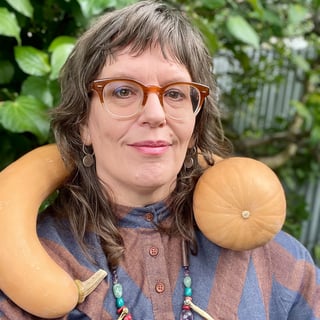
Speaker: You know Kirsten. She co-created Milkwood along with her partner Nick Ritter back in 2006 and has spent the past two decades sharing permaculture skills in so many ways,
Speaker: from in-person and online courses and workshops to best-loved books that, in our household, bear the squirts of tomato and dirty fingerprints that denote a deep and practical adoration.
Speaker: Kirsten now lives in Lutruwita, Tasmania and has been writing her way through a season of burnout and into gentler rhythms inspired by the moon, the stars, the garden and the land she now calls home.
Speaker: I squealed when she said yes to joining me on the podcast for a friendly catch-up about life. So I'll save the announcements to the end of the episode so that we can sashay straight into this beautiful conversation. Here are some Karawongs captured by a field recordist, who I've linked in the show notes, calling in the wisdom of Kirsten Bradley.
Speaker: Well, Kirsten Bradley, thank you for taking the time. Hello out of your Karawang-infused and leaf-mold-enthused life to hang out with us on Risk Healing today.
Speaker: Thank you. To get us into the seasonal spirit, because i see that we are both bundled up. It is the deepest of deep winters. I'm wondering what's alive down south right now?
Speaker: Oh, yes. Well, I'm alive and my family is alive, which is awesome. Fairly obvious, I guess, but, you know, I celebrate that on a regular basis. Oh, the wattles here, the acacias, are just starting to pop.
Speaker: ah The silver wattles go first. I live um in a valley on Malakari, Palawa country in southern Luchuita, and it's an old, it was a valley full of apple orchards.
Speaker: about 100 years ago and as those all got taken out, um as the forest is you know reclaiming its bits and bobs all over the valley, there's still a lot of those wattles of those pioneer species and they really trace in the valley's hills all the outlines of where the orchards used to be, especially the silver wattles and they're all just popping into bloom just this week so you've got this trace of you know 100 years ago what what the settlers were were doing here and it's yeah it always makes me think hmm
Speaker: Oh, that's such a beautiful image of the wattle kind of gilding those past endeavours or misdemeanours in beautiful luminous gold and honey-scented sweetness and a bit of reading landscape thrown in there as well. I really appreciate that.
Speaker: Yeah, and you can see on the some of the slopes that are the the poorer country or the the poorer soil, they go right up, these little sort of these lines of wattle and you're like wow that's like a 45 degree slope like that's a really tough area to farm on and hearing from old timers about oh that's where we had the the the raspberries and that's where we had you know the berry patches because the land was too steep to orchard on but we needed you know we needed to make the yearly not the tariffs but the yearly money And so we put berries up behind the the apples and things like that. And it's, yeah, it's as well as being an the indication of land use, it's all these different indications of different socioeconomic make-ups and how desperate people were at that point in time to to get by, what they were prepared to do, and that's all written in the landscape too. So, yeah, it's very poignant at this time of year.
Speaker: Yeah, i I have a friend, um maybe it's a mutual friend of ours, actually, Trace Bala. And as you know, I'm in Dara country and commonly known as the gold fields, and she calls it the fields of gold to kind of subvert that. gold mining emphasis and remind us of yeah that beautiful healing presence of the golden wattles and everything that's come after and everything that makes it so beautiful despite the knackeredness of the land so definitely seeing the gold in full bloom at the moment here too
Speaker: Yeah, you're probably um fairly in front of us. It's always everything's later down this far south, yeah which is fine with me. But when you say things like the something is out, everyone's like, yeah, we know it's been out for months. um Yeah. There's not too many hot takes down here when it comes to the something is blooming. That's okay. That's all right.
Speaker: own place. so as you're speaking, Kirsten, this is just a side question. I'm just, I love the everything you're weaving together there, as i as I observed, you know, your observation of the landscape and the seasonal indicators and the history of place. And i think this kind of information isn't actually readily available if you just punch a question into Google or as it were, ChatGPT, where do you get this really rich concoction of like place-based knowledge? Are you actually speaking to real people?
Speaker: Yes, i am Well, I mean, there's always, you know, it doesn't matter if you go to CWA or to choir or to, and don't know, coastal cleanups or to SeaTac, our local Indigenous corporations, various days. There's there's going to be old timers are really happy to talk to you about how things used to be. And that's, I always really appreciate that.
Speaker: Yeah, and having ah a background in permaculture education and all the region ag stuff was always so beautiful because you would have these old timers or just elders in in thought rather than age come up and share bits and pieces about how their farms worked or how the landscapes worked where they were and what their indicators were. And that coupled with a lot of permaculture theory, which is so good at, you know, encouraging people to recognise pioneer species and recognising how different landscapes go through. different successions for all these reasons.
Speaker: Yeah. You sort of end up with a soup of, Oh, that's why the bottles are like that. And then you're like, Oh, that land must've been used. And then next time you're at the local fireys picnic or something, There'll be someone there that's like, yeah, that's where the the raspberry orchards were right up there at the top, raspberry patches.
Speaker: And I guess you need to be interested in that stuff too. I could see if you're from a family where everybody was talking about that all the time, you might have other interests. But, yeah, to me it's all all the different layers of place that help us show up really well where we live. So I'm always always curious to hear what else people have experienced and what they know.
Speaker: Yeah, that slower, slower information and deeper knowledge feels more and more a conscious choosing, you know, consciously choosing not to gleefully slide down that slippery slope of pre-masticated information. You're like soup, a beautiful soup of knowledge is one thing, but not this kind of pre-chewed stuff that can be so easily presented online.
Speaker: But I mean, maybe I'm like, am I sounding old and fuddy-duddy? Like what's your take on using AI tools or really yeah quick and snappy tools searches to just cough this stuff up or some semblance of it, like how do you, or A, do you resist that way of of learning or acquiring information? And B, do you think we should be resisting that?
Speaker: Well, when it comes to AI, it's a big world out there. And we are, you know, using it a lot, whether we even know it or not. Now we use um digital it all anythings.
Speaker: i don't know, when I'm talking to students or I'm wondering ah something about beans or whatever, you know, earth-shattering fact I'm wondering. and it's It's always the really great reference books that I go to, partly because I have the privilege of having a really amazing reference library now. And as someone who has written a few books now and there's a lot of trauma associated with the fact that once you write the book, you can't change it. You can't hop back in there, hit edit and, you know, and update the information. And that can be quite upsetting at times when you're used to blogging.
Speaker: However, the way beautiful deep thinkers put their best knowledge in their books um and, you know, of course everybody's mortal and memories are fallible and new new knowledge comes to light. But I love going to like the bean chapter of someone's book and knowing that they have set down all the really crucial information they feel that we all should know about beans.
Speaker: And if i did a if I did a search on that, I just wouldn't find that information in the same way. Like it's sort of the crystallized knowledge that you get in a lot of reference books and in many places online as well.
Speaker: But yeah, if you don't know where to look, it's fairly hard to find anything other than a sort of median or an average of what everyone on the internet has said about beans, which is usually not that interesting in my opinion.
Speaker: Well, one massive reason that I've been very excited to speak with you is because I've been soaking up your Substack writings, which feel very layered interweaving of things you're finding out, practices that are blooming in your life.
Speaker: And it's just so gorgeous to to read the the outpourings of your mind and also the fruits of your research. And so I've been really desperate to speak to you because it's like, how are you doing this? Like, what is, what are all the practices and what is the life that's wrapped around this, this one beautiful gift that I receive on Substack through your writing? And I suppose the spirit that I wanted to bring to this conversation was digging into the nitty gritty of your day and your life and understanding the human who is putting these wonderful words together. And obviously a human who,
Speaker: I'm sure most people listening will know and love through your previous works. say Kirsten, I wanted to start with the start of your day. And if you have a morning ritual or routine, because i know, and I noticed so personally in myself that the way that I start my day patterns the rest of my day, it sets it sets my mood, it dictates dictates whether I'm going to be completely scatterbrained or have some degree of poise.
Speaker: Do you find the same thing? And if so, like how do you protect those precious hours of the morning and set yourself up to be able to write such wonderful things and live the life that you want to live?
Speaker: um um First of all, thank you so much. That's extremely complimentary. And just what I needed to hear at the end of book manuscript land, which is a murky swamp. um I love routines too. And I love hearing about other people's routines.
Speaker: um There used to be, the design files used to have a little column that was like my daily routine and I'd learn about all these different artists, um you know, how they got up, what they ate for breakfast, all these sorts of things.
Speaker: And they never called me to interview me because I wasn't really an artist then, but I wrote one for myself anyway while I was living at Meliodora because I was like, I got up really early and then I milked the goats and then I did this.
Speaker: um Yeah, and it's in a drawer somewhere, but I was like, ask me, ask me about my morning routine and the goats. And no one ever did. um Yeah, it's really seasonal down here. It really changes. So in midsummer, it's light. I'm an early bird.
Speaker: whether I like it or not, um which is quite frustrating because sleeping in does seem really cool, but I have very rarely managed it. So in summer, the sun's up by five and so you can get up before the world and before your inbox and before your kids and everything else and make tea and go sit outside with the birds um and now the dogs in my case and, you know, sit outside and set your head. in the early morning and that is my very favorite thing to do but at this time of year we're just past midwinter here and you can see the light creeping back in which is very exciting but when I get up 4 30 or 5 which is just when my brain wakes up um it is extremely dark and
Speaker: But I guess that has its own gifts. um Tea is mandatory as the absolute first thing, no matter what. And at this time of year, it's then take a cup of tea outside and if it's not raining, ah yeah, look at the sky, look at the stars, see what's happening.
Speaker: I've got a few hours until daylight at this time of year. um Lots of really special things happen in the sky at this time of year. Pleiades, the Seven Sisters, has just started rising um early enough so that we can see it for a few hours before the sun comes up, that's exciting to look for.
Speaker: And, yeah, just be with a pre-dawn world. um like Like you, if I'm fuzzled from the start, I find it really difficult to unfuzzle and get focused through the day. So, yeah, that first. And then ideally, if there's more time, which would be my perfect world, then dive into the studio and write for a few hours while my brain is still clean and hasn't you know been donked about by the day or responsibility or anything like that that's that's my perfect morning but most involve the tea the outside bit a little bit and then maybe
Speaker: half an hour of scurried writing before I drive my kiddo to school quite a few days a week and, yeah, just before the responsibilities and the care work kick in.
Speaker: And then once that portion of the day is sorted or abandoned, depending on the day here in our house, then hopefully getting into the studio, writing as much as I can.
Speaker: No goats though at the moment. No goats, yes. That bucolic milkmaid existence. There's seasons for that. There's seasons for that. You're quite right. And that's not saying there won't be ever goats again, but just no goats at the moment.
Speaker: Does anyone locally have goats? There's a few. There's probably more cows than goats in this valley. And there's yeah various ways to get yourself a bucket of of milk, if you like.
Speaker: And it's it's strange. Like a few years ago, if I didn't have, you know, three cheeses dripping on the bench, um I would have been rabid in my going out and finding some, you know, raw milk somewhere. And now, yeah, different seasons, different priorities.
Speaker: Cheese is great. um I'm not making it in a 48-hour cycle at the moment, but who knows? Life is long. I feel like the body can store cheese vitamins for a really long time, so you're probably just eking out the last batch that you stocked up on them. I'm still probably 20% cheese at this point. yes Yeah. Good to get that down a little bit so you have the joy of replenishing.
Speaker: I have to know what kind of tea you prefer to drink. Oh, yes. Very important. Sorry. I should have led with that. There's a local chai that's very good. but I tend to drink a lot of tea and so my weekly budget doesn't extend to an endless supply of that of the sticky chai.
Speaker: um I usually burn through all the black tea in the house quite quickly and just end up with good old black, black tea and then I chop up ginger and put that in it with leatherwood honey which is literally staple and too strong a honey for some people. But to me, it's like crack. I love it.
Speaker: Yeah. that is incredibly like it Yeah. Just the aroma. My mom lives in Tassie and I spent a lot of time down there too. And if I crack the lid on a jar and inhale, it instantly transports me to my fondest, earliest memories of romancing the island. It's so evocative. wow Yeah. Beautiful.
Speaker: and full design files mode, what's on your breakfast plate?
Speaker: um As I get older, i have to remember to eat breakfast. I'm getting better and better at forgetting all about it and then wondering why I'm having like delusions at 11am uh so ideally just just a little bowl of some yogurt and something crunchy and some sort of fruit which i've soaked in leatherwood honey which makes this amazing sort of compote and makes me very happy um Yeah, so on a good day I remember to eat and that's great because then I don't start having delusions of grandeur by 10.30 in the morning. Yeah, ideal.
Speaker: Yum. So down there in the deep, deep south, um I know there's a lot of community bubbling, brewing and doing all kinds of good things. I, as I said, did live down that way for quite a while and did some house sitting and we probably know quite a few of the same folks. Sure we do, yeah. Yeah, I'm really keen to hear what at the moment is cooking in the community, like what kind of things you're getting up to, how that community village rhythm
Speaker: sits at this time of year oh well we we did cheat when we moved to Luchweta we moved to a little town called Signet which is fairly well known amongst my friends of friends for being you know a cool place and um and they were right it's awesome so we definitely didn't land here and um have to sort of make things up from scratch not that there is ever nothing happening in a place but you know everything goes through cycles my favorite things in this little patch of the world at the moment ah there's a local seed library crew who maintain an excellent excellent community seed library at the c signet libraries
Speaker: outside and every second Sunday they have a pack and chat in the local um big cavernous cafe that always has enough space for everything and somebody will bring out a big like bread tray of all the jars of seeds that everybody's donated and then everybody sort of figures out all right what are we going to package up we're going to package up things that can be planted right now for the seed library so the seed library is always stocked with stuff you can plant right now And so there's usually some discussion or debate about what should go in the seed packets. And then, yeah, there's all these little pre-printed seed packets and they get all packaged up with locally grown, locally saved seeds that are the right thing to plant at this time of year with the um the intention that if you come to the seed library, you can yoink any of those packets of seeds and go plant them as opposed to
Speaker: be like oh I should have waited six months oh nothing came up which is um yeah an incredible initiative initiated largely by Heather McFarlane who is and an awesome local who's still the mix um but yeah has been very much taken up and run with by a gorgeous crew of community growers and it waxes and wanes and people come and go and There's always enough people to to keep it going, which is just excellent.
Speaker: So there's that. We have a great crop swap here once a month in Kate's driveway. um Between 20 and 40 bring a bunch of something and stick it on. these big long tables and then everybody goes around and says what they brought.
Speaker: And then there's a sort of free-for-all. Everybody um takes, not grabs, takes bits and bobs of what they want. And I love that occurrence because you always get so inspired by by what everybody else is is growing or making.
Speaker: and without fail every month I'm like oh you can grow that here oh I didn't know and then you sort of pick who's brought it and then you talk to them later and like how are you doing that or where's the seed from or you know what's your problems with this and with that and just learn so much and everybody yeah is very delightful around that sort of stuff I mean, it's it's a small town and it has all the bits and bobs going on in it that small towns do.
Speaker: It's fairly rural here, so the the local um fire services, um volunteer fire services are really well attended. And there's ah there's a branch every 10 kilometres down here for good reasons.
Speaker: And the other really cool thing happening down here, well, it's not cool, but it's a cool response too, is um the community response to the to the fish farms down here, to the toxic salmon feedlots that are in all the waters here and you know completely inappropriate and stabbing the ecosystems down here in the face and just really problematic on all these levels. And the community response, which is ongoing and has made a huge difference, is really beautiful to see because, you know, like any ecosystem, um losing big chunks of your ecosystem to really intense pollution is a long-term wound.
Speaker: And as the as the oceans warm down here, we we really can't afford to lose any more of our marine ecosystems. that is going to happen anyway. And so, yeah, making sure that ridiculous corporate farming practices aren't happening in our shallow waters is really important. And it's beautiful watching the community come out for that and and all the chefs in Luchaweda start going, you know what, Atlantic salmon is off the menu. And yeah, just watching the community response to something that a lot of people down here were told, well, you're just going to have to live with it because it's
Speaker: you know, it brings jobs. And, of course, that's never the whole story. So, yeah. Yeah, I couldn't believe the proliferation of the salmon farms. You can see the map.
Speaker: um I don't know where that, where George had the map brought up, but he was looking to fish when we were down there and just didn't want to fish within, you know, how many k's of the fish farms, which actually precludes a lot of that area.
Speaker: Most of the coast. Yeah, down south. it is super disappointing and i can imagine a very wily beast to confront and to face off with. what You mentioned chefs boycotting Atlantic salmon, Atlantic salmon on the menus. What other kind of responses are you seeing?
Speaker: ah there's There's a lot of community action and paddle outs and constant pressure on the state government down here, which is a pretty pretty weirdo little state government so um pressure needs to be applied from all sides um there's been a lot of community just mapping about what's going on where fish aren't being caught anymore uh whether you where kelp beds and all sorts of things aren't anymore when they were even just a few years ago water quality over summer there's a lot of community um
Speaker: water samples being taken so that we can all monitor the the water quality and how much um of the salmon sewage, I guess, for want of a better word, is showing up everywhere.
Speaker: um Yeah, it's it's a long game for sure. But it is it is very much increasing. And as the word gets out, more and more chefs and advocates on the mainland as well, ah going from like, but I love salmon to like, oh, my God, I had no idea.
Speaker: And that is fantastic to see. And it's, yeah, it's an ongoing process. Yeah, that brand has been so successful in polishing the turd of the truth of the matter. And it's amazing how many people do conflate that label with the purity of Tassie brand Tasmania and that, yeah, such a, such a Swifty that's been pulled there promotionally speaking, but I'm glad that more and more awareness is
Speaker: emanating out from the people who know who know what's actually going on. It is such a swifty and it's also such a sign of our times in some ways. Like I'll have beautiful friends come down here quite often as a bit of a you know reprieve and a retreat from their their climate action work or something like that and take them on a walk. And they're like, oh, what's that? And i was like, that's the salmon farms.
Speaker: And multiple times I've had the response of them going, oh, don't tell me there's something wrong with salmon as well. Oh, God, I love salmon. And just it's so interesting what messages...
Speaker: get out to what parts of our population around what's good and what's not good for our environment and these you know beautiful friends that are working in climate advocacy on the mainland um haven't heard about the problems with fish farms down here and I just yeah I always take that as really interesting sort of societal indicators of what tendrils are going where and where they're totally not because people are busy and tired and stressed and they just want eat something that isn't chicken. And that's what they found.
Speaker: Yeah, it's fascinating. Yeah, that speaks to me, that response of, oh, please don't add that to my banned foods list because I'm already struggling under the weight of all of the guilt that I feel for all of the choices and all of the decision fatigue and everything And it had a mountain on its packet. God, don't tell me that, like, I'm so silly that I yeah that i missed that one. ah Yeah, it's very human.
Speaker: Mm-hmm. Yeah, of course. Yeah. I want to ask you, Kirsten, about your move to Tassie. And I hope that doesn't feel really stale for you because I know it has been quite a few years and people, know um yeah, I'm sure like weedle you for information all the time. But I suppose my my overarching intention with asking you about moving to Tasmania is not so much about romanticizing or um creating some kind of tidal wave of Ruskelian's listeners moving to Signet, but more so gleaning insights from your decision-making process around that, because I would wager that a lot of people, a lot of the time, feel in a state of flux with their housing more so than ever, because there are so, so, so many different factors and limitations in place for people and
Speaker: folks who are wanting to grow more of their own food and live in more connection to the wild world and be part of a vibrant community, all of these things add up to a very challenging puzzle to solve in many ways. So in asking you about Tassie, um,
Speaker: I'm just really curious about some of the things that went into your decision as the magnificent permaculturalist we know you to be. What called first of all, further south? And then how did you reckon with pulling up your roots? I'd love to just hear anything you have to say about that process.
Speaker: um Depending on the day, I give quite different answers to this one. I think we we were fairly oversimplified in in the why and where of moving to Tassie. ah we We had been in lots of different living situations. ah We'd just been at Meliodora with the beautiful Dave Holmgren and Sue Dennett and for and before that, you know, renting and before that on a family farm which needed to be sold because Nick's parents
Speaker: ah couldn't do it anymore and we couldn't afford to buy it off them long story short yeah we were looking for some sort of stability when it came to housing there was we didn't really feel there was much of a prospect of being homeowners but we just wanted to be somewhere where we could aspire to to to not be renting for the rest of our lives where we felt it was cheap enough for that to be the case, which before COVID, Tassie, Lituita presented that as ah as an idea, if not as a reality. So that was a big part of it.
Speaker: And we'd been through a few bushfires at that point and then ironically ended up in the big bushfires just after we moved to Tassie and then would come back to visit family on the mainland. But, yeah, it was it the the list was fairly short. It was like affordable housing, somewhere that rains, somewhere that rains,
Speaker: um and maybe close to the ocean, maybe close to the water because I grew up. um on Wariwari country in Kayama, just south of Sydney. And although I didn't have any illusions that I would be um living on the beachfront again anytime soon, just being close to being close to the seaweed was a very attractive proposition. So down here in the south south of Luchuita,
Speaker: there's like a bazillion little bays and the whole coastline is really crenellated and it's an hour from Hobart which is pretty small as capital cities go but um big enough for me we did not look into things like excellent soil um there there was a million things we probably should have considered but um Having lived in a range of really beautiful places where we couldn't afford to put down roots, we were pretty keen to find somewhere that was, yeah, had rainfall and it was somewhere we could stay.
Speaker: I love that your aspiration is not simply to live by the seaside but near the seaweed. ah So wonderfully milkwood.
Speaker: And thinkk Nick was better with that. I was like, all right, it it doesn't need to be the coast. It could just just be seaweed. And he's like, right, there's rock pools in the channel. I'm like, yes, yes, there's rock pools in the channel. That that will do. That's fine.
Speaker: Yeah, and and partly because of the coastline is the commons. Everyone can go there and just hang out. You know, it's... It's a sort of endless space, even if you can only sit on the edge of it. And that's always been just really important to me psychologically. So yeah, it's nice to be back near such environments again.
Speaker: Yeah, you mentioned things that perhaps you should have looked more deeply into, or perhaps that would have just added complexity to, as you say, a simplified decision that has, I hope, um felt really nourishing to you. But with respect to people who are making some of these decisions now and with your most practical permaculture hat on, do you think that soil trumps community or, yeah, fertility gazump's heartfelt love of the land? Like what how does the practical and the poetic kind of mesh for you in terms of choosing a place?
Speaker: ah I do feel I'm coming from a, well, it's all very well for you to say that, Kirsten, now that you're somewhere green and pretty, but community trumps soil pretty much every time, in my opinion.
Speaker: I mean, soil can be built. fertility can be built we're all you know to be blunt about it we're all pooing every day and in a few years time a community can have a lot of very very very good growing medium as a result of all the types of composting that we can do and I don't mean that in a sort of all you need is compost but friends and community landscapes that you love Obviously, if somewhere is really difficult to live climate-wise, that is going to be difficult.
Speaker: But in a lot of parts of Australia, it is the places that are less fertile or the ones that do have the less ideal climates that are more affordable and less McMansion-ized, for want of a better word.
Speaker: So, yeah fertility can be built. to a degree. Rain can't be built, but... When I think back, there's a lot of points at which if I'd been thinking more along those lines, we would have ended up in some very different places, I think.
Speaker: And that's that's okay. i've named I've learned that now. So when people come to us going, oh, should we move here, should we move there? Soil is not generally, God bless beautiful soil, don't get me wrong. And if you can luck in on that, that's fantastic.
Speaker: If you've got little people, are there schools nearby? that you kind of don't totally disagree with the philosophies of. Like how far is the closest hospital?
Speaker: You are going to get older. How close is the nearest functional bakery? or so many different bits and pieces which...
Speaker: which make up functionality, which are ah good for us as you know as humans, but also they're the things that community congregates around both in times of ease and in times of crisis. So beautiful places that are a long way from everywhere and you're always going to have to drive the rest of your family to get to the shops are sometimes factors that you might want to think about.
Speaker: yeah yeah Yes, solid wisdom. And I can't help but ask, and I'm sorry if this takes the conversation into yeah apocalyptic territory, but I just think, got for how are you thinking about the years to come as more and more, like the stakes becoming higher and higher in terms of meeting our needs in community and having disrupted, if not collapsing systems, arguably that they are already. But does that enter your mind, Kirsten, or is it kind of unhelpful to dwell on Mad Max scenarios?
Speaker: And just in terms of like choosing where to live, would you be factoring in that kind of resilience or is it just the fear mongering that our mind likes to do that doesn't really serve our joy?
Speaker: um No, it's a great question.
Speaker: Any scenario you can think of, there's usually an example of it going the other way. know, you think about, know, places like Detroit hollowing out from the inside and then, you know, this the stories of growers' communities that are happening in the no longer tenanted land are pretty insane and you, you know,
Speaker: We can all think of examples of, well, that's the worst place to be. And, well, actually, it was pretty good. So I'm not sure about that sort of thing other than being somewhere that you love, if you have any connection to the the country or the land that you're on, I think is is a really good foundation for whatever futures we are going to make together. I think it's you know obviously a really, really, really great idea to build community infrastructure now while there is capacity and there are jobs and there's lots and lots of petrol and things like that. And none of us know exactly what's coming down the pipe, but you know a bit like permaculture theory has been on about for a good maybe even 50 years now, um if you build the sort of infrastructure that benefits you and the community and the ecosystem now, it will benefit you now.
Speaker: And if things get wild and hairy where you are in the next little while or a long while, um you're still better positioned if you've built that infrastructure, which has always come across as a fairly sort of soft pitch, I think, to most people, whereas I've always been like, that's brilliant.
Speaker: So if we build the community bakery, it's great now and maybe it'll still be there when we you know, when stuff gets really dire. It's interesting. So many of us are motivated by crisis and not before, but it can be quite, can be not very simple to motivate folks to invest in and create community infrastructure. But yeah, but I think that can be done anywhere.
Speaker: Ah, lovely. You have written about the culmination of the last couple of decades being a bit of frazzlement, a complete, leaving you completely frazzled, as you put it, with a capital C and a capital F. You say on your about page that you sit here in the mud for now and I'm presuming, you know, you're taking things a little more gently and perhaps even wallowing for a bit. So I'd love to know, Kirsten, how you knew you needed to change the pace and the the practice and the presence of your life.
Speaker: What's hard about doing that? What's hard about slowing down? What you love about it and how you stop overtaxing yourself, like taking on too much, which is oh so tempting. So that is a quadruple-pronged question that you can choose your own adventure to answer.
Speaker: Thank you. And if I need a prompt for the other bits, yes feel free to reprompt me. Where to begin on that one? My body decided I needed to stop near the end of last year and it did that by making me pretty sick.
Speaker: And so I sort of had to stop and I was lucky enough that my partner Nick could keep going. Otherwise I wouldn't have been able to stop for a while. And, yeah, there's the nebulous gifts of your body falling apart for a bit can be an interesting b land to live in for a while um I'd I've had grown up in a very sort of we can save the world activist family uh where everyone had been going at it hammer and tongs since well before I was born so I had a lot of models of of don't stop keep going and not many models of you can rest you know the problem will still be there and so all the solutions when you get up again and I just hadn't
Speaker: lived that way ever and if you are someone living with a womb or even without a womb but female hormones in their body then yeah perimenopause can come along and really swipe you over the head with um a rearrangement of everything your body runs on and henceforth how your brain works and how your body works or doesn't work in some of our cases and it was it just hit me in the head I could cricket that and ah rearranged what I was
Speaker: sort of able to do, how well my memory worked, how well my brain worked. And it took me a while to sort of get a handle on what the heck was going on. I just thought, you know, I'd sort of fallen to bits.
Speaker: So, you know, and that's not not an uncommon story, especially for gung-ho amongst us that get a lot of life out of keeping going, but also once we've got, you know, climate action or whatever backpack we're carrying,
Speaker: um really don't feel we can put it down because it's very, very important that we keep going. But um as I'm sure we've all heard stories of, yeah, everybody needs to stop and or pause or rest and rest is resistance.
Speaker: And there are many, many, many other ways of thinking about resistance and crisis work and activism work and revolutionary work if you like other than everyone going super hard all the time and it's I mean I've i've written about it and I've read a lot about this but it it took me for you know my body to say sit down right now and you're not getting back up until further notice for me to really get it because we live in a culture of of go i guess yeah so it's been a good thing to learn
Speaker: you know couldn't stop entirely of course and yeah as a full-time carer for my kiddo that's um you know obviously you use the last of your beans or your spoons or your energy where you where you really need to use it but all the same yeah a wake-up call and then once you are sitting in the mud for a little while and you realize all the awesome people around you are keeping going
Speaker: The whole the idea of the relay or the idea of the choir where we all take a breath whenever we need to but the note sustains because there's so many of us singing um really comes to light in a different way to if you've got this lifelong muscle memory of, you know, I either keep going or it all breaks. So it's been very revealing.
Speaker: Yeah, thank you for sharing about that. And there's so many things that I'm wanting to ask because I've noticed in myself that it's easier said than done. You know, it's one thing to say to stop and to rest, and it's another to recognize that that gung-ho nervous system is kind of rolling like a freight train with its own momentum. And so even when you do try to stop and rest, there's something that feels foreign, if not dangerous, if not alarming about that situation because it's completely contradictory to you know that usual state that you find your sense of self or sense of safety. Yeah, did you notice that there were certain practices or techniques that
Speaker: you had to consciously bring in to give yourself permission to rest or different forms of rest that weren't necessarily just laying down I'm not very good at just laying down yeah I mean you know and we are also all marinating in this instantaneous world of even if we're like, I'm not on Instagram all the time or whatever your version of that is, you're still, there's a lot of conversations going on in our heads and our bodies and our our near peripheries all the time.
Speaker: The beautiful garden at the back of our house has been a really excellent place. co-regulation technique uh for me um partly because I could still feel like I was doing something useful by spending an inordinate amount of time in the garden um and yeah I mean I i came back to writing and art making in a sense of like I'm I'm messing around with plants and printing ah but it gives you it gives me the opportunity to just focus on the texture of a leaf and focus on the properties of a plant for an extended period of time or at least a lot longer than I normally would because I'd be busy trying to figure out how to communicate this plant's importance to everybody I know so yeah attention and presence and
Speaker: Oh, it sounds so clichéd, but yeah, for someone who's, yeah, a bit of a freight train, the pausing and the presence has been big.
Speaker: I see this connection with what you're describing in terms of the writing that you're offering. Like you've got this vast body of work around how to, you know, how to do x y and Z, awesome permaculture activity, homesteading,
Speaker: thing And it's, you've always written in a way that is so personable and so delightful. Yet I see now you writing in ah in in a way that is more than the information, is more than a how-to. more like wrapping wrapping knowledge in a beautiful story.
Speaker: Does that feel right? Like the communication style has changed too alongside your um way of relating to your work perhaps.
Speaker: Mm-hmm. Yeah, and ah thank you again. I'm realising now that it's it's all love letters.
Speaker: For me, it's all love letters to the parsley or whatever I'm writing about and it's love letters to the people that I'm speaking to about how awesome parsley is and how what a beautiful garden friend parsley can be and I think in times past again because of this sort of I don't know activist upbringing and sort of like what you're doing has to be really useful that was my way of making the love letters really useful I think and
Speaker: And now that I have a little bit more space or my brain is just like, i don't know how to make this a how-to, I'm just going to write a love letter to Parsley, it's a lot easier for me to get out what's been in there the whole time.
Speaker: And fortunately, some of it seems fairly intelligible to others, which is a relief. i just So many of us have different sorts of learning injuries, as someone like Leah Avina would say. and during all the the pdcs or the permaculture teaching years just watching people from very different backgrounds come together in a room and try to get their heads around this crash course in ecology which sort of partly was the permaculture design course at the time and all these people that learn in different ways and can't get this concept but once you write it
Speaker: They can get it once they're they're sculpting it out of sand, you know, because that's the the landscape lesson or something like that. Then they get it. And watching all these usually adults who have got very full lives, very busy doing all the things they're doing and then are trying to ingest this new to them but also remembering of ecological knowledge.
Speaker: Watching people light up in all the different ways, i just, it always really got me. It felt so tender that not everybody can just sit down and read this and get it. There's all these ways that you watch people click with ecological knowledge.
Speaker: And I just used to love watching it all happen. And after that period of time, i was like, oh, how can I explain this in a way that's really welcoming, that nobody feels like, oh, this knowledge is for someone else. I'm not smart enough or I'm not this enough or not that enough to get this.
Speaker: um I'm really obsessed with welcoming people into knowledge that, know, probably belongs to them ancestrally anyway, allowing people back in.
Speaker: to their inheritance. Really? Yeah. That's all i'm trying do. It makes me so sad that we see solemn, important, serious information as having to be somehow stripped of personality. So eloquence is a tool of the activist.
Speaker: Yeah, and as I've been i've been diving into a lot of cultural astronomies, in in this winter of writing and learning a lot more about encoded narratives and how so many Indigenous knowledge bases and astronomies, ah the history of orality and oral cultures in particular, you take this important knowledge and you encode it
Speaker: in this way that everybody will remember so it it travels forwards in space and time and you know it's a vast ah oversimplification to say and you make it into a good story but you make it into forms that everyone can emotionally relate to and in the way we do science in particular or I guess you could say anything ah in our current world, yeah, so much so much of the emotion and the relationality to that knowledge is stripped out in a quest for it to be scientific or accurate or perfect. And, you know there's a lot of good reasons to get exact information right.
Speaker: But how it ceases to belong to the people, how it ceases to be felt knowledge and how that changes how you relate to place and how that changes to you how you relate to the natural world around you.
Speaker: um i think it's really devastating. And by whatever means necessary, i would love people to feel welcome in those sorts of knowledge spaces and for it not to be dry or scientific or too expert-y for them because, yeah, that's a it's a front.
Speaker: You mentioned that... You've had this in you all along, you know, writing love letters that maybe first took a certain form and are now pouring forth in a really, really personal and extra juicy way.
Speaker: from you, the love letters to parsley and the stars and the currawongs and the starfish who are unfortunately they meet their end in your garden. But this not sorry this notion of allowing, allowing ourselves to be led by our own interests and impulses very,
Speaker: is something that is constantly at the front of my mind. How do I discern whether this is useful thing to offer or some kind of momentary excitement that's going to die in the next two minutes or it's a life, something life leading me in a certain direction. How do I trust the feelings that I have inside? What do I share? You know, it's actually becomes really messy when you're trying to be so simple as be led by your nose, by your passions, by your curiosity. And
Speaker: Steve Solomon, a fellow Taswegian and giant in the gardening world, said something bloody epic in one or two bloody epic things in the interview that we shared last week. And I've been putting this particular nugget to a lot of my friends and it's generated so much rich discussion. And he said, the purpose of my life is to follow my interests and And he went on to say if he followed his interest and he ended up basically falling into extreme poverty and dying, then so be it, which was a very grandiose statement. But essentially the flavour of that is...
Speaker: I am here for a reason and I'm going to trust my instincts and my interests 100% and see where that leads me. And I'm interested to hear what you have to say in response to that, Kirsten, and like where where in your life you have been better or worse at following your nose.
Speaker: And even if you see that as as a kind of good idea generally. ah Yeah, it's a big call, isn't it? I very much feel that everybody thinks deserves to be able to follow their interests and I very much believe it shouldn't be something that only if you have enough privilege or stability or intersectional privilege or you know lack of debt or housing security it would be ideally excellent
Speaker: if everyone could just follow their interests as their primary concern.
Speaker: And when this sort of question or when that sort of statement really rankles me personally, sorry, Steve, no no shade on Steve at all.
Speaker: and just thought, well, that's very well for him to say, isn't it? What if you're a full-time carer of a disabled family member, you don't get to follow your interests. And you know my brain comes up with lots of cranky things to say.
Speaker: And then I always get hit with like, he's probably right. Unfortunately, white supremacy and capitalism have meant that that's not possible for most people in many versions of the world now.
Speaker: doesn't mean it's a great aspiration. And in that same way that, you know, everybody deserves to follow their interests. It also makes me think, yeah, we all should be able to do that. Yeah. Yeah.
Speaker: And it's beautiful that some people can. And so I sort of tend to get myself out of my cranky thoughts by remembering fantastic if you can, should be available to everyone.
Speaker: And then from there you may choose how can I make that true for me or you may choose how can I make that more possible for my community. There's a lot yeah there. It's little bit like saying why, you know, everyone should have an idyllic life and they should.
Speaker: And there should be a lot more justice and peace and people following their interests. And that's a very weird non-answer but I'm No, it's a great, sleepp but it's a great addition. And I had the similar, the similar responses and I kind of drew a mental graph of, you know, there's obligations and then there's inspiration and they're on, you know, I don't know if they're the correct opposing forces, but they're on my mental graph. And then in the middle, there are all those things that you said. There's, yeah, ability and means and responsibility and care load and trust and, you know, all of the above. So i'm just I'm just really fascinated by that question and maybe in ah in a Plotkin-esque way to how do we discover our ecological niches? What does it take to to listen, to hear? what the world wants from us, particularly in this time. Is the world up to speed with the current craziness of AI? And like, will it factor all of that into its prescription for me to to live the life that is going to contribute back to the restoration of things, of peace and justice? And it's just such a strange time that we live in trying to disentangle ourselves from all of
Speaker: you know, all of the many forms of very obvious enslavement that come at so many different people and just get back to how do we function as animals in an ecosystem and serve these roles. And maybe that is just to make night soil.
Speaker: Maybe it is. And, yeah, that's it that the other part of it. We are living at a time on earth, some of us, in a society where I'm just going to do what I want or I'm just going to follow my interests. It's really, really noble in some ways, but it's it is also possible.
Speaker: Yeah, I mean, if you if you do want to be in relationship with place, then Or you may have grown up in a culture where you're handed a lot of responsibilities for place and for connection and all these all these things. Like you you do have a bunch of jobs that need to be done regardless of of how you're feeling that day. And that's yeah that's part of responsibility and being alive.
Speaker: And i'm I'm interested that many of us live in a world where we don't have those responsibilities for all sorts of reasons and severance from country, but what that What that means to have that much choice is one of the many interesting threads. yeah So as a very longstanding earth lover and then with recent feedback from your body about how you might go about expressing that love of the earth and still maintaining your togetherness, I wonder, Kirsten,
Speaker: what you see as your role in these times. What is your imagining of the activist who you might be now as opposed to, you know, 20 years ago?
Speaker: Just only small questions, Katie. That's what I specialise in. this year,
Speaker: at this point in this year in my life, I would see my very primary role as as caring for my my teenager and keeping them alive, which is becoming a bit easier than it has been in past years but that is my that's you know top of top of my list and everything else needs to move around that and that's cool on the other side of burnout and also watching and participating in the world as it is now I think I think I am of most use
Speaker: If I can stay calm and keep writing it out of me, basically, um that that seems to be. a good use of of my body and my brain.
Speaker: um and as someone who's, yeah, like I was saying before, has been very, very urgent about things for a very, very long time, feeling a little bit post-urgency, not because urgency isn't crucial and very important part of the everything, but I think my my role in being constantly ah urgent ah is done.
Speaker: think there's definitely some wisdom to be had if I can if i can wear it lightly around knowing what it feels like to be that urgent and choosing to respond rather than react.
Speaker: Yeah, both, you know, as a writer and as a community member and as a family member, that sounds like a good good work to me. That does sound like good work.
Speaker: And what about your current work? Can you share any little tasty schmackos about the book, your forthcoming book? Yes, I can. Well, actually, I don't know if I can, but I will.
Speaker: Because I haven't handed the manuscript in yet. And until you actually like hand in a book, the publishers aren't generally, you know, for very reasonable reasons. Like that's when they start believing the book actually exists. So at the moment and it's,
Speaker: you know, it's just hearsay. i i'm
Speaker: I'm a writing a yeah ah book about the moon, which I'm hoping will be called The Common Book of the Moon. And it's ah it's a field guide to the moon for, you know, moon curious non-experts.
Speaker: And it comes from me always loving the moon and always wanting to find it in the sky, even for the many years I lived in cities.
Speaker: And, you know, the moon was the one thing i could I could sort of look for, even if there wasn't much other ecosystem around. And I was aware that obviously the moon had lots of rhythms and sort of known as this sort of mysterious, wandering, tricksy thing, but it's a know, it's a celestial body, there's geometry going on there, there's going to be a way to work out where to look for it.
Speaker: And the more I looked into moon books and trying to learn about that, um I couldn't really find many this is how it works from an earthling with eyeballs perspective.
Speaker: And moon rocks are really great and spaceships are really great and i I just wanted to learn how the phases of the moon works and where to look for them and what that meant for where I lived on earth. And long story short, I got really interested in it and decided I was going to do this this big moon zine. And then from there decided that maybe a little field guide might be a goer.
Speaker: So I've spent the last winter diving deeply into the moon and lunar cycles and the tides and the cusps of the crescent moons and what that means for where you live and how your view of the moon is a huge part of place and darkness and moonlight and how all these layered biorhythms and cycles interact with absolutely every species of life on earth, including us, and where we've come from with all that knowledge and where we might go.
Speaker: And throughout the creation of the book, I've been constantly surprised how little information there is for so if you're just standing there this is what you're looking at and this is what you're seeing and this is this is what it will look like in a week and I think it's it's common knowledge it's one of the oldest forms of common knowledge there is following the moon and its phases it's a you know clock far older the calendar far older than the calendars we use now and
Speaker: And a bit like a lot of the other things I've worked with, the knowledge ways, I just, you know, I think all of us deserve to be able to get a handle on it again if it isn't something we grew up knowing.
Speaker: And some people, you know, who have the privilege of continuous culture or just moon nerds for parents, um, would grow up with this knowledge, but it's not taught in school and i would love it to re-enter our lives because it's natural cycles that are happening around us all the time.
Speaker: and for someone also like me that's been so... passionately in love with the seasons, having some natural cycles that are holding steady and how they can help us hold steady in a world of fracturing seasons and a lot of things going awry.
Speaker: doesn't make everything okay, but there are some cycles that we can set our hearts by, if you like, and we all come from people that knew it.
Speaker: And so it's, you know, picking the thread back up of knowledge that definitely belongs to the people you come from, no matter who you are. And I ah like that. It's like the bones of knowledge.
Speaker: Oh, I see you got my telepathic memo saying, help me understand the moon. Because when you actually, when I realise, I don't know, the first thing about that big cheese wheel in the sky, i thought I did.
Speaker: But no, it's very complex. And it's also very simple, depending on which level. But, you know, there's so many things that should be common sayings that we learn as kids that tell us where the, you know, the the four quarters of the moon sit. Yeah.
Speaker: and you know If you grew up in the Torres Strait Islands, you're all over that by the time you're five. But in the culture I grew up in, it's not on the it's not on the page and if it is talked about, it's far too close to something woo or astrological to be seen as science. so And I don't like that, that basic earth rhythms have somehow been chucked out the window.
Speaker: Even that idea of having the... the anchor point, I mean, the constantly waxing and waning waning and ever-changing anchor in the sky beyond what might be quite flummoxed around us in the world is is just such a beautiful sentiment and thank you for sharing that little bit of uh preview intel with us hopefully my pitch will get a lot shorter than that by the time it comes i hope it becomes longer and more flowery because it's just so lovely listening to it it probably will you know
Speaker: kirsten is there anything that i haven't asked you that was just so obvious that i've missed Not that I can think of. What gorgeous questions, though. Thank you. And loving the new series of Fusculiants. It's just it's a joy to have in the garden with me. Oh, well, thank you so much for listening and being part of it.
Speaker: That was Kirsten Bradley. Find her writings on Substack and at Milkwood, and gird your Luna-loving loins for her forthcoming book. And I don't know when that is expected to come out, but keep your ear to the ground and maybe you'll hear whispers of it in the mycelial web.
Speaker: I'd like to dedicate this episode to listeners Ola, who wrote me a story about her bike ride home and a close shave with an Audi, which was so descriptive and so hilarious it put a big smile on my face. And also Zoe, who told me that she binged Ruskillians while completing her Year 12 art project.
Speaker: And everyone else who emails me leaves comments on the episodes or reviews on iTunes and Spotify, which more than anything gives me a boost of joy and confidence in this strangely unidirectional pursuit known as podcasting.
Speaker: I'd also like to express all of my squishiest gratitude to the community of beautiful humans on Patreon who support this work from their own pockets. I am eternally grateful to you for sponsoring me. We are all hanging out at patreon.com forward slash reeskilliance.
Speaker: Special shout out to new patron Sim. Thank you for the cheerleading. Whee!
Speaker: Oh