Transcript
Speaker: I've got kids at home, Dave. Yes, you do in fact have children. They love doing arts and crafts, but it's a pain by the time I go into seven different drawers for the supplies they need and get everything ready, the interest and their attention is gone. Well, that's a waste of time. Have you heard of Let's Make Art?
Speaker: Is that the company that offers art subscription boxes for both kids and adults, complete with step -by -step instruction supplies and access to free video tutorials? Yes, never heard of them.
Speaker: Well, with subscription options, one -off project kits, art boxes, and more, let's make art takes the guesswork out of arts and crafts and lets you get right into the fun part. As a listener of adventures and collecting, you can visit zen .ai .ai to save 20 % at checkout. Again, that's zen .ai .ai to save 20%.
Speaker: Your coupon code will be activated at checkout. Now let's make art.
Speaker: Are you ready, kids? Get your parents' permission, check your mailbox, and grab your shopping cart. It's time for the Adventures in Collecting podcast. I'm Eric. And I'm Dave. Welcome to Adventures in Collecting, where we talk toy news, culture, and halls, along with our journeys as collectors. Hello, everybody, and welcome back to Adventures in Collecting.
Speaker: Hi. I was going to jump in with a hello everybody, but I feel like I did that last time, didn't I? I don't remember. You know, it's one of those things where, you know, we just kind of have our, we've, we've got our little flow here, you know? And I like that you're, I like that you're ready to, ready to throw in a wildcard. Yeah. Maybe next time everybody.
Speaker: Like you like you'll just jump right. You know what, though? What will happen is and we've gone over this. If we both do it at the same time, no one will. No one will be able to tell us apart like stereo. Like, oh, why did they do a stereo mix on this double that? The ego on these two, they double in their intro now. Oh, man. But Dave, you know, there we are. We are.
Speaker: are reaching the end of kind of that Toy Fair season, all the announcements and stuff that have happened in place of Toy Fair. And we're starting to now approach as we get into the spring, we're starting to approach the con season. Now we're going straight into con season. And one of the cons that is happening soon is DK Econ. And that has something to do with today's episode, doesn't it?
Speaker: Eric, do me this huge favor that I'm going to ask of you. I'm going to ask sincerely and honestly that you do not bury the lead because I feel like there was a clue in there that everyone needs to pick up on. You know, you're so polite that I'm going to do that honor. Please. And I am not going to bury the lead, Dave.
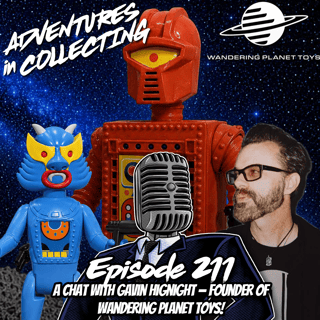
Speaker: That's because today, of course, we do have another guest. So, Dove Kellamer and Sarah Jo Marx started DKE Toys nearly 15 years ago and grew the company into the largest independent wholesale distributor of designer toys, limited edition art objects, collectibles, and gifts before moving that arm of the business over to Disburst.
Speaker: Today, DKE Toys continues to partner with the global toy community, showcasing independent toy artists at their quarterly DKE con events. With one of those events coming up, like I mentioned at the top of the episode here in just a couple of weeks as of recording, it's happening at the end of March. Joining us on the pod is DKE co -founder, Dove Kellimer. Dove, welcome to Adventures in Collecting. Thanks for having me.
Speaker: It's our pleasure. We kind of dipped our toes into the bootleg art toy community when we had Peter on Killer Bootlegs. And recently, for those of you that might be new listeners, we just had another toy artist on Dollar Slice Bootlegs, John Prior. So we're kind of getting into this whole art toy community and trying to
Speaker: You know go from dipping our toes to being kind of like experts so we're really excited to have you on well, thanks for having me I really appreciate it and I appreciate the support of the scene I think the the the resin bootleg scene is for those of you who don't know is Is a group of artists whose medium the way that they express themselves Themselves is action figure
Speaker: And it's a fascinating time. It started in about 2004 with an artist named The Sucklord. And from there, what are we, like 16 years in? I mean, I have a database of about two to 300 different creators that are all making their own
Speaker: action figures by hand. They're either sculpting or kit bashing, casting, painting, designing card backs, graphic design or painting paintings, casting the figures, painting the figures, assembling and creating sometimes one -of -a -kind pieces, sometimes additions. And it's a fascinating
Speaker: It's just a fascinating time because if you follow any of these artists and you follow any of what's going on, they're all just competing with one another and upping their game. And it's sort of like month by month. It's really an amazing time to be involved in this.
Speaker: Yeah, it's an amazing world to watch and to your point, there are so many artists now that are getting into it and it's just fun to see how they do kind of push each other. One person innovates maybe some sort of painting method or articulation method or casting method and then all of a sudden you see that kind of changes the scope of things and other people start to push even further and further. So yeah, it is an absolutely fascinating time to be following this.
Speaker: Yeah, and it's just fun to see too what gets produced and just like, you know, heading into DKECON, just seeing kind of what's going to be available and just all the different things that come from it. My favorite aspect of the scene is the immediacy, like where someone will see something on the news and it will be an action figure
Speaker: Sometimes several hours later, and I remember the Mike Pence vice presidential debate and the fly, right? There had to be like a half a dozen artists that was in a day or two had their own fly figure.
Speaker: And there were some that just had plastic flies and made a card and put a plastic fly in a blister. And there's another guy, Edwin Salas, who carved them out of wood and made his own.
Speaker: Medusa's Wild, she made a Baxter Stockman TMNT fly figure. It was just like the creativity is just out of control and the speed at which those images appeared on Instagram was, it was just amazing to see. Now, years ago, there would have been a fight. There would have been a fight like, oh, I'm the first one to do that. There's a lot of insecurity in the scene.
Speaker: and people arguing about, you know, I was the first to take a Boba Fett head and put it on a Buddha. Well,
Speaker: If you, if you were to come here to my warehouse, you'll see in my collection, I have, you know, Star Wars, Buddhas from 20 different artists. It's just the easiest thing to Buddha statues just everywhere. And then taking a head and put, you know, it's just the easiest thing to mix and match. And there were people, there were artists that would fight about that. You know, this, this is my idea. And it's like, well, you're both stealing from pop culture, like,
Speaker: It's not yours. And so now everyone gets along a whole lot better and it's fun to actually see multiple artists tackle the same subject matter. And you can sort of notice the difference in their work. Because when the suck lord was doing it, he was sort of the only one for
Speaker: Till about 2010 when Killer Bootlegs and Healy made... Both of them were active making their own stuff, but that's... 2010 was about when they started putting out their own stuff. And Dollar Slices come up with this wave theory, which I need to get on paper. Like, the Sucklord was the first wave, and, you know, Healy and Killer Bootlegs was number two, and he...
Speaker: So that he's part of three with another group of however many artists. But there was a time where they were all threatened by each other. And there was a time where people thought that Killer Bootlegs was this copycat because only the suck lord, of course, could make a resin action figure. But now it's so diverse and everyone has their own unique style, the best
Speaker: The best thing any artist could hope for is to have a unique voice and to be able to see their work from across the room and say, oh, that looks like a suckler piece. That looks like a dollar slice piece. That looks like a killer bootlegs piece. And that's starting to happen. You know, it's not like you're looking into work and it's indistinguishable from one another. So like I said, exciting times.
Speaker: So you alluded to it just a moment ago when you mentioned your personal collection. And as this isn't a podcast about collecting, we are all about collecting culture, obviously. The first thing that we ask all of our guests before we kind of get started is, what are you currently collecting? Wow. That's a problem.
Speaker: It usually is for our guests. It's a common problem. Right. You know, I'm a strong advocate that, you know, collecting is a disease. I am particularly afflicted and I am also a enabler. So thank you and I'm sorry.
Speaker: Yeah, collecting is, I've always collected stuff from an early age. I've cycled through lots of different types of collecting. As I'm hitting middle age, I'm and washing prices for things like Michael Jordan rookies that are perfectly graded PSA 10 Michael Jordan rookies selling for $700 ,000. Not that mine that I bought for $3 in 1986 was probably a 10 because that's very rare.
Speaker: But it could have been an eight or nine and those are still 50 grand. Like just so I'm having going through this period right now of it's not really like FOMO. It's like fear of missing out. It's just like I missed out. And so, um,
Speaker: And then I had this other problem, sorry to go off on a tangent, but I've had this other problem where as I've gone through these stages, I've usually like eradicated everything because I just had had enough. And I'm learning now that as I go through these stages to just keep something for nostalgia's sake.
Speaker: I keep a token of it. My wife was collecting, when we were in the distribution business, she was collecting handmade plush food. And she had curated a plush food show and she'd been featured in the newspaper and all that kind of stuff.
Speaker: And then she kind of got over it. And then we did a show recently where she sold off her collection, but I pulled out of one file box. I said, just fill this one box with your 10 favorite pieces. Like you totally get, you don't want to own 300 pieces of plush food. Got it. Let's keep 10 pieces, right? Something to like show your kids. Do you know what I mean? So, all right. So back to your actual question.
Speaker: I think primarily I am an art collector and with a focus on Star Wars. So I think I'm a Star Wars art collector. And I think everything is sort of in service of that. And the handmade resin action figures are generally an offshoot of that.
Speaker: I do also have a book problem. Because as a collector, there are entire genres of things that I do not want to collect or can't collect. But having the book about it, sort of like fills that need of not having to own
Speaker: you know, a thousand pieces of paper in a box or a drawer. Movie posters is a big problem, right? Like I don't collect, I don't collect mondo prints or, you know, movie posters or I have a few, but I know people who have flat files with thousands
Speaker: It's like, here's my poster collection, it's just in these drawers. And that's a tough one to display. And I know a personal friend of mine is a poster collector. And he has one room in his house that is adorned with posters. And then he's left with the tiresome task of switching them out from time to time.
Speaker: because he has so many that just live in a flat file. It's terrible. And archival framing is very expensive. And usually the framing is more expensive than the poster or the print. Like if you have a print that's worth five or $10 ,000, again, you're going to blow $500 on a linen backer with a Japanese hinge and a
Speaker: you know, UV archival glass or, you know, whatever it is, like putting it up on the wall in bad material is going to turn it yellow and brown in 10 years. And, you know, the fluorescent lights or the light from outdoors is going to fade it. Like, and that was my problem with movie posters. And then if you want to, it's not supposed to touch the glass to be archival. That means you need a mat around it and then that makes it bigger and it goes oversized. And then you, so it's, it's like,
Speaker: I know these people, I have a thousand posters that are all worth somewhere between $25 and $100. That's great. So my point is I'd rather have the book.
Speaker: For something like that, absolutely. I love it when there's a book of a designer whose, you know, their whole career is in there. I have poster books on different genres. It could be like World War One movies or Blaxploitation movies or, you know, whatever kind of cinema or it could be designers or it could be actors.
Speaker: They just and they just keep coming out and it's great. I don't have to buy the prints or the posters I just buy the books, but now the books are a problem. So But in a way they are art books. So that is sort of in service of the art. So everything I guess boils down to To the art and art is what attracted me originally to wacky packages Mars attack and garbage bill kids and
Speaker: searching for Star Wars references in all, you know, in all of those series just got me back into Garbage Pail Kids and wacky packages. So now like, like middle -aged and I'm like a non -sport card collector. It's like really weird. Like, I don't know. So yeah, collecting, big problem. Um, so where did the idea for DKE toys come from?
Speaker: I incorporated in I think 1999 or 2000 and I started to do a lot of different things.
Speaker: And I'd gone to film school and I started to do some production work and I started to do a little wholesale and I started to do, you know, and the lawyer would ask like, why are you starting the corporation? Like you have to state what your business is. I'm like, I don't know. When are we able to do anything? And then he just wrote like anything legal in the state of California. I'm like, perfect. That's great. And it just,
Speaker: As I went and found, re -bought my Star Wars Kenner action figures, I was like,
Speaker: maybe like 18, 19, 20 is when I, I got a collection and I just started gravitating back towards those. And then I would buy other collections and then start to sell them. And, uh, I mean, I could talk about this, like could talk about the origin story for hours, but basically out of all the things that I was doing, this is the one thing that just kept throwing money at me.
Speaker: It, it was like, I don't want to say it was easy. It was a job, but I don't know. It was just, uh, of all other things that I was trying to do. This is the one thing that, that came, uh, easy to me. It was simple. There were people just ready. Like if you had something someone wanted, they would just throw money at you. And back then it was just, um,
Speaker: You know, in the 90s, early 2000s, I mean, that was just, those are just magical time. Like, uh, toy business was kind of pre eBay or eBay was just starting and it was, they were eBay sort of took, uh, I dunno, they sort of chopped it off at its, at its knees a little bit. And if in,
Speaker: And ultimately good, you know, ultimately like we all had access to more stuff and most of those gatekeepers went away. Um, and prices changed dramatically. You know, things that people thought were rare just started showing up everywhere and other things, you know, where people realize are really hard to get. Um, so I basically just started trying to pay for my own habit.
Speaker: And that sort of grew. And I realized early on that I did not want to sell stuff at retail. Selling some stuff at a convention was... And having to deal with individual customers and mail order and at the time taking out ads or starting a website. It just seemed horrible to me. But I just gravitated towards wholesale. And I did a lot of closeouts and a lot of...
Speaker: selling on consignment at different shops. And then a 2005 designer toys sort of, not sort of, that's when it sort of, it exploded. And I was sort of there, not at the very beginning, but I started to meet people and I just became a distributor. I was already selling stuff wholesale. I was already familiar with the language of
Speaker: selling something to a retailer and you know before you know it doesn't years later we were representing 500 companies and that's probably when i had had it and i i sold the business to dispersed um dispersed took over the whole set my warehouse the employees and the wholesale business i'm still dke toys i just don't wholesale designer toys anymore um but
Speaker: What happened gradually over the years at the conventions was it got harder to get a small manufacturer to make me something really good to sell at the show to try and recoup my cost. Because even though the great thing about Designer Vinyl was that the additions could be small, but small is still 500 pieces or 100 pieces, as opposed to what was 10 ,000 pieces before 100 ,000.
Speaker: That's why Designer Vinyl took off, because someone with a modest amount of money could make 500 pieces in China. Whereas doing that before was a little more difficult. But still for a convention, trying to get someone to make me something good, one of our companies that we represented, when they could just sell it themselves at full price, just got difficult. But what was easy to do is get
Speaker: these resin makers to make me action figure and additions of 10 or 20 or 50 because they made them all here by hand in their garage. And there was one year we showed up at Comic Con and like every year it just sort of transitioned. The number of vinyl toys just went away. One year it was half and half. And then one year there was like only one vinyl toy. And then the next year it was only action figure. And I remember the Wednesday night of San Diego Comic Con
Speaker: And I didn't understand what was happening. It's just everyone was at our booth and we sold everything that we had. And I was like, holy shit, we have something here. The world is telling me something. Uh, and then I had to have my wife, like go to the warehouse and dig up some old stock and drive it down to San Diego. Cause I had nothing to sell. So I was supposed to retire, but instead I became a retailer on the convention circuit.
Speaker: That's not what I envisioned for my life and selling it retail, which was not something I ever thought I would, would do. And then pandemic hit and I did the shows because I didn't want to sell online. I didn't want to pack hundreds of boxes. I wanted to show up at the show with what I had to sell, do a lot of business in a short amount of time and then chill.
Speaker: but then pandemic it, and then we started a website. And then now I'm an online retailer. What the fuck? Well, I mean, the pandemic has forced people to be nimble, right? If nothing else, you know, it's one of those situations where, you know, unfortunately, outside of the public health issues, you know, that a pandemic
Speaker: is first and foremost responsible for, but it forces people to be industrious and forces people to maybe flex outside of what they want to operate as. Indeed. And once the conventions were canceled,
Speaker: I think it was my wife's idea. She just told everyone, like, we're going to set up the booth in the warehouse and Dove's going to be live on Zoom. Like, okay. So that first year during, for San Diego, which didn't happen, well, San Diego is July, 2020, right? I was in that booth live on Zoom for five days. I mean, I'm going to be honest. That's how we found out about,
Speaker: about DKE Tours was because they've got that live stream.
Speaker: Right and so like the hours of the show were like Wednesday night from 5 30 to 9 I was in the booth from 5 30 to 9 and then on Thursday I was there from 10 to 7 like every day and then we started to do interviews and contests and giveaways and then people just started watching and like sitting there for five days just watching me like talk which is uncomfortable but that's good that they are there and then the more I talked about shit like the more they bought stuff and it
Speaker: was weird. And we sold more than we'd ever sold at a convention. And now a word from our sponsors. And now back to the show.
Speaker: taking a step back, you mentioned that you've you've now been doing this for so long where you've seen kind of these different phases, right? So when you started, it was in that pre eBay world where you could still find cool stuff at maybe a thrift store or flea market, a pawn shop. And now you've you've gone through all of that straight through to the
Speaker: the pandemic era, you know, where we've all fully embraced this kind of virtual world that we live in. How has the art toy community changed over the years? What are some of the changes that you've seen? I think the initial change in what attracted me to art toys in the beginning was when I was in college, I had a bunch of Frank Kozak posters on my wall.
Speaker: and around early 2000s, he started making toys. And when I saw those toys, I saw something that wasn't licensed. It wasn't a brand. It was the embodiment of this person's art in the 3D form, but not an expensive sculpture, you know, one of a kind sculpture. It was
Speaker: art as a toy. And out of that, a community developed of people who were interested in the form of toys, but just based on their aesthetic and with a, I think a deeply rooted interest in who the creator was. And we all know George Lucas is a creator of Star Wars, but when I buy a Star Wars action figure,
Speaker: It doesn't have really a name of the sculptor, doesn't have the name of a designer generally. It's generally a commodity. It's something that is made by a licensee to sell as many units as they can.
Speaker: And I started to feel like there was no real soul there. And if you're a, I know you guys are action figure collectors, you know that a company is going to make a line of toys and they're going to push it until it stops selling. And when it stops selling, the licensee is going to either hand the license to someone else or
Speaker: The licensor is going to hand it to someone else or the licensee is going to figure out a new scale and a new way to sell you the same thing again because that's their business. It's not like they get to the end of the Star Wars line and say, we've made every figure. Okay, we're done.
Speaker: It's like, well, here's Darth Vader. It's clear. And here's the one with the cloth cape. And here's the one with the light light up lightsaber and the one with the helmet cut off. And I had all those figures I was collecting. I had all my vintage loose figures. I had sold off my card and collection years earlier and put a down payment on a house. And I still had the power of the force two line that was
Speaker: And I was buying two of everything through, I don't know, probably about episode two, I just, my brain started to explode. But then I saw a photo of a guy's collection, I assumed he was a guy, and he had every single figure loose, which is what I wanted, like in a case, like, you know, a thousand of them. And it looked like shit. And I was like, I don't want this for myself.
Speaker: And I sold them all. And when I got an art toy from either an artist that I liked that created something or I saw something that moved me in a 3D form,
Speaker: think there's a lot of people that just started to feel that way. And I think through the years that that audience grew, I think about 2008, 2009, it started to plateau when, you know, a lot of the kind of fair weather fans left, but I think it sort of stayed at that plateau for quite a while. And now I think there's little, it's sort of like separated
Speaker: into little conclaves of like there's us over here with these artists that are doing resin action figures and there's a lot of artists that have gone into like the monster and Japanese kaiju, safubi world and the artists who are really popular sort of started to sell their own stuff directly and a lot of the stores that were sort of
Speaker: on the front lines of this went out of business. And that's sort of when I realized that I had to get out of the distribution business because I never went to business school. I had pushed it as far as I could with me and a 10 ,000 square foot warehouse and all the people we were representing.
Speaker: I did not have the skills to take it to the next level. I was going to hire a manager that was going to manage more employees and have sales people. Scott from Dispersed, he wasn't dispersed at the time, but Scott Kinsley who took it over had those tools. I walked through the warehouse and my mind was melting. He walked through the warehouse and this was a crazy puzzle that
Speaker: you know, it's like, oh, we can fix this and I, you know, we can do this and organize this way. And you know, awesome. But then like, when it came to talking to an artist, you know, it's like, Hey, Dove, call that guy and see if they can make that toy. Right. So it's like, so it was a, it was a sort of a perfect fit. So, you know, I spent several years working for them and in that transition and, um, and their businesses changed. Like,
Speaker: I could not have sold to Hot Topic or GameStop or Target or Walmart. Nobody in the designer toy world wanted their stuff in any of those places. And now it's the goal. Like now it is the market has changed and the buyers for those stores are already attuned to what a designer toy is.
Speaker: But 10 years ago, they're like, what is this? This isn't Iron Man. This isn't Spider -Man. I don't know what this is. But now getting an artist to create something that has their name on it and their style, even if it's of something of pop culture, is something that a lot more people understand.
Speaker: Um, but when I was doing it, it was, you know, I guess, you know, it's the people always at the front of the pack of the, the, the largest headwind, you know, that kind of theory. But I think now everyone, uh, I think in general, like women understood, you know, a designer more from clothing lines. And this is a purse by this designer and that, um,
Speaker: fashion and yeah, I mean, I think that like that was understood. And maybe there were fewer men that were attuned to that, I don't know. But and then you would sort of see like what Target was doing. Target was working with a designer and creating, you know, towels and bedsheets and housewares and things all based on one designer's work. And that's sort of like, now the idea of a designer
Speaker: sort of understood by most people, I think, and the idea that there's a person whose job it is to express themselves in a 3D form, what we call a toy, but it's not always a toy. I mean, that's, Frank Kozak told me, he said this, he said that every art form has had a pop culture renaissance.
Speaker: And you can find that time for film or poetry or, you know, expressionist art, whatever there was a time. And he said, this time now is, you know, 3D toy art or 3D. It's sort of like an artist makes a print and makes a hundred prints of something and signs them. Well, here's like a 3D print in a way.
Speaker: Here's either someone's character that is something that they painted is now and now there's a 3d version of it And it's not always sculpted by them, but it is a design Of theirs and you walk into people's homes and they might not collect toys But they have this one, you know, you'll see they have a bear brick in the corner You know that sort of thing. Yeah, and I think you like like Dave I know a lot of the stuff that you know that that you kind of
Speaker: um, gravitate towards, you know, whether it was the, the Disney vinyl nations or, you know, some of the, the, uh, the artist, uh, the, the special artist additions of like the Funko pops, like that, that, uh, that mentality that like that artist fingerprint mentality has started to permeate into, into mainstream toys and collectibles as well. Yeah, for sure.
Speaker: Tell us a little bit about DK econ on its own and and kind of what the aim is for DK econ
Speaker: Well, starting on March 25th and for three days, I will have the booth set up here in the warehouse. The web store will also go live. If you go to DKToys .com and click the shop link, there are a selection of hundreds of handmade toys available all the time. But at noon Pacific on March 25th, we'll have close to 40 new exclusives that will be
Speaker: available for sale starting that day and you know until they're gone. It's usually limit one per person on the first day and then by Saturday we remove that by whatever you want. But this virtual show basically was born out of pandemic and we just decided that it did
Speaker: It did so well that why not just have one virtual show every year? And our schedule was so tight that we'd have nothing in the first half of the year and then it would be San Diego, New York Comic Con and Designer Con all within five months. It was hard on the artist, it's hard on the pocketbook of the collector, so we decided to skip New York.
Speaker: and do a show, a virtual show in March. And that way we're doing three shows a year. It's one every four months. And at least this one, we don't have to pack up the truck and travel anywhere. And it hits an entirely different crowd, like people who all over the world who couldn't go to a show. And not only that, when we show up at a show, it's after our online stuff, all of our stuff has gone for sale online already.
Speaker: which is a different model as well. We spent two years during pandemic, cultivating this audience and this crowd of people all over the world. And I just thought it would be so fucked up to all of a sudden say, too bad, go buy a ticket, fly to San Diego and buy your stuff or shh.
Speaker: I don't know, it felt wrong. So everything now for San Diego and designer con goes on sale the week before. And then we show up at the show just to do outreach and sell stuff in person. And we've increased the addition sizes and gotten artists to make more stuff so that we try to have more stuff for the show. But it is possible that some stuff sells out online and doesn't make it to the show. So how does an artist that may be just getting started get their work
Speaker: Showcased with DK Just get in touch I usually just need to talk to you on the phone Tell them sort of what the parameters are that we work on
Speaker: that we work in. And if you can make something that fall into those parameters, we're happy to work with you. The scene right now is super diverse. And there are people whose work looks like folk art. And there are people whose work looks so good and so meticulous that if you put it on a shelf in a store, you would think that it came from China.
Speaker: And then there's people whose paint jobs go so far beyond that, you know, into the scale of like crazy, like statue and model building and that kind of stuff. So as long as it sort of like fits our, you know, I don't want to call it a formula because
Speaker: I mean, we are mainly selling action figures, so I guess that is a formula. Action figure is generally a card back with a figure in a blister, and that's the format that seems to work. People call me and say, like, hey, I want to do this. One guy wanted to make, from recollection, just blew our minds. He made, the card back was porcelain, the figure was porcelain, and the blister was glass.
Speaker: And he made a Princess Leia and just said, Princess on it. And it's like we all saw this and it was like we had this like 2001 moment, you know, like looking at the
Speaker: the monolith. It was like, you know, the music started. It's like, what is this? This is unbelievable. And, you know, this guy works in porcelain and should check him out online with some recollection, I believe. And, you know, he's making a Darth Vader with his black porcelain for this show.
Speaker: And they're expensive. You know, I think you only made 10, 12 pieces or $300, but it's like this is what an action figure... His concept was this is what an action figure would look like, you know, several hundred years ago or in France, in the Renaissance or whatever. And all of these artists have these skills and they're just coming to this medium and just doing what they can do. Because if you think about all of the things
Speaker: that are necessary to do this job, there's only a handful of people that can do them all. Most people can't sculpt. And if you're a sculptor, you might not be able to paint a card back. Maybe you can do some graphic design. There are a few unicorns out there that can literally do everything. But most people are getting help on something.
Speaker: Most artists are getting another designer to do their car or getting an artist paint a picture on the car that they design or asking someone to sculpt something or maybe they don't cast or paint their figures. At the core of it, this is a conceptual art form. And there are a few guys out there who get shit from the other artists.
Speaker: who really don't sculpt, don't gasp, don't paint, don't design cards, but they come up with the concept and they sort of direct it and orchestrate it and get it all done. And I think one artist in particular whose work is, it's immaculate and it sells fantastically well. And, you know, people give him shit, but
Speaker: At the end of the day, you know, when George Lucas was on the set of Star Wars, like he didn't do the wardrobe. He didn't do, you know, he wasn't hanging lights. He didn't edit the film. You know, it's like, um, there are very few people that can do all of those things in any art form. Um, so just if the concept is strong,
Speaker: I think that's all that counts. And I've seen... If you look at our website, you'll see a lot of executions that are substandard, but the concept is strong and then it sells out because it's just... I don't know how to explain it. You just see it and it's like, oh, that's amazing. Why didn't I think of that? And then you buy it and then... I don't know. Sometimes there's some cattiness with other artists. I think they're just pissed they didn't come up with the idea.
Speaker: So speaking of all these ideas and the countless projects that you've seen kind of come across your plate over the years, do you have a favorite? Was there one that was like the project you were most proud of? I don't think so. I mean, I think they're sort of all my children. I know how I felt when I saw the Succlord's Gay Empire figure in 2005.
Speaker: Right. I mean, it was a pink stormtrooper, said homo trooper on it, the time for war. And there was a storm pink stormtrooper with a big crotch. Right. And I was like, wow. Like that. I mean, just.
Speaker: I mean, it was sort of firing on all cylinders, right? Because it was an art toy. It drew on popular culture. It was a political statement. It sort of had that ad bustery, wacky package, you know, parody quality to it.
Speaker: And he still makes gay empires to this day. And they still sell. It's like, it's ever -present. And that was sort of an epiphany moment when I saw that. And it sort of hit me over the head. Because this was an offshoot of the designer toy scene.
Speaker: and you know we sold his figures for him early on and I don't know we just sort of stuck with that and I think that's the one I think that that's what got me into it but there are so many examples we're working on a book now of Star Wars inspired resin action figures and
Speaker: It's all like I think all I can do is put out like a four or five hundred page book and cram everything in there because I can't. I can't decide like. You know, like this should be in and this shouldn't. So it was the first book primarily just Boba Fett figures and then, you know, books, the subsequent books will be other characters. There will be a lot of Boba Fett's. But
Speaker: I mean, Boba Fett is so easy to parody in every show.
Speaker: out of, you know, 30, 40 exclusives, there's always, you know, five, six Boba Fett's maybe, um, and they continue to sell well. And every time someone comes up with a new concept that no one has thought of before and everyone's like, fuck, I should have thought of that. Like it's, it's unbelievable. It just, yeah, it's getting kind of old, but it's like becoming,
Speaker: It's kind of when a joke just gets stupid after a while, and then you just keep saying it, and you keep saying it, and you keep saying it, and then it just sort of becomes part of you, and then you just go back to laughing at it. Well, we asked this question to John. Yeah, to Dollar Slice. Yeah. So why do you think Boba Fett is the character that every - Is like a calling card for the community. Yeah.
Speaker: Well, Boba Fett was mysterious, right? Boba Fett had very few lines. He was a bounty hunter. He looked rad. And there was all sorts of, you know, speculation. And there was like, I never read the books. There's one line in the book about being a Mandalorian, you know, and just that just sort of created this idea that there could be more of these.
Speaker: Like, what is the story there? I mean, it is unfortunate that Boba Fett, who was this minor character, ended up being
Speaker: taken because he was popular and being the basis for all the clones and all of the storyline based on this one random character. I mean, just think what if Dengar had been the most popular, right? And then all of episode one, two, and three would have been about Dengar and Dengar's son and and all of the clones were like spawn of Dengar and it's like
Speaker: I would have I would have much preferred like Zuckus or a four -alarm right like there's just clones of like weird like green brain aliens. I'm trying to be ridiculous on purpose but but you understand like yeah like the opportunities you're right you know the opportunism there um the toy was also very cool and there was the always the issue about the
Speaker: you know, the rocket firing and that also created some mystery. I'm sure other people could pinpoint other reasons why it's cool. And I think that you can also see now that they're explaining everything about Boba Fett and you're watching him get fat and old and then the mystique is sort of not there anymore. So it's like what was cool about him
Speaker: has sort of been ruined for financial reasons and in service of creating content for fans to go crazy over. It all goes back to that, I think it was Patton Oswalt that made the joke in either a stand -up or a show that he was on, but he said it was something about the... It's like going to an ice cream parlor and ordering ice cream, but instead of just getting ice cream, they teach you how to make your own ice cream.
Speaker: And then you have to make your own ice cream before you can get your ice cream. He's like, no, I just came here for my ice cream. I don't need to know how it was made. I don't want to be part of making it. I just want some vanilla soft serve and a cone, please. You just want to get in your car and step on the gas and have it go. You don't need a theory of internal combustion. But the problem is then you run out of stories to tell.
Speaker: And I think there are certain characters that I think there's a much larger conversation, but I think in the Star Wars canon, like the official canon, I think there are characters that they'll probably maybe leave alone and not give us full backstories on, like maybe somebody like Yoda, but it's just they already
Speaker: With the prequels, they already laid the groundwork to flesh out Boba Fett. If you watched the Clone Wars cartoon, you got to see him operate as this vengeful little prick of a kid that just wanted to kill Mace Windu for decapitating his father.
Speaker: You know, maybe some of the, well, not maybe, definitely some of the mystique has, has been eliminated, you know, for, for the, the indoctrinated fans. But, you know, to your point, I think going back to that original Kenner toy, you know, with the,
Speaker: the rocket firing action and I'm stealing Dave's very funny point from our episode with dollar slice bootlegs, but like a toy that could potentially kill you. A toy that will maim you. Like all of those things I think are contributing factors and it's interesting to hear how now this is the second time we've asked this question, we might have to add it to our list of like reoccurring questions. This might be...
Speaker: Like, although now I am very in a comedic sense interested in the book of Dengar. I mean, look, you can keep.
Speaker: You know in service of fans you can keep doing this forever And I'm sure they will and I'm sure that's why George Lucas sold it to Disney so they could keep it going forever as it Didn't sound like something he wanted to do And as long as the fans enjoy it they'll keep making it and when the fans are like that's enough then they'll stop or it'll become you know more sporadic I personally
Speaker: feel I'm in a good place now with Star Wars. There was a time after the prequels that it was sort of like a dark time for me when I was like, like Star Wars, like there was only two and a half good movies. And then there was this other stuff that I just been
Speaker: The way I justify it, the way I can sleep at night is I really just view Star Wars Empire and Jedi as canon. And everything else is fan fiction. Everything else is just someone else's take on it, someone else's interpretation. And even though George made the first three movies, it was so long in the future
Speaker: He was not the same person that he was when he was the age that he made Star Wars. Motivations were different. And I feel like that was like a different person who made those. And if you look at something that's been around for 75 years like Batman, everyone has something Batman they like. Most people, right? Whether it was a movie or the TV show or a cartoon or a comic or a toy or the breakfast cereal in a video game or whatever.
Speaker: There's something Batman that people usually gravitate toward. But I don't have to say, if someone says, are you a Batman fan? Say sure, but that does not imply that I need to love 75 years of what is probably mostly garbage. Yeah, you love the parts of Batman that you love. And I think that goes for most
Speaker: you know, characters in pop culture, you know, that have that sort of depth, whether it's a, uh, you know, a horror movie slasher icon that's, you know, nine movies deep, like a, like a Jason Voorhees or a, you know, or even a Michael Myers, you know, you might love Halloween, you know, the first one, but you don't like any of the sequels or, you know, like how part three, because it's not the Michael Myers movie.
Speaker: I get to pick and choose and there was a lot of fight with fans like you're not a fan, you don't like these or I hate this whole thing or Star Wars has taken a dump or whatever it's like no.
Speaker: My kids who are eight and five, like, you know, they got to watch Star Wars when they were five. And my son is eight now, like thinks that Star Wars and Empire and Jedi are kind of boring. And he thinks that one, two, and three are action packed and crazy and likes those the best. Yeah, I have a six year old and she's got a life size, uh, one of those wall vinyl decals of Ray.
Speaker: She loves the sequel trilogy, she loves those characters, she loves the animated content, and she's watched the original Star Wars films and the prequels, and she appreciates them as being part of the story, but when she wants to watch Star Wars, it's usually
Speaker: something with the Mandalorian or something, you know, with Rey, you know, she wants to watch the newer content and, you know, there's totally fine. You know, it's like I can be a fan. I can be a fan. I can pick and choose. And it's going to get to the point that there's so much content that no one's going to like it all. You don't have to like it all. And you can still you can still be a fan. But for me,
Speaker: If I just pretend that the original trilogy is it, and then just sort of imagine what everything else could be, then it's still very interesting to me. Because as soon as you explain Boba Fett, like it just loses a little bit of its luster. But if I just think of that as like, oh, this is Disney's take on it. Right? Remember, they could reboot all of this shit.
Speaker: Star Wars is going to be 50 years old soon. They could start from scratch. I don't know what else they're going to do. I know they have these huge plans that got scrapped and whatever. They could figure out ways to tell the whole story all over again with new actors. What a shitstorm that's going to be.
Speaker: It's like, you know, I'll be 80 years old. It's like, well, I was younger and I used to see Star Wars in the theater. You know, it's like, okay, okay. You know, okay, grandpa. That's not my Darth Vader. Exactly. So whatever. These are first world problems. Well, with that, I think it's time to head into some Q &A.
Speaker: This segment is brought to you by our friends at Chubsy Wubsy Toys. A traditional mom and pop toy store in Little Falls, New Jersey, Chubsy Wubsy Toys brings you the best new toys from the brands you love without the hassle of pounding the pavement, searching for them at larger retail stores.
Speaker: Visit them in person at 106 Main Street in Little Falls, New Jersey, or online at ChubsyWubsy .com. That's C -H -U -B -Z -Z -Y -W -U -B -Z -Z -Y .com. And tell them Adventures in Collecting sent you.
Speaker: So, uh, we posted that, uh, that you were going to be on the podcast and we, uh, we asked if the community had some, had some questions. And, uh, we do have, uh, we do have a couple of, or I should say we have a few questions for you. Um, two of which are come from specific people. And then one, we had a couple of people ask the same question. So can't give any credit to one of them, but, uh, Dave, do you want to, uh, go ahead with the first one?
Speaker: I would love to, at behind the bootleg asks, what is one of the hardest decisions you've had to make regarding a show? I guess the hardest decision is, is whether to do it or not. Right? It's whether you're going to commit, however much it costs, you know, 10 grand, you know, having all of this stuff created,
Speaker: put it in a van, advertise it, drive it there, set it up, and just pray that people show up. I talk to a lot of artists who are business people or artists who are trying to do business, and my advice to them is usually let the marketplace dictate what you do. People look at a toy, they're like, how much should I charge for this? It's like, well, just start at the bottom. And then when you can't make them fast enough,
Speaker: then you raise your prices. Um, so I've tried the resin action figures at mainstream toy shows and without a super sophisticated audience, it just doesn't work. Then you go comic -con is the hub of comics, animation, toys, movies, video game. And the people who work for all of those companies come and buy from us.
Speaker: But the kid who's going to a convention to buy his $10 Funko Pop and get an autograph from this person in their free poster is not going to buy a $50 or $100 handmade signed piece of art, basically.
Speaker: And so there's only certain venues that it actually works in. And there is some value to going to certain shows for outreach, to be on the front lines and explain to people what it is. But our booth usually looks like a
Speaker: a little art show, like a little mini museum sort of. And more often than not, someone will just come up, see something, laugh at it, take the photo, and then walk away. And that's great. Love it when people do that. People say, can we take photos? Of course. But at the end of the day, we do need to eat. So we want people to buy stuff.
Speaker: So, that's always the hardest decision is where to invest the money to, you know, make the biggest impact. I think we've settled on something that works, but I'm not too adventurous. I would say that, like, business -wise, I'm pretty conservative.
Speaker: It took a pandemic to make me an online retailer. It took seeing the demand of the audience at San Diego for me to migrate to an exclusive action figure lineup. So just following where the universe is leading me, I guess.
Speaker: Because if everyone stopped buying resin action figures, I'm not going to keep doing it and banging my head against the wall. I love it. But I would just try and find the next thing that I love, I guess. All right. So outside of the medium of toys, what artists do you admire?
Speaker: That's a rough question. We could talk an hour just on that. And I'm always discovering new people. And then once I discover them, I try to get them to make action figures. So that is awesome, actually.
Speaker: Yeah, that rules. So that is sort of an interesting phenomenon. There are no DKE branded action figures. The majority of the releases that we release are toys made by artists who make resin action figures and deliver finished product to us.
Speaker: But when I meet an artist that I like, I can sort of help them facilitate making an action figure for an artist who would never, ever work in that medium. So when you see toys by Frank Kozik, Ron English, Scott C, Jim Mafou that I could go on down the list, Alex Gross, like, we've helped all of those people get those action figures to market.
Speaker: Have you ever heard of there's there's this artist that I I absolutely adore on Instagram is his handle is at Alec with pen No, he does these really really absurd Like cart like almost like
Speaker: I don't know how to describe them. They're so, they're so, they're so strange and so fun and dark. Uh, but like his, like seeing some of the stuff that I've seen, you know, at, at, um, you know, on the DK showcase, I just see his, his stuff and I, and, you know, hearing you say that, like, it would be the one character that he kind of draws in, in all of his, uh, in all of his work, which I believe is, is sort of a caricature of himself in a way. I see it now, like missing the eye. Yeah. Yeah.
Speaker: Yeah, like very, it could be very toyetic. Yeah, definitely. So yeah, like I discover something, someone like this, and then if I can't produce it, then sometimes I can put them together with someone who can. So there's another guy, if you look up on Instagram, his name is Paul Rentler. And he's sort of like a collage artist and his, it's, um,
Speaker: it's graphic design there was a point in his career where he was cutting and pasting but now it's all digital and so he created the card back and you know sort of created if you go through his feed you'll see these busts of star wars characters like a tuskin raider and dark fader and so i put him together with a
Speaker: a resin toy artist. And so they collaborated with Tiddy Bean's toys in Australia. And he created the figure, he sculpted it, painted it, and Paul created the car. And they sort of like made this collaboration. And it's, you know, it's coming out for this DK Econ in March. Oh, awesome. Yeah, I love this. This art is gorgeous.
Speaker: And he does stickers and zines, and it's out of control. Ephemera eye wash. That's the new zine he just released, yeah. That's awesome. All right, last question in the Q &A. A friend of the pod, we've mentioned him before, at Dollar Slice Bootlegs, he asks, what does the atom bomb art taste like?
Speaker: Right. That's a little inside baseball, I think, for most people listening. What John knows that people listening probably don't know is that I own the original Adam Baum art from first series of Garbage Filky. And John has come over to the house and drooled over it in the past. It's a silly question and doesn't require an answer. But
Speaker: He basically, he was asking you a question so that you could flex with the fact that you have that. Exactly. Which I don't normally do that kind of thing. And I definitely don't go around licking art. Nor do you condone the licking of art. Maybe that's an art form in and of itself, but not for me. I mean, the snozberries taste like snozberries. We now have a new disclaimer. Do not lick art.
Speaker: Oh man. Well, with that, you have survived the Q &A. So congratulations. Wow. And that leads us to our final question. Dave, would you like to fulfill your role as this pod's James Limpton and ask the final question? I sure would. So our final question that we ask to all of our guests, what's your favorite and or strangest piece in your collection? It can be one of each or it can be both.
Speaker: Well, um. I think the strangest thing. It's more of a category. And I have another Instagram in addition to at DK toys on Instagram was where you should follow me if you care about resin action figures, but my other. Account is called at bootleg underscore GPK. And it.
Speaker: showcases my collection of every sort of fan -made, artist -made, and bootleg, garbage -filled kid. And they range from, like, some amazing artists who used to do garbage -filled kids and now do their own stuff. Mark Pingator is a good example who has done
Speaker: You know horrible kids all the horror icons and he's done a series of Star Wars and a series of turtles and a series of Thundercats and he -man and you name it like and he releases you know packs of cards and boxes and sets and uncut sheets and all that kind of stuff and then there's the sort of finding
Speaker: Garbage Pail Kid references out in the world. For some reason, there's a theme of tattoo artists.
Speaker: in their business cards. They must have at least 20 different business cards from tattoo artists who all use garbage pail kid themes in their, in the way they advertise their businesses. Um, to other, it's just sort of meta, you know, it's just weird. It's like garbage pail kids was a originally a wacky package parody of a cabbage patch doll.
Speaker: And then now people are parroting the parody and it just, I mean, the most recent set I got in the mail was called Fentanyl Patch Kids.
Speaker: And it's like just the most fucked up images I've ever seen. And so it starts in the early 80s with the direct ripoffs. Trash can pots and trash can kids and garbage can kids. You know, whatever, every conceivable
Speaker: You know iteration from an actual set of cards to a Skateboard company fucked up blind kids came out in 1988 with those four skaters who are now a big deal And it just keeps going and I have Thousands of cards of and the more the more ridiculous the more Absurdly or horribly done The more I like it
Speaker: If that makes sense. Not that someone's making it bad on purpose. They're just people who are doing the best they can. And they think it's good enough to make a sticker or a card or a postcard or whatever and put it out there. And I'm stupid enough to buy it. What can I say?
Speaker: So if you go through the feed, you'll just start seeing there's breweries that are now making their own custom labels that have GPK themes. It's sort of just exploding. And I'm caring less and less about what TOPS is doing.
Speaker: I get the new sets. They're cheap. You know, they come out like 10, 20 bucks. Like you get the new set of cards. Okay, cool. It's fine. They do their online releases. Okay, cool. I'm trying to keep up, but that's not exciting to me. It's always the artist, the fan, the creator who's taking the theme, twisting it, turning on its head, doing something that is not approved.
Speaker: sometimes completely offensive um and that's sort of uh where it's at for me well i mean that's the and and that's that's the uh in the spirit of of of garbage pile kids they were always uh offensive i mean many of them were were offensive they were but everything that was offensive is
Speaker: Not offensive anymore. I walk into the bank and they're playing Judas Priest. This is true. And I'm like, my wife looked at me and like, are they really playing Judas Priest in the bank? It's like breaking the law. You know, it's like, what the fuck is going on? What Twilight Zone have I stepped into that, you know, this is like, it's just part of the culture and no one's bothered by it. No one thinks that their kid is like,
Speaker: I mean, I'm sure there's someone who still thinks, you know, rock and roll is the devil's music. But do you know what I mean? It's just part of the culture. Like the. We've developed, we've developed culturally to be a little more a little less sensitive to things. You know, it's like this garbage filled kid really going to hurt a kid. I don't think the people buying garbage filled kids are not kids. They're like they're like 50 year old adults.
Speaker: Yeah, like, you know, oftentimes when I'm, when I'm going, you know, when I go to Walmart and I was going to say when, when I go to Walmart and Target, you know, and I, and I walk through the, you know, the collectible section and the toy section and my daughter's with me.
Speaker: She goes right past the Garbage Pail because now there's Garbage Pail kids toys. There's like pullback racers and little like minifigures. And they're really cool. They look like 3D expressions of the cards. I mean, it's like the characters are there. The sculpts are great. She walks right by. Couldn't care less.
Speaker: There's no, there's no, there's no nostalgia there. I was, you know, we were on a road trip and we stopped in a little roadside market. And my kid says to me, Hey dad, did you see the garbage girl kid little mini figures? And I looked at it like, Oh yeah, I got those. And then, you know, it's like, I don't like, those were made for me. Yeah. Like, I agree with you. Like kids, they don't care.
Speaker: Before we let you go, can you just remind everybody one more time, where can we find out about DKE Toys on the internet and remind us again when DKE Con is starting? We are at DKE Toys on everything, but everything is focused on Instagram. So if you follow us on Instagram, it does post to Twitter and to Facebook and all that stuff, but Instagram sort of like where
Speaker: the action is and where all the announcements are. If you go to DKToys .com, click on the store link, you can see all of the crazy creations of all of the artists that are out there. And if you click on the DK Econ link,
Speaker: By the time this is up, the press release for the new show will be there. And it'll have links to the store, links to the Zoom interview list and schedule for all the days. And every single question that you have about DK Econ will be answered on that page. And so just stay tuned. Log in. Give us a follow. And if you're into action figures but have not ventured into this
Speaker: genre before, it's pretty fascinating, and there's generally something for everyone. It does cater more to three and three -quarter inch and more to Star Wars references than other genres, but it
Speaker: I'm starting to see a lot of people's collections. People are just action figures. And generally speaking, there's always one or two resin pieces just sort of like hiding in the corner. It's like, oh, I really don't collect these, but I couldn't resist this one, that kind of thing. So I'm starting to see that a lot.
Speaker: Dove, thank you so much for taking the time to be with us. And we'll have to have you back on maybe in time for the next EKE Con. Sounds great. Thank you so much for having me and helping spread the word. I really appreciate all you guys do.
Speaker: Thank you, dear listener, for hanging out with us today. Subscribe, rate, and review us wherever you listen, and then tell your friends to do it. Thanks also to Joe Azari, the golden voice behind our intro. Our music is Game Boy Horror by the Zombie Dandies. Find more about them both on our show notes.
Speaker: Follow us on social media at AIC underscore podcast on Instagram and Twitter. Stop by and say hi. Show us your toy hauls and share your toy stories. Maybe we'll talk about it in a future episode.
Speaker: This has been a non -productive media presentation. Executive producer, Frank Kablaui. This program and many others like it on the non -productive network is distributed under a Creative Commons Attribution Non -commercial No Derivatives license. Please share it, but ask before trying to change it or sell it. For more information, visit non -productive .com.
Speaker: Dave, you know why I love using Zencaster? Is it because the recording quality is better than other methods of recording a podcast virtually? Nope. Is it because they offer a free version for hobbyists just getting started? No, not that. Is it because it's super easy to use for everyone and none of our guests have ever had an issue using it? That's not it. Is it because they offer automatic post -production and transcription services? Negative.
Speaker: Stop burying the lead. Why do you love Zencaster? It's because Zencaster is all of the things you just said, Dave. Well, and they sponsor this pod. That's right.
Speaker: Adventures in Collecting is powered by Zencaster. How about your pod? Get started now with Zencaster and use our code to start podcasting today. Visit zencaster .com slash pricing and use promo code AICPOD to get 30 % off your first three months of their professional plan or try it for free.
Speaker: That's z -e -n -c -a -s -t -r dot com slash pricing and use promo code AICPOD.