Transcript
Speaker: Starting with whack -a -mole as humorous as it might sound, I think is a good first step. Start to go after it, make it more difficult for the perpetrators who are committing these things to do something else, go somewhere else, pick another topic. And so the U .S. has been successful in Social Security Administration calls, they've been successful in automobile warranty calls, where they've actually put a real focus on them and you've seen them actually reduced dramatically.
Speaker: On our quest to solve the scam problem, I was wondering about regulation. What are the regulators doing to help us stop online scams? What is the impact of consumer protection agencies on regulators' decisions? Let's unpack the regulatory landscape across the scam lifecycle. Scam Rangers.
Speaker: a podcast about the human side of fraud and the people who are on a mission to protect us. I am your host, Ayere Tigar Levine, and I'm passionate about driving awareness and solving this problem.
Speaker: I've spent the last 15 years building technology to help financial institutions authenticate their customers and identify fraud. I've always been focused on protecting the banking transaction or activity, but when it comes to scams, the story starts well before the transaction. I've created this podcast to talk about the human side of scams and to learn from people who have decided to dedicate their lives to speaking up on behalf of scam victims and who take action to solve this problem.
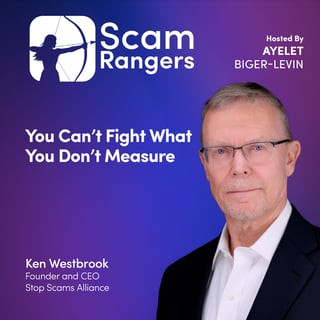
Speaker: One of the people I met along the way is our guest on today's episode. Welcome to episode 5 of Scam Rangers. Today's Scam Ranger is a veteran in the banking world and I can't wait for him to share his knowledge about regulation and action in this space. Since 2005, Ken Pala has been in online security. He was a director at MUFG Union Bank, recently retiring in 2019.
Speaker: He helped shape the initial responses to the U .S. 2005 and 2011 FFIEC regulatory guidance to improve online security for U .S. banks. He's an early adopter and has selected and implemented a number of online security products. He's also on the SCAM committee for the noble. So Ken, welcome to the podcast. I got to thank you very much. Pleasure to be here today.
Speaker: Great. So tell me a little bit about yourself and your involvement recently in the area of online scams. So what got me going in this really goes way back a while to the beginning of business email compromise, which is around 2011. And here's where employees were being scammed to send out money on behalf of their company. And when we would talk to these employees, they would basically not really tell us the truth about how much verification they did. And so you could start to see kind of the embarrassment or shame that
Speaker: When you asked them the questions, they just weren't giving you the right answer. So you could see there was just something else going on. And then the next was in the romance scams. Of course, romance scams, we'd see something, maybe a questionable wire. Our fraud people would call the customer. And again, they would not really tell you the truth, or they really believed that they were in love with somebody. And when you asked them questions, their answers were for them to justify why they wanted the money to be sent. And so you saw that it was hard to break this
Speaker: the scam because they just believed it so much. More recently, I've been on the Nobel Scam Committee and here I've been spending time looking at reimbursement issues and also looking at solutions beyond education for scams. I'm on this quest to understand who can help us fight scams and who's in charge. And I think your focus, you recently published a white paper that summarizes the evolution of the regulatory landscape in several countries in the world around the topic of scams.
Speaker: And I wanted to ask you, you know, what are some observation that you have in terms of the approach that different countries are taking and how it relates to the scam victims, not only, you know, the institutions, but actually taking the victims into perspective? Well, first of all, there really is no regulation about scams associated with authorized payments. So an authorized payment is where the customer is tricked into actually doing the transaction. Hence, it's an authorized payment.
Speaker: because the real customer did it. And when you look around the world today, there really is no regulation that's formal about what should happen in that circumstance. So when I started to look around the world, what you see are kind of discussions, dialogues, informal processes. And so one place is Singapore was an example that about just over a year ago, they had a lot of phishing scams and a lot of money was being lost. And this was the first time this happened in Singapore.
Speaker: And so there was no regulation for reimbursement. In this case, these were really unauthorized transactions, but they were phishing. But the government kind of convinced the banks that they should do reimbursement as a one -off type thing. And so they did. And then the government, the monetary authority of Singapore said, well, we need to look at this and see if we can come up with some kind of regulation to kind of address scams in general.
Speaker: And it's something that they announced they were going to be looking at around May of June of last year, and they thought they would have something out before the year's end. Unfortunately, they haven't. But what that highlights is how difficult it is to define what you might do in the case of a scam and how you might do reimbursements. It's just not as simple as it sounds. So that's kind of the Singapore situation. If you go back a few years, the Netherlands was one of the first countries
Speaker: to come up with protection for bank impersonation scams. And again, there was kind of uproar from customers and hey, something needs to be done. And so the bankers themselves, the banker associations in the Netherlands came up with a way to basically do reimbursements for bank impersonation scams. So that's just one of a lot of scams that we talk about, but that's the one they felt they could pay attention to. When you go to the UK, they've had a code
Speaker: which is in place, which is basically recommending that the major UK banks will reimburse for authorized push payment scams, which is interesting because authorized push payment or APP scams really has a variety of scams. It could be a romance scam. It could be an investment scam. It could be a bank impersonation scam. And in the UK, they've kind of lumped them all together and said, banks, you should really be reimbursing for all of these. Now, what happens to date is maybe 50%.
Speaker: of these scams are reimbursed by the major banks. And there's legislation in front of parliament which would more make this a formal process where there would be reimbursement and the PSR which is one of the UK payment system regulators there is going to come out with the formal language as to what it means for reimbursement. And then one of the things we also saw this past year was the concept of receiving banks possibly being part of the reimbursement.
Speaker: So typically, when you think of a reimbursement, it's the sending bank. So it's the bank of the customer who did the transaction. They're the ones who should be reimbursing. And we saw a discussion in Singapore. We also saw a discussion in the UK that, well, maybe the receiving bank is part of the problem. Because after all, that's where the money mule account is and things like that. So when we see this, we definitely see this difference about talking about receiving banks for the first time.
Speaker: in 2022. And we'll talk more about the US in just a little bit. But the other thing that's kind of interesting, you talk about the victims themselves, I would say the voice of scam victims in the UK is the loudest. And in effect, you're getting results in the UK because you have organizations like which
Speaker: and others speaking on behalf of the consumers, it tends to get more attention. In Australia, you have the voice of the customer, but it doesn't seem to be going very far. Australia tends to look at the UK, so maybe once the UK regulations pass about formal reimbursement, maybe Australia will do something.
Speaker: I wanted to also echo that with regards to UK and say that I talked to a few bankers in the UK and they said, you mentioned which they said, you know, we're worried about the Daily Mail. What's written in the Daily Mail has echoes and it impacts our customer satisfaction and expectation. So I completely see that trend of listening to the media and listening to what is being said about them. Also, they don't have 5000 financial institutions in the UK. It's, it's much smaller. So
Speaker: every customer is significant and they do care. Let's talk about the US for a second, because I think there were really, really interesting things that happened in the last few months with the Senate and conversations. Right. Well, in the US, it's been kind of interesting. Zelle has been the main battle cry. The loss is in Zelle and a customer says, basically, I don't even know what Zelle is, but all of a sudden I get a text message and it says, this is from Bank X. And did you just do a $2 ,000 Zelle transaction? If you didn't quick, no.
Speaker: customer looks at that. So of course I didn't do that. They click no and then lo and behold they got a call and the phone call purports to be from the bank. So this is an example of bank impersonation and the person on the line pretends to be from bank X and says, okay, we've got to do something about this problem. And so they basically convince the customer in essence to do what amounts to be the fraudulent transaction thinking that they're reversing the previous non -existent transaction. So you have a combination of,
Speaker: The text message, you have a combination of the voice call. You have the combination of the customer doing an authorized transaction. And so a number of these have occurred. The customers complain. They'll go to some of the people in Congress, and they'll go to their TV reporters. And so what tends to happen is once you get it to a TV reporter and they go to the bank because of the ensuing publicity, the bank all of a sudden comes up with some additional information.
Speaker: which allows them to then reimburse the customer. But along the way, there was also been some congressional hearings, and there was one in September where a number of the major banks were there, and you had some of the senators and all were asking questions. And the thing about the same time, there was a letter from JPM Chase to the Senate Banking Committee, and in the letter, Chase said,
Speaker: that they will reimburse for me -to -me bank impersonation scams. And so this is the first time that I've seen in writing where the bank, I'll say on their own initiative, because at that point no one was requiring them to do it. There was obviously the political pressure of some of the senators and congress staff.
Speaker: to do something, but they actually came out and put something in writing. So that kind of was the first time you saw that. So it appears that in some cases there are reimbursements for the ZEL scams in the United States that were occurring in 2022. There were some other banks I know of that also were feeling the heat and decided that they too needed to reflect on what was going on.
Speaker: The interesting thing then is a couple months later, I believe it was in early December, the owner banks of Zelle, which Zelle is basically owned by early warning services and banks own early warning services. So the owner banks came out and said, for these Zelle scam transactions, we think there should be reimbursement. But they had a twist to it. And they said, we think the reimbursement should be done by the receiving bank, not the sending bank, which everyone else, when they talk about reimbursements, it's the sending bank.
Speaker: And it wasn't a 50 -50 split like is being discussed in the UK for APP fraud. It was like 100 % for the receiving bank. And my understanding is that probably later this summer, maybe June, July of 2023, this will go into effect Brazil transactions. So a lot of things started to happen, but still there's no changes to the US regulation. And again, that's kind of the reggae type thing, which goes back quite a few decades.
Speaker: But Reggy really talks about unauthorized transactions and never talks about authorized transactions. And realistically, back then, you weren't seeing any scams or fraud associated with authorized transactions. Hence, that's why it's not discussed in the United States or in any other country. Because a lot of these regulations are decades old. So that's the US. So they've kind of come into the light in the last quarter and come up with some interesting concepts and considerations. Now, there has been some pushback
Speaker: on the part of some of the smaller banks saying, geez, we don't know. We can really afford Zelle if we have to do that. But again, coming back to the side of the customer, these customers do take these losses because they are tricked into doing these authorized transactions. And they lose money. And the reason it occurs is it occurs because the money goes over the banking rails in many cases, although these days we'll also see
Speaker: You know, money being withdrawn, cash withdrawn from a bank as part of a scam and put into gift cards or also put into cryptocurrency. I know you talked to Erin West from the district attorney's office in Santa Clara County, California a couple of episodes ago, and that's part of what she faces. So it isn't just using the bank rails these days, but it's also gift cards. It's also crypto.
Speaker: But the customers do lose, and so you have to take into account that this is a painful thing for the customers, and what is it that banks could be thinking about, given the fact this is a pain point and a loss to customers.
Speaker: Right, and in the previous episode, we also talked to Julie Conroy from Ita Navarica and the perceptions that customers have and their expectations of financial institutions to take care of them. So one thing that I wanted to ask with the banking regulation one more moment here is you described the situation in the UK, how
Speaker: Banks came out with a CRM contingency reimbursement model and the voluntary code and the fact that a few years later regulation did come out. It's not yet regulation, but it is in draft and it will come out very soon. Now we have a contingency reimbursement model in the U .S. It's not called that way. It's a model to appease regulators, to be proactive. What do you think about that? Why is this happening?
Speaker: Well, I wouldn't characterize it quite the same, because what's happening in the UK is kind of regulator driven. What's happening in the US, as far as what's really happening, is bank driven. And it's really the bank owners of Zelle that have come out about Zelle transactions. So no one's talking about other types of scams. So remember, in the UK, the authorized push payments involve romance scams, investment scams, and bank impersonation scams, among some other things, even
Speaker: Even internet purchases might be considered part of the APP. In the US, what we're seeing are these bank owners of Zelle talking about Zelle transactions. So one is it's very narrow in the United States, and it's being driven by some of the major banks. So it is still quite different. And to make some kind of regulation in the US will be difficult because you'd really have to change reggae.
Speaker: And my understanding is that would require congressional approval. So the House and the Senate would all have to agree to something. So I don't know that we'll see formal regulation in the US for quite a while. The Consumer Financial Protection Bureau was talking about coming up with some type of advisory, which would not be regulation, but it would be kind of the blunt stick kind of a thing. But even there, that's kind of intempered, but part of that was they were being sued because of the way they were being funded.
Speaker: The Consumer Financial Protection Bureau is pulling back a little bit on anything that might be controversial until they resolve this funding issue about any of the rulings that they come out with, are they in fact legitimate? So I think that's kind of dampened some of the action that I thought the Consumer Financial Protection Bureau would have come out with as late as December last year. But I think that's going to be in abeyance, just my own personal opinion, until they resolve the funding issue.
Speaker: There's a lot of concern around reimbursement because of the potential rise of first party fraud and buyer's remorse, which banks are talking about and legitimate concerns that they have. So until any regulation unfolds, it's really about better protection, better layers of protection around Zelle. How do we improve Zelle?
Speaker: Well, keep in mind in the UK, once they started the voluntary code, you started to see new controls being applied, confirmation of payee and a number of other controls. Some behavioral biometrics was applied. So when banks do have to reimburse, they start to think a little bit more about it. And part of it can be when you're a bank and you're spending money,
Speaker: First thing you look at, not that it's right or wrong, but the first thing you look at is, what's it going to cost me? And most of these scams don't cost banks money, so they'll look at other things where they can spend money to protect their bottom line. Well, now that you have the reimbursement situation, certainly in the UK, UK banks are spending money.
Speaker: And when it's soon going to go to 100 % reimbursement for almost any kind of APP scam, there will be money spent. And some of it is successful types of solutions. I think we will see that in the US, or we should. I don't think we're doing enough in the US on money mule accounts. I don't think we're looking closely enough about inbound financial transactions coming into accounts.
Speaker: that are money mule accounts. So there's really, I believe, additional controls that US banks can deploy to help mitigate some of these losses. And so that at minimum, whether you have to reimburse or not, banks should be thinking about
Speaker: the impact to their customers as far as the losses the customers incur, as opposed to just what it is to the bank's bottom line. I mean, luckily, when BEC fraud came in, a lot of the controls that were in place to address malware were very helpful to identify and address business email compromise and alert upon it. In the case of these consumer scams, it's a little more difficult. And so you really have to look at things a little bit more
Speaker: And you've got to look better, like as an example, at your controls around online account opening. It's just not good enough. Too much is getting through. But we also know that consumers are being complicit, where someone will offer them some kind of a little marketing thing on Instagram or Facebook, saying, hey, how would you like to make some money? And so customers are saying, yeah, you can use my bank account to receive whatever this money for and whatever it is, just kind of turning a blind eye, because it's a way to make money. The economy is tough. Maybe that's part of the reasoning.
Speaker: But nonetheless, you do have complicit consumers. And we've seen this in the UK. We've seen this with students in Canada, foreign students. They don't fully understand the banking system. They come from a third world country, maybe. And maybe something like this is considered acceptable. So when you do it, you've got to look at all these things. So it's not just synthetic IDs and account opening. It's real people with real accounts. But there needs to be better controls. And if the banks at least do that,
Speaker: Think we can we can feel a lot better, but you have to recognize whether you're reimbursing for this or not your customers losing real hard -earned money and Generally, it's because of the banking rails, but as I say these days to be fair It's also in money and gift cards through the the Walmart's and targets and stores like that But it's also through crypto going through crypto exchanges and
Speaker: Absolutely. And it's not just the financial loss. It's the emotional loss. It's the manipulation. It's the feeling of shame that they go through. And that is, at least in the interaction with customers, needs to be taken into consideration. I definitely agree. There is an emotional impact. And I think if you listen to some of these people when they tell their stories, it isn't just the loss they took, but there is emotional and mental. And in some cases, you might even see suicide if it was in a large investment scam.
Speaker: or somebody lost $100 ,000 to $200 ,000. In the podcast you had with Aaron West, a lot of the victims who contact her lose hundreds of thousands or maybe a million dollars in these pigbituring investment scams. And those are more difficult, but they do start with money leaving the bank.
Speaker: And then that's where banks just have to get better. Now, we've seen something in the UK where they've gotten government more involved. And so like if someone's withdrawing cash from a UK branch and you're trying to convince the customer, hey, this just doesn't smell right. And the customer goes, no, no, I want my money. They're actually authorized to call the police department.
Speaker: and the local police will come and talk to that person and tell them that, hey, this really isn't right. You are being scammed. I'm a policeman, policewoman. I'm telling you that. You've also seen where Santander Bank actually has hired some specialists with training
Speaker: to focus on contacting these scam victims before the money leaves and say, look, we're seeing something very strange here. We need to talk to you. And they'll say, no, I'm in a romance situation. It's really legitimate. I need the money to go. But they have this background and they're digging deeper. And they've had a number of cases where they've been successful to stop the scam and the customers stop sending any additional money. So there are things that banks can do and should do.
Speaker: So we talked a little bit about banks and liability. And I think this is a good continuation also of the conversation that I had with Julie Conroy about what banks are doing, what they are thinking that they're doing in terms of education to their customers and what customers are perceiving. And we talk a lot about liability and how the landscape is evolving. If we look at the scam lifecycle, it doesn't start at the transaction. Actually, at the point of transaction, they're already emotionally manipulated.
Speaker: So let's go back further back in the scam lifecycle and talk about the initial text or phone call. What are some other industries that could be players in this game of fighting financial scams? And what is evolving in that space? Yeah, so let's talk about how the scams begin. So there was a recent study by the FTC. It came out in December of 2022.
Speaker: And what they were doing was looking at social media. And they were looking at younger adults and they were showing that 31 % of the time a scam started because of some kind of social media notice information or whatever. For older adults, 15 % of the time it was from social media. And the other part of it, for younger adults, 10 % of the time and older adults, 24 % of the time, it began with a phone call. And for both groups, about 5 % of the time it began with a text message. So you clearly have
Speaker: A lot of this occurring in social media, and another part of it occurs in the telco world. And to be fair about this, there probably should be that these groups are helping to solve this problem, or helping on the reimbursement side. That's part of what the UK is trying to do, but I don't know how successful they'll be with their online safety bill. But if you look at the telco world, where you can be a little bit more concrete, where there are actually robocalls, so phone calls coming to the customer that are scams, or text messages going out.
Speaker: Now, to be fair here, certainly in the United States with the Federal Communications Commission, the FCC, and some of the Telco companies and Telco vendors, there has been some work to try to get a better handle on eliminating robo calls and robo text messages. So you have Stir Shaken, which has been out there, which is supposed to attest phone calls. Unfortunately, they show only about maybe 26 % of the calls get this attestation at the point of receiving the call.
Speaker: myself with my major carrier, I've yet to see any attestation on any phone call I receive. So I'm not too excited about what's going on so far. It's a good step, but we're not seeing the benefits just yet. But we do see situations like in the case of the text messages, there are now firewalls that are provided to some of the mobile carriers that will basically try to prevent text messages that are bogus from actually being delivered to the phone.
Speaker: So we have things like that. We have situations where you can also identify phone calls that come through. And as long as you have evidence of the phone call, which is a recording, you can go to the US Telecom and Broadcom Associations Industry Trade Group, and they will help you trace back the call to the source to get it eliminated and get the care, get the provider of doing that to stop doing it. And the FCC has also gone through some cases of shutting down some TOCOs that are providing this type of bad
Speaker: either phone calls primarily, where if they don't stop, they'll just say you cannot allow traffic coming from that point into the United States. It's good, but it's still not enough. So I wanted to ask you, it sounds like a game of whack -a -mole to me. It is. That's a common term used. How can we be effective in fighting robocalls? Well, I think starting with whack -a -mole as humorous as it might sound, I think is a good first step. Start to go after it, make it more difficult for the
Speaker: for the perpetrators who are committing these things to do something else, go somewhere else, pick another topic. And so the US has been successful in Social Security Administration calls. They've been successful in automobile warranty calls.
Speaker: where they've actually put a real focus on them and you've seen them actually reduced dramatically. But it is a bit of a whack -a -mole because companies, you could be telco company A and the FCC shuts you down, then you reopen as telco company B. And then you're going through some of the telco providers that will deliver phone calls and text messages into the telephone ecosystem. So it eventually gets to your Verizon and AT &T.
Speaker: It is whack -a -mole to a degree, but the more you do it, then it becomes more difficult and you just force these people to go somewhere else. So it's not going to be quick. It's not going to be simple, but everybody needs to participate. So one of the things I'm on my soapbox for is that banks should get more involved. It's too easy for the banks to say, well, I have nothing to do with Telco. It's unfortunate my customers get these calls and so on, but there actually are ways where if you can identify
Speaker: that fraudsters are calling and they're using the bank X name, that you can go after that and you can force that to be shut down. Now again, it might open up again a day later, but if you keep doing it, it just makes it more difficult. And like on Ellen text messages, the fraudsters will change what they're doing every three or four hours. So they're being very aggressive about what they're doing and the banks and the TOCO industry have to work together to help shut that down.
Speaker: And we're seeing it happen in other countries. You have Ofcom in the UK, you have the telephone regulators in the Finland are trying to stop spam messages coming from overseas. So there is an interest, but you need to put a real focus on it so that you can start to accomplish what Erin West did again. Now, even with Erin, she's not getting all the money back on these crypto scams, these investment things, but she's getting some of the money back. And for those victims, some is better than nothing.
Speaker: And that's what we have to do is we have to try to stop these scams from occurring. So if the consumer doesn't get the text message about the Zelle scam, there is going to be no Zelle scam. We have to stop the text message from getting there, but it takes a coordinated effort. And again, I want to make it clear there's a lot of good things going on, but more needs to be done. You can't rest on your laurels. We have not gotten there anywhere near yet.
Speaker: So let's talk about a coordinated effort. And I wanted to ask you, how do you see governments getting more involved? At the end of the day, people who lose their life savings will become a liability for the welfare system as well. It's kind of a zero sum game. So how do you see governments? And one of my questions is, how do we orchestrate all this? Well, first of all, I mean, a good example of government is the Federal Communications Commission in the United States. They have recognized the robocall problem
Speaker: they've also recognized the robo text calls. So they're putting out calls to the participants, the mobile carriers, the vendors, the trade associations, to come up with ways to help get rid of these calls. So in that case, the first thing is they acknowledge there's a problem and they want to participate in solving it. That's one of the biggest things. So we see that, we do see that starting in the telco area. So I think that's good. But again, as I say, there's just so much more has to be done because we're still seeing the millions of
Speaker: Robo calls, the millions of text messages, they're still getting through. So whatever we're doing is not good enough. On the banking side, frankly, I think the banks need to be more aggressive about adding the proper controls and kind of take ownership that it's their rails that are being abused. And forget about who has the loss, but let's start to mitigate and prevent the scam from occurring. Regulators, I think, will come out with some regulations. Certainly, I think in the Singapore,
Speaker: and UK countries about reimbursement. I'm not sure we'll see it elsewhere. Australia may be at some point, but certainly I think in Singapore and UK. So I think the best thing would be if banks just focused on putting better controls in place. Education. You always want to do it. And I've often thought, well, geez, if I really wanted to educate consumers about these things, what would I do? From my standpoint, what I would tell people is this. Number one,
Speaker: Add all your friends and business contacts into your contact system on your mobile phone so you know who's calling you. Number two, if you get a call and it's not one that you recognize, do not answer it, period. Do not answer it, let it go to voicemail, then you can listen to it. And by the way, if it happens to purport to be from a bank, don't take any call that's in the message, but go to your website, go to your credit card somewhere, go to it. Same with text messages.
Speaker: Do not respond. A lot of these text messages just start with, hey, that was a great weekend we had last weekend. And somebody who's kind of bored or lonely will want to go back and say, oh, I better tell them it wasn't me. They'll go back and say, hey, I think you mis -sent that text message. That's what the fraudster wanted. They've engaged in somebody who's got a little bit of time on their hands, a little bit lonely. And next thing you know, you're into a romance scam, you're into an investment scam, God knows whatever.
Speaker: So the message is do not respond and follow the same thing. If it's from a bank, follow what I said before, which is go to the website, go to your bank card. If people do just that, a lot of it's there. Now, the other part is on the social media. That's much tougher. I'm not quite sure how you do that because the social media companies don't seem to be very interested in really trying to aggressively stamp this out. But maybe if there's a point where you could say, look, if we can prove it was initiated there, you're going to pay part of this.
Speaker: They'll start to figure it out. With AI and machine learning, you can eliminate these ads, you can eliminate this content. It's to say, do you wanna make some money? We got something going on. I mean, just get rid of that stuff. But I think that's getting rid of it in social media is gonna be much tougher because they have big dollars going for them. It'll be interesting to see in the UK. That's the first place they're trying to do it, but it seems like that online safety bill is being watered down.
Speaker: So I think we're slowly creating a blueprint of what needs to happen. And so we talked about the telecos, we talked about social media platforms. I'm going kind of according to the scam lifecycle. We talked about banks and governments and upfront education. So hopefully all of this will happen right now. Some of this is happening. I wanted to ask you,
Speaker: What are you hopeful about? What do you see happening that makes you hopeful that we can drive real change? Well, I guess I'll be a little jaundiced and I'll say that I'm hopeful that reimbursement policies as they change will force banks to put more controls in place. You know, that's a paramount. I'm hopeful because of the FCC and the United States and some of the other countries. Ofcom is a good example in the UK. They're basically recognizing this is a problem. They want to see something done.
Speaker: So they want carriers to take action. Those are probably the two areas that I'm hopeful on is the fear of reimbursement, which is the stick, and then the FCC saying, look, this is just something we have to do. And I think the carriers make money by delivering marketing phone calls and marketing text messages. And so they want a clean environment. They really do. Part of the problem is, well, how do you do that? What's the controls? And I'm hopeful with things like AI and ML that machine learning
Speaker: that you can basically come up with some approaches where you can cull through more of these bad calls and more of these bad text messages. And certainly with text messages you have more time because you don't have to deliver them immediately. Phone calls ring right away. But with text messages you do have time to do an assessment. So those are the things I'm hopeful with. And I'm hopeful that banks get more active in this and become problem solvers and not just sit there and whine and say that's not my area.
Speaker: I don't know anything about it. There's nothing I can do. I think that's the wrong, wrong approach. I agree. And ideally the solutions that we find to this problem are also such that we'll eliminate the victims from being victims in the first place and being manipulated. That has to be the goal is to prevent the scam from occurring. That's the best thing you can do. Absolutely.
Speaker: Well, Ken, I wanted to thank you so much for joining me today and it was a pleasure and thanks for all the great insights. Ayelet, thank you very much. And again, thank you for inviting me on the Scam Ranger podcast today. Be sure to subscribe to the podcast. And if you want to keep current with the latest news on online scams, follow me on LinkedIn, yet at Bigger Levine. Have a wonderful week.