Transcript
Speaker: The Ottawa chief Nisawakit looked intently at his nephew. You must join our war party against the Chickasaw, he said gravely. I have dreamt it, and so it must be.
Speaker: This time we will defeat them, but only if you are there. Nisawaket's nephew was not a powerful chief or an influential warrior, no.
Speaker: His nephew was a ten-year-old boy, looking up at him with wide eyes. His nephew was Charles Michel de Langlade, and the spirit world had chosen him to become one of North America's fiercest warriors.
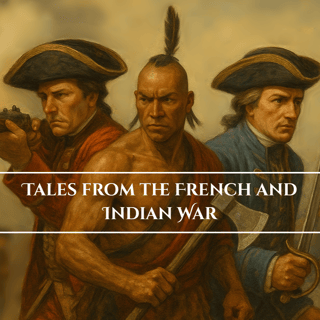
Speaker: If there ever were an individual who could best personify the French and Indian of the French and Indian War, it would have been Charles Michel de Langlade. Born in 1729 to a French-Canadian fur trader father and an Ottawa mother at Michele Mackinac, Langlade grew up with a foot firmly in both worlds.
Speaker: After surviving his childhood war experience as part of his uncle's war party, Langlade quickly grew in influence among the surrounding natives, particularly in his mother's Ottawa tribe, as well as the related Ojibwe.
Speaker: Charles Michel followed in his father's footsteps as a fur trader, setting up a post in what is now Green Bay in 1745, when he was only years old. Formed by his childhood in the frontier, interacting with various native tribes as well as French authorities, he quickly learned wilderness survival and travel, bush fighting, negotiation, and multiple Indian languages.
Speaker: In 1750, he became a cadet in the colonial marines, providing him professional training and discipline. Charles Michel's first true military exploit came in 1752, when French and British tensions were rising quickly, casting their rivalries long shadow over the Ohio country and the Great Lakes region he called home.
Speaker: The thriving Indian village at Picklelany, situated not far from Detroit, was quickly becoming a thorn in the side of the French. Pierre-Joseph Celleron, commandant of the fort, chafed at his inability to rid himself of the English traders established there, protected by firmly pro-British Chief Mameschia.
Speaker: But Celleron estimated he'd need nearly 2,000 men to storm the town, which he was unlikely to get from the colonial government any time soon.
Speaker: Then came along 23-year-old Langlad, with about 300 natives of the Three Fires Confederacy, offering to take care of the Pico-Wilani problem once and for all. They attacked the village when most of the men were away hunting, and many others were outside the town tending to the crops.
Speaker: Prisoners were taken to be later exchanged for the English traders lodged inside the small fort within the town. These men were then captured or killed, save for a couple who managed to escape and report the affair.
Speaker: Piccolani was not merely a chance for Langlade to prove his worth and win honor for France and French-allied Indians. The English traders threatened his own business interests too. Their removal helped his career in more ways than one.
Speaker: In 1755, Langlade reached the rank of Ensign. He was present at Fort Duquesne for the Battle of the Monongahela, and his presence was likely crucial to uphold Franco-Indian cooperation. While Jean-Daniel Dumas rallied the French after Beaujeu's untimely death,
Speaker: Langlade would have rallied and redirected the natives to execute flanking maneuvers against the neatly organized British. These maneuvers, including seizing the high ground and using skirmish tactics that the Indians had perfected, turned the affair from a battle into a slaughter.
Speaker: Later that year, he functioned as a scout for Fort Duquesne, and eventually he made his way to Fort Carrion, along with 90 or so Ojibwe and Ottawa warriors. It was there in the cold January of 1757 that Langlade faced off against the famous Robert Rogers and his Rangers, in what became known as the Battle on Snowshoes.
Speaker: After Rogers attacked a group of provision slaves in the dead of winter, Langlade set off in hot pursuit, successfully ambushing the rangers in a ravine. The young woodsman from New Hampshire would likely have died if many of the French soldiers' muskets did not misfire because of the cold and wet conditions.
Speaker: The two sides skirmished until nightfall when the rangers withdrew.
Speaker: 1757 turned out to be a packed year for the young Langlade, fighting again alongside his uncle Nisawaket, this time in upstate New York. In July, he participated in and helped orchestrate the bloody ambush at the Battle of Sabbath Day Point on Lake George.
Speaker: He committed to lying in ambush even when some warriors began to leave while he was awaiting an incoming British reconnaissance in force. On the 23rd, his patience and predator's instincts were rewarded, taking the enemy completely by surprise.
Speaker: And at the loss of only one man from his 300 or so, the French and Indian ambushers took over 100 prisoners and killed around 150 New Jersey provincials. Langlade participated in further action in the Lake George Front that year, including the infamous Battle of Fort William Henry.
Speaker: From all this experience in La Petite Guerre, otherwise known as bush fighting, irregular warfare, or hit-and-run tactics. He mastered wilderness warfare in the 18th century.
Speaker: He would prove his worth again, not that it needed proving to anyone at this point, in the 1759 Quebec campaign against General Wolfe's forces. On July 26, not long before the Battle of Bopour, Langlade, along with several hundred Indians, ambushed a detachment of British soldiers scouting the river and looking for a suitable ford.
Speaker: The results could have been even more devastating for the British if Langlade had not been hampered by a rigid chain of command system, depriving him of decision-making authority and a lack of reinforcements as well.
Speaker: Eventually, the French and Indian War came to an end, and Langlade returned to his home in the Great Lakes and resumed trading. He would eventually take up the Tomahawk and Musket again during the American War of Independence, this time fighting for the British, his old nemesis.
Speaker: He helped defend Montreal in 1776 and served under General Burgoyne in 1777. After the war, he served in the British Indian Department and lived with his family and other settlers that he had led there in Green Bay, leading him to be called later on the Father of Wisconsin and have a county named after him there.
Speaker: He passed away in 1800 at 72 years old. Charles Michel de Langlade was known to have boasted that he had participated 100
Speaker: We may not be able to know the exact total, but what we do know was that this man was one of the most fearsome and tenacious fighters in all of the 1700s. All who met him could not help but respect him as a result of his 30 years of experience fighting in some of the most difficult conditions imaginable.
Speaker: Governor Duquesne said of Langlade that he was acknowledged here to be very brave, to have much influence on the minds of the Indians, and to be very zealous when ordered to do anything. A comrade of his stated that he never saw so perfectly cool and fearless a man on the field of battle.
Speaker: Charles Michel de Langlade, military officer, Indian chief, fur trader, warrior, a man who seamlessly walked between two worlds, A man whose leadership and martial prowess shaped the French and Indian War from its beginning to its end.
Speaker: A man worthy to be remembered.