Transcript
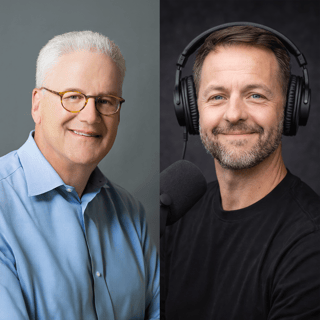
Speaker: Michael, professor, or should I say fellow? Yes, sure. Author, Michael Schrag. I appreciate you joining me here today. Would you mind telling me a little bit about yourself?
Speaker: Well, first and foremost, thank you for inviting me. I think the most important thing for listeners to know or understand about me is that I've had an affiliation with MIT for a couple of decades. and the research that I do used to focus on you know the nature of innovation and how do people create more valuable innovation. And it sort of flipped thanks to generative AI and other forms of AI from from how do people create better, more valuable innovation than how do how does innovation create more valuable people.
Speaker: I'm very interested in the notion of the cultivation creation of human capital in an era where our devices are becoming smarter than we are.
Speaker: And if you were to look at my background, my serious background is computer science and economics, which became more like behavioral economics. If you were to look at that background and and the work that I'm doing, i'm I've really become very interested in the shift from KPIs, measurement, key performance indicators, to KPIs. What happens when our performance metrics become smart, when they can learn and learn to learn?
Speaker: um I was inspired by Karpathy's tweet, X, on Vibe Coding. And because I'm very interested in insights, and if you'll forgive an acronymic pun, actionable insights, I transposed, transformed, transmuted his Vibe Coding ethos into Vibe Analytics.
Speaker: How do we work with messy data, even noisy data, to extract meaningful and measurable signal from that? And one of the techniques that I use, and this sort of reflects my mens et manus, mind and hands, MIT sensibility, is everybody knows what a hackathon is.
Speaker: I've done very, very well, ah you know with no modesty at all, you know in the spirit of good artists borrow, great artists steal, I've done very, very well taking the hackathon ethos and done a lift and shift, and now I run promptathons with my exec ed classes and my clients.
Speaker: So how do we get people to collaboratively engage with each other, to collaboratively engage with their LLMs and SLMs, to generate new kinds of insights, new kinds of artifacts. So those are really the three organizing and operating principles for my research.
Speaker: And the best thing about it is I'm genuinely interested in it. So happy to discuss, happy to share. I first became aware of you because of the innovator's hypothesis. By the way, forgive the interruption.
Speaker: excellent taste. You have excellent taste to pick up on that kind of thing. So I'm, I'm very grateful and it is ah it is, ah it a, a revelation as to your, your insight and, and your prescience.
Speaker: Thank you. I'm going to clip that and keep that around. I, I could use that. So i and actually I should say that that book is the original reason why you were on my list to reach out to.
Speaker: Then, you know, we go a few years past that and you wrote recommendation engines. Soon after that, we have the quickly increasing adoption of generative AI chatbots like ChatGPT and so on.
Speaker: And you, i think, you know, a couple of years have passed and you talked about now running promptathons and As you were speaking, what I was wondering a bit about is not so much how your thinking has changed from the innovators hypothesis as much as really the timeframe from recommendation engines forward, how has your thinking about recommendation engines, about generative ai changed much in the last five years? And then also, Michael, i'll I'll say this one thing I'm really curious about is you talking about innovation and executing upon ideas is something in my mind as well.
Speaker: My thinking has changed, evolved, but the fundamental things that I'm interested in, the fundamentals that matter most to me remain, i wouldn't say constant, but remain organizing principles.
Speaker: When you look at the innovator's hypothesis, What I was really intrigued by, and that goes back to the intro, you know which is the innovator's hypothesis began as you know how can people create you know more valuable innovations?
Speaker: But there's sort of a mandala virtuous cycle flywheel effect, which is how can people create more valuable innovations, and how do more valuable innovations create more valuable, how would innovation create more valuable people? And so I was very interested in that virtuous cycle.
Speaker: um Where did it come from? So I had done some work, and again, computer science, economics. I was very interested in rapid prototyping. And so I was struck by the notion of, you know,
Speaker: Pareto, not the Pareto optimum, but the Pareto principle. you know What's the 20% that gets you 80% of the way there? And that struck me as a fantastic framing for rapid prototyping.
Speaker: And unfortunately, or fortunately, I'm old enough that that rapid prototyping was one of the things that digital design, CAD, CAE, computer design, computer-aided engineering was colonizing colonizing legacy design folks. And so was thinking, hmm, we fundamentally changed the medium, the economics of the medium of design. So how will that change the economics of rapid prototyping?
Speaker: That, forgive me for talking more about myself, mapped back to my very first book, which was about collaboration. Collaboration as in Watson and Crick, Wozniak and Jobs, Wilbur and Orville Wright,
Speaker: What were the commonalities that made great collaborators effective collaborators? And the key insight was shared space. Watson and Crick didn't do the x-ray crystallography. They literally built metal models. Wilbur and Orville built prototypes in their in their bike shop.
Speaker: on on this. And Wozniak and Jobs say no more. They were the homebrew. They were the origins of homebrew computing. So what' what's the nature of the shared space? as As the properties of the shared space change, the quality of the collaboration changes. Now, what was freaking obvious to everybody?
Speaker: Shared spaces were becoming digital. The economics of digital thus transform the economics of collaboration. And if you change the economics of collaboration, you change the economics of innovation. But as they say in the old night TV ads that nobody sees anymore, but wait, there's more.
Speaker: Because the legacy model of innovation, and I'm just doubling down on the innovation issue here, the legacy model of innovation was what? R&D, research and development.
Speaker: But if you've got digital networks at scale, you've changed your innovation economics from R&D, research and development, to ENS.
Speaker: experiment and scale. You can do something that works with 50 or 60 people. And because you have a network, you can scale it up to 1,000 or 10,000 people.
Speaker: Whoops, it's not working. You accordion it back down to 1,000. And this is the kind of iterative innovation we saw in the early Yahoo, Google, et cetera. We've transformed the economics of experimentation and innovation. And that changes everything.
Speaker: But it also transforms how people as human beings collaborate. The tools, the technologies, the capabilities, the shared spaces that people use to innovate.
Speaker: And just to give the, not just the illusion, but the substance of concept. continuity here. You talk about the innovator's hypothesis, and we talk about my 5x5x teams, where small teams are trying to design experiments that can lead to testable hypotheses for innovation.
Speaker: What do you think a prompt-a-thon is? We have small teams of people. Instead of having individuals prompt, you have people with different perspectives and sensibilities and different, yes, C-word, contexts collaborating.
Speaker: And the outputs of and the outcomes they generate by collaborating around a use case in competition with others in the class or in the company or in a larger scale prompt-a-thon, it's fascinating.
Speaker: It's fascinating. So if you think about it, this whole notion of how does technology transform collaboration and how does collaboration transform technology, that's kind of the the flywheel mandala virtuous cycle network effects thing that has been the, the narrative spine, the research spine for a gosh, you know, almost three decades now.
Speaker: Michael, what do you think of the,
Speaker: implied philosophy, I guess the implied objectives from many business leaders that, that employees tend to feel that
Speaker: you know, you, Michael, if you're my employee, you're going to use AI to individually do so much more and that, you know, collaboration or humans, I, as a business leader, don't tend to value those nearly as much. Then I think you're not a good manager or a good business leader because the essence of these things is how do we create, how do we get,
Speaker: What do we do with undervalued assets? My view is, and I mean this sincerely, I have colleagues doing research on this. you know Anybody listening to this should absolutely be checking out MIT's research and my old boss, Eric Brynjolfsson's research at Stanford. It's that AI is not just about automation.
Speaker: It's just not about replacing human beings. It's about augmentation. It's about being a force multiplier. One of the most important things I've learned, and you know this is, I would say, a longer conversation, but that's what we're having, a longer conversation.
Speaker: Remember, I'm talking about human capital. I have spent time with people, and I'm sorry if this offends some of the pro-peace people here, but I've done work with SOCOM.
Speaker: ah and And the Navy SEALs. And there's the classic Navy SEAL line is that you don't rise to the challenge. You sink to the level of your training.
Speaker: Guess what? That is just as true for large language models as it is for human beings. How do we want to train these models? Do we want to train models just to replace people, to observe a pattern and then say, ah here's the most efficient way to replicate that pattern in a network, or in the spirit of understanding that outcomes are different than outputs, how can we radically up uplift the the quality of the outcomes in this regard?
Speaker: How can I, as a large language model, be a better collaborator with not just a human, but with a team of humans? You know, don't get me wrong.
Speaker: Of course, there are going to be tasks that are going to be automated. i I do not like filling out my own expenses. I would like to have agents do my expenses for me. I would like to have agents in my calendar notifying me as to obligations and learning, you know, when I need a 15-minute warning versus 24-hour warning on this. But I think leaders, your word, are are completely missing the plot.
Speaker: Even if they're an AI-first organization, if they say, how do I minimize my reliance on talented people and double down on ever better large language models?
Speaker: I think that is a mistake. I think that's a teleological, ontological, and epistemic mistake. on on this. And by the way, that's one of the biggest debates that are that are going on. But I will say this, I have run over 200 promptathons all over the freaking world.
Speaker: I have never, ever, no exception, never run across a time promptathon where human beings working together and with their LLMs didn't come up with something that went well beyond, how do we do a better job of automating this?
Speaker: How do we do this more efficiently? Efficiency doesn't have to be the enemy of effectiveness. And effectiveness doesn't have to be the enemy enemy of efficiency. but But boy, we need to have a, pun intended, more intelligent conversation about those trade-offs. My research emphasizes how do we better understand those trade-offs.
Speaker: So Michael, a former colleague of mine, Elliott Frick, he is the first person that i recall making this argument, though it's not unique. He has said that you can go as far back as you want. You can go as far back as the invention of the mechanical clock, but perhaps more obviously you can start with scientific management and say that We have for at least a hundred years, if not, you know, maybe since industrial industrialization or something like that, we have optimized business typically for efficiency and often actually given up on genuine or perhaps new value creation, the unique value creation that can come about from
Speaker: Watson and Crick having a conversation and one of them saying, I never thought about it in the way that you just described. Absolutely. So...
Speaker: As you're talking, I'm also thinking that whether it's in management schools, whether it's general business philosophy, capitalism, wherever you want to pin it, that I think there are a lot of people who are just so in the the mental mode that they they have this the paradigm in which they see AI in purely in replacing humans rather than, as you said, at using it as a force multiplier.
Speaker: With all due respect to to your your colleague, Mr. Frick, on one level, I don't really disagree. But on the other level, i must say that even though I'm intimately familiar with Taylorism and optimization, cetera, I must quote another well-known economist in that regard, ah Joseph Schumpeter, who talked about creative destruction.
Speaker: And we're We're living through creative destruction in the form of ai attention is all you need, in under you know a decade that a published academic paper has transformed industries, every all industries everywhere in that regard.
Speaker: So we we saw that with the internet as well. So I i still remain a big fan of of creative destruction in in in that regard.
Speaker: What you are saying, and I'm, forgive me, I'm taking and repurposing and repackaging what you're saying is, what you are saying is that the economics, the trade-offs we must consider now between should we optimize or should we create new value creation, what is oftentimes called in in algorithmic terms, the explore versus exploit,
Speaker: ah trade-off. I think that's becoming more important. Sure. Some organizations, and this is why the future is always so interesting. Are we going to get a greater ROO, return on optimization, or from ROCD, return on creative destruction?
Speaker: I don't know. I don't know. All I know is When I see what venture capital groups are funding, when I see what my students and colleagues are doing at MIT alone, and when I see what legacy organizations are doing well or where they can't keep up, I think, wow, I think we're going to be seeing a lot of success.
Speaker: For all of the efforts to optimize and lop off heads, I think we're going to be seeing a lot of new value creation. Now, will the human capital intensity of that new value creation um be as large 2035 as was in 2025? don't know.
Speaker: as it was in twenty twenty five i don't know I am not Warren Buffett. i i I don't put my money where my mouth is ah in in that regard.
Speaker: But when I look at at the kind of creativity going on, when I look at the kind of opportunities going on, i am going to err on the side of being more optimistic.
Speaker: That said, you know i you know i have no idea what kind of social or cultural upheavals may occur to undermine these sorts of things. As much as I like...
Speaker: people who I know in China, and I've been to China many, many, many times, I do not think I would like to live under a Chinese regime of AI and Alibaba, et cetera, as I would in the West.
Speaker: So I think there are going to be all kinds of socioeconomic and political economic rivalries played through the medium and mechanism of AI capabilities.
Speaker: Something you said earlier, forget exactly what it was, reminded me of this. And then it just came back up, at least for me, as you were talking. And a number of people have said it from Emerson to, you know, Eastern Asian philosophers to the Bible, their statements like where there's no vision, the people perish and at least as I understand it, that yeah we could interpret that purely as a matter or through the lens of leadership.
Speaker: That if you're a leader, you know you're not doing everything as much as you are hopefully helping people see that there is a better place over there and let's all get together and let's go there.
Speaker: And i I don't want to create too strict of a comparison here, but for lack of a better term for it at the moment, I feel like when someone is just looking at artificial intelligence as, this is simplistic, of course, but if they're just looking at it as, well, we made a a million dollars, a hundred million dollars, whatever it is in our business last year,
Speaker: how can i spend less next year, you know hire less people and use more artificial intelligence if it's purely that? It feels zero sum or similar. I'm lacking for a better term. That's exactly the right way of putting it.
Speaker: that's exactly And I have companies that say, Michael, what we want is to have the same amount of growth with 15% fewer people.
Speaker: That's their vision. You know, good luck attracting talented. But, you know, that that's... So I want to be careful here because do I consider that inherently unethical?
Speaker: No. Do I consider that inherently efficient? No. Because I think I want... i want I would advise an organization, and I can say this with credibility because I do advise organizations, you have a capability here. We barely understand the parameters, pun intended, and power and potential of this capability.
Speaker: you know I wrote a book. you you ah All the books we talked about, you we didn't mention this one. Who do you want your customers to be become? That's directly on point with the you know what is the vision of of this. You have to give people a vision. Who do we want our customers to become? Who do we want our best customers to become? How do we define best customer? Is it purely the money or something else? Who do we want our most typical customers to become? okay My argument is is a very simple one. Geez, shouldn't we be thinking about the impact of ai on our most profitable customers and customer lifetime value before we stop lo start lopping the heads off of employees? you know i'm I'm sorry. That's not a profound or insulting question. there's you know what are the three costs? There's sunk cost, technical debt, there's you know cost benefit, and there's opportunity cost. Oh my god, we're screwing ourselves on opportunity cost and cost benefit if we don't ask, gee, should should AI only be used for internal efficiencies versus external value creation?
Speaker: I'm sorry, how dumb is that? That's basically like saying, The food I'm going to eat, so long as it gives me nutrition, i don't give a flying F how it tastes.
Speaker: Conversely, we don't want people to say, all I care about is how the food tastes. Screw nutrition. Screw health issues.
Speaker: yeah I'm sorry to double down on the economics background that I have. What are the tradeoffs? What are the tradeoffs? Leaders can, and I've had good interactions with people we both know. I'm not going to disclose their names, but they're you know they're on the Forbes billionaire list.
Speaker: They don't have any trouble at all. articulating why they make the trade-offs they do or did. We may disagree with them, but nobody's going to say, you know, dad that makes no sense. There's no logic today. You justify that. and Oh, trust me. They can they can give you the answers. They can give you their underlying thought.
Speaker: They are different kinds of critical thinkers in in that regard. And that, to me, is one of the great undervalued aspects of AI, because AI becomes a vehicle, a mechanism, a tool, a mirror for revisiting and enhancing what critical thinking can and should mean.
Speaker: Not just critical thinking for the LLM or the SLM or the ensembled MOE, you know, mixture of experts, but for the human beings themselves.
Speaker: I'm a big fan of critical thinking. As am I, though. I fail often at it. You know, the the late Daniel Kahneman wrote a couple of books on that very issue, and and it wasn't targeted to you or people like you. It was targeted to all of us.
Speaker: When you mentioned, you know, some of these, these critical thinkers, you know, these billionaires was one word that you used. You reminded me of one way that I, a mental, an image that I have in my head often of not just you know, how we might use artificial intelligence, but also innovation. And i mean, heck, you could think about it in terms of your own physical fitness that imagine that Michael, you and I are out a hundred yards out from the beach in the ocean and we're both sitting on our surfboards and we're waiting for the next wave to come.
Speaker: And When I think that I'm seeing the right wave, in order to catch that wave, I have to start paddling.
Speaker: And the the the parallel here, the the metaphor is probably fairly clear. Paddling is like beginning to work, you know preparing yourself for the next wave, you know whether it's it's blockchain or whatever it is. But and but Not only if I catch the wave, do I have to hit the right wave and and all of that, yeah but it's so much more exciting if I'm on the front end of the wave than if I let the wave just, i i you know I rise and then I fall and the wave just keeps traveling toward the bridge. It's more exciting and I'm going somewhere.
Speaker: But- to for For anyone that has not surfed before, the one interesting thing about catching a wave is that it's so much easier for something that's small to be pushed along by the wave than something that's big.
Speaker: And so we could make parallels to startups or whatever else. But with this visual, one thing that I think about is that there are so few surfers or organizations in this case, that will be on the front side of the wave moving forward, and they're going to be passing everybody.
Speaker: And there's so many organizations that maybe even slip further and further from the shore. Because as that wave crests underneath them, they actually slide down the hill away from their destination.
Speaker: And as you're talking, ah this image comes to mind because yes, of course we have to start paddling and working, but also I think that there's an opportunity for, if you're one of those really critical thinkers, if you can talk about trade-offs and so on, that there's an opportunity to differentiate yourself from 99% of the rest of the individuals or perhaps organizations.
Speaker: Absolutely. So i'm I'm fascinated by the metaphor. i'm fascinated by the analogy. And in the spirit of full disclosure, i don't surf. I have surfed. But, you know, one of my strengths and weaknesses is that, and this is going, the good news is that it's going to reinforce the critical thinking point.
Speaker: One of my strengths and and and weaknesses is that i'm i I pay a lot of attention to what people don't say. And here you are, you're giving this surfing metaphor.
Speaker: But the reality is, because I have friends who surf and I have surfed enough, that that the way you have to understand your body and balance and the waves, the experience, some of these things are internalized, muscle memory. Others of these things are perceptual, you know,
Speaker: You see their visual cues. What you assume away in your metaphor is is remarkable. And in in the spirit of critical thinking, i don't think we should do that. You know, I think that one of my my... You mentioned in your bio, you know, your superpower is curiosity. If there's a a superpower I possess, and that is...
Speaker: you know, a phrase I use with great reluctance. It's, I pay real close attention to the fundamentals. But what I pay even closer attention to are the economics of the fundamentals.
Speaker: And the reason why I'm so interested in technology is what what do all successful technologies have in common? No exception. all They change the the fundamental economics of a business, of an industry, of a market.
Speaker: i'm ah I'm a Hyde Parker, University of Chicago kind of guy. may be at MIT, but I'm a University of Chicago kind of economist. Ronald Coe's theory of the firm, ah coordination costs, transaction costs,
Speaker: The internet transformed the economics of the firm, of transaction costs, of coordination costs. The AI transforms the cost, not of compute, per se, although that the hyperscaler centers certainly transformed the cost of compute, but the cost of inference.
Speaker: of this So the the the fund the economics of the fundamental units of analysis have have completely changed. And that leads to all kinds of recombinatorial opportunities for for innovation and new value creation. So my quasi tongue-in-cheek response what does it mean to surf before the water freezes?
Speaker: OK, what does it mean to surf when the water, when it's hot, when it's it's even steamier? What's the difference? And I don't know the answer. I saw the HBO thing on the 100 foot wave. But, you know, in different kinds of altitudes, when you're when you're competing versus by yourself. I mean, just the notion of what it would mean to surf when you've got five or six other people sharing the wave and the wrong, you know Those are not subtle distinctions. Why am I saying this? Because when I look at what you're asking, when I look at the examples that you're offering, it reminds me not not to say yes, but it reminds me to say yes, and that's why we need to pay more attention to the fundamentals. Do we really understand? do you...
Speaker: Do you understand? so there's a famous line. My dad loved this line. You know the the best way to learn a subject is to teach it. OK, one of the greatest things about being at MIT, and this is said with no modesty at all, is that virtually all of my students are smarter than I am.
Speaker: Okay. You know, they, they, they spend more time. They were doing vibe coding before me. They're, they're, they're doing many, I learn a lot from my students and most faculty will tell you that, that they, they learn tons from, from their students in this regard. The issue that I would raise with, you know, you surf,
Speaker: What did you learn when you taught somebody how to surf? What did you learn when you taught a teenager or a child versus a peer or a cohort? My bet is the challenge of articulating it, the challenge of demonstrating it, the challenge of doing it on the beach versus out there before the tiny wave.
Speaker: I bet you learned a lot in this regard. And I think we're in that kind of phase where, yes, I'll say it, a certain amount of epistemic humility is necessary.
Speaker: Right. on this because, my gosh, I really do believe that these models are going to become smarter than we are. And I'm not embarrassed to tell you that that one of the advantages that people like me at MIT have is we're used to people being smarter than we are. So I think most people are used to you know having people as smart or slightly smarter or not as smart as I'm in the room.
Speaker: Well, now, you know, it's like the Einsteins and Enrico Fermis and the Watson and Cricks and the Elon Musks are all going to, and the Jeff Bezos, is they're going to be in the room with you on this.
Speaker: And how do you, and i'm picking this phrase deliberately, how do you still contribute meaningful value when you're not the smartest creature in the room?
Speaker: Wow, what an interesting challenge that is. you get advice from your recommender system. How do I become more valuable in this meeting, in this room?
Speaker: I think we're going to be using these technologies to get advice and recommendations on how to get better and how to get better at being better.
Speaker: And just to torment you for 90 more seconds, I'm old enough. i Some of my best friends, then best friends, put together the MIT Sports Analytics Conference. It began in a classroom at Sloan. It took over the Heinz Center in Boston.
Speaker: And what what it's about, how performance analytics, sports analytics transformed baseball, football, soccer, cricket.
Speaker: Because world-class athletes, world-class coaches, world-class teams want to get better, want to get better at getting better, and they want to win.
Speaker: And they're looking for an edge. And I think the real challenge to people is, you know, do you want to use these technologies to become more mindful and motivated? Or do you want to use these technologies to become more mindless and have have your agent do that?
Speaker: I am, I'll tell you right now, tell everybody listening to this, I am prepared to be mindless when it comes to my expenses, so long as I get reimbursed. I am not prepared to be mindful, mindless when it comes to what is the future of intelligent KPIs, KPIs, because I think I can bring unique value and perspective in that.
Speaker: Yeah. think there is a map and territory challenge anytime. Perfectly put. Yes. And you mentioned, I think it was Schumpeter earlier and the Schumpeter would not have come to mind for me though. Fortunately, i am familiar with his work. What,
Speaker: you know, who I tend to think of, I guess, when I think of change and it, you know, big, you know, real trans, transformational change is, I think it was, was it Socrates that said that there is no change?
Speaker: No, that was Heraclitus who put his, you know, there's the the only constant is change and the other that that where there's no there's there's no change. You know, that's one that we're back to the Socratic and the pre-Socratic Greeks. By the way, I wrote a piece which I encourage people to read that won an award with my colleague, David Chiron in the Sloan Management Review called Philosophy Eats Yeah.
Speaker: OK? And why did we write this piece? Because you remember, of course, the Marc Andreessen Wall Street Journal piece over a decade ago, software is eating the world.
Speaker: And Jensen Wang, speaking of but speaking of billionaires, Jensen Wang says, well, if software is eating the world, ai is eating software. And so the logical question to ask is, well, if software is eating the world and ai is eating software, what's eating AI?
Speaker: Philosophy. Why? Because your models need to be trained to what telos, purpose, with what categories, ontology, with what knowledge, epistemology. so So philosophy becomes more important. So your model your, forgive me struggle to remember which Greek said what, the fact is in the future, in not in the future, in the immediate upcoming things that we do, philosophy is going to matter more. And just to give the illusion of of of of ah consistency here, what better ideological framework for examining trade-offs
Speaker: than philosophy, different forms of philosophy. And you know natural philosophy is what science became, political philosophy, economics. you know We're going to have to think harder about thinking.
Speaker: Metacognition matters more in this environment. And and to give to go right back to the beginning, that's what that's the innovator's hypothesis.
Speaker: in that regard. More rigorous thinking about the hypotheses we need to test. We need to frame and we need to test. Where's the value? Who gets the value? These are the the questions and challenges that haunt me.
Speaker: I won't say they torment me, but but they do keep me up at night. And it sounds like you get a lot of exposure to this, or you get experience with this, but the, I am so curious about what the next generation to put it very simply, but you know, subsequent generations, birth years, whatever. I'm so curious about how.
Speaker: being a 10 year old or being born this year and experiencing growing up and going through college and whatever with these tools how that will train you you know that will change your mental models because trying to predict that future it's it it's like a black swan sort of thing like It is a black swan, with apologies to Nassim Taleb. It is a black swan.
Speaker: Of course, the one thing I need to ah alert you to is, um you know, I was actually at an event with Nassim, who I know, and it was the it was before Anti-Fragile. It was the black swan.
Speaker: And then I went to Brazil to give a talk, and Brazil is filled with black swans, so it doesn't go over there. there um I could not agree with you more, but, you know, I'm not going to make any presumptions or assumptions about your age, but I know that it's, I am scared.
Speaker: and You know, I talk about tormented and I am scared when I take the subway in New York and or in London, or in Seoul, or the BART in San Francisco, and everybody is looking at their freaking phone.
Speaker: i mean, we are all cyborgs now. I mean, i see people burst into tears or scream if their phones aren't working or if they don't have access to something. So I don't know what it would be like I mean, so here are 10-year-old, 12, they grow up with phones. I see children in the crib, in the parabulator. They're not looking outside. They're not talking to mom or dad. They're looking at a screen on on this. So I'm sorry to sound judgmental, but I have no idea. i will say this, you know,
Speaker: Everybody at MIT is kind of scared because because the notion of legacy classrooms, I mean, it the good the good news about MIT, I mentioned our motto earlier. It's not the Harvard Veritas truth, whatever the F that is if if if you're at Harvard.
Speaker: It's mens et manus. It's mind in hands. MIT, you build things. You build things. There's a body experience in there, so not just the mind. And so i i think that's one of the things that that's going to differentiate education and training and apprenticeship, that it's going to be a different kind of experience. So it's not just going to be reading a book or writing or playing with the screen. It's going to go beyond that.
Speaker: but it But I completely agree with you. I think it's too soon to say. But I have, I honestly have no, I have, you know, nieces and nephews in college now. I have no idea what I would say to a freshman in high school about what they should be studying in in college. I will say this, though.
Speaker: I will say this. I would say, Take critical thinking, take metacognition seriously. Ask yourself, what is the future of thinking about thinking?
Speaker: And start getting there. You know, 500 years ago, you had to take a ship to go to someplace. You would write letters. and so Now people are furious if there is an instant communication.
Speaker: Oh, I do have one other constructive suggestion. If we're that 15-year-old. Read science fiction. Read science fiction. get Push the envelope of of what creativity and how other people imagine different worlds and different circumstances need. But yeah, I have no idea.
Speaker: i see people so dependent on their phones that I try to be less dependent. I react against it. When we talk about change, you know, the i think it really,
Speaker: I believe that on average, we are so much more sensitive to potential downsides nowadays. You know, everything you hear on the news, right? Is if it bleeds, it leads sort of stuff. And the things that get you clicking the headlines, whatever are 99% negative.
Speaker: And. percent negative and Whether that is a driver of this particular issue or it's just in the same, you know, swimming pool here.
Speaker: i think that it's so easy to, for someone to jump from, i have a concern or I'm confused. to this must be bad.
Speaker: And I don't think that you are saying that, but I do think that it's super easy for us to just relax a little bit too much, even if you are a generally critical thinker and to to stop thinking and to say, oh, well, something hit something from when I was a child has been lost, which means that That's the end of the story here. there's no There's no creative destruction going on. There's no creative. It's just destruction.
Speaker: I think, you know, kudos to you for referencing Schumpeter in that context as well. Creative destruction, of course, is an oxymoron. It's explicitly designed rhetorically as an oxymoron. And we're back to the trade-offs here.
Speaker: You know, how much of that destruction is creative versus how much of that destruction is just nihilism and destruction, and how much of that creative is creative, and how much of that creative is disruptive in a clickbait, self-indulgent sort of way.
Speaker: What I am more confident in than less confident in that It's like when paper replaced stone. I think that in digital, you know, supplanted paper, I think that the affordances, the degrees of freedom, i pick the word freedom deliberately, ah that these technologies enable, in they invite empowerment.
Speaker: They invite enablement. But just because you're invited doesn't mean you're going to accept the invitation. And even if you accept the invitation, that doesn't necessarily mean you're going to be a good guest or that you've arrived at a good time for this. So they're there's still chance. There's still risk. There's still uncertainty as a threat, not uncertainty as a resource of opportunity.
Speaker: But the privilege that I have is that I get to work with people who really are technically proficient and really do want to create value. And when I say create value, not just become a B as in billionaire, but but Elevate standards of living, improve critical thinking, process expenses better, enable learning, enable these kinds of virtual exchanges.
Speaker: So i i am i i am i have the advantage of a certain kind of professional sample bias. So um I enjoy it, and i I think I have the good sense not to take it for granted.
Speaker: Glad to hear that. Michael, if you could pick a group and tomorrow morning they wake up and they believe something different, something that actually changes their behavior such that they do work differently. They treat their fellow humans differently. They, if they're politicians, they legislate differently.
Speaker: Is there a group that you could name and is there a belief that you would just snap your fingers and have them hold such that the world that they contribute to becomes different?
Speaker: Yeah, I want to be careful on this. I am not in any way, shape, or form utopian. I do mistrust central planners. I do mistrust centralization for centralization, centralization particularly for the sake of efficiency. i like a healthy tension between top-down and bottom-up.
Speaker: But this is you know, so...
Speaker: We talk about who do you want your customers to become. I'll tell ah tell a quick story in this regard. My wife is the CEO of ah of a marketing services firm, advertising agency.
Speaker: Love her you know, i I question her taste in men at some time, but, you know, she's very capable. and And she liked the who do you want your customers to become. And she was talking with the CMO of a company we all know, and but I will not name for obvious reasons. I'm married and I would like to stay stay married on this ride. And so, you know, she actually asked the CMO, who do you want your customers to become?
Speaker: And with barely a beat, the CMO said, we want our customers to become people who buy more of our stuff. Okay. And talk about path of least resistance.
Speaker: My view is that that the fundamental change is I would like to see more people, more mechanisms, more of an ethos and sensibility that when we engage with people, we are trying to address the best in those people.
Speaker: You know, not just appeal to their fears, but but to ah appeal to their better nature and, yes, their better selves. We see this with LLMs. Sometimes it's called sycophancy, but LLMs can be trained to improve critical thinking.
Speaker: My larger point is I want innovation that has a thumb on the scale towards appealing. The default choice architecture, the default is let's first appeal to people's better selves. Now, we can debate about what a better self is, more compassion, kinder, more thoughtful, more considerate. i'm a you know I'm a first, the the the command in medicine is not do whatever you can do to save the life of the patient. It's first do no harm, okay? I want to balance a trade-off between first do no harm and give this person's best self
Speaker: a chance to show up, a real opportunity to show up. That's the fundamental ethos, sensibility, I want to change. and and And as we're coming to a conclusion here, this is the difference between affect and effect.
Speaker: I am so not worried about AI becoming more effective. I am so not worried about AI becoming more cost effective. I am worried about are we going to get the value of affect, how people feel when they engage with these technologies and with each other.
Speaker: I want more cost affective ai not just more cost effective AI. I really like a lot of what you said there. And I agree with you about a lot of this. There's, there are many things that we can talk about with leadership, culture, you know, consciousness, you know, the experience that we have, the lens that we look at the world through, but,
Speaker: Having mentioned coming around to the conclusion, I know that we have schedules, so we'll leave people, I hope, wanting more. I'm certainly wanting more. So, Michael, you mentioned at least one article, if not more, that you've written. We've talked about books.
Speaker: Is there somewhere that I should go to follow you or learn more after this? I appreciate the the the question. I have chosen, in no small part,
Speaker: ah because of what i told you, what I observe on subways all over the world, I really do not want to have a social media presence. I make certain notifications. I comment on my friends and colleagues stuff.
Speaker: But, um you know, i I would not mind at all if people were to go on Google or use an LLM and and and take a portion. I mean, i would i would love if a certain portion of the listeners here would take a slice of the transcript and drop it into an LLM and say, this guy talks about critical thinking.
Speaker: what's missing in the critical thinking here? Or here's an article that they've done or a talk that they've given. you know What is most relevant to me and what I'm trying to accomplish? What I'm looking for, I'm looking for, i believe that the work that I'm doing is relevant and yes, has value.
Speaker: And i would love for people to have the opportunity to choose for themselves on how they engage with it. And that's one of the reasons why I'm so grateful for this opportunity, because you've given me the opportunity to engage with you in what I hope will be an effective and affective way. Well, I appreciate your kind words. And once again, Michael, I appreciate you being here. Thank you for joining me today.
Speaker: Thank you. This was terrific. Much enjoyed.