Transcript
Speaker: Welcome to Scaling with Purpose, the show where we explore what it takes to build companies that aim for commercial success and meaningful impact.
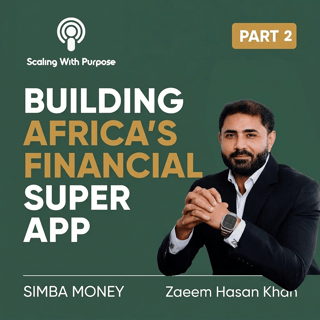
Speaker: I'm joined today by Zaeem Hassan Khan, founder and CEO of Simba Money. A FinTech based in Dar Es Salaam, building financial access for Tanzanians and across Africa.
Speaker: Zain, it's great to have you here. Welcome. Thank you so much for the opportunity, Mohamed. Thank you so much. ah Before we go into the story of Simba Money, I wanted to ask you something I ask every founder we have here in the podcast.
Speaker: What is the single most important lesson your journey has taught you? okay so I think you know to sum up my entire journey journey I think you know I've been part of board meetings strategic meetings where I have taken or we have taken billions dollars worth of this decisions right like we need to do this we need to do that this is how we're going change but the most difficult part is the process to implement right So that's the biggest lesson that taking decision in a closed room right with some numbers on a spreadsheet is very easy, but to implement it right is the most difficult part. And that separates, I think, from ah from
Speaker: an audience of generic founders to successful founders. right And that's the lesson to my fellow founders that you need to actually understand the methodology to implement the decision that you have taken in the boardroom itself.
Speaker: Yeah, interesting. So this brings some contrast in what is being discussed in two boardrooms, but inside the walls of a boardroom, and the real execution of things. Because it all everything looks really nice on paper until you are faced with the reality of of the practical side of doing things.
Speaker: Exactly. Beautiful insight. It also maybe sheds a light on on how certain people have a big mouth ah in inside the boardroom and they cannot execute and and other people are maybe sometimes a little bit more shy in the boardroom, but they execute really well, right?
Speaker: For sure. I'm going to give you an example. right you know So I think one of the biggest ah decision is around products, right like what to build and what to offer to the customer.
Speaker: they And boardrooms tend to focus on a concept called product centric. right you know if this is if this product is being worked uh is a successful product in south america market or it's a it's a it's a big success success in the european market or asian market it should work in africa all right theoretically Yeah. All right. So the theory is fine. The number looks good. All right. So this is a product centric approach. Right. So your all your decisions, all your ah spreadsheets, your data, everything revolves around the product itself.
Speaker: But what I have learned actually all alright is that if you really want to ease out ah alright the implementation process, all right you need to actually bring customer voice in the boardroom itself. right So which makes your discussions, your build, your deployment customer centric.
Speaker: right Because if your product is customer centric, You're going have a marketing activation process, market activation that is touching the decision making points of the customers.
Speaker: Your product becomes habit forming rather than just another product on the aisle itself. right yeah So I think one of the biggest things that the boardroom, the founders need to adapt is bring the customer into the boardroom.
Speaker: Interesting. Go beyond numbers, go beyond spreadsheets, go beyond some tools. right. Bring the customer to the boardroom.
Speaker: The customer automatically tells you what they're looking for. All right. And that's what all Africa that's what africa is all about. Yeah, interesting. And normally we move on and and go through your journey, but I'm really interested in how you look at this because ah you're saying bring the customer into the boardroom.
Speaker: ah Can you wrap that? How do you do that normally? Because for for some people, they would directly understand, okay, this is how to do it. But for other but people, it sounds very abstract, right? ah It sounds like something that is written in books or in poems that sounds very beautiful. But how to make it actionable for the listener?
Speaker: Perfect. So I think, you know, let me start from the theory side. All right. Because in the theories web we have read is that, you know, there's a go to market plan. All right. And you have your acquisition channels, you have your sales team. All right. And every product should has a go to market plan associated to it, you know, then the cost associated to it. But what I have learned and what I have actually modified is that I would like to actually create an umbrella called market activation plan. right
Speaker: That host number numerous sub go to market plans. right You understand what when what I mean is that when you bring the customer to the boardroom, you do a proper purpose personification of the customer. you do And personification can be done through demographics. right through urban and rural divisions. all right It can be done through ah gig economies, corporate customers or ah farmers to students. right And then you do a small C.U.G. Close user group. all right
Speaker: Founders, product strategists, they need to be with them. All right, guys, this is what we are doing. Like, you know, open your arms to actually accept feedback from day one. All right.
Speaker: Day one, from day one, the feedback loop needs to be perfected so that automatically, because you have the engine, you have the people, all to create super or state of the art products. All But if you have the feedback loop perfected, embedded within your engine capability, you don't need to think about what products to create.
Speaker: Your market, your customers will tell you which products to be created. What will happen? You achieve customer centricity. Your market spend decreases because absorption is high. All right. Because people will automatically latch on to it because they are craving for it. All right. And third is your overall all market activation strategy. The efficiency increases.
Speaker: right you can achieve wonders because i think every founder when they go and talk to investor the investors are talking about double digit growth double digit growth month on month and this is how you can do it right Yeah, very interesting. So actually you're saying instead of focusing on product features or other type of attributes of a product and spreadsheets and whatever, make the feedback loop part of your process from the beginning.
Speaker: So you should have a go-to-market strategy and part of the go-to-market strategy is the feedback loop strategy. And that should be one of the pillars of any go-to-market strategy ah you have.
Speaker: And I think that's a very valuable insight because a lot of go-to-market strategies are created in a waterfall method, ah thinking you create a go-to-market strategy and then you execute it Never change it.
Speaker: And along the way, everything you learn along the way, you don't use that learning to improve the go-to-market strategy or the execution of that. and And this is an interesting point. If you have a feedback loop into inside your go-to-market strategy, then actually you're saying that your go-to-market strategy should be agile.
Speaker: Yes. Should iterate... within the go-to-market strategy as part of the process and i i really like that insight very valuable thanks uh a lot for uh all right i think to just just to put the theory behind it all right because lots of our listeners are are freshly graduates or they're thinking about you know uh creating and uh a company and venturing into this entrepreneurship rather than doing fishnetting marketing like you know like make sure the product is displayed on all the social media your customer feedback gives you another arsenal called tactical marketing right you are because as i told you the market activation sits on top all right and then you have so sub go to market so then you can have go to market based out of personas for example
Speaker: Like what to showcase students, how to approach universities, for example. All right. How to engage gig economies, for example, how to engage e-commerce experts. All right. If your product is e-commerce. All right. So this tactical advantage, I think, is one of the key success arsenal for any founder. All right. Whether he is launching a product or he is in a mature product environment where he wants or he's looking for an extra growth now.
Speaker: Mm hmm. Yeah, I think that's ah very valuable because ah it's go-to-market strategies are not for people that first are penetrating a market for the first time only. it is also for entrepreneur entrepreneurs that already have a market, already have a market share, and they want to ah deepen their penetration of the market.
Speaker: So also in that case, you need a go-to-market strategy. Thanks for these insights. I think it's time to move to your journey because I'm really interested in knowing more about it.
Speaker: ah I have digged into your profile and I have seen that you have spent 18 plus years in regulated digital finance. So across Africa, you have worked at Credible, Telco DR, 021 and all these big ah companies before you have founded a Simba Money. So what I was super interested in is why did you make that step especially? And what makes Simba Money so special?
Speaker: Did you miss something into in in in the financial world that you wanted to add? or was it like a personal purpose i'm i'm really curious what is the change you wanted to bring in this market Thank you. So my journey with the digital financial services started from the teleco led fintech Strom that actually came in Africa 18 years ago. All right. So I was one of the the pioneers members, which where we launched a telco led prominent ah mobile financial service brand. And throughout my journey, I've seen the transformation of mobile financial service to digital financial service to do mobile first financial service. And now what we see is ah mobile first digital financial services. Right now, the banks and everyone are looking and trying to tap into this gold mine. all right Because it gives opportunity to not only increase local market shares, but also gives you an opportunity to go beyond the borders where you operate. All right, because now regulations are very healthy. Now they're very accommodative, you're going to see in Africa, lots of central banks have started to create sandbox solutions where FinTechs can come in experiment their product and XYZ. All right.
Speaker: Why i opted and the reason my passion towards Simba money because throughout my journey, I was actually managing singular vertical of this big umbrella called FinTech itself. right Like, for example, in Credible, I was managing the lending portfolio, right where we were launching various lending and saving products, all right where we were not dependent on the traditional credit bureau. all right we were actually We had different standards and attributes from a mobile user to give him and calculate a credit score for him so that we can offer him various lending products itself.
Speaker: All right. ah Telco DR was more of managing not only Africa, but the entire Asia market. All right. where Where we were, where I was spearheading digital transformation on cloud based, all right, on the telco side itself. All right.
Speaker: So I've been part of all these segments across my 18 years of life. All right. Simba money is my vision to unify everything.
Speaker: All right. to unify The unification of what the actual meaning of digital financial inclusion. All right. Like one app, one super app, one wallet that serves all the demographics, has all the products. All right. All right. And it's your.
Speaker: ultimate wallet to pay local if you're traveling you can take your wallet along with it you can you can buy stuff send money receive money so that's the vision of simba money itself yeah Interesting. Sounds challenging too.
Speaker: I mean, those are quite some aspects of fintech that you need to somehow yeah solve for the end user.
Speaker: um how How do you ah take that challenge on? I mean, what kind of team do you have? How how did you grow that team? I think challenge, yes, for sure. All right. But as I told you in this in the beginning, if you bring customer close to you, your customer will start giving you the feedback because don't forget Simba Money operates in Tanzania where you have the most mature telco led digital financial services. All right. You have giants like Yass, we have giants like M-Pesa, A-Tel Money. All right. We have more than averagely 30 million subscribers all right across uh the brand itself all right the challenge
Speaker: is basically to overcome any challenges that you know you go and talk to the customer because this is what that's why you're creating a company all right you go in you talk to them all right one of the biggest thing that we have achieved is our super app itself all right so i'll give you an example we invited uh people from aging from uh 18 going up to 60. all right so the whole ui ux design was actually was taken in in consideration that a digital heavy user can use it. right And also an elderly person can use the UI, UX itself. right
Speaker: ah So it's basically customer centric. Secondly, i would actually, if any founder who is actually planning to launch a fintech brand, it's always good to start engaging with the regulator early on.
Speaker: a right So rather than you know going in as a new company, all right you go in as a collaborator. right You go in, you know you say, this is my technology. this is how What are your deliverables? all right Because central banks, regulators, they have their own agendas. They have their regulatory objectives that need to be achieved.
Speaker: And you need to be an enabler for them. right For example, the digital financial inclusion was one of the biggest terminology right for the last 15 years. Now it has been divided divided into subcategories. There's a data inclusion right where you know everyone should be connected to data. That is one of the... Yeah, so so for the listeners that don't know what this financial inclusion idea is about, so can you very so shortly explain the the termin terminology, the term?
Speaker: Sure. So financial inclusion or digital financial inclusion is a term or an objective, all right, for any central bank to give access to basic financial services to all its citizens.
Speaker: right So that is the financial inclusion. right Like a person sitting in the in the rural area can can send and receive money. ah right And also a person sitting in an urban area can also send and receive money.
Speaker: right So that is the basic ah access to financial services. So financial inclusion is, I think, one of the key agenda across all regulators.
Speaker: so as i was saying that now it has been divided into data inclusion now there's a ruler financial inclusion there's a urban financial inclusion all right in ruler financial inclusion is like what okay fine you have given the basic financial services how you can actually you know offer various product that improves the life of the person living in the rural regions.
Speaker: One of the biggest example is that in the ruler in the urban, you have BNPL, buy now pay later. right In Ruler, all alright Simba Money has actually changed it as grow now pay later all right on the farmer side.
Speaker: all right yeah Very interesting concept. all right so the farmer gets the money all right beforehand that he can actually buy pesticides seeds all the machines and everything and then actually you know plow the land grow uh the crop and sell it all right and their stakeholders you know everyone makes money out of it all right so that is the perfect example of ruler financial uh inclusion all right and also being customer centric because I have two customers. I had the urban customer and I had the rural customers. All right. One wanted BNPL and one wanted to be supported. All right. On the crops itself.
Speaker: So what we did, we converted all right. The BNPL to GNPL grow now pay later. All right. But that's what it is. Yeah, beautiful. I really like this tool because ah for a lot of people ah that are growing up in the Western world, we have no idea how ah life is in rural areas, right? So we we don't have farmers in our network. But I think one of the most interesting things is that farmers have a big asset.
Speaker: I mean, having having ground ah to to be able to grow anything on is a very big ah asset and it gives you a lot of growth potential like or wealth-making potential. If you don't have any money to invest into growing anything on your land, then you cannot capitalize that potential.
Speaker: Yes. And what you are doing with this Grow Now, Pay Later is you are giving them the opportunity, you are enabling this potential for people to be able to create a real business around the asset they have.
Speaker: So they have value or they have a value potential and you are like the catalyst that makes it possible for them to really use that potential. And I think that is really beautiful.
Speaker: Appreciate that. Thank you. Yeah. So I just wanted to to zoom in on that just because I think um many of our listeners won't understand what impact this could make.
Speaker: And I like to pinpoint the impact. so You're saying actually that it is very important to listen to the customers, but also when you are talking to a regulator that you should look into, okay, what is the agenda of the regulator and to align with that agenda upfront so you can collaborate actually, like in any collaboration. And your advice is to start with doing that.
Speaker: early on. Not wait until you have the technology ready. No, do that upfront before you start building, actually, if I hear you correctly. So what I'm really interested in, because I know you have started a while ago, and I know that the regulation part is really the most tough thing that you could have as a business.
Speaker: um and And you are in a very strongly regulated environment. yeah industry let's say what i helped you to um understand how these regulators work because now you are giving us the advice and we are very thankful for that but what helped you to understand how it worked what helped you get this certification Okay, so I think, you know, for the regulation itself, all right, the regulators, first of all, you know, there are lots of insight available throughout the social media, right? You have laws, you have regulations, all right, that are part of the website of the regulation itself, all right? But also, you can actually have a very good markets understanding, all right, what other people are doing, like, for example, what telecoms are doing.
Speaker: right what banks are doing all right and uh i think i've been fortunate enough that you know when in tanzania particularly all right the the banking or the financial industry all right is very much accommodative all right they would actually you know uh they will talk to you all right they will actually give you the opportunity all right they'll give you your their advices they're gonna give you their learning all right in terms of how they are actually understanding the regulations all right and during that course you can also identify potential areas of engagement all right when you go to the uh the regulator all
Speaker: You don't become any other bank or a new bank or a fintech. All right. You go in with a solution. All right. That you already understood during your ah market engagement activity. All right. You tell them that, you know, this is the potential we want to work on.
Speaker: all right so that would be our primary focus all right so now you position yourself as an enabler all right as a sim solution provider all right this is where you gain interest from the regulator all right and you position your product as the primary to solve those potential areas. And the secondary is the normal generic features, for example, the the sending and receiving of the money in X, Y, Z. right. But in the end of the day, what you will achieve is that the regulator, all right, not only start talking to you, engaging you, all right. And also you'll have lots of market insight, all right, to act like a collaborator.
Speaker: right you can actually solve real problems all right what the regulations are actually uh facing because from the regulator point of view imagine that yeah they have to actually regulate the entire banking industry and all these prominent fintech players all right so there the majority is the authority all right If the regulator says that, you know, I want you to go and have lending capabilities to the farmers in those regions, the bank can come up saying that, you know, we have infrastructure issues, we have logistics issues, and then it becomes like a majority vote.
Speaker: But if you are a new player, if you are a new entrant, all right, you don't have those boundaries. You're not restricted. right So when you go to the regulator and you say that I am the person who will solve this issue by this product, right there you go. all right The regulator starts becoming your friend. right He starts becoming a co-collaborator. And it really opens doors right for other institutes to join you.
Speaker: So that's what it is. Yeah, interesting, because and i feel like a lot of founders and entrepreneurs see regulators as a restrictive entity.
Speaker: Like they're the people that restrict us in doing business. That's how most people see regulators. And I feel in how you how you are talking that you see regulators as a potential partner.
Speaker: You even said friend, right? So a regulator is on your side and he is also trying to help the people around and to make sure that you can have a very good product.
Speaker: So I think this mindset is very interesting to take along because and it seeing the regulator as an enemy or let's say someone from the opposing side that is trying to restrict you will really restrict your work and restrict how you will communicate with that person. And if you...
Speaker: ah act as if it's a friend or a partner or someone that is on your side, it will automatically also be like a self-fulfilling prophecy.
Speaker: The person will become your friend. It will become your partner because ah you understand his agenda and the reasons why this regulator moves. I like that way of thinking and I think that is very valuable.
Speaker: Yeah, I just want to give a perfect example here. yeah So in Simba Money, we have two verticals. We have B2C and the B2B.
Speaker: Again, you know giving you a more collaborative approach example from a regulator side. So one of one of the key pillars of the regulator was data inclusion.
Speaker: right We want everyone to give be given access to data. right So one of the projects that we are working now is that Any passenger that lands in Tanzania, all right, will be given a government-led teleco SIM card.
Speaker: right. All right. That SIM card will be automatically registered through his immigration status. all right. So register SIM cards. That is as per the law. All right. Secondly,
Speaker: When he walks out, right he has a data bundle that is a bit limited, but he has a data bundle that can be, know his is apps can work. like For example, Uber can work, Bolt can work. all right Or maybe he can give a WhatsApp call to the hotel if there's a problem. all right also he can also buy more data all right all right so technology aspects simba money is covering are covering the the digital kyc we are also covering the provision right but when i started to talk to the regulators now ttcl the government-led uh telecom is involved immigration is involved all right the airport authority is involved the bot is involved tcra is involved all five regular regulations are now working in collaboration with simba money to a to achieve digital data inclusion right yeah so that's what it is yeah awesome
Speaker: yeah i think I think having this collaboration mindset opens a lot of doors. Like you are saying in your example, ah if you are open to collaborate with these regulators, then automatically they will...
Speaker: a feel, the urge to collaborate with you instead of to punish you or to check you or to monitor what you are doing. So you put them in a position ah to help you.
Speaker: And I think in general, in business, it is a beautiful way to look at the world. Exactly. For all of you that enjoyed listening to this conversation, I did too.
Speaker: That's why It was a very long conversation of one hour. That's why we also split it into two episodes. If you'd love to hear the rest of the conversation, then stay tuned.
Speaker: We will release the second part in two weeks.