Transcript
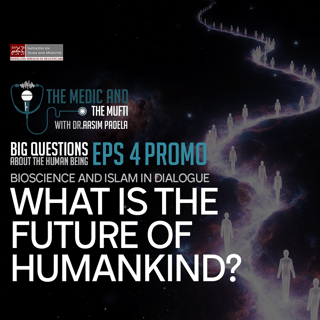
Speaker: As-salamu alaykum and peace be unto you, dear listeners around the world. Welcome to a special preview of our podcast series, Big Questions About the Human Being, Bioscience and Islam in Dialogue.
Speaker: I'm Dr. Asim Padella, and I'm honored to be your guide on this journey. Together, we'll explore some of the most profound questions about the nature of the human being and our place in the cosmos.
Speaker: Along the way, leading experts from around the globe will join us, scientists, philosophers, and theologians, bringing in insights from the laboratory, the lecture hall, and the library.
Speaker: Across six episodes, we'll wrestle with the questions of evolution, human consciousness and artificial intelligence, the future of humankind in light of new technologies, and whether we truly have free will.
Speaker: I'll also get to ask some of my favorite questions, Are we unique in the universe? Or is there an intelligent life beyond Earth? And to ground these grand ideas, I'll weave in real-life clinical cases and reflect on the bioethical dilemmas they raise.
Speaker: In this short preview, you'll hear just a taste of what's to come, snippets from our guests as they reflect on why it matters to ask these big questions, and how science and religion working together can illuminate the mystery of the human being.
Speaker: Let's begin with Dr. Jennifer Wiseman, an astronomer who studies the formation of stars and planets in our galaxy. She shares what it's like to glimpse signs of the vastness of the universe.
Speaker: One thing I love about astronomy is just that amazing sense of humility that we glean from looking up and recognizing that we are a small part of something magnificent and very large beyond our imagination.
Speaker: Our telescopes are better than ever before in human history. So when I look at these professional telescope images, it first of all just makes me kind of gasp in awe. One of my favorite images is called the Ultra Deep Field from the Hubble Space Telescope.
Speaker: And by deep feel, what that means is that the telescope just collected faint light over several days so that the faintest things in that direction of the sky would show up in the in the image.
Speaker: And the result is this collection of little smudges of light which are not stars. Every little smudge of light in this image is another galaxy. So a galaxy contains hundreds of billions of stars, but we now know there are hundreds of billions of other galaxies, each containing billions, sometimes hundreds of billions of stars.
Speaker: That gives me and just a sense of awe, amazement, Also, I would say a sense of of joy, you know, just to kind of feel like we have the privilege of seeing a glimpse of a universe.
Speaker: You know, we're just now starting to get a little hint of how amazingly rich and vast the universe is. That vastness we've just heard described on a cosmic scale is mirrored by the complexity of our human biology.
Speaker: Next, we'll hear from Professor Rana Dajani, Professor of Molecular Biology at the Hashemite University in Jordan. She shares how her faith inspires her career of scientific exploration.
Speaker: I'm a Muslim and I'm a scientist and for me Islam is a most fundamental message is using your mind, fostering curiosity.
Speaker: So that's the first thing in Islam. The second thing is it's okay to make an error and to to make a mistake. So you may have an explanation for something as a result of your questioning, and you may find out later that that was not the right explanation.
Speaker: And that's okay. And that opens up and frees up the opportunity to ask and to question and to seek knowledge and try to understand nature around us. So to me, those are two fundamental tenets of Islam that i adhere to.
Speaker: And they push me to become a scientist and to try to understand nature. And I'm not alone, right? this This concept of trying to understand nature is part of humanity. Our curiosity is part of why we survived.
Speaker: And curiosity is also, we might say, the beating heart of this podcast series. And like our other human traits, curiosity needs to be guided by ethical and spiritual awareness, according to Sheikh Hamza Karamadi, the founder of Basira Education.
Speaker: Science and technology are tools that enable us to achieve our objectives. So there's a verse in the Quran where it says that we have created human beings in the best of forms.
Speaker: The potential of a human being to have mercy and generosity and help other people, it exceeds the potential of any other creature. And then he says that then we reduced him to the lowest of the low.
Speaker: Meaning that if somebody does not cultivate and nurture their soul, then their mind, through their mind, they are able to achieve evil and harmful ends in a way that no other creature can.
Speaker: So science, technology, artificial intelligence, these are all means And if the people who are using these means, they are spiritually developed, they will use them for good.
Speaker: And if not, then the opposite. There is enlightenment narrative of science and technology and progress and the elimination of poverty. It's possibility, but you need spiritual development. You need a relationship with God in order to achieve that. And if you don't, then and everything becomes about satisfying your own desires, then you lose your moral compass.
Speaker: Adding on to this perspective is Professor Augustin Fuentes, Professor of Anthropology at Princeton University. He points us towards the importance of belief as a human experience and the need for belief to be included in scholarship and dialogue.
Speaker: I think one of the most important things for today and for the future is for all humans, not just philosophers and theologians or or the lay public, but scientists as well and scholars of all types to seriously consider, understand and engage with different belief systems and different patterns of belief, because belief drives, facilitates, creates behavior change for better and for worse much more strongly than any data from some scientific investigation.
Speaker: It turns out what people believe is real for them and therefore understanding those beliefs and working with people potentially to engage possibilities for flourishing, for better justice for all through sets of beliefs I think is really important. not pay attention to belief and to engage with it seriously as a scholar and a human being is to pass up a really important opportunity for humans to flourish into the future.
Speaker: And the theme of the importance to humanity of dialogue between different worldviews is echoed by Osama Javed Mirza, a doctoral researcher and Gates scholar at Cambridge University. I feel that today there is a lot of polarization about this for political reasons, but the synergy between science and religion in all parts of the world is a very strong theme as well.
Speaker: And I feel we should often bring that out, especially today, if we want to find unity on issues like climate change. I feel that we spend too much oxygen on Galileo versus the church and not enough on, for example, how indigenous communities within Ecuador fought for the rights of the forest.
Speaker: and for non-human beings. And I feel that if we share more stories of this, moving beyond just science, moving beyond just Islam and Christianity, I think we would be able to humanize one another a lot more.
Speaker: And I think that is what this world needs, especially when we have global issues that are existential in nature, Now for the final reflection in this special preview, let's listen to astrobiologist and theoretical physicist, Professor Sarah Walker of Arizona State University.
Speaker: She echoes a theme touched on by all of the experts we've heard from so far, the theme of a shared human responsibility to explore meaning in our universe. If we're not alone in the universe and life is some sort of cosmic imperative, you know, that's kind of a wonderful philosophy because it seems like the universe is teeming with life.
Speaker: And, you know, if we are the the only life that's ever appeared in the universe, in some sense that we have a huge cosmic responsibility because we're the only part of the universe that has come to comprehend any of the rest of it.
Speaker: It's a great mystery. It's why I'm obsessed with it and I work on it. But I also see sort of a personal responsibility as a scientist to try to build optimistic narratives of the future because the way that we construct theories and the way that we talk about our theoretical descriptions of the world at the base level, I think really does inform so many dimensions of society. And so I think it behooves us to to think about our cosmic responsibility no matter of what, um thinking about these deep questions.
Speaker: Professor Walker has it right. And our team has devoted this series to exploring those deep questions that Professor Walker so eloquently encourages us to consider. I hope this short preview has sparked your curiosity to journey with us as we take on big questions about the human being.
Speaker: In our first episode, we'll ask about the nature of knowledge itself. How can we know anything at all? From there, we'll travel from the sub-molecular to the interstellar, exploring how our genes shape behavior and considering scriptural indicates of intelligent life beyond our world.
Speaker: So pour yourself a cup of tea, slip on some headphones, and join us for an epic journey at the crossroads of bioscience and Islam. Until then, ma'as-salama, and peace be unto you.
Speaker: Big Questions About the Human Being, Bioscience and Islam in Dialogue was presented by me, Dr. Asim Padella, with Dr. Rauda Yunus. Muaz Mis'ud, Mohamed Darsha and their team from Aka Media Global and EMC Media LLC were consultants and dissemination partners.
Speaker: We would like to thank all of the discussants for giving their time and scholarship so generously. This podcast was supported by the John Templeton Foundation and hosted by the Initiative on Islam and Medicine and the Medical College of Wisconsin.
Speaker: The producers are Kirsten Dwight and Martin Redfern, and this was a Beacon Hill production. For more details about this podcast and about the project in general, please visit medicineandislam.org.