Transcript
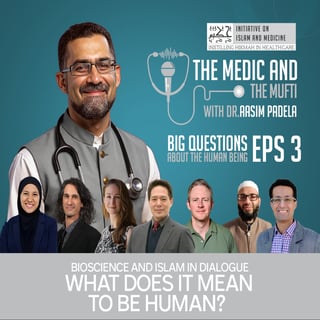
Speaker: Welcome to another edition of Big Questions About the Human Being, Bioscience and Islam in Dialogue. With me, Asim Padella. I'm so glad you chose to listen to this podcast today.
Speaker: But did you really choose? Or was it preordained for you by some deity to listen to this episode at this exact moment? Or did the sequence of events from the Big Bang until now set up a sequential path by which you were predetermined to listen to this episode?
Speaker: Believe it or not, some scholars would agree with each of these views. They would say that you were fated in some way to be listening to me right now, or for that matter, for me to be recording this when I did so that you could listen.
Speaker: Yet, if all is determined by physics and math or our biology, then what about free will? Do humans have any agency over the things they do and the decisions they make?
Speaker: In this episode, we will examine these questions from bioscientific and Islamic perspectives. We'll hear from experts on genetic predispositions that influence behavior. We'll also look at how a sense of agency, or the lack of it, makes an impact on some of the most challenging dilemmas for human societies.
Speaker: We'll hear about the role that agency can have in the rehabilitation of criminals and in the choices people make for good or evil in situations of atrocity.
Speaker: Let's start by examining a fictionalized case based on true event to get us thinking about how the question of free will plays out in real life situations. A 25-year-old gentleman is charged with disorderly conduct, causing physical injury to a bystander who then had to be rushed to the emergency room.
Speaker: You are an expert witness brought to the court during sentencing to advise on the moral culpability of the defendant given his diagnosis of antisocial personality disorder and his genetic predisposition for such.
Speaker: Should he receive shorter duration of jail time as punishment compared to an individual without the disorder, what would you advise the court? While we consider that, let's examine what scientists and philosophers say about free will.
Speaker: We'll start with Peter Ulrich See, a professor of cognitive neuroscience at Dartmouth College. He shares his definition. Free will involves a world in which there are multiple possible futures,
Speaker: which I can select. And in order to do that, I have to internally model those external possibilities. So I have to have a kind of realistic imagination. So free will is very much tied up with my ability to bias outcomes in the the world through my own actions and for my own reasons such that that future which is open in the world actually comes to pass.
Speaker: So the first part of that definition prompts a question about the world. Is the future predetermined in some way? Or are there different possibilities we might be able to influence? The second part prompts a question about ourselves.
Speaker: What kind of capacities do we need to have in order to exercise free will? Philosophers have debated these questions over millennia, including Greg Caruso, professor of philosophy and applied ethics at Fairfield University.
Speaker: He gives us an overview of the four current philosophical positions on this question. but think the best way to understand at least the traditional version of the problem of free will, it's a question of how to reconcile free will with the thesis of what's called determinism.
Speaker: And determinism is the thesis that facts about the remote past in conjunction with the laws of nature entail is only one unique future. There's a position called libertarianism. not the political conception of libertarianism, but the metaphysical one, which says that if determinism is true, agents lack free will.
Speaker: But libertarians believe we do have free will, so they try to make sense of an indeterminate conception of free will, where agents can have free will in a way that requires the falsity of determinism.
Speaker: There's another position called compatibilism, And it is what it kind of sounds like. It tries to make compatible these two different beliefs, the belief in free will and the belief in determinism.
Speaker: It says for an agent to be free and morally responsible, it doesn't have to be the case that determinism is false. It just has to be the case that agents act either voluntarily or with some form of what's called reasons responsiveness, their ability to respond to particular kinds of reasons for actions.
Speaker: Wow, that's quite a lot of different concepts for us to remember. I mean, I'm beginning to wish that we had the ability to show a Venn diagram in our audio podcast. So before we move to our next definition, let's break it down a bit.
Speaker: You will all have to imagine the Venn diagram in your own minds. There are two crucial questions. First, free will. Is it true or false? And second, determinism.
Speaker: Is that true or false? We heard about the libertarians who say free will is true, determinism is false. We then heard about the compatibilists who say free will is true and determinism is true.
Speaker: So now we come to the penultimate category in our imaginary Venn diagram. The hard determinist view was the view that determinism is true and incompatible with free will, either because it's incompatible with agents having the ability to do otherwise,
Speaker: or because determinism excludes agents being the appropriate source of their actions, since the ultimate source of actions drains back to these anteceding conditions, like upbringing, genetics, prior experience, heredity, factors that are ultimately beyond the control of the agent.
Speaker: Hence, proponents of that position say free will is false and determinism is true. Greg Caruso himself rejects free will, But unlike the hard determinists who we just heard about, he believes that the whole question of determinism is irrelevant to his position.
Speaker: He explains by introducing us to the very last category. I'm what you would call a hard incompatibilist, which means um whether determinism is true or indeterminism is true, we would still lack free will.
Speaker: In other words, he is saying free will is false and determinism is irrelevant. And don't let the unfriendly sounding term hard incompatibilism fool you. Many of its proponents are, in fact, motivated by a concern for fairness.
Speaker: They start from a concept and philosophy called the basic dessert. In its simplest, boiled down form, it means that good actions should be rewarded and even actions should be punished.
Speaker: But hard incompatibilists ask, Once one has rejected free will, then how can there be justice in praising or blaming people for their actions? Because they deem actions to be beyond the individual's control.
Speaker: And that's because agents are no more in control of determined events than they would be in control of indeterminate events. Now that we have a map of the philosophical positions, let's take a closer look at free will from a neurological perspective.
Speaker: Professor C. argues that there is an underlying assumption in the debate. Many other scientists and philosophers argue that we don't have free will. I would say that they typically misplace free will in action.
Speaker: They think of free will as being tied up with doing this versus that. I would argue it's much more fundamentally about imagining this versus that and then setting about doing it. And so action is downstream of volitional processes involved in the imagination. So that somebody, for example, who couldn't even act at all, someone with the locked-in syndrome, for example, could nonetheless attend to the radio or attend to the sound of the television or attend to their memories.
Speaker: That is quite interesting. Although I am a physician, I don't think we spent any time in medical school learning about the neuroscientific foundations of free will. If free will can be located in the volitional processes that precede action, could one say it is wired in our brains?
Speaker: I would argue that yes, there is a neuronal basis for free will. It concerns how we essentially rewire our cells. So neurons typically are thought of as generating action potentials or firings that go along their axons, which then make other neurons also fire.
Speaker: I would argue that neurons are actually doing quite a bit more than that. They are also rewiring each other's conditions for future firing by changing the synaptic weights of neurons, not necessarily making them fire.
Speaker: Neurons essentially are placing conditions upon their inputs for firing. So a neuron might fire to the presence of a cat in the world. And we have found such neurons. But I can also change the synaptic weights on that neuron such that it will now become a dog detector, not a cat detector.
Speaker: So we have some volitional control over what our neurons will respond to in a bottom-up way. How exactly do we do that? And although I think neuroscience doesn't yet fully understand how we change synaptic weights volitionally, I think it's clear that we must be doing that because otherwise we couldn't see what we want to see.
Speaker: But if the neurons are creating synaptic weight in different directions, could that actually mean that something is already happening before you seemingly make a choice? And if so, does this mean that the actual moment of choice is predetermined?
Speaker: More than 40 years ago, neuroscientist Benjamin Libet performed experiments that seem to suggest that we in fact don't have conscious free will. At least not in the way that we think we do.
Speaker: The essence of his experiments is the following. He has people move their finger or hand while watching a clock. And he tells the subjects, move your hand basically whenever you want.
Speaker: And moreover, tell me where the the second hand was on the clock when you first felt the urge to move. Well, it turns out that the urge to move might be 300 milliseconds, or roughly one-third of a second before I actually move my hand.
Speaker: But when we do lots and lots of such trials, we can see that there is a kind of activity in the brain that precedes even my urge to move, something like, say, one second to be before. So at time minus one second, I see brain activity,
Speaker: that is indicative of my eventual finger movement. And then at one third of a second prior to me moving my hand, I ah have the conscious urge to move and then i do move my hand.
Speaker: So something is happening in the brain, the so-called readiness potential before the conscious moment of choice, which is termed the W judgment. Professor of social and cognitive neuroscience, Emily Kaspar of Ghent University in Belgium, explains the significance.
Speaker: The results were pretty striking because what he observed is that this double-duty judgment happened indeed before the actual movement, but several hundred milliseconds after the initiation of that readiness potential in the brain.
Speaker: So it actually questions fundamentally to what extent our volition is really different from our body or is just the product of a specific brain activity.
Speaker: Does our brain somehow decide and we don't? But that's a difficult phrasing because in a sense, we are our brain, or we form a unity in a way.
Speaker: Professor Caspar was so intrigued by this that she reproduced the experiment. She suggests that even if any choice is are made unconsciously, there's still a moment to exercise a veto over our actions.
Speaker: I have indeed reproduced the work myself. I wanted to see if this time delay between the W judgment and the action was similar across individuals.
Speaker: That matters because actually in the original paper of Libet, the authors interpreted this very short time window between these two events as the veto period.
Speaker: So we may not have free will in the sense that our volitional processes are caused by brain activity, but we may have this short time window to decide to voluntarily inhibit or to veto an action previously determined by the brain.
Speaker: And I wanted to see if that veto period would be different with people from various degrees of impulsivity. And so I did this task on dozens of participants and I also investigated their basic impulsivity traits with questionnaires.
Speaker: And I indeed saw correlations. So those with a short W a time period between the double-O judgment and the movement itself, So those who have the highest impulsivity traits also have the shorter ah time window.
Speaker: That may due to a lot of different factors, but it's interesting to see that we may also observe variabilities regarding these critical time periods. Libet's original conclusions are often cited to support the lack of conscious free will.
Speaker: But those conclusions have their critics. Among them is Professor C. The experiments of Benjamin Libet have been interpreted by some people to mean that consciousness is not causal in the universe and that there is no free will.
Speaker: And I think that that is wrong for a number of reasons. One way is that, of course, brain activity has to precede any motor act, but we don't know at what you know what percentage of the preceding motor activity corresponds to volitional activity or non-volitional activity.
Speaker: And I would say the Libet experiment is just kind of barking up the wrong tree in that finger movements that have no meaningful purpose at all are not where the action is in free will. Where the action is in free will is not in physical action, it is in internal deliberations in our imagination.
Speaker: And Libet's experiments simply don't examine free will where it happens. Professor C. raises an interesting point. He claims that the core of free will consists of conscious choice.
Speaker: rather than the action resulting from that choice. So it is, in some ways, in our brains. But what about the influences on us beyond our own conscious choices? Han Brunner is professor of genetics at Radboud University in the Netherlands.
Speaker: He describes his first clinical encounter with a family seeking help for an unusual problem. 30 years ago, i was a young doctor. I was in clinical genetics, and this family was referred to us.
Speaker: And it was essentially it was one woman who had a son who had this problem and she two daughters. and because this is something that affects only men and is transmitted by women.
Speaker: She worried about her daughters and she wanted us to find out whether her daughters were weren't carriers. So how did this inherited trait manifest? Now, the interesting thing about it was that it wasn't severe intellectual handicap.
Speaker: The problem was behavior. So their behaviors are impulsive. And they're impulsive of different kinds. So there's impulsive aggression, usually verbal, like threats, the I will kill you type of thing.
Speaker: And then there's abnormal sexual behavior, which is all kinds like exhibitionism and voyeurism and suddenly grabbing a woman. And there were some instances of of two of these woman's brothers who went and set houses on fire.
Speaker: Professor Brenner set about tracing members of the family, taking blood samples and analyzing their DNA. It took us five years. It was difficult then to find a gene. And we found it was in the monoamine oxidase gene.
Speaker: I told the family what it was, and they were very grateful. There was not you know something they'd done wrong, but it was a gene. The gene defect is the underlying problem.
Speaker: But no gene codes for behavior. So what ah happens is that if the gene is not working properly, if MAOA is defective, then what you get is that there less balance in the brain.
Speaker: And that means that there is a propensity towards impulsiveness. Now, that doesn't mean that this will always happen. In fact, it doesn't happen most of the times.
Speaker: And when unfortunate behavioral incidents happen, they used there's usually some kind of of thing leading up to it, which could be a lack of sleep. It could be some other change that has unsettled the person. If the environment is unstable, that will increase the risk.
Speaker: So it's it's a bit like ah all of us. We can all fly off the handle if we're provoked. But the needle has shifted a bit. So it's a balancing. It's not black and white.
Speaker: So we now have a much more nuanced picture of what free will may be and where it may reside. At the same time, the idea of determinism is also coming into better relief. There is no single gene that codes for behavior.
Speaker: But as we've heard so far, genetic predispositions or factors such as impulsivity may shorten the window for an individual to voluntarily veto an action. So is there anything that can help us lengthen that window?
Speaker: How can we veto negative actions and increase our capacity to choose well? Dr. Gwen Adstad is a forensic psychiatrist who works with mentally disordered offenders. She shares her experience of helping violent offenders face up to their behaviors.
Speaker: A therapeutic sense of agency is turning out. in the research to be very important aspect of successful therapy. When it comes to therapy for offenders, then one of the goals of therapy is not just to help people feel better, but also help them refrain from offending in future. And that's something that, in my experience, many offenders do want to do.
Speaker: And we've all noticed this process whereby people often start in a kind of position of denial. Of course, the most extreme version of that, it wasn't me.
Speaker: And then there's a less extreme version, well, it wasn't me, it was my illness that made me do it. And then as treatment goes on, people say, well, I did do it, but I was mentally ill at the time. So you're not saying you were compelled to do it, but you're asking to have your blame mitigated somewhat because of your mental state.
Speaker: And then there's a state at which people say, I did this. I did this thing. And often that's the point at which they experience great shame and great distress and and sometimes relief.
Speaker: But the taking of responsibility enables a greater sense of agency. And it's certainly not about excusing them for what has happened in the past, but rather it's so it seems to me to be a process of ultimate respect, of taking people's previous cruelty very seriously and and helping them gently, gently to take responsibility for that.
Speaker: We have heard that the simple but far from easy act of taking responsibility can lead to a breakthrough. That even violent offenders may increase their sense of agency and reduce their risk of re-offending.
Speaker: Professor Casper investigated what happens to the people's ability to take responsibility under conditions where their sense of agency is suspended, specifically when they're following orders.
Speaker: I have developed a paradigm where people must decide between different moral behaviors, moral decisions, such as do I choose to hurt somebody with real electric shocks to increase my own monetary gain or not?
Speaker: And people were doing that either freely, so they had, for instance, 60 trials in which they could decide, or they were following my orders as the experimenter to give a shocker nod to another person.
Speaker: And I have looked at different brain processes. I have looked at the sense of agency, at empathy for pain, responsibility, moral conflict. So all these processes that are happening in the brain when we make moral decisions.
Speaker: And what I have observed overall is that when people follow orders, there is an attenuation of activities in those brain regions. So I think it's very interesting because it may perhaps explain why people can conduct, for instance, atrocities when they follow orders, because their brain is impacted and they it it does not process the the environment in the same way as if they were free.
Speaker: Now, all of us have heard the term following orders in relation to atrocities. It chillingly evokes the ultimate denial of individual moral responsibility. The study yielded evidence that once someone has started on the path of following orders to inflict even the mildest of harms, such as an electric shock and laboratory conditions, that this sets up a change.
Speaker: The activity in the brain regions for empathy and decision-making becomes observably reduced. This is groundbreaking work. It suggests that maybe individuals habituated to following orders have a little less agency, less ability to disobey even in the face of stark moral wrongs being committed.
Speaker: But if following orders sets up a self-reinforcing cycle, then what does it take to break free from that cycle? Professor Casper has also recently begun researching which traits are shared by people who disobey orders, and instead they become rescuers.
Speaker: For me, they are exceptional because when we look at genocides, there are different stages that occur, such as dehumanization, hateful propaganda, classification.
Speaker: And those steps are known to influence people's behavior and the way they are going to to react. And I think genocide rescuers are ah pretty fascinating in this sense because they were from the same context, they were in the same environments, and yet they resisted.
Speaker: And they not only resisted by not participating, but they resisted by going against the orders and risking their own life to save others.
Speaker: Genocides are known to be crimes of obedience with many people participating, but it's known not the only factors or source of influence that is at play during a genocide. So other possibilities could be that perhaps rescuers are less sensitive to integral biases because they have evolved in an environment that that value most a shared humanity, like the fact that all human beings are the same and we are not split into different groups.
Speaker: perhaps rescuers also are less sensitive to risk. We also observed for instance in one of the studies we conducted last year that rescuers compared to perpetrators and bystanders they had much more role models in their lives than the other groups. So when they were children many of them witnessed their parents or relatives also rescuing people.
Speaker: So perhaps that has shaped their moral development in a way that they could see that there is another option that is not just following orders or following social dynamics.
Speaker: They are rare. ah First of all, many died because of their rescue actions, so they are not easy to find. But I really see the value of studying them and understanding how they can resist and how they can somehow regain their own free will in these contexts.
Speaker: Professor Kaspar's discussion about rescuers reminds me of the process of character formation. According to Aristotle, as well as Islamic theologians such as Imam al-Ghazali, our moral development requires us to have moral exemplars.
Speaker: Admittedly, I am simplifying it a bit, but the general idea is that one learns to act good by emulating those who do good, and then eventually habituating towards the good.
Speaker: Here are some promising signs then from this early stage of research. A person's sense of agency may be impaired if they are conditioned to obey. Conversely, agency may be strengthened by belonging to inclusive communities and having strongly moral role models.
Speaker: Some signs of hope then, that we may be able to nurture agency to foster resistance to moral harm. And now we return to our overarching question. So what is the verdict of our scientists and philosophers on whether we have free will?
Speaker: That's a very good question. And honestly, after all these years of research, I'm still not very sure of the answer. Because when we make a simple decision, the brain takes into account our life, our past experiences, all these sensory inputs that we may not even consciously proceed to help us make that decision.
Speaker: And so in that sense, I don't think we have free will because we are not aware of all the different factors that influenced this final decision to make that action instead of that action.
Speaker: But I do think that we have a degree of freedom in the sense that we may not be fully determined by everything that happened before and that we may still have the possibility to rectify some actions or to decide otherwise.
Speaker: Agents are still causally responsible for their actions. That is, they could be legally accountable in a monetary sense for the wrongs done so as to repair and restore the agent and perhaps have them financially recoup for damages that were done.
Speaker: But we would have to reject some fundamental sense of moral responsibility, the sense that would be needed to justify, for example, retributive punishment. I do very much believe in free will. Free will has come up in in the context of this gene.
Speaker: I think even though there is an effect of the genetic makeup and it makes a person somewhat more unstable, that doesn't in any way take away their free will, I think.
Speaker: You might have a situation where at the present moment you have no choice but to act a certain way, but then you might say, well, I have no responsibility for it because I have no choice. However, in the past, we had the capacity to imagine becoming a different kind of person and then exerting ourselves to accomplish that.
Speaker: One analogy would be going to the gym, right? So let's say, right now I'm quite weak. I can't lift 50 kilos. I might say, well, i have no responsibility for that because I'm so weak, I can't do it.
Speaker: But let's say that, you know, a year ago, I realized that I would in the future be in the position of having to lift 50 kilos. Well, I could have gone to the gym and trained myself, and then today, had I done that, I would be able to lift 50 kilos.
Speaker: So even though it's true that right now, as I am, I cannot lift 50 kilos, I have responsibility in part for that because I could have created myself to be a different kind of body by sculpting my body, by going to the gym,
Speaker: And I would argue that's also true of the mind. I have the capacity to sculpt my mind and my character such that in the future, I would become the kind of person who could not, for example, commit murder.
Speaker: We heard a range of views there from professors Caspar, Caruso, Brunner, and C. And finally, from Dr. Asad. She echoes the idea that free will may be, as in Peter C.' 's analogy, a muscle to be built.
Speaker: My position is that we all have the capacity to make choices that are cruel and unusual, to pick a phrase from the US Constitution. I think i think we all have that capacity.
Speaker: But I equally think we have a capacity to make good choices, to make choices that build up our lives together. The practicing of virtues, the the the repeated practice of thoughts that are kind of healthy and contribute to well-being and flourishing, not just of yourself but other people. These are things that we can practice.
Speaker: But they do involve intention, both intention and attention. And it boils down to kind of taking your mind seriously, really taking your mind seriously and what goes on in it and being able to develop that capacity to observe yourself, thinking.
Speaker: Well, where does that leave us? It seems that there is no singular scientific perspective that can answer our questions definitively. We still don't know whether our actions are predetermined due to the Big Bang, or because of our genetic makeup, or because of what we ate in the morning.
Speaker: Some scholars, as you've heard, argue that we have choice. Leaving aside whether this is in the imaginal realm or in the world of action, others hold that all choice is an illusion.
Speaker: I may be dating myself here, but I loved the Matrix movies. I have vague memories of dialogues between Neo, Morpheus, the Architect, and even the Merovingian about choice.
Speaker: They were running throughout the series. One particular exchange has been burnt into my mind. Morpheus says, everything begins with choice. And the Merovingian replies, choice is an illusion.
Speaker: You see, there is only one constant. One universal. It is the only real truth. Causality. Action, reaction.
Speaker: Cause, and effect. Everything begins with choice. No, wrong. Choice is an illusion created between those with power and those without power.
Speaker: I mean, can we ever really get outside of our brains or the matrix in order to truly know? Science and philosophy do not have a singular or complete answer. It seems that of all the big questions we've considered in this series, this is one where there is the least agreement amongst our science and philosophy experts.
Speaker: And we'll invite three of these experts to weigh in again when we explore the ethical questions that free will raises for ideas of crime and punishment. Let's now turn to the Islamic theologians and Muslim thinkers on the matter.
Speaker: To begin our exploration of Islamic perspectives, let's start with Professor Abdul Razak Abdullahi Hashi, a core project team member with a doctorate in Islamic studies, who is presently professor in the Department of Biotechnology at the International Islamic University, Malaysia.
Speaker: He initiates his discussion of the laws of nature that you will likely agree lie beyond our control by reminding us about some fundamental aspects of the human being. The human beings, we can see it as a body structure.
Speaker: so gene right The the tissues, the muscles, the bone, they are taking this three-dimensional component that is taking space and time. And in that level, they say human beings are controlled and governed by the universal laws.
Speaker: The laws of gravity, for example, controls it. Surely if I go to a high altitude and then I throw myself, the gravity will pull me down to the ground. So in that case, there is no free will.
Speaker: And there is no responsibility. Why? Because in that sense, I am governed by the natural laws. In the Islamic tradition, we call it sunnatullah. So...
Speaker: Surely in that sense, in that aspect, you are not accountable, you are not responsible for whatever happens to your body. Why? Because your body is like any other structure that takes space and time.
Speaker: As a listener, you may be thinking that what Professor Hashi just said ah so obvious that it need not be stated. Yet, I have found that many Islamic theologians begin diving into complex topics by starting with a very broad 10,000-foot generalization.
Speaker: So just bear with him a bit. I promise you it will get a little more interesting in a short while. Okay, so it's easy to agree that we have no control over, and therefore no responsibility for, the effects of natural laws on us.
Speaker: Professor Hashi continues by considering an aspect of human nature that is more nuanced in terms of moral accountability. You notice that we have what we call natural instincts or desires, if you will.
Speaker: In the Islamic tradition or in the Arabic language, they call it al-jibilat al-tabi'iyya. The instinct of, for example, hunger, the desire to fulfill your sexual needs, is for example.
Speaker: That aspect is different from the one we mentioned just now as a body. because these one are inclinations that are inborn, natural, gifted, not acquired, it but they are there, part of human nature.
Speaker: You are not responsible for having, let us say, sexual needs, or why you are hungry, you know, for example, or why you are thirsty, you are not blaming it for that. But fulfilling it in a decent way, that is your responsibility.
Speaker: In other words, having it is not an issue. But fulfilling it and directing it into the right way is something that you can control it. It's something that you can manage it. It's something that you can direct it.
Speaker: And that is the beginning of the moral journey for the human being. This view of how moral responsibility applies to natural instincts reminds me of something we heard from Professor Kaspar earlier.
Speaker: Her experiment identified a brief window of opportunity during which we can exercise a veto over a particular impulse. Her results suggested that when an impulse arises, we do appear to have an opportunity to refrain from acting upon it.
Speaker: It's interesting that this neurological evidence seems to align with the Islamic understanding of impulses arising from natural instincts. While they are blameless in themselves, we are responsible for channeling them in an ethical way.
Speaker: Professor Hashi continues to explain how our intellect allows for moral responsibility. You have now the faculty of thinking or intellect or rationality or reasoning.
Speaker: Here is where the moral responsibility now becomes fully realized. Whereby now, not only that you have inclinations, but that you have a faculty of mind, which helps the individual so distinguish between what is right and what is wrong. And the Islamic tradition, they use the word bulu. I think the English, the right English word is maturity, whereby an individual now has reasoning or they call it akali or intellect, if you if you want to use that word.
Speaker: So far, it makes sense. We are not responsible for natural laws acting upon our body, We have inborn instincts and desires which we can channel. And then we have voluntary acts which we can pursue.
Speaker: And these two latter domains are the domain of responsibility governed by our intellect. Another of our core project members, Professor Muhammad Yusuf bin Muhammad, also from the International Islamic University of Malaysia, chimes in here.
Speaker: Professor Youssef is an assistant professor in health sciences and comments on the theological importance of the intellect or al-aql. In Islamic worldview, the aql is very important because we are a special creation of God as being given the rational capacity.
Speaker: But this rational capacity is used to first to understand the revelation. Because the relation given by God, the Prophet Muhammad, peace be upon him, the Quran, and the authentic prophetic traditions, you need akal, you need mind to understand it.
Speaker: You need to understand it whether it's this obligation taken literally or this obligation taken contextually. and how to worship, how your actions toward others, how your actions toward the environment, what the good things that you you need to do and what the bad things you need to avoid.
Speaker: That's the purpose of Aql. What I think Professor Youssef and Professor Hashi are getting at is that human beings are endowed with rationality in order to make choices and are then held morally responsible for those choices.
Speaker: would make little sense, pun intended here, to be given the gift of intellect or the burden of responsibility if one's actions were fully determined by a deity or by the laws of nature.
Speaker: Against this backdrop, Professor Hashi explains a core tenet of the Islamic faith. This equation is addressed within one of the six tenets of the Islamic faith.
Speaker: known as Al-Qadha wa Al-Qadha, the belief in the divine destiny. Then the subject is addressed are the subjects that we are addressing today. Are human beings free or they have they are predetermined?
Speaker: Qadha basically means predestination or preordained Qadha, the Arabic word. And Qadha basically means destiny.
Speaker: or fix it or measure it, right, or fate it. So a Muslim is required to believe in the divine destiny or in the divine predestination, right.
Speaker: Predestination basically means the knowledge of God which covers everything and everyone from beginning to end, eternal knowledge, that is covering all. Qadr means destiny which means everything exists in the knowledge of God but at certain point everything will be brought in to its right time to exist and appear manifested so you have the knowledge of God that is covering everything including you and i but Qadr means God makes things at the right time in the right place and then they appear according to the plan and the design of God
Speaker: if isn't God's foreknowledge and brings all actions about, then are we not determined?
Speaker: your behavior my behavior and your action um my action so if everything isn't god's forknowge and he brings all actions about then are we not determined As Professor Haashi pointed out, the core principles of Al-Qadha and Al-Qadr raise questions about the ways in which our lives are fated and where free will lies.
Speaker: Then the question comes, since God knows everything before I am born to this world, He knows what I'm going to do, he's going to ah He knows who am I, where am going I am i'm going to exist and and so forth.
Speaker: Then am I free for my actions or is it something that is already being ordained, you know, determined for me? Are we free for our actions or actually we are not free for our actions whereby God has decided everything and God knows everything and what you are going to do is already being decided by God.
Speaker: Therefore, you are just like a machine. You are just programming. You are just doing what you are being destined for. You cannot go beyond that. The tenet of divine decree tells us about aspects of the fatedness of humans, which prompts the kinds of questions about free will that we're asking about in this episode.
Speaker: And as Professor Yousuf explains, it also points us towards certain attributes of God. In Islamic view, when we talk about the divine decree, that's the word in korea Arabic is Al-Qadha or Al-Qadr.
Speaker: Al-Qadha means the divine decree to make it very easy for us to understand. at least there are four criteria. Number one, we believe that the God is omniscient, which means that God is all-knowing.
Speaker: All-knowing, past, present and future, God knows everything. And the second thing is that the knowledge of God is in written form. We put it on the preserved tablet. They call it as the preserved tablet. And the third thing is that the will of God always, what we call, is much more higher than the will of the creations.
Speaker: Which means whatever things that happen in this world only can be done with the permission of God. That's the third thing. The fourth criteria is that God is the one who created our actions.
Speaker: Now you you might ask that how is it possible that God created our actions? Because in Islamic faith, and there are many verses of Quran on these things that Allah created the actions to us, good and bad, but we are the one who choosing that particular action.
Speaker: So we've heard about the human faculty of intelligence or reason, which gives us the capacity to choose. And that this capacity comes with moral responsibility and accountability for our actions.
Speaker: We've also heard about the tenet of divine destiny and predestination, which informs us of God's foreknowledge and omniscience. Professor Youssef then further described that our destinies are metaphorically written down in a preserved tablet.
Speaker: For Muslim listeners, he was signaling to the prophetic tradition that the first thing God created was the pen, and that he commanded the pen to write all the things he has ordained until the day of judgment. Those decrees are preserved in the tablet, al-lawah al-mahfuz, so to speak.
Speaker: With that said, how do we reconcile all of this with free will and choice? Professor Yusuf provides an overview of the spectrum of Islamic thought on this topic. In Islamic um theology or Islamic school of thought, yeah indeed we have a spectrum.
Speaker: We have a group, we call it Jabariya, school of thought. We believe that everything is governed by God. And they were quoting certain verses of the Quran when the when God mentions that God created all of all of our actions.
Speaker: So they believe that we are living like a puppet. So it seems like to be like an essentialist, to be like what we call hard determinist, that we do not have any control whatsoever. Everything has been determined by God.
Speaker: We have another group which is the Mu'tazilites who believe that, no, we cannot subscribe evil to God. So humans are creating their own actions and humans are accountable on their own actions. We cannot subscribe this to God.
Speaker: And the mainstream, the Sunni groups believe that we are in the middle in which that we do have laws as mentioned earlier and things that have been governed by God. God is the one who knows everything.
Speaker: God has created our action. But we have the ability to acquire those things based on our intention. So when we have a certain intention, God created the particular action, we chose to take it So we are being accountable on the choice that we took.
Speaker: The three positions within Islamic thought that Professor Yusuf described appear to have some overlap with the spectrum of secular philosophical positions we heard about earlier in this episode. The Jabariya school of thought is akin to the hard determinists, albeit with a different conception of the nature of predetermination.
Speaker: Secular hard determinists would cite naturalistic forces like evolution, whereas the Jabariyat school of thought sees predetermination as coming from God. The Mutazilite school of thought shares a similar outlook with libertarians, as they believe that humans possess free will without constraint.
Speaker: The mainstream Sunni school of thought is akin to compatibilists, in that both take the view that we have ah at least some ability to exercise free will, even though there are things that are beyond our control.
Speaker: To nuance this further, the Sunni school of thought that Professor Yusuf is referring to are actually at least two schools, the Ashari and the Maturidi, and one may even add the Athari as well, all with further nuance.
Speaker: But for now, let's stick with the division he presented for our conversation. I will say that this is more a middle path. in which that there are laws, you are governed by God, there are things that beyond our control, and there are things that actually we have a choice. That is why we go to many verses of the Quran, for example, in Surah Zalzala, chapter number 99, stated that, one deeds that you are doing it, either good or bad, going to be accountable on the Day of Judgment.
Speaker: So whoever does an atom's weight of good will see it, and whoever does an atom's weight of evil will see it. So because scholars were thinking that if we do not have free will, then all of these punishments make no sense.
Speaker: All of this reward make no sense. And all of the purpose of life is no no sense. Make no sense. So the mainstream believe that, no, we are accountable for our own action. We have a free will to choose and we are going to be accountable of that on the Day of Judgment for every single day, good and bad.
Speaker: So I will believe them taking more on middle stance, or we can call it as a compatibilist. Professor Hashi cites several Quranic verses to support this middle stance. with this underpinning of divine justice.
Speaker: Now we focus on the aspect of justice. When we read the Quranic verses, we notice that God is just. Chapter 4, verse number 40, God makes it clear that God will give a fair retribution to everyone.
Speaker: Allah not be known as man, and a man a man, and a man is man, and a man is a man, and a man is a man.
Speaker: Indeed, Allah never wrongs anyone even by an atom's weight. And if it is a good deed, He will multiply it many times over and will give a great reward out of His grace.
Speaker: In other words, someone gets punishment or reward according to their deeds whereby it makes it clear, for example, chapter 45, verse number 22,
Speaker: The Quran makes it clear, God will not do any injustice to anyone, but he will give a fair ah account to everyone according to your deeds.
Speaker: but one upon ah whos standing we one oh bobin <unk>li to ku luev in bimaca saba ahum la u lau For Allah created the heavens and the earth for a purpose, so that every soul may be paid back for what it has committed, and none will be wronged.
Speaker: If you read chapter 18, verse number 29, Allah SWT says, Truth has come to you, that's the revelation of prophethood, but whether to accept to it or deny it, that's your choice.
Speaker: Very clear. I will say in the original text there, but what it happen meabcon imanha afa you mean um man shafa truth has come to you but it's your choice whether to believe it or not to believe it why because after all you will be accounted according to your choices but like umun love be
Speaker: yet And say, O Prophet, this is the truth from your Lord. Whoever wills, let them believe. And whoever wills, let them disbelieve.
Speaker: Okay, so now let's recall our epistemic framework. These Qur'anic verses are of the highest epi epistemic grade and seem to be pretty clear about moral accountability and about divine justice.
Speaker: So how do we understand theodicy or the problem of evil from an Islamic perspective? Professor Youssef continues. In the Islamic concept, we believe that God created everything, good and bad.
Speaker: But it depends on you, how you're going to guide it. Now it comes to the first thing, the first part that God is the most, the omnipotent, the issue of omnipotent of God. So when you claim that the the bad not coming from God, then as if that God not able to create something bad.
Speaker: It's not the issue whether God is creating a good or bad. The issue is that what is our choice. So that is the school of thoughts in Islamic views. But the mainstream use is that we believe that everything comes from God. But yet God gives us the freedom to choose.
Speaker: Because there are creation of God which do not have this kind of choice. For example, the angels. So in Quran, for example, chapter number six mentioning that the angels, when they instructed, they will follow God 100%.
Speaker: They're not against God. But there are other creation of God, which is us, which have the ability to make a certain choice. So now comes to the question why there are creation of God that not going to have any free will at the angels, but there are other creation of God who have a choice.
Speaker: the It is because God diversifies the creation to show that He is omnipotent. And when He gives a choice and He puts them to a test, that is why in the test you have a good and you have a bad options.
Speaker: What we've heard so far from our Muslim thinkers are that both predeterminism and free will are included within the Islamic theological framework. Professor Yusuf reflects on how belief in free will can benefit individuals and society.
Speaker: The way I look is that because the implication of having a free will, for example, let us say we believe that all of the things that happen in this world are deterministic and not we do not have any choice, then we have a problem of how do we justify criminal behavior.
Speaker: And those people are just coming to the judge and saying, oh my Lord, it's not me, it's my genes. It's going to deconstruct the sociological and judicial system because crime can simply be mitigated.
Speaker: But having said that, we do acknowledge, yes, there are certain behaviours, maybe due to diseases and etc., but we must go but certain procedures, neuroscientifical evidence emerging etc., to prove that.
Speaker: Second thing is that gives a motivation for us. If we believe that, yes, there are certain things that are beyond our control and there are certain things that we can do to motivate o ourselves, then we can have a more, I would call, optimistic life.
Speaker: more motivation towards a good life. And reflecting on his own position on the free will question, Professor Yusuf turns to philosophy more than to science. It is an uncertainty in the results of science that opens to the interpretation.
Speaker: So we can't really claim that science put the nail to the coffin to this issue, which means that, no, we do not have a free will. But having said that, even science could not tell us whether we are completely free.
Speaker: and That is why i believe that the philosophy comes in because saying ourselves is free does not mean that we need to really go beyond the laws. We can say ourselves is free even within the laws.
Speaker: That is why I subscribe to the idea of compatibilism. You know you are living in a governing law but at the same time you can choose to a specific actions that you want to do.
Speaker: Within the compatibilist perspective Professor Youssef just described, there is a nuanced understanding of human nature, which includes the capacity for both good and evil. He goes on to explain that we are born with a blank slate, but that we need to follow divine guidance in order to resist evil inclinations from taking root.
Speaker: The Muslims believe, especially based on the Quran, that The God given both natures, good and evil, ingrained in ourselves. But under normal circumstances, humans are being created with the pure fitra. They call as fitra.
Speaker: Pure innate disposition. But rather later on, due to the environment factor, due to the upbringing, they have two tendencies. Either to choose the good ways or the evil ways. It depends on them.
Speaker: But both are being given to them because part of the test. When they were created, they were created in a very clear, we call it the fitrah. That is very clear, like a blank slate. But later, they developed the tendency to choose between these two particular areas.
Speaker: And the human nature, is based on the Quran, tend to have more weaknesses because of the inclination of Satan and et etc. They try to whisper and try to deviate human being.
Speaker: That is why we always constantly need guidance from God. God knows what we're going to choose in future. But God does not impose on us. And under certain criteria, you are accountable on what you do. So you can't simply say that this is something that God has to do to me and I do not have any say on this.
Speaker: Well, human moral accountability is clear then. However, Professor Yusuf continues, there is a set of criteria applied to determine whether an individual has acted with their full rational capacity.
Speaker: Number one, you must have a sane mind. In the Islamic perspective, you must have a sane mind. And second thing is that you must reach maturity. When you reach to a level maturity and you know what is good and what is bad, then the third thing is that you are not being false.
Speaker: And the fourth thing is that you must have a knowledge on it. you must have a knowledge that that that particular thing is wrong. And of course, under certain things that are based on the innate disposition, we might think that this particular thing is wrong.
Speaker: right But there are certain things that become very subjective. For example, we take a robber. When a robber tries to rob a bank, for him it's good. because he get more money.
Speaker: But for the victim or for the for the bank, it's not good because you're going going to take the money from them. So God himself, the creator in Islamic worldview, when God is the one who created the robber and also the one who works in the bank, knows what is good and what is bad.
Speaker: But having said that, there are certain universal good and bad which can be known by our akal, our rational capacity. So rational capacity is important for a Muslim in order to execute a certain action and this must be based on the revelation.
Speaker: I will see there's a similarities here in in which that ah both views subscribe that when you have a lacking of mental capacity, you are not totally accountable. but But in Islamic worldview,
Speaker: The sanity is very important. And what if the conditions for sanity aren't met with regard to a particular individual carrying out a given action? It's a diminished responsibility.
Speaker: For example, when you are being convicted to a certain crime, and it shows that you have a lack of mental capacity, and this is must be done based on medical perspective. For example, you do neuroimaging, evaluation of behavioral tests and it shows that you are actually do not have a control.
Speaker: That is why for us to understand the free will, we need to understand there are few criteria. Number one, it must be you have the intention. Second is that it must come from yourself.
Speaker: And third, the ability to do otherwise. Which means that if you are performing certain actions that lead to crime, if you are not able to do otherwise, that means you have some issues with your own body, issues with your own brain, and issues with your own mind.
Speaker: So when you are lacking of a mental capacity and depending to the judge that going to evaluate you and the jury, so of course you're going to have a diminished responsibility. And while the Islamic framework provides criteria for assessing whether and an individual has rational capacity, it can draw upon resources of science to provide the evidence with which to make that assessment.
Speaker: For Professor Youssef, these different domains that religion and science can bring to bear upon the question of free will point to complementarity, not conflict. Now talking about the conflict, do we have a certain ah clear conflict between science and religion?
Speaker: I would say no, because number one is that science operates in different ways. Science talking about the mechanism and etc. and does not really talk about why do you do do we have these things.
Speaker: But religions, mostly are complementary to what science has been mentioned. So I would say that it works at operationally at different level. So I don't see any clear conflict on these things because science is and very uncertain.
Speaker: And science does not discuss about moral obligations. Moral obligations are more on philosophy, right? ah More on ethics. And that is discussed in religion.
Speaker: So in religion, it's very clear that we are accountable for what we do. Science talks about how does but the brain's activity influence the protein build up and how does those proteins work together in know in order to form a certain behavior.
Speaker: But science does not discuss whether this person should go into jail or not. whether this person is actually accountable or not. That is more on moral discussion, more on philosophy, more on ethical paradigm.
Speaker: That is why I see there is not a clear conflict happening between these two paradigms. Well, that brings us to the tricky subject of punishment. You might recall it the case we opened with.
Speaker: You're a clinician asked by the court to weigh in on whether to commute the sentence of an individual with antisocial personality disorder, someone who assaulted a bystander. Based on what you've heard today about genetics and theology, what would you recommend?
Speaker: Now that you've had a think about it, I want you to hear from our panelists. Professor Greg Caruso rejoined us to consider if, like him, you deny free will altogether, should any offender be punished?
Speaker: The issue of punishment is a complicated one, and I think it definitely directly connects to this issue of free will. If you ask someone, why should we punish this wrongdoer? One answer you might give is they deserve it.
Speaker: And that notion is what is often referred to as the retributive notion of punishment. That retributive notion of punishment requires a kind of free will. So free will skepticism is correct.
Speaker: Retributive punishment is not justified. But there is other reasons you might give for why you should punish someone, like punishment is necessary to deter crime, or it's necessary to keep society safe, or it plays a role in the moral formation of the wrongdoer.
Speaker: Those are forward-looking justifications for punishment. And those are perfectly consistent with the rejection of free will. But I would add, I also have an approach that I've developed that's what I call the public health quarantine model.
Speaker: So for instance, if I were to come fly to see you in person and somewhere along the lines, I contract Ebola, I think everyone would agree the state would be justified in quarantining me, i.e. restricting my liberty.
Speaker: And on my model, that justification is grounded in what I call the right of self-defense or prevention of harm to others. I imagine if you're like me, you've never thought in this nuanced way about punishment.
Speaker: We all likely think of it as retributive or restorative. I mean, we have verses in the Bible and the Quran about eye for an eye, which suggests retributive model. And in our legal context today, courts try to make victims whole for their loss.
Speaker: A public health model is interesting. We won't delve into it much in a deeper way in this podcast, but I encourage you to look it up. And Dr. Gwen Adshead also rejoined us to consider how this kind of public health model can be implemented by sentencing for treatment, not only for punishment, giving examples from sentencing possibilities in Britain.
Speaker: I think it's important when we think about sentencing to remember that sentencing is not... just about the individual. The sentencing is the court's response on behalf of all of us. Because when people commit a a crime, and particularly a crime of violence, you know it's committed against all of us.
Speaker: It's not just the victim. So when the court goes to sentence, they are sentencing, I think, not only as an act of condemnation, but they are also sentencing for protection.
Speaker: So sentencing is really complicated. It's not just about risk management. It's also about sort of condemnation as well, but also about whether there's something that could be done for this person. So, for example, people could be put on probation with a treatment requirement.
Speaker: And in fact... particularly since you know there's some reason to be concerned that putting people in prison may actually make them more antisocial rather than less. So we need to start getting thoughtful that we need to have more joined up thinking, I think, between mental health services and criminal justice.
Speaker: and particularly in probation. And that's the real-world meeting of the role of of the sentencer and what can be learned about what's going to help that person.
Speaker: How risky is he, and what could we do to make him less risky? Next, we asked Professor Han Brunner, can the kind of genetic predisposition that he discovered in one family be used in the court of law to say, my genes made me do it?
Speaker: The question has been raised whether one could use this in a courtroom. And in fact, it has been suggested by some lawyers in various court cases in the United States and in Italy.
Speaker: I know a few examples. And I think generally, i would say these people have a tendency towards impulsive behavior, but then still the gene or the gene defect does not explain their behavior.
Speaker: If a person from the family that I reported on, if a person did something bad and I was asked to testify, I would tell the court that they had a condition that does affect them.
Speaker: But I wouldn't tell the court that they had a condition that took took away their free will. Returning to our Muslim thinkers, Professor Yousaf points out that there is a methodology to follow in ascertaining the level of rational capacity, and hence the level of responsibility, that an individual bears.
Speaker: The first thing is that you must examine the evidence. You must go for neuroimaging, you must go to genetic testing, etc. So then you must have the behavioral assessment, whether this person has the ability to do otherwise.
Speaker: So if it's proven that when that particular person not able to do otherwise, of course we can go for the defense and tell talte the judge that he is not able to do otherwise.
Speaker: So based on that, then we can go for the mitigation cases. But if a person just claimed and using the re-excuse of genetics, of course we're not going to take that for consideration.
Speaker: So based on the evidences that provided, if it reached to the level of certainty, then I believe that the judge going to, i order the jury going to have a good decision on that. And Professor Hashi expands on this to tease out the respective roles of theology and science.
Speaker: In any given circumstance, in order for you to make a judgment or to make a conclusion on moral and legal responsibilities, there are two levels.
Speaker: They call it tasawur and tasdiq. Tasawur basically means conceptualization or description. So let us say when a crime takes place, we want to understand what are the causes of that crime.
Speaker: So therefore we check the person mentally, psychologically, whatever. Then we send, we send to who? We send to medical doctors, to psychiatrists, and to other relevant professionals who are related to that case.
Speaker: in order for them to describe the condition and attributes of that individual. Because we want to know the true picture of what caused these crimes. And I'm sure this is similar to the Western Wall as well.
Speaker: So when the judge receives the report from those expertise and professionals, then the judge now walks on to build the judgment. And this is what they call tasdiq.
Speaker: So there are two levels, tassawr first and then you have tastiq. So in the Islamic tradition, religion and science go hand in hand, I put in that way, because science is in charge for describing realities, understanding cases.
Speaker: So the job of medical doctors, the job of scientists, their job is to put the realities of things in front of us, to describe, to tell us about the mother nature and its elements, right?
Speaker: The theology and juris, or jurisprudence if you want, they put provide judgments. But the descriptions of what is going on and realities are provided by scientists.
Speaker: And this role of bioscience to furnish evidence within an Islamic legal process provides an apt example of the complementarity and integration of religious and scientific perspectives.
Speaker: So in Islam, this is where you know, they talk about integrated approach whereby scientists and expertise, they tell us what is going on and the legal groups or judges, they give us the judgment. So both science and theology are needed in this case, in the Islamic tradition. And I'm sure this is the case in Christianity. This is the case in Judaism as well, because religion basically provides values while science gives us, you know, the concept and understanding and descriptions.
Speaker: So we don't see any contradiction between the two for us. All right, we're near the end here. So we've heard a range of views on the case study from our interviewees on crime and punishment, and the possibility of quarantine or treatment in addition to, or even instead of punishment.
Speaker: And we have heard views on the importance of establishing rational capacity, while not allowing the excuse of genetics to remove moral accountability altogether. And we've heard about how science can generate the evidence needed to be taken into account,
Speaker: but that the ethical import of that evidence must be weighed.
Speaker: So, let's return to the epistemic framework from episode one. When someone claims, my jeans made me do it, or even God made me do it, are those claims supported by evidence?
Speaker: Are they probabilistic guesses? Or are they falsehoods dressed in explanatory clothing? From a clinical scientific perspective, I would argue we're much closer to falseness than certainty in such claims.
Speaker: There's a weak link between gene variance and actual human behavior. And as clinician scientists, we must be honest about those limitations. As ethicists and religious adherents, we must be careful not to undermine a person's moral culpability without compelling justification.
Speaker: That said, I personally don't believe prison is particularly rehabilitative. So I might still argue for an alternative sentence, but on other grounds. Ultimately, I'll leave you to draw your own conclusions.
Speaker: While today's episode stretched the mind, our next one takes us beyond it, literally. In episode 6, we'll be asking, is extraterrestrial intelligent life out there? a discussion on human uniqueness.
Speaker: It's our final destination in the Big Questions journey. So invite your friends, share this series, and bring new listeners aboard. The last episode will be, well, stellar.
Speaker: Until next time, wishing peace to you and your loved ones, Dr. Asim Padilla.
Speaker: Big questions about the human being, bioscience and Islam in dialogue was presented by me, Dr. Asim Padella, with Dr. Rauda Younos. Muaz Mis'ud, Muhammad Darsha and their team from ACA Media Global and EMC Media LLC were consultants and dissemination partners.
Speaker: We would like to thank all of the discussants for giving their time and scholarship so generously. This podcast was supported by the John Templeton Foundation and hosted by the Initiative on Islam and Medicine and the Medical College of Wisconsin.
Speaker: The producers are Kirsten Dwight and Martin Redfern, and this was a Beacon Hill production. For more details about this podcast and about the project in general, please visit medicineandislam.org.