Transcript
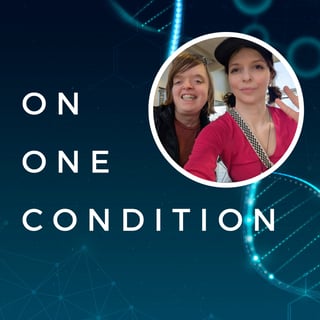
Speaker: Hi, I'm Sylvain Bertolo and you're listening to On One Condition, a podcast to raise awareness awareness about health conditions by listening to people who leave them every day. My guests today are two guests, actually, Kelly Berger and Avery Roberts, and we're going to talk about collagen 6. Hi both, thank you for joining me on the show. How are you doing?
Speaker: Hi, thank you for having us. Yeah, we're excited to be here. So I usually start with a song because I love music and I think everyone has a song, but I think it would take us to too much precious time here. And I know we've got plenty to talk about, including your own podcast. I'm very curious about it. So we'll get there.
Speaker: But if you don't mind, I'd love to focus on Collagen 6 to start with. Could one of you explain what it is and how it impacts you?
Speaker: Sure. So most people kind of have heard of muscular dystrophy, which is a neuromuscular disease. and But within the muscular dystrophy ah umbrella is some different types. So some people have heard of Duchenne muscular dystrophy. Some people have heard of spinal muscular atrophy, SMA, ALS, or Gehrig's disease is also within that umbrella. But also is our type which is congenital muscular dystrophy so congenital meaning at or soon after birth um so it kind of depends where the phenotype kind of shows up where it presents itself so either your either cmd could show up
Speaker: you know early in life or later in life, but no matter what, since it's congenital, it's always been there since birth. It just kind of depends when it presents itself.
Speaker: So then within the CMD umbrella, it's crazy how deep you can go, it's five primary subtypes, one of them being what Kelly and I live with, which is collagen 6, like you said, and collagen 6 and all of the CMD subtypes are ultra rare.
Speaker: And CMD is kind of, and collagen 6, a rare genetic disorder of the muscles that causes the muscles to break down faster than they can repair or grow. So the main symptom is muscle weakness, which leaves our community members and affected individuals primarily as mobility device users. So Kelly and I are both power wheelchair users as our means of independence.
Speaker: And yeah, Kelly, I don't know if you wanted to speak on some of the other symptoms. Yeah. I think what you also So within collagen sits, there is severity levels. So um some people with collagen sits are walking into their thirty s and 40s. And some of us are have been in wheelchairs or mobility devices early on in life. So there really is a very wide spectrum of severity. so within collagen sits, there's also what's called ALREC, which is the more severe form, which is what me and Avery have. And then there's intermediate. And then Bethlehem is the more mild form.
Speaker: one where people can still do steps, walk, do do a lot more within that. So um I think Avery hit it pretty well. I know a lot of the other symptoms are also respiratory insufficiency. So a lot of us rely on mechanical ventilation support like at night through what's called a BiPAP um to help us with just extra breathing support and sometimes even throughout the day as well with daytime ventilation.
Speaker: It just depends kind of where we are on the spectrum of who needs what kind of support, but those are definitely some additional support systems that our community members need. Okay. Is that something that is progressive?
Speaker: It is, yeah. It is? Yeah, so it's a neuromuscular progressive muscle weakness disorder. With no treatments or care. Now, talking about treatment, I will come back to understanding collagen 6 a bit more.
Speaker: There has been some success with Duchenne in recent news. Is that something that could be beneficial for ah you too? Do you know?
Speaker: Yeah, for sure. i We always say that like we can learn from our Other, you know, neuromuscular disease communities win from their losses, learn from their wins. And that kind of helps lead the way for, you know, all the other neuromuscular disease communities, all the other, the larger rare disease community. We're definitely hopeful that kind of the work that they've done with Duchenne can kind of help us along our journey. They've kind of been the guinea pig in a way, but we're really grateful. Yeah.
Speaker: And we feel like we can definitely learn from them. And we always say that one a win in one neuromuscular disease community is a win for all. Yeah. Well, fingers crossed.
Speaker: With it being progressive, have you been power wheelchair users all your life? Or is that something that progressively you have had to come to?
Speaker: Yeah, it kind of depends person to person. and I know me and Ava are kind of Similar, but I think and no person with CMD is really the same in their journey. We all look a little bit different. So for me, I actually walked, and I say walk-ish. It was more of a model, but I walked up until about my teenage years before I had a major spinal fusion surgery to correct scoliosis.
Speaker: um And then after that, I was a power wheelchair user full-time. um But yeah, so the majority of my life, I have used a power wheelchair as my means of mobility. And i walked pretty similarly to Kelly, kind of like a waddle up until I was about eight or nine is when I started to transition to a power wheelchair. Not because walking got harder, but I think I saw that I could be more independent and do things more efficiently wheelchair.
Speaker: a wheelchair and then my mobility kind of gradually declined after not using so much of my muscles anymore because I wasn't walking so much.
Speaker: and because CMD just gradually progresses. So around that time is usually the time that people usually transition to a chair. But I transitioned just because I felt like it was gonna make my life easier, honestly.
Speaker: And that's what I tell parents a lot of young kids with CMD. because they want to try and push off transitioning to a chair or mobility device pretty far. And that's totally fine. But also, it's important to realize that it might actually make a life easier, not only for the whole family, but for the individual themselves.
Speaker: So yeah, i transitioned around seven or eight. And then I had my spinal fusion at 10 years old. So kind of similar to Kelly. Yeah. Okay. So I've been listening to your podcast, which I really, really like.
Speaker: And there was an episode where you talk about hiding or downplaying your disability. That transition to the wheelchair, did you find it difficult?
Speaker: How did you approach it yourself? I think it was also too like a safety component. I think where we were in that time in our lives It was more of like we would fall a lot, get injuries because we weren't stable. Walking around was really more of a hazard. So that transition was also just to protect and preserve our bodies so that it was a safer way to get around and just increase our independence overall. But yeah, I would say that it's more of I think, and everybody comes to terms on their acceptance level and
Speaker: at different periods. I think it's more of just adjusting to your new environment, you know, like having to put down ramps and you know, just ways to get around.
Speaker: That's more of the changes. You know, you're still you. You're just navigating in ah in a different way now. don't know. It depends person to person on how that transition kind of goes. It was pretty seamless for me, but just more adapting to what's around me and more within the home to like your environment to try to be what's to get around and navigate better.
Speaker: I think for me, too, it was also a safety thing because I was always falling. Like i broke my the my same arm twice just from either falling and then trying to catch myself or other people trying to catch me and then catching me wrong.
Speaker: So I think it was also a safety thing. I think it wasn't difficult just because I think everybody around me embraced it. And yeah, I think I also had to adapt to the feeling of them looking different because when you're, you know, walking and maybe you're not walking, you're Like everybody else, because you're walking a little bit slower, you're waddling, but it's also, you're able to hide it a little bit more than if you were in a chair. And so I think it was also adapting to that at such a young age.
Speaker: that, you know, I wouldn't say it was difficult. it was more just definitely something that I needed to get over. And I think Kelly and I are still navigating that. It's a constant journey with that for sure.
Speaker: It's hard to hide wheels. Yeah. Well, hopefully you don't want to hide them. Yeah. We embrace it yeah that's right I can imagine that, especially going through teenagehood, everyone's very conscious of of how they look already.
Speaker: So is is that a period of time that you found a bit trickier to adapt? And in one of your episodes as well, you talk about acceptance and how did you move from awareness to acceptance in a way in your friendship groups or around you?
Speaker: I think it's always kind of defying the odds. I think Kelly and I are so often told that we can't do something, you know, and around that teenagehood time, it's, you know, driving, it's going to school, it's going to college, it's preparing for the future. It's, you know, your friend groups, it's relationships, it's stuff like that.
Speaker: um And I think so often people are told like, you know, the disability community is told you're not worthy of that or you can't do that. You you're not going to go to college, like kind of those expectations.
Speaker: And yet I think for people like Kelly and I, it's kind of like more of a drive to defy those odds, you know, and so. I think that's kind of how Kelly and I shifted teenagehood. I think that's kind of another way that Kelly and I are similar. But I think that's an experience of many in the disability community.
Speaker: We don't see it as something different, but of course, something that, you know, another thing that we have to overcome. But it's not a huge deal to to go to college. Just like we're going to go to school like everybody else. We're going to drive like everybody else.
Speaker: At least that's kind of how how I saw it. What do you think, Kelly? Yeah, I think we'm just having others dictate what they think your life is going to look like and just having the courage to be like, no, like watch me do all these other things. Right.
Speaker: And just not taking no for an answer. I think that's what my biggest motivator is, is just, you know, watch me do all these things. And i know for me growing up in my life,
Speaker: school I was the only girl in a wheelchair I was the only singular person so for me it was more just like forced upon like I took it upon myself to be like yes I'm different watch me still do all of these things you know so that was kind of just my big motivator to still have that success story and not be shunned and and be the different person I wanted to be different in a positive way but Also, if I can add something, I think a lot of people feel, and I have definitely felt this, that when you're growing up living with a disability, you're forced to mature quicker than your peers.
Speaker: You're forced to deal with things quicker than your peers. You're forced to have these really tough conversations, have these really difficult experiences, and keep thriving at the same time.
Speaker: And so we're kind of forced to mature quicker than our peers, which, you know, it could be a bad thing. It could be a good thing. But I think that's something that I definitely found as well.
Speaker: Yeah. When you said that people would tell you you won't be able to go to college, I don't understand why that would be the case.
Speaker: But do you face a lot of negativity like that that, even if it's not from bad intention? But do you face a lot of things like this?
Speaker: Yeah, I think society kind of is still... it's definitely getting better but there's still some of that like old-time prejudice or stigmas in a way that say that disabled people aren't going to they're not intelligent they can't lead fruitful lives and just all these you know things that kind of get in your head and like they're ableist thoughts that you know we can't achieve these things and and have these kind of vibes and so I mean obviously I'm i'm not a person that lets that get to me I like to to prove people wrong. So definitely have not listened to that kind of noise. But yeah, I think it's just pushing through some of those, those statements to really come out on the other side. And yeah, it just, it's wild to me that that does still exist and people think like that. But but yeah, unfortunately it is it has a real thing. Yeah.
Speaker: Wow. How did you two meet? ah You want to tell a for me? Yeah, no, so we actually, it was during peak COVID times. So when everything was virtual and we just... We're on a like little CMD gathering and it was a Zoom and we just realized that we had the same subtype the same like condition and and we had so much other things in common and just decided to team up and friends friends ever since. And yeah, just spiraled into this.
Speaker: The internet has been generous in that way of being able to connect you know and make such meaningful connections. yeah There's so much community around rare diseases that it's such a positive aspect of the internet and social media. sure Do you agree with that?
Speaker: Oh, for sure. Like, honestly, when I think about it, I don't know what we would do without social media, just because in the disability community, you really have to. It's so key and crucial that we share experiences, that we share resources with each other. Because, you know, within the rare disease and the disability community at large, there's so many differences, but there are also so many commonalities that it's just very important that we share all of these experiences and resources and also just ensuring that nobody feels alone.
Speaker: um I think that social media is a huge part of that as well. But when you think about it, like there are so many people that we would have never met if it weren't for social media.
Speaker: And so I think the Internet has just been really crucial, you know, in that aspect and in that way. But I think also if you look at it from another way, it's also really important when it comes to raising awareness and shifting perspectives on people's perspectives.
Speaker: and perceptions of disability. I'm not on TikTok, but like people on TikTok, you know, making a vlog of how they live their disabled life, how they're living independently, you know, while living with a physical disability, it gives us the ability to kind of show the world and show society that we're still living very fruitful lives. Because I think people, there are so many stereotypes and misconceptions, as well as just assumptions. I think a lot of people assume that we sit at home and at all day and do nothing and are very,
Speaker: isolated and so I think in so many ways the internet and social media um has been so crucial for our community yeah that's good and it allows you to do podcasts as well I mean this is true yeah Well, let's talk about the podcast. Why did you decide to do it? What what was the drive behind the Will Talks podcast?
Speaker: We really didn't see a show kind of out there like ours, like two rare ladies just... living their lives and having conversations and just talking topics that are deeper or maybe different than that's not really talked about. And we really wanted to create a space that felt safe where people like us could feel seen and heard and and also amplify other disabled individuals and their voices as well. We like to have a lot of people better are our friends or those living with CMD like us. And it's just been really fun. and We like to have fun with it and a lot of puns and i different things like that. So um it's been really great. It's been amazing.
Speaker: a really fun outlet it's a great adventure and a ah journey we're still learning in the in the podcast world but it's been a really fun one i really like it it feels very direct and and i like i like that yeah yeah think you tell the truth that it is and it's very good uh the episode on the zebra lines parking is a Yeah, it's nice. Well, nice. No, all the way through, was thinking, well, it's just common sense and respect. Why why do you have to park in a place where you shouldn't be parking? But anyway, you've covered that very well on the podcast.
Speaker: What does it bring to you? Like, is there anything that you have now you have the podcast that you didn't have before? Well, I think one of the main reasons why Kelly and want to start it is that we didn't have this kind of thing growing up.
Speaker: You know, there are so many young girls living with CMD or rare diseases or disabilities in general that Kelly and I have connected with that we mentor.
Speaker: the thought of being able to leave behind something like this for a young Avery, for a young Kelly, I mean, that was one of like the main reasons why we wanted to start it.
Speaker: So that if someone, you know, came across this or even the girls now, they can listen to this and feel seen, feel heard, feel validated. And so kind of the feedback we've gotten from their parents as well of young kids who, you know, at that time when you first get a diagnosis, it's very, there's so much uncertainty of what the future holds.
Speaker: To have this as an outlet to kind of share not only mine and Kelly's stories and our experiences, but also being able to amplify other disabled voices.
Speaker: It's just been very fulfilling, the feedback that we've gotten from our community and our hearts are are very full and we're really grateful for kind of where we are less than a year out from when we launched it and So Kelly and I don't only do it, I think, from for our own fulfillment, but also knowing how much good and how much it's helping people in our community. Like, we literally just got a text the other day saying that it helped a mom write an announcement for her daughters her daughter to stay at school, i think her elementary school for rare disease day.
Speaker: And that, like, Kelly and I were over the moon. That, like, our own episode that we made that we put, you know, time and effort into because it is not easy to watch a podcast. Let's make space for that, as I'm sure you know.
Speaker: oh here And so to be able to get that text on rare disease day that that had happened and it was really helpful for her. To craft it was, it was just so fulfilling and rewarding.
Speaker: It's funny because i don't know if you agree with that, but obviously you get metrics, analytics, numbers, but the end of the day, for me at least, it doesn't mean anything. But those stories, this kind of feedback, knowing that you've been able to help at least one person makes it worth it. yeah for sure yeah it has an impact yeah yeah you mentioned mentoring young people can you tell us more about that yeah so we've always taken it kind of upon ourselves to seek out young cmd females that are you know maybe in that transitional period like we'd
Speaker: talked about earlier and just kind of help aid in their journey throw some resources at them answer questions things like that we always kind of get joy and it's really fulfilling to kind of help them in their journey because like Avery stated before like we didn't have that like we were literally just just just living trying to try to get by and not having those access to things like that that are a lot more relevant now and somewhat easier to find still hard to find some resources and things. But yeah, if we could just aid in their journey at all and ah be able to steer them and, and help them be their guide, that that's really honestly what, what I get the most away out of is helping guide them in their journeys. That's been a really big thing that I really, really find fulfilling. So. Yeah.
Speaker: That's amazing. ah How did you get to do that? like How did you find the path to being a mentor for young people? Honestly, it just kind of happened naturally through just different connections. and Some of the parents or moms that say, hey, like could they speak to you on this? or Just kind of setting up just little virtual hangouts and things like that to try to had just have conversations and talk openly about whatever is on their minds and what they're going through and just show them like, Hey, me and April are able to do all these things. We live with the same condition, just like you. And, you know, all these things are possible. I think it's, it's easier to say those things, but to, to show, you know, to have backup, like, Hey, like this is my vehicle. I can drive. And this is my degree. I went to school, you know, to show them that, you know, we are living proof that all of those things are possible so that that could be a path for them too.
Speaker: Yeah, yeah. I think it's that, but also I think a lot of people would think that it's only that, like that it's very much of like a support group, which like it is. And like, we do want to show that degrees and driving and relationships and all that stuff um that's possible for them, but also just a fun hangout, you know, like, but sometimes there are times that we'll be like, you know, on FaceTime or on Zoom, and we won't mention CMD at all. Like, it's just, we want them to feel like that they can, you know, not only look up to us, but, you know, know that they have a friendship, a friend in us. So I think that that's another side of it as well, that is really important to Kelly and I that we
Speaker: are able to create that space for them, that safe space as well. Yeah, and it sounds like you're balancing the negative voices that they hear with positive voices and showing proof that actually you can do everything you want.
Speaker: Yeah, sounds very, very good. So Avery, you were lucky to go to Rare Disease Week. So at the time we're recording this, it was last week.
Speaker: How was it? I've always been curious about what it's like and what you get to do there. Oh my God, how much time do you have? I could talk all day about Rare Disease Week. So yeah, i for some background, every year, the last day in February is Rare Disease Day because during a leap year, February 29th,
Speaker: is the rarest day of the year. That doesn't happen often. And so the last day of February is Rare Disease Day. And then the week leading up to it is Rare Disease Week.
Speaker: The EverLife Foundation for Rare Diseases hosts an event every year called Rare Disease Week on Capitol Hill. And it gives the rare disease community a chance to go down to Washington, D.C., our nation's capital and advocate to our legislators about the issues affecting us every single day.
Speaker: There's a Hill Day where we do that. There's other you know events throughout the week that we can go to. There's a legislative conference the day before um to help brief you on kind of the current legislation that might relate to you and your community. And so I was really grateful to be able to go down to D.C. again um to represent our CMD community on the Hill and raise my voice in that way, as as well as just put a face to to rare disease on the Hill.
Speaker: It was a really exciting week. It's always very empowering. And I feel like I leave as more empowered than ever. And this was my sixth year, i think, participating in it, whether it be virtual or in person, just because I've seen the impact it has as well. I think it's really important that we humanize the issues that affect us daily.
Speaker: um and raise our voices for, you know, for those who may not be able to or who are not comfortable to. and because I think on unless you live this life, it's not top of mind, you know, that when you look at a set of stairs and, you know, look at a ramp, that the ramp is actually the most universal way to access a building, you know, because everybody can go up a ramp.
Speaker: but not everybody can go up a flight of stairs. So it's those kind of issues that we need to connect to public policy. And so, yeah, last week was a lot of focusing on access to research. Luckily, the recent appropriations bill was really a lot of people were scared what was going to come of that but it was actually really exciting what was in that that got passed in that bill and so it was a lot of kind of thanking our senate that our legislative offices for that as well as just kind of celebrating how far we've come but also how far we have to go
Speaker: And so it was a lot of legislation around access to research, delayed diagnosis, and why we should be shortening the diagnostic odyssey, as well as, you know, other things, accessible air travel, the SSI penalty, elimination. So just...
Speaker: Yeah, a lot of exciting events. I got the chance to go to a Senate Special Committee on Aging hearing with our senators that was focused on FDA delays.
Speaker: So that was really exciting. Rare Disease Congressional brief Caucus briefing. So yeah, it's it's a long week, as Kelly knows, but... But it's very cool and I totally recommend to to anybody. And even if you're not able to go down to D.C., like, believe me, I know it's hard. It took a lot to get there. It's a lot to make this trip happen again. But, you know, anybody can reach out to the members of Congress and their office. So I really encourage everybody to do that as well and to to share your story. It's it's really important.
Speaker: Yeah. Yeah. and again, a story is so much more powerful than numbers. It's so, it's easier to forget numbers or hide from numbers. Whereas when, when people hear your own story, that's the kind of things that remember.
Speaker: Have you seen progress year over year? would say we have, I think we, with our current political environment, it's definitely scary. There are scary. It's,
Speaker: scary times, but we, you know, are just trying to keep progressing forward and to not lose that momentum. You know, obviously when it comes to to policy and legislation, those are whole other processes.
Speaker: But I think that we've definitely seen progress, but we feel that there needs to be more advancements quicker. A huge theme of last week was consistency and urgency and that we need more action and that, yes, we can raise awareness, but it's really the action and the change that we need, not years from now, but that we need today, tomorrow.
Speaker: And, you know, a lot of, you know, sharing stories of the impact that delays have had. People getting delayed diagnosis have made it so that people can't walk today. People can't see, can't eat on their own today. And that's just from a 30-day difference. There was one mother who shared a story. I think her daughter was less than one years old and she was having seizures and she brought her to the ER and they were not willing to
Speaker: do genetic genetic testing on her because they were telling her that she was hallucinating and that it was postpartum depression. And meanwhile, because they didn't test her for, you know, any genetic diseases, she had a delayed diagnosis.
Speaker: And it's believed that if those yeah ER doctors had done something, would have tested her immediately that her symptoms of not being able to walk anymore, not being able having a loss of hearing, loss of, you know, eyesight, you know, not being able to eat on her own. It could have been preventable. And so it was stories like that, that were really impactful, but showed that we don't have a lot of time. You know, the rare disease community doesn't have time. Yeah. Yeah.
Speaker: To your point, every delay it impacts someone's life. Yeah. And you don't know how much that impact is, but it's an impact. Yeah. I've got a question for you you both.
Speaker: i imagine it could be a very long answer, but because we're bit short of time, I'll give you one answer each, okay? Yeah. why what What change would you like to see?
Speaker: Kelly, maybe, if you want to start. I think I would like to see, I know Avery touched on action, I think I want to see more people caring. I think in this fast-paced society, we're all so onto the next thing, onto this and that, that we forget to stop and look around and get to know people more. So I think that I would like to see more people care to want to include people with it with disabilities and care about you know getting access and equality and all that. heavy buts I'll try to keep it short say that, just have more people care.
Speaker: What about you, Avery? In the disability community, we always say that nothing about us without us. um And so I would hope that more people would include the disability community in conversations, you know, centered around them to ensure that the authenticity is there, that the changes kind of have a real impact on the experiences that we have to deal with every day.
Speaker: I think also what's kind of tied into that is access, but also inclusion and then equality. Like I would like to see disability humanized and the norm instead of it kind of having to be separate.
Speaker: And so I would like it included, but also equal to to everybody else if that makes any sense i think that was like five answers i the sure okay yeah okay i'll have to cut it like just keep one answer and okay and so do you see things that are designed for disabled people and you think well that's been designed without disabled people Absolutely. There are ramps and curb cuts in very sketchy makeshift access ways that I feel like I'm like, we've even thought about this. and I know me and Avery have a joke that like every disabled access entrance is behind the back dumpster. Like we have to go around the building the smelly dumpster that's dark and creepy. Yeah, it's just, I know it's one of those things where it's like, I feel like we're always thought of last. So
Speaker: We built the building. Now we have to figure out, oh, we should have put a ramp. Where do we put that? Oh, we'll just throw it around back. And it's, yeah, a lot of our head shaking and and things like that. So a lot a lot of change still needs to be made it in that regard.
Speaker: But yeah, there are a lot of laughable moments of who built this, who did this. yeah Yeah, quite a bit. I would like to see kind of like what Kelly's saying, like accessibility brought into the infrastructure from the start, always being a part of the conversation from the start. I think so often access is an afterthought or even worse, a burden. I think a lot of people think like it takes a lot of budgeting. There's a lot of fear of doing it wrong.
Speaker: and I think I would just like to see it in the foundation, yeah you know, of every opportunity of every building. And yeah, I mean, shout out to Washington, DC, ah just because that's kind of what's at top of mind for me right now. It's, I would say the most accessible city in the US, not in the world, but in the US, it's very flat, it's very smooth. And I think accessibility is pretty much there in the foundation. It's not like there's a ramp on top of stair. Like it's built in, you know, Kelly knows DC is like my favorite city, which is New York. So I'm not far from the New York city compared to even New York. It's, it's so accessible and disability friendly. And so I kind of
Speaker: hope and wish that other places and other cities can kind of model off of that. Yeah. Wow. We've covered a lot.
Speaker: Thank you. No, that's very good. Thank you. I just have one last question for both of you. What's your happy place? a place where you feel at peace? Whoever wants to start.
Speaker: i feel like you're to have a similar answers, but I always enjoy being by a beach. somewhere warm, just that serene escape of just hearing the water, the warm sunshine, just to kind of clear your head and just said to yourself, that's me definitely my happy place, my peaceful place.
Speaker: Nice. What about you, Avery? I was going to say the beach too, but I'll go over there. I'll go over there. I love the beach. I love to travel, but I also love cities. like I love New York. I love DC.
Speaker: I think also i just love being with people. like I'm such a people person. I love being with family. I love being with friends. I love talking to Kelly. I you know love spending time with my boyfriend, like just stuff like that. I love being with people and so I think that's also kind of my happy place and just safe place you know while the world is so chaotic it's kind of nice to be able to escape to those quiet places yeah yeah well I would have said the beach myself and so
Speaker: like god that's well yeah Amazing, amazing talking to you both. Thank you so much for your time. I really appreciate it. And i encourage everyone to listen to the Wheel Talks podcast because i like how you put things. And I think people will have had a sense for it during this podcast. And and I'm sure they'll enjoy listening to you more.
Speaker: Thank you for having us. It's been so chatting. Yeah, been a great conversation. thank you.