Transcript
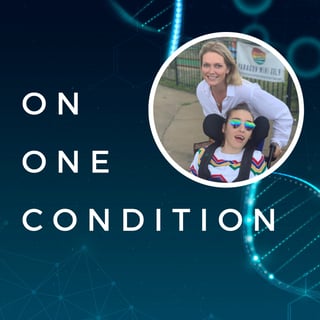
Speaker: Hi, I'm Sylvain Bertolini, listening to On One Condition, a podcast to raise awareness about health conditions by listening to people who leave them every day. My guest today is Roberta Smith, and we're going to talk about Allergy syndrome and her daughter, Chloe.
Speaker: Hi, Roberta. Thanks for joining me. How are you doing? I'm doing great. Thank you so much for having me today. It's my pleasure. So you know I like starting with a song. So which song did you choose and why?
Speaker: I do. Here Comes the Sun is a song that navigating the early years of Allogile Syndrome with my daughter and her twin sister who does not have Allogile.
Speaker: During our hospital stays, I had this little monkey toy that I had bought in the hospital. has long legs and And it has Velcro on the hands so that you can wrap it around the car seat.
Speaker: And you can push the center of it and it would play here comes the sun. nice And this worked. Gosh, my daughters are 22 years old now. And this worked until a year ago.
Speaker: and it really became. kind of the uplifting tune that we would listen to during our hospital stays. it would come on the radio. it was just a reminder of you know, better days.
Speaker: Wow. That's a very positive way of approaching life. That's nice. You've just alluded to the fact that Chloe has a twin sister, but Chloe is the only one with allergial syndrome. Is that correct?
Speaker: That's right. I have twin daughters that are 22 years old, Chloe and Claudia, and Chloe has Allogel syndrome and Claudia does not. Could you tell us what Allogel is and how did you realize that Chloe has the condition?
Speaker: Absolutely. Allogel syndrome is a pediatric cholestatic liver disease that affects some to all organs and systems.
Speaker: So when Chloe was born, you know, I had, you know, twin daughters and carried them to full term, but they looked totally different at birth. And we could tell right away that something was different with Chloe. She was much smaller. She had a a yellow hue to her. So she was jaundiced.
Speaker: And before we left the hospital, I asked them to please check her bilirubin numbers because I was concerned about the jaundice and and it was brushed off a little bit to be, you know, neonatal jaundice.
Speaker: But when the numbers came back a day and a half later, after we left, they said, you need to take her to a larger hospital. The liver numbers are indicative of liver disease. So we immediately went to a larger hospital where they assessed her and What is very interesting is that um many people do not get an early diagnosis of Alligeal, but at the hospital we were at, someone knew Alligeal and they thought she had the facial features of Alligeal and therefore they tested a lot of lab work. They checked her kidneys. They looked at her heart. They looked at her her spine and skeletal system and her liver and they pieced it together and said,
Speaker: We believe she has this and we would like to do a genetic test. And at that time, genetic testing would turn around. I think it was like a three month turnaround. And so they said, well, in the meantime, let's get you over to even larger hospital that has other allergial patients get her scheduled for a liver biopsy. So at about a month old, she had a liver biopsy and they said during this s liver biopsy, if we believe it's allergial syndrome,
Speaker: we'll just take a biopsy, close her up. But if we believe it's biliary atresia, another cholestatic liver disease will perform a surgery and she will come out having the surgery.
Speaker: So we didn't know what would happen during that biopsy. And so they came out and said allegeal syndrome and thus unfolded several years of different diagnoses underneath the allegeal syndrome umbrella.
Speaker: Okay. So is it quite unusual to have such a quick diagnosis then? Do you know how long it tends to take for other other children?
Speaker: Yeah. At that time, 22 years ago, it was kind of rare to have an immediate diagnosis of allergial syndrome. And even now we see some individuals, if they're around a very large institution or hospital system, they would receive a much quicker diagnosis. But for those in the outlier, rural communities, rural hospitals, this could take years. And even now,
Speaker: We see individuals, adults who are diagnosed only because their children are diagnosed. So we see a big spectrum between now babies who are closer to big hospital systems to adults and even grandparents being diagnosed.
Speaker: It really depends on where you are, what kind of center you're nearby and what the physician knows about Alligeal. Yeah. You said multiple further diagnosis after this initial diagnosis. What do you mean by that?
Speaker: Because the allogial syndrome is actually a syndrome and it affects some to all organs and systems. Everyone who has it has it differently. So for example, my daughter had severe liver disease, stage two chronic kidney disease, an eye anomaly, the facial features, short stature, where some people may have severe cardiac and no liver, and maybe they have mild kidney issues and an eye anomaly.
Speaker: Or maybe someone has butterfly vertebrae and mild cardiac involvement and severe liver and no kidney. It's really dependent on what clinical features they present with.
Speaker: And these diagnoses could unfold over the course of weeks to years. It's not necessarily that then you have a load of tests to discover what's the level of the severity in a way or which organs it's affecting. It's more that you discover based on, for you at least, you discovered based on the symptoms that Chloe had.
Speaker: Now... People look at all of it. If they suspect Alagil, they look at every system. But that doesn't always happen in other parts of the world or even more rural areas. So it's very dependent on the care.
Speaker: Yeah. What kind of impact does it have or did it have? Because I know ah Chloe has been on on a treatment journey, which is good and we're going to talk about. But what kind of impact did it have on Chloe as she was growing up?
Speaker: For those who have severe liver disease or even moderate liver disease, 85% of those who have that have pruritus. That cholestatic pruritus is called itching.
Speaker: My daughter started to itch. It's a debilitating and just insatiable itch that you can never scratch all over your body.
Speaker: And because I had twins, I noticed at a young age that Chloe was digging her face into my shoulder. She was only a few months old, four three and a half, four months old. And I thought, why why is she doing that? It's different than what her sister was doing. And so I went to her pediatrician who actually knew Alligeal and he said, I think she may be starting to itch.
Speaker: And i read about that and I started to get very scared because those who have this severe pruritus They are impacted very negatively by the itching because you just can't ever relieve it.
Speaker: For Chloe, really the hardest symptom of allegeal syndrome overall was colostatic pruritus. It started off where she was itching. Then i would see little cuts on her face, even as a baby.
Speaker: And then as it progresses, she got older, it moved to digging her ears out blood all over in her bed when I would get up to see her in the morning as a toddler, she'd be standing in her crib and rubbing her hands in blood.
Speaker: I could smell it. The second I walked in the room was like a wall of blood. It was very, very difficult. And that progressively impacted the family, the family dynamic.
Speaker: I could not sleep. I was up all night scratching. If I tried to go to my room, I could hear her suffering all night long and I would agonize and I would get out and just go scratch with her and lay with her, scratch her back until I fell asleep or if she fell asleep. And if she did fall asleep, the second I stopped, she would wake back up and I'd keep doing it.
Speaker: It impacted my ability to work. It impacted my ability to function. It impacted my mental health and it impacted her in other ways as well.
Speaker: Sleep deprivation is unbelievable. It impacted her sleep, her ability to function during the day, her ability to concentrate even when she went to school.
Speaker: And so at 12 years old, we were able to get her into a clinical drug trial. And I'm in northern Michigan, and I would work an eight-hour day. we would drive down to Indianapolis to Riley Children's Hospital for this clinical trial.
Speaker: yeah It was seven hours away, and she ended up being in that clinical trial for over 11 years before getting a liver transplant in June of 2024.
Speaker: So liver disease for her was the biggest impact, as well as the overall burden of disease was heaviest because of the calesthetic pruritus.
Speaker: That sounds horrendous. And I can completely empathize with the the lack of sleep. And i imagine the feeling of not being able to do anything from your point of view.
Speaker: That must be those be so difficult. You know, Sylvan, it was very, very difficult. And I think back to those times. I don't know how.
Speaker: I was able to actually hold down a job. And during that time, I became a single parent with no, no help with the additional parent, you know, and I think with rare disease, people just live their normal lives and they might be impacted by substance abuse or drug abuse or ADHD or some handicap or, you know, they have life
Speaker: that they're dealing with. And then they have rare disease on top of it. And so that was the situation in our family where her father, he had a substance abuse problem that once the girls were born and this rare disease became all consuming, he could not cope and he left.
Speaker: So I was there doing all of it. And and I, I'm so blessed because i I wouldn't want it any other way, you know, in terms of being there. But at the same time, you know, you still have to be able to support your children and hold down a job. But when burden of disease for something like calesthetic paritis is so very heavy, it takes a mental toll.
Speaker: Because you can't you can't do everything that you need to do the way that you need to do it. And you're so sleep deprived and anxious. I'm telling you, it's tough.
Speaker: It's tough. Did you get any support from like the healthcare system? Or did you have anyone around you who was here to help you, to give you a bit of time?
Speaker: i Yeah, I did have friends and family that would help me, which thank goodness. But The health care system and something that we try to bring to light at the Eligible Center Alliance is that there is no support in the health care system for caregivers.
Speaker: You know, insurance doesn't cover caregiver support. So the caregiver would have to go to their own physician and start their own pathway for treatment. And it's not really recognized as part of treatment for rare disease or under a family umbrella for a caregiver.
Speaker: I think it's important, you know, with rare disease that we start acknowledging the caregiver impact and the emotional aspects and the burden of disease on the patients in a different way.
Speaker: Yeah. Going back to the itching, did Chloe get any relief from scratching for it to go to having bloody hands by just by the fact of scratching against the bed?
Speaker: Are you able to describe what kind of itch it was? Because i yeah I find it very difficult to understand. So it started off with the cutting on her face. digging out her ears, which when I say digging out her ears, if you could imagine blood all inside of the canal, fresh blood smeared down the face, up in the hair, in the bed, on furniture, to just using your clothes to move it around against your skin to create some kind of friction or relief and never getting relief.
Speaker: scratching in one spot or all over until excoriations and bleeding, which then causes scabs and those don't heal because you tear them off repeatedly. So that's how very bad it gets. And that's all the time. There is no relief from that other than one-offs like maybe a cold bath that might bring you know relief for 30 minutes. It's not something that can be addressed with topical lotion or creams, but there are certain sedatives that
Speaker: that were used, for example, hydroxyzine, it's kind of a more potent form of Benadryl. And that could maybe take the itch off. It could relieve some of the itch as an antihistamine, but not enough to make a difference. So the clinical drug trial that we were a part of, gosh, I'm so grateful to have been able to enroll my daughter in that.
Speaker: It is an IBAT inhibitor, which is an ileal bile acid transporter. which will move the bile through the biliary tract and through her system. That way it's not collecting in a body and causing the itching to the extent that it does. yeah And so for her, I started to see relief within a couple of weeks. And really where I noticed relief is if we were watching TV, She wasn't sitting on the floor digging her hands and feet into the carpet, suffering. Like shit if we were watching TV, I could hear oh grunting like the whole time because she's digging her hands and feet.
Speaker: She was actually sitting with me just enjoying the show. And she didn't know any different. But for me, it was an unbelievable obstacle that we were starting to overcome.
Speaker: And eventually she started sleeping through the night. I hadn't seen that in years. I hadn't slept through the night in years. And so after couple months of that, I'm like, wow, this is amazing. You know, I don't even know what it's like to to sleep normally. And you could see the scabs were starting to go away.
Speaker: ah She was eating more. She was sleeping better. I felt she had, you know, a burst in in growth, like a growth spurt. And she was filling out and gaining weight, which I feel directly attributed to the ability to sit and actually eat and get sleep. So it was amazing. I would say if I had to put a percentage on it, we saw anywhere from an 85 to 95% relief from the itching. it never goes yeah It would never go away completely for her, but we saw enough that she
Speaker: actually could function. That's incredible. That's, I felt emotional when you describe the change because it sounds ah like we are completely life changing. That's unbelievable. Yeah. When you walk into a room, Sylvain and you smell blood, the second you open the door, i mean, that alone should paint a picture of just how horrible, at like a literal nightmare.
Speaker: And you're living that every day because you're, as a parent, watching your child suffer. I can't describe watching what happens to, you know, your psyche when you're watching your child suffer day after day after day after day for years and you have nothing to help them.
Speaker: Crazy. No, no, I can't imagine. And that... is one symptom of one issue under the algeal umbrella.
Speaker: I was about to ask actually, so the so the clinical trial, is that something that addressed just the itching? Was there anything else that she had access to that was impacting the other symptoms?
Speaker: The drug trial was very significant. even though it's one symptom of one aspect of the liver disease, it truly was through community surveys. We know that it was the hardest symptom to deal with under allergial syndrome.
Speaker: And because it just had such a heavy burden of disease. And since the FDA approval of this particular drug in September, 2023, And then following that also another FDA approved drug of another IVAT inhibitor, we have seen just a huge reduction in the severity of colostatic pruritus in the community as burden of disease. That itching has kind of dropped down the list of like the number one debilitating symptom to now like number two or three, where now we have other issues that have floated to the top in the community because
Speaker: but we're seeing other things because itching is not as prevalent. Of course it's there. It's prevalent in everyone, but it's not as intrusive if they can get treatment, but you know, it's not available all over yet. So we have parts of the world that have been watching people on clinical trials, like in the U S for 10 years with this drug.
Speaker: And they're still sometimes a year away from it. But in terms of her, she still has chronic kidney disease. She has had a liver transplant because in April of 2023, she was diagnosed with hepatocellular carcinoma. They found a tumor in her liver due to the progressed liver disease and had that ablated.
Speaker: And then she had to wait six months to be cancer-free. And then they were able to get on get her on the transplant list. She was on the liver transplant list for nine months.
Speaker: And the physician kept saying to me, you need to find a donor. You have to find a donor because she was an adult on the transplant list and a small adult. She's four foot, 11 inches tall, just very petite.
Speaker: He said, I'm very, you know, I can't express enough. i'm I'm concerned about her ability to get a liver and you really need to work hard to try to find a liver for her. What was the urgency?
Speaker: Adult women on the liver transplant list have the highest death rate waiting for a liver. Oh, okay. So I made a decision to go public and we're a very private person.
Speaker: And so we went on a social media promo for trying to find a liver. And after nine months, Chloe's health was declining and I started to really get scared. I thought, man,
Speaker: We've come so far. and a friend of mine called me and she said, i see you guys are having a tough time. are you doing? I said, well, you know, times are hard.
Speaker: So she said, well, I really want to come and see you. Would that be all right? Let's make arrangements. I said, absolutely. And just as we were ready to hang up, she said, hey, can I tell you something? and I said, sure.
Speaker: She said, think i'm I'm a match for your daughter. She went through all this testing for months and made it to the very end of the testing with one more thing that she had to do. And they told her, we think that you're a match and they wanted to confirm it through a biopsy. And she said, I'm going to be scheduling, you know, one last MRI and then a biopsy to follow. And what do you do as someone like you're so grateful?
Speaker: But she lived a couple hours away from me too. So I couldn't, you know, i was like, should I like, should I swing by and pick you up? What can I do? you know, because it's incredible to hear that news and you feel so much relief, but you know, there's still time to go yet and anything can change.
Speaker: We just made it through that. And we were there to wait for the results and we would call each other after that. And then she was able to pick the date that she wanted to donate a portion of her liver.
Speaker: And we planned it together. And we met there at the hospital um in advance and went through all the, you know, all the waiting room stuff and did that together. And then they were both in the surgery waiting area, all prepped and ready to go. And I said, I got to go see my, my friend.
Speaker: And I went and saw her and she says, well, we're doing it, buddy. And we hugged and I was like, man, I, and I will never be able to thank you.
Speaker: and then, you know, my daughter went back and she went back and then in recovery, they were on the same floor, but one was down one hall and one was down the other. So they would have to try to walk to each other and push their, you know, their holes holes in you know, try to walk and it was it was an incredible experience. Incredible.
Speaker: Yeah, it's good to hear that there's still some humanity out there. Telling you. and So now with the liver transplant, has it had any impact on her symptoms at all?
Speaker: How does that affect allergial? For allergial syndrome, because it's a syndrome that affects some two organs, it essentially took away her liver disease under the syndrome umbrella.
Speaker: And so Chloe still has halageal. She still has the chronic kidney disease associated with it. She still has, you know, mild pulmonary stenosis. She still has facial features. She's still, you know, has aspects of the syndrome that will continue to progress.
Speaker: what is sometimes hard for people to really wrap their, their minds around is that when somebody has something like a transplant, it's like a whole new diagnosis and a whole new set of treatment pathways for life. yeah So not only does Chloe have aligial syndrome still, but she now also has liver transplant and that changes how she steers her life for the rest of her life. So she has immunosuppression drugs that impact her.
Speaker: With transplant, sometimes comes complications. So we've navigated those complications like bile duct infection, like strictures, like infection.
Speaker: We just continue to manage that while also managing the other aspects of alageal. Yeah. Wow. It's a never-ending question.
Speaker: That's a syndrome for life. Yeah. Yeah. So it's ah it's about navigating rare disease indefinitely. Yeah. And I think that's something people don't really grasp.
Speaker: It's not like, I was about to say, not like getting a cold, but it sounds too too benign, but I completely understand that. Yeah. It's something that you have to manage and that Chloe will have to manage for her whole life.
Speaker: There are so many layers to rare disease. We could think about, okay, she's had a transplant. or you could think about the more in-depth reality of what that is or the impact of that, the emotional impact, the impact on your ability to manage your appointments, the chronic illness throughout your life.
Speaker: Sometimes with something like Allagio, there are sometimes two to five, six specialists, you have to rotate those appointments, you have to manage your mental health, you have to adhere to your drugs, you can't not take your immunosuppressants.
Speaker: You know, so now you're committing for a life of medication. And although, you know, people would automatically think, well, you know, you should just be so grateful to be alive. And that should never be an issue. But for a teenager or a young adult,
Speaker: to know that for the rest of their life, they have to take this drug every day and they can't forget it. Or if they forget it for too many days in a row, it could it could cause ah life challenge that could be detrimental to their future health.
Speaker: There's a lot of heaviness to all of that. Along with that, the mental health of trying to navigate a chronic illness or rare disease as a child who someone else is managing your care and then try to flip that and manage your own care in such complicated circumstances.
Speaker: It's very scary and it's immobilizing for both sometimes the caregiver and the patient. Yeah. Yeah. I can imagine. And you had all this time investment for the clinical trial as well, driving seven hours to get to every appointment. That's right.
Speaker: When we first talked, you shared with me, and I will paraphrase that the pharma industry doesn't necessarily reciprocate the support that they get from patients.
Speaker: What did you mean by that? I think when Companies are working in rare disease. They need an in to learn who are all the patients, who are the key opinion leaders, the physicians.
Speaker: And oftentimes organizations are the keys to unlock those doors with introductions and as well. The companies don't know all the community members in a rare disease community. So an organization would really spearhead the messaging into the community and help link those individuals over to the company and the opportunity because who wouldn't want to be treated for a rare disease?
Speaker: But at some point, sometimes the companies surpass the knowledge of an organization. They may now know way more patients, way more physicians. They might have way more contacts around the world.
Speaker: And I think the goal for a company should be how can we reciprocate and help connect patients to an organization once that trajectory changes for you know the connections?
Speaker: How do we reciprocate sharing the physicians, the institutions, the knowledge that they have gained as we have helped with them.
Speaker: and I would say i've worked with a few different companies now, and I was in a really unique position as a parent, a caregiver, you know, managing the clinical trial, because I also and the president of the nonprofit who was intricately involved in helping these companies with their drugs.
Speaker: So experiencing the clinical trial or having that clinical trial experience for so long and also having the pulse on the community while also having relationships with the company it allowed me to see gaps in understanding what caregivers and patients need to start in a clinical trial, maintain for so long in a clinical trial and to stay in it.
Speaker: For example, if a clinical research site is making the hotel room, I would work eight hours, leave, drive seven hours. So I'm not getting to the hotel until one o'clock in the morning.
Speaker: If, and most typically it was on a Thursday night. So we'd have a Friday appointment. So in the middle of the night, when I get there, if there's an error with the registration for the hotel, they don't just say,
Speaker: well, sorry, the name is wrong. And some of this information is wrong, but we'll go ahead and give you the room anyway. No, you have to now pay for the room. And you might have to submit a reimbursement that would take a week to submit and wait 12 weeks for the reimbursement.
Speaker: If I am already putting my job at risk, because I'm traveling so much, you know, and I'm a single parent in my situation. So I'm Every single time I go to the clinical trial, I could be potentially putting my job at risk.
Speaker: Then if it's in a larger city, which most clinical trials are, they're with a large institution, they want those patients to be close to the institution. But then you're dealing with big city costs of hotels.
Speaker: We were right across from Lucas Oilfield right there. So if there was a game night, that hotel room, which was maybe $280 night was now $650 a night.
Speaker: So if there was an error, now I'm paying for that with money I don't have and waiting three months for the money back times that by maybe three more times in a 12 week period where I'm waiting for the reimbursement for the first one.
Speaker: I could have compounded costs waiting to come back to me. These are the types of things that I was able to help navigate with the company. okay This is happening to me and I'm broke.
Speaker: This is happening to other community members and how can we respond and change this? And I have to say the company was great. They immediately did what they could. They changed their policy on reimbursements, but not all companies.
Speaker: do that. So it was a a learning experience. And I learned so much. That's just one example of you know, if I did not have the wherewithal or the means to carry that money for even a little bit of time, it could have kept me from keeping my daughter in the trial.
Speaker: Yeah. These are the types of things that really need to be addressed. So I think where we miss out where there's a gap is that companies still Don't get in front of organizations before the protocols are made, before these rules are made, before they truly understand what families are going through.
Speaker: Yes. And I know people in the industry who are trying to change that. Unfortunately, it's quite difficult to change. And I wish it was much easier to address those challenges because without the patients, there wouldn't be any clinical trial.
Speaker: Without the community like Alagil, I'm sure it would be even much harder to find patients for, especially in the rare disease space. So I'm glad you shared that. Thank you.
Speaker: You're welcome. What's Chloe's situation now? Is she able to be independent or do you still care for her?
Speaker: Chloe, because she had her liver transplant at 20 years old, and had complications afterwards. When she graduated high school, she was already starting to get sick. We didn't know at the time that she had cancer, but she was very jaundiced. She had progressed liver disease. And so she didn't leap from high school to college.
Speaker: So she stayed home and just worked a job in town. And it got to a point where You know, we went in for further testing and had the cancer diagnosis, and then you're kind of consumed by that. So, you know, she is not able to go on and do things like her sister is. So here we see that they're surpassing of having twins, what one can start moving on in their life to into adulthood. And so Chloe was really stunted by what was going on medically in that critical developmental peak time.
Speaker: then going through something like transplant, you're waiting, you're just waiting around. So she can't work in that waiting time because she's sick. And she's kind of stuck to her room or stuck locally.
Speaker: and then when you finally get transplant, there's a huge healing process there. So I think now where Chloe is, is that she has had fewer and fewer complications. She's able to now volunteer a few days a week with limited hours and is starting to look, you know, toward her future. She's taking some college courses online, which is wonderful.
Speaker: you know, she's thinking about her future in different ways. I think she finally wants to get her driver's license because she just was not up to doing that before. And so she's making plans for the future. And I think,
Speaker: I'm loving it. Keep it going. You know? Well, I wish her all the best. Thank you. i have one last question for you. Sure. What's your happy place? A place where you feel at peace?
Speaker: My happy place. You know, when the girls were little, I would hear them playing and laughing and teasing each other.
Speaker: And I think my happy place is when my family is together and there's joy and nobody's thinking about the weight of life, the weight of rare disease.
Speaker: We're just being, you know, and hearing my kids laugh. That's my happy place. That's so nice.
Speaker: Thank you so much. It sounds like you've been through hell of a lot. You've described so many things that made me emotional thinking about your situation and Chloe's situation.
Speaker: And I'm glad that Chloe is in a place where she can start thinking about her future. That's amazing. I look forward to seeing what direction she goes. Yep.
Speaker: Well, thank you. And I wish you all the best. Thank you so much.