Transcript
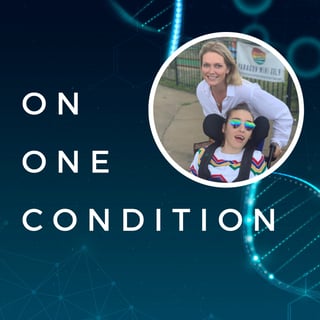
Speaker: Hi, I'm Sylvain Bertolo and you're listening to On One Condition, a podcast to raise awareness about health conditions by listening to people who leave them every day. My guest today is Gay Grossman and we're going to talk about ADCY5 and her daughter Lily.
Speaker: Hi Gay, thank you for joining me on the podcast. How are you? I'm doing fine. Thank you very much for inviting me to be on your podcast. Well, it's a real pleasure.
Speaker: As you know, I love starting with a song. So which song did you choose and why this song? I chose Pachelbel because it's something that has always... remember it actually being on a commercial when I was very young. i used to grow up watching the news at breakfast and there was a commercial by General Electric that would play this song and I always loved this song.
Speaker: And It was supposed to be played at our wedding. And when the flautists started playing a different song, my husband and I looked at each other and I said, she's playing the wrong song. I know, but only you and I know it.
Speaker: Yeah, um it is. It's just always i have it playing in the background a lot when I'm trying to, you know, just kind of decompress and relax. I just think it's a nice song. Nice piece. I should call it a piece instead of a song. the Yes, that's that's true.
Speaker: Nice. And we don't get classical pieces a lot. So I like that. So we're going to talk about ADCY5. And i guess the best place to start is probably explaining what it means, what it is, and how it's impacted you and your daughter, Lily.
Speaker: My daughter has a variant on that gene called ADCY5. And it presents itself much like cerebral palsy where she is affected not cognitively, but physically.
Speaker: And so her trunk is very weak and she needs help with pretty much everything. She's getting stronger because of a treatment we've been able to identify. She's getting stronger all the time, but she still needs help with things that you and I take for granted, like walking up a couple stairs or getting dressed, cooking.
Speaker: things that we do without thinking about at all. Yeah. How old is Lily now? She's 28. And that's something that she's had from being a baby?
Speaker: yeah it's genetics. So she was born with it, with that variant. And, you know, we were discharged from the hospital with a healthy baby. And we started noticing when she was about seven or eight months and started asking a lot of questions, started asking doctors, but They kept reassuring us that nothing was wrong, which is what you want to hear as a parent.
Speaker: okay As time went on, it became more clear that she was having a lot of challenges. Was it easy to get a diagnosis? What was the process? No, not at all. Because back in the day, you know, this was 1997 when she was born and a lot of the genetic testing that was being done was not obviously what's being done today.
Speaker: So she was 15 years old and She was diagnosed through whole genome sequencing, which was not available commercially. We were able to get her into a study and the study was able to diagnose the gene, but she was the first one Scripps here in La Jolla to be diagnosed through whole genome sequencing. And she's one of the first in the world to have whole genome sequencing.
Speaker: Wow. Was it easy or difficult to get her on that study to to get the whole genome sequencing? I like to say I can be very convincing. so I was told about the study from another mom and i found out who was coordinating the study and I went to see them personally. I didn't email them.
Speaker: I went with a bright pink binder with a picture of Lily's face on the, on the front and a picture of her in her wheelchair in the back. And I just explained that.
Speaker: that in this notebook is every medical test result and every one of them is normal and we are out of tests and this is really our only hope to help her.
Speaker: She at that time had severe movements that would wake her up sometimes every five minutes. It's much like watching someone having a grand mal seizure over and over and over again, but it wasn't.
Speaker: She was aware and awake when it was happening or painful. you know, she would sometimes pull a muscle and then it would happen all over again. And it was just a repetitive, debilitating, destructive, awful time that this was happening.
Speaker: Was she having those movements constantly throughout the day? She would have them sometimes during the day. It was kind of like a vicious cycle. If she had a really bad night, she would likely have a really bad day and it would just kind of build on itself. But, um,
Speaker: she would mostly have them during the day when she would transition, like when we would, you know, stand her up on her feet to move to maybe another chair or she used a walker when she was younger and it would be when she would get up to use her walker and start walking like kind of three steps in her legs would bind and get really stiff and the movements would start and she would just, her whole body would get really stiff and you'd have to, you know, catch her before she fell. Yeah. We just kind of knew what happened. And anybody who worked with her at school, they would know. Like if she if she stood up, you'd have to kind of watch her until she gets going.
Speaker: And then she would run off. Okay. So I imagine that it was quite dangerous. Would you be able to leave her by herself? No. Do you have to constantly watch her?
Speaker: Yeah, she has 24-7 care still today. Oh, yeah. How was it for Lily? Because you said that it's... affecting her physically, but not cognitively.
Speaker: Did she share any frustration with not being able to control her body as she wants to? Oh, for sure. Yeah. I mean, she, she was little, she would get very frustrated and you know, it's hard to know and to watch everybody else running around freely and so smoothly when your body won't cooperate. So yes. I mean, I remember when she was very young, she was probably two walking with her walker and she looked across the street at the kids playing and said, I want to do that.
Speaker: You know, that's hard for a parent to hear because of course that's all we wanted her to be able to do too is whatever she dreamed to do. Yeah. But she's very, very smart and she and I spent a lot of time reading and going to the library. yeah know, she was always a little ahead of the curve and remember one time she was very little and we went into the the library and we asked for, she loves the ballet. So we asked for Swan Lake and the librarian took us over to the children's version of Swan Lake. And she looked at the librarian and she said, no, the real one. And the librarian said, she kind of looked at me and she said, you know, it's, it's, it's hours long. I just don't know if she'd have the staying power, you know, to watch it all. And,
Speaker: Lily and I kind of looked at each other like she doesn't know us. know she doesnt She doesn't know Lily. So she's always been, you know, just very aware. yeah You know, reading early, knowing that activities are either something that she has mastered and she wants to do the next thing, or it's something that she doesn't even want to be involved in. She knows very quickly what she wants to do and and not do. She makes decisions very quickly about everything.
Speaker: That's how she does everything in her life. She just knows what she but she likes. Nice. I imagine that that's something you need to be able to grow up with the condition that she has.
Speaker: So going back, because I took us on a tangent here. Well, all very interesting, but we were talking about the genome sequencing. That's how Lily was diagnosed.
Speaker: What did it lead to? Was there anything that was then available to you? Yes. So we had done a lot of research about things that she ate, exercise and what kind of exercise she was doing, her sleep.
Speaker: We were really managing that very acutely. I mean, we were making sure that she had as much sleep as possible, however she could get it or however much rest she could get. And from a very young age, we were feeding her, you know, whole foods, organic foods, because then we thought she had a mitochondrial disease. And when I read about the mitochondria and it turning, you know, food into energy, I thought, well, why would I waste her energy filtering colors and things that her body doesn't need? And so we, know you know, we knew exactly what she was eating and what time she was eating.
Speaker: We had her on medications that would try to stop the movements or at least dull the movements, which of course would dull her as well. And once we had the gene, we knew that none of those medications were really helping her.
Speaker: okay And so we were able to take her off of all the medications that were dulling her and focus on the actual gene and what might be able to help her.
Speaker: There was one paper that we were able to use with a family, written about a family that had a facial twitch because of this genetic variant, but we've never found them. They weren't affected like Lily is. You know Lily's the first one in the world to have this full body presentation. Now they're now they're hundreds, like 600 to 800 people.
Speaker: We didn't really have anything to go on, but we did have one drug that we could try. And we did, and it would work well, but then after about a month and a half, it would it would start another symptom, which would be one extremity of her body would start constantly moving.
Speaker: So like her head would constantly start moving. And if we stopped it for a couple of weeks and then we started it again, she would have a a time where her body wasn't as spastic, but then her arms might start moving and then we'd stop it and we'd start it again, but then her legs might start jiggling.
Speaker: You know, she always said to me, it's a love-hate relationship with that medication because it does help me, but then it really gets challenging. Yeah. So we didn't have, we still don't have all the answers, but we had more answers. And getting her off of those medications that were dulling her was very helpful to her.
Speaker: And i have often said to her, how did you go through school with with all of that? And she said, I don't know. I mean, she just, she did get through school. She had to, you know, it's very challenging getting through school because some days she just physically was so exhausted. And I remember thinking to myself, I'm so exhausted. yeah I don't know how she can get up and go to school, but she always wanted to. I think it was kind of a way for her to, you know, change her mind. You'd have to ask her some of these questions because I can answer as a mom, but she's the one who's really the expert on, you know, what it's like.
Speaker: Yeah. Talking about school, did she have to go to a school for children with special needs or was she able to follow the standards? She always went to a typical school.
Speaker: Okay. And she was the only one that I knew that had a physical challenge. There was one child in her elementary school who had CP.
Speaker: And then we moved to California and The only other child was younger than Lily, but they were the only two who used a wheelchair or walker.
Speaker: How easy or difficult was it to get the school to accommodate for Lily? I can tell you there was no school that was smooth.
Speaker: Yeah. Even nursery school. By the time Lily got to college, she had learned to accommodate things on her own. And she knew what she needed for accommodations for classes because your IEP doesn't follow you to college.
Speaker: But she knew what she needed to access classes in college. And she was the one who would go to each professor and say, this is what I need. So I would say college was less of a challenge. I was not involved in that. She really managed that herself. But I didn't.
Speaker: involve her in the challenges that we had with schools when she was growing up, because I just thought there was enough for her to manage with school itself. And it was really my job as a parent to work with the school and make sure that she had what she needed.
Speaker: But no, it was not smooth. No. I know schools can be very specific about their roles, not doing too much to deviate from those rules. So I can imagine that it must have been very challenging. How did you get them to accommodate? It was, but my husband and I really made sure that we came up with solutions rather than just going to schools and demanding things. So for example, when she was in kindergarten and we said she needs a laptop because her you know her ability to speak what she needs or answer questions
Speaker: it would be delayed because her mouth muscles are also affected. And so if she was in kindergarten and someone asked her to say something, it would, you know would take a while for her to, to express herself. yeah And we had her using a laptop at home starting when she was two, and it was just a regular laptop. It wasn't a special piece of equipment.
Speaker: So in order to have her worksheets filled out, if you can take yourself back to kindergarten and they'd have a list of images right down the left hand side. And then on the right hand side, there'd be a blank space and you had to write down or even just match the word to the object.
Speaker: yeah And Lily wasn't able to hold a pencil. So we wanted her to be able to do the work herself. And the solution the school would come up with was, well, we we will have, you know, she'll have an aid and they can scribe for her.
Speaker: But you don't really know if the child knows how to spell balloon. if you have the child pointing to the balloon and then saying balloon and the person writes it in, right? How do you know that you really know that what a B is or an a So I really wanted Lilly to do the entire process. And actually the law is that any assignment has to be accessible to a student just as it would to another student. So for example, if if Lilly had a textbook,
Speaker: She had to have that textbook in PDF format so she could look at it on her laptop because otherwise she is trying to hold a big book in her lap. It's too heavy for her to hold.
Speaker: yeah So going back to kindergarten, what we did with the um with the images matching them up to the words, my husband was in IT at the time. And so he was able to identify a software software.
Speaker: where the worksheet with the worksheet could be scanned into the computer and then a text box could be highlighted next to each image and then Lily could type in the word. And that way Lily was able to do all the assignments just like everybody else.
Speaker: But we had challenges, ridiculous challenges. I'll give you an example of high school. There was one teacher that I really went head to head with because one semester Lily had all zeros for her labs in science.
Speaker: And so, of course, I'm saying to Lily, like, why aren't you doing your labs? And she's saying, I am do that doing them, but I can't hand them in. And i I like it took me a long time to get out of her not because she wasn't trying to, but, you know, because the communication was hard for her. And I say, what do you mean you can't hand them in?
Speaker: And she said, well, you have to hand them in before class is over. And I said, but why can't you hand them in before class is over? Because you're doing the lab on your laptop. And she said, because i have to print it out.
Speaker: And I said, but isn't there a printer in your classroom? So anyway, to tell you what actually was happening, yes, it was required for students to hand it in by the end of class.
Speaker: Lily had to leave the classroom and go down to the library, which was the farthest building in her high school. Her high school is pretty big. It's a full city block. She would have to go down to the library and print it off and then take her entire lunch break to go all the way back to the science room, hand in the lab, and then get herself to the cafeteria for lunch. And by that time, lunch would pretty much be over.
Speaker: And so I went to the teacher and I said, I see a printer right over there on the counter. Like, why can't Lily just send that to the printer? And he said, well, that's not her ink. And I said, OK, well, why couldn't she email it to you?
Speaker: And he said, because I don't like to have my inbox full. And I said, well, you know, work with me on this. Like, how can Lily get it to you? And he said, she can't. And you told me not to treat her any differently than any other student.
Speaker: And I thought, holy cow. That's the kind of thing that we were up against many, yeah many times. Like, just... I would say treat Lily like another student, but my gosh, at the same time, you can't not let her hand things in because it's not physically possible for her to write it with a pencil on a piece of paper like everybody else is doing.
Speaker: Yeah. High school, I would say, is the was the worst, but I'm proud to say the entire high school campus has been rebuilt because of challenges that we had with them.
Speaker: And, you know, they were very proud in saying to me, well, this all can't be done while Lily's here. And I said to them, doesn't even matter to me because I'm here to help Lily get access to an education. But the next child and the next student and the next grandparent who wants to go to a concert and see their child or whomever wants to access will be able to. And now when I drive by the high school, I feel very good about the fact that every student has access to things that Lily wants.
Speaker: had challenges having access to. Well, that must have been a lot of fights. It was. But, you know, I look back at it now and, you know, I talk to families and i help families. They'll send me messages and say, you know, how do I do this? And I always say to them, you have to go with a solution. You can't just fight. If you think about it, teachers are not taught to help students who have challenges. They don't know what the solution is.
Speaker: And you know your child better than anybody. And if you can come up with a solution and show them how it works, it not only helps them with your child, but the next student who comes along could also benefit from something like that.
Speaker: Yeah. Well, incredible, but very true. Going back to Lily's treatment, there was a treatment that worked for a few weeks, but then was not very nice for Lily.
Speaker: What was your next step after that? Well, the first thing that we did when we found out what the gene was, was we knew not having other families, we weren't going to be able to do research. We knew we needed about 100. We knew we needed a critical mass to do any kind of research or getting any researcher to give us attention.
Speaker: And so you can imagine that them finding the gene and helping Lily was big news here in San Diego. And so we were able to take advantage of some press that was really helpful to us. And we agreed to every single story and journalists who was interested in speaking with us on one condition, that they put the website, adcy5.org, in their article so that if there were other families who read the article and read about the symptoms, they would connect with us, or at least they would go get a genetic test. They would go talk to their doctor.
Speaker: And so that's really what helped us. We were able to not only find individuals who had these symptoms and help them get to a doctor who could get them a genetic test, but we also were able to find researchers who were studying the gene but had never seen a patient before.
Speaker: So we immediately started you know building our team and that scientific advisory board and doing research and talking to all the families who contacted us that were affected by this variant.
Speaker: And we had One gentleman call us who was in his forties and he was just diagnosed and we were having zoom calls with him and he kept telling us, you know, I really need to send a video to you when I'm not drinking coffee.
Speaker: I so clearly remember closing our laptop and my husband and i looked at each other and we said, why does he keep talking about that? And then he sent us the video and he looked like Lily moving.
Speaker: And I thought, wait a minute, what's happening here? So we connected him to our researchers and they made the connection because another individual at a very young age in Europe was given coffee by his parents.
Speaker: And they noticed that it it would dull the movements and and they just you know did better. And so this was when Lily was in college. And so the researchers then By this time, we had a mouse model and they were able to test caffeine on the mice and prove that it does turn back the overexpressed gene.
Speaker: We were fortunate enough to be so in contact with the researchers and the the clinician that Lily saw that we were able to work as a team to get it really dialed in and get to her the dose. And you know how often should she take it during the day and night?
Speaker: It has a very short half-life. So it took a long time, like I would say a year and a half, to get it the way it needed to be. But today, Lily's, i would say, almost night and day of what she was before. She sleeps all night.
Speaker: She can get herself in and out of her wheelchair. She still does use a wheelchair, but she can stand up from it. She can, you know, use the bathroom independently, whether she's in her home or at a restaurant.
Speaker: She can speak very clearly. She's been on a panel. She has done a podcast where she used equipment for the longer answers, you know, that might be more challenging for her to say just because her mouth does get tired, but she is confident enough to do something like that now. she She is, you know, continuing her education and she's, you know, it's very clear in the moment that i realized that her speech had truly changed was even I, who knows her better than any anyone, when she was in college, I would need to FaceTime her so that I could see her mouth and understand what she was, just understand what she was saying. is before she started taking caffeine.
Speaker: And I knew one day when I was on a call with her, that was not a video call. And she needed me to call the credit card company because she had a question about one of the charges on our card.
Speaker: And as soon as the gentleman answered the phone, i thought, oh, my gosh, I don't have Lily's account number. It's the first thing he's going to ask me, right? So I'm texting her madly, like, send me your account number.
Speaker: And, of course, he said, what's your account number? And she rattled off the 16 digits. And he understood her the first time. And I thought, yes, she is completely different than she was before.
Speaker: Because she wouldn't have been able to do that. yeah Well, that must have been a massive change for her. Did it change anything else? Well, taking her off all of those medications and then putting her on the right, you know, small compound is what changed her life. And we just, just this past week, we went to a restaurant with her.
Speaker: She usually tells me what she wants to order. And then I just order it. Well, this time, she ordered it. And not only did she order it, she she loves burgers. So she ordered a burger and she wanted it without lettuce and no sauce, no bun and with French fries.
Speaker: And so the woman is writing all this down. And then Lily looked at her and she said, could you please read it back to me? Because she wanted to make sure it was right. yeah And I thought it was really the first time I had seen her not only order, but also so clearly explain exactly how she wanted the order to be and then requested it be read back to her to check the accuracy.
Speaker: Yeah. Wow. And how did you get to get the dose right for Lily? Is that, so did did it require any trial? mean like a clinical trial? Yes. Yeah.
Speaker: No, it didn't require a clinical trial because it's already approved. It's already approved compound that people can use, but it did take a lot of trial and error and feedback from her.
Speaker: And also she is, you know, under the watch of a team of doctors to make sure that she's not taking too much to affect other parts of her, of her body.
Speaker: She's continually giving feedback to not only her doctor, but researchers so that we can help other families too. And that's that's what we do is when families come to us and they say, you know, we want to try this and it's not working, we connect them to the doctors and the researchers.
Speaker: Okay. So are you still involved now with people who have ADCY5 then? Yeah, my husband and i are the ones who lead the foundation. My husband more so than I. he is the one who oversees the board and works with our scientific advisory board and the researchers.
Speaker: We did go to the Movement Disorder Congress this past year. It's the fourth time we've attended and we had a table there. And the first time we went, we had a table and the the clinicians who came up to us had never heard of the gene and they didn't know what the symptoms were. And we remind people that it looks a lot like cerebral palsy or it could be diagnosis of mitochondrial disease or epilepsy, but you need a genetic test. And this year, you know, time has passed because the last time there, the first time that we went, it was probably six to eight years ago.
Speaker: This year, we had so many doctors coming up to us and saying, oh, I have a patient that has that. I have a patient who, yep, that's one of my top five genes I test for now. They know it. And we do a lot of posting about it. And, you know, doing things like the podcast with you is what helps get the word out to other families who might be challenged with things like cerebral palsy or epilepsy or mitochondrial disease. But, you know, things have changed so much in genetic testing that If you have a diagnosis like that, that was something that was the diagnosis five years ago, today it's looked at as a symptom, but it's not the root cause of the disease.
Speaker: The root cause of the disease is the gene. And if you don't know what the gene is, you know, we couldn't have done the research without knowing the gene. We couldn't have connected all these people. And we're still doing research. You know, we're working on an ASO. We're working on other small molecules that might help even more.
Speaker: There's a lot of research that we're still doing. Wow. You make it sound not effortless, but you don't make it sound hard. about but I'm sure that that everything you've talked about involved a lot of effort, a lot of pushing in the right direction and so on. i you know it's I've been told that.
Speaker: I don't know how to change that to let people know how hard it was. But I've had other people tell that tell me that before. And some people will say, You've always made your life look so easy. It doesn't look like it's that hard. And i don't think, well, first of all, we didn't let people sleep in our house because Lily was crying all night. So nobody really knew what the nights were like, and you know except a very few chosen people could be a part of that world for us. And nobody was in the school meetings with us to see how challenging that was.
Speaker: So no one really knew. And I think really when friends of mine said, I didn't know how hard it was, was when she was diagnosed and the articles were in the newspaper.
Speaker: And people started reading about Lily. And they started reading about our life. And there was one article that was written by Gary Robbins from the San Diego Tribune. And he wrote about two things that stick out to me. One was he shared the detail that we couldn't open our windows at night, even in the summertime, because Lily would cry and people in the neighborhood would be able to hear her.
Speaker: hu Our next door neighbor, even i remember one time came over and said, I can tell you're going through a hard time because he could hear her crying. There was nothing we could do. The other thing he wrote about was we didn't know that she had a normal life expectancy until she had a genetic test. And at that time she was diagnosed with an undiagnosed mitochondrial disease. And, you know, 80% of people diagnosed with a mitochondrial disease don't live until they're 20.
Speaker: yeah And so my husband and i always lived with We're going to be the 20%. And we always planned and had her education around she's going to survive into adulthood, but we didn't really know.
Speaker: And, you know, he also put that in the article. And that was the first time that we had to tell Lily that because obviously we didn't share that with her. Yeah. But we had to tell her because it was going to be in the newspaper.
Speaker: And she wrote one of her college essays that said, I learned I had a normal life expectancy the same day i learned I didn't. You know, was a challenging conversation to say to her, you know, we yes, we knew this information and we didn't share it with you. And this is why yeah i never wanted her to think that she, you know, we wanted her to know that her possibilities were endless and she could do whatever she wanted to do.
Speaker: With accommodation, she can do anything she wants to do. It's amazing. I've got one last question for you. What's your happy place, a place where you feel at peace?
Speaker: i see My happy place is the beach. I love the water. And it doesn't matter what time of year it is, but I live in San Diego, so it's always nice. But I'll tell you today, it's a little cool. It's in the 60s.
Speaker: But I love to wake up and see the sunshine and just know that I can be there and just kind of check everything else out.
Speaker: I'm with you on that one. I'm happy on the beach. It relaxes me in a way that nowhere else does. i love it Well, thank you so much, Gay, for sharing your and Lily's story.
Speaker: I've got the feeling that it was a very tough journey. it doesn't transpire so much. I don't quite know how to. I am pretty personal with my personal life and fair enough. I share what I share because I know it will help another person. And I remember how challenging my most challenging year was when Lily was three.
Speaker: And I remember that feeling so clearly. And so what I do is try to help those parents who are struggling and, you know, going to bed and thinking who's going to help me. Nobody's helping me. Yeah.
Speaker: that was the worst. I want someone to know that there's always someone there to help them. And we've gone through the hardest part, I hope. yeah And I hope that there'll just be more success with helping other families.
Speaker: I'm sure there will. It's incredible to hear about the progress for Lily, this life-changing treatment. And other families. There are many families in our yeah community that we've helped.
Speaker: So she's not the only one to receive this and and have the attention to get the dosing correct and They're more, you know, they're more. There's always more to help. we new New families are diagnosed all the time. I just got an email actually this week from someone who said, my son was just diagnosed and I've had a tremor my whole life. How do I get myself tested?
Speaker: Well, it's great that they have you to help. Thanks a lot for your time. I wish you all the best. Well, thanks for reaching out.