Transcript
Speaker: Honestly, I think the word akiya is a little bit problematic. Not so problematic for foreigners, but I think it's loaded term for Japanese speakers. i think it brings up a lot of feelings of exactly that kind of despair that you're thinking of. Like, oh, Japan used to be great, and now there's abandoned homes everywhere combined with like the weak yen that foreigners, for foreigners, it's quite cheap, but for Japanese people, the word akiya kind of is like loaded with all that extra baggage of Japan not doing so well economically.
Speaker: Welcome back to the Buying a House in Japan podcast, the number one Akiya and Japan real estate podcast in the world. Today we are recording from Ueno, primetime Sakura season. Joey, how are you doing? I don't love the Sakura season.
Speaker: lot of people, pollen allergies. Despite that, I'm doing good. It was a long trip. I am tired, but Otsukaresama desu. We're recording this in April. This has been after our month Bender Through Japan. You'll see a ton of content that we probably have recorded over the past couple weeks.
Speaker: um Quick recap. We went from Tama, I got sick. Joey went to Otaru, then we met down in Fukuoka, then we went to Beppu, and then we met back to Tama, meeting ton of people, recording a ton of content.
Speaker: At the start of this trip, we had kind of had three pillars that we were trying to focus on. Health, not drinking, and energy. Joey, give us the quick ratings of each one of those.
Speaker: health um also not drinking i actually think we did good there were two two events where we did bad but i think overall like it's really easy to drink in japan the nama beer culture so it's just kind of everywhere every um so many social gatherings especially in a business context revolve around alcohol and we did a great job just drinking non-alcoholic beers except for two events i would say the party we threw which you know obvious and then we had a day where we kind of like slipped up a little bit and five shots of whiskey. and thats got heaac I got sick. I got the stomach flu, but I agree with you.
Speaker: A minus. A minus. All right. Health and specifically eating healthy. What would you give us? We tried to eat much more healthier. Again, kind of like drinking in Japan. Like when you're traveling in Japan, restaurant food is just so maybe maybe not processed, but like fried food everywhere. Konbini food definitely, you know, processed. And when you're on the go, sometimes you're just you're eating at convenience stores a lot. What we wanted to do was we tried to get like a home chef to meal prep us a bunch of like healthy meals and we'd eat that through the day or the over the time we were here.
Speaker: didn Didn't work out. um We ended up eating at a lot of restaurants not so much kind convenience store food but a lot of restaurants. B minus. Yeah just quick note on that I feel like Japan's food tastes so good but you have to be really conscious of like how healthy it is especially when you eat out like Joey loves the Indian food, sorry bro, but there's like so much sugar. They they make that taste too good here. Love the Indian Konbini food, got a ton of preservatives. We ended up eating so much tonkatsu fried food.
Speaker: I caved and had like freaking pudding and ice cream for breakfast since we were in Oka. I was like, cake oh my God, we ate so much cheesecake, coffee, but overall we did better than the trips in the past, I would say.
Speaker: Agreed. Energy wise, this is a long trip. So this is a three week trip. This one was pretty long. And again, like I feel like I need the break days in between. yeah And all our break days got filled up, which is like a good, we as you were saying, like it's a good problem. you know This is a problem that we wished we had when our business was so small. And now it's like, you know, so many people want to meet and so our break days get get skizzled up with meeting other people. And it always makes sense. But yeah, man, it's tiring.
Speaker: And then especially with flights, we tried to do flights this time instead of driving and just like the airport security, getting to Narita Airport from the house. That was tough. I think energy wise, I'm giving us a C near the end of it. I was running on fumes and just the the activities we're doing.
Speaker: I wasn't giving it my full full energy. I got sick midway through, which is a clear signal. So I, maybe I get an F and there in there and that if I had to go through with that and thanks for covering an old Tati bro, but I couldn't make it, if I had to go there, I think I would've been sick for the rest of the trip.
Speaker: But the good thing is we did do a lot more delegation here. You know, I think Travel coordination is stressful a lot of times. Doing these bookings in Japanese is hard. So we did have someone help us a little bit through that, and I think that was a big win. We did explore looking having ah like ah a personal chef meal prep for us, which is quite common, actually, I heard it in Japan.
Speaker: um with it yeah Yeah, delegation is leverage, something I'm learning. And I'm i'm new to that, too. you know I feel like I fixed everything on my 4Runner on myself. But I'm learning. and delly When you have the the cash to do it, delegation is leverage.
Speaker: cash but also like it just makes you more productive if we had to do all that ourselves i think it was it would have been harder so as we kind of grow as a company we are trying to realize we're we're realizing we can't do everything so it's been actually cool we we put out a job posting we had 200 people apply think if you're a listener of the podcast and you did apply you know we're we're going through and vetting a couple people but it's it's great to see that ah especially as a remote company, we we can hire people locally and then people are still eager to join us and if Hopefully they can help us in part of that delegation.
Speaker: Stay tuned for more job postings, fully remote company yep from anywhere. Anyways, today we're going to go into like a Dear Diary series, just kind of talking through our our experience this trip. You'll see a ton of content we've been recording over the past couple weeks. I feel like the main themes of this trip have, we've been focused on people and visas, how they've gotten here, their stories, a little bit less on buying a home in Japan, but I think that's the natural segue of our journey. You know, we've bought six homes to date. If you haven't heard, we made a site called Akiya Mart that we are helping people through the purchase process, finding, buying, and then post-purchase at this point. Definitely. I think people are naturally curious. If you're interested in real estate in that in another country, you're also going to be interested in like, well, how long can I stay? Can I get some sort of immigration status there? So I think it's yeah it's the natural sort of like
Speaker: Segway. Segway, yeah. A lot of rules changing. April 1st, today another couple changes. One, the bike rules have changed. This is a big one. We should have someone actually properly to explain this. But supposedly you can no longer have it your like earbuds in, you can't be on your phone, you can't be drinking.
Speaker: Umbrella. Umbrella? how do you... You can't an umbrella. i can't carry umbrella? Got raincoat It's so whack. Yeah, so I think these are now blue ticket. um I don't know what it is. Misdemeanor? Maybe less than a misdemeanor kind of thing.
Speaker: I think it's just a way to raise revenue for the police. Force it? No, I feel like there's enough incidents of people like on their phone all the time. So it could be... a yeah Both maybe. Yeah.
Speaker: Other things that changed April first Not another change, but actually i I realized on the trains here, I didn't need to open on like my iPhone. I didn't need open the Suica card and then tap it. It just automatically goes. So I don't know if you have, if you're coming to Japan you have Pasmo or Suica and you have it on your Apple wallet, you no longer need to open it. And maybe this is just me misunderstanding. could just like tap it. So that was, that was dope.
Speaker: i don't think they have Suika on the Android yet. Could be wrong. It's got to be coming. this So the story, rewinding back, the story I was telling about City Hall.
Speaker: So I got the immigration visa here, and I have this ID card, and it has your address printed on the back. And I also have a Jumin Hill. So this is, I'm trying to change the address on the Jumin Hill from Tokyo to Okinawa.
Speaker: And this is just a straightforward, this is the same process a Japanese person would This isn't like a foreign specific process. But they told me that, oh, because you've lived here for less than a year, it's been about a month at the current my current residence here in Tokyo, they're like, oh, we need to do a short interview process on wirere why you're moving. Like we can't just accept it kind of thing. And I just said, oh, ah something with my company is relocating me. And they're like, OK, that makes a lot of sense. They're like, OK, company, that makes sense.
Speaker: but it's interesting, you need to convince the government yeah as a Japanese citizen that like of your move. if you're If you're moving somewhere less than, like isn't that kind of crazy? Why do I need to prove to the government that my move is legit?
Speaker: I mean, there were conversations over and over, I think we've had this this month. is just like There's so many of these kind of things. The oddities of Japan. Yeah, this month we really focused on, i feel like more visa relocating to Japan versus buying a home in Japan. I know that's our podcast, but this is the reality of us as Joey moves to Ishigaki. and He might be considering it too if you're looking at housing. i feel like the next logical, maybe not next logical, but related topic is like, oh, maybe I could get some sort of immigration status. How can you get here? We've talked to Lucas, who's here on like a young person. What's this is like working holiday visa? Working holiday visa. Linda, who's on the...
Speaker: spousal visa with Tim being the HSP visa. Carlos on the business manager visa. Eric also applying for the business manager visa. Actually if you're young out there the working holiday and you're at a reciprocating country that has that agreement with Japan. I think it's so good it's two years versus we're seeing people on the student visas going to the language schools. That seems like almost like don't know if you have no other options or you want something to happen quickly the language school route can be good, but I think the working holiday visa seems way better. Two years. We actually talked to couple people on the language school route. Some like dive in and and love it, you know, i be working hard at Christian, for example. There's so many different paths to Japan, even though it sounds prohibitive at times, but
Speaker: Yeah, I mean, being here right now in Sakure season is crazy. It's honestly, ah it's so beautiful, but at the same time, it's like 8 a.m. and there's like a thousand people behind us already. And it's joggers. Little joggers, a ton of foreigners, hotel prices. Like, ah i actually don't recommend coming at the end of March and April.
Speaker: Why is that, Joey? We're also maybe a little sakura-ed out. Me personally, it always just reminds me of pollen allergy season. So my my all my memories of sakura season are itchy eyes, you know, closed sinuses, sneezing, runny nose, day drinking tiredness. So like, I don't love this. I don't have many fond memories of this season, but it is beautiful. If you can see behind us here, it's sakura season, cherry blossom season, but it's the height of tourist tourism in Japan. like It's so famous yeah and it also coincides with spring break as well. So just like people are free during this time and it's like maybe peak tourist season in Japan.
Speaker: We try to come to Japan during off-peak season. We definitely screwed it up this time by coming now. i like All our hotels were booked up. We blew it. We blew it on that. The hotel price, that dorming in where we're staying, our our shadow dorming in, costs like triple, I think, of what it normally costs. So it's a little shocking. but And I'm sneezing all day. Running nose all day. You've been throwing down the cuff and show medicine.
Speaker: I don't know, like, yeah, if you have allergies, that's a real consideration for why not to come to Japan, I believe now. Pretty bad. And like we said, the air quality has been low. So maybe that made it worse. But like, I don't know, this was right like I've been through allergy season here before 15 years ago. I felt the same anyway. So don't know air quality index has gone down. But yeah, I agree. Like I ah if you have allergies, especially to pollen, like personally, I would avoid this time in Japan. Yeah, but it it is like the weather is is crushing. We came here in early March and it was freezing and now it's like t-shirt shorts probably later today. I know we're we're rocking our Aki Amar Patagonia gear here right now. We did get it for everyone on the team.
Speaker: Temperature wise is perfect. Temperature wise is perfect. crowded wide's Crowded wise, not perfect. It's a hard, it's like a double-edged sword. I feel like Japan, you like the weather's good, but it's too crowded. Weather's bad and it's actually still crowded.
Speaker: don't know. Spring is still one of the best. Spring and fall, if you've never been to Japan. October. I think October is good. October is busy, though, too, with the fall leaves changing. Yeah, but less less pollen. So, like, I think October is, like, perfect temperature. No pollen. yep and Leaves are changing.
Speaker: Pretty good. All right. little bit of ah a side side topic here. We came here and I think the Iran War started, I think, in the beginning of March. There was a lot of freak out over oil prices.
Speaker: Joey, economist here, what are your observations on you know what how things have this past month in Japan and what are people worried about? I do read a lot of news. i have not read much. Japan Correspondence. haven't had much time to read news over the past month, but I've been reading, I guess, headlines here and there.
Speaker: Seems like when, ah so February, when oil prices first started climbing a little bit, or I think maybe when I got here to Tokyo is when ah the bombing started in Iran and the Strait of Hormuz was closed.
Speaker: Prices jumped up. I think it when I first got here in February, it was around like, again, I'm comparing Okinawa prices, which might be a little inflated, like high 160, so like 168 yen per liter. um And I think that at the peak, maybe a few weeks ago, we were seeing like 190. almost like 200 yen per liter, so about 30 yen increase in price, but it's come back down. yeah And so Japan had, i read about 200, maybe 250 days of strategic oil reserves um that government's just keeping and they've been putting that onto the market to lessen the effects. And they've also been straight subsidizing oil companies here. So basically just to you know buy, giving the oil companies money to bring the prices down for consumers. So those two things, we did see a drop in oil prices at the pump.
Speaker: recently, back down to, I would say, even lower, like 140, we were seeing. Yeah, it seems like Japan has kept it, government has kept it quite stable. I don't know how smart this is, as Japan is not a huge producer of oil.
Speaker: And I think you there was a 60% comes from the Persian Gulf. Really? There was like a real tense moment, I think, when Takeji went to the US and was trying to figure out, like, how can they open that up? I think Ola APAC was quite worried. But seemingly, you know nothing has changed here in Japan.
Speaker: um We'll see. I mean, just on the news, when we were in the, they got TVs in the sauna here, just in the sauna yesterday, they're saying, oh, there's a shortage of the nitrile gloves that the medical industry uses because they're made with petrochemicals. They come from China. China's keeping them, so there's no supply coming in Japan anymore. So they're running out of the nitrile gloves. So I wonder if we'll start seeing more of those kind of like shortages in products that rely on petrochemicals to to produce.
Speaker: Definitely. Yeah, let's see what the economic fallout or how how things will go. There was something about a deal between Japan and Iran that they'd start letting the Japan oil tankers through. i don't know if that ever panned out or not. There was talk about it though. Yeah, we're also like from an economic perspective, what Japan has hit $1 to $1.60. So from a US dollar perspective, you know, now's a good time to maybe purchase in Japan. But economic activity here seems Seems a little scary. you know like We were talking to Lucas um yesterday, and he was telling us up in the shore in Hokkaido, they're like giving each citizen like a stipend. a shore of bucks. A shore of bucks that you can like spend at you know to combat inflation. So I think each there are local areas that are definitely hurting more.
Speaker: It was like 2 man they were getting. No, no, it's way more than that. I think it's like yom man or something. Yeah, so which is like $300, $250 or two hundred and fifty dollars or so so um I don't know. I mean, from Tokyo perspective, obviously ah it still looks bustling. It's super, super crowded with tourism. But again, as we go out to those further areas, i went' going to Beppu, Beppu was actually pretty popping this time.
Speaker: Yeah, we actually went to more probably, I guess, central, larger cities this this time around. Yeah, I mean, the haze in the air stood out in Beppu. That was kind of crazy. But the the resounding thing, too, is like just looking around our neighborhood in Beppu, like everyone's so old, eight like 70, 80.
Speaker: um I'm gonna miss Beppu and I you know we definitely are looking to sell our house but come back hopefully to Beppu but it's um every time I come to Japan I do leave with a little bit of feeling of despair I'd say just like ah shit like what's gonna happen but I feel the same about the U.S. honestly too yeah I mean Tokyo seems so bustling Fukuoka seems so bustling even Beppu was bustling Otaru was bustling so there's like Yeah, we this time we hit mostly pockets that are are are bustling. We weren't driving through Shikoku this time. Yeah, and I think most of our customers at this point, just heads up, we have our Akiemark Direct Process in which we can help you purchase anywhere at any price in Japan. Most people are still looking at kind of the more popular cities.
Speaker: We have some folks that are looking in real middle of nowhere, but you know, ultimately up to you. But just keep that in mind. Our biggest recommendation is visiting the city before you decide, hey, that's where I want to buy.
Speaker: From a business perspective, anything you're excited about? You know, we're at we're headed into Q2 now. Going into Q2, I think there could be some rebranding we're going to do. Oh, it's coming. Yeah, it's coming. um So stay tuned for that. are we rebranding, Joey?
Speaker: Yeah, I mean, honestly, I think the word Akiya is a little bit problematic. So um not so problematic for foreigners. I think it's great SEO term and we'll probably continue to use that word on our website and and different places because it's ah kind of like a jargon term that people use when they're thinking about affordable property in Japan.
Speaker: but I think it's a loaded term for Japanese speakers. So when I was in Otaru and our friend Tatsu, who was directing and filming the video that we were making, would he was you know contacting different restaurant owners or different places asking if we could film there. And and when he was explaining,
Speaker: our business to those store owners, um none of their reactions were stoked when the word Akia came out. I would say neutral to almost like slightly negative um reactions to it. And I think it's a loaded term. I think it brings up a lot of maybe feelings of exactly that kind of despair that you're thinking of like oh japan used to be great and now there's this so many abandoned homes everywhere maybe some feelings combined with like the week yen that foreigners for foreigners is quite cheap but for japanese people it's still quite low and even like our friend tomo was saying like oh the week again is not such a problem it's more of the low wages in japan that are the her true source of frustration there. So I feel like the Akiya, the word Akiya kind of is like loaded with all that extra baggage of Japan not doing so well economically. And I feel like when Japanese people hear that word and a business built around it, maybe it almost seems predatory to them.
Speaker: And so I think that it's not such a great term to use domestically domestically at least. So we're thinking about a rebrand using that word, maybe a little bit less and maybe not in our our business name. It's interesting, yeah, from the foreigner side, that term is like, you know, there's a certain perception of the word and domestically there's a difference. We're trying to straddle both here. You know on our site, we have not only akiya, quote unquote, but we have all all homes that are vacant and for sale in Japan. So we're trying to move more towards kind of again, that Zillow of Japan versus being pigeonholed into only akiya because we want to work with a wide range of buyers, not just those who want to buy, quote unquote, abandoned homes. Yeah, and people have the misconception that we only have these cheaper abandoned homes on our website, which is no longer the case. Definitely how we started, but yeah, no longer the case there. Big thing's coming soon. We've been working with like, you'll see some team photos. We've been working with a lot of people. and It's now kind of solidifying some partnerships on the Japan side, I think.
Speaker: you know we We haven't been like faking until we make it, but we've kind of just like been holding it together. But now we're like we're a real company. well like It was so good to assemble the team. We just had a Wall Street Journal article come out. We have a couple other publications coming out.
Speaker: ah Big things coming soon. But, Joey, it's crazy. It's been two and a half years. I think we've we still like we man it like we would like vision board all these things, and we've we've hit a lot of these goals. so it's um I don't know, we did it, bro.
Speaker: Honestly, kind of surprised. But we put in the hard work, you know. It's been hard work. Yeah, these are like, i don't know, every time I come to Japan, I think my parents and people think like, oh, you're going for vacation. Like, hell no, dude. I regret it every single day. The vacation is kind of going back to daily life. Yeah, i'm I'm stoked to go back to California. Don't get me wrong, Japan's awesome. But I'm excited to go back. um You know, every trip we come out here has been so much fun.
Speaker: For those again, who are looking to move to Japan, I think this past month, we really documented more so people who have already here who are doing it. I think the resounding thing is like, if you want to do it, just just do it. Right? Like, don't, don't overthink it.
Speaker: Just come at Like it was the same with the business. Like if you're thinking about making a business, you just got laid off. We're prime examples. We're not like special dudes by any sense. You know, we, we just did it, kept working hard and everyone we talked to, it's doing the same thing.
Speaker: Yeah, if you want to do it, just do it. But also Japan, you can't do it casually is like I feel like the other kind of message like, you know, talking to Carlos, you get a lot of the same frustrations that I've Yeah, there's no shortcuts. No shortcuts is like a big lesson.
Speaker: All right, Joey, top one our top one or two highlights of this trip. We got special access to some hot springs in Beppu, two of our favorite hot springs.
Speaker: One is like a three Michelin star one. We had the whole place to ourself to film the video. That was really cool. And then also we got the same treatment at, I would describe it as like the most magical hot spring I've ever been to.
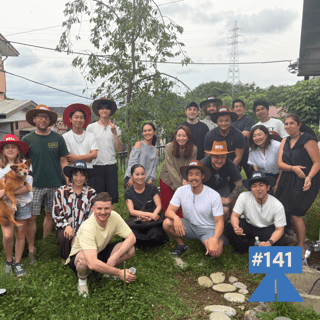
Speaker: well you'll You'll see it on the video. There's a waterfall, there's a bamboo forest. us There's a, you know, it's it's really crazy. And we also got exclusive access to that as well when it was just us here by ourselves. ah Okay, I was going to say that, but second one, I'd say we, I mentioned at the beginning of this, like we work with so many people online every day. I feel like it was so good. We gathered everyone together for a party. We got everyone these jackets. We did a photo shoot.
Speaker: I think the weird thing, the the highlight for me was when After our party, Linda got that guy to drive us home and we didn't take the taxi. We had some guy who drove our car back to our house and when we were had a drink a little bit. So it was ah in a weird way that was a highlight.
Speaker: Also, we found out we had like two little raccoons that come through to our house in Tama. Like we'd always been seeing these like pieces of crap. We're like, is that Linda's dog's crap? No way. And it's been these raccoons that are quite cute. Too big for bird or squirrel, but like...
Speaker: too large for a dog yeah we couldn't figure out what kind of poop it was weird highlight but uh is a raccoon's tail mokco moco moco that actually that was really funny fua fua uh inside joke but that's going to be coming for our rebranding but joy great job this has been ah a good trip it's uh it's cool to have this background people are piling in here now at this point but um Come by with the Sayu, hot water. You got the coffee. We're gonna get more coffee. Oh, coffee machine broke. Espresso machine broke. but
Speaker: Good trip. Low point of the trip. Low point of the trip. We are going to try to get a new espresso machine had to for future trips. I think another high point of the trip was, not that I 180'd on Otaru, but like I see okay for what person. oar like Too bad you haven't been there yet. but too t Low point, getting taking those five whiskey shots and getting the stomach loop.
Speaker: Take care of yourself if you are coming to Japan. It's a marathon a lot of times. And... We survived trip number seven. i don't know what this is. Six, seven, eight.
Speaker: Somewhere, yeah. you know Maybe around turn trip number seven in the books. Catch you guys later. Don't forget to like and subscribe. This podcast is produced by Devin, our podcast producer. Carlos, are at one of our editors, and Lucas, who chops up so chops up all our content for reals. Thank you, guys. Would not be possible without you.
Speaker: Thanks for listening to this week's episode of Buying a House in Japan. If you find the show helpful or at least entertaining, give us a five-star rating. Takes five seconds and really goes a long way. If you or someone you know is looking for a Japanese home, check out Akiyamart.com, our English-friendly site that lets you browse over half a million listings. That's A-K-I-Y-A-M-A-R-T.com to find your dream home in Japan.
Speaker: If you've got questions or feedback, drop us a line, email contact at akiamart.com. You can also find us on Instagram as well as TikTok, where we post properties, tips on the home buying process, and updates on our own purchases and renovations. Thanks again for listening, and we'll see you next week.