Transcript
Speaker: I believe firmly that I will advocate for this till the day I die, that grief and love are twin sides of the same coin. You love deeply and then the price of that is grieving deeply. And grieving deeply is a way of loving deeply.
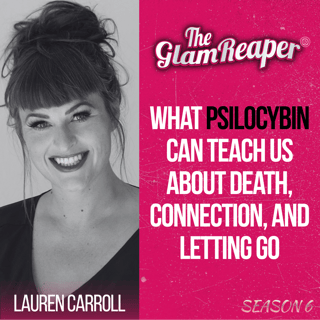
Speaker: Hello everyone and welcome to another episode of the Glam Reaper podcast. I'm your host Jennifer Muldaney aka the Glam Reaper and on today's episode we are delving back into I feel like it is a bit of a theme this season we're delving back into the death doulaship. We've had quite a few death doulas on this podcast. It is a very topical thing at the moment and extremely so in this person's case but I would love to welcome death doula Lauren to the show. Hello Lauren and welcome.
Speaker: hi thank you so much for having me. Now, Lauren, tell us, where are you dialing in from? Yep. So I'm based in the Midwest in a city called Fort Wayne, Indiana, and this is where I was born and raised.
Speaker: Very cool. Very cool. And what is it that you do for career, for living? we had a little chit chat before the podcast, other than taking care of your gorgeous children. but What does Lauren, what is Lauren all about? So, yep. So I do two things. One, i do work full time for a cancer nonprofit here in Fort Wayne. I'm the director for education and wellness.
Speaker: um It is still very difficult, as anyone who's pursuing death dula work knows, to do this full time. ah But then on the side, i do pursue um funeral industry reform and I do provide individual programs. care and support, similar to what a death doula would do. i prefer a little different terminology. So death doula is the term that's become part of the part of the lexicon, if you will. Yeah. Public lexicon. But it's ah it's not gender inclusive. And ah some of the roots of that word, you know, go back to referring to a female slave.
Speaker: or servant. So I actually prefer, i prefer to just personally refer to myself as a community death care advocate. Okay. death care, death care is a term that's probably come up on your podcast before.
Speaker: and then community is a very important piece of that because I am never doing what I do in isolation. It takes literally a village it takes a community do every aspect of this work that's really interesting that you say that actually because one of the recent um podcasts we had this season and just released was with the death doula i am her name is nicole and one of the quotes we took from the episode was that it takes a village so i'm glad we're all aligned on that So that's great. and
Speaker: Interesting what you're talking about with terminology, because I actually have a little bit of a beef with the business um in in terminology and also actually with death doulaship. And I actually had a chat with a good friend of mine who's a death doula as well and talking about that Because while I love the idea of of a death doula and all that it encompasses, my vision or my version of what it is and could be and maybe should be, and I don't mean to police it, but is...
Speaker: is somebody who sits bedside with a family um with the just the dying, and is very much that sort of bridge between hospice and death care-ish, right? As in they're involved in both of those, but they're helping that transition, They're helping somebody um die if they're alone. Like, for example, I have no kids. I have no partner. You know, ah I'm sure people will. I hope people will come to my bedside if I'm dying. But if not, you know, i yes, we hire people for every other aspect of life. Why wouldn't we hire somebody to to make it a bit more comfortable for us? Right.
Speaker: um And then and then also supporting the family. So that's my idea of it. And I don't know if that's idealized and if you want to go get into that. um But where I feel like and maybe it's because I have a marketing background where I feel like the death doula concept that's out there now in the media gets a bit gray or blurred is because it overlaps with so many different roles. Right. Right. And i think a lot of funeral directors, ah hospice practitioners, lots of different people, myself included, are often confused.
Speaker: Like, what do you do? Do you do? Because as well, a lot of people who call themselves death doulas do entirely different things. so I don't know. There was a lot in there. So I definitely work with that. So that one of the things I love about this work right now is that it is so grassroots, is that it is so moldable. You know, I have a business partner who lives and works out of Texas and she is a seamstress and an artist. And so her, you know, if you want to call it her death doula work, looks like sewing and creating these beautiful hand-painted handmade shrouds that then people can choose to be buried in.
Speaker: So she's not doing any active, you know, sitting at deathbeds, keep holding vigil, helping plan for end of life. You know, that her work looks very specific to her gifts and her talents. And that's beautiful.
Speaker: And so this can take on a number of different faces And that does make it difficult. um I think there's also we have to do a better job of connecting with the funeral industry as it exists currently in North America, because as far as they're concerned, I heard a speaker say this recently. I thought it was brilliant. So I'm just going to reference it here.
Speaker: She said, you know, two funeral ah directors in the funeral industry, which is a heavily regulated industry, they can't move an inch without crossing their T's and dotting their I's and filling out forms and making sure everything is in alignment.
Speaker: You know, to them, we're like a wild, wild west. They have no idea. It's hard for them to wrap their heads around how we can be out here doing what we're doing, which they don't fully understand typically, um without any regulation.
Speaker: It just doesn't compute. It's like speaking two different languages. And i think there is some inherent tension in that because one of the things that we represent, um and this is something I dive into in my mentorship. So I have created a six-month mentorship process called the Mortal Clay Mentorship.
Speaker: It's a deep dive. it is available virtually. So we gather once a month on the first Wednesday of the month for two hours. There are guest speakers. There's a rich curriculum.
Speaker: There's case study-based role plays to develop skills. But essentially, we do a deep dive into um each participant's own death narrative, their experiences, their beliefs about mortality and death, how those have shaped them and their approach to death and dying and grief in our culture. But one of the things I say in that mentorship very clearly is I do have a lot of knowledge and experience to share But death and grief are the ultimate teachers here.
Speaker: And I think what separates a death doula, to use that terminology, from some of the other um roles and other faces that this work can take if you're in hospice or social work or funeral industry death.
Speaker: that I think we're trying, i hope we're all on the same page with this, we're trying to invite people to sit at the feet of death and grief itself again. Because our systems, they serve a role. I'm not, I don't, I don't want to obliterate the systems. We do need them.
Speaker: um But some of those systems in place have become so systemic and so sterilized and so process driven that that it actually alienates us. It cuts us off from the energy and the power of the thing itself.
Speaker: Right. So one of one of the questions that I get asked sometimes is like, well, OK, so you do this part time and you don't have a degree or you know anything like that. So what qualifies you to do this work? What qualifies you to mentor people or walk alongside someone while they're dying? And I always have two answers to that. I say one.
Speaker: Dying is deeply human. it's This is not, know, we have we have been conditioned to think about dying as an industry and a profession um and the very existence of the funeral industry.
Speaker: Just by nature of its essence tells us, oh, there is a select group of people who know how to do this. They're the professionals. I can't do it. I can't handle this. I need to just pass it off to them.
Speaker: um When that is not necessarily always the case, there are legal things that you have to in many states and trust or partner with a funeral home to accomplish. But, you know, for for a long, long, long time, the majority of history.
Speaker: Caring for the dead has been something that people groups did within their own communities. um And there are still indigenous peoples who do that. So it's ah there is some inherent tension there. And so I tell people it's very human work. um We have to kind of unshackle ourselves from the Western way of thinking about this to some degree. And then also I say, just because you do something full time or you have a degree,
Speaker: That does not necessarily mean that you are actually sitting at the feet of death and grief itself and that you have a relationship with death and grief. Because what I've actually witnessed is that, you know, this used to be a shared burden. When someone died, the whole community or you know specific members in the community would come together and take on different roles and do different pieces of this.
Speaker: ah Now we have shifted all of that labor, that emotional, spiritual, physical labor, over to one group of people, funeral directors, and we've said, okay, handle all the death.
Speaker: You know, therapists are in there too. They're working with people on grief. But um that is a massive burden. and i so And I say that with a lot of compassion. I'm not anti-funeral director. I'm not anti-funeral industry.
Speaker: I'm pro-reform. But the idea of putting the full weight, the full burden of a community's dying people on this one little group. I mean, frankly, it's kind of insane. And i think the um i think the statistics and that we see about um things that people who are in the funeral industry struggle with in terms of mental health or substance abuse or, you know, rep they're reflecting this, that it is brutal to try to carry all of that for an entire culture, for an entire country. So the other thing I say is that I actually think sometimes a coping mechanism, if you're doing this full time, if you are yeah logging 80 hours you know a week or so however many hours um doing this, you know you you actually disassociate.
Speaker: there There is a very understandable human disconnect that you have to do. Because it's not possible to maintain that level of connectivity, um of holding sacred space.
Speaker: It's just you're going to bleed out. And so by having some boundaries on it or having the boundaries placed upon you in this case, because it's very difficult to do full time. Most of us are doing it part time.
Speaker: There's almost like a silver lining in that. That is we are capable of coming to this with more of our full selves and holding sacred space um without burning out so quickly.
Speaker: yeah And I think if we were doing it full time, I think you would see if more death doulas were actually doing together. with dot With the dying full time, I think you would see very similar burnout rates and statistics in that group. So, yeah.
Speaker: Yeah, I mean, yeah, there's a loss there's a lot I agree with and there's there's some things that I would question um on on what you said there. I mean, the i i I agree with you on the the part time. I think it does allow people to come a lot more healed and repaired in themselves to then be there for families and there for the dying and and and all the things that they're supposed to do, right? 100%. And It's I guess it's it's very interesting. um Like the funeral director in the funeral industry and even like it's gas. I've been in it like 18 years between Ireland and here. And even I've seen things like change and evolve, um which I won't even touch on in this because I feel like we'll get 10 rabbit holes and it'll be 10 hours long. But they're really being pitched as the the devil, though, and the bad people. And what that breaks my heart because the majority of funeral directors that I personally know anyway, and I know a lot of them, and is they come to it with very heart. It's heart centric work for them. It's compat like they come from it. They're not there to make a quick buck. Like the majority of funeral directors are hurt out and they are not getting paid what they should be. But they're being pitched by the media as these gold digging, you know, Lurch Adams family vibe.
Speaker: People that just, you know, wait and ambulance chase and and all of this sort of stuff. And what's frustrating, I think, is the death doula is pit being pivoted pitched as this sort of more female, more softer, more lovely, more loving kind of, a you know, Angel versus Deborah media I'm speaking specifically and it is very interesting and i I personally actually love that you very much want to be kind of called an advocate community death care community advocate I think was what you said right
Speaker: um because ah I again I don't know if it's just my marketing background and my frustration and I had this with water cremation as well had have it with water cremation as well is the consumer gets a very I mean they're already grieving their brain is shut down their brain is in survival mode they I had this when I started 18 years ago and I was suddenly an event planner but for funerals the Irish people were like I'm sorry what if you're not a funeral director what are you what the fuck are you do like get out of here like get of here like what do you want what is this nonsense right and it's taken me nearly 20 years to like even get to where I've gotten so and even still people haven't a clue what a celebrant is or what a memorial planner is so anyway we won't go down that road but it's I think that's
Speaker: very confusing like I wish the death doulas who call themselves death doulas and I've actually had conversations with people I'm like call yourself ex call yourself something like create something you're not a death doula like stop pitching yourself into this because if if you know, if everybody, yes, it's amazing to to offer yourself in death care to your skills and that's what you should do, right? And there's so many incredible skills out there. And as you said, it takes a village and it is, it's like all part of community as far as I'm concerned. And that the Irish people, that's what we did. Our wakes are literally famous
Speaker: for how we will send our people off, right? And I think we need to come back to that 100%. And I love like these these home funerals and I love all of this. and And I'm not necessarily a fan of legislation and structure and systematic and all that sort of stuff. Like, i think there's a place for it. I agree with you on that. I don't think it needs to be. I mean, what's in interesting to me is The United States seems to have more issues currently in the funeral space, from what I can see, than the countries I met on the road where I just came off for the last two months. Australia doesn't have regulation. Ireland doesn't have regulation. Most of European countries, they don't have regulation and they don't have these issues.
Speaker: So it's a bit like the gun laws, you know, like we don't have guns in Ireland. We don't have any issues with guns in Ireland. We don't have school shootings. So it's so fascinating. And again, meaning in with curiosity, i you know, there is no funeral police. And I don't know how many times I've had to say that to people. Like if another person corrects me, and especially when I started and I first got over here to America and I kept saying coffin the whole time, talking about a casket and the amount people who would correct me, I'm And I'm like, now that I have a bit more oomph and a bit more pep in my step, i I push back and I'm like, at the end of the day, you can call it a casket. I call it a coffin. Yes, I know they are actually different shapes. Factually, I understand that. We are industry people. or
Speaker: The family don't give a shit. They just know it as the box that their family member is going. Their loved one is going. They don't care. Stop correcting them. We are not here to police people on death and dying and grief.
Speaker: We are here to educate. That's a really good jumping off point because I think where some of the um like conflict, if you will, or some of that oversimplification, what you described is the media or the the perspective of the funeral professionals as being evil or bad or greedy, and then the death doulas being this angelic solution,
Speaker: Yeah, I agree with you completely. way what It's a massive oversimplification and it's not fair to either group. um And so I'm not I'm not a fan of that either. But I do think um having you know, this is a good we can segue to like the legal situation here.
Speaker: in the federal lawsuit But here there are places in the U.S. where um the industry itself has created an environment that is extremely controlling.
Speaker: And so it's very difficult for the people, the community members who are living in those places to have a healthy relationship um with those industry professionals because it's forced to.
Speaker: you know It's an entirely different thing when you have free will, you have the ability to choose. Well, I want to do this on my own. I want to bring in a professional in this space because I need the support.
Speaker: um There's a wonderful, wonderful book that's on my to-read list this year. as ongoing education called too poor to die. and the reality is that that, you know, it's the average cost for burial you in the U.S. is over 10,000 now. And there are so many people that do not, they can't afford that.
Speaker: They don't have the money to do that. And so then when you're living in a place like the state of Indiana, where you legally have to hire a funeral director, you have no choice. Hmm. um You're backed into this corner and your your options are taken away. And now there's this forced large expense in the middle of your grief.
Speaker: um And that is not conducive to a healthy relationship. And so and then you get into the actual funeral code. So the the root of our lawsuit um was the fact that Indiana Funeral Code 2515217 states, I'm just going to read it to you. It defines funeral s service.
Speaker: or i'm Providing funeral service as in part providing at need counseling for survivors of a deceased individual on the services methods and alternatives for final disposition of human remains and um providing any counseling on the requirements of federal and state law applicable to the sale of funeral services and merchandise.
Speaker: So what does that mean in just normal language? It means it is illegal in Indiana or was for any anyone other than a licensed funeral director to even talk about water cremation, cremation, flame-based cremation, green burial, shrouds, um the cost of things.
Speaker: That is so controlling that it's almost mind blowing to say that it is illegal for anyone to even speak of these cities. When I started this work, I founded Death Done Differently in 2019. On a total side note. So I love that. I love that name because when I started my business, like whatever, 18 years ago, it was it was a totally different business name and it was in Ireland. And Twitter was kind of a bit of a big deal. And I used to do my tweets and I would do hashtag Death Done Differently.
Speaker: Like back then. Well, it's funny. Honestly, actually, when I saw the business, your business name was like, how did somebody not come up with that before now? Because it's just so brilliant. The DDD. love it. Anyway, it's very simple. It was very important to me that I had a word death in the name. it's like, yeah I can't continue to hide that. Like we already have such a death phobic culture. Yes. um We're also dead starved. Yes. So anyway, yeah, I started in 2019. I knew i knew because of the legal landscape. I took my time. i consulted with an attorney. I had him look over my contracts, my website, the um the language just saying it's everywhere in my content. Like, hey, I am not a licensed funeral director. You need if you are coming to me for services at the time of a death.
Speaker: you are going to absolutely have to also hire a female director. And I can help you choose one. Like, I can do that. But from day one, there was a significant portion of my work in sitting down with families or even doing public educational speaking that was, i viewed it as a form of, ah like, activism.
Speaker: You know, it was um It was illegal. It was very illegal for me to be speaking openly about, hey, this is this is actually your full range of choice.
Speaker: And this is you should feel empowered that you you don't have to do that. um i wish that everyone had that full knowledge so they could make the best decisions for themselves. And we're we're moving in that direction. yeah um But I did it willingly because I knew it was too important. It was more important um that people had this knowledge and information and were equipped to handle these things.
Speaker: um And not you're right, in the middle of grief, like you said, cognition has changed. You've got a fog. You're trying to make big financial decisions, et cetera. Yeah. So then, long story short, the um it wasn't a client. I've never had a complaint from a single client or anyone I've worked with. But um we we believe a funeral industry professional filed a complaint um when I encountered them while supporting a family.
Speaker: and said, hey, she's she's acting like a funeral director without a license. So then an investigation was opened. We wrote, I had a funeral director I've worked with numerous times write in a letter of support saying, absolutely not.
Speaker: She's very good at staying in her lane. She knows exactly where that begins and ends. I had clients write in letters. At the end of the day, it didn't matter. It's just the it wasn't personal. It was just like the wheels of bureaucracy crushing and grinding things out.
Speaker: So they issued a cease and desist and they sent an official letter and they said, you either need to go get your licensure to be a female director or you need to cease completely.
Speaker: And I had to make a decision. It was like, okay, either I just lay down and concede and go, you win, you're so much bigger than me, or I start reaching out. I communicate with other people, um thankfully, I've connected with. over the years doing this work and say, hey, this is happening. what Who should I talk to? What should I do next?
Speaker: And it is all truly um thanks to Akilah Murphy in California. i I very, very gratefully had her on my radar. i had not spoken to her before, but I was aware of her case.
Speaker: So i reached out to her and just said, hey, i could really use some advice. And she put me in touch with the Institute for Justice's legal team that she had worked with.
Speaker: And the next thing I knew, they were flying three lawyers out and they were discussing working together and me being a client of them to bring forward a First Amendment case.
Speaker: And so that is what we did. We settled. It was actually brilliant. i loved so many parts of this. I'm still learning so much. We settled. So because we did not want to tip our hand, we partnered with a local law firm in Indianapolis, which is the capital of Indiana, um to represent me in settling.
Speaker: So the state did not know that the Institute for Justice, which is the largest public interest law firm in North America, they did not know that they were backing me or they were involved at all.
Speaker: um I think they were probably a little surprised that I even had representation for the cease and for handling the cease and desist in the settlement. But we worked with the law firm in Indy, settled that because we had to put that to bed before we could file our lawsuit against the state. They couldn't be going on simultaneously. Wow.
Speaker: And then once we settled, once we settled that, it was kind of like a chess game. was like, okay, we've put that to bed. We know that all the language in the settlement allows us to make this next move.
Speaker: We are in the clear. and I think it was just a week or two after... the settlement that we filed our lawsuit against the state and said this is a First Amendment violation.
Speaker: You cannot tell people they can't talk about death and dying and funerals without having a license. So and now three years later, here we are. We've officially one And it's a really good feeling.
Speaker: Wow, wow, wow, wow. Well, if there's anything we love at the Glam Reaper podcast, it's a David versus Goliath story with David winning. So congratulations. yeah I can only, know, I mean, listening to that story, I have anxiety because I would just stress so much and overthink things and think, oh, my God, what's the thing? Think of me and all of that. So fair play to you. Absolutely incredible. Hats off to you um to to go through all of that because you also helped in the process. I mean, such a clever maneuver, as you said, a game of chess, and but also just you help so many others because
Speaker: I know even me myself, not a death doula, not a funeral director, always been crystal clear about that. I am a celebrant and I am an event planner for funerals. Those are the two I do. And then obviously podcast and all that. But I mean, I write articles for publications I always have done back in Ireland. Always always the whole time. Report on conventions. obviously do this podcast. I speak on stages. I do free workshops. I do all of these things. And all of that involves me talking, arguing, negotiating, debating all these terms. And and that is absolutely insane that you couldn't even talk about it.
Speaker: Absolutely insane. So well done. Absolutely well done. What's the next steps for Lauren? o Next steps. You know, I, my heart and my hope is that there will be more positive partnerships and collaboration here between death workers and the funeral industry. You know, I really, really want to um widen the circle of care.
Speaker: And I think that that is what the focus of, you know, anyone who calls himself a death doula or is a community death worker or grief worker.
Speaker: You know, I think that should be our focus is how can we ah right improve and strengthen what is already there.
Speaker: um And there are some things, yeah, it's like there's going to be barriers or there's going to be sometimes resistance to, say, new forms of body disposition because there is so much money involved. It's a, you know, massive, massive billions of dollars industry.
Speaker: But um we're we're trying to move the needle on what is guiding decisions, you know, and and for many of us to move it more towards, you know, what is ecologically better for the environment you know what is gonna be affordable for families yes there's a yeah there's a very real need for um just grief literacy work Yeah, what we've lost. and Well, we're even there's a this could be an entire different topic for a podcast for you. But, you know, we are moving toward we're we're such comfort seeking missiles in a way that's in all of us.
Speaker: um And it's a deep part of Western culture is to avoid things that make us uncomfortable or are difficult. But um we're moving in a direction where grief is beginning to be questioned.
Speaker: on its um validity and its place and is grief mental illness is grief necessary and I I believe <unk>ly that I will advocate for this till the day I die, that grief and love are twin sides of the same coin.
Speaker: And you you you you love deeply and then the price of that is grieving deeply. And grieving deeply is a way of loving deeply. um And i'm I am very concerned about the future of what that may look like if we continue to move toward eradicating grief in a way by using AI um to replace our loved ones so we can continue to kind of psychologically and emotionally trick ourselves into thinking they're still here and of thereby avoiding grief. We have no idea what the ramifications of that are um in terms of humanity and what makes us human. So
Speaker: ah long story short, I'm getting off topic, but what is, what is it for me? So I am working on a couple of things. on Like I said, I offered the mortal play mentorship and that's twice a year So we've just started our um autumn cohort.
Speaker: And so I am thrilled to be working with this group of individuals. um It's always customized. So I cap it. It's, it's not a, It's not like ah at a distance. You do it on your own, your own pace. It's very involved, very interconnected, community oriented. So you're really connecting with other people um who are doing this work in different parts of the country and are learning a tremendous amount about yourself.
Speaker: about different shapes that this can take. And you don't have to be even wanting to go into it as work. Like you could just do the mentorship to deepen your own relationship to mortality and grief and die. um So that is a huge focus for me is the mentorship.
Speaker: And um I've got some other ideas. i So I mentioned my business partner in Texas. um She and I have created a product called the Shroud Doll. If you go to my website and there's there's a page there, these are...
Speaker: gorgeous gorgeous little beings she hand sews hand stitches these little uh fabric dolls that are weighted and can be manipulated so you can like fold their arms over their chest and each each comes with a little shroud and they're an educational tool that we are trying to get in the hands of death doulas and death workers and so that when they are giving these public educational talks or they're working with a client, they can demonstrate how easy it is to shroud.
Speaker: um And someone can actually do it themselves and start to build the muscle memory and go, oh, i I can do this. I know how to do this. And if I can do it on a small scale,
Speaker: With some guidance or support or direction, I can do it on ah on a larger scale. That's nice. so we're we're rolling those that out. Yeah. Love them. They're beautiful. They're um racially inclusive. And um I highly recommend anyone who's trying to find a tool that will help them Get more public speaking gigs, for lack of a better term. Yeah. yeah This is a real right in the really great really great in for hospices. Hospices have responded really positively.
Speaker: i was just very saying that. sounds like a perfect spot for them. Yeah, that's great. We've a lot of death doulas. We've a lot of death workers, but specifically doulas that tune into this podcast. So, um so yeah, we'll leave all your links and everything below. And um you that's that sounds like a really great thing. Part of me is like, hmm, can I incorporate it into mine? But I, I don't. that It would not work with mine at all. And that's, and that's, this is actually what I would encourage more people to do is, stay in their lane, know what they're good at. Like ah instead, what I would do is I bring on a death doula or somebody who fills in the gap, the yin and the yang. You know, that's what again, it's community. It's let's teamwork makes the dream work. That's what I say to my team. Everyone, every funeral and memorial we do. um Lauren, it's been an absolute pleasure talking to you. I feel like we could talk for hours. Unfortunately, we're on a time limit. Maybe we'll get you back again to I feel like there's definitely stuff to unpack there with the whole grief and the AI thing, because I have a lot of thoughts on that. I've been done panel discussions and stuff. And um yeah, I think there's a lot of positive and negative that we can go with. But maybe we'll get we'll get a a podcast going on that. But yeah, Thank you so much and thank you for the work that you do. And yeah we really appreciate it having you.
Speaker: Thank you. It's been a delight.