Transcript
Speaker: What is the meaning of the
Speaker: hunt it? Welcome to Mythic Mirror, the podcast for lovers of myth and fantasy who want to live magical and fulfilling lives. I'm your host, Mary C. Kehoe.
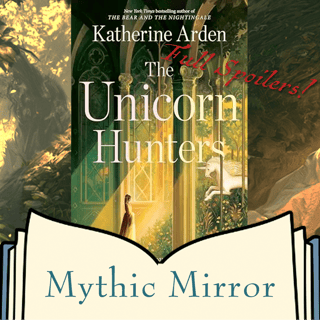
Speaker: And I'm your co-host, Carolina Carter. And today we are talking about the intro, the very beginning of The Unicorn Hunters, which is what our book club is reading right now. Come join us.
Speaker: We love the book so far. Yes, by Catherine Arden. Mary and I have previously read, hilariously this time, I am the one guilty of not finishing the series yet, but I will. But her Bear and Nightingale series, Mary has read and recommended to me. And now we are both reading this one together.
Speaker: This one is set in Brittany in 1490. And it is about a young woman who does not want to marry the king of France and have Brittany in subsumed into France.
Speaker: So she is using all of her wit and wiles to save her little dukedom. Duchessdom? Her duchy. Oh, there it is. She's doing her best to save her duchy.
Speaker: And now that and includes a unicorn hunt. Yes, it is important to say this is a spoiler-free episode. We are going to be just enticing you to read this book with us while doing a little bit of a deep dive into the symbolism and mythology of the unicorn.
Speaker: Very important. We haven't touched on this one yet. Yeah, I'm very excited. So one of the things I love about this book so far is It reads in the beginning as just a, well, not just, but it reads in the beginning like a historical fiction.
Speaker: It feels very grounded. The author herself, Catherine Arden, is an historian, and you can you can really tell she knows in depth her topic.
Speaker: um The same thing with her Russian trilogy. It just, it's so grounded. And you then you go from there and you start to get little hints of mythology and feeling of the people themselves believe in the other world and that it is close to them.
Speaker: And just through their belief, you start to think, oh, things might things might happen are that are Otherworldly. Yeah, where I'm at in the book, just at the beginning right now, obviously a unicorn hunt has been proposed.
Speaker: That's not a spoiler. The book is called The Unicorn Hunters. But you're not sure if they exist still, um ah because everything has been so real so far that you think, well, maybe there's a myth of unicorns in this forest. So people sort of as like a ritual go to hunt them.
Speaker: You know, maybe one was seen there 200 years ago. I don't know. So that's that it was super interesting to me to have that uncertainty because I was kind of expecting just to be flung fully into a fantasy world. And it like you said, it reads very much like a historical fiction at the beginning. Our heroine, whose name is? Anne.
Speaker: And she is a real person in history. Ah, very good. So Anne uses, so this unicorn hunt is her idea in order to delay the marriage talks ah with the envoy from France in order to have her own plans come to fruition.
Speaker: And so far we've seen her play this envoy. She knows how people view her and view women in general. And so she plays into that, even down to what she orders for him to eat when he first shows up.
Speaker: And i just love seeing her switch from who she really is to to this part that she's playing into just to get him to agree with her and underestimate underestimate her.
Speaker: And, you know, never, ever question that she may be up to something. Right. Yeah, I do love that. I love a clever heroine. um And obviously we've introduced her little sister as well. So the stakes are high.
Speaker: Mm hmm. You know, you're like, well, she can handle herself. Then you realize she's doing so much of what she's doing to protect her little sister. And you're like, dang. Right. Because if it doesn't work and they get rid of her, it's going to be her sister who gets married to the French king. Yuck.
Speaker: nothing against the french to be clear no it's against um child marriage yes and maybe the french no no not the french they're great my grandma said we were part french so well we are all the way back to lafayette napoleon i almost said that i was like no no no not him the american one everyone knows the the good one ah
Speaker: The good one. Well, Napoleon was doing great until he went too far. He was uniting Europe and then he built an empire. Nothing wrong with that.
Speaker: Can a man have hobbies? Yeah, so unicorns. We love talking about myth mythology and fantasy. I can't believe we haven't talked about unicorns yet. um Mary, what was your first memory of a unicorn that you saw?
Speaker: When did you first see a unicorn? When did i first see a unicorn? The first thing that came to mind is the Little White Horse book by Elizabeth Gooch. Because that has a unicorn in it.
Speaker: um oh Oh, but I do have an earlier memory, and this might be what you're thinking of. So our mom would... when we were going to sleep, she'd tell us a story about each of us would have a unicorn who also had wings. So a pegasi unicorn would fly in through the window and and pick us up and we'd go on these adventures during the night and we would always pause and she'd let each one of us describe our unicorn.
Speaker: Do you remember what yours looked like? No, I totally forgot that. And and now that you've said it, I'm starting to have a vague memory, but I 100% forgot about that. Well, happy to remind you.
Speaker: Well, when I dig through my memories, my first unicorn that I can remember looking at was a Lisa Frank lunchbox that I had in kindergarten.
Speaker: That had mommy unicorn and a baby unicorn on it. And I was really proud of it. And I went to school and another little girl had the same lunchbox. And I didn't like that. ah Should we dig into this? She was like, we have the same lunchbox. And I think I said, no, we don't.
Speaker: Because mine was very special. Yeah. I could not have been more than four years old. It was at the same time that I was scared to use the bathroom because I was very convinced there was a dragon living in the shower and or outside the window.
Speaker: It's a very turbulent time in my life. I think I couldn't reach the light switch. We don't have to stay on this too long, but I think I couldn't reach the light switch, so it was kind of dark in there, and I was very afraid of a dragon situation.
Speaker: Back to the task at hand. Okay, Greek and Latin terms include monokaros and unicornis. No. Unicornis. No. That second one's made up. Earliest accounts they think may have been an Indian rhinoceros. Because of the seals in the Indus Valley. Okay.
Speaker: Key idea about unicorns is that in mythology, originally presented as less of a like a fantasy creature and more of like an exotic and distant creature.
Speaker: And thinking of that in terms of our book... Here's where I was with it was just that this idea of it being something that exists on the boundary between the real and the imagined and how well she's walking that line, at least in these first couple chapters of the book of just being real and imagined and being like, what is real? What is imagined? Is this going to be a super fantasy book?
Speaker: Are unicorns real in this book? um So just setting the stage with the unicorn and that being sort of like this in you feel like you're in this sort of in between, I thought was very clever.
Speaker: And I would add that she uses language to accentuate that where you've got the court French, which is what they use now in the everyday, which kind of symbolizes that the the.
Speaker: the real or the concrete world with courts and political drama. And then she would, so she switches to her native Brittany when she's telling the story to her little sister that has some fae folk in it.
Speaker: And the, all when she speaks to the people who live in the countryside, she's always using her native tongue and And so the the belief in the Fae world is kind of intertwined with that language. And whenever she's talking with um people, her her native countrymen.
Speaker: Right. Which is exactly why i printed off this picture. Because... Sorry, I'm looking at my notes because I had like lots of good ideas, but ah I do have to look at the notes. I'll hold this here. The medieval unicorn's defining conflict is freedom versus possession. Anne, our heroine, occupies a similar symbolic position. Her political importance makes her valuable to others, while her own autonomy makes her difficult to control. I was thinking of this tapestry while she was talking to her little sister and her little sister's like, you're not going to go away, are you? And she's like, well, I have to.
Speaker: Where it's like, she could run away. oh and she tells her little sister something about that, where they live a life of luxury and convenience at the price of being a monarch.
Speaker: And that that is what really brought this picture to my mind because this unicorn It can escape, but it sits, it lays down within this fence, keeping it in. Because why, Mary?
Speaker: Why? i don't know.
Speaker: Something's worth staying for. Yes. Which is interesting because the unicorn in a lot of medieval art also symbolizes Christ.
Speaker: And you could say he also stayed when he didn't have to because there was something worth staying for. You could say that. I think I wrote it. i write down I wrote, can someone maintain personal autonomy when their existence carries political meaning? Yes.
Speaker: e We see her as this little spitfire manipulating and moving through the world, but does she actually have, can she have freedom when her life is tied to her kingdom and her v political position? She has freedom within the bounds of how she wants to save or disregard her land and her people.
Speaker: And if she wants to save them, then she has the freedom to choose within, you know, and come up with things. But yeah, she can't just do anything.
Speaker: it's That's part of the sacrifice, I guess. It's part being king. Queen. Duchy. Duchess. I like duchy. All right.
Speaker: Fine. Duchess. So diving into the history of the unicorn. So you mentioned the Indus Valley and that is the there were seals um that many seals found, and they're of mythical creatures as well as real creatures. So it's, again, what you're saying about the unicorn kind of riding that space between the two, because, of course, everyone now thinks that was either
Speaker: a mythical creature that was getting embossed on this seal or it was of an extinct type of Hmm. But the i was just reading an article, and this guy was going in way in depth into linguistics and everything and showing um that there was a possibility of some type of one-horned animal at that time, linguistically speaking, in terms of um words that were used in
Speaker: mythology of the era so I thought that was very interesting and so then you mentioned Greek and Roman because that's the next time that's our first on the in the in the west first recorded history of or recorded mentioning of the Mono Keros how would you say that in Greek when Minoceros?
Speaker: oh That's kind of what i was thinking. All right. Which, so Pliny the Elder said, and I'm reading my notes, it has the head of a stag, feet of the elephant, and a tail of the boar, while the rest of the body is like that of a horse.
Speaker: It makes a deep lowing sound and has a single black horn that projects from the middle of its forehead two cubits in length. Okay. And the Romans considered Pliny's account truth for more than 1,600 years.
Speaker: Now, I always kind of forget how long these ancient civilizations were around for. So you read something like that. Wow, that's a long time. So he was also the first one to write about the character traits, stating that they were amongst the fiercest animals in India and impossible to be captured alive.
Speaker: This would become a running theme to their mythology, particularly in the medieval period. So then in the 6th century, a traveling merchant from Alexandra put together an account from his time in Persia.
Speaker: And he said, oh this is kind of funny. He talked about how the unicorn avoids capture by, i guess, in his mind, there's a lot of cliffs around because anytime a unicorn is about to get captured, it happily throws itself off of the cliff and lands perfectly on the point of its horn and is thus unhurt.
Speaker: Say that again. What? So this man's name is his Cosmos. I don't know how to pronounce his last name, but he's sixth century. Cosmos makes shit up this.
Speaker: Yes, that is what it means. A traveling merchant from Alexandria gave an account of how the unicorn escapes capture by jumping off of a cliff and landing perfectly on its horn and thus not dying.
Speaker: hu Because somehow physics, you know the point of the horn, ah in the we differentiate. I mean, i was pretty sold until now.
Speaker: Maybe he saw a narwhal diving into the water. Maybe he just heard something and didn't speak Persian. Do you ever wonder how these guys, like, how you how many thousands of years later, like, that guy's story makes it through? Yeah, right? Why? Who did he tell that wrote this down? Like, why... Why is that immortalized?
Speaker: Yeah, this traveling merchant, out of all the traveling merchants, why is his little, like... He just makes something up one night and thousands and thousands years later, two girls on a podcast are like, what the hell? Going with what you're saying, because I was looking at, because all of these are, you know, the Greek and Romans talking about a creature in India or in Persia. So I went and looked at, in in Indian mythology,
Speaker: And the earliest traces can be found in the Vedas. And let's see, back to, let's see, 1500 BCE, e the Vedas mention a mythical creature, Akashrinya.
Speaker: Akashrinya? I knew I wasn't gonna get that one right, ah which translates as one horned. And it's described as powerful, divine creature possessing magical abilities.
Speaker: And let's see, here we go. In the Piranhas, it describes it as a white horse-like creature with a single spiraling horn. This mythical being is considered a symbol of purity, power, and strength. So it's funny that these Greek and Roman ones have more of a chimera type look, whereas in the Hindu texts, it's actually a lot more like how it is in the medieval art that we see. And that is now what a modern unicorn is based off of, which I thought was pretty interesting.
Speaker: Now I'm having to look up chimera because I forgot what they were. An animal made out of many animals. Gotcha. Oh, I have a quote from Leonardo da Vinci, too. we'll See, this guy, i believe. Yeah, right? He had words worth writing down. The unicorn, through its intemperance and not knowing how to control itself, for the love it bears to fair maidens, forgets its ferocity and wildness, and laying aside all fear, it will go up to a seated damsel and go to sleep in her lap.
Speaker: And thus the hunters take it. I'm glad you brought this up because there is a sense of bad foreshadowing that I feel about this because. OK, so the everybody knows this, the unicorn, you can hunt it all you want, but it won't come up to you. Like power cannot kill the unicorn. Strength cannot catch the unicorn.
Speaker: what ultimately defeats the unicorn is trust and betrayal and betrayal and that is what is sitting most deeply unsettling within me about this book is I am worried if she's the unicorn if she's the unicorn the good news is I have been off with so many of my book guesses that we don't need to be too worried about this one but that is something I was thinking about I hope not. we were going We were hoping for a lighter book after the last one. So yeah we can always hope.
Speaker: I mean, and in her last books, the main girl. Wow. Spoiler alert. Mary. So we have hope. Would you be able to hunt a unicorn? Me?
Speaker: Yeah. if you were if you had If you were put in the position. I haven't been a virgin for many years. Well, I can't believe you would ask me that on this podcast.
Speaker: That aside.
Speaker: Mary. hot in here.
Speaker: Would you? No. Of course I wouldn't be able to. Good to know. Would I be able to hunt unicorn? Could you betray a unicorn laying asleep in your lap?
Speaker: No, duh. Yeah. Well, okay. Here's the thing. What if like it was like my whole family dying or the unicorn being captured? Right. Don't have to worry about it. Not a virgin.
Speaker: Losers. That was a close one. Here's a question. Why are humans so determined to possess things they consider rare and or extraordinary?
Speaker: Because we're dumb. Next question.
Speaker: Take a pause for our Discworld delight. Yeah, that's a good idea.
Speaker: Okay, I have a confession. You didn't post it. No, I did. i posted it very late. So there's not very many guesses. But um one of them just said, I know it's a Vimes one.
Speaker: That's an interesting guess because it's a Nat McFiegel book. Which, oh, there is one. There is one Vimes book that has Nat McFegals in it as well. This was not that book.
Speaker: Here's the book. We free men. Love it. For today. Timelessness grew like ice. Waves froze on the sea.
Speaker: Birds were pinned to the air. The world went still. But not quiet. There was a sound like a finger running around the rim of a very large glass.
Speaker: All right, Mary. I got some hard questions for you. Great. Are you ready? Mm-hmm. We've talked about marriage, political power, autonomy, and choice.
Speaker: So my questions for you are, what is the difference between x captivity and choosing to stay? um one One, you have a choice, and the other, you don't.
Speaker: this This is such a trick question. Mary.
Speaker: Mary.
Speaker: Can devotion and freedom exist at the same time? Yeah. Mary! You're not? Okay. dan What do I do with you?
Speaker: How much agency can someone have when their marriage has political consequences? If they care, their agency is within the bounds of how they can save the world. Which, you could say, for...
Speaker: Anyone, mean, women had less, even women in power had to be very smart in how they were able to use their power.
Speaker: But I would think, I would say even men in power lose a certain amount of freedom if they want to keep that power. I think what I'm driving at, I think the distinction I'm trying to create here, Mary, if you would let me. Please. you would allow a little atmosphere to enter in.
Speaker: uh what I am feeling at the core of these first couple chapters is the difference between being possessed and choosing devotion because is she allowing her kingdom to possess her is she allowing obviously she has to have a husband in short order is that being possessed or is she choosing this devotion to her family and her country and what's the difference Right. It's kind of the the prison that you choose yourself is no prison at all. Exactly.
Speaker: and Do you see now, Mary? Do you see now? It is the prison that the unicorn chooses. So is it a prison?
Speaker: Is this a captive unicorn, Mary? Yes. No. Unless off-screen is the rest of the unicorn family held at gunpoint. There's no off-screen.
Speaker: okay It's a tapestry. i
Speaker: So the question is... Politically, she's held a little bit captive right now by France. They are forcing a choice upon her. But she has found a third choice. not you know it's Right now, from the French point of view, it's marry or marry the king or we're going to come and conquer you mil with the military and finish the war that your father lost.
Speaker: So they think they're holding her captive and she has found a third door, so to speak. see's She's getting outside of the captivity that France is trying to put her in. But then she is still within the captivity of choices that she has as a ruler in her time, as a woman ruler in her time.
Speaker: Suffice to say, she's doing the best with what she's got. I should have done this much, much earlier, but when I'm holding up the picture, it's the famous tapestry of the white unicorn surrounded by a fence sitting next to what I believe is a pomegranate tree, which I think we could go into the symbolism of pomegranates more.
Speaker: I think that's relevant to this tapestry, and I think it's relevant to our conversation. On account of Persephone eating pomegranate seeds and being trapped in the underworld.
Speaker: There's more trapping symbolism. Don't they also symbolize fertility? Which it's interesting you bring up Persephone because there is ah a little bit of a feeling when she's going into the the forest famed for its...
Speaker: fae connection otherworldly connection she's warned not to go in by the woman who raised her so there is that a little bit of is she going to get over in over her head with with the mythic side of the world i have no doubt she is pomegranate symbolize fertility abundance life death and resurrection so some similarities to the unicorn there Mm-hmm.
Speaker: And hopefully, maybe, our heroine. Maybe, hopefully not. Yeah. So speaking of symbolism, I wanted to go into East Asian mythology a little bit. There is a mythical being that a lot of people have...
Speaker: paralleled with the unicorn which is interesting because usually it has two horns more like antlers so it is the chi lin in chinese in japanese it's kirin and in korean it's gillen and yes so the earliest depictions are two horns there are some with one But the body or the body of a horse or a deer, iridescent scales of a fish and a tail like a lion or an ox.
Speaker: So there's some similarities there, even if it even if it has two horns. In the classic book of rites, the Qilin is listed as one of the four intelligent creatures along with the phoenix, dragon, and tortoise, often referred to as the four auspicious beasts. The Qilin heralds virtue, future greatness, and just leadership. It also embodies prosperity, longevity, and a heavenly status.
Speaker: and you only see it during the reign of a just ruler. So even though this one has two horns, here here on the Mythic Mirror, we love to find similarities in world mythologies.
Speaker: And this one does, i see why they, people, I see why, hello dog. I see why people parallel it with the unicorn, more of like what it means and what it symbolizes Although this one has always been auspicious and sacred rather than a ferocious wild animal that then kind of grew in symbolism. Although, again, in in India, they have it as, um you know, similarly auspicious animal. So it's the Greeks and Romans who brought in the ferocious wild animal part of it.
Speaker: hey It is interesting, though, that across that all cultures have a unicorn and in all of them it is a symbol of strength, of purity, of moral goodness and rightness. I think that's OK. Whenever they do that, and by they I mean history and culture, it always makes me think like, OK, this had to be real. Right. Or is it just in our collective unconscious that this ideal exists and manifests in this way? But why a unicorn?
Speaker: and across all these cultures, across all this time. Joseph Campbell find has found, did find, a lot of those similarities in his, you know, all of his books.
Speaker: Talks about what different mythologies all over the world and the parallels there. And i think he goes with the idea that a lot of it is
Speaker: symbolic of the human existence and something that is so innately human and that we are so it's coming out in similar ways across the world there is also the question of did something exist and I know a lot of you know obviously the historians and archaeologists don't think so but I beg to differ I, of course, do as well.
Speaker: I like to leave some questions unanswered. Maybe it is important to mention because you mentioned that often unicorns are used as symbolism for Christ and sacrifice.
Speaker: They are also mentioned in the Bible. Yes. So some people think that was a mistranslation and now they change it to wild ox and things like that.
Speaker: And I want to know why they can assume such a thing. right We can't pick and choose our mistranslations. Yeah. Do you remember that song we used to listen to about why there weren't unicorns anymore? Yeah.
Speaker: And you and I would listen to it and just bawl our eyes out. What is that song? It's Irish song. Or is it Scottish? But yes, it's... ah There were cats and rats and elephants. But sure as you're born, you're never gonna see the unicorn. Because they were playing and then the rain came down. And it talks about them crying and I'm like, who who did this to me?
Speaker: I know. And it's like a jolly folk song. yeah Yeah. And then also, obviously, The Last Unicorn. Very culturally impactful cartoon.
Speaker: We should read the book. We should. So you mentioned that there are unicorns in cultures all over the world. And we've talked about Europe and Asia. we have not talked about the Americas and they too have unicorns, obviously not called unicorns, but let's see here. We've got, okay. So the Hopi tribe in the Southwest believe unicorns are messengers of the gods capable of bridging the gap between the human and spiritual realms.
Speaker: There's that bridging the gap and living in both worlds again. Mm-hmm. Did they have a singular horn? No. I'm trying to find that out because they're kind of giving me generalities and I want to know what specific tribes were thinking and how they saw them. The specific physical descriptions of unicorns in Native American folklore vary greatly that this diversity highlights the rich tapestry of beliefs and traditions across different tribes and nations. And I am reading from mythologyworldwide.com.
Speaker: Just to give credit where credit's due. Yes. So the Navajo people in the Southwest envisioned the unicorn as a creature with the body of a mountain lion and the head of a horse.
Speaker: with associate associated with strength, courage, and the ability to navigate the treacherous landscapes of their homeland. The Cherokee incorporated feathers or scales into their unicorn depictions, reflecting the specific animals and natural elements that held significance within their traditions.
Speaker: Okay, so the myth was not borrowed from European sources. It predates the European entry, and it appears to have been shaped by the unique experiences and ah observations of indigenous peoples across the Americas.
Speaker: So there you go. The Lakota saw the unicorn as the embodiment of wankantanka, the great spirit, and its horn symbolized the power of creation and renewal.
Speaker: And the Hopi tribe associated the unicorn with the Kachinas, spiritual beings who embody the essence of nature and guide humans on their spiritual journey. So that's pretty cool.
Speaker: So then the question is, so did they bring this mythology with them over the land bridge? So are these the these unicorns, do they have their origination from?
Speaker: Yeah, I think they do. may I think they're the same. Yeah, that would make sense. Or their cousins. Yeah, the land bridge was, but where was it supposed to be? Because it was and it Alaska to Russia. And in Russia, there is also a myth of a unicorn.
Speaker: So this is Indrik. In the sacred traditions of the Dove Book and Russian folklore, the Indrik was a formidable mythical creature revered as the king of all animals.
Speaker: And this, they think Indrik is a a phonetic distortion of the Russian word for unicorn, which is Yedren-Narok. Oh, so sometimes it is called the father of all beasts or the mother of all beasts.
Speaker: It walks through the underworld like the sun through the sky. It pierces solid rock with its horn, digging underground tunnels and opening springs that fill lakes and rivers with water.
Speaker: So across all cultures, it's some representation of freedom, power, innocence, love, purity.
Speaker: Where did you get freedom from? I don't know. I was just thinking about my unicorn in the fence over here. I don't know, they're out there in the wilds and free. That's true, that's true. Hard to catch. Hard to catch. like i see what I see what you're saying.
Speaker: And I love that in so many of these, it's about bridging between the two worlds. And that that is what mythology itself does for people all over the world.
Speaker: It bridged between the two worlds, which then, ah not only why did humans all come up with the unicorn, Why do humans all over the world create or talk about another world?
Speaker: Something to think about. That was something, speaking of the other world, that um it wasn't just with Joseph Campbell. It's not just about what people, you know, that they're all creating something that's similar because of it's tied to an innately human experience. But also he talks about how a lot of it's based on what they would see in dreams and like vision quests and things like that across. So then that begs the question of why people all over the world would
Speaker: dream or see through ah spiritual journeys these similar creatures. And in that sense, whether or not they're real and out there or if it's a representation of how connected the human spirit is, it's equally beautiful to me.
Speaker: Yeah. and they touch on this in in this book too with the unicorn hunters, this idea that the unicorns can exist and then stop existing because they're back in the other world and then back in this one and back and back and forth.
Speaker: And I love the fluidity of that idea. And in that sense, I can believe that unicorns exist. Because I believe in the other world, the fae world, in some form ah or another that we can't quite understand. Me too.
Speaker: So speaking of unicorns, what's your spark of the week, Carolina? I went and saw E. Coyote vs. Acme. And that has got to be one of the best movies I've seen in a long time.
Speaker: Highly recommend. I laughed. And i just I just thoroughly enjoyed it. And it felt like it had been a minute since I had sat in a movie theater and just like thoroughly enjoyed myself.
Speaker: good sometimes I feel like I go to the movies for those like long painful ones just to feel something but it's nice to go to just like a movie and enjoy it yeah oh that's not true I should say I did also go and see the invite as well also good also a very thoroughly enjoyable movie sorry Two for two. right Yeah, two for two. What was your spark of the week?
Speaker: My ongoing spark, of course, is my book launch, which is now up to 65 backers. No, 66 right now. oh And ah we are inching closer and closer to the 6,000 mark.
Speaker: Wow. And I mean, the backer number is is what is exciting to me and seeing these names come in and seeing it start to shift away from people I know to people I don't know. Wow, that's really cool.
Speaker: Yeah, and just that a stranger would ah want a signed special edition book. And i I do love that about readers that we, I mean, I've done the same thing on Kickstarter of backing an author I don't know and taking that chance.
Speaker: God bless you people. And there's a couple people who have backed it and given more than the reward that they wanted. They pledged more than what the reward was listed as.
Speaker: And that just, yeah, it leaves me a little speechless at the generosity of people. That's awesome, Mary. So if you'd like to check out my book, Breaking Inlands, it is on Kickstarter for less than two more weeks.
Speaker: So go check it out. Join the fun. Yes, join us on Kickstarter. and We would love to meet you in Breaking Inlands. And as always, we are so grateful to be spiraling through the universe with all of you. It's not always easy, but no good story ever is