Transcript
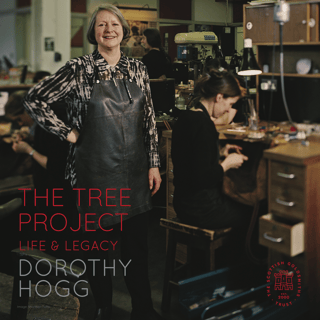
Speaker: Hello and welcome to The Tree Project, Dorothy Hogg Life and Legacy podcast series. I'm Emma Goering from the Scottish Goldsmiths Trust and this podcast series has been developed to highlight the impact and legacy of the late Dorothy Hogg MBE and her influential time leading the jewellery and silversmithing department at Edinburgh College of Art. The participants in this project were selected by Dorothy alongside her friend Curator Amanda Gain. For more information on this project and all those involved, head over to our website
Speaker: In this episode, I'm joined by Beanie Major. Thank you for joining me, Beanie. Let's start with introduction and what it is that you do now.
Speaker: I'm Beanie Major. I'm a jewellery consultant for private clients, helping clients to purchase special pieces of jewellery and build their jewellery collections. And I graduated from ECA in 2008. Tell me about your journey towards studying at ECA and why you made that decision and reflect upon your time there and your relationship with Dorothy.
Speaker: I was always pretty focused on heading for the world of jewellery. I basically started designing jewellery when I was 15 for my GCSEs. I had an incredibly inspiring teacher at school and I think incredibly rare opportunity where we actually had jewellery benches and were able to study it as part of our design technology GCSE in A level.
Speaker: My teacher was a lady named Anne Legge who had graduated from RCA as a silversmith herself and had been quickly snapped up by Tiffany's in New York and had been creating one -of -a -kind tea sets for them and sadly family circumstances and tragedy brought her back to the UK where she got a job as a teacher and set up.
Speaker: department and I'm really incredibly indebted to her as I am to Dorothea because there are two people that really set me on my career into the jewellery world. Firstly, her inspiring me, I was the art scholar at school. Whilst I'd always loved art and had a passion for drawing and a very natural eye for that, it was really on discovering design that I felt
Speaker: really excited and the fact that I could create something that had this purpose and I remember learning about ergonomics and all this kind of thing and thinking about creating something that an important purpose in life. That really set me on my trajectory and actually when I applied to Edinburgh I know that Anne called up Dorothy and they had a lovely chat and I
Speaker: I think Dorothy had been RCA as well, so they had lots of contacts in common. And I was so lucky having done an art foundation down south that I was offered one of two places at Edinburgh College of Art. There were 12 of us in the year. It was the only course that I applied for, having decided that I was definitely going to continue on to do jewellery design at university, having done my art foundation. I looked around a few colleges and I just completely fell in love with the work they were doing.
Speaker: at Edinburgh College of Art and I jumped on the train, went up for my interview and I think I must have been one of the last interviewees because before I'd made it back down south I had a lovely email from Dorothy saying that they had accepted me onto the course and that was that. I'd love to hear more about being on that course and the culture that Dorothy fostered. Were there any particular projects or learning that stand out in your memory?
Speaker: Thinking about my time at ECA, I can always remember it being quite full on. I lived with students from the university who I think had sort of two essays a year and were spending more time partying very hard. But we did have to be, you know, checked in every day, five days a week on the bench, creating and making jewellery.
Speaker: as well as extracurricular activities alongside essay and coursework as well. So I always remember there was always this thing about being a DOS art school and I remember thinking the injustice of it all, how hard we were working and always encouraged to be there. But I think there were definitely positive sides to that. We became incredibly close -knitted as a group of students.
Speaker: no opportunity really to not be there every day you know building on your skills, connecting with the tutors and really putting in good time at the bench. I think for me it was the sort of sheer joy of for my first year I joined and second year as I said experiencing all these new techniques and
Speaker: ideas that I had had limited access to prior to that. So right now I'm thinking particularly of the casting project that we did where I think we learnt different ways to cast so there was the cuttlefish casting.
Speaker: and casting in the sand and I remember that being really exciting and just the opportunity to experiment with different materials and different techniques that were very traditional but then also being given the opportunity to explore and push the boundaries with those techniques.
Speaker: Probably one of the most defining moments for me, they always say you can only really join the dots looking back, was actually a lecture that we had with Lorna Watson, who was an ex -ECA graduate. And she was really exploring the e -commerce space at the time. And I remember it just really resonated with me. And I particularly remember her saying that jewelry sales had been down
Speaker: the previous Christmas and jewellery obviously is a huge category at Christmas time and for some reason that really stuck with me and I don't remember at the time but once I had left uni that was something that just like remained with me and definitely when I came to starting
Speaker: my blog, that was past the foundation for launching that site because e -commerce was becoming more and more important, we were going more and more online. It's hard to think back to days when we weren't so connected online but the premise of my blog when I launched it was really how am I going to take this world that I know, my contemporaries, other designers, young independent designers and make people more aware of them, how am I going to connect
Speaker: with that younger audience and how am I going to make jewellery relevant online? If jewellery sales are down online, what can I do to make it more accessible to people in this at the time new online world that we were experiencing?
Speaker: and this is sort of probably around the same time that Instagram launched so it's very much in the days where people were following lots of blogs and street style blogs and fashion blogs and blogs for everything was really where it was at online and that obviously gave way to other platforms like social media and Instagram and platforms like that. Tell me a bit more about your relationship with Dorothy and how she mentored and guided you as well as being your teacher.
Speaker: Dorothy, I met Dorothy when I went up to Edinburgh and she was obviously a huge...
Speaker: part of the reason that I chose that course. I always had an incredibly great relationship with her and I don't think as much as I'd like to think it was, I don't think that was unique to me. I think Dorothy had an incredible understanding of people, specifically how different people learn, how they took on information or
Speaker: or how they reacted to education and I think she was able to sort of tailor the way she taught down to each individual and I think an advantage of certainly the jewellery course at Edinburgh College of Art and I'm sure other jewellery courses
Speaker: around the country is that often the courses are quite small so you do get a lot of one -on -one time with the tutors where you get to sit down, you get to discuss your work but beyond that also discuss your worries, discuss your troubles. She really was much more than just a tutor, she really was a mentor. At one point I was having a real confidence crisis with my work and I didn't know what direction I was going in and
Speaker: she was always able to sort of help you distill that and break it down. It's interesting because now I'm thinking about it, I remember her saying to me that she didn't think I was going to be a jeweller in the traditional sense and she didn't know
Speaker: where i was going to end up but i remember her sort of highlighting specific skills to me that she thought that i had of course i didn't think much of it at the time but thinking back now specific conversation i had with her i think she was very
Speaker: student and probably quite on the money with that. I did try and go into making but ultimately I've ended up somewhere very different to having a jewellery brand or being a designer maker so that was quite interesting.
Speaker: I think it was in my second year that Dorothy broke the news to us that she was going to be tiring and moving down to London to do her artists in residence at the V &A. I remember we were all just absolutely gutted.
Speaker: As I mentioned, she was an incredible inspiration to us all, both with her own practice but also just in the way she taught jewellery. I have no idea about my contemporaries but she kept in touch with me after she had left. We actually had some secret tutoring sessions after she had gone, which I think just shows how much
Speaker: care Dorothy had for her student, how passionate she was that her students succeeded and did well, that even long after she had gone and she was down in London, she was still prepared to take some time out to help me and no doubt some of my other contemporaries as well, although I'm sure we all kept it very quiet to really get us through to the end. Those last few months of finishing a degree at art school are always, you know, long sleepless nights,
Speaker: crazy portfolio building, lots of tearing your hair out, wondering if you're going in the right direction. You know, to have her sort of ongoing support during that time was incredible. And actually being down in London quite a bit, I was incredibly lucky to go and visit her on her placement, her artists in residence at the V &A. And it was wonderful to sort of continue to keep that relationship up and, you know, it was incredibly
Speaker: I'm incredibly grateful for Dorothy for the huge impact she's had on my career, for her support and also for just her understanding of the way I work. I think her knowledge and her understanding and being able to sort of foster my creativity in the way that she did. Wonderful. Tell me about what happened after graduating. Take us along that career path to where you are now.
Speaker: After I left Edinburgh, I headed straight down to London, my family all down south. I headed down and I explored lots of different things. I went to go and work in retail at Tiffany's in Harrods and I was desperate to get a job working for Sean Lean, who I think at the time sort of was quite a big inspiration for
Speaker: a lot of my generation studying at that time, him and Alexander McQueen had really taken the fashion and the jewellery world a bit by storm and had been sort of very revolutionary in their ideas and the materials they used, especially with Sean, he had taken
Speaker: you know, a very traditional fine jewellery craft. He started off in Hatton Garden in restoration of antique jewellery and he had this very traditional understanding and knowledge of jewellery and I think when McQueen came along and sort of challenged that they were able to sort of open up all these kind of realms that hadn't really been
Speaker: explored before. I love the fact that Sean Lean was taking traditional techniques and traditional materials and putting them into entirely new context on the catwalk and really pushing those boundaries and making pieces that beyond jewellery were really sort of whole
Speaker: body pieces that were really making people question jewellery design in a way that perhaps it hadn't been before. And I think it also gave way to this new type of jeweller who was really becoming the face of their brand
Speaker: I think it took the industry from maybe being much more sort of traditional jewellers to being branded jewellers that was really really interesting and I think especially being at art school at that time and seeing what they had been doing was incredibly inspiring. I worked at Tiffany's and Harrods which was fascinating, I got a real insight into sort of commercial retail world
Speaker: I went there because I needed to earn some money. Obviously being in London it was extremely expensive having been in Edinburgh. But whilst I was there I was really angling to somehow get my foot through the door with Sean Lean. I kept sending off my CV and
Speaker: and hearing absolutely nothing and my dad's kind of on my back saying you can't just apply to one company you need to be applying to multiple companies but I was pretty focused on getting to work for him so I remember I called up one Monday morning and I said look I'm really interested in coming to work for Sean is there any internships or anything I can do to sort of
Speaker: be involved and they said well actually we're looking for an intern on the bench do you have bench experience and I obviously said well I'll send over my CV which I did and I think that was obviously fantastic there was such a focus on being on the bench at Edinburgh College of Arts so I went in the next day took in some of the pieces for my collection and by the following Monday I was in the workshop
Speaker: which was fantastic. I mean, really interesting suddenly to take everything that you've learned, but then be applying it to the real world, to jewelry collections that are selling in Harrods, in Selfridges, in shops around London. That for me was totally thrilling to suddenly be, you know, working in this hat and garden workshop for a jeweler and the jewelry brand that I had admired throughout my education at Edinburgh.
Speaker: Whilst I was working with Shaunine, I guess that was probably the point at which I began to reflect on what Lorna Watson had said in her lecture when I had been at Edinburgh. And I was avidly following fashion blogs and street style bloggers at the time and I would spend hours sort of going through them all and bookmarking them all.
Speaker: And I thought to myself, how can I make jewellery relevant? We're talking pre -jewellery e -commerce. I think Net -A -Porter was yet to have a fine jewellery offering. I think Instagram had just launched. We're talking about 2011 now, so I had worked for Sean for a couple of years. I'd done a bit of travelling. I had worked my way into the design team from the bench.
Speaker: but I really wanted to find a way to make jewellery more accessible so I launched in September 2011 a jewellery blog called In Detail and the premise was really simple it was to show real women wearing real jewellery through a series of interviews where we would go and meet with inspiring women
Speaker: who are working in all different fields, from all different backgrounds, all different cultures, and interview them through the lens of their jewellery, which is really fascinating because if you ask someone about a piece of jewellery, it always relates to something important in their life, whether that's a person, a place, a milestone, whether it's been passed down, whether it's something they've bought for themselves. There's always these incredible stories that come through it, and I think
Speaker: Sitting down with someone in their jewellery collection gives you the incredible ability to go quite deep quite quickly in a way perhaps you might not otherwise and I don't think I was a particularly natural interviewer but having the jewellery there allowed the person being interviewed to open up.
Speaker: quite quickly because you could see always when you were speaking to someone about a piece of jewellery how emotionally important that piece was and by sort of tapping into those emotions what incredible stories came out, incredibly personal stories through sort of discussing those pieces.
Speaker: So that was really the premise. I think it was really exciting. I was one of the first people to really be doing anything around jewellery in this sort of blogging sphere. So it took off very quickly. We went down to all the fashion weeks. I launched it with my boyfriend at the time. He was a graphic designer and he picked up a camera and we went down and shot Street Style at London Fashion Week.
Speaker: hopped on a plane and train and went to Paris Fashion Week, New York Fashion Week. We got in the way of all the fashion photographers who were trying to get the outfits and we were like running in and trying to zoom in on the jewellery and see how people were really styling their jewellery to really inspire people to think about the way they wore jewellery both on a sort of level of
Speaker: the stories and what it represents but also in the way they were styling it. And we weren't fussy about whether it was fine jewellery or fashion jewellery or what it was made from. For me it was just as fascinating to hear about a friendship bracelet that someone's kid had made them at school as it was to hear about a family diamond that had been passed down through generations.
Speaker: It was also fascinating to see how people did wear their jewellery and this sort of hybrid consumption between fashion and fine jewellery. Maybe pieces that, you know, they had made themselves or their kids had made. It wasn't sort of exclusive that you were in one camp or the other. Jewellery is, it kind of weaves through our lives and people still had important pieces from
Speaker: when they were much younger, pieces they had inherited, pieces they had acquired in more recent years for themselves. And I think it was really fascinating to see how people collect and build over time. So when I started the blog, I was still working with Sean. I sort of took the idea to him and said, look, this is something that I want to do.
Speaker: and I think it was around Christmas time so he said why don't you take three months to go and explore that and see what happens. Looking back I think I was quite brave at the time, I'm not sure I'd be so brave now. I called up various jewellers, I tried to find out when events were happening and I tried to sort of network as much as possible. We went to the studios of jewellers to do interviews with them and the whole thing just snowballed
Speaker: really quickly. I think it was the right thing at the right time and the industry very quickly picked it up and became fascinated with what I was doing and I did start getting invited to a lot of collection launches and a lot of studios, people wanting to sort of share their stories from the industry perspective. I actually had never ended up going back to Sean Lean.
Speaker: So Sean was incredibly supportive and I think also having Sean's name behind me, going out and meeting people, definitely had some gravitas as well. In the same way that having been at Edinburgh College of Art and learned under Dorothy Hogg got me that job with Sean Nien on the bench at the first place and likewise the same for my school days and leg
Speaker: Yeah all three of them have been incredibly important parts of my career and actually it's really lovely to have the opportunity to reflect on that. There seems to be this community of ECA alumni and do you keep in touch with your peers and did any of the former graduates inspire you?
Speaker: I think one of the things that Dorothy was also really good at was creating this ongoing network within past and present ECA students. There are a lot of names and people that I know, certainly I know their names, I know their work.
Speaker: that Dorothy would sort of talk about them and their careers for years after they had left the department and I think that was always very inspiring. I think Dorothy was always very keen to show her students that there were lots of different avenues that you could go into in this industry and how varied it is. I was lucky enough to actually go and work with Lorna for a few months after I left
Speaker: Edinburgh College of Art. She at the time was I think creative director of Ashley Clark who were one of the first companies to really put fine jewellery online in a very accessible way. It was really interesting to go and connect with Lorna, Dorothy had obviously talked about her a lot, she'd been a visiting tutor during my time there.
Speaker: you know, it's always wonderful to have those connections within the industry. And I think Dorothy was particularly responsible for sort of fostering those connections over the years. I love what you mentioned earlier there about interviewing people with their jewellery as a great way to enable a deeper, more personal connection, those that you interviewed. Tell me about how you transitioned from the In Detail blog to what you do now.
Speaker: I ran in detail for nine years. I shut it down at the beginning of 2020 with VU2 focusing on working with private clients to help them source pieces of jewellery. It was a very natural, organic decision to go into that in as much as with the access I had to the jewellery world, I began to get people asking me to help with purchasing
Speaker: I've inherited some money from a grandmother. I'm looking to propose to my girlfriend. Whatever it was, people were coming and asking me for help in navigating an industry, a market that is often incredibly closed and daunting for people as well.
Speaker: I was lucky that my business kind of found me through obviously the expertise and context that I had built up over the years. I always refer to myself as a bit of a generalist within jewellery. Throughout the time that I was running in detail I was also consulting for retailers and jewellers in the industry and that gave me a really fascinating but very sort of general
Speaker: insight into the industry. So I kind of took up every opportunity that came my way and worked across things from marketing, helping people with content. I launched a jewellery department for a new department store, bridal department store that was launching in London. And I think it was really when private clients started coming to me and asking for my help.
Speaker: that I realised the opportunity and the strength of the network that I had built up, unlike a sort of traditional jeweller who is
Speaker: creating jewellery under one brand name. I work with all sorts of jewellers and people within the industry depending on what my clients are trying to get done. Whether that is sourcing a bespoke jewel, finding something last minute sort of off the shelf piece as a present or something like that. But also they might want to source a really special gemstone or diamond or more recently, you know, I've had
Speaker: things such as taking clients who enjoyed workshop visits or visits to a mine. I'm really trying to bring to life what I got to experience through the blog, the insights that I got, the sort of behind the scenes that often the end consumer doesn't get to see.
Speaker: It's extremely varied what I do for my clients. I'm very open to all requests, try and keep an open mind and really try to instill my knowledge and my passion on my clients to give them the power and knowledge to purchase pieces that ultimately are going to last.
Speaker: they're gonna want to keep and treasure for a long time. I think that's one of the things that I love about jewellery is that it is not something that is fleeting. I've always been pretty against trends in jewellery. I try and steer my clients to avoid them and really think about
Speaker: what's important to them when they're purchasing a piece of jewellery and what's going to stand the test of time and hopefully be passed down to the next generation. I don't like the sort of more throwaway side of jewellery. I love it to be something that they're really going to treasure. You mentioned about clients wanting something that will stand the test of time. I'd be interested to know about what other values are important. Are people asking you about the provenance of materials, the craftsmanship
Speaker: what things are important to them and do you think these things have changed over the last few years?
Speaker: I think there are three main areas that I have distilled it down to when people are shopping for jewellery, in particular fine jewellery. First of all that is where do they go to purchase fine jewellery. The industry has boomed over the last few years, more and more branded jewellery has burst onto the scene.
Speaker: As with everything these days, the more choice we have, the more choice paralysis we have. So even though I think now a lot of my clients are very aware of the jewellery brands and jewellery retailers and where they can go to shop,
Speaker: sometimes it's almost that it's too overwhelming and there are too many options whereas when I first started out I think a lot of it was I had this secret black book that people weren't aware of but because the brands and the retailers can connect so directly with the consumer first hand these days that's less the case today it's all about helping them to navigate through that and distill who's the right jewellery brand for or jewellery designer for them
Speaker: The second thing is the actual product and the piece of jewellery itself. It sounds kind of crazy but I work with a lot of women so typically we kind of think of maybe a male proposing with an engagement ring and actually I work with a lot of women who are involved in buying the engagement ring for themselves.
Speaker: So you would then sort of say, well, you sort of cut out that problem of not knowing, you know, what to buy her, not knowing what she wants to wear. But I haven't found that to be the case at all. Actually, it's sometimes harder working with the women who obviously want to purchase this piece that they're going to wear every day and represent something so important to them.
Speaker: So really helping people to choose the right piece and understand what their style is and how that piece of jewellery fits into their life is a really important part of what I do and you know a big question that a lot of people ask me that you know I just don't know what would suit me I don't know
Speaker: what would work with the other pieces in my collection. So that's the second thing and then the third thing I think is price of jewellery. What should I be paying? I get asked a lot but I think the real question or the real underlying worry there is I don't want to be ripped off.
Speaker: and you know there is I guess this history maybe of people being sold things that perhaps weren't what they were in the past and there is this real underlying worry of maybe the diamond I've bought isn't what they've said it is or perhaps I haven't bought gold I've bought something else and I think for someone who hasn't had the opportunity to handle those materials and work with them that can be incredibly daunting
Speaker: am I paying the right price for this piece? So that's definitely something that I help clients to navigate as well. In terms of values, we're seeing a huge increase in people wanting to know the provenance of materials, where stones were mined, which mines they've come from, wanting to sort of understand the process, where they're made, and, you know, sort of who's been involved in the making of that piece, which I think is happening across
Speaker: all industries and has a really positive impact as well on the industry to get that feedback from the consumers and be able to feed it back to the brands and really sort of drive the industry to think about where they are sourcing their materials from.
Speaker: I get a lot of clients asking, you know, wanting to buy secondhand pieces or stones that have maybe come out of antique or vintage pieces, which I think is really interesting and shows that the client is much more concerned with sustainability of those pieces. What a unique and interesting job you've carved out for yourself. I'm trying to imagine what your typical working week is,
Speaker: Maybe there isn't such a thing for you, but could you try and describe what it might look like? My typical week is varied as much as I try to structure it. You never know when a client request is going to come in. Often they come in quite last minute. I am pretty much a full -time WhatsApp -er these days. I communicate with all of my clients, all of my suppliers, all of the jewellers in my network.
Speaker: through WhatsApp, which has its pros of being able to build very personal relationships with clients all over the world and to sort of be a jewellery advisor in their pocket as and when they need, especially for clients who are purchasing something like an engagement ring, which is a very important purchase, just being on hand to sort of guide them through the process.
Speaker: I accompany clients to meetings when they are purchasing a bespoke piece of jewellery, so I get to interact with a lot of different jewellers on a daily basis. I get to go along to collection launches when jewellers launch new collections.
Speaker: which is always fascinating to see how brand is developing, what's new, be able to see what's being produced and what the appetite is for those pieces in the market and obviously at the same time meet with some people from the press who are normally attending those events.
Speaker: I do have to fly sometimes around the world to meet with clients and get a sense for what's in their jewellery box already and how we can build on that. I always start very much with the client, who they are, what their life starts like, what pieces they have in their collection already, is there anything that we can remodel or just bring out from the back of the jewellery box and breathe new life into it.
Speaker: I'm quite lucky that I can kind of work from anywhere really as long as I've got my phone and my laptop which you know especially these days people are so much more comfortable with meetings over zoom in fact most of my clients now prefer to meet over zoom and communicate through
Speaker: WhatsApp and social media channels, which is really interesting. Sometimes I'm juggling lots of different projects at once. I'm learning every day. As I said, I'm a bit of a generalist in the industry. I've got an incredible network of people who really are the specialists. So I really see my job as knowing the right people for the job, whatever that job may be. So when a client comes in with a request,
Speaker: I'm pretty sure I've got the person in my network to be able to help with that and that's incredibly satisfying place to get to after being in the industry for over a decade now to be able to sort of utilize
Speaker: that network that I built up over the years and often at times I didn't really know why. I had the website, I was building a community, I was building this connection between the consumer and the jewellery industry but it was never my intention for it to be my business so I'm really happy that today I've managed to find a business
Speaker: that very much takes everything I learned over the years of writing the blog and consulting for retailers and brands and kind of distill that into a service for the end consumer who ultimately I was always writing for, creating the content for.
Speaker: And to take the stories of the women who shared their jewelry collections with me and be able to take the knowledge I gained through that and help women and men to buy jewelry and kind of create those stories. Thank you for joining us today, Beanie. It's been so interesting. If any of our listeners would like any further information, then do have a look at our website. And before we go, Beanie, is there any last thoughts from you?
Speaker: It's wonderful to have the opportunity to sort of reflect back on those years because you don't necessarily realise how impactful they were and Dorothy was such an incredible person so I just feel very honoured to have been able to have been tutored by her and for her to have set me on my path and she's a huge part of where I am today.