Transcript
Speaker: You can't get attached to your pieces. Meet Kim Canfield, a potter who creates baby face mugs with different facial expressions. I actually started to carry around these mugs with me. I put my coffee in it, but they kind of reflected how I was feeling. Kim's pottery and sculptures have been greatly influenced by her time working in children's hospitals.
Speaker: Some of my sculptures are actually based off of the very first patient I ever worked with. Outside of just making pottery, Kim also teaches pottery and she really enjoys teaching it as well. I think it's really cool to see I can give someone clay and everyone's going to make something different.
Speaker: One of the last things Kim talks about in this episode is her excellent advice to find your own new voice with your partner. You're going to find your community of people who really love your words, so just make the stuff that you love. And there's so much more in this episode. I hope you guys enjoy it and I'll see you guys in there. Kim, welcome to Share with Pottery and share with me what is something that has helped you the most along your pottery journey so far.
Speaker: I would say so far what's helped me the most is honestly failing. So I've been in pottery now for I would say probably the last.
Speaker: I'm probably going to say decade. I would say the last decade I've been in pottery. And the thing that's helped me the most is just kind of failing through everything. So whether that was learning how to sell my work or applying to shows or I really enjoy doing festivals and art shows and stuff like that, you kind of learn as you go how to do stuff. And so I would say what's kind of helped me the most is just throwing myself out there, giving it a shot and
Speaker: Just kind of failing as I go and I I learned what I need to fix next time Absolutely love that shaping nation the more you fail the more you're gonna learn and the more you learn the better your pottery is gonna get so Tell me the story how you got started making pottery
Speaker: Okay. I'm going to try to like make it a shorter version, but basically I didn't go to school to begin with to do ceramics, to do pottery. I was actually going to school for exercise science and PT. I ran track and I played soccer and all I wanted to do in college was play sports.
Speaker: But for that, with being in high school and playing sports, to go down a quick list to kind of give you an idea, I had a pretty serious concussion that lasted me several months. I want to say around nine months. I fractured my lower spine. I had bulging disc in my back. I had to wear a back brace. I broke both of my seat multiple times. I had stress fractures in both my shins and I broke a lot of fingers too. And this is all before I even got to college.
Speaker: The problem is when you're going into an exercise science and PT program, most of the time the people around you, your colleagues, they're also playing sports in college while doing that major. But as I was going into college, I had a lot of health issues and injuries and I wasn't going to be able to play sports or really do anything, which is kind of difficult. So that was really starting to get to me. My first semester in college, I couldn't play sports. I was going to college to play sports and I just didn't feel right.
Speaker: kind of backtracking back when I was in high school, like I mentioned, I had a really serious concussion. And I think concussions now are treated very similar to how concussions were treated then, which is you basically have to sit in a room in a dark room and just there at the wall, you really can't do anything to stimulate your mind or else it's not going to heal. And so this is going on for so long, I was getting kind of stir crazy, I couldn't do anything. And so I actually started teaching myself to oil paint.
Speaker: and it caused a little bit of pain but I was willing to deal with that if that meant I could do something and so I started oil painting and when I was younger I also loved doing like drawing and painting and I loved the sculpt with my hands and so when I was going into college I kind of remembered that I thought that's what got me through a lot of my tough times when I was just really sad and kind of depressed and
Speaker: I kind of had to come to terms with and accept the fact that I don't think I could play competitively at the level that I want to in the future. I don't think I could play in college. And to be honest, if I were to continue down this route of doing PT and exercise science, I don't think I can see myself in this in the future. And so after my first semester, I decided to give myself the opportunity to go after doing art in college. So by my second semester, I was a studio arts major with a concentration in drawing and painting.
Speaker: After a little bit, I ended up finding my way over to ceramics. We started off with hand building and I absolutely fell in love with it. And I just ended up taking more classes. So then by the time it was the end of my college career, I was graduating with a BFA with my concentration in ceramics and sculpture. So that's kind of how that full circled. I love that. And I can't even imagine having a concussion for nine months because I had one for two weeks and that was miserable. Nine months is crazy.
Speaker: Yeah, it was somewhere between I would say like seven, nine months ballpark. So most concussions, I'm no expert on this, but a lot of concussions are usually two, three weeks, but then some of the more serious ones can last many months or even longer than that and affect you long -term. So mine lasted for a long time. It just wasn't healing and I got hit pretty hard.
Speaker: Yeah, I can imagine because I was miserable the two weeks when I had mine. So tell me the story about when you got your MFA from the University of Delaware.
Speaker: Yeah. So after I graduated with my BFA, I was a studio tech for a little bit, ceramics tech as well as a woodshop tech. And I decided I wanted to pursue higher education. I wanted to go and get my masters. So I decided to look at a couple of programs and the one that kind of best suited what I needed. I went to the University of Delaware and that was a two year MFA program. What is something you learned during this time that helped you with your own pottery?
Speaker: So with anyone who's ever been like in an MFA program, they're really intense, but it's a very intense time for you to focus and hone in on your thesis, your body of work, whatever it is you're kind of working on. And so the thing that I learned during this time was more about myself and why I made the work that I made.
Speaker: I would get into the studio around eight o 'clock in the morning, closer to nine o 'clock. So I had to teach also at the university I was at. And then it wasn't uncommon for me to stay until 12, one o 'clock in the morning. So that's how most of my days would go, including the weekend. And so when you're forced to spend so much time in your studio around your work, you just get to learn more about yourself and kind of why you made that work. So by the time that I reached the end of that program, I had a pretty good idea.
Speaker: I had a better idea and sense of why I was making what I was making. What was your why behind what you were making?
Speaker: That's like a longer explanation, but I thought I went into it with one expectation as to why. And I'll get into that, like talking about like my babies that I make and my sculptures, but I just had a very personal, deep connection with my work and with a lot of the kids that I worked with. So it just kind of made me learn more about myself and just my experience and the places that I worked at.
Speaker: Absolutely love it. And speaking of your baby mugs and sculptures, tell me the story of how you started making your baby pottery that you make today. So my baby face mugs, I started making those actually when I first started off in ceramics in undergrad. I think it was ceramics one or two that I started making those, but it was mostly hand building I was doing at that time before I did the wheel. But I started off making these faces and I always like sculpting. I like
Speaker: sculpting faces and hands and feet. And so I started off making these babies and they started to morph and change over time. And I've noticed over the last 10 years that they changed pretty drastically from the first one till the last one, or the more recent ones that I've made. They were just kind of like my little grumpy pals that I had around the studio. And when I became a studio tech after I graduated, I was the one in charge of firing our gas kilns. Gas kilns have to be
Speaker: babysit, babysat basically. They are giant burning basically furnaces in the back of the building. And I didn't want to be responsible for our burning, like our building burning down. So they had to be watched all day long. So I would load these late at night. I always waited till the last minute. And so I would load up these huge, this huge gas kiln until like 11, 12 o 'clock at night. I would preheat it or I would candle it throughout the night. And then I would come in around four in the morning to start the kiln actually.
Speaker: And it would fire throughout the day until the night. And then I could finally go home. But I was so grumpy. I was so tired because I'd only get like four hours of sleep. And then I had to come in and fire this. And this was happening like every, I would say two weeks, sometimes sooner, especially at the end of a semester. But I was so tired. I was so grumpy. And as people started to like trickle in in the morning, more like eight o 'clock or so, I just didn't want to be messed with or talk to. So I would, I actually started to carry around these mugs with me. I put my coffee in it.
Speaker: But they kind of reflected how I was feeling. So it's more like that grumpy face that I was making, that angry, upset face was really how I was feeling because I was just tired all the time. Absolutely love you. Turned your pay to turn into art. I love it. So you are inspired by your time volunteering and working in Children's Hospital. Tell me more about this.
Speaker: So the way that I kind of ended up making this body of work, I worked on this body of work starting in undergrad, and then I started working on it in between going to grad school and then my entire thesis in grad school was dedicated to this body of work. But this has been ongoing, I would say for the last eight years, seven, eight years that I've been making this work, but it is dedicated to my time working, volunteering and interning in
Speaker: behavior centers, psychiatric facilities, as well as children's hospitals. And to be very honest, I never intended on working in any of these areas. I actually just kind of accidentally ended up in them, weirdly enough. The first facility that I was ever at, something that I accidentally kind of fell into, and I was working with kids under the age of 13. I was no, by the way, I'm no doctor.
Speaker: a psychologist or professional or anything like that. So just saying this is from my experience, I'm no professional by any means. But I was just in there to kind of work with the kids and a lot of it had to do with art and art therapy. Just kind of working with the kids on art projects and talking to them. But I didn't really realize what the setting was going to be and that's kind of how I accidentally ended up in these areas.
Speaker: But the first facility that I worked in was mostly with kids that were, unfortunately, from very traumatic backgrounds, abusive backgrounds. Some of them dealt with PTSD and a couple of other things. But then the facility in the hospital that I worked after that was more, I would say, assault and dealt with
Speaker: kids under the age of 13 that experienced mental health illnesses and disorders that were not commonly seen every day. So you did have things such as anxiety disorders, OCD, PTSD, and even mood disorders like bipolar disorder. But in the one facility that I worked in was more on the rare side of things, which was actually schizophrenia.
Speaker: And schizophrenia is not usually seen or developed until later in your late teens, mostly adulthood. And so it is extremely rare to see kids diagnosed, but it's not really diagnosed. It's really early onset symptoms of schizophrenia that you see maybe around 12, 13 years old. But we didn't have cases like that and it was just very
Speaker: I don't even know how to describe the experience. It's one thing to like kind of hear about it and not really know, but to see it firsthand, to work with these kids and experience it. A lot of this is kind of based off of feeling like I wasn't really prepared for this. I was never trained also. So I was kind of put into these situations where I had no background. I didn't know how to deal with these situations. A lot of these were complex, difficult situations, and I didn't know how to react a lot of the time.
Speaker: And looking back, I wish someone would have trained me, but to be honest, every single time I went into one of these facilities, I was given like a 30 second debrief of like, you can't hug the kids, you can't touch or anything, you know, you can't have staples, you can't have shoelaces, like really quickly debriefed what you can and can't do.
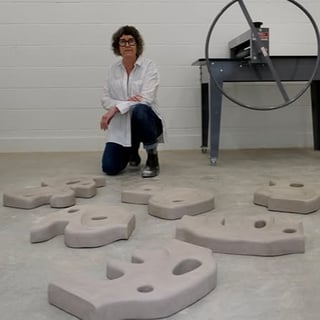
Speaker: I never felt like I had proper training for it, but we've dealt with things that really were not seen every day basis. And so a lot of my work that I make, my sculptures, my larger figures are more so based off of my time working in those facilities and trying to gain some sort of understanding for these complex disorders that I had no experience with. So it was, for one thing, it was kind of,
Speaker: learning about it as I go and trying to figure it out. Some of my sculptures are actually based off of the very first patient I ever worked with. And that memory, that kid will forever be like
Speaker: huge part of my life but it's just again very important child that I worked with and has always stuck with me so a lot of my figures actually based off of him and why a lot of my figures actually look the same is because it kind of all come back to the one child that I worked with at the very beginning and then some of them are also me starting to
Speaker: dive a little bit deeper into my research with certain types of like disorders, whether it's behavioral, whether it's like personality disorders, but I've always been interested in this kind of stuff. And it's just something I'm called exploring, but it's also just a time for me to reflect on that period of time that I was working in those facilities. How do you bring your outside research and apply it to your sculptures?
Speaker: So with certain things like with schizophrenia, for example, I had to do a lot of research and kind of more understanding for what that was. And not only that, because we were dealing with such rare cases of seeing early onset symptoms of that in children, more like early teens, I would say, I had to do some research outside of that to kind of gain the more understanding of some of the symptoms, what to kind of look out for,
Speaker: how kids may be displaying some of these symptoms when working with them. So it kind of helped with my work and with reflecting on this period of time, just to kind of do some more research outside of just working in these facilities. Very interesting. So something I love you do is you don't just make baby face mugs. You also make something called cereal mugs. Tell me a story how you started making these.
Speaker: So besides that heavier kind of work and that subject matter that I work with for my normal body of work, I also like making cereal mugs, donut mugs. I just recently made cake planters and more like food -based sort of stuff. So before even thinking about going to school for exercise science and PT or even art, I wanted to be a pastry chef and I wanted to do everything with desserts and stuff.
Speaker: I just wanted to finally that I was done with school with grad school and everything. I wanted to just start making stuff that was just fun and colorful and bright. And I just wanted to experiment with doing that kind of stuff. And the reason I did serial mugs was because I was just thinking back like nostalgic on my childhood.
Speaker: And I'm one of seven kids. And my one brother in particular, I always think of like me and him with like our favorite cereals growing up. And his was Fruit Loops and Fruity Pebbles, which I hate. I think they're disgusting.
Speaker: And my favorite is Lucky Charms and I like Captain Crunch too. So it was just something that was personal to me and kind of nostalgic. And I think they're very fun. And it was fun trying to figure out how to make them and just be more conscious of like, how am I going to make the handle and how am I going to, you know, put the cereal on there and, and sculpt them. And it was just like a fun challenge for me, but it was also just like a fun, some fun project.
Speaker: absolutely love that shaping nation. You don't have to be stuck doing one thing over and over again, you can branch out and also add your other interests outside of pottery and apply them into your own pottery as well. I love that. Now, can you walk me through the steps of how you create one of your baby face mugs?
Speaker: So to start a baby face mug is a combination of wheel throwing and hand building. So I sculpt all of my faces, all my baby face mugs. So they start off as a cylinder on the wheel and I'll push out the walls. So you just kind of have like a cup shape. So they start off on the wheel. I let them dry a little bit.
Speaker: And then I'll go in with a needle tool and I'll start marking off where I want the eyes to go, the nose and the mouth. And then I'll start to push and pull the clay by doing this. So like I would push in the eye sockets and push out the cheeks. That way you don't have to add as much clay to the piece, so it's not as heavy. But then I'd go in and I'd add eyeballs and a nose and a mouth, and then I would sculpt and push the cheeks out. And then whatever kind of expression I was kind of feeling. And when I would sculpt the ears,
Speaker: And I just started putting a foot on the bottom, but they start off on the wheel and then I go through and I actually hand sculpt it. So you mentioned that you would make the face based on however you were feeling. Tell me more about that.
Speaker: So they started off with, well, whenever someone asks, like, why do you make these faces? It's because I make these faces. And I've always made like faces like at the kid as I was pulled, my siblings would tell me I would just make like the nastiest facial expressions, but they started off with like a snarl. And then I started doing like a screaming face and then like a crying face. And I really just like to push to see how far I can
Speaker: basically push these expressions because it takes only the slightest detail or crease or mark to change a facial expression. It doesn't really take that much. And so I was trying to see how far I could push it to like what kind of facial expressions could I do? And so I started playing around with like three or four different expressions.
Speaker: Absolutely love that. Something else about your baby mugs that I really like is how do you get the skin look onto your mugs? Because I can't figure that out with my sculptures. Like the baby face mugs? Yeah.
Speaker: So it wasn't until it took a little bit, but I knew I never actually like glossy glazes. I think they're pretty, and I do have some at home that are glossy, but I never wanted the faces to be glossy. And sometimes people ask me like, oh boy, are you going to put a clear glaze on the outside? And I don't like the look of it, but they're actually, I paint all of my baby face mugs with Amico's Velvet Underglaze.
Speaker: It is such good quality glaze, underglaze. And after they're bisquered, I'll paint like three or four layers and I'll blend a couple of different colors. But to get that skin kind of look and not too shiny, I use the underglaze. What are the colors you use for that skin look?
Speaker: Oh, I'll either if I'm looking for like a certain sort of like, if I'm doing like skin tone, like some of the more realistic kind of baby faces that I do, not the more like cartoonish ones, I'll do a combination of like red, blue, yellow, until I get like the right skin tone that I'm looking for. But if they're more cartoonish and playful, I've done like blue faces, I've done green, I've done
Speaker: pink, blue. I'll do like all different rainbow colors because they're just kind of fun to me. I think I did red the most. I like red, especially with some of the angry faces. But I'll just mix it from scratch and then kind of find like a skin tone that I like to use. Yeah, absolutely love that. Great explanation of that. So let's talk about the business side of pottery. Can you tell me about the moment when you decided to go full time as a potter?
Speaker: Yeah, so for me, like full time, I teach ceramics during the day. So I teach high school. So my high school teacher during the day, and then after I'm done, I'll go home to my own studio space, and then I'll continue to work on my work when I get home. So I teach ceramic during the day, and then I work on my own pottery at night. And I'll work pretty late at night most nights on my stuff, plus a weekend. So it's pottery around the clock, basically.
Speaker: So as you just mentioned, are a teacher. How did you become a teacher? How did you become a teacher? I really enjoy teaching. I've taught everything from like adults to kids. And I just really like teaching. I think it's really cool to see, I can give someone clay and everyone's going to make something different. I like seeing how people process through what they're working on, how they come up with their ideas. And I like to help them problem solve.
Speaker: I enjoy teaching. If you were to give advice for a beginner just starting out, what would you give them? Like a beginner without a student. Yeah. I tell them like you have, you can't get attached to your pieces. It's really hard no matter what age I teach.
Speaker: I tell people like, I know it's different from other mediums, but you can't get attached. So when you make it, and even after you fist fire it, even after you glaze it, you can't really get attached to it until it's like after it's been glazed fired. Because at any step of the process, it can be ruined. The glaze could come out funky, or like most people, you accidentally chip the side of it. So you got to be okay with just letting stuff go and just, you're going to have stuff break all the time. Excellent advice.
Speaker: What advice would you give to someone that wants to start selling their own pottery? My advice is someone that wants to sell their own pottery. I always say it kind of sounds weird, but you got to have some confidence in yourself. And what I mean by that is when you're starting off and you're selling your work,
Speaker: I feel like every pot or every artist, you make something and then you sit back and you give it a couple of days and then you're like, I don't like this. Or I think this looks dumb or you get rid of it. But I went through that for so long where I would make work and I would be so hard on myself. I'm like, I don't like this. No one's going to like this. And it's really interesting because even through a screen through social media, I feel like you can pick up on if someone actually like
Speaker: someone can actually pick up on if you're really truly passionate about what you're making, if you really like what you're making. And I think I feel like that can actually come through. So I was going through a lot of times where I was making stuff and I was like, no one's gonna like this or no one's gonna care or no one's gonna care to know about my work or the process of it. But I feel like
Speaker: Something I was able to help me sell my own work was to be comfortable with sharing about the process, sharing about why I was making it, why I was passionate about it. So for example, with like the cereal mugs, kind of sharing the background as to why I started making it and why I was
Speaker: my personal tie to it. And then other people were able to connect with it. So I think for so long, I just was like too hard on myself with my work. And I wasn't confident about it or proud about it. And that's definitely going to affect how people will see your work and if they want to buy it because people want to support you as an artist, they want to support your work. And if you're already feeling like meh about it, you're not a huge fan of it, people pick up on that.
Speaker: And I feel like that also came from the fact that because I made baby face mugs, I get mixed reactions. So some people really like it and some people think it's really cool, but I've also gotten plenty of the other side where people think it's really creepy and weird and they don't understand it, which is fine. But I think I let that get to me because people would let me know that, especially when I was doing art shows and craft fairs, because it's just a general public. People don't hold back and they'll let you know how they're feeling. And people will tell me like,
Speaker: I kid you not, I would get comments like, what's wrong with you? Why would you make this kind of stuff? This is really inappropriate. You shouldn't have this. I've been in so many different areas. I always get a couple of people. And that really influenced how I felt about my work. And it made me more reserved about my work. And it made me feel like no one really is going to want it. So my advice is just be confident about your work. Be confident about what you're making. And someone out there is going to love what you're doing.
Speaker: Love that advice. Now let's talk about discovering your voice. Can you tell me about the moment we knew you were heading in the right direction with your pottery?
Speaker: I think I am pretty lucky to say I felt like from the beginning I was heading in a good direction. I feel like sometimes a lot of artists go through these moments of, I don't know what I should make. I don't know what kind of artist I'm going to be, even in the pottery world. But I think early on, I knew I wanted to make figures. I wanted to make figurative work. I wanted to sculpt large scale. So the moment I started building some of my first figures, I felt like I was doing what I was supposed to do. I felt like I was going in the right direction.
Speaker: What were you feeling when you started making your first figures? I just kind of felt like a connection to them. I just loved them. I loved the fact that like this figure in front of me that I was building is something that I created. I just felt very proud of it and I loved seeing them and I was just really proud of myself that I basically kind of taught myself how to build figuratives because I didn't have someone in undergrad. Like I had a professor who
Speaker: would also build large scale and he would help me with armature and giving me advice, but to have someone specifically teach me how to make figurative work, I didn't have that. And so I just felt very proud of myself that I was learning to make standing figures and complex sort of like sitting and legs were crossed and just learning how to do this. I was just really proud of myself and kind of what I was creating in front of me. Absolutely love it.
Speaker: What are some new opportunities that started coming your way once you found your own voice? I feel like some of the new opportunities that came my way were once I started making my figurative work and I knew that's what I liked and that's what I wanted to learn more about. You start connecting with other artists who are also doing the same things as you. So when you're making that work and you start connecting with them,
Speaker: you're also seeing what they're doing. So maybe you're looking at some of the opportunities that they have, maybe where they went to school, who they studied under, maybe some of the classes they took or some of the techniques that they use. So starting to get connected with like that certain group of people to do the same thing as you kind of opens up opportunities for other things to happen. Absolutely love it.
Speaker: So you contribute growth as an artist to working in a lot of different studios that's surrounding you with the community of artists and potters. Can you tell me more about this?
Speaker: Yeah, I think one of my favorite parts of being in this community and working in ceramics is all the studios that I have worked in. I've been in a couple of different studios and either as a guest artist, a teaching artist, the technician, whatever it is, I've been down in Virginia. I'm from Pennsylvania, so I taught a lot in PA, Delaware as well. And every single community studio that I've been in,
Speaker: has been absolutely incredible. You meet some of the coolest people. You get to be around so many different people of so many different levels and different styles. But the community is what really got me into ceramics because it's just such a wonderful group of people who all get together and you talk about clay, you talk about the tools that you're using, the techniques. It's just such a cool community to be a part of.
Speaker: Definitely agree. And that's one of the main reasons why I do this podcast, to connect with other potters. What advice would you give to someone looking to discover their own unique voice with their pottery? I feel like to discover your own voice, honestly, you just kind of have to get out there and start looking at work. So you've got to go to galleries, go to openings. That's also where you meet people too. You meet other artists, but play around with different types of clay bodies and material, maybe different
Speaker: surfaces and stuff, but I would say start doing your research, start looking into other artists. I tell my students that all the time, like you're only experiencing so much in the classroom. You're only going to really grow and see what else is out there when you get out there. So I feel like in order for you to discover your own voice and kind of what you like and what kind of work you want to make,
Speaker: You got to start looking at work. And for example, like Nseka is a great place. I feel like when we all go to Nseka, it's very overwhelming. You get to see like all the different types of work and people that are just exhibiting their work, sharing their work, but you got to get out there. That's the biggest thing. I love that advice. Kim, it has been so great champs today. And as we're coming to a close here, what is the one thing you want to hammer home with my listeners today? One thing I want to hammer home is make what you love.
Speaker: type of work that makes you happy. I know I've fallen into that before where I ended up making work that I felt like maybe this person, this, I see this person over here is doing really well, making this kind of work. Maybe if I do that, I'll do really good at that too. Or, um, I think what we've all kind of fallen into that when you're not really sure what you should do, but
Speaker: Just make what you want to make. And I had that fear a lot with my baby face mugs. I was like, after getting some negative comments, I was like, maybe I shouldn't do this, but you're going to find your people. You're going to find your community of people who really love your work. So just make the stuff that you love and share it. I feel like if you start making stuff that you don't truly like to make, that doesn't really interest you, then you're going to experience burnout pretty quick.
Speaker: I absolutely agree. Some excellent party words of advice. Cayman has been so great champion today. Where can my listeners go and learn more about you? I'm on Instagram. My handle is babyfacemugs. And then you also check out my website for my work as well as some of my bigger sculptures and installations at babyfacemug .com.
Speaker: Hey thanks for listening to this episode of Shaping Your Pottery with Nick Torres. If you want to master the art of pottery and dive deeper into the techniques of the potters I interview, I created a newsletter that does just that. It dives deep into the techniques of the potters I interview. If you want to learn more, go to shapingyourpottery .com forward slash newsletter or click the link in the description to learn more.