Transcript
Speaker: Welcome to Rebloom, a podcast about change, creativity, and coming back to yourself. We are Lori and Jamie, and this is a space for honest conversations with people who felt that quiet nudge to realign, whether that's in their work, their creativity, or their everyday lives.
Speaker: Each episode is a conversation about becoming, about listening closely, making shifts, and finding your way back to what matters. So if you are in a season of change, you're questioning or starting again, we are really glad you're here.
Speaker: This conversation just blew my mind. um what What you're going to hear about and this creative revolution that Flora's creating is beyond brilliant. I think it's so needed and so beautiful. And i want to be i want to be in her RAV4 driving from city to city. and just being there to cheer her on. So I can't wait for everyone to hear this conversation.
Speaker: Oh, I can't wait either. This conversation is going to take you on Flora's artistic journey that she has been on throughout her career, but also you're going to want to connect with her. And it's about connection and community, and it it's a beautiful conversation. And, you know, just being creative, letting your creative heart just intuitively shine. And i cannot wait for everyone to hear this conversation.
Speaker: Well, hello, Lori Siebert. How are you? Hey, Jane. Good to see you here. I got to see you about a week ago in Chautauqua, which was amazing. oh my gosh. What a dream. i had you and Kara here and we you were able to teach for the first time here um i taught for the first time here it was so magical and so much fun loved loved love chautauqua for anyone who's not been it's just this magical place it is we got to hear natalie merchant speak from the 10 000 maniacs we did i got to meet her i don't know if i told you that but i actually met her after you met her too that oh that's right that's right we both did yeah yeah yeah Yeah, she was really lovely. here's It's like Josh Groban was here last night. I mean, it's just been this beautiful summer. Ken Burns was here. so pumped I missed him. I know.
Speaker: It was so fun. And then um one of the things that Lori and I got to do this year is we, I am a big supporter of the arts here, the the visual arts, and they had a wonderful experience. gala and Lori and I created florals that matched the artwork that was going up for auction. And that was really fun. It was fun, but daunting because I'm not a floral styler, even though I love flowers and I paint them. But when I walk walked into that room and it was filled with fresh flowers, I'm like, I don't know where to begin. But you began well and your piece sold for a lot. same It was good. Yeah, it was good. was good. So summer has been great and our podcast is back on track. And who do we have today, Lori?
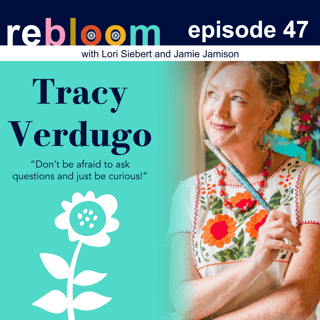
Speaker: We have kind of a superstar. So I've been following Flora Bollie for... a very, very long time. She's the pioneer of intuitive art and her art is breathtaking, but she does make some interesting pivots within her her life and her career. And I'm really curious to hear about what she has coming up because it sounds really interesting. So welcome, Flora. Welcome, Flora. Thank you. i'm i'm so thrilled to be here with you both. And yeah, thanks for having me on.
Speaker: Well, thank you. And how has summer been for you? Summer's been a really nice balance of beautiful summery activities mixed with a lot of work, but like both and and yeah, very energizing. I feel very energized right now.
Speaker: I got to stay on your property for Carrie Schmidt's retreat because I taught for Carrie and we stayed there yeah the second year. It's a beautiful property. And for our listeners, and and where for our listeners where is home, Flora?
Speaker: So I was living out at this land that Lori was just mentioning, which is about an hour outside of Portland, Oregon. And about six months ago, I moved back to Portland. So now I'm back in the city and still running that retreat venue out there. But but yeah, back in my studio in Portland.
Speaker: You have a lot going on. You're ah you an author, you're an artist, you're a retreat leader, and now you have something big coming up, which we'll get to. But we kind of always start back in the beginning. I'm always curious about what people, what they were like and what they were into when they were children.
Speaker: What was little Flora like? Little Flora was pretty shy and very happy to be like in nature, building weird forts and things or playing with art supplies. I was always an arty kid. That was a thing that's that that is a thing that's been with me from the beginning. It was always my comfort place to just create and be in my imagination. And yeah, I had kind of an interesting experience.
Speaker: uh reality growing up because both uh i grew up in wisconsin and both of my parents at different times um in my childhood were the director of the ymca in in green bay and which is where i'm from and so i kind of grew up like at the ymca and in really a lot of senses and at y camp and just doing all the ymca things and so it was ah It was a beautiful childhood, very, very community-based.
Speaker: um We were not like the kind of family that just kept to ourselves. We were just like out there with the people all the time. And um my mom was a really passionate community leader. And i'm so was my dad, but I i think i I feel my mom in me a lot. And um yeah, it was just ah kind of an, it's like one of those things where when you're growing up in your family unit, you don't realize Yeah, that it might be special it is. Yeah. And as an adult, I'm like, Oh, that was kind of you know, interesting yeah shaped, like who I am today, for sure.
Speaker: It's, it's interesting, you mentioned leadership, because you just did a reel about speaking about leadership. And I know community is huge for you.
Speaker: So I'm not surprised that that I didn't realize that was your upbringing. But that makes so much sense. yeah Yeah, it's in my blood. And you know, it's interesting. I i also grew up at the YMCA. I was a swimmer and spent a lot of time, a lot of hours at the Y. And you know what, until you just said that, I guess I never really thought of it. But yeah, you're right. It was community. It was people. It was it was really a special place to be a kid where kids could be kids and really you could explore all different kinds of things. What a great way to start and what amazing parents. Yeah.
Speaker: To kind of yeah have those jobs too. that's Those are cool jobs. Yeah, they were cool. They were cool people. Oh my gosh. So did the art when you you know were growing up and artistic, did you choose to pursue art when you went off to school or was that?
Speaker: i did. yeah For me, it was kind of the obvious next path. I was very much like the art teacher's pet in high school and just did as much as I could to be in that room. making stuff and so when i when i went to college i studied art um i didn't however at that time think i could be a professional like studio artist that just felt like it was reserved for like you know very small handful of people and so i just assumed that i would be a graphic designer or interior designer or some art related profession that had a paycheck involved um And then it was, you know, my of years in the college, I've been taking all these painting classes. I was working at a coffee shop. And it was a coffee shop that would put you know people's arts art on the walls. And so I had a little show with just my paintings that I'd made in in my classes. And to my astonishment, um I sold most of them. And oh that was a real like light bulb moment for me because, and I'm such a practical like Midwest person that I just was like, wait a second, I just made more money selling those paintings than I did if I worked how many hours in the coffee shop? you know I'm just like doing the math.
Speaker: And so... It just got me onto this idea that maybe I could make money doing this. And then I just focused on that for like the next 15 years or so. I just got really just every show I could have, putting my art up everywhere, doing street fairs, having little shows in my house, building my little email list, like all the things. I was just a kind of a natural entrepreneur because I've always felt like that's just another way to be creative.
Speaker: And And then it wasn't until about 15, 16 years ago that someone invited me to, um to share my process with other people, um, for the first time, which had never even occurred to me for all those years. Um, you know, and then it was like, oh, okay, sure. Let me see how that goes. And then I, you know, showed up, it was at Squam art workshops and I, um, I ended up having 60 different people over the course course of, you know, three days take this, this workshop. And that was when I really just realized this is my passion. Like I love painting and I always probably will, but to share it with other people and to watch their creativity come online is something that feels like more of like my real soul purpose. So yeah ever since that first class, I've just been...
Speaker: that's what I've been doing. It's been running. Wow. Yeah. have Have you always um worked intuitively? Has that always been your process from the beginning? Well, I think, you know, when I was, I think most kids just naturally work that way. So, so, you know, that was where it all started. And then when I went to college and studied art, I got, you know, you get all the technique and then you think, oh, I have to I have to know why I'm doing this.
Speaker: Like I have to have a ah ah artist statement that explains the, you can make it up. Yeah, exactly. But I definitely came out of art school being like, okay. I have to have, um, a reason for doing it. Right. Like a, um, a goal in mind or something. And then it wasn't until i actually didn't get in to all the MFA programs I applied to. Cause I was like, I guess I'll just go I got my BFA, now I'll go get my MFA. Naturally, i got rejected from every school.
Speaker: And so ah that was such a blessing in my, in my, on my path, because what I did instead was I just painted and I just, you know, painted in the corner of my bedroom.
Speaker: And it was through that process out of school that I really realized that the purpose, the why behind my work was the way that the work ah the process of intuitive painting and not painting with a plan actually informs living and that's been just my the the interest I've had ever since and so it really came out of um figuring out what worked for me and what kept me interested because I'm the kind of person that will just like not do something if I'm actually not authentically curious and interested anymore and so for me I'm like if I'm going to keep painting
Speaker: I need to find a way that will keep my interest. And for me, intuitive painting, which I didn't know that that was what it was called even then, you know, it was just how I was painting, um to me was the most fascinating. It was the most like, wow, this is like out on the edge, not having a plan, letting it unfold, turning the canvas around, changing directions. And then, you know, over time, I realized this is just like life.
Speaker: And these are the lessons i love that that I need in life. I need to learn how to stay present and be open to change and make courageous choices and listen to my personal urges. All of that, that I was learning in the painting process.
Speaker: very obviously became how i wanted to live. I love that. I love that, Flora. And I was going to ask you to expand on intuitive painting for our listeners, but you just, i mean, you just did a little bit, but yeah, can you tell us a little bit more about it and and help the non painter or someone to understand that just a little bit more?
Speaker: Well, I think the term intuitive painting is a really big term like a man that encompasses a really large swath of approaches to painting and It wasn't until I was, so after that very first workshop I taught, I was asked to write a book the same very week because there was an artist or ah author scout at the retreat. And I thought, oh my God, how do I write a fricking, how do I put this into words in a linear way? And so it was, then i remember the moment I sat down on my computer and I Googled intuitive painting because I thought, well, that's,
Speaker: it's from my intuition, you know, and I was Oh, it is a thing. and yeah but then what happened, the person that popped up when I Googled it, this was back in 2010, was Michelle Casso or Casso. I'm not sure if I'm saying that right. And so she had written these books and I thought, well, she's the intuitive painting lady. If I'm going to call what I'm doing intuitive painting. I better go learn from her is this was my thought, right? So sweet to think back on this. And then I immediately signed up for her three day workshop in San Francisco. I showed up. I'm like, let's see what intuitive painting is. And on the first day i realized, Oh my God, how everything she's saying and doing is the opposite of me.
Speaker: We like, oh yeah we couldn't, I mean, and I love, I think what she does, it's more process painting. um You couldn't do layers, like layers were not allowed. You had to just, wow yeah, she said, you know, you have to just go with what comes out first. um There was no music. We weren't supposed to really move our bodies. Oh, wow. We were supposed to kind of hold the brush in a certain way. i mean, it literally was like everything i would say the opposite of is how it was. So I had this, and I totally understand.
Speaker: I don't say any of that to say that's the wrong way. It's just that it was so different. And um I remember going back to my, you know, where I was staying that night and thinking total identity crisis. I was like, well, if that's intuitive painting, what the hell am I doing? You know? yeah And then by the end of the three days, I came to this place of just realizing, oh, isn't it so beautiful that it's all intuitive painting, but it's just different through different approaches. And my approach is all about music and movement and layering and changing directions. And that's what i work with. And, and so I actually got really empowered by that experience to think maybe what I have is something different to bring out. And, and I imagine that there will be people just as people are attracted to that, her work, There will other people attracted to my work. And so I don't think there's one definition for intuitive painting. um For me, it's just it's coming from the inside out and really trust. It's about honesty. I always think it yeah comes down to honesty and to trusting what is true for us.
Speaker: Love it. And how that looks is like. could be anything. Yeah. It's actually, i agree that ah it's a good thing that you weren't doing things like her because um she's already done it. And your process is your process and you're you are unique. And that's why I love artists and how creative brains work because I love when I teach and every single solution in the room is completely different because yeah it comes from a different person with a different story with a different background.
Speaker: I love that. I was going to make one point earlier when you said you were not accepted um for the MFA programs. Yeah. one of Jamie's friends recently, Kwame, in a talk that he gave Chitakwa said, when you get the nose, it's usually an opening for a bigger and better yes.
Speaker: And ah like kind of felt that when you shared that story that, you know, that MFA thing wasn't meant to be and other things were.
Speaker: and i And I think that experience has really informed how I teach too, because i never want to tell someone that there's one way to do something. I don't like what I hope to create in my retreats is an environment of permission where people can really do what is natural and meaningful to them and then follow that.
Speaker: and And so I'm not there to say, this is how we do it. You know, I give a lot of prompts and I give a lot of ways into it. um to support the process, but really it it all comes down to um freedom.
Speaker: And i I want people to be to feel more free and more embodied and more connected to themselves. Like if you're painting from that place, to me, that's intuitive painting. And, and any version of that is like, beautiful.
Speaker: Yeah, it's trusting, it's trusting your own intuition in your creativity rather than copying yours or copying and, and Lori's right, like in the workshops that we do, it's always such a joy to to see people who've kind of captured the technique maybe you've showed them, but then they've, they've listened to their own heart and how they want something to be and how they want it to appear. That's such a gift too. yeah When people do that.
Speaker: I love that. I love when I learned something from the people yeah my and I do every time. yeah yeah you Every time you're like, Oh, I never would have thought to do that that way. exactly not it My mind gets blown every time I teach by everyone in the room. This episode of Rebloom is brought to you by Jet Creative, a women-owned creative studio and longtime friends of our podcast.
Speaker: Jet Creative partners with brands and individuals to help clarify their story, strengthen their visual presence, and communicate with intention. Their work is rooted in collaboration, care, and the belief that thoughtful creativity has the power to connect with people in meaningful ways.
Speaker: We are extremely grateful for their continued support of Rebloom and the conversations we care so deeply about. You can learn more about Jet Creative and their work by visiting the link in our show notes.
Speaker: So I love the pivot from doing your own work to then sharing and teaching. So that seemed to be the first pivot. And, you know, one of the things that I have found in my life and my career is that the more you share, the more you get back.
Speaker: I think sometimes people are like, oh, I can't tell my big secrets. And I'm like, yeah, you can. Like the more you share, again, it just, it's just the world opens up. But tell us about, you started to share, know, You did your first teaching and then you wrote the book um or started writing the book.
Speaker: And then tell us how that chapter started to unfold. I have to say it was just one of those ah moments in life that was so unexpected for me. um I didn't even know art workshops were like a thing. i was just coming in um from this other place, but the place I was coming from was having been really dedicated to my own development, to my own process for a lot of years, like 15 years really before I ever taught. So i i I think I take some pride in that. Like I didn't learn
Speaker: what offer from anyone else. It was really like my own thing that I came up with over many years. And yeah, taught that first workshop at Squam, That was back in the day of like blogging, being really big. Remember those days where everyone's connected. I've been to Squam Lake too, by the way. love Squam. It's so pretty. It's so special. Yeah. felt really, I realized as soon as I got there, like, oh, this is, I'm really honored to be invited into this space. It's beautiful. But yeah, again, I wasn't even really involved with the blogging world at all, any of that. And then all of a sudden I had the opportunity to share my process with these 60 different people.
Speaker: And a lot of those ladies were bloggers back in the day. Right. what happened was this wild like web of, you know, probably, i don't know, at least a quarter of them roadblocks about what we had done, because I think what i brought was different and we were working on these big canvases we were dancing it was like a whole thing right yeah and and um and so quite rapidly i started getting invited all over the world to to teach these workshops and it was just like holy shit like i didn't even see this coming and then i got the book deal then i got another book offer and i was like what is happening but i was so lit up by it and like truly
Speaker: like I said earlier, I just loved being in the room with people. And I realized, oh, this is, this is like where it all comes together for me. And so I just said yes to everything. And I like set off on these like global like retreat, like experiences where I taught like three different places in Australia, then I went to Europe, then I went to Mexico, you know, i was just all over the place, figuring it out as I went for sure. But just bringing, bringing my authentic thing, you know, the thing I'd been really developing for all those years, not with the purpose of doing this, but just for my own process. And um it's just been a really massive blessing. Like i'll i like have emotion come up when I think of it, like how
Speaker: I feel in a lot of ways it was just like I was at the right place at the right time, but I'd also put all this work into creating something. And then the way that it was received was just beyond my wildest dreams. And um yeah, just really blessed. And then I had a woman, Beth Kempton, some people probably know her. She was one of those students in that first Squam class and she's just brilliant person from the UK and she wrote me and she said, I think like, would you want to do, would you want to create an e-course?
Speaker: and i And I said to her, what's an e-course? like had no idea what she was talking about. It was 2010, you know? And she's like, well i've been doing some research. And I think like what you have could be a really neat e-course. And I was like, well, if you want to help me, I'll sure. You know, so she flew over to Portland. We filmed it. She helped me with it. And it was like the first, I'm pretty sure it was the first intuitive experience.
Speaker: painting eCourse that existed and we put it out into the world and it was so well received and then it was just this global situation happening and it was just beautiful. That's amazing. And it was such, I will also just say, it was such an edge because i was, like I said, this shy person really and like not really the person that I'm like always sitting in the back of the room. You know what i mean? I'm like not like look at me at all. And so all of a sudden I'm in front of cameras. I'm like, the the center and my voice and like, you know, I think a lot of times painters become painters because we don't want to talk. And that that was me. i was like, I'm the shy kid with the sketchbook. You know, I'm not like. Miss Lori's like that too, aren't you? yeah Yes, I am. And then we become teachers and we're like, oh my God, I have to talk. And like, yeah so you know, now it's like who I am today is
Speaker: like such so different based on just being constantly put out of my comfort zone and being asked into these situations that were not comfortable. Let's just say that like definitely edgy. But then you know how it is when you do something that's uncomfortable and then you survive.
Speaker: you, it becomes more and more, you know, comfortable. Just, just a little practice. a little practice always helps. I taught public speaking for years and, and the kids were always, you know, so nervous. And I said, of course you're nervous. You haven't done this, but you know, if you do it and you keep doing it, like you've done, you know, of course. And then, you know, just little by little, it gets a little easier. And, and then you're like, oh, this is fun. You know, it's not so bad. Lori and I have told the story a ton of times, even doing this podcast, we're like, what are we doing?
Speaker: We said, I mean, if we went back to episode one, we'd be like, Oh God, Oh God. But you know, now it's just like, Oh yeah. Like we're just having a conversation and it just, it feels more, it you, you get to a point I think where it feels more natural and it does feel more authentic yeah after you've worked. well you wrote it For me, it's like, you realize that the best versions of you are your authentic versions. Like I would look back on these videos and i would see a moment where I was just being myself.
Speaker: And I yeah would say, oh, that was the best part of the whole thing. yeah And when I was trying and there was some level of performance energy, that was not the good stuff, you know? yeah so And then, and it's so true. And it's also so true in the painting process. It's the same thing. I'm like, the harder you're trying to make this good, the more life you are sucking out of it.
Speaker: That's why our palettes are like the best thing we did all day at the end of the day. And our paint rags. The paint rags are always beautiful. Yeah. And that always shows us like, oh, and we just can let things flow and be honest and natural. I mean, obviously there's a place for techniques and all of that too. But when we can just be real with it, whether it's our art or our life, that's when the good stuff happens. And so that's what I've learned in terms of like speaking and sharing over the years. I'm like, girl, just be yourself. And that's amazing. Yes. When it's the best.
Speaker: Yeah. I have a friend who I dearly love and she's hilarious and funny and she loves to talk about friendship and love and girlfriends. And I'm like, just go on Facebook.
Speaker: camera and talk about all those things so the first couple times i filmed for her i'm like let's just do a couple now yeah and now she's doing one every monday and she's just gotten i can see it she's gotten better and better and it's yeah you just have to do it yeah like you said the only way through this makes it's the only way maybe not perfect but practice makes you more comfortable more And, you know, now I just finished teaching um opera students actually for a couple of days about social media and branding because along the way then, so you started out with, you know, these early bloggers, but then of course came the internet and came, came not the internet, but came social media and Instagram and all the things. So did you lean into that and start to share your work that way too? oh I sure did. I thought Instagram was the coolest thing because I always,
Speaker: have loved taking photos. That's like a little side passion of mine is just photography. And I like to write too. And I like to share. I'm like, ah I'm a, I'm a sharer person, you know?
Speaker: And so when Instagram came along, i was like, how cool that we get to take photos and write things and share our lives. And i you know, those days of early Instagram were so sweet and so so honest. And it was just this place that we could, it was a very natural extension of the blogging world, right? Where it was just this another venue to do it.
Speaker: And as we all know, that's changed so much over the years, but yeah, I definitely dove right into that. And, um, yeah. Yeah. I feel lucky that I got into it when I did and just, you know.
Speaker: it Yeah. Ditto. Yes. Yes. So we're going to fast forward a little bit now. I want to hear about the creative revolution that you're about to embark on because I think it's so brilliant. Thank you. know as creative this happens to us where we just get these i mean for lack of a better word like a download right like this just like an idea and it just really dropped in and it came from the question that i'd been sitting with which was what is mine to do
Speaker: And that question came from the current, you know, geopolitical state and just the immense amount of upheaval and injustice and disconnection and divisiveness. And like, you know, I don't need to talk about that because we all know what's up with that. and And so I just kept asking myself, what is mine to do? What what what what can i do?
Speaker: um what How can I be a force of um togetherness and upliftment and humanity and bringing people together? And and I would just always land back to two things, community, because that's how I was raised and that's my thing, that's my jam, and creativity. Yeah.
Speaker: And so, you know, i a lot of my retreats look, I know a lot like you're all like where we go, we go to Italy or we go to Morocco and we're like in these fabulous places with these small groups of fabulous people and everyone paid a lot of money to be there. And it's just this wonderful thing. And i love that. And I will keep doing that.
Speaker: And i wanted to create something that felt more accessible, more local, more like less of a commitment. And so I just kept thinking, like, well what does that look like?
Speaker: And what I landed on was that I would get in my Toyota RAV4 and like head out on a cross country road trip offering one day gatherings in different cities across the country. And the idea behind that was that the price point could be affordable. I could give tons of scholarships if people just didn't have the money, you know, they could come anyway. um they would meet the people that are in the places that they actually live.
Speaker: Love that. Yeah. just Like, cause you know, I hear it all the time. I, in a retreat, oh, I feel more connected to these women that I've known for a week than I do to my friends back home. So I don't have this community back home.
Speaker: Right. And I, I just find that I, that always makes me a little bit sad, you know? And so My idea is that I roll into a city where there's going to be seven different stops. um I bring people together in the room and I imagine there'll be like maybe 50 100. I don't really know, but bigger groups and something that I'm um that I've gotten good at over the years is being able to create deep, authentic connection quite quickly in a group of people. I just like have my ways, you know?
Speaker: so waha So they come together. or sauce Yes. And, um and we get connected with each other and, and then we use creative practices. So we won't be painting, painting. We're going to be doing more like drawing and pastels and just all kinds of different art materials. but also movement and voice work and writing and authentic connecting with each other. So i've cra i I'm crafting, it's coming into focus, this like really potent, you know, eight hour experience of community connection and creative expression and those things kind of supporting each other. And I hope, my hope is that people walk out of the room at the end of the day feeling like,
Speaker: inspired to do what is theirs to do because that to me is where we're at in this big mess is like what's what is yours to do like how can we all bring our gifts forward they're all different and we need them all right now yeah so inspired to just be in your life in a way that you know is your way to to make a difference in your way and then also the reminder to folks that that we're all creative and that that creative expression and um all of these different ways that we use creativity are not a luxury they're not just for your hobby that it's actually a way of being
Speaker: and that way of being is creating something out of nothing that was not there before, um is actually like our life force moving through us, and it's the same vibration that is what will change the world.
Speaker: it's It's being able to have the imagination And the vision and the capacity to bring something forward, that's what we need right now is to actually, i mean, this is, I'm going global here, like big talk, but it's like, that's what we need to create a new world out of these systems that are obviously breaking down.
Speaker: i I love that so much. And I know Lori's got a follow up question. But you know, the one thing that I want to say is that so beautiful and in community and and creativity is so important. And yes, you're helping people to find their own creativity, um whether whatever it may be, but also by opening up creativity.
Speaker: It also helps them maybe in their professional world to see that it doesn't have to be the way that it always was. They can be creative in everything that they're doing in their life, which to your point, makes the world better and change. that's where That's where our change agents come in because they think, oh, I can be creative here with a paintbrush. But guess what? You can be creative as an accountant to too. Well, not really. you mean you can't steal money. Yes, you can. Yes, you can. you can find new systems that would work and you can think outside of the box is my point. And you're really helping people to see that in all parts of our life, we can look outside of the box. I love that. But Lori, go ahead.
Speaker: Well, I have a friend, Ann Brown, who friend slash client, I've known her for a long time. She spoke at one of the ARPA's Jam conferences we did. And she shared, I don't know the name of the person who did the the YouTube show or series, whatever. But the premise is that in history, if you look back, there are um seasons that happen and you can sort of watch the historical, how it unfolds and it keeps repeating itself. We are in an era of chaos at the moment, but typically following an era of chaos, there is a rebirth season of creativity and community and hopefulness like a renaissance. yeah I'm holding my hope that that's going to be the case. And I feel like, Flora, what you're doing
Speaker: It feels very much like that leading, leading a charge that's about community and creativity is so needed. Yeah. Yeah. I had the thought the other day, it just kind of dropped in. That was like, cause I, what I see in the world right now is that greed is like the main, like one of the main problems, right? just this insane greed that's happening. Yeah. And how creativity is the opposite of greed.
Speaker: That creativity is this generative, like very human, yeah you know, giving, um expansive, sort of energy on an energetic level and how that like counters this, these energies of like greed and isolation. Um, so. And it's, it's got such a beautiful, i mean, you do see the trends now, the kids are going back to the analog. Like, I think the whole digital revolution took everybody like, wow, wow, this is all cool. And now we're like, okay, enough with the screens. How about we get dirty and we, you know, start journaling and writing and, and, um, painting and, and playing piano and doing all and gardening and cooking and doing all the things that we should be doing and connecting. And I think that, I think 2020 caused a lot of pivots, um,
Speaker: um And certainly, I love this idea. I want to know, are you making it all the way to the East Coast? I hope this crosses so I can come see you too. yeah you when When does this begin? When does your journey begin? Yeah, it starts on September 19th is the first one in Portland, Oregon, where I live. And then we go Denver, Minneapolis, and then I am doing my East Coast stop is at the Omega Institute and that one's actually a five day. um In Rochester?
Speaker: In Rhinebeck. Rhinebeck, Rhinebeck, yeah. So that's, it's it's the same spirit of the whole tour, but it's a longer version. Yeah. so So that'll be the five day. And then from there we go down to Arkansas, Hot Springs, Arkansas, um Santa Fe, New Mexico and Santa Barbara, California.
Speaker: wow Wow. You really are going cross country. Do if you have a team traveling with you or are you just hopping in your car by yourself?
Speaker: Thank God I have one dear friend who also happens to be an incredible like event organizer um who's down to go on the whole, we're doing it for two months. This journey is going to take us two months. wow She and my friend Leah is coming with me and then my My you know operations manager, Lacey, is helping from her computer with things. But um yeah, it's a pretty small team where we're getting volunteers in each place to help with things like setting the tables up and and all of that. And um one thing that's been really cool, because I love collaboration, i just am all about it. I'm like, let's what can we do together? yeah is that I kind of put out a call collaboration.
Speaker: that I said, you know, are you like, I mean, that's how we're sitting here today, right? yeah are Do you have a podcast? Can we talk about it? But I've also gotten people like we have musicians that are going to play at a couple of the events. We have a guy, an amazing portrait photographer who offered to do portraits of everyone at the end of the Santa Barbara event. um We've got, you know, people hosting after gatherings at their restaurants and Just like people sending in like beautiful handmade things for the goodie bags. It's just, wow it's not just me, you know, like it was my idea. i might be heading, heading it up, but this is definitely going to be a cool.
Speaker: collaborative thing. And you know, if anyone's listening and they're just like, I want to be involved, like just reach out because we're making this up as we go. is organic. It's so grassroots. I love it. I want to be involved. I want to be involved. yeah I know I can, I can like get like 10 people involved. I know I'm thinking of all the people at the top of my head. Yeah. i mean, you are involved because we're sitting here right now having this conversation. conversation yeah Also like, let's do it like calm or like we can connect. I've got, I've got people that are like, i grow flowers and they're going to bring their flowers for the tables. I mean, it's just like, it's community. You're building community. You're building community in each of these places. I'm trying to get a little teary-eyed. I know. It's so good. it's that's i have goosebumps right now, like down my legs. Like I just feel, you know, there's part of me on certain days where I'm like, really girl, what the hell are you doing? This is so much work. Like this is nuts. But then that part is so quickly countered by the deeper knowing yeah and the calling like, don't know, but I'm supposed to be doing this. And so I am, I'm just saying yes. And i it's I, don't know, you know, when you're about to do something and you kind of know that
Speaker: there's going to be other things that come from it or it's going to be something that you can't even touch yet because yeah it can only happen when it's happening. yeah This whole thing feels like that. And like there's something bigger about this that I don't know what it that means yet, but It's just how you paint.
Speaker: The process, what you're creating here is just how you paint. You listen to your heart, you listen to your soul, you listen to the core, which is community and creating and... You know, I think the beauty is exactly what you're doing, and I love that. You're bringing it to a different audience who's going to give you a completely different perspective than the people who can afford to go to those retreats, to your point. Those are lovely.
Speaker: They're fantastic. But you can be you can change a life in one day with artwork and show them that they can do it. and Oh, my God. I'm going to cry. This is just like...
Speaker: It's so amazing what you're doing. It's so good. It is so great. well I know, Lori, we felt that this summer just teaching locally. I mean, I do think... Oh, totally. Yeah. yeah Yeah. I love when though when they surprise themselves. Yeah.
Speaker: I had a moment in the one class where this woman did this really simple, just amazing little drawing. Yeah. And i I cheated and I used AI, but I wanted to show her what that little drawing would look as a really big painting on a wall. So I just quickly did that. And when I showed her that, like like her whole face and demeanor and Bob, like she had never seen her work that way. Yeah. like Amazing. like yeah being, I guess, valued that way. yeah And i love she since had reached out to me, like through an email, like I just, I love those moments when you can show people yes what they're capable of and what's inside them and you get them to bring it out. This, this summer we taught, I taught um a floral class and a photography class and I had an 84 year old gentleman in the class and
Speaker: And he just reached out to me yesterday. I need to call him back. And he said, I just want you to know that what I've learned, I've made several flower arrangements this summer and I get lots of feedback. I mean, his wife didn't come to the class. He came to the class. He couldn't have been cuter. he goes, and we were in the newspaper together, which we were. They had pictures of us together in the back. mean, it was. But.
Speaker: It doesn't matter how old you are. People still want to just have a little creativity in their life and love that. And I love that you're bringing this to the community. I think that that's so special.
Speaker: and Yeah, thank you. And i just I think one thing that I really want to say is that you know no one that it needs to have any kind of art experience to come to one of these. like what ah That's a big...
Speaker: thing about how I'm creating the curriculum is like, this is going to be absolutely for everyone. And I'm, you know, like the very first art project we're going to do is like a collaboration where we're all going around the tables and we're just getting prompts and we're just playing and we're linking our breath with our marks and our, you know, like just stuff that's just absolutely playful and and somatic. And so, yeah, anyone who's listening that maybe hasn't done art before,
Speaker: I hope you'll come. You know, this is this is kind of the point is to to be reminded that that we all have a lot of creative capacity. We just have to practice. We just need to just need to have a way in. i think that sometimes the thing that gets in people's way is they do have that craving to create, but they don't know where to start.
Speaker: Absolutely. Absolutely. And I think sometimes too, they forget, and I've used this, I've said, I've shared this a lot. I mean, I started in watercolor, went to mixed media, then went to photography. And then I've really, but that, that's sort of where I started as a young person. I loved photography and I've now come back to that.
Speaker: Well, actually now I'm going back to mixed media. So it's kind of funny, but you kind of wander through these different And it it it may not be where you land, but it's okay. You're just exploring where you should be and giving yourself permission. And sometimes it works and sometimes it doesn't work, but it's that exploration that is so important too. yeah You're giving people people an entry point or a point point of entry and permission to just try. And it'll lead to who knows what. I mean, I just see the tidal wave that this will create. It's amazing.
Speaker: Oh my gosh. So this starts in September yeah and it's two months. And then you've written, let's also share, and we'll make sure we have all the links for people too, so they can find out when you are in their community. Hopefully they will be able to connect with you then, which I think is just so special. And you've written four books in your journey. How about that? Did you ever think? like No, no, no, none of this has been the plan. There was no plan. Yeah.
Speaker: Yeah. No, one thing has led to the next to the next. And it's like exactly what Laurie just said. It's totally how I paint. I don't have a plan. I just stay with the one thing that feels alive. And then that leads to the next to the next to the next. And it's how my whole career has unfolded. It's how this tour is unfolding. I just find it to be the most interesting way and the most authentic way to to operate is from that place. So maybe I need to stop planning so much. I'm going to stop planning.
Speaker: I mean, planning has its place, right? Like i always say, we need the banks of the river, you know, some plans. You can't do a two month tour without some level of girl yeah some planning. going on. You got a map. You definitely need some directions from point a to point B. But when you're there and in this space, yeah, that's just what ah what a brilliant idea. And I have a feeling that this new chapter is going to open another chapter too. I don't know what it is. You won't know. what It'll be interesting to see what it is. if You'll be president. No thanks. Yeah, no.
Speaker: Yeah, I mean, one thing that I'm really excited about is to have a one-day curriculum because I could see bringing it to a lot of different types of populations and and and people and just having something that's really accessible and, um yeah, beginner-friendly and material, you know, simple. Yeah. That is one of the reasons I want to do this is just to create another way of offering.
Speaker: i Love, love, love. I love this. This is fantastic. Oh my gosh. What an incredible journey you have had and what a joy to talk to you today. This has just been brilliant. knew I was going to love you. i've always yeah known that. And I so wanted to chat with you because I saw you when we were at Carrie's thing, but you were always kind of in the middle of something, but finally pinned you down and got to chat but so yeah I love I love meeting you in this way and just I want to thank you both for your like I feel like you're like cheerleading me on with this adventure and I just really really appreciate it that's what's bringing this whole thing to life is like
Speaker: the community that's coming ah around to support it. So yeah, community and creativity, you can't go wrong. It started when you were a child at the YMCA and you're bringing it to each of these places and spaces now. And, and it's just bringing joy. It's bringing joy back into people's lives, which we all need of that right now. And so, you know, bless you for doing what you're doing and the lives you're going to change in the next couple of months are going to be incredible.
Speaker: absolutely you thank you thank you and thanks to everyone who's listening i would love to see you there thank you oh my gosh i hope and we'll have all the information so hopefully you can see flora when she is on her journey the next couple of months and if not certainly we'll have information on her website and her books and links for all of that and thank you so much and to our listeners peace love and re-bloom Thanks for spending this time with us on Rebloom.
Speaker: We hope something from today stays with you. Maybe a thought, a feeling, or a spark of inspiration. And if this conversation resonated, we really hope you'll share it with a friend.
Speaker: We sure are grateful you're here and we'll see you next time.