Transcript
Speaker: You're not putting up with this information. Putting up with what? I can't talk to people. I am out of here. What? Oh, come on. What? Because I have a little conversation with somebody.
Speaker: What? If I was having a conversation with Bob or something, would we be having this talk? What am I sleeping with Bob?
Speaker: Oh, come on. You're gonna drive 300 miles of your mother? I would run into my mother and I'd never mind.
Speaker: Last month, I watched an 18-month-old unlock an iPad. Seven seconds from picking it up to selecting content. Home button, swipe, folder, app, thumbnail, play.
Speaker: The child had roughly 12 words in his vocabulary. None of them were tablet. None of them needed to be. I'm not a parent. I've never been in a financial position to seriously consider it.
Speaker: Job security, housing costs, the general precarity of the last two decades. The math never worked. So I observe from the outside.
Speaker: I visit friends with children. I watch the dynamics at birthday parties. I notice the timers, the negotiations, the low-grade anxiety that hums beneath every interaction between zennial parents and the devices their children use.
Speaker: Episode 8 left us with a question. What are you afraid your kids will never experience? I do not have kids, but I have a nephew. I have friends raising digital natives.
Speaker: And the question still applies. The fear still applies. The sense that something is being lost. Not through malice, not through negligence, but through structural forces far larger than any individual parent that applies.
Speaker: I'm Jeff Pavlisko, and this Zenulous. Episode 9, The Performance of Parenthood. What the data says about raising children in the attention economy.
Speaker: What the economics explain. What the next generation may never know. and why it matters to everyone, parents or not. Let's start with the numbers, because the numbers tell a story that individual antidotes cannot.
Speaker: According to a 2023 report from Common Sense Media, children under 8 in the United States now spend an average of 2 hours and 30 minutes per day on screens.
Speaker: For children under 2, the number 49 minutes per day. from 15 minutes 2013. up from fifteen minutes and two thousand and thirteen Among tweens, daily screen time averages 5 hours and 33 minutes.
Speaker: Fourteens, it is 8 hours and 39 minutes. These figures do not include school-related screen use. This is recreational. This is social.
Speaker: This is the texture of growing up. The American Academy of Pediatrics recommends no screen time for children under 18 months, with the exception of video chatting.
Speaker: For children 2 to 5, the recommendation is one hour per day of high-quality programming. The reality, for most families, is double or triple that.
Speaker: The gap between recommendation and reality is not a parenting failure. It is a structural inevitability. Consider the economic context.
Speaker: The United States is one of the only developed nations without universal paid parental leave. Child care costs more than college tuition in 28 states. The median zennial entered the housing market during or after the 2008 crash, carrying student debt loads that previous generations did not face.
Speaker: The financial architecture of modern parenthood is built on sand. Parents are exhausted. They are working longer hours for stagnant wages.
Speaker: They are managing households without the extended family networks that once provided free childcare. The screen is not a lazy choice. It is often the only available babysitter.
Speaker: And the content itself has changed. Children's programming in the analog era, think Sesame Street, Mr. Rogers, was produced by public broadcasters with educational mandates.
Speaker: It was slow. It was paced for developing attention spans. It assumed a child sitting on a carpet watching a television from across the room with no ability to swipe, skip, or select.
Speaker: Modern children's content on platforms like YouTube Kids is algorithmically generated. It is optimized for engagement metrics, click-through rates, watch time, autoplay continuation,
Speaker: The pacing is faster. The colors are more saturated. The cuts are more frequent. A 2019 study found that the average shot length in popular children's YouTube content was 1.9 seconds.
Speaker: For comparison, the average shot length in Mr. Rogers' neighborhood was roughly 12 seconds. Children's brains are being fed a diet of visual stimuli specifically engineered to prevent disengagement.
Speaker: This is not a conspiracy theory. This is a business model. YouTube's algorithm does not care if a child learns the alphabet. It cares if the child keeps watching.
Speaker: The content that succeeds is the content that triggers the strongest neurological response, along with surprise, delight, frustration, desire.
Speaker: in the shortest amount of time. Children's content creators know this. They design for it. The result is a media environment that functions less like education and more like a slot machine.
Speaker: Xennials, we remember the slower version. We remember television that ended, shows that had finales, schedules that required patience, We are the generation that can feel the difference between analog childhood media and digital childhood media because we experienced both.
Speaker: And many of us, parent or not, look at the current landscape with a sense that something fundamental has shifted. Let's talk about the parents themselves, not as individuals making choices.
Speaker: but as a demographic responding to conditions. Xennial parents, those born roughly between nineteen seventy seven nineteen eighty five Occupy a unique historical position.
Speaker: They are the last people on earth who remember their own analog childhoods. They played outside unsupervised. They used encyclopedias. They waited for television shows.
Speaker: They experienced boredom as a default state. They also adopted smartphones, social media, and streaming services during their young adulthood. They understood the technology.
Speaker: They understand what predated it. and they are now tasked with mediating that transition for children who will never know the before. The research on parental anxiety in this demographic is striking. A 2022 Pew Research study found that 71% of parents with children under 12 worry that their child spends too much time on screens. Yet 62% of those same parents say that screens are necessary for their child's education and social development.
Speaker: 45% say they rely on screens to manage daily parenting logistics. The numbers do not add up to hypocrisy. They add up to a bind. Parents are simultaneously afraid of the technology and depend on it.
Speaker: They're trying to hold two contradictory truths at once. This is where the guilt originates. Not from laziness. Not from ignorance, from the recognition that the tools being used are necessary and potentially harmful at the same time.
Speaker: The screen time timer becomes a moral instrument. The parental control app becomes a source of surveillance anxiety. Every decision, allow the tablet, restrict the tablet, delete the app, download the app, carries the weight of a generation's uncertainty about what childhood is supposed to look like.
Speaker: And then there's the performance layer. Parenthood has always had a public dimension. But social media has transformed that dimension into a content vertical.
Speaker: Milestones are documented. Birthday parties are staged. The private chaos of raising a child is curated into posts that emphasize joy, growth, and aesthetic coherence.
Speaker: This is not unique to Xennials. Every generation of parent performs to some degree. But the scale is different. The audience is larger. The feedback loop is faster.
Speaker: The pressure to present a successful childhood is constant. What is often missed in critiques of Sherating is the economic function of the performance.
Speaker: For many families, the documented childhood serves a social purpose. It maintains connections with relatives who live far away. It creates community with other parents navigating similar challenges.
Speaker: It provides a sense of agency in a process that often feels uncontrollable. The performance is not simply vanity. It is a coping mechanism. It is a way of making meaning out of labor that society undervalues and undercompensates.
Speaker: From the outside, From the perspective of the non-parent, the observer, the economically displaced, it is easy to misread this. It is easy to see the screens, the posts, the timers, the guilt, and conclude that parents have lost the plot.
Speaker: But the reality is more complex. Parents are doing structural triage in a burning house. They did not build the house. They did not light the fire. They are trying to save who they can with the tools they have.
Speaker: Time for the Xennial confessional. This one comes from a listener, a parent, someone outside the structure we have been describing. And the listener wrote, I'm a software engineer.
Speaker: I write code for a living. I understand exactly how engagement algorithms work. I know about variable reward schedules. I know about the dopamine loops.
Speaker: I know that the app my son uses was designed by people like me to make him unable to look away. And I still give it to him because I work 60 hours a week, because my wife works 50, because we cannot afford full-time childcare.
Speaker: Because dinner needs to be made and the laundry needs to be folded. And there are only two of us and only 24 hours in a day. I know the machine. I built the machine. And I feed my child to the machine because the alternative is collapse.
Speaker: I do not need judgment. I need infrastructure. I need a society that does not force parents to choose between their child's a neurological development and their family's financial survival.
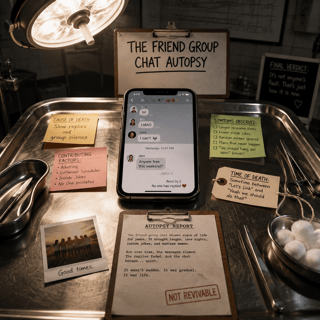
Speaker: Thank you listener for sending that in. That is the confession that matters. Not the guilt. The context. The parent who wrote that is not failing. The system is failing them.
Speaker: The economy that demands 60 hour work weeks from both parents is failing them. The childcare market that costs more than rent is failing them. The technology industry that monetizes children's attention is failing them.
Speaker: The guilt is a byproduct of structural violence. not individual inadequacy. And for those of us without children, those of us who watched the economic math and opted out or had the option made for us by circumstance, there is a responsibility to see this clearly.
Speaker: To not mistake the symptom for the cause, to advocate for the infrastructure that would make analog childhood possible again, paid leave, affordable childcare,
Speaker: Shorter work weeks. Community support networks. Regulations on the algorithmic targeting of minors. Because the toddler with the iPad is not a parenting failure,
Speaker: He is a canary in a coal mine. He is evidence of a society that has privatized the impossible task of child-rearing and then blamed individuals for failing to achieve it.
Speaker: Episode 8 left us with a question, and it's time to answer it. What am I afraid kids will never experience? I'm afraid they will never know the freedom of an unmapped afternoon.
Speaker: The specific structural freedom of a child who leaves the house with no device, no GPS, no tracking, no expectation of documentation.
Speaker: The freedom to get lost, to be late, to be bored, to be entirely unreachable by anyone for hours at a time. I'm afraid they will never know the texture of analog boredom.
Speaker: The long, empty hours where nothing is provided, nothing is scheduled, and nothing is optimized. Where the mind must generate its own entertainment or face the discomfort of its own silence.
Speaker: I am afraid they will never build a fort out of desperation. Never write a terrible story out of sheer lack of alternatives. Never stare at a ceiling until it becomes a universe.
Speaker: I am afraid they will never know privacy as a default condition. The experience of having a childhood that is not content. Not documented.
Speaker: Not performed. Not data. The right to be ugly. To be cruel. to be weird, to make mistakes, without those moments becoming permanent, searchable, shareable artifacts.
Speaker: And I'm afraid, most honestly, that they will never know the world I knew. The slow world, the heavy world, the world where information had to be sought, where music had to be hunted, where friendship required presence, where not knowing was a state you could inhibit without panic.
Speaker: I do not have children. I will not pass these memories to offsprings of my own. But the question from episode 8 is not only for parents, it is for anyone who cares about what comes next.
Speaker: The toddler with the iPad is everyone's future. His attention span, his relationship to truth, his capacity for solitude. These will shape the society we all grow old in.
Speaker: So what are we going to do with the time we have left? That is the bridge to our finale. Not as parents, as witnesses, as citizens, as the generation that remembers the before, speaking to the first generation that will only know the after.
Speaker: That is episode 9 of Xenialist, the performance of parenthood. If you have a confession, as a parent, As a non-parent, as an observer, send it in.
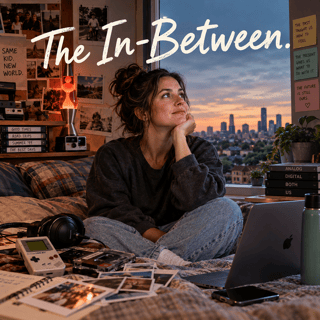
Speaker: I will read it. I will sit with it. I will not mistake structural failure for personal flaw. Next episode, the in-between, our season finale, synthesis, survival, and what we do with the memory of before and what we do with the time we have left.
Speaker: Until then, Look at a child. Any child. See them as the future. Ask what you are afraid they will never experience.
Speaker: Then ask what you are willing to build so that they might experience something better. The video is over. The room is quiet. The work is not done.