Transcript
Speaker: You can never talk about the cost of food without talking about the cost of health care. They're linked. If you add the two together, the sum of those two has not changed over the last 60 years. What has changed is the relation between them. It used to be 50 years ago, food was about 18% of the household spending and and medical costs were about 8% or 9%. Now that's just reversed. I think most people would rather spend a little more for food and have good health, then buy as food as cheap as possible and then be sick for most of their lives.
Speaker: In season two of Agrarian Futures, we're starting with a simple question. How did we get here? Farms are disappearing. Land is getting harder to access. Rural economies are hollowing out.
Speaker: But there are people building better ways forward. Join us as we investigate what's broken in our food system and what it looks like to build something better.
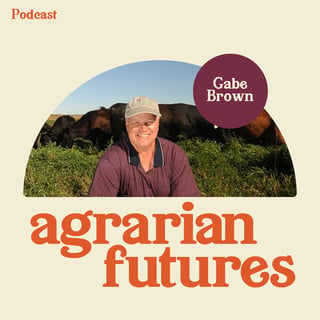
Speaker: Bob, welcome to Agrarian Futures. Bob, you are a farmer, scientist, pioneer in the organic agriculture movement in many ways. I have the book you wrote, Grain by Grain, with Liz right in front of me, one of my favorite books.
Speaker: Really excited to have you on the podcast today. Would love to start with one of the core stories or themes in the book, which is Big Sandy, Montana, where you're from. For you, farming has always been more about just growing food. It's really about community, about identity, about meaning.
Speaker: Could you start with painting a picture of Big Sandy and what that community looked like when you were growing up back in your childhood? Well, first of all, thanks, Emma, for inviting me. Big Sandy is where I grew up. It's a town of about, in those days, in the 50s and 60s, it was 1,000 people.
Speaker: And now it's 600. So it's changed a lot since I graduated from high school and went off to college for 10 years. and When I was growing up, we had five elevators to receive grain from the farmers. We had five bars and five churches. So I thought things were in pretty good balance.
Speaker: Now we don't have any elevators. We're down to three bars, I guess, now. I think we still have four churches, so it's still pretty good in that respect. But half of Main Street is kind of boarded up now. When I was a kid, Main Street was two blocks long and lined with businesses. High school was ah the center of the community, of course. There was 40 kids in my class. Now the size of the class of my children graduated from here, 20 years ago or so, we're down to half of that. So it's been quite ah a change. So that was the town I grew up in, and it was a lot of fun.
Speaker: And I really appreciated it. I appreciated our neighbors and everybody that was a part of it. And you grew up also as better farming, quote unquote, through chemicals was starting to become more mainstream.
Speaker: Do you remember anything about that shift and what promises were made and also whether that played into the decline of of your town and and your community?
Speaker: Well, no one would have guessed at the time, but when the ah chemicals were first introduced, they were looked at as a wonder drug. There was a big challenge controlling weeds. When 2-4-D came out, my father was one of the first. Well, everybody adopted that almost immediately, but he he was one of the first to build his own spraying rig and was spraying weeds and eliminating a big problem that was partially resolved of monocultures. But by the 60s, everybody was using them.
Speaker: Everybody was using the chemicals, the weed killers, the herbicides. And when I went to school, that was ah that was all that was talked about is the future farming, better living through chemistry was kind of brought home to the farm.
Speaker: As things went on, the the cost of machinery for spraying and the chemicals themselves kept getting greater and greater. Came back to the farm in 78. ah eight and I switched to organic.
Speaker: I started experimenting about eight years later in 86, and by 88, I decided to completely change to regenerative organic principles. It was only then that i realized that the amount of money that the farmers, least our farm, was receiving from government payments was equal to the amount of money that we were spending on chemicals. So you could look at the chemical bill. was not a um It was a pass-through. the money received from the government actually just passed through our our checking account to the chemical companies.
Speaker: And I thought that was kind of an interesting observation. We were receiving about $25,000 a year in government subsidies at that point, and that's just about what our chemical bill was. How did it shape the way you viewed agriculture, the mindset around thinking about the ecosystem and how to manage it when you went from conventional to organic?
Speaker: We also were introducing at the same time an ancient wheat to the market. under that We later added a trademark to that and marketed under the trademark of Kamut. And it turned out to be a wheat that people who couldn't eat modern wheat could eat without any difficulty.
Speaker: And when i saw that right before my eyes, friends of mine who could not eat wheat could eat this and had no trouble with and actually made them feel better. It changed how I thought about food. Well, I thought about commodities. I said, that's all we're used to growing is commodities. That's a very industrialized word and that You don't even think about your growing food. Actually, you're growing commodities and commodities are exchanged on the and a commodity exchange and you know you can buy features and and all that sort of stuff.
Speaker: And you lose track that you're actually dealing with food. I was at a food show one time and a lady came up to me and shook my hand real strong and looked right into my eyes and said, thank you for growing food for my family.
Speaker: I was shocked by that. I had never been thanked ever for growing food for anyone. When you're a wheat farmer, you don't ever meet your end customer. It's not like having a farmer's market or something where you get to talk to the people that actually eat what you grow. A grain farmer hauls their products into the grain into the elevator who... um ships it off in big rail cars, they they never say thank you.
Speaker: They come and look at your samples. They take samples out of your truck and try to figure out if they can find something to dock you so they don't have to pay you so much.
Speaker: And that's that's the thanks you get. Looking for something is wrong. And so to have someone thank me for what I was doing changed the whole way I i'd looked at my farm and what I was doing. So I went home from that food show emma And I never grew another commodity on my farm ever again.
Speaker: The only thing I grew after that was food. and good food, food that nourish people and nourish families to help children grow up healthy and strong and help prolong the life and health of of the elderly and and and keep all of those working in between healthy and well-nourished. And that's what we do now. And that's our main focus is the nutrition, high nutrition for food and and and seeing it as a means to improve the health of those that eat it.
Speaker: Well, that's a perfect segue into Komoot. Tell us about Komoot. What drew you to that specific wheat? And what did you discover about its nutritional and cultural value as you began to grow it?
Speaker: Well, I first saw this ancient wheat when I was ah probably a sophomore in high school. I went to the county fair, and this old man, um probably younger than I am now, but looked pretty old to me, had a ah red Folgers can full of this grain. And he said to me, hey, Sonny, he said, he kind of waved me over. He said, would you like to try some of King Tut's wheat?
Speaker: And I said, oh, sure. And he poured this giant wheat into my hand. And that was the first I'd ever seen it. And the story was that there was a fellow from our county in Montana, north central Montana, Choteau County, that was in the Air Force and stationed Portugal.
Speaker: And he went to the bar one night and the guy, the Air Force man next to him said, hey, look what I took out of an ancient tomb in Egypt. And he poured this pile of grain on the bar. And the guy from Montana said, oh my gosh, he said, my dad is a wheat farmer. You think I could send some of that home to him? And he said, oh, sure. And i don't know what kind of deal they made, but talked about 32 kernels.
Speaker: And he sent that home and that his dad planted it and it all grew. which should have been the first clue it didn't really come out of tomb, you see, because after it lays around for 4,000 years, there's not much life left in those kind of in those grades. But anyway, that was the story. Everybody loved it. I never thought really anything more about it until I was in graduate school in California, at Davis, and I was...
Speaker: eating a package of corn nuts one afternoon just to pass the time and have a break from the lab. And on the back it said, corn nuts made with a giant corn. And I thought, oh man, I wonder if they'd be interested in giant wheat.
Speaker: So I called up the corn nuts people who were just a few miles down the road in Berkeley at that time, I think it was, or Oakland maybe, and not far from davis got a the new products guy and he said oh yeah we might be sending that and i called my dad i said dad if you can find some of that old king tuts wheat and about a week later he called back he said well i've got a pint jar that's about two-thirds full i said great send me a few tablespoons He sent me the the sample and I sent the corn nuts and contacted them back in a couple of weeks and said, this is fantastic. but We'll take 10,000 pounds. And I said, well, I don't really have 10,000 pounds. I didn't want to tell him I only had i you know just a little over a cup.
Speaker: I said, but if you give me a year or two, I said, i have everything you want. And so I called my dad and I said, dad, put that all in the garden and plant it right now. And so we planted it. He planted in the garden. We thrashed it out by hand. We sent the grain to California and they planted over the winter. So we were growing two crops a year. In about three years, two or three years, two and a half maybe, we had 50 pounds.
Speaker: So I called back the corn nuts people and the fellow I talked to was gone. no one was interested in the story and no one wanted to try it anymore. So we just put it on the in the shed. on the shelf.
Speaker: And there it sat for three or four years. So we went to our food first food show in 86, I mentioned to you. And my dad took it along. My my parents, my dad, my mother went with us to um help us at the food show. And my dad was showing everybody this jar of giant wheat And thousands of people went by our booth in two to three days. And one person from San Diego had a natural product store, stopped and he said, oh man, that's just what I'm looking for, ancient wheat. If you grow that, I'll buy everything you can produce.
Speaker: And so we went home and in 1986 in the spring, we planted a half an acre. 30 years later, we were contracting with organic farmers all over Alberta, Saskatchewan and Montana and some of North Dakota, contracting over 100,000 acres.
Speaker: ah Just an amazing rocket ship that took off. And the main propellant was the flavor, but also the fact that people felt better after they ate it as I mentioned to you before. We found out it was a close relative to Durham. It made a wonderful pasta.
Speaker: In America, it was made into a cold cereal by Arrowhead Mills. That was the first big success we had in America. And that was so successful in just a few months. It was their number two seller right after Corn Flakes.
Speaker: Many other manufacturers copied that from there and that took kind of took us off here. But Italy turned out to be our biggest customer and they took over three quarters of everything we planted went to Italy. And in Italy, they made over 3,000 different products. So it really, really took off in Italy. So that was the beginning of it. Because of the people saying to me that they could eat this and it made them feel better, it really perked my interest in doing research or sponsoring research to try to understand what the difference between this was and modern wheat.
Speaker: I couldn't find anybody in America that wanted to help us with any research because a most of the scientists I talked to said I would be wasting my time and their time and my money if they did that kind of experiment. They believe there's nothing wrong with wheat. This was 30 years ago. If people were having trouble, it was in their head.
Speaker: And i found a completely different attitude in Italy. And so we started working with the University of Bologna and the University of Florence. And very soon started doing human clinical trials studying chronic disease because in our first trials we found the grain was anti-inflammatory. That had never ever been described in wheat before. as being anti-inflammatory because modern wheat is slightly inflammatory.
Speaker: and And inflammation is tied to all chronic disease. we started studying chronic disease. And as a result, now we publish 37 peer-reviewed journal articles that you can find, most of which you can find on our website, kamut.com, if you're interested in the details. It really got me going with the whole idea that food should be our medicine and medicine should be our food.
Speaker: You've been an outspoken critic of modern wheat and its ties to chronic illnesses. What do you think we've lost in the way we breed, grow, and process food today?
Speaker: Well, the problem is that we have two main goals in this country in regard to food. Those two goals are abundance and cheap. And we've achieved both of those.
Speaker: We have the cheapest food in the whole world. But guess what? And along with that comes a big price. So there's a very high cost of cheap food. We are also the sickest country in the whole world.
Speaker: Over 60% of our population has at least one chronic disease. 40% have two or more chronic diseases. The CDC says that 60% of that is due to the food that we eat.
Speaker: The big effort we have made to um produce abundant cheap food, we have lost a lot of nutrition because the focus is only on yield and no one looks at nutrition or no one has in the past. And so it's just kind of gone by the wayside.
Speaker: That wasn't by intention. Can't say that, you know, it's it's nobody's fault. But now that we've noticed it, I think it really is our duty to try to replenish that and take a step back from where we're going and go further in the research of nutrition and trying to grow nutrient-dense food rather than just tons of commodities.
Speaker: And that's what we're doing. And you've been talking about food as medicine long before it's became trendy. Based on that and and your experience and also the research you've been doing for many years, how do you see the relationship between farming practices and creating nutrient-dense food?
Speaker: Oh, Emma, that's a really good question. I went to a a food as medicine conference here a couple of years ago, and they had one part-time farmer on ah one panel. And all they talked about was you know avoiding bad foods, well, soda pop and you know Twinkies and high sugar and high fat and all this kind of stuff. but almost no mention was made of how the food was raised in the first place, or the contamination with pesticides and herbicides and all kinds of poisons.
Speaker: Very little talk about that. Nutritious food is produced on four main pillars. The first was starting with the right seed, a good seed, a seed that has potential for high nutrient density, not just a seed that has high yield potential.
Speaker: And that's what we have. But we need a seed that has high nutrient potential. And you put that seed then in very healthy soil, soil that's alive. Soil that's not been killed by a bunch of chemicals, but soil that's full of vibrant microbiology that associates itself with the roots of the plant, helps feed the plant. The plant helps feed the microbiome of the soil. And it's just a ah wonderful cycle that just goes round and round. Then the next pillar is harvesting that food at its peak nutrition.
Speaker: So particularly with fruits and vegetables, you don't want to harvest them green so you can ship them around the world or across the country without spoiling or bruising them. You pick them at peak nutrition and then maybe you serve more of them locally and regionally so you don't have to worry about shipping them around the world or across the country.
Speaker: This really goes with local production a lot better than you know one section of the country feeds all the rest. That's very high risk in my mind. We saw that at COVID when there's the problems of that, when you have too long a food chain. The final pillar is minimal processing.
Speaker: So you don't process it to death. for And wheat is the worst example. Over 90% of the wheat in this country is made into white flour. You're throwing away one third of the nutrition when you make white flour. The pigs in this country are eating better than the people of this country because they eat the brand and the germ that is cast aside when white flour is made. There's two or three principles of minimal processing. First of all, you don't decrease the nutrition that enters the factory, and like the case of white flour. You try to maintain it. So you make a whole grain flour in the case of wheat. You don't refine them and and take out a bunch of a really good nutrition. So you try to maintain the nutrition that the farmers work so hard to create.
Speaker: And then you don't add negative things. It's more than just not taking out what's good, it's not putting in what's bad. So that means we don't put in colored dyes just to make something that looks pretty on the shelf, but it's not good for you at all to eat. We don't put in um all kinds of other things that extend the life of the the manufactured product, but to the detriment of those that eat it.
Speaker: So you don't put anything in that's negative. And the same with farming, you don't put any chemicals on that it cause residues and and disease in the end that are negative. So you keep the nutrition as high as possible and you don't have anything that's bad. And then you eat it as local and as fresh as possible.
Speaker: And could you touch a little bit on wheat specifically? Obviously, you started and grew Commute International. You guys export a lot of your wheat to Italy because that's where people are interested in higher quality, nutrient-dense wheat.
Speaker: In America, if you were to go to the grocery store and and buy some bread, where does that wheat come from and how is it grown? Well, if you're going to a regular grocery store and buying a non-organic bread, then you're probably buying white bread because that predominates. But even if you buy whole wheat, if you're buying non-organic stuff, that means that It's been grown with chemicals and there's probably some residues in that grain.
Speaker: If you're buying white bread, it means that it's been stripped of a third of its nutrition. Most of the bread in America certainly processed from wheat grown in America. We can...
Speaker: pretty well rely on that. But the question is how it's grown and how much nutrition is in the bread itself. If you were to grow by organic bread, you can rest assured that there's been more effort to produce soil that's healthy and vibrant and growing more nutrition in that bread.
Speaker: The other question is, if you're looking at ancient grains and camoose is just one of them, there's einkorn, there'selt there's spelt, there's heirloom wheats also that were not bred for the purpose of increasing yield over and over over decades, but have been selected for properties that are related to taste primarily and the texture.
Speaker: That's what the bakers look for. Taste, interesting enough, really is tied to nutrition. The better something tastes, it's not all doctored up with a lot of salt and sugar. The better it tastes, the better it probably is for you it has and the better nutrition it has. So if it tastes good, it probably is good. If you're eating you know raw fruits and vegetables and bread from the store or any other products that aren't all doctored up.
Speaker: That's one indicator. So I would encourage you to just use your own gifts of your your nose for aromas and your tongue for flavors and tastes. Let those tell you if you're making progress or going in the right direction in your buying.
Speaker: There was a story in your book that really shocked me around when you guys were selling into Italy. And then one year they came back with some testing that was showing a little bit of glyphosate residue in your guys' crops.
Speaker: And then you guys did a bunch of testing and you ultimately figured out that glyphosate was coming in through the rain from other farmers in in the area. so So that just kind of really shocked me in how ubiquitous and widespread these chemicals are to the extent that they literally fall to the ground through the rain.
Speaker: Shocked us too. We were um quite shocked. Well, first of all, one week the the limit for glyphosate in wheat in Italy is 10 parts per billion.
Speaker: you know what it is in America? It is 1,500 parts per billion, and it's still accepted as organic. The rules for organic allowance is 5% of EPA tolerance.
Speaker: When Monsanto, who owned the glyphosate in those days, realized determined they were going to start using Roundup, which is made of glyphosate, as a desiccant. That means they're spraying it on the crop right before harvest to kill weeds and kill also the crop and dry it out so it can be harvested more easily and uniformly. Then they went to the EPA and they asked that limits be raised, and that was done about three times.
Speaker: In the very beginning, 10 parts per billion would have been about what was allowed in America. And by the time they got done, it was up to 1,500 parts per billion. We always were testing for 50 parts per billion going into Europe because we thought at that time, that was as good as we could get.
Speaker: The test became more and more... fine-tuned and then they were down to 10 and then all of a sudden we started seeing blips of the presence of this chemical and at one point it went over 10 and then we had a recall we lost a lot of business with this problem of course some of our customers were saying oh your farmers are spraying at night and they said well no we don't believe that's true and if they were spraying it would be 100 times more than 10 parts per billion because that's what you find if you direct spray A firm from Germany come over and they spent all summer looking at everything they could to find the source of this. And as you mentioned, they ended up discovering that it was in the rain that was falling on on the farms that were now organic, but they were being contaminated with the glyphosate. And we found that one third of our organic farmers were contaminated to the point that The grain was over 10 parts per billion of glyphosate. So Monsanto said in the beginning, don't worry if this is the best chemical in the world. It's so benign. It disappears, broken down in the sunlight. It's absorbed by the soil. It won't go anywhere. And all that's a lie.
Speaker: It's the most used chemical now in the whole world. And it's contaminating everything. It's contaminating surface water, groundwater, soil. And now we find it in the rain. What we're seeing in just a little bit of research we've done on our farm, about one third of the rainstorms come with enough glyphosate to be detected. And what we've seen is friends of mine that are ah more surrounded by chemical agriculture had higher amounts in the rain.
Speaker: So if it was coming from far away, you'd think that it would be well mixed in the clouds and it'd be uniform, which is following the rain. Now I'm starting to think that maybe it's being kicked up in the dust that blows up before a big rainstorm and then it's rained out and then the rain washes it out of the air in the dust particles. So we don't know. what We'd like to do some more research to understand where it's coming from, but we know it's there.
Speaker: And that's quite quite disappointing that even those that are making all the efforts to reduce and eliminate chemicals on their own farm are still contaminated to a certain level. Still nothing like if you're spraying it directly on your fields, but you're still being somewhat contaminated by the chemical that's everywhere present now in the environment. Wow, that's awful. You recently started a new nonprofit, the Quinn Institute, which is all about what we've been talking about, the kind of intersection of food, health, and rural vitality.
Speaker: Could you talk a little bit about the mission and what the change you hope to spark through it? Sure. So the the different things that we're looking at is biological control of perennial weeds. So perennial weeds are one of the biggest challenges for organic farmers.
Speaker: And so there's no ah good biological control. And we're we're looking for ways to manage. We don't need to eliminate weeds, but we need to manage the weeds so they don't take over our fields and destroy our crops.
Speaker: So that's one of the things we're looking at. We're looking at new crops. We're looking at new hard white winter wheat. which has high nutrition. And so that's another project that we're looking at. We're looking at different rotations.
Speaker: So we have different rotations that farmers can use. We want farmers to be successful. So ah the Institute is divided into nine 60 acre fields. So full size fields for our area that show farmers how to have a successful rotation. We have a nine-year rotation, which is kind of ah a long rotation. Diversity is very, very key to a successful organic production. The more you can mimic nature, i like to tell my friends and neighbors, the more successful you'll be at organic agriculture and growing high nutrition, because that's what nature has been doing
Speaker: for eons. And the more we can mimic that, the better off we're gonna be. So we try to mimic that as much as we can with rotations, with growing companion crops, with growing cocktails. We're gonna be experimenting with grazing down our cover crops and our green manure crops rather than working them into the soil so we can have another, an animal component added to the mix and increase the vitality of our soil that way. And again, mimic nature because in the prairies we had large animals, which is important component. of keeping the prairies healthy.
Speaker: And that's been removed now. The buffalo are gone. So the cattle are ah kind of a replacement for that. But a lot of grain farmers don't have cattle anymore or utilize them in their fields. So that we're trying to look at that also. We're doing experiments with a composting of manure and doing one-time application of compost and see what a long-term effect that might have. It's not something we could do every year. It's affordable, but In Utah, they've been doing some studies for, i think, 30 or 40 years and still you'll still see effects of one-time applications. So we're going to be a part of that study with the University of Wyoming and Utah State University. We're going to try to have teaching gardens and show people that don't have farms, or even if they do have farms, they should have gardens. If they don't have gardens and don't know how gardening, we want to teach aspects of gardening, and then we'd like to have a teaching kitchen.
Speaker: where we bring our food into the kitchen from the farm and show people you know what to do with a turnip. Other people don't know what to do with a turnip and other things that they might take out of their garden. So we want to have show people how to prepare fresh food off the gardener, out of a produce section of the of the store, and then also how to repurpose leftovers.
Speaker: ah Half the food in this in the world goes to waste. It doesn't go to feed people. It goes to waste. And I think that is a real crime. And part of that is we don't use leftovers. Things are thrown out.
Speaker: We don't save our food much. We like to teach different processing ideas and projects so people can preserve their harvest. And at harvest time, it's the cheapest time to buy food. and And that should be the time we should be pickling or canning or drying or freezing or all those kinds of things we'd like to teach people again how to do.
Speaker: We'd like to have ah our health component. We'd like to bring in medical personnel who would focus on chronic disease and prescribe food from the farm rather than pills from the pharmacy to help people improve their health.
Speaker: So those are some of the the projects we're wanting to do. We want to do outreach. So ah this past year, we we sponsored and participated in a gardening class at Rocky Boy Indian Reservation right near us to help people learn how to grow a pizza, growing tomatoes and basil and and peppers and onions and showing them how to garden. In the fall, we're going to bring that stuff back and do a pizza. We're going to make pizza out of ah what they grow in their garden, plus the dough from the kamut grain that's growing on the reservation farm. which is also good for diabetes, help them have the joy and the satisfaction of growing their own food. And this is what we're really trying to do up front and help people do that in a real way.
Speaker: And I love how holistic and also rooted in your specific place the organization is. It sounds like a lot of it is about figuring out ways to grow more food in your context, the short grass prairie in Montana, and also helping the local community find or rediscover you know more strategies for a self-procurement or homestead gardening, or basically increasing the amount of food that is grown in your community for your community. In your book, you talk about how growing up, you still remembered uncles and aunts that would bring you local fruit that they'd grown or other local produce that by now basically is no longer really available. And I think I heard also somewhere that
Speaker: In Montana, I think 3% of food people eat comes from Montana. So by and large, even in these like rural communities that are growing tons of food for commodities markets, less and less food reaches their plate.
Speaker: So, Emma, a ah really good example of that is during the COVID, height of the COVID pandemic, paranoia, in our little town of Big Sandy, the shelf for flour was empty.
Speaker: So here we are, surrounded by wheat, and yet not a kernel to eat. So it's like being in the ocean surrounded by water without a drop to drink. And because of the way industrialization of that is set up, everything is centralized and comes in it's milled. It goes to California, big distribution centers, and then goes back out.
Speaker: And i think that is a real wake-up call of how what a house of cards that is and how risky that is, is not having our own local food supply to maintain the the majority of what we need to nourish us. We don't need to grow coffee here or pineapples or fun things that we have know to add little spice and enjoyment to our meals. But we should certainly be able to grow the basic foods that we eat in every locality all around the whole country. And it would bring so much more employment back to rural America and nutrition to the rest of the country. And that's what we really need, I think.
Speaker: Yeah, and that also gets to the core, one of the core issues, which is our obsession with cheap food. How do we go about thinking about educating people about the importance of value rather than cheapness? And also, you know, what can we do on the policy and government front? beyond labeling to actually like enable a different food system that isn't just focused on producing as much food as cheap as possible, but rather on good value, healthy food?
Speaker: That's a good question. i I think the main thing first starts with education and educate people on the high cost of cheap food. And they can see it all around them. The the farmers are paying the high cost of cheap food, but going broke.
Speaker: Anybody... can see that in their own neighborhoods. The communities, once the farmers are going broke and leave, the communities suffer. They no longer have those farmers to shop in those communities. The stores then start closing. The communities go down. So the communities are paying the high cost of cheap food. Our environment is paying the high cost of cheap food If you look at the pollutions that are surrounding us now, we have a dead zone in the Gulf of Mexico, the size of New Jersey from chemical contamination. How big does it have to get before it maybe we think we're going in the wrong direction? We have wells. A lot of the wells in Iowa are no longer safe to drink from. The the children are forbidden to drink from many of the wells in Iowa because of the high nitrates, and that's from chemical fertilizers. that we are contaminating our soil with and and groundwater.
Speaker: We have the glyphosate in the rain we talked about, it's everywhere. How far do we need to go before we can think maybe we've gone too far, we're going down the wrong road? But the people have to say they won't accept us anymore at the checkout counter. If they start rejecting that,
Speaker: then they will drive a change away from that. And the last high cost is the cost of healthcare, which is staggering. We're gonna go broke as a country unless we solve that problem.
Speaker: And most every family has somebody with some chronic disease. We get 60%, that's six out of 10. That's the majority of the people. So every family has somebody with suffering from chronic disease. If there are more than two in the family, at least statistically, Those are the kinds of things we need to connect the dots. You can never talk about the cost of food without talking about the cost of healthcare. They're linked.
Speaker: If you add the two together, the sum of those two has not changed over 60 years. It's about 28% of the average household spending is the sum of those two expenses. What has changed is the relation between them. It used to be 50 years ago, food was about 18% of the household spending and and medical costs were about 8% or 9%. Now that's just reversed.
Speaker: Healthcare is 18, 19% and food is down to six or seven or eight. I think most people would rather spend a little more for food and have good health than buy as food as cheap as possible and then be sick for most of their life.
Speaker: Those are the choices that we have to start with. The second thing I think is really important, to haven't talked about too much, is research. For the example, USDA research budget is dominated by the chemical industrial food production system in America. 99% of the research goes to that kind of agriculture.
Speaker: In America, 6% now of all the food is organic, that is sold in America. Why can't we least equal or we should exceed where the market is going? ah Research is for the future. If the future is organic, and I think it is, because it's the only answer that makes sense, then why don't we have at least 10%, at least six is the is the bare minimum, but we should have 10% of the budget focused on organic agricultural production and trying to better the nutrition and better the success of farmers that want alternatives to chemicals.
Speaker: So those are the two things that I would really focus on and encourage of the education and then the research, those two things to drive this change that you're talking about.
Speaker: Yeah, absolutely. To finish us off, you've been in the organic movement for quite some time now. The organic movement itself has gone through quite an evolution. Yes.
Speaker: Speaking to maybe someone that's starting out today or a younger generation coming into adulthood, thinking about how they can support the food system, either as farmers or as you know engaged eaters or in other ways, what would be your word of advice?
Speaker: As farmers, I would say start small if you're going to change something, or if you're going to start something, start small. Usually that is dictated by finances anyway, but sometimes people want to change too quick before they really know what's going to be the consequences and and understand how to respond to them. So that was what I'd say to the farmers. Another topic we haven't really touched on is the cost. How did people pay...
Speaker: If we're going to pay more for food, how do people who do not have the means pay for that? ah How does a young family start? How do they start paying more for food? Well, one of the ways that they can help with their food costs is to grow some of them themselves in community gardens or even in their backyard or their back patio or something. They can grow something to reduce help reduce their food costs. The other thing they can do is eat or buy more Unprocessed food. Don't pay all the expensive costs of processing, especially organic. That's really expensive. Buy potatoes and fix casseroles. Buy wheat and grind it into flour.
Speaker: Buy fresh vegetables and cook them fresh and make casseroles and freeze them during the week that you can eat all week long for what you fix on Saturday, for example. Buy in season. Buy local.
Speaker: Most of those things can save money if if that is a big concern. If you buy the grain and you take that home and you crack it yourself with a little flaker mill, you can afford to feed your family. It costs about 17 cents a serving.
Speaker: A family of four could be fed for less than 50 cents. So that is not very expensive. And yet you're feeding them a whole meal of porridge for breakfast, of cooked cereal that's very nutritious and very healthy for them.
Speaker: In some ways, you can save a lot of money by doing a few things yourself. and and improve your nutrition along the way. So that's what I would say to the general public. That's awesome. Well, thank you so much, Bob. This was incredible. And i urge anyone listening to this also to, if you're interested to read his book, which was amazing. And i think very clearly specifically kind of illustrates the challenge in agriculture and the and the solutions that we have. And also to go to the Quinn Institute and read about what they're doing there and the research they're doing and obviously donate if you have the means.
Speaker: So yeah, thank you so much, Bob. was so great to talk to you. Thank you, ema Thank you so much for inviting me. It's been a great time with you and I wish you a great success and have a great day.
Speaker: Agrarian Futures is produced by Alexander Miller, who also wrote our theme song. If you enjoyed this episode, please like, subscribe, and leave us a comment on your podcast app of choice.
Speaker: As a new podcast, it's crucial for helping us reach more people. You can visit agrarianfuturespod.com to join our email list for a heads up on upcoming episodes and bonus content.