Transcript
Speaker: Thank you.
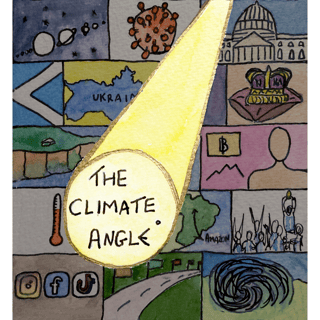
Speaker: Hello and welcome to the first ever episode of The Climate Angle, a podcast where you examine headline and not headline news from the UK and around the world and ask the oftenest question, what's the climate angle?
Speaker: All too often, the news we are exposed to neglects to address the climate crisis or consider the role and impact of climate change on a problem or situation.
Speaker: We often find that consideration of the climate crisis in news stories most readily, frequently and or easily comes when the stories themselves are about a climate disaster.
Speaker: Each episode, myself and a couple of guests will be examining a topical story, event or situation and discussing the climate angle because there always is one.
Speaker: For our first episode, we'll be discussing an important foundational concept because of its role in underpinning how we need to be thinking and talking about climate change, systems thinking.
Speaker: To help us understand this concept, I'm joined by two experts.
Speaker: The first is Richard Calland.
Speaker: Born in the UK, but primarily based in South Africa, he is a lawyer, writer and political analyst.
Speaker: He's a fellow of the Cambridge Institute for Sustainability Leadership and Associate Professor of Public Law at the University of Cape Town.
Speaker: Welcome to the first ever episode of The Climate Angle, Richard.
Speaker: Yeah, thank you very much, Shamaya.
Speaker: I'm delighted to be involved in this conversation.
Speaker: I love the title of this podcast series, The Climate Angle, because it captures a really, I think, significant idea that everywhere we look, there's a climate emergency emerging, hitting us.
Speaker: And therefore, everything we think about, whether it's development economics or public policy or governance, should have a climate angle.
Speaker: So I celebrate this and welcome the opportunity to contribute to this first ever board podcast.
Speaker: Oh, thanks.
Speaker: I'm really happy to have you here.
Speaker: My second guest today is Andrew Watson.
Speaker: Trained as an artist, he exhibited in his hometown of London before entering international education in West Jerusalem 24 years ago, since when he has worked across four continents in a wide variety of positions.
Speaker: He is currently based in Amsterdam.
Speaker: Together, he and Richard founded the organisation Sustainability Education, which we will talk more about later.
Speaker: He also happens to be my dad.
Speaker: Welcome, dad.
Speaker: Well, hello, Shamaya, and good evening, Richard.
Speaker: It's wonderful to be part of this.
Speaker: I think it reflects the urgency of the situation we currently face across the globe, something that Richard and I became particularly conscious of together as partners 10 years ago.
Speaker: I feel I'm always trying to play catch up because
Speaker: having entered education after eight years doing something else, I couldn't help but consider how lost the education sector seemed to be in preparing for a better and more peaceful and more sustainable future, despite the fact that I actually entered
Speaker: education as a teacher because I discovered the International Baccalaureate to whom I've committed a great deal of my professional and personal career and contributions to society.
Speaker: So really looking forward to the conversation.
Speaker: I think we're going to look at some key questions, aren't we?
Speaker: Yeah, absolutely.
Speaker: And with that in mind, we'll get straight into it.
Speaker: Richard, could you give us a layman's overview of where the concept of systems thinking comes from and what it actually is?
Speaker: Well, I think there's two aspects to it.
Speaker: One is that we are thinking about a system here.
Speaker: This is the climate change problem, the climate crisis, the climate emergency, however you term it, is a systemic problem.
Speaker: What that means is it cuts across every aspect of human life on Earth, as well as the natural world.
Speaker: It has social dimensions, it has economic dimensions, it has governance dimensions, and increasingly it has very important political dimensions.
Speaker: The second is the interconnectedness, the joining of the dots, so to speak.
Speaker: And one of my colleagues at Cambridge, Will Day, often puts it like this at the end of his 360 degree tour de horizon of the world and the state we're in, by saying that we as humanity face the challenge of unprecedented urgency, complexity and interconnectedness.
Speaker: So I think the core thing is that interconnectedness, that the dots are joined, and if you pull one bit of the system, another part will be affected.
Speaker: And to give a very simple, very contemporary example, we know that through the course of history internationally,
Speaker: If energy prices go up, the cost of food goes up.
Speaker: The two lines in the graph are intimately connected.
Speaker: And that's a very simple example of how one bit of the system, if you tug it in one direction, will have an immediate impact
Speaker: on the other and those are what we call the feedback loops but the point is we're confronted by a system level crisis and therefore we have to contemplate systemic change systemic transformation if we're to stand any chance of coping with what lies ahead.
Speaker: Thank you that was very well put is there anything that you'd like to add to that maybe from a pedagogical or educational perspective Andrew?
Speaker: Yeah, sure.
Speaker: And again, I think...
Speaker: perhaps viewing education through the prism of an artist.
Speaker: I viewed all things as one and I probably made the assumption that things, ideas and practice would be connected, not just within an organisation, but across organisations.
Speaker: And that's become sort of a real passion and given me a sense of real purpose about how to organise, lead and bring together different organisations, particularly schools, of course.
Speaker: But within that,
Speaker: educational dimension, we have our own educational ecosystems as well, which are made up of several elements.
Speaker: First, we have a chronosystem, which is about the influence of time, of course, the evolution of reform patterns across time, how education has evolved
Speaker: certainly from the industrial age, has taken shape, but stubbornly refused to change that shape.
Speaker: I think it was Ford, wasn't it, who suggested that if he'd asked people what they'd wanted when he was inventing his motor car, they would have asked for faster horses.
Speaker: And I think that's really a very visceral, has visceral relevance for the world of education.
Speaker: Then we have the macro system, which is overarching beliefs, the economic and political agenda.
Speaker: So again, you know, this is very consistent with what Richard was talking about in terms of those connected systems.
Speaker: We have an exosystem, which talks about indirect and external environments, such as the government policies, which is sometimes, of course, beyond the control of educational system, at least in terms of autonomy within schools.
Speaker: The French national curriculum is a good example of how inflexible education can become.
Speaker: We have external agencies for accreditation and validation, of course, which are also part of that system that we need to sometimes adapt to, to meet accreditation needs, which has significant value in terms of a kite mark, which parents in particular need.
Speaker: are very interested in because it helps their child access whatever it is they want to do in the future.
Speaker: We have something called a mesosystem, the interaction of the microsystem and the environment, the professional learning and organizational culture within a school.
Speaker: And I know we'll probably talk about this a little bit more in a moment.
Speaker: But, you know, for me, the question is always what places is sustainability thinking?
Speaker: What places do the SDGs in particular play in shaping the experience of education in the school?
Speaker: And lastly, we have the micro system, which is the immediate environment, which is about the actions and interactions of school leaders, teachers, staff, parents, governors and students.
Speaker: So I guess that's about how you live out your values.
Speaker: And you can't address one part of that picture without having an impact on the other elements within.
Speaker: Thank you.
Speaker: That was quite detailed.
Speaker: And you've kind of touched upon some of the things that I was
Speaker: going to ask in a bit, going into a bit more detail about how we kind of think about systems as from your distinct disciplines.
Speaker: So I'll come back to Richard, being in law and politics, doing a lot of work in that kind of maybe bigger picture systems level.
Speaker: What does systems thinking look like from a legal perspective, from a politics and policy perspective?
Speaker: I'm not sure what it should look like.
Speaker: What it looks like right now is that the legal profession in general is struggling to cope with this kind of complexity and interconnectedness.
Speaker: Not in totality, but like many disciplines, I think it's really having to battle to adjust to this new interconnected world.
Speaker: But some people are doing that.
Speaker: And I remember a conversation probably three years ago now, just before COVID, when I met with the senior partner of a major law firm in South Africa, but it's an international law firm.
Speaker: And we had lunch in Johannesburg.
Speaker: And he was complaining about the, not the quality of the law graduates from my university, where I'm a member of faculty, but
Speaker: in a way their mindset and outlook.
Speaker: He was saying you're producing good lawyers in the old traditional sense.
Speaker: He said I don't really need good lawyers anymore, I need professionals who crave complexity was the expression he used.
Speaker: And the reason for that was because he said his clients, the clients that come to him who have problems that reflect this interdisciplinary kind of interconnected world we've started to describe in this conversation.
Speaker: In the midst of all of their complexity and the challenge that that particular client may have, there's probably a legal problem.
Speaker: But there's also a governance or a political problem or an environmental one and a sustainability reporting one or some community relations one.
Speaker: I'm thinking here of a mining company.
Speaker: The mining companies legal problems are likely to include all manner of other issues that are interconnected with those social, environmental, economic, as well as political and legal.
Speaker: And so in other words, the challenge for every sector and for the graduates and the professionals who enter those sectors, whether it's law or other areas, the challenge is the same.
Speaker: It's to have the intellectual and professional agility and training that will prepare them
Speaker: to be leaders in that field, given the complexity and interconnectedness of the context in which they're going to have to work.
Speaker: I think that's it's really interesting hearing that, because if we come back to the point of the podcast, looking at kind of everyday news stories that people encounter, a lot of them require consideration of law and policy.
Speaker: So if you look at the status of climate refugees, for example,
Speaker: what's their legal status, their ability to actually, for example, seek asylum somewhere else?
Speaker: Because I think under international law, there's no kind of explicit definition for a climate refugee and their right to seek asylum somewhere.
Speaker: We still haven't kind of adapted to that problem.
Speaker: And just thinking about what's going to happen in the next few years, even within countries, so that the United States
Speaker: We can expect to see huge amounts of internal displacement and migration because of climate change.
Speaker: I mean, we kind of already are.
Speaker: What's the kind of the how how adaptable is the legal system in regards to particularly in the US making that political change in order to support those laws?
Speaker: Yeah, it's a very good example, Shemayim.
Speaker: And we know, again, that there's plenty of evidence in history where extreme weather conditions, the automatic reaction, the inevitable reaction is that the people affected will move.
Speaker: You know, if your livelihood is threatened or devastated by drought,
Speaker: for example, you don't sit around there and starve, you try and move to get to somewhere where you can rebuild your life.
Speaker: So as the climate angle on society, bearing in mind that the population of the world is going to increase from what it is now, approaching 8 billion to over 9 billion by the midpoint of the century.
Speaker: that's a lot of people that, and many of whom are going to be on the move, searching new safer destinations because of the impact of climate change.
Speaker: So that's the climate angle to immigration and to refugee status.
Speaker: It's going to present huge political governance and policy challenges for probably every part of the world, I would think.
Speaker: So that's really significant.
Speaker: And I'm
Speaker: Your question triggered an immediate recollection of a conversation I had this afternoon with my LLM class on transparency, law and governance.
Speaker: One of the students works at an NGO, an environmental rights NGO.
Speaker: She was asking me about a conversation she'd had recently with a development bank who basically are reluctant to, well, they want to fund renewable energy, but they don't want to get out of coal yet because they're still...
Speaker: following the blueprint of South Africa's energy mix.
Speaker: And they say, well, South Africa's energy mix still includes some coal.
Speaker: Therefore, we should continue to support that because we're worried about jobs and inequality.
Speaker: And I think the pushback to that is, well, it's not a good investment because A, it's going to be a stranded asset very soon.
Speaker: B, it does harm.
Speaker: So on the one hand, you're trying to support the economic development of people, particularly the poorest and most vulnerable communities in society.
Speaker: On the other hand, you continue to fund something that is going to harm them.
Speaker: And that doesn't make sense.
Speaker: It's just not smart.
Speaker: Yeah, and I also kind of, I think I'll let Andrew talk about this in a minute, but also in kind of education we experience, I would maybe consider that somewhat greenwashing, the idea of just saying, are we going to put forward these green policies and say we're doing X, Y, Z, while simultaneously continuing practices that are unsustainable?
Speaker: Andrew, do you want to talk a little bit about what that looks like in education or
Speaker: perhaps in the arts as well?
Speaker: Well, I'd certainly like to talk about it in relation to education, because I think there are direct parallels to be drawn between and analogies between the idea of, you know, the problem of coal as a stranded asset, shall we say.
Speaker: And I think the education systems that I've encountered, especially national systems, are populated with stranded assets.
Speaker: And the biggest tragedy of all is that we may, if we're not careful,
Speaker: produce a huge number of them in the form of students who are unable to adapt or think flexibly or think in terms of serving each other because they have had such a narrow experience of education which is still directed towards content-based learning in particular subject areas which have only come apart
Speaker: because of an artificial division of knowledge, which may have been relevant at the time of the Industrial Revolution, but now is no longer relevant.
Speaker: So that craving complexity that Richard talks about needs to be reflected...
Speaker: in how students learn and where they learn and how they learn and i think in terms of what that means for the educational sector as as the situation the global climate crisis increases and the situation becomes more urgent so the responses need to be more radical and
Speaker: There's a chap called Simon Shinnick who talked about starting with why.
Speaker: It's true he was talking about that message through the lens of Apple and the business sector, but the same is true for education.
Speaker: It is the moral purpose which drives education.
Speaker: who we are and who we need to become.
Speaker: And the role of education is to essentially transmit the soul of society from one generation to the next, as G.K.
Speaker: Chesterton pointed out.
Speaker: Similarly, it is therefore the choice of a school, whether they want to be the mirror of society or the change agents of it.
Speaker: And I don't think there is a choice anymore.
Speaker: I think one has to push, one has to conjure, one has to provoke people
Speaker: the leadership in the educational sector as well as cross sectors, but my particular work is in education at the moment, to say what we're doing is not actually good enough at the moment.
Speaker: And to challenge complacent attitudes, to challenge and provoke different ways of thinking,
Speaker: and also provide solutions to what that those those different ways of learning and preparing students young people who are going to shape the next generation but also are going to have to not just survive but thrive in it and we need to produce a system which does just that and at the moment with perhaps very few exceptions which you might talk about presently it doesn't do that
Speaker: Thank you.
Speaker: You've kind of, again, touched upon something I'm going to ask about in a second.
Speaker: But could you both maybe talk about you've both kind of lived in different places and maybe between you covered a huge amount of the globe, perhaps ironically, considering the topic of conversation.
Speaker: But what are your different...
Speaker: experiences of maybe cultures or languages and how they understand or um or kind of approach a concept like systems thinking do you notice differences depending on where you are is systems thinking easier to get to grips with in germany versus south africa for example or in the netherlands versus east jerusalem that kind of thing
Speaker: Well, sure.
Speaker: Perhaps I'll respond to this first, if I may.
Speaker: I think there are some very graphic differences between, as one might expect, between LDCs, less economically developed countries, and more economically developed countries.
Speaker: But one might, again, extend that to the idea of less educationally developed countries and more educationally developed countries.
Speaker: And I think, again, that comparative analysis between international and national systems of education is worthy of great scrutiny.
Speaker: Because within the international sector, essentially you have a far greater level of autonomy in terms of the direction of your moral purpose, whereas national systems are essentially designed to promote a sustained economy over time.
Speaker: I mean,
Speaker: you know, some countries also get that part wrong.
Speaker: Actually, I think United Kingdom has lost its way in that sense over the last 30 or 40 years.
Speaker: Um, but certainly in somewhere like East Jerusalem, uh, culturally, politically, socially, uh, there was, and I've obviously, I've worked there for the last two years as, as a director of a K through 12, 1000 student school.
Speaker: Sustainability and systems thinking was a foreign language.
Speaker: And the great irony and tragedy of that is that they are surrounded by the harsh evidence on a daily basis of climate change and the impact of not thinking in systems.
Speaker: So there's dissonance, there's dereliction, there's disappointment on an everyday basis because connections are not being made between the urgent and obvious symptoms of climate change which are around them all the time.
Speaker: and the need to do something about it.
Speaker: So education has become a factory product in a place like that.
Speaker: And I think, as I said, there's a parallel to be drawn with Ford and his faster horses.
Speaker: I'll end this particular comment by just making reference to a conference I went to yesterday in Amsterdam, an edutech conference which highlighted a myriad of
Speaker: inventive, innovative approaches to technology.
Speaker: And under the banner of preparing students for the 21st century, and I had to reflect with some scepticism that, well, A, we're a fifth of a way through that century already, so there seemed to be a bit behind the times in that
Speaker: But secondly, I was horrified.
Speaker: The word sustainability and climate change were absent from any of the conversations that I heard and any of the panel discussions.
Speaker: I thought that was extraordinary that that would be absent because it seemed to be so clear to me, at least, and some of my colleagues, that that should be and needs to be the focus of what we're doing.
Speaker: Yeah, my brief contribution on this would be to flip it and say, well, where is it not that people struggle with this issue?
Speaker: And I think that, frankly, pretty much everywhere.
Speaker: And the climate angle comes and goes.
Speaker: And there are conversations that one has with serious professionals in different places, even my own university, my own faculty, where the climate angle and the sustainability angle is conspicuous by its absence.
Speaker: And you think, what planet are you living on?
Speaker: do not appreciate that there is very little point, for example, continuing to educate young people to become great lawyers.
Speaker: If the legal system breaks down, because society breaks down, it's analogous to the argument we make to business leaders.
Speaker: If you're not willing to accept that business as usual is dead, then you are going to become a stranded asset.
Speaker: We have to recognise that human life on earth is imperiled.
Speaker: There's an existential crisis here.
Speaker: And joining the dots, therefore, is a very simple but essential act of self-preservation and enlightened self-interest, if you like.
Speaker: And the failure of people who have education and power and privilege to recognise that, I find bewildering, frankly.
Speaker: So that's why it's from the University of Cambridge Institute for Sustainability Leadership perspective, it's a leadership issue.
Speaker: And where I see more inventive approaches is where people step up, take leadership responsibility and say, we are going to understand this from a systemic perspective and we're going to join the dots and we're going to therefore respond in a way that reflects that.
Speaker: Yeah, absolutely.
Speaker: I was going to bring up the new UK, well, relatively new UK Prime Minister and the kind of slow but steady kind of decline in environmental regulations and environmental care by the British government over the last 12 years or so.
Speaker: How do we, what's our kind of ability in the different kind of arenas that we exist in, the different arenas that we work in?
Speaker: How do we respond to individuals and organizations who want to place and seem to only place economy at the center of everything?
Speaker: Everything comes down to must cut taxes.
Speaker: We're looking at the cost of living crisis, very short term economic thinking processes.
Speaker: What do we do about them?
Speaker: How do we help?
Speaker: And perhaps, can I respond first to that?
Speaker: I think that from an educational perspective, one has to, first of all, nurture a sense of hope.
Speaker: Hope in the possibility of manifesting change and modelling that change ourselves.
Speaker: I remember when I first became principal at the International School of Florence, a lot of students wanted to go out on the Friday strikes inspired by Greta Thunberg.
Speaker: And some of my colleagues at the time came to me and had their concerns that students might be missing school.
Speaker: And my response is there was actually nothing more important than going out to advocate for this kind of change.
Speaker: So not only must the students go, but you must also go.
Speaker: not as chaperones, but to demonstrate as well and to make your voice heard.
Speaker: So I think it's absolutely essential to engender a sense of agency in young people and a sense of ethical agency to demonstrate and to model advocacy in its multiple forms, but also to model culture shift within your own organisation.
Speaker: And I think one of the reasons I am hopeful, especially in the education sector, is that the systems can be shifted very visibly and quite cleanly to...
Speaker: to become action-oriented, sustainable schools is by no means a distant dream.
Speaker: I think they're very clear strategies one can deploy to change the way you do things in a very inspiring and hopeful but meaningful way.
Speaker: Yeah, you're calling for collective action, you're calling for protest, and I agree with you.
Speaker: We need a revolution.
Speaker: And those are not my words.
Speaker: Those are the opening words of a book about sustainability written by the person who is now King Charles III, the King of England, and who is the patron of the University of Cambridge Institute of Sustainability Leadership.
Speaker: And that book he wrote a few years ago, you know, the British monarchy is not known for its revolutionary instincts or tendencies.
Speaker: Yeah.
Speaker: Charles, Prince Charles, as he then was, recognised that systemic change requires a revolutionary outlook.
Speaker: You're not going to achieve this through evolution.
Speaker: and incrementalism and the climate science to bring in the climate angle very directly to this shows that we've left it too late and because we've left it so late we're at the 11th hour clock is ticking towards midnight and the sharpness of the curve of the transition that we now need to undertake
Speaker: by 2030, get on a completely different economic development pathway by 2030, if we're to stand any chance whatsoever of meeting the Paris Agreement targets for mid-century and the net zero targets that have been set for mid-century, that requires a revolutionary mindset from leaders, from activists, and from all of us working in this sector.
Speaker: Can I just add that one of the things Richard and I very consciously and purposefully do through our Sustainability Education Summits is we do bring together leaders from different sectors with teachers, leaders, and particularly students from around the world to confront the failure of education to meet their needs.
Speaker: And that plays out in very graphic and exciting ways.
Speaker: For instance, we had one of our sponsors in the Berlin summit recently was given the floor and they were explaining how much good work they'd done in relation to sustainability.
Speaker: But they didn't reckon on a young person at the back of the hall who'd done their reading and their research, who was able to challenge them directly on their proposition.
Speaker: And I think that is the voice that we try to nurture.
Speaker: That's the sense of agents who we hope to inspire.
Speaker: And the outcome of that is that
Speaker: is that the guys who are doing the leadership now, or indeed who have been failing to think in revolutionary terms, have to adjust.
Speaker: That is the forum we try and create, and it has to be action-oriented.
Speaker: And indeed, I think there's some evidence that it's having that effect.
Speaker: I always think whenever I talk about or try and give someone an example of systems thinking when they've not really...
Speaker: encountered the concept before.
Speaker: I always talk about the structure of the British civil service and how we have these kind of disparate elements all working on different policies and there are clear overlaps between like for example the childhood obesity epidemic.
Speaker: You cannot tackle that just through the health department, you have to use different departments and my friends who work in the civil service tell me that there's no or very limited collaboration between
Speaker: different pockets of government.
Speaker: So I use that as an example of the way systems thinking needs to be implemented at a higher level so that they can first of all model what systems thinking looks like, but also to practically then tackle problems
Speaker: because no problem exists in isolation, no problem can be tackled from the perspective of one discipline.
Speaker: So what are, maybe in your kind of ideal world, what are some of the practical things that you would like to see happen on a bigger scale?
Speaker: Well, first of all, very simple, although very difficult solution is that everybody,
Speaker: should have a systems thinking training.
Speaker: And like any important and difficult challenging discipline, you can do a two-year master's in systems thinking at MIT, or you can do a one-hour session with people like us.
Speaker: And there's different ways of doing it.
Speaker: But any injection of systems thinking into any person at any level in any country or any sector would be valuable, I think.
Speaker: So I think the responsibility on organizations, again, in any sector in any country, is to think about that and to insert and invest in some systems thinking training for their people.
Speaker: And it's the one thing I think would make a real difference to people's outlook, because once you understand the linkages and once you've been presented through the linkages with the science and the information,
Speaker: Unless you are so blind and so enrapped in the commercial interest you're trying to protect as a climate denialist, you will react and respond appropriately to that.
Speaker: And that will lead to greater action.
Speaker: I think your example of the civil service applies to many, many organizations around the world in different parts of society.
Speaker: And the opposite systems thinking is linear thinking.
Speaker: And that's what you're describing.
Speaker: And linear thinking is comfortable.
Speaker: People and older people have been brought up with linear thinking.
Speaker: But the education system, particularly at university level, is still steeped in linear thinking.
Speaker: Try getting different faculties in the university to work together on climate, which is necessary.
Speaker: There's science, economic, social, philosophical, psychological, virtually every faculty has a climate angle.
Speaker: But try and get them to work together on it.
Speaker: Very difficult.
Speaker: And my daughter, to bring her into the pitch, when she tried to find an interdisciplinary degree to study as an undergraduate anywhere in the world, struggled to find one.
Speaker: Universities are not delivering on this basic educational, I think, imperative.
Speaker: I think that's right.
Speaker: And just to extend that part of the conversation, I think some of the work we do is directly trying to assist and contribute to a conversation about how tertiary education shifts their expectations in terms of the type of student they would like to come into the university, but also the kind of provision
Speaker: of education, the experience of education they offer that then prepares students to contribute to that sustainable world that we're talking about.
Speaker: There cannot be a disconnection, there cannot be dissonance between the admissions criteria and then what we expect and hope to happen five or ten years afterwards.
Speaker: So for instance from an international school perspective
Speaker: One of the great measures of success is what students are doing five or 10 years after they leave the school.
Speaker: Are they contributing to a better, more peaceful world?
Speaker: I remember actually when I first met my first graduating cohort of diploma students, 10 years after they graduated from Jerusalem, one of them was working for the UN.
Speaker: One of them was doing a PhD on water appropriation in Palestine.
Speaker: Another was working for Save the Children in Ramallah.
Speaker: Another one was working for Tony Blair's Quartet.
Speaker: I'm not sure that's a measure of success.
Speaker: But in its pure essence, one could strongly argue that they were all engaged in a passionate pursuit of a better, more peaceful world, which is what we had tried to instill in them in the first place.
Speaker: From a systems perspective in school, I also concur with Richard that one has to train, one has to bring...
Speaker: the community to the threshold of their own mind by providing relevant meaningful training.
Speaker: So what we've done most recently in Amsterdam is to shift mindsets from having the expectation that there is a budget that provides for whatever needs you have to creating a sense of what a circular economy can mean in terms of contributing to how the school functions
Speaker: how you manage your department and how you serve the community through initiatives.
Speaker: And that's something which is manageable.
Speaker: It's something that can happen incrementally.
Speaker: And it means you're shifting culture gradually, even within the culture of urgency that we're trying to instill.
Speaker: So thank you both for your incredibly insightful thoughts and perspectives.
Speaker: We'll continuously return to the concept of systems thinking throughout the podcast.
Speaker: Firstly, as it's such a fundamental aspect of tackling climate change, but secondly, because it underpins the entire podcast itself.
Speaker: And both of you have given us a great foundation to build on.
Speaker: The final section of the podcast is just a bit of either self-reflection or raising awareness of something that you've encountered in the news recently.
Speaker: But for the first episode, I just want to focus a little bit on self-reflection, an important habit to adopt.
Speaker: So kind of while we talk about climate change, also thinking about our own climate impacts.
Speaker: And in the context of the climate crisis, because humans find it difficult to plan and think about the long term, it's sometimes harder to appreciate the impact you can have on the long term.
Speaker: So I think one of the positive things I've done in the last few weeks, I've made a conscientious effort to take more trains rather than flying.
Speaker: I've just moved to Amsterdam.
Speaker: basic things like having a recycling cup, taking my own bags to the supermarket and stuff like that.
Speaker: But I am more and more aware of the amount of, and this is maybe a kind of low level superficial consideration of my impact, but more aware of how much plastic we use every single day.
Speaker: Primarily because last year we'd always take bags to the market and then put fruit in them.
Speaker: But the amount of plastic that we wrapped
Speaker: our foods in at the supermarket is just astonishing.
Speaker: And it was kind of a shock to re-immerse myself in that again.
Speaker: So I have been collecting more plastic.
Speaker: And then in the Netherlands, they put it in the bin rather than in a recycling bin.
Speaker: And it allegedly gets separated later, but not entirely sure about that.
Speaker: So I always kind of think, well, am I doing the right thing by buying this food in plastic?
Speaker: What else do I do if not?
Speaker: That kind of thing.
Speaker: So any reflections on your part?
Speaker: Well, it's challenging.
Speaker: We are all guilty, probably, of hypocrisy.
Speaker: And change is never clean or linear.
Speaker: And one has to be both hard on oneself and demanding.
Speaker: And Shemayim, you're asking yourself the right questions about your own conduct and behaviour, but also somewhat forgiving in the sense that change is non-linear, it's up and down.
Speaker: And Runciman, Cambridge historian and philosopher, wrote a brilliant book called Political Hypocrisy about 10 years ago, which talked about the fact that change is non-linear and that sometimes the pursuit of perfection can get in the way of progress.
Speaker: There is no perfect way of doing this.
Speaker: There is imperfection anywhere, everywhere.
Speaker: We all of us have to just single-mindedly say we're going to keep trying and we're going to push harder and we're going to demand higher standards from everyone, especially those in power.
Speaker: I fly too much, but I like to think it's for a good cause in the sense that I fly for purpose.
Speaker: to do things with people, usually with powerful actors to try and convince them to take transformational steps in terms of their impact on sustainability.
Speaker: In Cape Town, we faced a day zero on water three years ago.
Speaker: We'd had four years of drought and we were seriously running out of water and all of us had to change the way we
Speaker: We related to water and used it.
Speaker: I've tried to maintain some of those habits.
Speaker: So it sounds ridiculous.
Speaker: But when I get in the shower, if it's warm enough, which it generally is here, I will wet myself, then turn the shower off.
Speaker: And this is going to sound a little bit too intimate for such a thing.
Speaker: But I then cleanse myself with the soap without the water running.
Speaker: Because when you think about it, it doesn't make sense to try and wash yourself with soap as the water is running.
Speaker: You can save a lot of water by simply doing that because the water is only on for 40 seconds, 20 seconds at the beginning, 20 seconds at the end.
Speaker: And if we all have that kind of consciousness around the resources we're using, I think it can make a very big contribution.
Speaker: For my part, I also remember a sustainability summit where a young gentleman from a United World College asked if he could do a carbon audit of all the participants, all the 100 delegates who were attending.
Speaker: And we gave him the floor the next morning.
Speaker: And with his finger pointing in multiple directions, he suggested that there were a significant number of political hypocrites in that room.
Speaker: But in the best fashion of UWC, he was also a solution focused young man.
Speaker: And he said, well, what are you going to do now?
Speaker: He challenged us.
Speaker: And that is a question we were asking the whole delegation.
Speaker: It's a question we challenge constantly through our work together.
Speaker: And so it seems only right that we should ask ourselves the same question.
Speaker: At that point, I gave up flying.
Speaker: I'd probably been flying too much for 10 years or so, and I haven't flown.
Speaker: I've flown maybe twice necessarily over the last 12 months or so.
Speaker: And I've given up driving.
Speaker: I don't have a car.
Speaker: I haven't had a car for five or six years now.
Speaker: And I have to say that that single decision has been one of the most liberating of my life.
Speaker: And that's a beautiful example of mind shift because there was something that I once thought was essential, which I now realize is irrelevant.
Speaker: And I've adjusted my life accordingly.
Speaker: And my life is much richer as a result.
Speaker: Thank you so much, Richard and Andrew, for your time, your invaluable insights, and for your honesty and openness in reflecting upon your own climate impactful actions.
Speaker: I've loved having you on.
Speaker: Thank you for...
Speaker: being part of the first ever episode and for spending your time with me.
Speaker: I really appreciate it.
Speaker: Thank you, Shemayin.
Speaker: I feel great.
Speaker: Thank you.
Speaker: With the rest of the series.
Speaker: It's wonderful.
Speaker: Thank you.
Speaker: Thank you.
Speaker: Thank you very much.
Speaker: And thanks to you, listener, if you tuned into this first ever episode of The Climate Angle.
Speaker: You may have noticed and indeed potentially being critical of the fact that the language I in particular use to talk about climate change has not been consistent.
Speaker: If you have any comments, readings or feedback about this, then do get in touch via our Twitter at The Climate Angle and make sure you listen to our next episode, which will be all about the use and impact of language around climate change.
Speaker: What do we want?
Speaker: Donut economic.
Speaker: When do we want it?
Speaker: Yesterday.
Speaker: It's better for your sustainability.
Speaker: Will that affect my shop mobility?
Speaker: It will need some implementation.
Speaker: That might ruin my reputation.
Speaker: Well, we don't want that sort of deviation.