Transcript
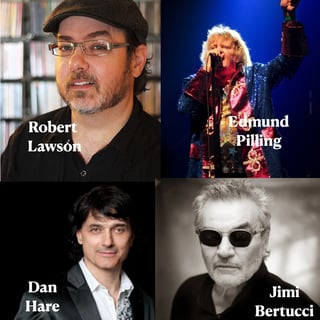
Speaker: Hi, it's Dan here and I wanted to let you know that this is a very special episode of the show. Some glimpses from my chats with four previous guests. You'll hear about 10 minutes of each guest's 60 plus minute conversation, which will give you a small idea of the many topics that we covered. Also, you can listen to the entire conversation at either linernotes .ca or on any podcast platforms. Just search for liner notes revealing chats with Canada's retro music makers. Enjoy.
Speaker: My special guest, my friend, songwriter, engineer, producer, vocalist, guitarist, and bassist, Kevin Stewart -Swing, who has worked with the likes of Bronnie Bentall, Idolize, Al Harlow, Thor, and many more. So thanks for joining me today, Kevin. How are you? I'm just terrific. I actually played recorder in in june in ah elementary school, too. There you go. see we We forgot that in the intro. But starting at the beginning, you were born in England, and you came over here very young, I'm assuming.
Speaker: Yeah, I was born just north of Liverpool, funny enough, like in 62. I mean, that's how old I am. I was kind of around where, I don't know if I got anything out of that, but yeah, I came over here in 65. Okay. So you were a young guy and you come to Canada and then what was your musical influence? Like, like how did you get into music? You just decide one day that it was ah a cool thing to do. Did you get some formal training? or I did, but you know what it what really was? was ah Because I had a strong English accent still when I started school and I i kind of got into that the unpopular mode, like getting kitted around.
Speaker: and all that stuff. So I didn't really have much of a group you know and and we moved a lot. So by the time I was about 14, I was thinking, okay, I hate this. What am I going to do with the rest of my life? I'm going to do something. And ah I kind of as an intellectual decision eventually decided that I was going to be a musician. I picked up a little classical guitar and a fellow came up to me and he was telling me about a, I was a North fan at the time and North fan was kind of a hotbed then. And one of the bands, you might remember a guy named Joe Staples. He had a band called Midnight City.
Speaker: So they needed a bass player in two weeks and I thought, well, to heck with it, I'll forget about this acoustic guitar. It's too small anyway. and yeah I'll get a bass and I'll join Joe's band in two weeks. and you know Of course, that never happened, but I did end up playing with Joe and stuff. But ah I actually kind of decided to be a bass player before I could play a bass and ah just kind of went out there and figured it out. Ended up with Barney Bentall pretty quick. and you know Yeah, I mean, I've always respected you for that because you play guitar and you play bass and you're one of those guys that that does both well and is is okay to do either, which is great. That's ah been ah good for you over the years and helped. You played in lots of bands because of it as well.
Speaker: yeah Yeah, and it's usually been bass. I didn't really get into guitar until later. i i I just dropped that idea and just got right into bass and then you know started fiddling around with guitar. and Now it's getting to the point where people are calling me as a guitar player, which is interesting. That's good. so well That's what I often ask my guests. you know how much of what you did was ah you know Did you have a defining moment or how much it was planned or how much it was just sort of an accident?
Speaker: And it sounds like you had a bit of a plan that you wanted to to be a musician and you set out on that path. Yeah, I definitely had a plan. I mean, I was, I was still carrying the residual of the, the school thing being, you know, not popular and stuff. So I kind of wasn't a great team player. You know, I, there's the old saying is I wouldn't want to belong to a club that would have me as a member. I was kind of in that thing at that point. yeah So I jumped around a lot and there might be some hard feelings about that. And I mean, I mean, it hurt me more than them. I, if I could have stayed in my first band and still been in Barney Bentall, but, uh, but it's been a great journey, you know,
Speaker: Well, i I mean, you and I are so probably similar in that regard that that I've always wanted to forge my own path. And some people, they read that the wrong way, but you got to follow your path, man. I mean, yeah what other path are you going to follow? Are you going to be a side guy in somebody else's path? No, I mean, it's an interesting gig. Like you watch movies like Hired Gun, and and I know a lot of guys that are those guys. yeah And ah they're great players and they they really dedicated to their art. but Yeah, I kind of I guess I'm getting that way a lot more, you know where I I'm a bit of both ah I can be a side man and I can be a leader and I can definitely not confuse the two roles So I have more empathy when someone's the leader I'm not going oh you should pay me more and he should do this and that because I know what it's like, right? So I think it helps, you know
Speaker: No, that's a good point. And and i've I'm the same way. like i I can be a great sort of guy if i if you say, tell me what you need, I'll do it. But that's part of my path at that point. And then I'm back on my own path. So again, I respect you for that. And I and i know that you know you've been through lots of different situations and trying to find your path. And and I just was never going to give my life over to being a side guy for somebody else. So I'll do it when it comes up. But we did the legend shows, as you know, for many years. And I was great that way. I would often say, well, I don't need to be in charge, but somebody does need to be in charge. Yeah. if it' cease to be it You're sitting there going, I would love to lay back here, but I can't help but interfere yeah because you go I don't want to, you know, the bus is about to go over a cliff. you know Yeah, exactly.
Speaker: So you really you excelled quickly. I mean, you were in Brandon Wolf, which moved into Barney Bento, but you were a kid, right? You were 16, 17? Totally. Well, the neatest thing was was i I walked into my high school stage band. I'd been playing for about six months, just self -taught. And ah I told them I could read music and and I snuck into the stage band.
Speaker: And unbeknownst to me, this was the best, gonna be the best stage band in Canada Junior. So I was only six, eight months playing and we were in Toronto and we won. You know, we opened for Mo Kaufman in front front of 1 ,500 people and Hey Good Hearty was a adjudicator. So it started You know, my life changed real quick. All of a sudden at a social group, I had friends, I was immersed in music and I was actually playing, you know, serious shows. We're in CBC and all that. So, and then I decided to leave school. I'd always wanted just to get out of school. So I finished, you know, grade 10 and I joined Barney Bentall. And I just kept going. I'm still doing it. Yeah. Well, there you go. That's super cool. And of course you had the feel for it too. I mean, a lot of guys,
Speaker: wanted to be. I can't count how many friends I i know that that really, really, really wanted to be a musician, but it just they didn't have it in the in the soul and the heart kind of thing. And so it just fell away. But you were one of those guys that just sort of had this natural affinity and just went into it and it kind of worked out. But you weren't in Brandon Wolf for very long, right? That was a bit of a short note saying what happened with that? Well, this this is a story of me. I was first in a band called Dirty Diamond Coal Company that was the invasion and ah and I was really into that. but to But there was a conflict of me trying to be in two bands. At that point, I was in both. So I decided to make my commitment to Barney
Speaker: and I'd lied about my age too so we' we're getting fired everywhere because I was 16 and they were waiting for my 18th birthday so we could go to Alberta at least and play and because that's where Barney was from and ah not born but that's where he'd come from. That's where the band was based out of right was Calgary?
Speaker: Well, that's where the construction company is. It was Bran and Wolf. It was Barney and a guy named Gary Fraser who he wrote as as Robert Arrow. He's a huge part that you don't hear in the Barney story, but it's the two of them. and they came and They brought their construction company ethics. so you know i North Van and we'd rehearse 9 to 5 Monday through Friday and stuff. and um but yeah they They came from Calgary anyway. So how you got into Barney Bento? How you got into Bran and Wolf? It didn't last that long.
Speaker: No, no, no, I just ah i did um like a year or something and then I'd actually left and they had the record coming up, the first record that we did at Little Mountain and Cool It, you know, 16, 17 years old or whatever it was, they said, will you do the album before you go?
Speaker: So there was already a new bass player. You might know him as Brad, um I can't remember his last name. Brad Kilburn, right? Brad Kilburn, right. So he's waiting in the wings, must have been crummy for him. And and i'm I did the session and we had a record and it did really well. It got him a deal with A and &M and Paul Rudolph from Hawkwind, the guy that replaced Lemmy in Hawkwind was the producer. And you know, we're in a little mountain, but yeah, so I think I did about a year with that. Yeah, and you co -wrote the Blonde on Blonde song. Yeah, and so which which on on the independent record, it has my name on the A and &M record, it doesn't, so I'm uncredited on the A and &M record. Oh, really?
Speaker: Yeah. why why these is mouth I was a dumb kid and I got papers in the mail to sign, you know, to to go with So Can and everything. And I just was so scattered. I never even filled the papers in. So I, you know, um on my side, I didn't do the due diligence and I think they just did some, some, I don't know what they did, but you know, if it ever came down to it, yeah, I co -wrote that song.
Speaker: Yes. Well, there you go. ah Well, the thing is, it's funny because when when you look back, you know of course, we're we're similar age and you look back and the timelines just seem so short. like Everybody was switching around in musical chairs and you're doing this and for a short period of time and it seems so short now looking back.
Speaker: Yeah. and and i mean i don't have a good reason The only reason I left was actually, you know I got that kind of wrong. When I left, I was doing the invasion and I was doing Barney Benton. We had really strong management and direction in the invasion. and I think that band could have been really huge.
Speaker: And the manager was saying at that point, like on a loyalty level, like, you you know, these days, everybody plays for everybody. In those days, it was almost kind of weird, you know, especially if you got two bands that are really going for it and you're just jumping in between. So that actually was why when I think about it was to make a commitment to the invasion.
Speaker: And we didn't get along like, I mean, I mean, not that Barney Bentall in particular, but none of us had any social skills. Like, I mean, I'd never even been in a, you know, in in a romantic relationship really for a long time at that point. So I didn't know. And I'd blame everybody else for my own, I was carrying all this stuff. And I always also thought the rain, you know, the ticket was just a phone call away. So I kept just auditioning and getting gigs and taking the gigs and then jumping, jumping, jumping.
Speaker: Today, I'm very honored to have as my guest musician, author, teacher, and somewhat of a music historian, Mark Dunn. We'll be talking about his book, You Get Bigger As You Go, Bruce Cockburn Biography, and get some insights into one of Canada's most well -known and most loved entertainers. So thanks for joining me today, Mark. How are you? I'm well. Thanks for having me, Dan. Go ahead. But I would like to start with you and your situation. Now, you're a performer yourself.
Speaker: ah been performing for over 30 years. You've done a bunch of albums and you're a writer, you've done poems and articles. and so how did this all come up Tell me a little bit about your career and how this all came about with the book. um Well, I'd been much more active as a freelance writer ah during my earlier part of my life, we'll say. And, um, in the last years I've been teaching, I teach at Sioux college in Sault Steamer, Ontario. Yeah, it's, it's very enjoyable. And, um, so I didn't have to make my living through my writing any longer, which kind of freed up my time and energy. And i I kind of thought who, you know, what would I want to write about? And I wanted to write about music. And the the first question I asked of myself was what is this power that music has to transform our
Speaker: lives by changing you know our thoughts or giving us insight into our own experiences. That was the first question, which coincided with a renewed interest in Bruce Coburn's music. um i As they said I said, I was no longer needing to write for a living. So I decided I asked myself, who would I like to interview? And it was Bruce Coburn. So I started interviewing him and did a couple of articles and then the My writing ah started to incorporate his music in it because I went back and I started listening to his entire catalogue, catching the albums that I'd missed.
Speaker: and then um you know reacquainting myself with ones that I'd kind of forgotten about. yeah so One of the first things when I read a book about a particular entertainer, and I've read many, there's various kinds of books. so Obviously, the autobiography is usually assisted by somebody. and Yours is a biography, but it's um was it approved? was it Did you have approved content in it?
Speaker: So um I don't really think of it as a biography. I i kind of think of it as a beginner's guide versus music. And there is a biographical section, but it's kind of its main focus is ah tracing Bruce Coburn's, ah the his music, ah cultural presence. And i I don't spend a lot of time on his personal life. ah I kind of feel it's none of my business. So I focus focus on the music and um is playing through the years. When I first realized that I was So I'd been writing, I'd been listening to music and and just writing about it. And, um, I started meeting people and, um, who knew Bruce or had played with Bruce. And anytime I met someone like that, I'd ask them a bunch of questions and document it. And so I started interviewing people and I'd probably been into it about three years. It took seven years to write the book and um about three years into it, I realized, I think I'm writing a book here. So I contacted, um,
Speaker: Bruce Coburn's manager, the tremendous Bernie Finkelstein, he's just ah just a legend, um and just kind of said, I think I'm writing a book on Bruce here. what do you know What do you guys think about that? His response was, well, we won't stand in your way, but we won't endorse it. So it's not officially endorsed. um However, I will say that if Mr. Finkelstein or Robert Covered hadn't wanted this book to be written, it probably wouldn't have been because everyone I spoke to pretty much contacted them to ask if they could speak to me. So okay yeah so I think there was an implicit kind of, not blessing, but more like just just let it go and see what happens.
Speaker: And with someone like like Bruce Coburn, like there's no way you can write about the music without you know talking about his personal life to some measure, because it's an integral part of his music. That's true, absolutely. So obviously you're going to get some of that, but I appreciate the fact that you're focusing more on the music. And secondarily, I guess the the approved content, I mean, there's sort of ah not an explicit, but maybe an implicit sort of, hey, you know try to get it right or or don't write anything unflattering. Was there any of that?
Speaker: and Because he he mentions I think at one point that he didn't totally agree with everything perhaps in the book did you ever find out what that was. No no I'm very curious to know. um Yeah so there was no pressure put on me at all and I think too I had a bit of a prior history they interviewed.
Speaker: publish the interviews with you so several times so I think they had a sense of what I was going after and I kind of spoken with them enough that I think they had kind of a sense that I wasn't going to you know ah do any gotcha journalism. so Well for sure and you you're not trying to be salacious you were trying to write a you know something about this particular person's life and the impact that this person had so I think your your motives were were pure in that sense i would suppose and also i'm completely biased right because when you read the book you realize it's yes the first um i worked with a great editor named elister thompson and his. Response to my first a first couple of drafts were.
Speaker: So Bruce Colburn can do no wrong. So I had to change my thinking a bit and kind of be more critical. But it's clear that ah it's not really an objective account of his music. i am ah I am a fan and I'm a great admirer of his work. Yeah, well for sure. and yeah so the One of the first things I had to ask you about was the name thing, the Cockburn -Coburn thing. and and you know I never quite understood that. you You explain it quite well in the book. and and you know I just wondered why he didn't just pick Coburn and just go with that because it's always back and forth. and I was always confused by that. Can you shed some light on that?
Speaker: Sure, so the pronunciation is Coburn um and the it's a Scottish name. um So the cock is ah you know it's it's it's a bird basically. and um So maybe you're asking why, I don't know why he didn't, he has spoken about that. why Like he said, some members of his family have anglicized their name to be phonetically Coburn. I think that would probably make life easier in some So some settings, you know, like the playgrounds and locker rooms, things like that. Well, because they're used interchangeably. So it's it's odd. I'm thinking, well, which is it and and why? Is it just because you don't want like, I mean, Cockburn obviously is is, you know, got some other connotations that that would be an issue. So Coburn seems like a softer version of that and and one that's more palatable to the general public. So why didn't you stick with that? that and
Speaker: Well, I think he i think he's he's very consistent with the spelling, which okay you know phonetically is cockburn, but the the pronunciation is coburn, yeah so it's it's always pronounced coburn.
Speaker: Okay. Yeah. But then I've seen it spelled C -O -B -U -R, like you explained in there with C -O -G -B -U -R -N, but it's... Oh yeah. So some people have with that last name, have anglicized it too. Right. But Bruce is always C -O -C. Yeah. Okay. Okay. Yeah. I just, I had to ask you about that. Sure. Yeah.
Speaker: Okay, well, so then the other thing about him is that, so you talk about the fact that he found this old guitar in his grandparents' attic, and then he ended up studying jazz and stuff. So a lot of the players, like it's funny because you think, okay, this guy wrote some songs, they sound pretty good. But then you you see certain players, like like a Gordon Lightfoot, for example, or or in this case, Bruce Coburn and stuff, that that they're they're substantial players. I mean, they're not they're not sort of campfire hacks. Like Bruce Coburn is,
Speaker: ah he's a virtuoso on on his instrument. But because I saw there that that Bruce Coburn actually studied jazz at Berkeley for a time and and took lessons and and was quite a schooled musician rather than a guy that just came up and learned by by acclimation or osmosis, I suppose. Yeah, he certainly he did study and he still studies music and guitar for sure.
Speaker: So then he he's got that sort of um story of where he weaved himself through the business and played in some bands and then decided that he was going to go ah solo. yeah So why do you think that was in his case? He just didn't want to be part of a ah group of people, just had his own, wanted to forge his own path. and I guess it was my sense of it. He said about that um he had a body of songs.
Speaker: that worked better with just voice and guitar. and But that at least is what he said publicly. um It can be so challenging to keep a band together. To be in a band, it's often ah more direct to go solo.
Speaker: Yeah, fair enough. But then then, again, he's had his foot in lots of different yeah camps, right? I mean, he's got the band, he's got the trim down, stripped down, and then in solo, right? So it's just whatever the flavor of the day is, I guess, is what he does. well And I think, too, like at that time, he he kind of went solo about 1969 or so. um At that time, that was the beginning of the era of the singer -songwriter, the most recent era of that. So I think there was probably just a cultural trend toward that way of performing.
Speaker: Today I'm very honored to have as my special guest bassist, extraordinary composer, producer and engineer, Ronnie Robson. He's worked with members of some of the top bands in the world, so we'll be talking about his musical adventures. One of the things you did that was super cool is you played a bunch of different instruments. I'm i'm similar in the sense that I've tried them, but it's important to have a feel for what it's like to be a drummer and a feel for what it's like to be the keyboard player and the guitar player.
Speaker: Yeah, no, exactly. And the thing about it is I learned to play drums because one of ah one of my my older friends, Steve jacket, he was a great drummer and.
Speaker: him and I, we used to jam together and he said to me, you know what, you're really good on bass. You seriously consider that instrument because you're right on the money with me. And he was a really good drummer. He's like a Keith Moon type, which put me in a situation where ah you know I got to practice, like I got to get my stuff together jamming with him. And next thing you know, the next week he'd say, you know, you play drums and I'll play bass.
Speaker: and yeah And it was one of those type of things where in a rhythm section, in a band, bass and drums are the most important. We're the foundation, right? yeah So that that kind of the education, I'll never forget. So you were a multi -instrumentalist, which gave you a good grounding as far as emerging as a bass player primarily, but having the the background and the other stuff. And then you began working in the recording studios and stuff too. You were interested in the engineering and and being a session guy.
Speaker: And so how did that all come about? You just went down and got a gig at a recording studio. out of high school, I didn't know what I wanted to do. And my parents were saying, you know, um you got to you got to make a decision what you're going to do. And I said, yeah, yeah, yeah, yeah. My dad said to me, you know, get your business degree, and then we'll figure it out from there. And I said, OK. So all of a sudden, I was, I don't know, I was having coffee on the damn fourth one day. And a buddy of mine said, oh, we're looking for another. He worked in a recording studio, by the way. And he said to me, he says,
Speaker: um We're looking for another engineer and you know what it's funny that I run into you, would you be interested in this?" And I said, yeah, he goes, the only problem is it's really weird hours and it's not going to be like a 40 hour work week thing. And I thought, you know what, let me get my foot in through the door.
Speaker: And I was working at a number of restaurants at that time um as a sous chef and bartender. And you know again, I didn't know what I wanted to do. So i'm I'm picking stuff that I know that I can do. So that's why I was doing it. So all of a sudden, I'm in the recording studio and I have amazing people around me, amazing artists. And you know I started to learn. And that was back in the analog days.
Speaker: Oh, yeah. So yeah so and and it it was it was really good education for me. And not only as as an engineer and working business with music, um I kind of shaped my or sharpened my personality more because people got to know me, um ah who I am and what I can do and and helping them as well. So it was it was it was cool. it was I really loved it.
Speaker: I've known Greg, I've known the guys in Godot for years and years and years. And I worked actually on their 35th anniversary concert so cool and ah started working on their documentary. The documentary never happened. Is it going to happen? so I hope so. We're trying to. But you know what? um Yeah, him and I,
Speaker: I mean, how many times that we've been together, how many times that these guys have been over to my house, it's like absolutely incredible. Absolutely. Great band, man. God, holy smokes. Well, but that was I was going to ask you how do you, how do you connect with all these people? But I guess in some ways it's it's the best of worlds and and you can sort of draw from people through your connections and then have them work remotely. You don't need to be sort of flying all to one location or anything. so You connected with a lot of people like ex -members of Ozzy and Sabbath and Whitesnake and, you know, Megadeth, like you said, and hold there's a whole list here. It's a long list. Yeah, ye it is. It's getting longer too, which is great. So how do you connect with those guys just through the recording world?
Speaker: Yeah, you know what, they have a reputation and I have a reputation. So I mean, things are really quiet right now. I'm doing my own little thing. I've got, you know, a upcoming project that I'm doing, yeah but yet I'm still, you know, I still talk to a lot of people every day, every week. it's It's amazing. It really is. You said you're you're doing the post audio for television and film and social media projects. So you have an active studio and with lots going on right now, right? Yeah. Yeah. It keeps me busy. That's for sure. and Definitely. But you know what? Music is is my number one thing. That's just the thing. and it's um I'm lucky and I've always been lucky. There's there's a form of luck. you know There's personality. Yeah. There's
Speaker: you know, the way that I am. Yes. But it's it's been luck. Today, I'm very honored to have as my special guest singer, songwriter, guitar player, Lisa Hart, best known as the lead of the Lisa Hart Band and also as a solo artist. You started right away like you weren't there was no grass growing under your feet, right? You got right into the scene and you were singing and performing in front of people at an early age. I was I was 10 when I first made my first money at it, which was ah thrilling a $10 bill.
Speaker: You know a check for singing on them on a jingle. That's so great i'm there. I know that's so crazy, isn't it? Yeah, my belle familiar is a mealtime treat. Anyway, it was a it was a big jingle and um i I got this money and I went wow I show this to mom and dad and I'll convince them that I I just need to go from A to B I don't need to all this stuff in it in the milk. So um I did convince them I was very convincing. I came to music You could not stop me. So my dad used to drive me downtown in the middle of winter, down Montreal, because there were no buses that came out really late, you know, back into the door. I could get there by myself, but I had to get him to come down. He would come in with a big coat over his pajamas. And I'd sit at the end of the bar and have a little shot with the owner and wait for me to finish and drive me home and then drive me to school the next day. So I was 11, 12.
Speaker: i singing downtown at the Cafe Andre and um the yellow door and all these c great folk places, you know, it was amazing. I was 19 years old, so I had left Canada. I went to England by myself. Well, first I went to Germany and I joined a gypsy band. wow And I joined a gypsy band and that became kind of raucous. That became very dangerous.
Speaker: there There was no one really looking after me and i ah they were all pretty crazed and there was a lot of drugs and alcohol and I didn't understand or want to get into that. So I escaped from this guest house really using the sheets. You know, the sheets that you tie together to get down to the ground out of the window, I did that. And I got out of there and I ah caught a lift with this young agent from the UK, Bill Thompson, his name was.
Speaker: um He gave me a lift. Of course, he had ulterior motives, but I managed to escape him, too. And when by the time I got to the UK, I had friends in London. So I phoned them up and went there right away and stayed with them. And then I had auditions with um Tony. Tony, what was his name? Oh, he escapes me right now. But he wrote for Silla Black and Petula Clark.
Speaker: And I had been compared to Petula Clark for a long time as a young girl. So they were giving me material to sing. And ah you know I was sort of recording at Pi Records and stuff like that in the very early days. And then I started this all -girl big band, the Christine Misat. And we just we just rampaged around Europe and the Middle East. It was crazy.
Speaker: So but your whole story that that early story is the parents worst nightmare. I mean, you're somewhat naive, I am assuming, right? You're just going out in the world. You want to sing. And then you find all the the pitfalls and the dangers of the world too. We were driving to where Greece, we were, we had a gig in Greece and we drove through Yugoslavia in the early morning and it was, it was dark and rainy and we were hungry and we had no money at all. Just all this money went on.
Speaker: And we stopped and we picked some grapes in the vineyards just before you get to the border of a priest. And out of the out of the bushes come all these farmers with bayonets, with guns with bayonets. Oh, God. And so they put us in a little country jail there. Wow. And I didn't, you know, I mean, we're laughing now, but can you imagine? So yeah i am ah I said, well, why don't we just sing our I have no fear at all. but Let's just sing our national anthems and we'll do that thing they do in the movies where you take the tin cup and you run it up and down the bars and we'll just scream for the consulate, which worked. It worked. Oh, wow. yeah So somebody came and got us out and we carried on our way. We paid. We had to end up paying for the grapes.
Speaker: They wanted US dollars. It was great. Yes, of course. And then we got to Greece and there was a coup that we went to play the gig at the US base in Athens. And by the time we got back to the hotel, all our luggage that we had dumped off when we got there had been taken back to the airport. We were told it was the coup because it was in the 60s. It was that big coup. And um it was again, we had to like run for our lives. and It was like that on the run. Yeah.
Speaker: when they When that song came out, I thought, oh my God, this is my life. Wow. That's crazy. Yeah. yeahing adventures Well, you know, it sounds like it. help parents worst nightmare Now I'm so naive. I didn't even lie to them. I told them everything that was going on. I wrote copious letters, which my mother kept. My mother kept everything. So.
Speaker: I have an ability to write a book about this because she's got everything that I wrote, like in the time, in live, right? Well, you should write a book if you've got the primary source. I mean, that's right from the the horse's mouth right at the time, right? Oh yeah, exactly. And I could, um today I wouldn't be able to remember the details that the letters convey, but I was going through all of it the other night and I'm thinking, Oh my God, yeah I was there. This was happening. This was real.
Speaker: I was dancing in the desert with Japanese soldiers and Russian generals and i'll prize all kinds of crazy things that could have happened. And yet I felt very, very safe, very safe. The Egyptian people are really lovely people too. So how did you make it back to Canada? you You hung out there for a few years, I'm assuming, and then you made your way back to vancouver back to Toronto, I guess. At the time, well, I had a manager here.
Speaker: that was very upset with me that I wouldn't come home. And he had a group called The Bells. Now, The Bells were very famous in Canada. yeah They had songs out by Ken Tobias, who I had worked with, by the way. At that point, I had had a band with Ken called the Crystal Staircase in Montreal. So we knew knew each other really well. So my manager at the time, and his manager, um was kind of upset with me that I wouldn't get out out of these boots and come back and and record something for real because the bells were doing so well, I could sort of follow or open for them. So you got back, to you got to come back to Canada, but I mean, that must have been a real dose of sanity for you to work with good people and be back to a comfortable, more comfortable situation, I guess. Is that fair? Well, I want to tell you though, our band in the Middle East, this band leader, Christine Lee, priy v as she calls herself, she
Speaker: She is one of the best drummers I've ever worked with in my life, baran bar bar none. And then yeah um her, like our band was so tight. I really missed when I got home. I was concerned that I wouldn't be able to put together something that great. yeah um Because it was all just laid out for me. I just had to sing front. I just had to be that North American singer that they needed, you know, with that the balls and the soul. We were doing a lot of R and &B and a lot of big bands.
Speaker: um yeah Blood, Sweat & Tears, Coliseum, all these big horn bands, right? Because we had horns. When I got home, there was an ad in the newspaper that ah the Vanelli family was looking for a background singer. And I needed cash right away. I needed to make money. My parents were not going to support me forever, right? So I can have a little rest and get better and get rid of the dysentery. But um They were going to hold it forever. So I figured I better get a job. And I wasn't really strong enough to go out and find people in front of them at that time because it requires money to put together all that. Right. Yeah. And what, how old were you at this time? Um, 18, 20, 20. 20. So you're, you're like a year later, right? I'm back, I'm back home and I auditioned for, um, Benelli. Yeah.
Speaker: That was that was ah interesting, actually. yeah Tell me more. You auditioned for the but family at that time because he was very tight with his family. So Mom and Dad and Ross and Joe, they were all there at the audition, which is normal. But then you had to pass an integrity test, an ethics test, too, which was interesting.
Speaker: I mean, I just felt like I was on trial. And after all my crazy adventures in Europe, I didn't feel like I could tell them anything. I just said I was a girl from Dorval. You know, I wasn't about to talk about my own going out in the Jeep and the Ashish and I couldn't talk about any of that. That's funny. So they were just very on the level. They were all about the music and they were working really hard. And my God,
Speaker: i when i at When I asked for a band, oh, Tina was such a great drummer. And drummers and singers that work like that and eventually become front singers, there were very few singers that had my experience at that point because of my age. And I just had this wealth of experience. for nineteen I've already been singing like six years.
Speaker: Yeah. And also your genres. I mean, like when I look at your timeline, how quickly things moved. But I mean, you you had the classical influence, you had the guitar, the rock, jazz, even fusion stuff. And then, of course, the folk influence was everywhere. Yeah. So you had all of that all sort of wrapped up in one person, I think. That's right. And and and bringing all those influences into every song. Right. So it gives us a unique sound. And I always said that the Lisa Hart band It took us 10 years to get the sound and that's and and bands. It takes a long time to really cook and create that recipe. that That's yours.
Speaker: And then, unfortunately, you always read seem to reach, I don't know if this is right in your experience, but you get to this place where you're finally there and everybody starts to change their life. No, it's an arc, right? You're building, you're growing, you're hungry, you're trying to get to where you think you need to be. And then you get there and then the arc sort of takes its its place. You plateau a little bit and then it starts to, to people start to go their own way, I guess.
Speaker: So you you found your way. you You had some kind of a record deal and you did the Touch Me in Aftermath. You were a solo artist at first, right? You were recording? That was after Gino. After Gino. Okay. And I was living with Ray Blake from National Can, the guitar player. Okay, I got you. And he had a group called River Sin. And somehow in there, I got this deal with Polydor and did Touch Me. Okay. And we never tried. And Then I went on to do a solo album with a guy named Billy Meisner, who was part of a very famous vocal group here. though the So Laurie Bower Singers, they were called. And they were very famous here in doing all the recording, the backgrounds and everything. And Billy was part of the roster, friends with Bob Hahn. Bob Hahn was the original guy that hired me when I was 10.
Speaker: So he he was the jingle master in Montreal, but he was also a producer. He had a label called rising records or Champlain Records First and then Rising Records. That was attached to CFCF, CTV. Yeah. And out of all of that, I eventually came to Toronto and did all of that. But we had a group called Oz before Lisa Hart Band and then Oz morphed into Lisa Hart.
Speaker: Thanks for checking out these short bits from my much longer conversations with previous liner notes guests. Don't forget you can listen to each full interview at either linernotes .ca or on any podcast platforms. Just search for liner notes, revealing chats with Canada's retro music makers. Until next time, I'm Dan Hare.