Transcript
Speaker: Welcome to All In Adams, the official podcast of Adams County Government, where we're all in for our residents, our employees, and our community. So whether you live here, work here, or you just want to know more about what makes Adams County a great place to be, thanks for tuning in. We're all in, Adams.
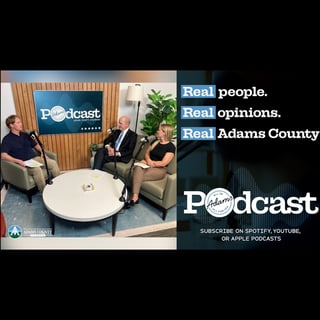
Speaker: Hello and once again welcome to All In Adams. My name is Brian Durth. I'm ah in the Communications Department here at Adams County. With me today I have Leah Campbell and Ella Gleason there with our Community and Economic Development Department.
Speaker: And today we're going to talk about one of those great government acronyms we all have, DSO, which stands for Development Standards Overhaul. So Leah, start with you. um What is DSO and can you just kind of explain to us a little bit what that means? Yeah, so short answer, the development standards overall is exactly what it sounds like. We are overhauling um all of the Adams County development standards and regulations.
Speaker: little bit of a longer answer. um The development standards and regulations are the rules that govern all land use and development in Adams County. So think zoning, what things are allowed where and what should they look like. Also engineering standards like drainage,
Speaker: road improvements, curb gutter sidewalk. um There's environmental standards in there. um the We're opening up the whole book, so everything's getting looked at, but I will say that the main focus is on the zoning area. So what things are allowed where and what design elements do we want to incorporate?
Speaker: Okay. And that that book, I've seen it, it's like 1,200 pages. It's a big one. So can you kind of say ah explain a little bit more when you talk about zoning, um what does that include? And does that include residential, business, everything in between? Yeah. So every property in an incorporated Adams County has a ah zone district and yes, that includes residential. So there are several different residential zone districts, um, kind of broken up into urban and rural. So the urban ones will be a little bit more dense. Um, and then the rural ones are more of the like residential estate and or the agricultural properties, some, some really big properties out, out East. Um, and then yes, also commercial and industrial as well.
Speaker: Okay. And that includes everything from building a new home and then to something small like putting up a fence, correct? yeah everything in between? Everything in between. yep right And just just to confirm, um this is for only unincorporated Adams County? does include people in municipalities like Thornton or Brighton? Correct. Only unincorporated. Okay.
Speaker: And ah Ella, moving on to you, um why is this project relevant to residents of Adams County? um What can people who are going to undergo some of these home improvement or building projects, ah what can they expect to to see with the new DSO regulations? Yeah, so like Leah was saying, this applies to all properties in unincorporated Adams County.
Speaker: And you know for many of us, our home is the biggest investment we'll ever make. So it's certainly important to all homeowners, but also renters, ah property owners, business owners in Adams County, because to Leah's point, again, that these are the land use laws for all of unincorporated Adams County. So um everyone should get involved. Everyone should care because it's going to affect really everything. We know it can come across as a very dry topic. It is not everyone nerds out on it like we do. um But we've tried our best to make it approachable for everyone to understand, you know, how is this realistically going to affect my neighborhood or my business?
Speaker: And we've done that on the website. Yeah. Yeah, ah as a residential property owner, ah we are in the urban zone districts ah increasing housing options, which is really exciting. So increasing ah or adding in housing types like duplexes, multiplexes,
Speaker: And then we currently allow accessory dwelling units, ADU. Some people call them like granny flats or mother-in-law suites. You can have that accessory to a single family home now.
Speaker: We're proposing to add it to a duplex, which is also exciting. We've seen a lot of interest in that. So, Those sorts of changes, ah adding beefier open space standards, so creating better public spaces for people in their residential neighborhoods.
Speaker: And then in the commercial districts, we currently have six commercial zone districts. They're not super different. So what we did is we combined them down into three new ah commercial districts for ease of use.
Speaker: So ah for commercial property owners, that'll be something they they'll be interested to see. Not much has changed as far as like setbacks or standards go. We're really just changing the name to make it more simple.
Speaker: And then as far as use standards go for commercial and industrial uses, we really just tried to simplify and clarify our codes over 20 years old. So we really tried to modernize it and bring it up with the times.
Speaker: We have a change in use permit currently. ah Most every other city and county calls it a site plan review process. So we're modernizing that, ah creating a site plan review process that will hopefully be easier for business owners um and developers. And then, um Some use uses like outdoor storage.
Speaker: We really needed to clarify some of those use standards ah to just let people know what's expected. And then food trucks, we didn't have any standards at all, but that's something we've seen over and over again in the county and something we we want to encourage. It's a great business. um We have a lot of food truck businesses in Adams County.
Speaker: So again, providing clarity as to what's expected. So we're adding those in um So yeah, we have tried on the website to call out kind of the the high points or what might be most exciting or interesting to people.
Speaker: ah But middle of June, that entire draft will be available for folks to look at and to review. If you really want to, you know, take pen to paper and review all 1,200 pages, you can do that.
Speaker: um Or we'll have kind of those big topic ah sections called out for people to review. Gotcha. And, you know, you mentioned food trucks. We've got some fairly small businesses probably owned like like owned by us by ah by a single person probably in yeah some cases. And then you've got things like big warehouses and everything. Do these ah these new DSO regulations, do they apply – the same regulations apply to everyone or are there different standards for for different sizes or different types of of yeah organizations? Yeah. Great question. So we're going to regulate as planners, um, place and scale and impacts. So, um, they might all fall into the bucket of a commercial use, but what's the scale at which they're operating? You know, different scale businesses are going to have different impacts as far as parking or noise, uh, depending on your business, like environmental considerations. So there will be, ah there are in the current code and in the code to come,
Speaker: ah general commercial standards, but we have what are also called use specific standards. So for folks who operate say a restaurant, they could look and see the use specific standards for a restaurant to see how that might impact their specific business.
Speaker: um So sometimes they're general, but when it comes to impacts that are specific to that kind of use or that scale of use, ah we do get specific in regulating those. And is, is, you know, Adams County has a pretty wide geographic basin.
Speaker: Um, does everything like apply to like the urban core kind of in Southwest Adams County that it does out toward Bennett and Strasburg and Watkins, or are there different standards for like rural versus urban?
Speaker: Yeah, so in a lot of places, it does make sense to regulate them differently, right? um So in residential zone districts, like we were speaking to, um those zone district standards are going to look a lot different than, say, an agricultural property out towards Bennett.
Speaker: ah We're going to allow more density. We're going to require maybe a higher level of design for some of those multifamily properties. um We expect it to be you know more of an urban neighborhood than we would in, say, Bennett.
Speaker: um you're gonna be able to keep more animals if you live in an agricultural zone district. So those standards, um zone district standards vary as far as like urban versus rural.
Speaker: but then also with landscaping, ah we did make some updates to our landscaping standards. One of those being getting smarter about um the current water situation that we're in and um thinking critically about the water resources that are available in the east and west parts of the county. So um requiring ah native landscaping in the more urban parts of the county where we do have water utilities and requiring less to no landscaping in the Eastern, more rural parts of the counties. So there are differences like that because as we know, it's a very diverse county ah far as like geography and um even weather goes. So we took that into consideration for sure.
Speaker: and And you mentioned, you know, like agriculture is a big, agriculture and livestock is a big part of Eastern Adams County. How will folks that that are in those industries, how will they be impacted by some of these changes in the DSO?
Speaker: Yeah, so ideally a lot of the things we have done to change the urban areas of the county will protect the agricultural areas. And what I mean by that is um we are encouraging more growth in the established areas and discouraging sprawl into the agricultural areas. So preserving those lands by encouraging the growth where the services exist, where the roads exist, um where development and communities are already occurring.
Speaker: um Excuse me. We also, again, ah addressed some of the use permissions. So we had some industrial uses that could be conditionally permitted in the agricultural parts of the county.
Speaker: ah We removed those from the use charts, again, to um only really allow agricultural, residential, and agricultural supportive businesses in the eastern part of the county because we do want to preserve those lands for years to come.
Speaker: That's important to us. ah So again, it's almost, ah I don't know that they'll see many changes in their zone district regulations or what applies to their property specifically, but it was almost the opposite of approach of encouraging everything in the western part of the county so as to preserve the eastern part county.
Speaker: Yeah, that makes sense. yeah um And so um I'm going to give you a chance to nerd out like you said you you like to as planners. um Overall, you you know, you talked about this, the the previous set of regulations being 20 or so years old. Like what are some of the other big changes that are coming down with these with the with the new overall?
Speaker: Yeah, so i think the um think housing form and type is something we've seen change a lot in the last 20 years, and I spoke to that a bit. But mixed-use development is something we're making more room for.
Speaker: We did add mixed-use standards maybe five years ago into our code, which gave us some time to... see how the development community responded to that.
Speaker: We didn't have anyone rezone to mixed use. So that kind of told us, okay, we didn't get it quite right. And what is mixed use exactly for people? Yeah. um So mixed use is a development where you have residential and commercial in a single project.
Speaker: And um yeah, so we didn't see, we created this mixed use zone district. No one has rezoned to it. And so that told us, you know, maybe we need to go back to the drawing board. So we did. Okay.
Speaker: And one thing that we made room for with the code update, ah our current code allows for vertical mixed use, which tends to be commercial on the bottom. So think shops, retail, banks, that kind of thing.
Speaker: And then multifamily residential above. um which you'll see all over neighboring communities, mainly Denver. um It's not always appropriate in the Adams County context, right? Like maybe along corridors like Federal or Pecos, you might see that kind of development. But what we were seeing more often is a request for horizontal mixed use.
Speaker: So it might be the same building, but you might have commercial out front and then behind it, us and some townhomes. So more on a scale that would make sense for our communities.
Speaker: know we saw a really cool project come in a couple years ago. it was an old church and someone was looking to put a brewery out front and have some townhomes in the back. that wasn't something that zone district would support at the time.
Speaker: ah But that is the kind of creativity we want to encourage um in the community. So that's one change we made to kind of get with the times. um And yeah, and I think the theme there is kind of flexibility, yeah like building in more flexibility, stuff that's a little bit more context based. So that, you know, not, not everything makes sense on every property, even if they are the same zone district. So just like,
Speaker: adding a little bit of context specific flexibility in the standards. Totally, thinking more about neighborhoods and not necessarily use by use on each property, um but thinking, again, to nerd out a little bit. If anyone's familiar with the term form-based code, and this is gonna get really nerdy, sorry. We currently have a Euclidean code.
Speaker: um And so this means you have these zone districts and certain things are allowed in certain zone districts and we keep them separate and that keeps things safe and healthy, which is true.
Speaker: um But there's a new form of thinking, form-based zoning, which you're thinking more about the form of the community. So the physical like building form and not necessarily, not as much about what's inside the building.
Speaker: um Or like the look and feel. Exactly. And the scale um and how all of that works together to create a greater neighborhood context. So we did incorporate some elements of that into the code.
Speaker: So again, ah think less in these silos of zone districts. We still have our zone districts, ah but thinking more in the neighborhood context to create places people actually want to live.
Speaker: So you're looking at zoning and kind of a more holistic approach, like kind of like we want to build these into ah into communities and with neighborhoods and kind of connect people and let them not have to get in their cars if they want to just go down the street. They can walk, they can bike.
Speaker: um And can you talk a little bit more about how that played into the thought process for the this process of ah of the overall? Yeah, so at our at its core, um development standards and regulations implement the comprehensive plan.
Speaker: ah So the Adams County Advancing Adams Comprehensive Plan was adopted in 2022. And that's like the guiding policy document for land use in the county. Something that plan really focused on was something called the 20-minute community, which is that idea you're talking about of like, how do we create communities where folks are 20 minutes from everything they need?
Speaker: In denser parts of the county, it's gonna be less than 20 minutes, but because we are you know a pretty suburban, rural community, what we landed on a 20-minute community.
Speaker: And so that is an idea that we kept front and center as we were doing the code of, um like you said, how do we allow for a more flexible mix of uses um so that we don't just have these you know commercial districts and residential districts, but that they can all work in harmony together.
Speaker: And one other thing that was ah brought up in the advancing Adams plan when it was passed was parks and open space. So how do you, how does the, how does the DSO plan to incorporate open spaces into to the the bigger picture?
Speaker: Yeah. so we have updated our amenity space requirements is what we're calling them. um Currently we'd only see these big, uh, Parks provide, well, I'll step back and say, with any subdivision, we require public land dedication.
Speaker: um However, we didn't necessarily require any sort of um private public space as part of a larger residential development unless we were going through the planned unit development process, which is a development process outside of our typical zone districts. So the developer writes the standards for the zone zone district, ah basically.
Speaker: In that case, we were requiring private open space. Moving forward, um we are going to be requiring amenity space for any residential development of four units or more.
Speaker: Now this is new residential development, so not existing. um But we have this really smart table that has, and our consultant came up with it, um but it names different types of open space.
Speaker: And it weighs them with a multiplier ah based on the kinds of open spaces we want to see in our community. So, for example, you might have a nice stormwater swale that might be worth 0.4 points. um But if you want to build a community center, well, that's going to be, you know, 1.8 points.
Speaker: um And so we use these multipliers to weigh the things that our community needs and wants, um you know, more places to recreate, more places to gather, that kind of thing. So they're not all held equal and we can incentivize, you know, though the open space that we want to see.
Speaker: so that'll be one big change is um requiring these kind of open spaces for new residential development. Oh, good. yeah And to kind of wrap things up here, I mean, I'm sure people who aren't planners are probably still going to have a lot of questions about this process and what it means for them. So you're going on tour, right? We are. Can talk a little bit about ah how people can get involved over the next ah month or two and yeah and how how how they can connect with with the planners and find out what this means for them? Yeah, so first of all, as Ella mentioned, the draft will be live mid-June through the end end of July. So that's one way can go online and and review the draft. um And we we encourage people to do that. ah
Speaker: It is a long document, but we will help guide people to the things that are most that might be most relevant to them. um But yeah, we're going on tour. So our first um open house will be on June 23rd the Anythink Pearl Mac Library from 5.30 7.30.
Speaker: um And then we'll have several other events throughout the rest of the summer as the draft is live. um And you can find all of that on our website. Will that be linked to in the show notes? Yes, we can we can we can link to that. we can And you you can also find ah find information on where the different roadshows will be on our social media accounts throughout county government as well. so okay um Well, that's great. that's That sounds wonderful. I think we're about out of time. So thank you, Leah. Thank you, Ella, for being here with us today. And thank you again for watching and listening. And this has been another episode of All in Adams.
Speaker: That's a wrap for this episode of All In Adams. Thank you for joining us as we explore the people, programs, and the policies that make Adams County a great place to live, work, and thrive.
Speaker: If you enjoyed the show, be sure to subscribe and share with your friends, neighbors, and colleagues. Have a topic you'd like us to cover? Let us know. We're All In for bringing you the stories that matter most.
Speaker: Until next time, take care of each other and stay connected with us on Facebook, Instagram, Nextdoor, and x We're all in, Adams, and we're all in for you.