Transcript
Speaker: Retirement.
Speaker: That's what we're all aiming at, right?
Speaker: But exactly what does that mean?
Speaker: It conjures up visions of endless days of golf, drinks with little umbrellas in them on a tropical beach, feet up reading a book.
Speaker: Is that what it's all about?
Speaker: I don't think so.
Speaker: Life would get pretty dull after a while without anything meaningful to do, don't you think?
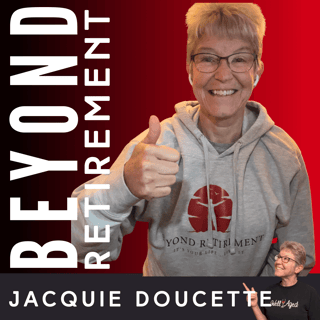
Speaker: I'm Jackie Doucette, and I'm on a mission to discover exactly what life is like beyond retirement.
Speaker: Join me while I chat with people who've already done it, who've retired to something rather than from something.
Speaker: Let's find out together exactly what's waiting for us when we say goodbye to that nine to five.
Speaker: Hi everyone, welcome to episode 246 of Beyond Retirement.
Speaker: If you recall, last week I was talking with Kimberly Best, and we talked about a number of topics that should be top of mind as we prepare for retirement.
Speaker: If you haven't listened to that interview yet, go on back and listen to it after this one.
Speaker: The first thing that I want to rehash today is end-of-life planning and the idea that we need to have these chats.
Speaker: It's not an easy topic, and it's one that we've talked about a couple of times on the show now because of its importance.
Speaker: As we approach retirement, we begin to understand that life doesn't last forever, and we need to plan accordingly.
Speaker: It's an uncomfortable thought to consider.
Speaker: I don't know about you, but I want to have the best possible experience in my final years.
Speaker: And since we never really know for sure when the end is coming, it's better to have these conversations early, while everyone's healthy, because they're easier to handle in that light.
Speaker: End-of-life planning is about making conscious choices.
Speaker: It's about making decisions ahead of time about the health care we want to receive, how our assets will be distributed, and how we want to be remembered.
Speaker: As I said, I know it's not a comfortable subject for most people, and that's okay.
Speaker: We shouldn't let our discomfort prevent us from having these vital conversations with our loved ones and the people who will be carrying out our wishes at the end.
Speaker: one of the first steps we can take is to think about what's going to be important to us in our final years.
Speaker: It's essential to have these conversations, not only with ourselves, but with our loved ones.
Speaker: Do we want to focus on our quality of life?
Speaker: Or do we want every possible medical intervention?
Speaker: Do we want to be in a hospital bed or even in our own home, connected to machines that are keeping our bodies functioning with the hope that there will be treatments or cures for whatever's going on?
Speaker: Is this how we want our family members to remember us?
Speaker: Ask yourself these questions and make sure that everybody knows the answers.
Speaker: If we choose not to plan for the inevitable, we're more likely to experience unnecessary suffering.
Speaker: It's essential to ensure that our loved ones know what our wishes are so that they can advocate for us in the event that we can't speak for ourselves.
Speaker: And knowing our wishes makes their decisions easier, or at least that's the goal.
Speaker: the need to worry about what's right is taken out of their hands.
Speaker: It doesn't mean they're going to enjoy taking the necessary action, but it does mean that they shouldn't have to agonize over it.
Speaker: Our loved ones aren't going to want to make those decisions when the time comes.
Speaker: They'll want to keep us alive longer no matter what, because saying goodbye hurts.
Speaker: It's not easy to think of others when you're hurting, so having the decision made in advance is the kindest thing that you can do for them.
Speaker: The other part of this topic is the idea of dying well.
Speaker: As Kimberly pointed out, it's not just about avoiding as much pain and suffering as possible, which we all want to do, right?
Speaker: But it's also about spending time with loved ones, doing the things that bring us joy, and finding a sense of peace and acceptance in our final moments.
Speaker: That's the idea of quality over quantity that I mentioned at the start.
Speaker: Make sure you think about this aspect of the end as well and discuss it with your loved ones so they understand why you're making whatever choices you make.
Speaker: My mom always said she didn't want a funeral or a memorial or any sort of ceremony when she died.
Speaker: I asked her why not, and she said she didn't want people making a fuss about her because she didn't believe that there was anything after life, so there was no reason for it.
Speaker: I said, I understand that point of view, but I suggested to her that the memorial service is actually more for the people left behind than for the person who died, because we're all left with a hole where our loved one once was.
Speaker: The service provides some closure and allows us to say goodbye.
Speaker: She considered this for a bit and said, well, I'll be gone, I guess, so you can do whatever you want.
Speaker: We talked about it a bit more and came to an agreement.
Speaker: I'm glad we had the talk because I wanted to be able to say goodbye to her and I didn't want to go against her wishes.
Speaker: Another part of end-of-life planning is considering what will happen to our assets when we die.
Speaker: Estate planning can help ensure that our loved ones are taken care of after we pass away, but it can also help us live a more meaningful life in retirement.
Speaker: Living that more meaningful life can take on many forms, so it's essential to think about this in advance so you can plan appropriately.
Speaker: During retirement, we have the time and resources to do many things we've always wanted to do.
Speaker: Retirement's our time to explore things that we may not have had time to before.
Speaker: Kimberly recommended checking out volunteering, which is a great way to feel more connected to your community and a fulfilling way to spend your free time.
Speaker: She also talked about how when we retire, we may need to build new relationships.
Speaker: This can be challenging for people who may have lived in one place for their entire lives.
Speaker: But building new relationships is essential for our well-being.
Speaker: And Kimberly suggested that we explore new shared interests, join groups or clubs, attend local classes or seminars,
Speaker: Learning new skills is also a great way to spend time.
Speaker: Our brains need stimulation, and learning a new skill is a great way to keep our minds active.
Speaker: Kimberly suggested trying a new hobby, such as knitting or gardening, or taking a class at a local community college.
Speaker: Perhaps one of the most important things we need to do in retirement is take time for self-care.
Speaker: This can be something as simple as taking a walk in nature, getting regular exercise, or spending time with friends and family.
Speaker: Kimberly talked a little bit about embracing technology and using it to stay connected with loved ones who may live far away.
Speaker: Making sure we have access to health care and that we are staying up to date with doctor's appointments is also essential.
Speaker: So, as I've said, we can travel, take up new hobbies, volunteer with charitable organizations.
Speaker: Creating an estate plan can help us ensure that the money we've worked hard for is used in ways that matter to us.
Speaker: Now, I know that you might be thinking that estate planning is an expensive and time-consuming process, but that's not necessarily true.
Speaker: There are online options available, but I recommend working with an estate planning attorney to ensure that your wishes are properly documented and legally binding.
Speaker: Finally, we can all benefit from thinking about how we want to be remembered after we pass away.
Speaker: What legacy do we want to live behind?
Speaker: When we're gone, how do we want our loved ones to remember us?
Speaker: This doesn't have to be elaborate or extensive.
Speaker: I know that when we think of someone who's left a legacy, it usually means a building is named after that person or there's some scholarship donated by their estate or whatever.
Speaker: But that's not what I'm talking about.
Speaker: Sure, if you've done things right all your life and end up with a big estate at the end, maybe you want to think about that.
Speaker: But what I'm talking about is thinking about what people will say about you when you're gone.
Speaker: Were you a good person?
Speaker: Did you teach your kids how to be good people?
Speaker: Maybe it's too late for some of this, but it's never too late to do something kind for someone else.
Speaker: Did you play with your grandkids or spend all your time at the office?
Speaker: Did you come home and kick the dog because your boss got on your case?
Speaker: Or did you leave work at work and make the most of your life?
Speaker: So preparing for retirement involves planning for end of life, but it also involves planning what's going to happen between now and then.
Speaker: Making sure you have the resources to get you to the finish line is pretty important, and knowing what lies at the finish line is essential.
Speaker: It's okay if the answers to any or all the questions I've posed are difficult.
Speaker: I hope that by reflecting on these questions, you can plan for a retirement that feels fulfilling and gives you peace of mind.
Speaker: Thanks for tuning in today.
Speaker: I hope you enjoyed this episode of Beyond Retirement.
Speaker: Don't forget to subscribe and leave me a review if you found the episode helpful.
Speaker: If you have any questions or comments, please don't hesitate to reach out to me.
Speaker: Next week, I'm going to be chatting with Sandy Short, who's a mindset and life coach, hoping to help you design a great retirement.
Speaker: Hope you'll join us.
Speaker: And that's it for this episode of Beyond Retirement.
Speaker: Thank you so much for hanging out with me.
Speaker: I hope you enjoyed it.
Speaker: Are you ready to start rocking your retirement?
Speaker: Head on over to www.beyondretirement.ca forward slash rocking it and sign up to plan out your own roadmap for retirement.
Speaker: Don't wait till it's too late.