Transcript
Speaker: I wanted to move forward as a maker. So I, you know, after seeing and living with and collecting these beautiful pots, I made some drastic decisions, big changes. I decided that I fell in love with pinch pots.
Speaker: What is up, shaping nation? This is Nick Torres here and on today's episode, I had the great pleasure of interviewing Kate Morant. Kate makes some really incredible hand built pottery that she used to make wheel thrown pottery, but made the switch to coil building and pinch potting. In this episode, you'll learn why Kate made that switch. You also learn about how Kate networks and use networking abilities to help her do workshops and produce her own workshops. Finally,
Speaker: You'll learn about why you need to be making bad pots in order to find your own unique voice. And there's so much more this episode. I hope you guys enjoy it. If you love pottery and want to take your skills to the next level, you're in the right place. Find your own pottery style right here on Shaping Your Pottery with Nick Torres. Let's get started. Welcome Shaping Pottery and share with me what is something you believe potters should be doing to have success in pottery.
Speaker: Well, I definitely think that if someone is interested in having a unique body of work, it's important to really be experimental with what you're doing and make a concerted effort to do something semi -original. You know, if you're trying to make functional pots, there are of course limitations to what can really be functional or really even utilitarian if that's something you're interested in, but it's important to
Speaker: educate yourself and absolutely I love that advice. So tell me a story how you got started making pottery. Well, I went to UW Stout for my undergrad education and I began as an art education major. But then during my drawing one course, I decided to add the studio art BFA. And I really didn't have much experience with clay other than
Speaker: you know, elementary school, little bit of middle school, some high school. So I took my required class in undergrad thinking that I was going to be a painter. But once I got into ceramics, I just completely fell in love. And, you know, something really clicked for me. And that, you know, it's just kind of history. So I've been working with that ever since. I love that. So what made you continue going down the pottery path?
Speaker: like pursuing ceramics or as a profession. Just pursuing ceramics, just the journey itself, what made you continue it? Sure. Honestly, it was the first time we were on the potter's wheel. In my ceramics one class in undergrad, we had the first quarter of the class was hand building and I really enjoyed that.
Speaker: I was in the studio all the time working with it, but our first day on the potter's wheel, that just felt like magic. It just really clicked for me. And I just lived and breathed being in the studio and being on the potter's wheel, making functional pots. Absolutely love that. And we're going to talk a little bit more about your pottery in just a bit. But for now, tell me about the story when you became an emerging artist for ceramics monthly.
Speaker: Sure, I, you know, it's an open application process.
Speaker: And honestly, I had no expectation that I was going to be selected as an emerging artist. When I applied, that was the first time that I applied. I just kind of decided that I was going to apply sort of as practice. And, you know, I told myself I'm not going to get it this year, but maybe I'll get it next year. And to my surprise, they selected me as one of the emerging artists for ceramics monthly. And I was just totally shocked and completely over the moon. Yeah.
Speaker: What were you feeling when you found out you became an emerging artist? Well, at the time I was a teacher and we actually had an in -service day. So I was in this, you know, it was kind of like post COVID Zoom meetings for these in -service days. Like we were all kind of split up around the school attending meetings via Zoom. And I got an alert, saw it pop up during my Zoom meeting. And fortunately I didn't have my camera on and I was
Speaker: happen to be standing at a standing desk for my meeting and I just started jumping up and down and fist pumping. It was just an incredible moment for me. I love that. So you mentioned that you were a teacher. Can you tell me more about that?
Speaker: Yeah, well, like I said, I double majored in undergrad and in undergrad I repeatedly. Considered strictly pursuing ceramics, but I'd had this dream since I was 10 that I was going to be a teacher and it felt like a stable career and was something that I was really interested in and I've always really cared about.
Speaker: education and access to education and having good teachers. So I decided, all right, I'm going to pursue that. And, you know, for now, I'm going to be just a part time studio potter around my teaching schedule. And, you know, I really loved teaching and I still love teaching, but I just have come to the point, you know, in the last few years where being a studio potter really clearly became
Speaker: a major priority for me. When was the moment when you realized that being a studio potter is more the priority for yourself? Well, there wasn't really one moment. But I think like a lot of people during quarantine, you know, you had time that we didn't have before to really do some self reflection. And that was a really challenging time
Speaker: to be a teacher and especially actually the time after quarantine was really rough being a full -time in -person teacher and then also teaching remote at the same time. I just felt totally zapped of energy and it was really kind of losing my excitement for teaching day in and day out. And it was really hard to kind of accept that.
Speaker: In 2020, I think I started seriously entertaining the idea of being a studio potter. I think that was the first time that I really, truly considered that as a legitimate option for me. I love that. And we're going to talk more about that a little bit later. But for now, let's talk about your pottery. Can you tell me the story how you started making the pottery that you make today?
Speaker: Yeah, I was a wheel thrower all through undergrad. You know, that's what I really fell in love with. I mean, I loved clay right away, but the potter's wheel is what really hooked me. Like, that's what really convinced me that ceramics was my thing, that that's where I needed to be.
Speaker: But after graduating, I really kind of lost interest in the processes that I was using and the work in general that I was making. So, you know, at that time I was starting my career as a teacher and I just really didn't have the time or energy to put into continuing to make.
Speaker: So my first few years of teaching, I didn't make anything other than demo pots for my high school students, which in some ways was kind of nice to be able to take a step back after having a senior show and being stress beyond stressed about that. But within those few years of taking a break from making and focusing on teaching, it did give me the opportunity to live with pots and collect pots and really
Speaker: take time to reflect on what I was interested in within my collection and how I wanted to move forward as a maker. So I, you know, after seeing and living with and collecting these beautiful pots, I made some drastic decisions, big changes. I decided that I fell in love with pinch pots, thanks to Candice Meth specifically. I saw her pots at the Western Wisconsin Pottery Tour during one of their
Speaker: last years as a tour and it was just so incredible. And I'd seen her, I ran across her on Instagram originally, but seeing her work in person just really was amazing. And I decided, all right, I'm going to switch techniques. I'm going to teach myself how to make pinch pots because that's not something I'd
Speaker: ever actually really done, probably since kindergarten. So I got in the studio and started playing with that new technique. I went and bought stoneware, which I hadn't used for years. I'd been working with porcelain, bought some books to read on hand -building. Sunshine Cub and Melissa Weiss have fantastic books that
Speaker: really helped guide me in those early months of making and just decided to get to work. I made a lot of different kind of styles of work, all pinched and all in this dark stoneware, but I decided to just start experimenting and I wasn't really focused for a while on making a body of work until I was
Speaker: satisfied with where my technical skill was going and until I kind of decided what I wanted my work to be about. I love that. Shaping Nation, you don't have to be stuck doing the same thing over and over again. If you want to make the switch from wheel throwing to hand building, you can definitely do that. I love that. So now you are inspired by your natural surroundings. How does this impact the way you make your own pottery? Yeah, so when I first
Speaker: Started searching for kind of my voice within my work. I really took some time to reflect on what I was interested in outside of ceramics. I found that that's been a good guide for me in creating a cohesive body of work is just finding.
Speaker: know that kind of that theme that I wanted to pursue. So I was really interested in like sculpture in general. I love Barbara Hepworth's work and she's always been a great source of inspiration for me. So I started looking at cocoons and bones. I took several life drawing classes in college. I was really interested in
Speaker: you know, those forms. And I decided to, you know, take qualities of those things that I was interested in and try to find a way to bring that into a functional body of work. And that started as a very literal interpretation of turning a seed pod into a cup. But I decided to continue working and kind of abstracting that idea because I wasn't necessarily interested in
Speaker: being super literal, I did want more of an abstract interpretation of those elements that I was interested in. Why seed pods? What gene is that? I just think they're really beautiful objects. That's something that you see regularly, or at least I see regularly in rural Wisconsin.
Speaker: you know, I peeled them apart as kids, like all different types of seed pods. And it just seems like something that I could work with, like an object that I could translate into ceramics, you know, pots or vessels, seed pods or vessels. So that just really made sense to me.
Speaker: I love that shape nation. If you have an interest in something else other than pottery, you can apply that interest into your own pottery. I love that. So now can you walk me through how you coil build your mugs and how you get the shapes, get it to shape like how you shape it.
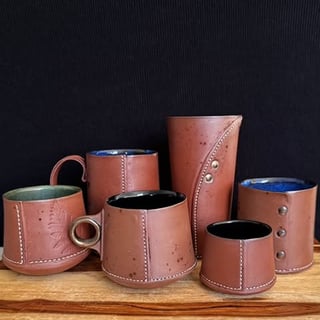
Speaker: Sure. All of my pots are made in sections. So anytime that you see a ridge in any of my works, that shows you where a new piece of clay is attached and then pinched up from. So, you know, I make a variety of mugs, but like those four layer mugs where the handle kind of like squishes and compresses the form a little bit. I work, you know, on that first section. I work just on a banding wheel.
Speaker: just using that coil and pinch approach I do sometimes use I have an extruder to extrude coils just to make the process a bit faster and you know even just a little more gentle on like my fingers and hands for the long term but I allow things to dry I've got a little plastic greenhouse that I use as you know it's kind of a damp box so I put pieces in there allow them to dry to leather hard and
Speaker: Attach the next section, pinch that up. Cut the rim down to whatever angle and height I want. Put it back in the damp box. So I often revisit pieces through a few days or several days in order to finish them up. So most layers are completed within just one day. So you can kind of count the days that I've revisited the pieces.
Speaker: I love it. That was an excellent explanation of that. So let's talk about the business side of pottery. Can you tell me about the moment when you decided to go full time with your pottery? Well, going back to, you know, quarantine, right? That was kind of when I started entertaining that idea. And honestly, once I received that, like emerging artists ceramics monthly publication, I
Speaker: I got a great boost in confidence. I felt like for me, the work that I was making was really outside of what I'd been pursuing up to that point. So it was just incredibly validating. And sometimes when you're working in your own studio, I don't work in a community studio at all. I'm in my own space and it's rural.
Speaker: you know, a lot of makers around here and there isn't a very strong arts community in my specific area. So, you know, you kind of live in a bubble a little bit. And, you know, I was kind of worried about how people would really receive my work. Like I was excited about what I was doing, but that was no guarantee that other people would care or be interested in what I was making. And applying for that and the long shot of being awarded that and then
Speaker: Getting that award was I think was a moment where I thought I could really do this. I could actually make this happen. And, you know, I didn't leave teaching for a couple of years after that, but that gave me the encouragement that I think I needed to really continue pushing to apply for shows and sales. And, you know, I knew that I could make that happen once I'd kind of laid the groundwork for that professional transition.
Speaker: Absolutely loved it. That is super cool. So what were you feeling when you decided to go full time? Mostly excitement at that time, but also a little bit of terror. And, you know, the terror increased as my teaching time, you know, the ending of that slowly approached and I feel like the excitement kind of stayed the same. You know, I felt like it was something that I knew I could do.
Speaker: I'm a bit stubborn as a person. I'm definitely an anxious person, but I'm stubborn. So I will panic a lot about things that I'm concerned about, but I will also kind of dig my heels in and I'm a little like, I'm kind of convinced that I can kind of do whatever I set my mind to. I just have to work hard enough and take advantage of opportunities. So yeah, it's been a lot of work, but it's been really exciting.
Speaker: I love that shape nation. Sometimes you just have to dig your heels in, be a little stubborn, and continue working hard so you can make your dreams come true. I love that. So outside of selling your pottery, you also do workshops. Can you tell me more about this? Yeah, that's something that I've really just kind of started to, I think, break into.
Speaker: You know, networking, anyone who's really interested in getting into teaching workshops, it really is about networking. I mean, so much is about networking. I think many of the opportunities that I've been offered or been able to take advantage of have come from, you know, taking the time to reach out and get to know people and make connections and just being sincere and authentic.
Speaker: So I was, I met somebody at Encica who actually lived just a couple hours from me. It was funny. We were joking because we're both from, or not from, but we both live in Wisconsin and we had to go to Cincinnati, Ohio to meet.
Speaker: Ran into each other in Cincinnati at the Expo Center and he, after seeing my work, was like, oh my gosh, you know, I'm familiar with this and my students would love for you to come and do a workshop. So he just kind of threw that out there at me and I snagged that opportunity and, you know, kind of used that to present myself as, you know, as an educator. You know, I have a background in teaching but
Speaker: You know, that isn't the same as running a workshop, but that experience helped me reach out to other places and connect to other places. And now another place has reached out to me without me reaching out to them. So now I have a workshop at the end of February in Waukesha, Wisconsin. That's an in -person one for a full day.
Speaker: And I have a virtual workshop with Picosa and they reached out to me, which was really exciting to not always be that person reaching out and searching, but, you know, once you've established yourself, the opportunities will start to come to you. I love that. So now what advice would you give to someone that is looking to network with other potters themselves? Yeah, I found that I think the best moves I've made kind of
Speaker: professionally in general would be that I have volunteered for, you know, assisting with pottery tours. I, you know, spent a few days on a few different pottery tours, helping out potters at different stops, helping them, you know, check out with begging things that sold, you know, like helping out with making snacks for different stops, like just helping people and
Speaker: getting to know them and sharing your enthusiasm for making with other makers while, you know, working hard and making good work. You know, you have to make good work in order to make opportunities happen. That's your first step. But once you've made good work, making those connections with others, you know, that's what's going to lead to really incredible opportunities.
Speaker: I love that shaping nation. The most important thing is to make good work. The better your work is, the better it is, and easier it's going to be to network with other potters. I love that. So let's talk about discovering your voice. Can you tell me about the moment when you knew you were heading in the right direction with your pottery?
Speaker: Yeah, there was one mug that I made. It definitely has some similar qualities to my finalized or current body of work, but of course has some differences.
Speaker: And, you know, I keep it in my studio space and it is an ugly, ugly thing that I made. And I knew that it was ugly when I made it. But there were moments in that piece that I was just really excited about. And that one ugly mug that I made, you know, led me, I think, to the body of work that I'm making now. So experimenting and
Speaker: you know, like not being afraid to make bad stuff. I think that especially for people who felt like they built skills and, you know, built up a body of work that was well received, it can be really discouraging to change directions and to have to like be bad at what you're doing for a while. Like you kind of feel like, you know, you're wasting
Speaker: like the skills and the support that you had previously. But if your heart isn't in what you're doing, then that tells you that it's time to make a change and it's okay to struggle again and to be, you know, like concerned a little bit with where your work is going. Like that discomfort is, I think, a good thing.
Speaker: in the long run and you just have to keep fighting through it. And it's just gonna take time and energy and frustration, but it's worth it at the end when you can come to something that you're really excited about again. Absolutely agree. I love that. And how did embracing making bad work, how did that contribute with your growth as an artist? Well, it gave me the opportunity to make forms
Speaker: and even objects that I hadn't ever really imagined myself making before. So, you know, being willing to have months pass where you're just making a ton of different stuff that is all unresolved, they are dissatisfied with, like that's okay, and is actually probably good, right? So being willing to do that is
Speaker: I think really significant to reach the other side and make something that is original and has a unique voice to it. I don't think a person can really reach that without struggling through that really awkward phase. Absolutely. Shaping Nation, you're going to have an awkward phase where your pottery is probably going to look like crap, but that is okay. If you get through that phase, that's where your pottery is truly going to start coming alive. I love that.
Speaker: What new opportunities started coming your way once you found your new voice? Well, that was when, you know, the first things I think that that kind of happened for me was I started to have galleries reach out to me about gallery representation, about sending work to be kind of in their store space year round. That was a really big, you know, big kind of moment for me. And the first time I got an email or an Instagram message like that,
Speaker: And then after that, I was invited to be in some.
Speaker: exhibitions, which was also a great feeling, sending work to a new gallery that honestly I'd never sent work to before, but whoever was the juror was excited about what I was doing and they wanted me to be a part of it. So, you know, making those connections and, you know, sharing my work that way was really great. And now I've been able to continue networking through those pottery tours and I've been invited to be a part of several really
Speaker: amazing pottery tours in this year. And I'm really, really beyond thrilled to get to do that. And it's all because I've built these connections and worked really hard in continuing to foster those relationships and continuing to develop my work, not settling for what necessarily has been successful in the past, like continuing to
Speaker: develop what I'm making, even though it's been successful, like continuing to push my work and make changes. That's been significant. What advice would you give to someone looking to discover their own unique voice with their pottery? For someone looking to really revamp their work, I think the first place to start is
Speaker: know, take a moment to reflect on what it is you're really interested in within other people's work. Like, what are you really responding to? And I think also reflecting on your interests outside of ceramics can really introduce new and interesting qualities or forms or just ideas in general into your work. So
Speaker: you know, get out there, look at other people's things, you know, write down those things that you're interested in. Another great piece of advice that I received in undergrad was from Susie Lindsay. We had her come do a workshop on campus and she had us write a list of qualities, so a list of like adjectives that we wanted to describe our work. So whether that was
Speaker: you know, full or organic or sharp, edgy, you know, whatever kinds of qualities we were interested in, taking some time to really reflect on those things and then make work and ask yourself, am I achieving those things? Do I still want to achieve those things? You know, there are a lot of ways to approach kick -starting or restarting your work.
Speaker: That was some excellent pieces of advice. Kate, it has been so great chatting with you today. And as we're coming to a close here, what is one thing you want to hammer home with my audience today? Make ugly pots. You know, like when you are feeling discouraged, experiment, it's uncomfortable. But, you know, and it's, it's, I feel like it's ironic me saying this because in undergrad, like, that wasn't really me. Like I,
Speaker: didn't want to try new things really. I kind of had my potter's wheel and this vision and I didn't want to stray from it and then the end of undergrad came and I just felt totally and completely lost and the only option to really move forward in my mind was to just make a
Speaker: bunch of changes. And I think that that's all worked out for the best for me. I'm happy with how my journey has been. But it was tough being in that position. So maybe yes, be afraid to make changes, but do it anyway. I love that some excellent parting words advice. Kate, it was so great sharing today. Where can my artists go and learn more about you? I'm
Speaker: fairly active on Instagram. Try to be active on Instagram, so you can find me at kate .marotts, or you can visit my website, marotteseramics .com. Thanks for listening to this episode of Shaping Your Pottery.
Speaker: If you are struggling with finding your own theme for your pottery so that, you know, you are known for something, I put together 53 themes that you can use and you can take. All you have to do is go to shapingyourpottery .com or slash 53 themes. That's five three themes to get these 53 themes.
Speaker: It's really important for you to find a theme for your pottery so that you're not going to get burnt out. You can have multiple styles with your pottery and you can be known for something. So again, go to shapingyourpottery .com forward slash 53 themes. That's five three themes to get these 53 themes. Thanks, guys. I'll see you guys next time.