Transcript
Speaker: If you would like to support the podcast and get bonus content every single month, then come support me on my Patreon, where I will give you bonus content on about how to make pottery, how to find your voice, and a bunch of other things just around pottery. Come support me on my Patreon, just go to shapingyourpottery .com forward slash Patreon to come support the podcast.
Speaker: If you love pottery and want to take your skills to the next level, you're in the right place. Find your own pottery style right here on Shaping Your Pottery with Nick Torres. Let's get started. What is up, Shaping Nation? This is Nick Torres here. On this episode of Shaping Your Pottery, I got to interview Lindy Diehl. Lindy makes some really incredible
Speaker: functional pottery. Emphasis on the funk, she makes some really bright and squiggly and awesome pottery that she incorporates her own personality into.
Speaker: In this episode of Shaping Your Pottery, you will learn how Lindy thinks about making her functional pottery and how she incorporates her own personality in it. You'll also learn about learning how to reflect onto your pottery so that you can learn what you like about it and continue to keep on growing with your pottery.
Speaker: And last but not least, you also learn about not doing too much to your pottery. Sometimes we do too much with our pottery and that ends up making things worse. So you're going to learn about not doing too much and how that is really beneficial to you. Lindy, welcome to Shaping Your Pottery. And share with me, what is something people might not know about you? So I am actually a really good speller and I really enjoy
Speaker: learning how to spell new words. And I also did spelling competitions as a kid. So I really enjoy learning new words and how to pronounce different words. OK, this is another random question, but what do you think is the hardest word you have come across? Oh, gosh. That's a tough one. I feel like anything with like a silent letter, like a
Speaker: or even X and Z's kind of get tricky. So I don't know a specific word, but anything with like a silent P or something is always throwing me off. That's awesome. So for the past two years, you have been attending residencies. Can you tell me the story on why you started to attend residencies? Yeah, so I
Speaker: graduated from graduate school in 2019. And I went into teaching shortly after and was an adjunct for a few months and COVID happened. So I found myself teaching a ceramics class online, which is a whole other territory. But I really kind of, I realized within myself that I hadn't really
Speaker: taken the time to see what I could do outside of academia. I had always been in classes and had that guidance to kind of push me and steer me in certain directions, but I really just wanted to take the time and see what kind of work I could make, of course, with guidance still, but with a different atmosphere and different experiences behind it.
Speaker: So how did taking this leap into, from going from studying from academics and stuff to outside of academics, how did this affect you? I had a little bit of a rough time just kind of guiding myself and figuring out what work I wanted to make. I didn't have the professors critiquing my work
Speaker: Consistently, I had my peers that gave me feedback, but it was really just different advice along the way. And yeah, it was a little bit of a tough transition, but I finally just kind of figured out and did a lot of reflecting, honestly, that got me to making the work that I'm making now.
Speaker: What were some of those reflections that you were doing? Really just I needed or reflecting on some experiences in my life. And of course, 2020 was kind of a pivotal and maybe turbulent year for most people. And that's when I started making my squiggle mugs. And so they really represent kind of a very turbulent
Speaker: pivotal time in my life. And they're very special to me for that reason. What is something you have learned from your residency that really took your pottery to the next level? I would say learning when to let go and when to push forward. I feel like as a maker, I get really I mean, I think we all get attached to certain pieces or
Speaker: we get really excited about a certain project or design and they don't always turn out how you think they're going to. They maybe look way better in your head and then you get to actually making it and you realize, wow, there's a lot of troubleshooting and problem solving that I have to go through to figure this out. Or learning when to nurture a piece and when to maybe just
Speaker: work through it, but maybe not spend a ton of time on it. So, or even just acknowledging when a piece cracks, like I don't need to sit there and try to patch it. Like if it's cracking, then maybe I just need to move on and try to make it again or try a different idea and see how that works too.
Speaker: Absolutely. Shaping Nation, if you're listening right now, sometimes you have to let go of the things that you maybe thought were going to bring you some more joy or more, maybe make your pottery better. Sometimes you have to let it go and move on to something else so that you can pursue your pottery even further. So now you mentioned nurturing like pottery. Can you explain that to me a little bit more? Sure. I think nurturing to me is
Speaker: spending time with a piece or as you're making it, you're really taking your time on it, stepping away from it and seeing what it is turning into. And if that matches what's in your head, that's great, but also keeping an open mind and allowing the medium to kind of be whatever it wants to be and bring its own energy into the idea.
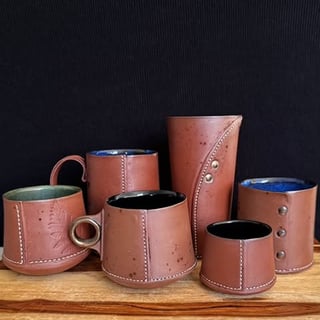
Speaker: I absolutely love that. I love the keeping an open mind because I feel like that's when our voice really starts to show up more and our pottery grows more when we have an open mind and not being so stagnant. I love that. Absolutely. So let's talk about your pottery. Can you describe to me in one sentence what you make? I make a functional tableware emphasis on the funk.
Speaker: that also serves as decor. Love it. Awesome. So tell me the story, how you started making your fresh functional forms. Sure. So again, it was kind of during COVID. I was trying to teach a ceramics class and found myself in an at home studio that was kind of just in a makeshift space.
Speaker: And I made a lot of work that I didn't love. And I was really just trying to keep busy and see what it kind of turned into. And I started with this idea for my squiggle mugs. And I did a lot of iterations, different ways of putting the form together, firing the form.
Speaker: until I eventually figured out what worked best. And really just kind of focused on that for a little bit. That brought me a lot of joy and I really loved the end result and was really happy with the direction that my work was going. When you finally found like this new style of yours, what is it that you really liked about it? I felt like
Speaker: I have always really struggled with bringing my personality into my work. I am, you know, mostly a little on the reserved side, but I do have kind of a quirky sense of humor. And I really wanted to find a way to just incorporate more of that into my work. I love color. I've never been
Speaker: a neutrals person despite me wearing a gray shirt right now. I really love color and I think it just represents my personality and it felt very fresh, almost like a breath of fresh air when I started making it. That's amazing. Shaping Nation, if you're listening right now, how can you add your own personality into your work?
Speaker: And how can you make things like maybe more bright or maybe just more weird and like things that you love and add it to your pottery? Can you walk me through how you make your functional forms and how you think about making unique shapes? Sure. So recently I've been working with a standard porcelain clay body, which is kind of finicky to begin with. So hopefully
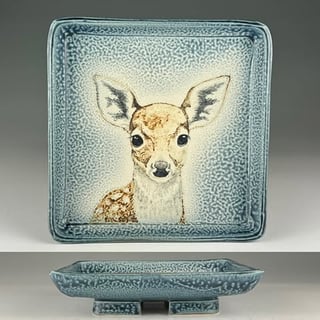
Speaker: It definitely brings its own energy for sure. So learning how to work with porcelain to begin with was just a challenge on its own. But I started to just consider more of a visual language in my work and what those visuals represent. So I have like the squiggle on my mugs. I have some plates that are
Speaker: more of like an egg or oval shape, and really just kind of documenting this visual language and how it represents each chapter when I'm making this work, or what the definition of that visual is. So to me, the squiggle on my mugs represents growth. The oval, I'm actually not sure what the oval represents yet, but it's just
Speaker: making sure that I'm documenting it and keeping track of these repeating forms or shapes in my work. I love that so much about how you're documenting moments of your life and incorporating it into your pottery. I think that is a really amazing way to think about pottery. That is really great. Thanks. So you are inspired by the ability to document chapters, like you just mentioned, and events from your life. How does this come back into your work?
Speaker: That is a good question. I think I mostly just, whenever I am working or spending a lot of time on a piece, I really just consider the headspace I'm in, you know, what's happening around me. And I'm kind of more of a sentimental person as well, so maybe that plays into it. I really like to reflect on certain events and
Speaker: kind of just keep track in that way. But it's important to me and it shows up in my work again through that visual language. But I think also just acknowledging that I am making functional wear that people are going to use every day. And not only do they document chapters of my life, but could also help
Speaker: maybe not document, but carry someone else through a chapter in their life or play a role in that way. And I think just realizing for me anyway that vessels just can carry a lot more than your cup of coffee in the morning. They can carry whatever energy you put into that piece.
Speaker: I love that. That is a really great way of thinking about things. And it really you can really see your personality when you are thinking about it that way. I love that. So what advice would you give to someone trying to add a little bit more flair to their pottery and add their personality? I think, I mean, again, I made some work that I really wasn't thrilled with. I think just don't be afraid to make some work that
Speaker: doesn't necessarily resonate with you right off the bat. I kind of consider it like a conversation. There are some conversations that maybe you don't have a lot to add to and then there are some that you really want to talk more about. So making work that maybe doesn't resonate with you completely until you get to that spot
Speaker: where it does, and when you realize that it does, sit with that work and figure out what is working with that, like what elements do you like about it, maybe what isn't working that you want to improve, and move on to the next piece and carry that through.
Speaker: That is some excellent advice. Shaping the issue for listening right now, how can you think about your pottery more like a conversation rather than just making your pottery? If you think about it like a conversation, then you're going to have a lot more ideas and more topics to kind of talk about with your pottery. And that is a really great way of thinking about it. So right now, what is something you are currently experimenting with your pottery?
Speaker: I have really been itching to incorporate more mixed media into my functional pieces. I haven't quite figured out the best way to do that, but I've been collecting some supplies. I have some resin dice that are really fun, and they have rainbow dots on them that I really wanted to figure out how to incorporate.
Speaker: I have some disco ball mirror tiles that I'd love to figure out a way to use. And I've kind of just been stowing away all these materials to kind of save for a rainy day and figure out what I can do with them. I love it. I'm looking forward to seeing, seeing your progress more. I love that. So let's talk about discovering your voice. What was your biggest challenge when it came to finding your voice?
Speaker: Um, again, just learning how to incorporate my personality into my work. Um, and also acknowledging what I call the too much gene. So how much is too much? And, um, I have the gene where I like to do too much to my work. So learning how to kind of edit things back, refine them more and, um,
Speaker: making sure that not only am I happy with it, but I'm happy that it or happy allowing it to go out into the world and I'm okay with it living with another person or in another environment. And I'm just happy with how it stands on its own. I love the part when you are talking about not doing too much because I feel like as potters, we do tend to
Speaker: Overdo things sometimes and it can kind of ruin the piece a little bit and I love that piece of ice. That is excellent So what is something you wish you knew when you were trying to discover your voice? I think just that I keep thinking of all of the work that I Wasn't totally happy with but I wish I knew That it's okay to go through that phase. It's okay to
Speaker: not like the things that you're experimenting with and learning from your failures or things that don't necessarily work or maybe look better in your head. Excellent. Excellent. I love that. So awesome. So what advice would you give to someone trying to discover their own unique voice? I think just really taking the time to
Speaker: sit with your work and use it regularly. And I'm guilty of not using my own work enough, but I have really been trying to make an effort to do that. But you can really learn a lot by using your own pieces and using them not only in the way that you intended them to be used, but maybe figuring out another
Speaker: way that they can function in a different environment. So why is it important to use your work more often, rather than just going out and trying to sell it all the time? I think you can just, or for me at least, I've learned, you know, what isn't working or what I do like about the piece. Like earlier, when I was making these mugs right from the get go, I
Speaker: saved a mug from the first round that I made and I realized like the handles are okay but I realized there were some improvements that I wanted to make to make them more comfortable and just minor adjustments here and there that really make it a little more cohesive and better aesthetically in my opinion.
Speaker: I think that is really, really great. Shaping Nation, instead of going out and trying to sell every single piece of pottery that you make, sit with your pottery for a little bit and look at it and maybe get the feel for it and maybe you'll find things that you like or don't like about it and you'll come up with ways on how you can actually improve it as well. That is some extra advice to sit with your pottery. So as we're coming to a close here, what is one thing you want to hammer home with my audience today?
Speaker: I would say make sure you are documenting everything. It does not have to be for social media. It can be for just your own records. But I have found myself, like I was digging through old photos the other day and I found some of my earlier work and it's really almost rewarding to see how your earlier work relates to
Speaker: what you're making in the present and almost researching your own work in a way and seeing how it develops. And of course, it's also important to research other artists or other work that you may admire, but I would say it's equally as important to look back at your own work and see the development through there.
Speaker: Definitely agree. Lindy, you provided some excellent advice today. Where can my audience go and learn more about you? You can find me on Instagram at lindy .deal. That's L -Y -N -D -E -E .D -E -A -L. And I also have a website. It's just lindydeal .com. You can find me there.
Speaker: Thanks for listening to this episode of Shaping Your Pottery with Nick Torres. If you want to start discovering your own unique voice, you must first start with the right questions. That's why I put together a free 15 question booklet for you to start discovering your own unique pottery voice. All you have to do is go to shapingyourpottery .com forward slash questions to get this free booklet.