Transcript
Speaker: Real quick before we get started, did you know that the questions that we asked are going to determine what our pottery is going to look like and is going to determine what our voice is going to look like? That's why I created 15 questions that you can use right now to start discovering your own unique voice. Go to shapingyourpottery .com forward slash questions to get this free booklet.
Speaker: If you love pottery and want to take your skills to the next level, you're in the right place. Find your own pottery style right here on Shaping Your Pottery with Nick Torres. Let's get started.
Speaker: What is up, Shaping Nation? This is Nick Torres here, and in this episode of Shaping Your Pottery, I got to interview Hannah Lindharp. Hannah makes some really incredible, bright, designed pottery. In this episode, you will learn how Hannah makes her pottery. You'll also learn the power of putting in the reps and building your skills so you can make your vision come to life. Hannah,
Speaker: Welcome to Shaping Your Pottery and share with me what is one thing you love besides making pottery? Oh, that's a really good question. I live in West Virginia and I love going outside and hiking and biking. So I guess I just love being outside. Love it. I love hiking as well. It's so such a great like refresher. Yeah, it's easy and it's relaxing.
Speaker: Exactly. So can you tell me the story about why you decided to switch your major to ceramics? Yeah, so I went into college just getting a general studio degree and I was focusing on 2D like painting and drawing. And after my second semester, I saw that a pottery class was open, there was one spot left, it was very random. And I signed up for the class and within two weeks, I fell in love with it and changed my major to ceramics.
Speaker: What would you say is one thing you learned from your time studying ceramics in college that you still kind of use today? Yeah, so I still consider myself a student of the craft. I don't think you ever really master the craft of ceramics. So I guess the idea of exploration and experimentation that I got from college is something I really use today. I absolutely love that. Shaping Nation, if you are listening right now,
Speaker: The more you are exploring and trying to get better, the more your pottery is going to get better and the more you're going to be able to evolve your voice and find your voice. So in the spring of 2018, you decided to go full time with pottery. Can you describe me the moments leading up to this? Yeah, so I had just graduated from college the summer prior, so around May, June, 2017. And whenever I graduated,
Speaker: I knew basically that I wanted to try to pursue this full time. Like I was young, I had no dependents, no children. So I thought this is the time to do it. So the three years prior to graduation, I had a job and I saved all of my money so that I could buy myself a wheel and get some startup for the business. And I guess it was just like, I was really unaware of how hard it was going to be, but that was actually a blessing because I didn't feel scared at the time.
Speaker: But looking back, it was terrifying and I was really not prepared. But it's just been a learning experience since then and I'm really grateful for that time. What were some of the things you weren't prepared for?
Speaker: just like I thought I knew more than I did, but I always had my professor there in college that would back me up and I could ask questions. And just not having that direct source, even though my professor in college, his name is Jeff Greenham, and he was still a major resource. Like I was able to call him and email him, but it's different not having someone constantly there, like looking over your shoulder, trying to see what you're doing wrong, what you're doing right. And
Speaker: So just realizing that, oh, this is fully on me now. I think that was like the biggest wake up call. So what did you do to kind of get through that, those struggles? Just a lot of research. Like I watched a lot of YouTube videos. I asked for help. I have other Strem Assist friends who I leaned on and just having this mindset that I'm going to fail a lot of the times and being okay with that.
Speaker: I love that so much. Shaping Nation, if you're listening, you're not going to succeed all the time. You're probably going to fail more than you are going to succeed, but those failures are going to lead you to discovering something new and to pursuing pottery further and making it even better. Yes, that's a major point in ceramics because it's such a finicky craft. If you wanted something easy, don't go into ceramics because it will break your heart more than any relationship ever will.
Speaker: I would say just go in there knowing I'm going to mess up a lot. And that's totally fine. I absolutely love it. When I started ceramics, it reminded me a lot of baseball and baseball. You literally when you're good at baseball, you're failing seven out of 10 times. So that's what it reminded me a lot of. And I love that so much that you mentioned that.
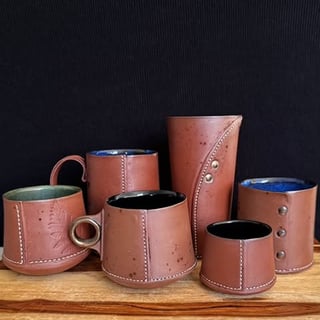
Speaker: So let's talk about your pottery. You are inspired by little rituals in everyday life and making them a little bit more exciting. How does this affect what you are trying to make? Yeah. So I'm someone who struggles with anxiety and just having like these small moments of pause during the day really helped me out. So just like if I feel like overwhelmed having a cup of coffee or just stopping to like look at flowers, even just,
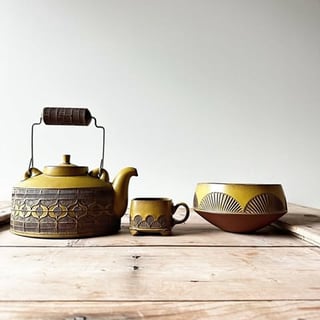
Speaker: it really helps me out to stay grounded. So I like to incorporate that into my ceramics and just making the ritual of having a cup of coffee a little more special and whimsical. So that's why I like to add little details and make my work really bright and colorful. Can you explain to me some of these details that you add onto your pottery? Yeah, so
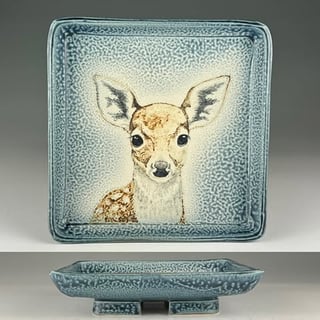
Speaker: A big thing that I'm using right now is Ray slip. So I have an air pin machine, which is like a little extruder that has a raised clay in it. And I pipe it onto my ceramics and I really like it because it adds some hand play to the pottery. So like when you hold it, you can fill these textures and it adds a little bit of eye candy, individual interest. And that's been something that I've been focusing on for the past two years, probably. So can you tell me the story, how you started,
Speaker: making the party that you make today.
Speaker: Yeah, so my work really changed during the pandemic. So I currently work in a private studio in my basement. And after the pandemic happened, restaurants were closed. I wasn't going out seeing my friends as much. So literally all I did was just wake up and go to the studio. And it became a big experimentation time. And that's whenever my work really changed was because I was spending so much time
Speaker: But basically back in college where my focus wasn't necessarily on production or on sales at the time. It was mainly just experimentation. So you mentioned experimentation. What do you do now to continue experimenting while also being able to sell your party at the same time? It's really just setting time apart. So I'm really strict with my schedule because I'm a
Speaker: schedule person, like that's just how I've always worked. So I go to the studio from like nine to five normally or even later, depending on what I'm working on. But then I will dedicate evening time if I have the chance to experimentation or weekend time to experimentation. And it's just something that keeps me interested in the craft because I feel like if you become so routine in your work, it becomes almost boring and you kind of lose that spark in the interest and it's really easy to get burnout.
Speaker: So just to help prevent that, I need that experimentation time to keep it interesting for myself. I absolutely love it. Shaping Nation, if you're listening right now, you have to make time to experiment. You have to schedule it out. If you are working maybe three hours in the studio, you have to schedule out maybe 15, 10 minutes, whatever, just to experiment. So you're not being burnt out and not doing the same thing over and over again.
Speaker: So can you walk me through how you make your unique designs and shapes with your pottery? So most of my work starts out on the wheel and I like to create. It's evolved over time where they kind of used to be more like bulbous shapes, but they kind of turned into more angular shapes, but I really.
Speaker: I plan out the designs, but I really let the piece speak for itself during the progression of the process. So if I'm working on the piece and at a certain point it asks for a different shape of handle, or I feel like a different design would complement it better, I go for it. But I think my process is somewhat planned, but also flexible to make changes if I feel like it's necessary.
Speaker: So you mentioned like where you're kind of like almost kind of going with the flow with that. What in your mind makes you think like something else should change? I don't know. I it feels weird, but especially for pieces that I really enjoy, they kind of develop personalities where they kind of become like humanistic if that doesn't sound weird. But if a piece is more bubbly to me, I usually add more rounded elements to it or if it's like
Speaker: more stern, I add more strict elements. It's really hard to articulate, but it's just the personality of the piece really speaks to me and then I try to compliment that. Love it. I absolutely love it. So what is something you do to keep the making process a little bit more fun and enjoyable? I know you explained that you experiment and you take time to experiment, but what else do you do? To keep things interesting? Yeah. Yeah. So
Speaker: I do a little bit of TikTok and video work and just breaking up my day filming and editing really helps a lot and taking breaks when I need to. But something big that I recently did is
Speaker: transitioning my business from a home studio. And I recently bought a building in my downtown area to convert it to a public space. So I'm really excited to introduce more teaching into my studio practice and break up the production and teaching aspect of my business. What made you want to pursue this? It's been the dream since the very beginning. Just been waiting for the right time financially and for the right building.
Speaker: But I would say, ever since discovering ceramics in college, I've always had a desire to have a public studio space, to have my personal studio and to teach, and to basically be a total hub for my business. So this has been the dream since the beginning, and I'm just so excited that it's finally coming true. When can people start taking lessons from you? Hopefully by the end of spring. So construction is starting in January.
Speaker: Things are moving pretty quickly, which I'm really excited about. That's exciting. That's super exciting. So you mentioned scheduling earlier. What does how do you schedule out your kind of day for making pottery? It basically starts backwards because, you know, as Sarima says, we basically have to deal with the kiln lords and the time moving backwards. So I think of a deadline or an event.
Speaker: And I work my way backwards thinking, OK, I need like a week to fire. I need about a week or two for drying. So here is my last day to work on work. And then I work backwards from there and then deciding, OK, so today is a throwing day. And we should be throwing these colors to get this deadline finished. So I just work backwards on my schedule. I love it. I love that you're starting at the end in mind because that's like where a lot of it's going to end up anyway. So you have to work backwards. Yeah.
Speaker: So can you tell me what is a pet peeve that you have just in ceramics? OK, I think I'm going to be really careful with this because I feel like everyone's tactics work for them. It's beautiful. But for me personally, I like sanding down the butts of my mugs, especially if they are really rough or they could scratch a table because I've forgotten mugs that scratch my table and
Speaker: So I spend a lot of time with like my diamond core grinding disc and I sand the bombs of my mugs. But I have mugs that aren't sanded and they're very beautiful. But just for me personally, I like sanding the bombs of my mugs. That is interesting. So I didn't understand like when I was like, maybe a couple years ago that
Speaker: the bottom of the mugs were scratch tables and I didn't understand that and I was scratching my table as well. It's funny that you said that because that made me start doing that as well, kind of like making my bottom super smooth. Yeah. So let's talk about finding your voice. Can you tell me how long it took you for you to actually find your voice? That's a really interesting question because there have been very many moments in my ceramic career that I thought I found my voice.
Speaker: but then just by working and doing more kiln firings and just doing more, that voice is changing constantly. But I would feel that I found a certain consistency in my work around like a year after college where I thought, okay, I really enjoy color. I like pattern. I like texture. And so those are always been like the center points of what I do.
Speaker: but the overall look of my work has been evolving for years and it's still evolving. So I think now it's consistent enough to where it's recognizable as my work, but I can say even in two years from now, it'll probably look very different as well.
Speaker: I love that because I think finding your voice is always about developing it further and making it look better. And I love that you said that it's always kind of changing. It's never going to stay the same. You're not the same person that you were last year and you're not going to be the same person a year from now.
Speaker: Yeah, and I used to be a lot more strict with that. Like I like when I first started my business, I was like, okay, you are stuck with these shapes, these colors, these designs. And over the years, I really let myself be more flexible with that being like, I don't have to stay like that, because then my work will never grow. Definitely agree. Excellent advice. So before you found what you like to make in your voice, what would you say was your biggest struggle? Um, a big thing was imposter syndrome, just feeling like,
Speaker: I was copying other people because I feel like especially at the beginning when you're in school, you're looking at other people and trying to think, okay, is this unique enough? Is this special enough? Is this something that people will be interested in? So I think the biggest struggle for me mentally was just feeling like my work was progressing enough and that it was strong enough for something to be proud of. So how did you get over this imposter syndrome?
Speaker: It's still something that I struggle with. I think any artist or maker, it's something that we do struggle with, but the way I kind of take care of it for myself is just thinking, you did everything you could, you did your research, look how far you've come and looking at pictures of the work that I've made in the past and just letting myself be proud of the progress that I see in my own work and just accepting that it's enough right now.
Speaker: I definitely agree. We put too much pressure on ourselves and we have to like kind of keep living in the now. Like this is my work right now and I enjoyed it to what I made. That is really powerful. After you found unique voice, what new opportunities began to come your way?
Speaker: Yeah, especially whenever my work got consistent to where it was being recognized. I've had more shops contact me and different shows contact me. And I feel like people really appreciate the consistency or like the fact that you will show up in your work and you will produce good work. And so people have that trust in you. So I feel like
Speaker: just by finding that voice and staying true to the styles that I'm attracted to, people have responded very well to that. I love that. That is so amazing. So what advice would you give to someone looking to find their own unique voice? This is the most like generic advice. It's a generic for a good reason. It's just keep making the work.
Speaker: Because you could go on Pinterest all day. You can go to a million museums. And because I had conversations with people who say, I've done so much research. And I say, well, how much work have you actually made? Because having this concept in your mind is going to translate very differently to what you actually are able to produce. So my biggest advice would just be going into the studio and
Speaker: just mess up a lot because you are, and that's okay. You're gonna throw away a lot of work. You're gonna have work come out of the kiln and it's gonna take garbage, but you have to do that. That is some very powerful advice. Shaping Nation, if you're listening right now, if you have a vision in your mind, you need to work up to that vision. You need to build your skills so that you can have that vision come to life. Even if you do all this research, if you don't have the skills, it doesn't matter. So as we're coming to a close here,
Speaker: What is one thing you want to hammer home with my audience today? I will just hammer home a few ideas. So the first one that we've talked about before is be willing to fail. And that's okay. Someone's always going to be better than you. And that's totally fine. Because the more you progress in your skill, you will be better. And then you're going to have a career that someone else is going to look at and be inspired by it. So I would say, just keep working.
Speaker: And another idea that I am working on for myself is finding that work life balance of working really hard in the studio, but also be willing to give yourself breaks because especially pottery is very strenuous on the body. So if you need to get up and you need to like work your hands or like just take care of your mental health, it's like get out of the studio and take a walk. So be really kind to yourself physically and mentally when it comes to ceramics. That was some excellent parting words advice. Hannah,
Speaker: Where can my audience go and learn more about you? Yeah, so my Instagram, TikTok, and Facebook are all Hannah's Clay Creations. And you can find most of my information on my website at hannahsclaycreations .com.
Speaker: Thanks for listening to this episode of Shaping Your Pottery. If you have questions about developing your voice or just pottery questions in general, send them to me my way. Go to shapingyourpottery .com forward slash contact to send me your questions.