Transcript
Speaker: Real quick before we get started, did you know that the questions that we asked are going to determine what our pottery is going to look like and it's going to determine what our voice is going to look like? That's why I created 15 questions that you can use right now to start discovering your own unique voice. Go to shapingyourpottery .com forward slash questions to get this free booklet.
Speaker: If you love pottery and want to take your skills to the next level, you're in the right place. Find your own pottery style right here on Shaping Your Pottery with Nick Torres. Let's get started.
Speaker: What is up, Shaping Nation? This is Nick Torres here. And on this episode, I gotta interview Ben Carter. Ben runs the podcast, The Tales of the Red Clay Rambler. And he also produces the Brickyard Network, where he helps other podcasters develop podcasts for pottery.
Speaker: In this episode, you will learn about how Ben creates his wonderful terracotta slip and glaze decorations pottery. You'll also learn about creating a routine for your pottery for yourself and scheduling out ways to make pottery even if you have a family or a full -time job and you're scheduling out that time so you can make time to get better.
Speaker: You also learn about slow progressions, how the success we have with our pottery is gonna come from the slow amount of work that we do, and not from the big home runs, but from the singles, from the bass hits that we are doing, and how we are trying to improve our pottery a little bit at a time, not getting the home runs. And you're gonna learn so much more in this episode. I hope you enjoyed a lot, because I know I did. I'll see you in there. Ben, welcome to Shaping Your Pottery, and share with me
Speaker: How did you get started in ceramics? I was fortunate to go to a high school in Salem, Virginia that had a pretty developed ceramics program. And I just want to put a plug in for public education because it was just a normal high school in rural Southwest Virginia. But by the time I left there, I had made, I think I'd had five classes in ceramics specifically. So I really felt like the training even in high school was pretty good to take me on to the college level.
Speaker: I definitely agree with that because I also started when I was in high school and I think that experience helped me so much and I loved it so much. So let's talk about your podcast, The Tales of the Red Clay Ramp. Can you tell me the story how this got started?
Speaker: Yeah, I was living overseas in 2012. I was living in Shanghai, China. And I had a lot of artists that were coming through Shanghai to our art center, the pottery workshop, that were then going on to Jingdezhen, which was another location of the same ceramic residency. And I would have these artists come and just hang out for a couple of days while they cleared their visa and while they just needed to kind of decompress from the long trip.
Speaker: And I had, you know, really amazing conversations with folks like Janet Debus and other artists that were coming through the studio. And I realized that I should just record those conversations. I was not having a lot of conversations about art in English because most of my friends were artists that were speaking Mandarin and my Mandarin is not good. So I really couldn't have an in -depth conversation about art unless we were speaking English. But thankfully, the folks that came through
Speaker: they were english speaking and they were really engaged in and wanted to talk about their art practice so the podcast was was just born out of that that idea that i should be recording the conversations i was already having. When did you decide to take it further and continue pursuing the podcast.
Speaker: Yeah, I did that for about a year. I think it was a year, maybe more before I moved back to the States. And I was doing it really because it was fun. I mean, you have that same experience. Like, it's fun. It's really fun to talk to people about their work. But when I realized that it was a bigger project, that I really wanted to try to document the field of studio ceramics, that was probably a year or so into the process.
Speaker: And at that point, that's when I started to realize like, Oh, maybe I should try to raise money for this so that I wasn't just doing it for free. And so about two years after that, it took me a long time to professionalize the podcast. But eventually I did do a Kickstarter and started raising money and then eventually started getting sponsors. And that's when it became more of a business.
Speaker: I'm curious, you don't have to answer because it's just like personal question, but how much did you raise for your Kickstarter? I think that first one was 13 ,000. And the idea was that I would get a big enough chunk of change that I could kind of give myself room to focus on the podcast. And you probably experienced this as well. It's like
Speaker: when you start off doing it, you're not making so much money off of ads that you can just stop another job. So having that chunk of change in my bank account really helped it made it kind of justified how I could spend 70 hours on the show without without having direct income from it. I definitely that is a super smart way to go about it. So can you tell me, since starting your podcast, how has it elevated your own pottery?
Speaker: Yeah, I really have seen so many good makers that it's humbled me. And I think I was like many young potters. I was thinking, Oh, I can do this. I can, you know, go out and make a living at this. And I really was when I was first started the podcast. I was, I was a professional potter for years at that point, but talking to my biggest ceramic heroes like Michael Simon, um,
Speaker: like all these different ceramic heroes of mine, it's humbled me on a really deep level because I realized there's so many different ways you can communicate through the material of ceramics. And in my case, studio pottery, because that's really what I make as studio pottery. So for me, it's been a case of being inspired by other people, but also seeing that I have to up my game.
Speaker: that I have to communicate clear through the medium because I see people and have talked to people that have, say, for instance, taught or been an artist for 40 years. The level of refinement in their work is naturally higher than mine is. So it's really encouraging to just keep going, keep pushing, keep trying the next new ideas in the studio.
Speaker: I absolutely agree. I love the part when you said to up your game. Shaping Nation, if you're listening, if you are struggling to kind of find your voice or maybe you're kind of stuck in a little bit of a rut, just try upping your game and making your pottery even better and your voice is going to look that much better. I love that. That is some great advice.
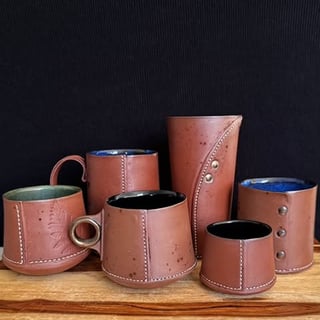
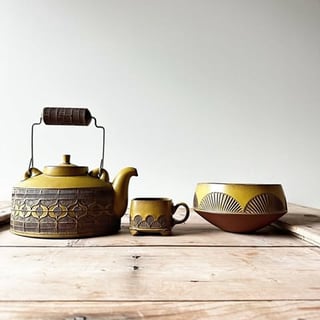
Speaker: So we're going to get back to your story a little bit later. But for now, let's talk about your pottery. Can you describe to me in one sentence what your pottery is? Yeah, so I make terracotta pots, so red earthenware clay that's decorated with slips and glaze. And I'm really interested in how do I paint on the surface of the pot with this red clay? Why did you choose terracotta?
Speaker: There's something that's very pedestrian about terracotta, like it is literally can be used for flower pots and roof tiles. For instance, in China where I lived, a lot of the roof tiles were terracotta. And actually, you see this out in the southwest of the US as well. And I really like that it's a humble clay. It's a clay that's not elevated as being special. In fact, if you break a flower pot, more than likely, you're just going to throw it away. You're not going to fix it or mend it because you can just buy another one that's really cheap.
Speaker: But i'm interested in how do you take this material and through decoration increase the value of the object so essentially like how does decoration make it special or make it culturally significant. I love that i love that way of thinking about part i feel like it makes it so much better and get you thinking a lot on how to really make it beautiful so can you. Tell me you were inspired by.
Speaker: Appalachian crafts and many eras of historical ceramics. What is it about these that inspire you? Yeah, I think a big part of finding your voice is realizing that you already have a voice. And the voice that I have is come through my family's tradition of quilting for one and gardening is the other thing. And I just grew up around quilts that my grandmother made and other crafts that were collected in the Appalachian Mountains. I'm from Virginia.
Speaker: So I'm from the Appalachian Mountains, and there's a really strong tradition of both quilting, woodworking, and ceramics in that area. But also gardening, from my earliest memories with my grandmother, Claudia, instead of watching TV, we would just go out and work in the yard. And it was everything from picking up sticks when I was really little to planting the beds or pulling the weeds or all of that stuff. So I kind of feel like that
Speaker: That was already in me, you know, by the time I found ceramics, all that visual input was in my mind. But then when I saw historical ceramics, I saw those same visual things, the floral patterns, but I saw them in Chinese pots from 1100 AD.
Speaker: or Turkish pots from 1700s. You know what I mean? I saw the same things I was interested in in historical forums, and it made me feel like, oh, right. What I'm attracted to is what human beings are attracted to. The sense that decoration can both mimic the world around us, but that it also can be put onto a pot to make that pot significant.
Speaker: I'm blank here, I'm sorry, I had something I was gonna say, but if it goes back to me, I'll come back to it. Sure. So, can you give me a simplified version of how you just create your pottery? Yeah, all of the forms are made with the terracotta clay, and I'm mostly a thrower. I do do some hand building, but as of, say, the last probably two or three years, I really have just been throwing.
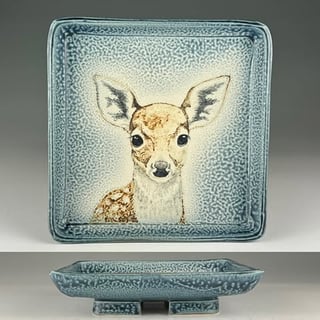
Speaker: And once I make the form, I can either brush on or dip a white slip that goes over the red clay. And for me, that's a really beautiful base layer. So sometimes I will do almost like a gestural line work that goes in that white slip. It gives some energy that's behind the underglaze that I then put on top of that.
Speaker: So once I have the base layer of white slip, I can paint under glazes or add glaze elements to really enliven that surface. So it's a process of layering. I'm kind of building up layers as I go. So I just remember what I was going to say earlier, and it also brings me into this next kind of segment, I guess. So how does being inspired by Appalachian crafts and historical pottery, how does that come back into your work and how do you think like in terms of how do you incorporate that into your work?
Speaker: Yeah, for me, it's been as simple as research. I look at a lot of historical pots. I have an Instagram account called History of Ceramics, and I have taken images from places like the Metropolitan Museum in New York or the Detroit Institute of Art, all these different museums, and posted it to Instagram. And that's really my research library. That's what I go to, to look for forum, to look for the rhythm of a pattern.
Speaker: And then once I'm in the studio, I'm taking some base idea that I get either from my own aesthetic experience like just living in the world today or these historical pots. And then I'm going to react to the material as best I can in the moment. So the parameters I make is that I'll make like let's say a set of 10 serving bowls. And if it's the first time I'm working through this forum, I will try almost 10 different designs on each of those.
Speaker: And then as I fire those and take them through the process, I'm picking out which one seems to have the most energy, like which line quality is the most stands out the most or has the most impact. And then the next time I make those, usually, you know, four to six months later, because my cycles kind of slower now, I have a young daughter, so I'm making pots slower these days.
Speaker: But the next time I get back to those bowls, I'll start with the best one, and then I'll make 10 more, but then evolve or iterate off of what I thought was the best one that first time. I love that about studio ceramics. It's about slow progression. For me, it's not about let's try to hit a big home run. It's more like let's just slowly get better and slowly get better. That process of revision is how I do that.
Speaker: I absolutely love it. Shaping Nation, it's not about the big home runs, it's about how you can get better a little bit at a time and a little bit, and you keep on stacking those little successes. That is some excellent advice.
Speaker: So there's two things that you mentioned earlier. So one was the energy. You mentioned energy on how it looks. And the other thing was that you have a daughter. So the first question I want to ask you is, what do you mean by the energy of how it looks? And the second question is, how do you balance your life with your family and then pottery?
Speaker: Sure. So the energy one is a good one. And I think if you take, you know, 10 potters and line up a row of pots, most of the potters will pick the same pot. That's the best pot. And I can't always figure out like, why is it we all like that one? But for me, it's often that the form is a little fuller. Like there's a little more expression outward in the form, meaning like when I'm throwing, I'm thinking about almost like that. I want the pot to feel like it's breathing in, you know, like it has this
Speaker: this sense of volume or expansion. And then the decoration, when it's on top of that form, I'm trying to think about variety. So how do I have sort of thick lines that go into thin lines so that there's this contrast of movement? Because that's what happens when you have that thick to thin as your eye follows that. And I think that's the surface energy is like, what's the sum total of all the marks you've made on the pot? And are those marks as energetic or as gestural as possible?
Speaker: That is very interesting. I love hearing about that because it is true because like if you do line up a light line of pots you're gonna your eyes gonna be drawn to one and most likely most everybody else is gonna be drawn to that too. That was a really great way of thinking that.
Speaker: So can you tell me, cause you have a daughter now as well. How do you manage family time and also pottery time? Yeah. Now my daughter is so cute right now that I really don't want to miss like any part of her life. So most of my potting is at night after she's already gone to bed. Um, I work full time as a podcast producer for the Brickyard network. So my, my daytime hours are filled with helping other people make podcasts and making my own podcast.
Speaker: And then when my daughter gets home from school and then my wife gets home from work, I'm usually making dinner or helping clean up or with childcare. And I really found that to be fulfilling. Before I had a child, I didn't realize that I would want to be with my daughter more than in the studio.
Speaker: I kind of always thought like, Oh, I always want to make pots. But those first price six months, I only made work when she was asleep late at night. And now I'm starting to like my work time in the studio is creeping back into the daytime hours a little bit. But for the most time, it's after dinner when my wife's taking care of my daughter and I can, I can get focused in the studio. I love that a lot. That's really amazing. So how do you
Speaker: like schedule out like when you are gonna work. Like obviously, because sometimes things can like get a little bit jumbled. Sure. Scheduling is the key word there. Like every part of my life is scheduled now from the time I wake up at about six in the morning to when I go to bed at about nine, 30 or 10. Every single hour has some goal.
Speaker: And I used to think as a younger person, like, oh, that's so boring. I want to be able to improvise and just travel and do whatever I want. But now I see like the routine that my wife and I established in our life. That's the thing that gives both my daughter security, but also gives us security so that we know what's going to happen.
Speaker: So during the daytime most of my time is sort of dedicated to larger tasks and then when i get to the nighttime when it's about my studio work i try to give myself very small chunks small goals in the studio because it can be it can be too overwhelming to think.
Speaker: I've got a show in May, I need to make 100 pots before then. That's too big of an idea. What I try to do is break it down into each day. If I'm going into the studio tonight, I have mugs that I need to decorate. I'll take six mugs. Generally, I work at about an hour and a half to two hours. I'll just focus on those six mugs and try to decorate those because that's where I'm at in the working cycle at the moment.
Speaker: But I try to just make those small chunks because also the small successes, you know, like, Oh, I got six done. That's what motivates me tomorrow. If I if I make the ideas too big, I feel like I'm never accomplishing anything. So you bite off little chunks, and then you get the pleasure of sort of fish finishing those tasks, or at least I do.
Speaker: absolutely agree without like routine like throughout the week this podcast probably would be like all over the place I probably want to be as consistent I love that then geez that was some really great advice right there so can you tell me how has your pottery evolved into what it is today
Speaker: Yeah, when I first started, I feel like I was more interested in form, you know, like I was doing a lot of soda firing, or I guess I shouldn't say when, when I first started in high school, I was making sort of typical cone six pots. So using a lot of floating blue glazes, like a lot of things that a lot that most studios in the US have, if they're cone six studios.
Speaker: But then when I got older and I went on to study ceramics in college, I became enamored in atmospheric fire. So like wood firing, soda firing, salt firing, all of that. And because of that, I didn't do hardly any decoration because it was more just let's make the form and then get it into the kiln. And then the kiln was going to take care of a lot of that decoration.
Speaker: But now, at the point I am, almost every pot I make is decorated in some way, shape, or form. And it's because they go into an electric kiln. They're not in a gas soda kiln anymore. So if I put a pot in that has no decoration and I just electric fire it, it's pretty plain. There's not a lot going on. So I decorate the surface to try to give some of that energy that I talked about beforehand.
Speaker: So I think for me, the evolution has really been in the surface design. How does the surface design change over time? And it's slow. Some years, I probably don't make anything that looks that different than the year before. But then if I switch bodies of work and I switch the glazes I'm using or the color palette, then all of a sudden, it's like there's a big change that happens.
Speaker: So right now, I'm in the middle of those small changes. What I made last year, this year, looks pretty similar. But I'm just focusing on how do I be a better painter? How do I come up with more creative color patterns? Because I really think about color schemes. How do I make this have as much energy as possible as I'm working in the studio?
Speaker: Absolutely love it. That is some that's I love hearing the evolution of people's like pottery that is so cool So what is something that you are currently experimenting with to make your pottery kind of grow a little bit?
Speaker: Yeah, I've been working a lot with the idea of dipping a pot and then drawing into the surface of it when it's wet. So I'll take the white slip and dunk the red, the red pot into that. And then I have about maybe a minute to a minute and a half to draw before it
Speaker: dries and solidifies on the surface of the pot. So that's a really short timeframe. And when I say draw, I'm really making kind of more gestural marks. So think about like an undulating line made with a wide brush, like something that's like a hakame brush.
Speaker: I'm really drawing with that. So it's not I'm not drawing fine detail. It's more about how do I get that base layer to have as much movement as possible so that I then can put more sort of refined marks on top of that. But it's also fun. You know, like I'm I'm dipping pots and you only got like 90 seconds. So it's totally decisive, you know. And I like that. I like kind of putting pressure on myself with those time limits and the limits of the material.
Speaker: And I think it's going to keep things fresh a little bit for you too, because you're not going to be doing the same thing over and over. That's really cool. So let's get back to your story a little bit. Can you tell me the story how the opportunity to go to Shanghai, how did that come to be?
Speaker: Yeah, pure luck. I think I was a hard -working potter before then. I was in graduate school and I was looking for opportunities to travel and live abroad. One of my friends had worked in Jingdezhen at the Pottery Workshop, which is an international ceramic center.
Speaker: that's in the city. And I had known about that city and I really wanted a job. So I just emailed the director and I said, hey, can I work at your center in Jingdezhen? And I heard nothing back.
Speaker: And like for six months, I just, I kind of forgot that it even happened. And then one day out of the blue, about two months before I graduated from graduate school, she emailed me back and said, we're all full in Jingdezhen. But if you'd like, you can come to Shanghai and we'll see if you like it.
Speaker: And it was luck, man. I feel like I just got offered this job. And the job in the beginning was really more of a resident artist to just come and work in the studio, and I was teaching some classes. But I ended up staying two and a half years there, and I became the director of the school part of that business.
Speaker: which was an amazing experience. I was working with students from Europe and of course students from mainland China and Taiwan and Japan and all of that Pacific region. I was teaching in English, but I also had co -teachers that were teaching in Mandarin. We had this really eclectic mix of both students and teachers that were there at the pottery workshop at the time. How did this experience help with developing your own voice with your pottery?
Speaker: I got to spend a lot of time at the Shanghai Art Museum, which if you're ever there, you should totally go. It's an amazing world -class museum. And I got to see a lot of history of ceramics that I had never seen in person, there in person. And I studied the pots. I studied scroll painting. I was looking at all these different forms of Chinese material culture.
Speaker: And I think where I evolved the most was my understanding of negative space, which ironically didn't come from the pots, it came from the scroll paintings. So if you ever see those really large ink paintings in their landscapes, you'll see that they're often in the foreground, they'll be a mountain, and they'll sometimes be a human figure that's really small. Like if the scroll painting is five feet tall, the person will be like an inch.
Speaker: And then there's this middle ground of mist, or sometimes it'll be the ocean, sometimes it'll be clouds. And then in the background, you'll see this other smaller mountain. So it looks like a cohesive landscape, but what you're getting is this sense of depth.
Speaker: And once I saw those scroll paintings and really started to incorporate that into my work, then I started to set up the layers on my pots differently. And a lot of this had to do with working with other artists who also said, hey, have you thought about putting deep space in pots?
Speaker: Because that was really the thing that I was not doing. I was talking to Liz Quackenbush, who was a professor at Penn State, and we were working at a residency together. And she said, there's no distant space in your work. Everything is right up in the middle ground or the foreground. So it was a good lesson to think about that distant space. And they do it in the scroll paintings and the historical scroll paintings. And I do that a lot more in my own pots as well. So what do you mean by distant space?
Speaker: Yeah, so if you think about atmospheric views, so let's say you're looking at a picture of, let's say the Grand Canyon or somewhere you're looking off into the distance. Generally things when they get farther away get much smaller. And that's how we know that they're farther away.
Speaker: because our brains have adapted to that idea of atmospheric space. But when you're on a pot, you really only have the pictorial space of that surface. You can't really build. I guess you could do this in sculpture, but you can't build into the form if it's a functional pot because the the coffee or the tea is what goes on the inside.
Speaker: But you can paint the motifs you're doing at different scales. So if you want to make a vine or a flower look smaller or make it look more distant, you make it smaller. And your brain starts to think like, oh, it's going back into the surface of the form. And you can also do this with color. So let's think about if there's really vibrant color, your brain tends to think it's close to you as to where if it's dull color, your brain seems to perceive that it's farther away.
Speaker: So if you mix that scale and then that change in intensity of color, you can really enliven the surface of a pot to make it look like there's something going on back in the background there. That is really interesting. I think that's going to help a lot of people that come up with new ways to decorate their pottery. That is really amazing.
Speaker: So let's talk about discovering your voice. What would you say had the biggest impact with you discovering your voice? Well, this is a great question. I went to school at the University of Florida for graduate school, and I was having a meeting with Linda Arbuckle, and I had been making pots that really looked like
Speaker: sort of historical pots from the Middle East. I was using a lot of glazes that looks like they were from that era from about the 1500s on. And I love these pots. So I was I was replicating them in some ways that I was still interpreting, you know, like they didn't look, they didn't look like historical pots. But you could tell that was the pond I was trying to swim in. And Linda Arbuckle set me down one day and she said, I know you like these pots.
Speaker: but you're not Persian, you're not from the Middle East. Like what is your family lineage or what is your aesthetic heritage and how can you draw from that? And what she was doing was nicely talking to me about that I was appropriating from another culture. You know, like I was really taking another culture and again, I was interpreting it, but still that was not as powerful as if I could take from my own culture, from the Appalachian mountains, for instance.
Speaker: And once she told me that i was deeply confused because i really didn't know i was doing that i was just following what i liked you know i love those pots i was just taking elements of those and putting them on my pots.
Speaker: But what was different is that when the taproot became the Appalachian Mountains and eventually became my own family heritage with quilting, all of a sudden everything fit better. I was not mimicking anything. I was actually speaking with the voice that was already in me.
Speaker: And i don't think i would have gotten to that if linda didn't you know politely tell me like hey you're looking in the wrong spot. And i think this is like a good thing for young potters to hear you already have a unique voice all you have to do is figure out how to say what you wanna say through the material you don't have to look to another culture you can you can reference the lessons of aesthetic lessons of another culture.
Speaker: But more than likely, the culture you grew up in, that is the power, or at least for me, that's the power in the art that I make, is being able to reference that culture and use the things that I've learned from quilts, which are, you know, quilts are like so loaded with pattern and texture and surface that once I really found that, that's what helped me find my unique voice.
Speaker: Absolutely, that was really powerful. Shaping Nation, you may be looking at things and trying to do things that you really like to make, but sometimes you have to look in a little bit of a different direction to make your voice become more natural and actually stand out for you more. That was some really powerful advice. So, you teach and are around potters all the time. What would you say is a struggle potters face when they're trying to discover their own voice?
Speaker: I think that the history of ceramics, at least in the US, often skews towards Japan and China and Korea because in the 1950s when the Japanese potter Hamada Soji came to the US, they did this big tour, and he gave lectures and he did all of these things. And it made it so that our studio pottery movement was really looking towards the east.
Speaker: And I think that that was good for that time. But I've realized with myself and with my students, we're in a world that is so fantastic visually. You can get on Instagram and see artists expressing themselves all around the world, but doing it in a way that's specific to their time and place.
Speaker: So I think for me, when I see people whose work I really enjoy and that feels relevant to me, it's the people that are sort of mining their own cultures. It kind of goes back to the last question. It's like, how do people interpret the life around them as opposed to borrowing from another culture's nostalgia? Because that's really what was happening in the American Mingay movement. Well,
Speaker: I'm really painting with a broad brush here. So I think there are parts of American pottery movement that were looking to Japan because it was easier to copy that aesthetic. But I know a lot of potters now that do reference Japan, but it's really that they're referencing their own lives. So I think when I teach and when I talk to young potters and old potters alike, what I'm looking for is like, who has found their own taproot and how are they working and creating from that taproot?
Speaker: I love that. I never thought about that because I don't know too much about ceramic history, but hearing that, I can definitely see that's a big impact and how the world has changed and that definitely affects it.
Speaker: So what advice would you give to someone trying to find their own unique voice with their pottery? Just to get in the studio. I really think that you can't help but have your own unique voice. So as long as you make enough work, you will work your way and your hands will work their way into having a unique voice. Because I think every mind is unique. Like we can acknowledge your mind is different than my mind.
Speaker: And also your hands are different than my hands. So we're both going to automatically have a unique voice because of the way we think and the way we touch clay. So I just encourage younger potters like just make, just keep making. And if you can get a job where someone else will pay you to increase your skills. So I was a production potter for years working for other potters.
Speaker: and that was really helpful because even though I wasn't making my own work, my hand skills were getting better and I was getting paid, which practically, you got to get paid. I encourage people on the way to finding their voice, get better skills and get paid to do it. Excellent advice. I love the part about building your skills, especially getting paid to do it. Awesome. As we're coming to a close here, what is one thing you really want to hammer home with my audience today?
Speaker: Hmm, this is a good question. I think, well, for one, I hope that your audience is grateful to you because I really think what you're doing is important. You're sharing other people's work in a really broad way. And I think that's what I want the listeners to realize too, is like we live in the age of Instagram, we live in the age of podcasts, we live in the age of the internet. Like when I first was in school, I had encyclopedias.
Speaker: I had to go to the library. Not that that was a bad thing. That was a good thing. But what I'm saying is that we have so much visual information today. So if you can take in that information and then share that with other people, automatically it makes your own work get better. And I think you might have experienced this through making a podcast. It's kind of the same as what I was saying earlier.
Speaker: the service you're doing by giving other people this, this format to talk about their work. I think that that's a really important way that the whole field of ceramics, that we all know each other more, we know each other's work, and hopefully, that means we will all grow more. It's kind of the whole, that old saying that all ships razz with a tide, you know, like is more information brings us all up, that our skills get better. And you can see this, like, I think the pots that people are making today are better
Speaker: This is controversial, but I think they are better than some pots made. Well, I'm talking myself into a corner here. But I think that we're in a golden age of studio ceramics, where people are making leaps and bounds of growth forward. And I think that that is a really good thing. And I think it's because of the information we have access to.
Speaker: So if you're out there and you're listening to this, dive into podcasts, dive into all the different ways that you can learn about ceramics because it's not what it used to be where if your dad was a potter and then he taught you your style, then you would be like your father.
Speaker: or your grandfather or your grandmother, however the family lineage went. Now the world is really open to us aesthetically. And I think that's important. I think that global aesthetic that is rising out of this internet age is what's pushing the field forward. I absolutely agree. Since starting this podcast, I feel like my voice has literally changed so many times and has grown just from learning and hearing about other potters. And that is some really last words of advice. Ben, it was so great chatting with you today.
Speaker: Where can my audience go and learn more about you? Yeah. So people can follow me on Instagram under Carter pottery. Um, you can also check out my pots or buy pots at Carter pottery .com. And then all of my podcasting stuff is either under tales of a red clay rambler or, uh, the brickyard network .org. So check those out. We have six different podcasts that are all about ceramics. So, um, check us out. You can find us on any podcast app.
Speaker: Hey, I hope you enjoyed this episode of Shaping Your Pottery. If you would like to support the podcast and get bonus content every single month, then come support me on my Patreon where I will give you bonus content on about how to make pottery, how to find your voice, and a bunch of other things just around pottery.
Speaker: come support me on my my patreon just go to shapingyourpottery .com forward slash patreon to come support the podcast i would really appreciate it i'll see you guys next time