Transcript
Speaker: Hey, real quick before we get started and get into the episode, if you want to figure out how close you are to discovering your own unique voice, I put together a free little quiz for you to see how close you are to finding your own unique voice. If you would like to take this quiz, go to shapingyourpottery .com forward slash quiz, or you can just go to shapingyourpottery .com and it'll be right there. I'll see you guys in there.
Speaker: If you love pottery and want to take your skills to the next level, you're in the right place. Find your own pottery style right here on Shaping Your Pottery with Nick Torres. Let's get started.
Speaker: What's up Shaping Nation? This is Nick Torres here and on this episode of Shaping Your Pottery, I got to interview Emily Gabriel. Emily makes some really incredible slip design story pottery. I absolutely love the way she makes her pottery in her designs. In this episode, you'll learn how Emily makes her slip design story pottery. You'll also learn about
Speaker: Making what is happy for you, making stuff that brings you joy, sort of brings cheer for everybody else as well. You also learn about how to create a story for your slip or for just your pottery in general. I'll see you guys in there. Emily, welcome to Shaping Your Pottery and share with me what is something you believe potters should be doing to make the best possible pottery they can.
Speaker: Well, thank you for having me. I'm really glad to be here today. As far as what potters should be doing, I think potters should be making as much pottery as they can because by making a large quantity of pots, you just begin to become more proficient and you begin to see what you like to do, what you don't like to do. You could just just practice a lot of skills. And the best way I think that potters can become better is to just make a lot of pots.
Speaker: Definitely agree, 100%. That's like the most simplest way you can just get better at making pottery. Simplest thing you can do. 100%. You have been making ceramics since high school, but you took a little break for a while. Can you tell me the story how you got back into pottery?
Speaker: Sure, yes. I've moved a lot around quite a bit in my lifetime and in 2014 I moved back to Canada and I got married and at that time I didn't really have a place that I was making pottery but my husband knew that I was really missing that passion part of my life so he encouraged me to find a place that I could pursue pottery again and I looked around in my area and there's a
Speaker: that has a community studio that I could join. So it was a little bit expensive, a little bit outside of what we could afford, but he really wanted me to find that passion again. So that's how I got back into it. I absolutely love that story. You call yourself an accidental full -time potter. Can you explain this to me some more?
Speaker: Yeah, sure. So when, when I was back into pottery, I was just doing it as much as my schedule allowed. I was working on part time retail position. And the more that I was doing pottery, the more I really dreamed of being able to pottery full time. And I was doing some side sales, but I wasn't really doing
Speaker: big bulk amount of sales. And then when the pandemic hit, I was laid off from my job at the retail position. And so I just figured I'd take the opportunity to pretend being a full -time potter, to practice being a full -time potter, to see if I could really make a go at it. And the support was just so overwhelming that I was making more selling pottery than I would at my retail job. So it didn't make sense for me to go back to my job. So that's why I called it accidental. It wasn't planned.
Speaker: Can you describe to me the moment what made you keep on really pursuing being a full -time barter? Well, I can't think there's a really a moment other than I knew I was loving what I was doing and I just didn't want to go back to a traditional job. I like being my own boss and having the flexibility to take a podcast call in the middle of the day or get a coffee with a friend and working for myself allows me to do that. So that's what really keeps me motivated to keep my hands dirty.
Speaker: Absolutely agree. So now you mentioned your husband was really, really a big part of you, like pursuing ceramics. Can you tell me the impact your husband has just had on your ceramics and you as a person?
Speaker: Yeah, for sure. He's super supportive, so he really wants to see me succeed. So I usually refer to him as my studio manager. So he does all of the grunt work. He helps me pack boxes when it's time to ship things. He helps me load and unload kilns. He recycles clay for me. He's just really my support that helps me work full -time in a studio because full -time in a studio and running a business isn't just making
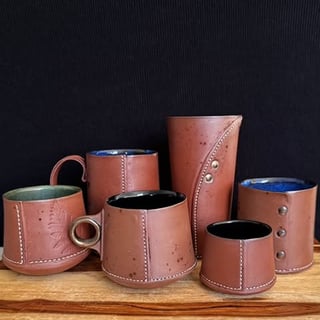
Speaker: fun creations all day long. There's actually a lot of grunt work that my husband very happily steps into so that I can be mostly making creative things. Absolutely love that. I think that is really amazing that you guys are like a real team right there. I love that so much. Absolutely. Yeah, we are. So let's talk about your pottery. In one sentence, can you tell me what you make? So I would say I make highly decorative functional pottery.
Speaker: Can you tell me the story how you started creating this highly decorated functional part? Sure, yeah. So I was really searching for my voice. I was trying to figure out what my thing was. And for a while, I was making a lot of mixed clay mugs. I liked being that I get where I look, but a lot of people do that. So I couldn't really put my finger on it and say, that's my thing. It's just a thing lots of people like to play with sometimes. So then I was trying to really make each piece
Speaker: artful and not just another thing that got dipped in glaze and I've always loved like texture and design and colorful things things that are cheerful and I saw this brawl at my past job that had
Speaker: some decorative texture on it and I thought to myself I bet I could do that if I could just figure out the technique which is flip trailing. So I started playing with slip and I asked someone in my community how to make slip and I didn't want to invest in like an actual slip trailer so I tried a bunch of cheap tools that I bought at like dollar
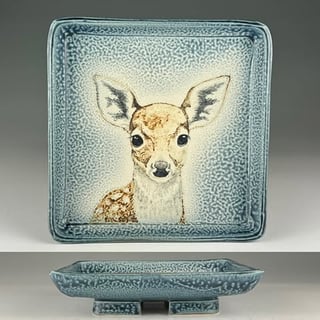
Speaker: and all sorts of things that I was like, I bet I can make this work until I finally landed on a technique that works for me, which is actually an icing bag. It's super cheap and it's super easy to squeeze. And so I just got into it and I love drawing on the clay.
Speaker: I think that is amazing. So we'll talk more about your voice later on. And also a little side note, as I was making these questions, I started coming up a bunch of ideas for my own pottery to use for some crayling. So I'm excited to start trying stuff out and learn more about it. That's awesome. So something I found interesting is you have a goal to have a mug in every house in your hometown and bring cheerfulness to every morning with your mug. How does this impact how you create your pottery?
Speaker: So I would say that I try to make mugs that make me happy. So things that are cheerful and bright, usually things that are a little bit unpredictable. So I sometimes draw like panda bears or polar bears in a garden mug because why would a bear be in the garden? And I think that's fun and cheerful.
Speaker: And as far as the locality goes, I try to find plants or flowers that are local to our area so that it kind of gives that vibe of support local. And I think a lot of people have said to me that their mugs kind of just make them happy in the morning. And so that's really inspiring to me to continue to work in that direction.
Speaker: Absolutely love it and I agree so much shaping nation The most important thing is for you to make what you actually love to make because that's what's gonna actually bring other people joy as well And they're just gonna enjoy it more you're gonna enjoy it more. Everybody is gonna be a lot more cheerful. I love that Now can you give me a an explanation of how you create your slip trailing designs?
Speaker: Sure. So mostly I do freehand. So when something's really complicated, I'll give it a template, but I like things that have lots and lots of design. So when I first started, I just do like a flower on one side of the nug. And I listened to this other Potter talk about how one of his mentors
Speaker: looking at his work, suggested he is ignoring that the mug is round. And that was just an aha moment to me, like, I can decorate this whole mug, not just one side of it. So then I kind of was thinking about what's in a garden. And so I would add little things like bees and ladybugs and frogs and, of course, a panda bear. So it's not in a garden.
Speaker: But I like there to be a little bit of a story. So sometimes I do ocean mugs with submarines and whales and jellyfish. I just want there to be a bit of a story element so that if someone's looking at it, they could kind of put a storyline in their mind as well as just enjoy the artfulness of it.
Speaker: How do you come up with different stories while you're creating your designs? That's a good question. I don't always think about it until after I've drawn the mug. So it's a little bit backwards, I know. But once I've got two frogs on a mug, I think about what those frogs might be saying to each other. Or if I'm trying to place their arms and their legs on the mug, that sometimes will influence how I draw the positioning of them. But it's not until after that I realize I've drawn a story.
Speaker: absolutely shaping nation, you don't always need a plan for what you're making. And if you're trying to make a story to see what is going to happen, see what like what you are making, see how it just turns out. And that's how your pottery is really going to be your own unique voice by doing that. What advice would you give to someone trying to add slip trailing into their own pottery?
Speaker: So slip trailing always looks way easier than it's gonna go when you first try it. It's really messy. You get it all over yourself. Mixing flip is like water and clay going everywhere. But I would just say keep doing it. Like my first few slip trail monks were a disaster.
Speaker: I don't know where they are now. I feel a little bit shy about where they might be right now, but I would just say keep practicing. And if you have, like, if you're not producing a lot of pieces and you don't want to wreck one with bad slip, then just practice on a piece of paper or
Speaker: on your wear boards or repeat the canvas, just practice squeezing whatever tool you're using so you can get an idea of how hard you have to squeeze whatever tool you're using to put the slip down and what the lines are going to look like and just do it over and over and over again until you get comfortable with the tool and how it moves.
Speaker: Definitely agree. So repetition is the mother of skill for this repetition. Absolutely. Love that so much. So let's talk about discovering your voice. You mentioned that you were really looking for your voice. What were you doing to try to find your own voice?
Speaker: Um, I was probably trying a few different techniques. So like I said, I was mixing clay, like to make the agate ware. I was trying a little bit of sgraffito, drawing on things. And then I was also doing the slip trailing and it really felt like the slip trailing.
Speaker: just suited me somehow. And then sometimes I feel embarrassed how I don't think of things until someone else suggests it to me. And so I was doing slip designs that didn't really have a lot of color in them. But then I realized I could put underglaze in the empty spots, like a coloring book. And I was like,
Speaker: Why did it take me so long to think about? And so putting the underglaze in them just really brought them to life for me. And that's when I really felt like I really loved what I was doing. I could put these bright colors and very detailed designs. And that to me just felt like,
Speaker: my inner artist was coming alive. I can't put my finger on when exactly that happened, but I do know that I didn't see a lot of brightly colored, highly textured pots in my community. I was like, this is really something that I can hang on to and I enjoy doing. So that's why I just kept going with it. Absolutely love it. Can you tell me how your pottery evolved?
Speaker: before you were making a slip drilling into what it is today? So I started with a lot of bowls. When I was really young in pottery, like I said, I like to make big bowls. And then I thought, well, maybe I should try this mug thing, but I hated doing handles. And so someone showed me a way to do handles that I felt like I could kind of grab all this. And I realized that a mug is something I just really loved to have.
Speaker: So I made a lot more mugs because people like them. And so then I just made my piece with handles and to make mugs quite a bit. And I wanted them to like be really pretty mugs. So that's the direction I went in. I love that. I did the same exact thing. I felt like I hated handles. And then once I figured out the guess, I love this now. I absolutely love that. Yeah.
Speaker: So you contribute your growth as an artist to being a part of a community. How does this help you with discovering your own voice?
Speaker: Oh man, community is so important. So most of my learning in pottery came from a community setting. I would say when I was in Atlanta, I lived in Atlanta for a long time. I was part of the pottery community there called Mudfire that some of your listeners might be familiar with. And it's very member oriented when I was there. And it was very much if you had a question, you ask a question and people would help you figure out the technique.
Speaker: And I was there for quite a few years and the amount of sharing was just so influential on me because there's things that we'd ask each other, questions we'd ask and be like, oh man, I never thought of it that way. Or I never had had the courage to try this technique or I hadn't looked at my work.
Speaker: in this way without all those other voices suggesting or asking questions or encouraging and so for me it really helped me to go from like a somewhat okay potter to a much more proficient potter because there's all these experienced voices around me asking questions, giving me direction, offering suggestions when I didn't know what to do. That also kind of helped me see it more of that I didn't want to just
Speaker: the production potter and there's a time and place for that but I really wanted to be a potter that made like really beautiful individual pieces. So that's why I think community is really important because you learn so much from other potters that have such a wealth of experience and it's so hard as an individual to know as much as you possibly could know about pottery.
Speaker: definitely reshape nation. I say this all the time, but how can you get around to other potters, other artists, and that will really help you discover your own voice that much quicker and help you come up with new ideas as well. I love that so much.
Speaker: And additionally, if I can just add one more thing, I wouldn't be able to do slip trailing if it hadn't been in a community. Cause it was someone in the communities that I asked, how do you make flips? And they're like, Oh, you just do this and this. And I was like, Oh, well now I can do slip trailing. So community is so important. 100 % agree. That is some A tier advice right there. Now, what struggles would you say you face when you were trying to find your own voice?
Speaker: I guess what's the most difficult sometimes is trying not to like mimic other people's work too much. Like you feel like a little bit of an imposter if your work looks too much like someone else's. So you're trying to find something in this very kind of crowded space sometimes. Like there's so many potteries been a craft since
Speaker: well since like the beginning of time and so it's hard to come up with an original idea kind of the same way like it's hard to come up with an original story so it can feel tricky sometimes to try to like carve out a niche because it feels like it's all been done before but I think if you can get past that and realize yeah it's all been done before but we all have like our own inner story to tell then that's a good direction to go in.
Speaker: Definitely agree 100%. It's our own little twist that we put on it that makes it our own. It makes our own boys. I love that.
Speaker: What is something that you are currently doing to evolve your voice even further? So I'd say the most recent thing that I've been doing is to rethink about how I'm using slips in my pottery. So I've been dying a lot of slip for a long time. I was just using white slip and then it occurred to me, oh, I can use black slip or red slip. I can use all sorts of slips. And then after I've been, and most of my slips come from the clay body, so I'll make black slip from
Speaker: black clay and red slip from red clay. And then I realized, well, I have all this white slip. I can dye it with stains. So I've been dyeing slips with stains and trying to figure out how to incorporate different color slips into my motifs, as well as not just applying the slip with the slip trailer, but like maybe painting it on in some cases, like just trying to use the slips in more applications than just slip trailing.
Speaker: Definitely love that. So something that I believe really causes people to not find their voice is boredom. What is something you do to prevent boredom?
Speaker: Well, this is a hard question because I make a lot of the same stuff all the time. But lately I've been trying to throw like some different pieces that generally aren't big sellers for me, like platters or vases. I know a lot of potters do well with those forms, but that's not what people come to me for. But a big platter or a big vase gives me more space to play with design and motif. So it kind of allows me to experiment with it.
Speaker: or do a more elaborate thing. A lot of times I end up keeping them so I get really pretty pottery pieces for myself. But it does kind of help curb that, okay, I'm making another mug with another handle. But then another thing I do is try to think about my same motif, but
Speaker: in a different application, or a different orientation on the mug, or different colors, or the inverse. Just to look at it slightly different so it challenges my thoughts sometimes. I'm not sure if that makes sense.
Speaker: I definitely love that. I love like making different things and just looking at different things in a different angle. I think that is a great way to prevent boredom from your pottery. So as we're coming to a close here, what advice would you give to someone trying to discover their own unique voice?
Speaker: I would, again, say to try a lot of techniques, like try this graffito, try slip trailing, try all the techniques. I don't know. Try a whole bunch of stuff, like try a bunch of throwing and then changing and altering that piece. Just try a whole bunch of stuff and something
Speaker: and all that you're trying can kind of light up your inner self a little more than this other thing. Like, I can do sgraffito, but I get bored. I'm like, oh, I don't want to do any more of this. But I can sit and draw in pots with slip all day long. So I would just say, try a whole bunch of stuff, and something will stick. Like, something on the inside of you will resonate and be like, oh, this is my thing.
Speaker: definitely agree 100%. I just went through that myself recently where I was stuck only on wheel throwing for a while that I went to sculpture with my characters and it lit up for me. I absolutely agree with that statement 100%. That's awesome. Emily, it was a really great chat with you today. Where can my artists go and learn more about you?
Speaker: So the best place really to find me is on Instagram. It's where I'm the most active. It's M, Gabriel R, E -M, Gabriel R, or Facebook also. I am developing my website a little bit more. I've mostly just been selling through my social media sites, but the best way to like get hold of me or just to see what I'm working on is on Instagram.
Speaker: Hey, thanks for listening to this episode of Shaping Your Pottery with Nick Torres. If you want to discover how close you are to actually discovering your own unique voice with your pottery, I put together a free four question quiz. It's very short. It takes 30 seconds for you to take. If you want to know how close you are to finding your own unique voice, go to shapingyourpottery .com forward slash quiz or you could simply go to shapingyourpottery .com and it'll be right there at the top.
Speaker: I hope you guys enjoyed this episode and I'll see you guys next time.