Transcript
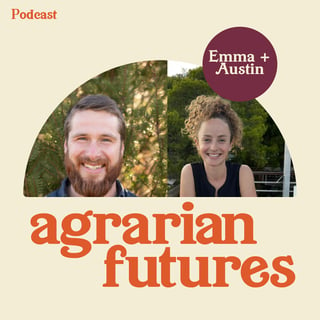
Speaker: So Emma, we've been at this for about two and a half years now, recording podcasts, being able to have great conversations with a whole variety of guests. Today we're going to do a little bit of a review, walk through the last couple of years, what we've learned, the inspiration that we've gained, what we see as we have maybe a little bit of a clearer picture of what agrarian futures look like.
Speaker: But before we get into that... We never really introduced ourselves. So can you start by just giving people a little bit more of a background on you, particularly like what led you to the point where you were interested in having these kind of in-depth conversations about the future of agriculture? Yeah, like you said, it's funny and that we've been doing these podcasts for two years now and never really introduced ourselves. So I'm glad that we're doing it today. yeah And in person also. So that's always better.
Speaker: So I grew up in France in a very agrarian, rural economy. My dad was biodynamic vegetable farmer. had ah and a kind of CSA style garden. And a lot of our neighbors were, you don't call them ranchers in French, but like cattle farmers. ok And still in that kind of more communitarian ethos where like I remember every year doing the hay together. So all the farmers would get together and we would go from field to field and would do all the haying together. And so the kind of agriculture, rural culture was like embedded in how I grew up. And
Speaker: Coming from France with this kind of idea of terroir also and the kind of the connection between food and specific place, that was just something that I grew up as a value that was very important.
Speaker: And when I first came to the U.S., that was one of my first shocks was seeing how disconnected my peers, I came here initially for high school, were from food. like There was really just no understanding of where it came at all. We don't have a strong sense of terroir here in the u United States. Not too strong. I guess like you would say, it maybe be like cheese comes from Wisconsin. And some wine from California, but that's about it. Yeah.
Speaker: And so I think that experience coming to the U.S. and like realizing like, I mean, not that it's anywhere near close to perfect in France. Like there are massive ones. All the same challenges that you have in the U.S. exist in France in maybe a slightly less extreme way. But coming to the U.S. and just kind of seeing the extent of, The challenges between like the disconnection of food and the commoditization of food and the resulting like really low quality of food we were eating yeah kind of just got me started on a journey to learn about food systems and understand like what had happened yeah and why had we gone to this place and, you know, what could I do about it? It was a very striking difference from you having come from a biodynamic CSA in France to regular food that's eaten in the United States. And that was a shock that really highlighted those differences. Exactly. And as someone that had a dad that was a farmer and that is also maybe a little bit heady,
Speaker: I knew that I wanted to kind of help the farming system, but not necessarily be a farmer myself. And I think something that we'll talk about as like one of the takeaways is like that we need a lot of people to kind of... leave The food system isn't just about the farmers. It's also about everything thing around it that can kind of make that possible. And I kind of saw that as more of my role.
Speaker: So ended up spending a few years in Egypt working for an organic food distribution company. I was basically running the company... and sourcing from small farmers in Egypt and then selling under our brand to large supermarkets in Egypt like Carrefour and some other ones, which was like a crash course in the challenges of a corporatized and centralized yeah system where you have small-scale farmers dealing with these massive buyers that have all the the power and the control. So I did that for a few years. I came back to the U.S. I did a business degree. And then for the last five years or so, I've been really involved on the finance side and of things and thinking about like, if we want a better food system, how does financing yeah change and and how do we finance these new models? And so that has been kind of a meandering path. But
Speaker: Worked with a a number of like funds in the space, like Dirt Capital Acquire Valley. Worked with some kind of high net worth individuals and foundations that were interested in investing in organic farmland. And most recently, i started and I'm running a nonprofit called World Within that is focused on...
Speaker: basically changing the financial system and investing in models that are enabling kind of decentralization and local control and food and agriculture is one of our core focuses so for example we invested in old salt one of the the people that we interviewed that we interviewed for the podcast earlier earlier this year i think so so that kind of gives me little bit of a of an idea how I came to this space. Turning back to you, i'd be curious to hear about what brought you to this space. I know you don't come from a farming background at all. Not directly.
Speaker: Of all the things you could have done, how did you end up doing this somewhat niche, but very important thing? thing around agroforestry and some the culture. Yeah. So I am a general, ah one generation removed from the farm. So both of my grandfathers farm to one degree or another. So my grandfather on the one side, my dad's father, he he had a dairy farm. My dad grew up on ah a small dairy farm in Minnesota.
Speaker: My grandfather on the other side, he worked in and around farming all of his career. He ran a grain mill. He had his own grain processing. business at some point. i don't think he ever really ran a farm itself, but he was always in and around farms.
Speaker: So I'm fairly well connected through the family, but a little bit removed myself. I also grew up in Europe to a large degree, even though I was born in the States. I spent a lot of time growing up over in Belgium. I also had that experience of coming from Europe back to the States and just had maybe but a different perspective, having seen how agriculture is done in other countries as well. as it helps me with a little bit of ah a wider perspective.
Speaker: I didn't have maybe the same trajectory as a young adult, but I got interested in regenerative agriculture, got interested in permaculture and farming and all of those things in college. And when I was in my mid-20s trying to figure out what I wanted to do with my career, realized that there was a need for people who could plant streamside forests in Pennsylvania. So I'm based in Pennsylvania. We're in Lancaster County.
Speaker: Lancaster County has a very large Amish and Mennonite population. So we have a lot of small farms, maybe one of the highest concentration of like small economically viable farms where like farming is their number one income rather than off farm jobs in the country. Really a thriving agricultural community.
Speaker: And there's a lot of conservation efforts going towards cleaning up waterways. So that's how I got involved with this from a perspective of wanting to drive conservation, but also in a way that would allow farmers to make more money off of that area. So having productive, profitable conservation, that's how I got into this.
Speaker: And while I was doing that, i had a couple of clients who I was planting trees along their streams and they said, could you help me plant trees in my pastures? Because that's really where I need additional shade because my cattle get he stressed during the middle of the day during the summer.
Speaker: So I would like to have shade in my pastures. And I realized that if we could figure out how to do this and do this well at scale, this scales up so much better than streamside forests, which are super, super valuable for conservation, but they don't integrate with the overall farm business very well.
Speaker: Whereas if you can plant trees and pasture, now we're talking about dozens of acres per farm, hundreds of acres per farm, depending on the size of the farm. And in a way that actually makes the farm more profitable as well as drives the conservation value, whether it's water quality, wildlife habitat, whatever your goals are, it's driving that conservation as well on a pretty large scale.
Speaker: So that's how I got into this world of silvopasture. And over time, it turned into a business called Trees for Grazers, where we have a number of people who are working full-time year-round on working with farmers, mostly in our area, but we're expanding our geography more and more over time to add trees in their pastures. Like you, i did not get into this as a farmer myself. but I've been worked with and around farmers and my goal has been to make farmers more sustainable and more profitable through the work that I do.
Speaker: And I would love to double down a tiny bit on where you currently live and the kind of culture of Amish and Mennonite yeah farmers. For people that are not familiar with that, can you describe a little bit what that looks like yeah and maybe what are some lessons for farming we can gain from that? Yeah, yeah. It's a really interesting culture within us farming. Both the Amish and Mennonite groups are, they're Anabaptists, they are pretty cohesive communities, very cohesive communities, where they stay together.
Speaker: They support one another quite a bit. They have certain rules that and certain ah requirements that you cannot, depending on the group, like you can't have tractors or you can't have can't have rubber tires on your tractors. Most your Amish are going to farm with horses.
Speaker: Conservative Mennonites are going to be a little bit different. The Amish in particular, they will farm with horses or mules. And that puts a cap on how big and industrial that they can get. Because of that, you've had a very different outworking of the way that farming looks like in these Amish and Mennonite communities. It's not just in Lancaster County, but in Ohio, Indiana, there's a lot of communities like that around the country. And think largely because of that, farming has really flourished, like small farms, like small farms and small farm economies, all the things that support those small farms, whether it's manufacturing, like equipment manufacturing, or animal processing, those things, seed dealers, they're very, very high concentration in Lancaster County.
Speaker: And there's also a really high, this is very important, like there's a high value that they place on farming. I think in most of the culture, we place a pretty low value on going into farming, like you can't make money doing farming. And why would you want to be a farmer when you could go to college and get a degree whatever?
Speaker: But among the Amish community and the Mennonite community, the value, the social value of farming is quite high. And it has encouraged a lot of people to go into that. So there's a very high density of farms in the region. And I'd say there's a whole spectrum of profitability, but there's quite a few farms that are making a really good go at it.
Speaker: Also, it helps. And this is one of the things that I think we've seen throughout is it's very important to understand your context. Lancaster County is very close to a lot of metropolitan areas. Philadelphia, D.C., Baltimore, New York City are within a couple hours. And so there's a really strong community that grows high quality food for those markets.
Speaker: And that's not the case everywhere. Depending on where you are, you may or may not have access to markets like that, but that has been a really important thing for farms in my area of Pennsylvania. Yeah, I spent a summer in the Driftless region of Wisconsin, and there's a lot of Amish farmers there too.
Speaker: I was working for Organic Valley, and Amish dairy farmers are the most successful dairy farmers. so you spent lot of time in the Driftless. The Amish tend to be the most profitable yeah your experience. Yeah, so I'll double down neck. Yeah, i spent ah a decent amount of time in the Driftless region of Wisconsin, but there's also a lot of Amish farmers. And I think it's important to recognize that Amish farmers...
Speaker: are basically the only group on Africa that is making it work today. I mean, that's maybe a slight simplification, but I do think it's important. Amish farmers are a growing percentage of the entire farming economy, especially in the diversified kind of small scale. Small scale in particular, there's other folks who are definitely making a go at it and doing well on like large scale farming, commercial operations. But on small scale in our area, there are often farms between, let's say, 20 and 200 acres. You don't tend to get many farms that are above 200 acres.
Speaker: Small scale, they are doing a really good job of making a go at it financially. Which I think points to a couple of different things, like one, keeping your input costs quite low, reducing your reliance on outside inputs, and focusing on markets where you have a competitive advantage. Many Amish do conventional dairy, but a lot of the clients that we work with, they've transitioned to organic or to even grass-fed dairy, where they have competitive advantages, they can have niche markets, where they're not trying to compete one-on-one against commodity growers. That's a through line for me among all the people that we've interviewed who are looking, making to make a go at it on small farms, regenerative farms. Almost no one is doing this in a selling them to a commodity market.
Speaker: And I hear it's a great segue to start going into discussing some of the key things that we've learned from the podcast. But before we go there, just to follow up on your story, what drew you to want to do this podcast in the first place?
Speaker: That's a great question. So for me, ah selfishly, I wanted an excuse to be able to talk to really cool people. and be able to pick their brains and learn from their varied experiences on what they've found that works and what they've found, what they've learned about why we are at the place that we are today in the agricultural space. That was a really big driver for me. I'm intellectually curious and i enjoy having thoughtful questions and conversations with people who are really doing a great job at what they're doing in this space and making a big difference. So yes, it was a very selfish thing for me to do.
Speaker: And I would say on my side, the other thing I was hoping to to get out of it or to enable, which I hope we did, is to me, or at least when I talk to people that are not in the farming space, I think there's kind of this perception of farmers as kind of backward. It was a change.
Speaker: I think there's also a perception that like what we need to solve is how to farm better. The way farmers are currently farming is destructive and we need to... yeah Discover yeah new methods, cover copying, whatever, that will allow us to start farming in a way that's better for the environment. When in my experience up until then, and and the farmers I'd been talking to, I'd always been blown away by how courageous, intelligent, competent, resourceful. resourceful, I think that's a big one, farmers are, yeah and how by and large I think they they have the answers and it's more a question of understanding like what needs to change around them. What are the barriers? what are the barriers? Yes.
Speaker: to allow them to farm in a way that is better yeah the environment and our health because they know how to do that. It's just a question of making that possible. yeah How do we systematically eliminate the barriers for farmers, whether that's financial barriers, institutional market access barriers, like how are we getting the food to the consumer and even like land access and land acquisition, which we had an opportunity to unpack a lot of those different ones.
Speaker: And I would say also policy and culture. What do we value as a snack? And I think as long as we want the cheapest food at all costs. And the most, the one that's going to take the least effort to prepare. Right, exactly. The most convenient. Yes.
Speaker: We're probably never fully going to solve the problem. I know that we've done over 40 episodes now. There's a lot of ground to cover, but what are some of the, maybe the most important insights or most important things that you've learned throughout this process of having conversations for our very futures?
Speaker: Yeah, well, I guess maybe I'll start with maybe the context, some of the challenges, and then we'll also talk about like the kind of inspiring solutions and that we've seen. But I think on the challenge side, one huge one is land. It's come up again and again.
Speaker: we had a first interview early on with Christina Villa about access to land. You know, there's 300 million acres that's supposed to change hands over the year. decade and it is not affordable.
Speaker: A farmer yeah cannot justify buying land based on the income he can make farming. yep It's a big one. It's an elephant in the room. It needs solutions. And I think the farmer's land trust is one solution. So thinking about land trusts and hotels like that, you know, there's potential role for investors that want to invest in land. So kind of detaching the farming from the land ownership potentially in certain situations. So there's different kind of inklings of potential partial solutions, but by and large, it's it's today still unsolved, which is that land is unaffordable. And I think it's worthwhile taking them just a little bit to flesh out like why land has become so much more expensive to buy and so much more challenging to cash flow with what you're producing from that land. Because like this is one of the most important things in farming today, I think, If you want to create an agrarian future, if you want to for yourself or for society, if you want a strategy around this, like you really need to understand the land piece and why acquiring land the way that it has, maybe it was in previous generations is so much more challenging today.
Speaker: It's basically land having become an investment yeah class. yes it's It's that simple. Land is today not valued on its productive capacity. yeah It's valued on its development potential. um It's valued as an asset capacity. It's a low risk, right stable asset that historically keeps going up in value. So if the stock market is going haywire, right land is always great investment. It's inflation hedge. yeah So it has certain properties that have made it over the last 10 years in particular. People call this like the financialization of land. Made it an asset class and its value is no longer tied to what you produce off of that. Yeah.
Speaker: One of the interviews that I would have loved to have done, Alan Nation is is an author who unfortunately passed a little while ago, but I would have loved to be able to interview him. he highlights in some of his books. For ah quite a while, actually, the value of land has been disconnected from the the productive capacity of land. And he talks about even the fact that outside of investment, there's The fact that in the United States, a lot of people value having a good bit of land, whether it's for recreation, for hunting. And if you can earn a city salary and you can work remotely, so that's like become even more of a thing in the last number of years. If you can work remotely or you you can commute into town or into the city, It allows people to own much larger pieces of property. And if you're a farmer and you're having to compete with someone who's a banker in town for that same piece of land, that drives the price of land up. And so that's been the case for quite a while, but it's only intensifying. And i don't see it changing course at all. think I think this is only going to get more and more the case. And so we'll need to have recognized and have strategies around being able to get the right operators on the land
Speaker: even if they can't buy the land itself. I think another big one is the economics of farming. The economics of farming are extremely challenging.
Speaker: Especially if you're on a small farm trying to get into farming. So I think of farming as a number of different categories. With most of those categories, the bigger you are,
Speaker: the more of an advantage you have, the more economies of scale you have, whether that's row cropping, whether that's growing beef, orchards, whatever it is. If I was wanting to get into farming as someone who doesn't have, who doesn't already have a farm, getting into row cropping would be immensely challenging because of all of the capital required, both for the land, for the equipment, the annual capital that you need for seeds, and the margins are razor thin on that. Even someone like, so one of the our early conversations was with Josh Payne, who's a farmer in Missouri. And he has family farm. It's about 600 acres. And in his part of Missouri, that's a small farm. That's a small grain farm. And it's marginal at best to make a go at commodity cropping a farm of that size. And that's having a family land and family and equipment that's already there. And if that's a small farm, that's going to be hard to make economically viable. Like we need different options. And and Josh is one of those examples of people who have looked at what makes sense for me for this land and has developed other options where he's looking to get as many people per acre on that piece of land and making a really good go at it too.
Speaker: You did a cool interview with Beth Hoffman. So Beth Hoffman and and also Brian Reisinger that we talked to we talked with them around the same time. And both of those have really good resources on books that they've written on why the farming landscape is the way it is today. Like if you wanted to understand why we farm the way that we do today, those are probably the two best resources that refer people to as great summaries that also have like personal connections where farms have consolidated.
Speaker: They have gotten bigger and bigger over time as machinery has gotten to be able to, farm you can farm more land with fewer people. And the price, the margins are probably slimmer and slimmer in the commodity game where it's it's hard for someone to, it goes back to the idea get bigger or get out, which has been a large part of our agricultural policy since and think the 60s and seventy s if I understand correctly.
Speaker: Another theme that came up again and again through our podcast is that at the same time that you have, you know, the average age of farmers is 68 and they typically don't have anyone in their family that wants to take over from them. And yeah there's like this impending labor crisis. Mm-hmm.
Speaker: There are a lot of young people that want to get into farming and want to get into ranching. And typically, they want to get into it in a different way. You know, they're drawn to the regenerative, to the natural, death the yeah to the small scale, to the diverse. And I'm thinking here of our interview with Tyler. Tyler Boo, yeah. Our interview with Carlisle and a number of others, people that really have this, like, thirst. Yeah.
Speaker: And didn't come from farming families in most cases. Like a lot of people who grew up in the suburbs or grew up in the city who now want to get into farming and they're looking at this landscape of, whew, boy, even if I have experience, even if I know all the skills, which is a whole lot to acquire, the financing, the land acquisition, the cash flow.
Speaker: It's a lot. It's a lot. But they really want it. And they really want it even though we know that farming is one of the hardest things you could do. And that they know that they will never make a good living.
Speaker: Depending on what you compare to, on what your standards are. Depending their comparables, other jobs that they could go pursue. It'll take you a lot more work and a lot more creativity and hustle to make the same amount of money that you could in a town job. Exactly. yeah One of your your specialties over the last number of years has been finance, particularly around agriculture. What are some of the things that you see as the most challenging sides of finance that we don't have, that where we've lost strength?
Speaker: But maybe what are some of the the things that you see that we're currently developing financial tools that will actually support farmers in the years ahead? That's a great question. I think that if you look at finance, it has developed and consolidated over the last 50 years.
Speaker: We used to have small local banking institutions. You put your money, that your savings and loan, get from money from local people, they would lend it to local farmers. And so like and on on the banking side, like you just said, in the 1970s, the average person had their savings, not their checking account, their savings in a local bank.
Speaker: And that local bank was circulating that money into the local economy. Yeah. And they were able to do so because they knew each other. Like the banker went to the same restaurant, went to the same bar. like the Same church. There was all this contextual understanding that allowed you to be able to underwrite that farmer because he had a reputation. You kind of saw him show up every Saturday at the market, like went on time, and you know that he was hardworking things like that. And so we went from that situation where you had 16,000 banks across America and people with their savings in those banks lending to Local institutions and local farmers to a world today where we have we went from 16,000 to 4,000 banks and the majority of savings is no longer in banks, but actually in the stock market. Yeah. where you basically have these huge pos of capital that are distributed by a few people and basically underwriting to corporations yeah they don't have the capacity to understand
Speaker: whether that local farmer is viable yeah unless they're doing commodity real crop farming because they can look at the like soy prices know on the like exchange for the last yeah whatever, 10 years and be like, okay, we're going to underwrite based on that. But if you come to them, well, first of all, they won't even have a meeting with you. But if you somehow were able to get a meeting with them, showed them your like model for like selling a CSA your 25 different crops, of course, none of them that are insured and most them that they don't know, like they have no capacity yeah to underwrite that. So basically, to summarize, massive consolidation in the financial industry means capital, you
Speaker: being allocated towards large corporations and large commoditized row crop farming and small-scale diversified farmers having no access to capital. And so there are a few new initiatives that have been started that are trying to resolve that.
Speaker: One of my favorite and one of our early podcast interviews was with Charlie from Walden Mutual. Yeah. So they are a new mutual bank based in New Hampshire that is basically trying to go back to that system I was described. So like what if, you know, you could take in deposits from people that care about regenerative agriculture in New England and beyond and lend it out to local farms and adjacent businesses to agriculture that are trying to build a resilient, decentralized, localized food system. Other interesting examples are like Skaia Akiptan. They're like a native CDFI. They are leveraging a lot of like foundation and government money to basically lend out to young ranchers in indigenous communities.
Speaker: of people don't know this, but indigenous communities have some of the highest percentage of ranchers. They're based in ranching by margin. Mm-hmm. Another project that we talked to was Mark from Potlicker Capital. So he's doing some incredible work basically providing low-cost patient loans yeah to black farmers in the South.
Speaker: There's a number of other of these like kind of new initiatives that are basically trying to recreate the nodes that we need that can provide the capital that farmers need that want to be doing things in a more regenerative way so i think the broader takeaway from that is that again kind of going back to something said earlier we want to improve the food system we need to think about all the enabling conditions yeah yeah and we need to think about us as people that are maybe not farmers like what are the ways in which we can engage finance is one piece and i think some other pieces you know are know markets yeah brands technical assistance culture So one of the important things that I think has come out a lot of those conversations is maybe we had a certain infrastructure, we had certain services that served local farms that we've lost in many ways, in many areas, we've lost those, which is similar to we've lost a lot of our local markets as there's been consolidation in the retail grocery space.
Speaker: So how do we get that back? Like specializing, specialized services that maybe are not local services anymore, but that allow you to go to a potlicker capital, that go to a Walden Mutual, that might not be in your town, but they are someone who has become really, really good at serving the needs of a small farmer. We haven't talked to folks from GrazeCart, but that would be like one example of a service that a lot of farmers use that allows them to sell locally or sell to people who want to buy from their farm specifically and facilitates a farmer being able to sell the food that they produce to the the people that really want what they have, even if it's hard to to get into the local grocery store. They can go directly to the consumer.
Speaker: So having these these specialized services that can help farms throughout the country, and hopefully that means that over time, we'll have more and more local services again as we're able to build back more of these local farms to get more of the infrastructure that supports those. yes Yeah, absolutely. I agree with that.
Speaker: One other thing that was important to me and was touched upon maybe most directly in the conversation with Dave Chapman and also to a certain extent with Rex, founder of Greenpeace, yeah is the um danger of the regenerative agriculture movement and the environmental movement more broadly getting corporatized, greenwashed.
Speaker: And Dave is like an incredible kind of spokesperson for the organic industry. agricultural movement. He's now leading the Real Organic Project. yep Which specifically wants to push back against lot of the greenwashing that has happened and say, no, we want really high quality, nutrient-dense food that is grown in sustainable ways rather than just avoiding chemicals and substituting with plastic in many cases. And I think the important thing to understand here is that we saw what happened to the original organic movement. Coming out of the 60s and the counterculture and the hippie, like we had the birth of the modern organic agriculture movement. It was a ah lot of like young idealistic people. Dave was one of them at the time. who basically were like, we're going to fight back against this kind of extractive, industrialized mode and like farm differently. And the movement grew. It caught on. you know People started to care about that. People started to go to the health health stores, and make an effort to buy food that was high quality. And in the 90s, as the first official organic government USDA organic certified. and likeed and as corporations started to
Speaker: latch onto it because they saw that there was like a market demand for it and that consumers were willing to pay more for something that was organic the movement got co-opted and what was originally organic in the sense of like diversified you know regenerative turned into a kind of greenwashed, dumbed-down model where you replaced monoculture with an organic monoculture that is more generally better. you You're using less chemicals, but isn't the soul of what they were trying yeah to do. yeah And I think that that is important to understand today in a world where like in the regenerative agriculture space, you hear all sorts of like exciting claims around
Speaker: you know, Coca-Cola has, you know, agreed to source, you know, 10% of their meat from regenerative farmers. if Coca-Cola is doing a whole lot meat, but yeah. when i cooked dons as you know You know, we are going to source 20% of our meat from regenerative farmers. And you have all these like large corporations that are like, you know, signing commitments for regenerative. And That is so tempting because it sounds so, it's so persuasive in the sense that they're so big that, you know, just... They can move the needle so much. Yeah. But i think yes I think it is important to remember that we've gone through this before. Yeah. It did not end well. We have to very careful about keeping those entities accountable. Yeah.
Speaker: I think it's worth painting a picture here. And maybe understanding that structurally they are not capable of creating in the better food system. They are not set up Those are not the right actors. They don't have the right leverage or the right incentives to create that.
Speaker: So we've talked about some of these more maybe ethereal things. So finance, the value of land, the cost of land. Let's look at what are some of the examples that we've seen. People being able to make a go at it. Highlight maybe some of the ones that we've been able to have conversations with. Yeah, let's highlight some of the best examples. And you yeah, we have been really lucky to talk to a wide range of the most inspiring models out there that I really think, you know, each one of them kind of shows or starts to give an idea of like what could this could look like if it if it was replicated. There's the whitel pastures, for most people doesn't need an introduction.
Speaker: But I mean, they are a phenomenal example of what it looks like to turn a multi-generational commodity ranching farm into, i mean, the most incredible um model they're about 5 000 acres used to be just like annual grasses that were like you know painted i think every year like using lots of fertilizer famously will will harris was very much a conventional farmer for the first part of his career and he said if i was told to spray one unit of ah herbicide i would spray two units if i was told to give one unit of growth hormone i would give him a three units right So he pushed and pushed and pushed on that industrial farming system for the first however many years of his career yeah and then turned it around.
Speaker: had a very, very different trajectory for the second half of his career. Right. And so today, every animal, they have cows, sheep. Chickens. Chickens. Pigs. Pigs. Rabbits. Rabbits. Goats. Goats. All kinds of stuff. of Every single- They have orchards. Right. Every single animal is born on the farm, raised on the farm, slaughtered on the farm.
Speaker: Every single part of that animal is recycled. and The meat is sold, obviously- Leather used. The leather is used. yeah The rest is composted. They are now in one of the poorest counties in America, poorest county in Georgia, imp employing 200 people.
Speaker: They are now marginally profitable. And it is just, I mean, for anyone that goes and visits, it is like the physical manifestation of like what regenerative can look like. I mean, it's incredible. yeah I'm trying to think of some others.
Speaker: So Josh Payne is one that we had talked about already where he He was able to acquire the the farm from his family, but made 180 degree turn largely because he found out that he was allergic to agricultural chemicals, yeah would be deathly allergic, would not have been able to continue and went towards sheep farming instead. And now has developed a perennial agroforestry systems there as well, where he's adding chestnut trees and honey locusts and mulberries and And he runs pigs on the land as well as the sheep. So he's been able to stack more layers to the farm over the last number of years. yeah And is able to be much more profitable, able to employ and many more people on that piece of land than if he had continued on with commodity row crops.
Speaker: Those are some of the examples of people that we've interviewed. Joel Salatin would be another one. Quinn. Many of those had farms when they started. And they transform them. Yeah. And they show us examples of what that farming can look like. What are some of the examples that you've had conversations with over the podcast of people who did not have access to that, but they still found their their niche within agriculture? Yeah.
Speaker: Yeah, i mean, one super cool one earlier on was Brittany Cole Bush, shepherdess of the West. Her model, she actually spent a decent amount time studying kind of nomadic tribes in various countries and in Africa.
Speaker: You know, knew she wanted to do something connected to the land and connected to animals and basically started a grazing for service and business. Yeah. So doesn't have to own the land. Yeah. She's bringing sheep onto the land in order to mostly provide fire risks in California. Right. And what was super you know what is super smart about her model is kind of recognizing that in her case, monetizing the fire suppression benefits. Yeah.
Speaker: made more sense than monetizing the meat. So I do think she eventually sells the meat. But the way her business works is basically getting landowners, government and private owners to basically pay her to come in and use her sheep to basically cut down the brush and reduce the risk of fire, yeah which they would otherwise have to pay team of people to mow and weed and weed whack. Yeah. That is one incredible, super creative model. Yeah.
Speaker: There's ah even more opportunity as people recognize the risk of fire isn't going down. The amount of development in fire prone areas is not going down. So that is going to be a service that continues to be needed and and grows.
Speaker: Another one is solar agrivoltaic. yeah systems where the solar panels are set up in large arrays and you're able to come in with sheep in particular to graze those white oak pastures does quite a bit of solar grazing and there's a lot more of those solar fields going in and so having a service around using sheep to graze land i think will only continue to grow Any other compelling example of someone that did not have access to land? So one of our early conversations was with Daphne Rose, yeah who is a horse logger. She fells trees and does the does the logging, and then she skids them out with horses.
Speaker: And one of the interesting things there was that even though there's a lot of other logging companies out there, right? Big logging companies that come in with big machinery, and they can get a lot of work done fast,
Speaker: A lot of people really want her services because she's ecologically minded. She's very selective. She has a very light footprint on the land. And so there's a lot of landowners in her region that would not want a regular logging company to come in, but will pay for etra For it to be her to come in with her horse to do this logging, it's a very neat little niche that she has developed that I think could very well be picked up by many others around the country. Does not require her to own land, just enough space in order to be able to keep her her horse well fed. And then otherwise, she is a service provider to her community. Mm-hmm. We were able to highlight a number of different service providers or people who are able to support regenerative agriculture movement. Cole Allen was one who is using his financial skills in order to provide bookkeeping and accounting and those kinds of services for farmers. in order that the farmers can be more profitable and understand their books and their incomes and their expenses better so that they're able to be more successful. Let's say another one would be a number of folks who take leather goods, so hides off of regeneratively raised animals, and they turn them into high-quality leather goods. And the more that we can take from these regenerative systems and value add them, then the more that those farmers who raise those are going to see more income for their operations.
Speaker: Another example of a group of people that didn't have access to land but is now farming is the Breadtree folks. Oh, yeah. Breadtree is a company that started with the the goal of let's perennialize our food system. Let's establish chestnut trees in particular in to their Western Massachusetts and in the New York State.
Speaker: So chestnut trees, but then they've also added other trees, tree crops, staple tree crops. And that's a particularly challenging thing to do, right? Like maybe one of the most challenging things to do because not only do you have to acquire access to a lot of land, you also have to wait a long time before that land cash flows.
Speaker: This is a a theme in perennial agroforestry systems, perennial food systems, is if you need to make an investment that won't start to pay you back for five to 10 years, how do you do that?
Speaker: In their case, they've been creative about financing. They've raised money from investors in order to bridge that gap between when they plant their trees and when those trees will start to yield. Mm-hmm.
Speaker: It's a great example of folks who have overcame quite a bit of a challenge, financial challenge, time frame challenge, yeah even operational challenge, because there's not a whole lot of existing chestnut orchard operations, especially in their area. So they've had to figure out a lot of things how to get these trees established in their context. Yeah. how to estimate what their cash flow is going to be because you have to wait six years in order to even get some crop and be able to estimate what. So they're having to develop the market for this. They're having to develop the yeah the supply, and the production at the same time and having to do so five years out yeah in the future and having a big lag time. yeah so
Speaker: agroforestry systems in general are going to be, i think there's a ton of upside. i mean, it's what I do, but they think they can they come with unique challenges. Did say? Yeah, yeah, yeah. Did you mention? Did you mention that there's a lot of upside to this agroforestry system? Yeah. But like yeah everyone knows, like the the key challenge with them is that time lag. Yeah.
Speaker: A final one I want to throw into the mix that just came to mind is Glenn Elzinga, which I interviewed pretty recently, one of my favorites. But he also doesn't come from a ranching farming background, who's an ecologist. And they acquired a very small parcel of land that is the base for their operation. Mm-hmm.
Speaker: But they are basically dependent on leases from BML land. And they go up into like the high mountains every summer. They basically leave on horseback yeah in like May yeah and are out there camping, doing like 18 hour a day days until like the end of the summer, at which point they come back down. Mm-hmm.
Speaker: Talk to him, and um I think you realize, like, the many ways in which they kind of represent this kind of new, like, lighthouse model for what ranching farming differently could look like. I mean, phenomenal, like, the way he thinks about feeding his animals and kind of moving them to the landscape and allowing them to, like, selectively eat on the right grasses in the right order to best foster their health and also best foster the health of the landscape is, like, incredible. I mean, he's like such a deep thinker.
Speaker: They also are, you know, direct marketing directly to consumers. All of what they're doing, they're completely bypassing the commodities market. Importantly, if we're talking about eating local, like they're in an area where there's not very many people. and so they're able to access people who really want their stuff right from even from how remote that their reach is. Right. And every summer they take on, I want to say it's like 10 or 20 interns and they have 300 plus people applied for those like 10 positions a kind of standout example of like what a better system to look like so i guess maybe to finish this off no i'd be curious this is a question i've been getting from a lot of people but i would love to get your answer on it like what makes you what makes you hopeful why are you excited about the future of food systems and what makes you think that it's going to get better
Speaker: Hmm. I don't think that it's all going to get better. i think there's going to be parts of the farm economy that continue to consolidate, that continue to get more extractive. Again, if you look at grain farming, like with robotic technologies and those kinds of things, I can only imagine that's going to continue to consolidate into fewer and fewer hands.
Speaker: Price of land is only going to continue to go up. There's definitely reasons to to be cautious about or to not be optimistic about those things. But I do see a lot of opportunities out there in the farming space from my own perspective, from the work that I do day in a day out on silvopasture, on agroforestry for livestock. I do think that that is going to have an immense effect on the way that livestock are reared on pasture, both ruminants, cattle, sheep, and goats, as well as pigs and poultry. i think it's going to have a really, really significant effect on
Speaker: But it is going to take time. Like we're just going to need to have patience and and thoughtfully address a whole variety of things. But thankfully, there's a lot of low hanging fruit in the agroforestry space. And it's just kind of a matter of time before I think we'll see very, very significant changes coming to our food system by investing agroforestry.
Speaker: Yeah, I mean, I would agree. Realistically, things are going to continue to get more corporatized and consolidated in many ways, at least in the mainstream economy. But I think what also gives me hope is that doing things differently is totally possible. It's definitely not easy, but it's possible. People are doing it already.
Speaker: and It's irresistible when you actually experience it. and Like it is actually better. And I think when you see the people that are doing it already and you see how inspiring it is. i mean, for anyone that's gone to visit white equestrian or any of these other farms, the beauty and the kind of sanctuary they're creating, it's it's exciting. because Mastodon Valley Farm is maybe one of those that we we haven't talked about yet, but that's a beautiful example yeah of what a perennial ecosystem farm can look like that's being done right now with 20-year-old trees that are yielding, and providing shade and windbreak and fee for livestock.
Speaker: There are more and more examples that people can look to in order to create these resilient, truly regenerative agricultural systems. Right. And who wants row crop soy when you could have mass in farms? mean, like, who wants to live and in that first yeah example versus the second?
Speaker: also So I think that's the kind of irresistible piece of it, which is that I think it is better than anyone that spends any amount of time in it would experience that. so Very good. thank god This has been fantastic to catch up on two and a half years of podcasting and of fantastic interviews that we've been able to have with a whole wide variety of folks. This has been a lot of fun and I look forward to a lot more of this. Yes, likewise. Thank you.
Speaker: Agrarian Futures is produced by Alexander Miller, who also wrote our theme song. If you enjoyed this episode, please like, subscribe and leave us a comment on your podcast app of choice.
Speaker: As a new podcast, it's crucial for helping us reach more people. You can visit agrarianfuturespod.com to join our email list for a heads up on upcoming episodes and bonus content.