Transcript
Speaker: Improvising!
Speaker: Improvising.
Speaker: Multiverse is real.
Speaker: Improvise.
Speaker: Compelling.
Speaker: Innovative.
Speaker: Improvisation.
Speaker: It's magic.
Speaker: You know, make something up.
Speaker: Welcome to Think Like an Improviser.
Speaker: I'm Jeremy Richards.
Speaker: In this podcast, we explore how the skills and insights of improvisation can elevate your creativity, confidence, success, and well-being.
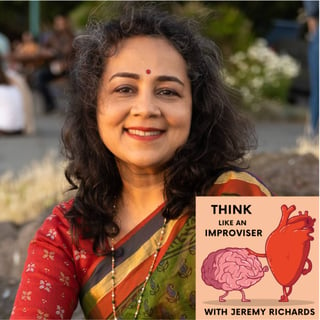
Speaker: My guest for this episode is Dr. Belinda Fu, a family physician, educator, and improv actor in Seattle.
Speaker: Belinda founded the organization ImprovDoc to teach improvisation skills to fellow clinicians.
Speaker: She's seen how the surprising insights from this practice can improve communication, cognition, and wellness for both the physicians and their patients.
Speaker: Hi, Belinda.
Speaker: Thanks for joining us.
Speaker: Hi, Jeremy.
Speaker: Thanks for having me.
Speaker: You and I have known each other and performed together since 2009, right?
Speaker: At Unexpected Productions?
Speaker: 2009, yes.
Speaker: You wrote it on the calendar.
Speaker: It's burned into my heart.
Speaker: You were already there when I joined.
Speaker: I was there since 2001.
Speaker: Yeah, I know.
Speaker: And then a few years back.
Speaker: Before that, doing improv in college.
Speaker: But when did you get started?
Speaker: Was that your first foray into improv?
Speaker: That was not quite my first.
Speaker: I took my first improv class in January 2007.
Speaker: That is also...
Speaker: burned into my heart.
Speaker: And then in 2009 was when I first started doing some shows.
Speaker: I did a few long form shows over at Jet City Improv and then got into Unexpected Productions in the fall, joined the ensemble.
Speaker: When did you start making that connection between improv and your practice in medicine?
Speaker: That happened very gradually.
Speaker: Right after I joined UP, I started a job as faculty at a family medicine residency program.
Speaker: So that's teaching doctors who are done with med school.
Speaker: So they're totally doctors, they're doing their specialty training.
Speaker: So I was one of their faculty teaching the family medicine.
Speaker: And one of the things or
Speaker: Among the things that we're tasked with teaching, the residents are things like communication.
Speaker: And I was very frustrated with the tools that we had to teach communication.
Speaker: They felt very, well, they didn't feel useful because a lot of them are scripts.
Speaker: They're mnemonics.
Speaker: I'm particularly galled by anything that has E for empathy.
Speaker: Like, what am I supposed to do with that when I walk into the room?
Speaker: Like, I'm being empathic.
Speaker: It just, it always felt very, I don't know.
Speaker: It's like you listen to a lecture and they say like, be empathic.
Speaker: You're like, okay, that sounds good.
Speaker: But it just, it just didn't feel very useful.
Speaker: And so then I am on my own time learning these improv skills in parallel and starting to see like, whoa, wait a second.
Speaker: I am learning these skills of listening and connection and what feels like empathy in this performance, theatrical setting.
Speaker: This should be used in,
Speaker: medical teaching and medical communication, medical practice.
Speaker: So it was very, it was gradual over a period of years.
Speaker: Do you have any memories of a specific story of when it really clicked for you or where you saw improv helping fellow physicians improve their practice?
Speaker: One really common example, like this is okay.
Speaker: Here's, here's a good example because this one's evergreen.
Speaker: It comes up all the time and improv very clearly helps in this.
Speaker: So
Speaker: One thing that we're taught in improv is to accept the offer and build on it.
Speaker: The yes, and thing.
Speaker: And just breaking down any conversation or any interaction into something so simple as you have to say yes to the thing the person gave you and acknowledge that was their reality before you add something else and move on that simple.
Speaker: skill I see play out a lot when you're speaking with patients recommending a certain therapy or treatment and they are not interested in it.
Speaker: And a common example would be vaccines.
Speaker: And this is long before COVID, but there's always been understandably hesitation around vaccines.
Speaker: And so the flu vaccine is one that I feel very strongly about recommending in the past.
Speaker: And
Speaker: I would often see these encounters.
Speaker: I remember, this is, I remember specifically, it was a med student went to go see one of my patients and came out of the room and said, the patient is totally not interested in having a flu shot.
Speaker: I said, would you like a flu shot?
Speaker: And they said, no, absolutely not.
Speaker: I don't believe in them.
Speaker: They'll like make me sicker.
Speaker: I was like, okay, well, that's pretty common.
Speaker: We actually get that response fairly often.
Speaker: So, so I was like, okay, well, we'll go back in the room and, and talk to her again.
Speaker: And the med students meeting this patient for the first time, like there's no knock on the med student at all.
Speaker: And I, and I've known this patient for a long time.
Speaker: So I said, oh, no, I heard that you, you talked about having a flu shot.
Speaker: And my patient said, yeah, I'm not really interested in getting it today.
Speaker: You know, I've got a lot of concerns around it.
Speaker: And I said, oh, okay.
Speaker: Sounds like you're totally clear.
Speaker: You don't want to have, you don't want to get the flu shot today.
Speaker: And you mentioned that you had concerns about it.
Speaker: I'd love to know what those concerns are.
Speaker: And the patient's like, oh.
Speaker: well, I heard that it can cause, and, you know, she started to explain all these things about what her concerns were.
Speaker: And then we had this whole conversation and at the end of it, she's like, oh, great.
Speaker: I'll totally get my flu shot today.
Speaker: And the med student was like, what?
Speaker: You know, like, just, but for me, like the example was, I said, it's like, I'm not a wizard.
Speaker: It's just the yes and principle.
Speaker: If the patient said, I don't want it.
Speaker: And I said, you don't want it.
Speaker: I heard you.
Speaker: And
Speaker: I'd love to hear more about your concerns.
Speaker: So it was just building on that, which created a room for more of a conversation.
Speaker: So that, that is like a classic example.
Speaker: What would be like an example of an objection to explain why they don't want it and how you build on that or eventually turn it around?
Speaker: Sure.
Speaker: So one of the concerns, if we're talking specifically about flu shots would be, let's see now, concerned about flu is that.
Speaker: Or we can, we can even play this out.
Speaker: Like, do you want me to be a patient?
Speaker: You certainly can.
Speaker: That's the one thing improvisers actually get hired to do is to work with doctors and be difficult patients, right?
Speaker: Okay, Dr. Fu, I don't want my flu shot because I feel like it's just going to actually give me the flu instead of prevent it.
Speaker: Oh, Jeremy, thank you so much for sharing that concern with me.
Speaker: You're concerned that if you get the flu shot, it would actually give you the flu.
Speaker: Did I understand that correctly?
Speaker: That's what the message boards say, yeah.
Speaker: That's what the message boards say, okay, cool.
Speaker: Thank you for sharing that with me.
Speaker: I would love to understand your concern even more just to make sure that I'm giving you the correct information and supporting you in your healthcare choices.
Speaker: When we're talking about the flu, I wanna make sure we're talking about the same thing.
Speaker: What does the flu mean to you?
Speaker: just getting aches and pains and maybe even nauseated or cold symptoms.
Speaker: You know, all the stuff that the flu shot might do.
Speaker: Okay, gotcha.
Speaker: So the flu to you, your mind means like a constellation of symptoms, aches, pains, nausea type thing.
Speaker: And those feel like the same side effects that the flu shot could potentially give you that right.
Speaker: And the same thing.
Speaker: Okay, I'm so glad you explained that to me because it points out really what I think is a deficit in our healthcare education for the general public, which is that the term flu is
Speaker: but common public vocabulary that's actually used kind of sloppy.
Speaker: And I'm guilty of that too.
Speaker: It's used to mean a ton of different things, but the flu shot is actually really specific.
Speaker: It's only for
Speaker: influenza, which is one particular vaccine.
Speaker: But when we talk about the flu, just general, we're talking about, you know, stomach flu, which is not influenza or common cold, which are also not influenza or like all these other things.
Speaker: And so we like muddy the waters.
Speaker: No wonder you're afraid of getting the flu from the flu shot because you wouldn't be afraid of getting like generic flu if it was like a generic flu shot, but it's actually totally not.
Speaker: They're totally different things.
Speaker: So the influenza vaccine
Speaker: is really great for preventing influenza and cannot give you influenza just the way it's built.
Speaker: I've had to talk about that.
Speaker: And so that's why there's just this confusion.
Speaker: Okay.
Speaker: That seems like obviously the conversation might go on longer than that, but I can hear how you're really empathizing and you are yes ending and really connecting in a way that, frankly, in my experience in medicine, doctors don't always have time for or the disposition for.
Speaker: And they just want to like, no, you're wrong.
Speaker: Sorry.
Speaker: And just locking, as we would say, in improv.
Speaker: So you must be an awesome physician.
Speaker: And yet you are not practicing medicine actively in the last year or so.
Speaker: Correct.
Speaker: You've kind of transitioned into something new.
Speaker: So I, my current clinical practice, I don't currently have my own panel of patients right now.
Speaker: I, my clinical practice is in working as faculty in a residency program.
Speaker: So I continue to work with the residents supervising their patient care, seeing patients with them, discussing their patients.
Speaker: So if I just, I, I, I don't have appointments like 2 45 on Wednesday.
Speaker: So that's happening right now.
Speaker: I'm in the supervisory clinical role and spending most of my time teaching.
Speaker: I mean, I, I,
Speaker: I'd like to think I'm an okay doctor, but I mean, it's not, it's like you don't get like scores or points or something like that, which thank God.
Speaker: But I think one of the things I really learned because of improv that really helped me in like clinical care, because sometimes you'd have these interactions that don't go well and you don't know why.
Speaker: But with improv, I felt like it really gave me these specific tools and insights to slow the conversation down.
Speaker: And it's true that we do not have time.
Speaker: The current American healthcare system is,
Speaker: terrible.
Speaker: It's I have so many inappropriate words to describe when I think about the healthcare system.
Speaker: And it's, it's not good for patients.
Speaker: It's not good for doctors.
Speaker: It's not good for the actual practice of medicine.
Speaker: What happens in the room, the human interaction, the healing, it feels like the conversation we were starting to have feels like
Speaker: could take a long time and if someone's running a schedule and a budget and looking at dollar signs like don't spend that much time with the patient talking to them but if we slow down that moment and say hey you're i hear you and i hear your concerns i'm i have the opportunity to build a relationship with you and teach you something that empowers you and your health for the long term and that's the real benefit if we're just looking at it like 15 minutes are up you need to get out of here because we need to
Speaker: see the next patient and like crank it through sure then i don't have time to be like oh you don't want a flu shot all right too bad bye you know just terrible that's terrible care yeah but with improv i can have this conversation which i can dial up or down in terms of its length i was like going going full in there but i can have a much faster version of that conversation that you know lasts less than five minutes that's always worth it
Speaker: Whether or not they get a flu shot, what matters is that they have a better understanding of their health and their choices and their options.
Speaker: So they're making an informed decision rather than one that's based on incorrect information.
Speaker: And I feel like improv gives me the ability to have that conversation.
Speaker: And this is something that you're continuing to teach and share through keynote lectures.
Speaker: And you have this website, ImprovDoc.
Speaker: Can you tell us a bit more about the business you've created around this?
Speaker: Yeah.
Speaker: So like half of my time I spent doing at University of Washington and some of the affiliated residency programs here, specifically family medicine, the rest of the time is spent doing freelance work, teaching many of the different realms in which communication and improvisation can improve the practice of medicine and general health and wellbeing.
Speaker: So a lot of the shape that tends to take is in doing their keynote presentations or workshops or designing courses.
Speaker: at different institutions around the country and even internationally, sometimes sharing the many different ways in which
Speaker: Improvisation inspired and based work can be used to help different aspects, whether it's patient physician communication, interprofessional communication.
Speaker: There's a ton of teamwork that happens in the practice of medicine, more specific niche areas like difficult conversations, delivering bad news.
Speaker: Unfortunately, we do a lot of that in medicine, general tolerance of uncertainty.
Speaker: How do we stress management for ourselves, for our students and learners or for our patients and a lot of work too in
Speaker: well-being and resilience, which has, especially over the last few years, become even more and more at the forefront.
Speaker: Yeah.
Speaker: Just imagining what's at stake in your profession is humbling for somebody who's spent a career in the corporate world where it's rarely that urgent, but knowing that you had a little bit lower stakes.
Speaker: I know.
Speaker: It's interesting how that plays into the research also around imposter syndrome for me to sort of crowbar that topic in because I've been, as you know, you know, writing this book about it.
Speaker: And an article that came out just in 2022 was about how the medical profession
Speaker: is one of the areas where imposter syndrome is most prevalent because there is this feeling that you always need to do more and contribute more.
Speaker: And maybe there's a savior complex mixed up in that as well.
Speaker: And that someone else is always better at that.
Speaker: Can you talk a little bit about how you've seen that or experienced it at all in your profession?
Speaker: Absolutely.
Speaker: And I want to be specific that this is really Western medicine, as we know that we're speaking of.
Speaker: This practice of Western medicine, as it's trained, has baked into it this culture of perfectionism and rigidity.
Speaker: And of course, it didn't, I think there's, if you go far enough back, it didn't start that way because less was known.
Speaker: But for some reason, as the centuries have passed, the expectation is that, well, really maybe because less was known, that you knew everything there was to be known.
Speaker: But that is absolutely impossible.
Speaker: It is just quantifiably impossible for any one person to know all that there is to be known.
Speaker: But the expectation of complete authority and knowledge and infallibility still exists.
Speaker: And also in the training of the traditional Western medicine training system, there is this unfortunately punitive culture and one that's shame-based and intolerant of error.
Speaker: I'm sure there are medical historians who know far more about how it came to be, but the, as the literature verifies what we know to be true, that is definitely the case where there's shame, there's guilt, there's perfectionism.
Speaker: And that's why you're, you're seeing that number, that statistic about imposter syndrome being so, so prevalent.
Speaker: Do you see anything in the tools of improv that can help you manage that?
Speaker: Yeah, absolutely.
Speaker: For me personally, it's been this incredible rehabilitation practice of doing improv.
Speaker: So in improv, right out of the gate, I remember learning from one of my early teachers, who's Matt Smith, and very early on taught us the failure bow, aka the circus bow.
Speaker: Oh, yeah.
Speaker: Ta-da, or yes, you go, ta-da.
Speaker: Yeah.
Speaker: I failed.
Speaker: I failed, I failed.
Speaker: Thank you.
Speaker: Exactly.
Speaker: It was so shocking to me because it's so antithetical to everything that I had internalized throughout my medical training, which is that if you mess up, you are deserving of scorn and inadequate and insufficient in every way.
Speaker: Here, every time you mess up, you're supposed to take a gigantic bow and everyone claps for you.
Speaker: And you're supposed to celebrate that because that's an opportunity.
Speaker: that in itself was one of the most powerful life-changing things that i've ever learned because one was just the repetition of the training doing improv can alter your reflex so that my instinct when i make a mistake is not to self-flagellate but simply to i made a mistake and we move on and i also learned over time that i have i don't i don't do you know in the clinic right
Speaker: Took off the wrong leg.
Speaker: Yeah, exactly.
Speaker: But I have learned to be able to acknowledge like, okay, I made a mistake.
Speaker: There's this knee jerk reflex that's still always going to be there.
Speaker: It's like, oh, you're not perfect.
Speaker: Oh, you messed up.
Speaker: And I have also cultivated all these other reflexes that say, and this is how you learn.
Speaker: And you acknowledge that you made a mistake to the person and it does not define who you are.
Speaker: And perfectionism is impossible.
Speaker: And so this it's just given me this whole other way of existing and responding and being in the world so much more healthy and more realistic.
Speaker: That's beautiful because the rigidity of responding to smaller mistakes could
Speaker: coil around itself to lead to bigger mistakes.
Speaker: If you're so fixated and rigid in that way, as opposed to improv being more adaptive.
Speaker: we are what is the quote we are what we repeatedly do or what is it something like that right that's yeah and so in medicine work we pray practice unintentionally practice becoming ashamed of ourselves or hiding or feeling like an imposter and in improv the antidote where we over and over and over again practice failing and regarding that as growth and opportunity and development
Speaker: and constantly saying, come as you are, you have everything you need.
Speaker: Every mistake is an opportunity and leads to new things.
Speaker: That's all the mantras of improv.
Speaker: That's a great alternate philosophy.
Speaker: No matter how much I've heard them, it always helps me to remember them.
Speaker: Oh, yeah.
Speaker: Because the practice is another thing and we're never done.
Speaker: And that's what improv teaches us as well.
Speaker: that we're never done, that we have to keep practicing.
Speaker: I think that's wonderful.
Speaker: So I'm just thinking about this.
Speaker: So in improv, we're always practicing.
Speaker: even though our friends ask us, it's improv, why do you practice?
Speaker: But we're always practicing.
Speaker: Presence is the practice, as I say.
Speaker: Yeah.
Speaker: Yes.
Speaker: And I was just in a wonderful session led by a colleague of mine, Ankit Mehta, on uncertainty, the uncertainty in medicine, about similar things that we're talking about right now.
Speaker: And we were talking about how medicine is practice as well as the practice of medicine.
Speaker: Like you're never actually there.
Speaker: It's not a fixed endpoint or it's attainable.
Speaker: So both of these things are
Speaker: our practices.
Speaker: And the more we practice, the more we get better at whatever the deliberate practice we choose to do.
Speaker: And so that intersection of taking an improvisational mindset, which does cultivate that kind of resilience spirit and philosophy,
Speaker: has an effect on the practice of medicine that can make it feel better, honestly, because I think that the practice of medicine need not have that destructive aspect to it.
Speaker: It's unfortunate that it's developed that.
Speaker: And I feel that the practice of improvisation superimposed on the practice of medicine can kind of reclaim it for the healthy experience that it could and should be.
Speaker: Yes, absolutely.
Speaker: And I hope we get a chance to help you get your message out to more people who practice medicine, people who are patients.
Speaker: So between those two groups, that's everyone.
Speaker: And in that light, where can people learn more about the work you're doing?
Speaker: Thank you for asking.
Speaker: There are a couple of places.
Speaker: My own website is BelindaFu.com and I have a couple of other sites that with which I'm affiliated.
Speaker: So improvdoc.org, which you can also get to my website is a source for some references and resources and just general concepts about some of the things we were talking about improv and medicine.
Speaker: And then related, but different medical improv.org is specific to a course for medical educators.
Speaker: And that's anyone in the healthcare realm, being using, I'm using that in the broadest sense of the term for educators in the healthcare realm, who would like to learn how to use improvisation as part of their teaching skills or their teaching toolkit.
Speaker: It's called Medical Improv Train the Trainer Workshop, and it's run out of Northwestern with Professor Katie Watson, who I learned medical improv from.
Speaker: Once I got these ideas rolling in my head, I connected with her and together we launched this project.
Speaker: course based on a curriculum she has been teaching for a very long time to medical students at Northwestern.
Speaker: And so we hold this.
Speaker: I'm able to teach at it still.
Speaker: It's about every year, depending on a pandemic or not, information about that there.
Speaker: So improvdoc.org, medicalimprov.org.
Speaker: And belindafoo.com.
Speaker: And belindafoo.com.
Speaker: All right.
Speaker: We'll share the links to all of those in our show notes.
Speaker: And thank you so much for joining us, Belinda.
Speaker: Thank you, Jeremy.
Speaker: It's really a treat.
Speaker: We have a video highlight from that interview linked at jeremyrichards.com.
Speaker: You can find more information about Dr. Belinda Fu and her work at belindafu.com and improvdoc.org.
Speaker: I also featured Belinda's story in my new book, The Accomplished Creative, Overcome Impostor Syndrome, Forge Courage, and Tap into Limitless Creativity.
Speaker: Now available on Kindle in paperback and as an audiobook on audible.com.
Speaker: For more information about the book, this podcast, or to connect with me, visit jeremyrichards.com.