Transcript
Speaker: If you love pottery and want to take your skills to the next level, you're in the right place. Find your own pottery style right here on Shaping Your Pottery with Nick Torres. Let's get started.
Speaker: Welcome to Shaping Your Pottery with Nick Torres, where we help potters find their unique style and help them improve their pottery. Today, I'm interviewing Amy James. Amy makes wonderful designs with her pottery and her glazes are absolutely wonderful. Amy, welcome to Shaping Your Pottery and share with me something about yourself that most people don't know.
Speaker: Hey, thanks for having me. So I was thinking about this. I guess for the pottery community that's probably listening to this, I'm kind of a gym rat. I don't share that on my social media very much. It's all pottery stuff, but I love going to the gym and, you know, lifting heavy weights and getting it all out of me and then going to do the pottery after that. So. I love that too. Yeah. Yeah. So tell me how you got started in pottery. So.
Speaker: It's kind of a, I got into it in kind of a roundabout way. So back in 2012, I was going to, I moved up to Duluth, Minnesota. So I'm originally from Minnesota and I went to school for a couple of years, didn't know what I wanted to do and found this community college with a good art program in it. And
Speaker: The biggest part of that art program was the ceramic studio. So there was a bunch of different art classes you could take. And in this building was the downstairs, the entire downstairs was a ceramic studio and upstairs was painting classes. So I was taking painting classes and saw the ceramic studio in there and decided to take ceramics.
Speaker: I didn't want to do pottery at first. I wanted to do sculpture. So I took it with the intention of doing sculpture only. But when you walk in there and you see everybody on the wheel and the instructor throwing on the wheel, you're like, okay, I got to do that too. And I was just hooked ever since then. So that was about 10 years ago now. It's crazy. What is it specifically that you love about pottery? I think the process
Speaker: So all of the steps that go into making it, it's fun getting your hands in the clay and being able to make a form and carve it. So if you're more artistic, you can use those skills to, I guess, carve and paint on it if you want, and then the glaze. So there's so many different application techniques you can use.
Speaker: that and you can make a functional product. So not only is it a piece of art, but it's also a mug or a plate or anything that you can use. You can drink out of it. You can make flower pots, stuff like that. Would you mind sharing with me your biggest challenge from just pottery or general, or just in life?
Speaker: That's a broad question. So pottery specific, I think, finding time for it now, because I have a full time job. So I'm in the military. I work a lot, travel a lot. I'm also going to school. So when I'm taking classes and working, it's tough to fit in the pottery somewhere.
Speaker: Luckily, I have the weekends off, so that's kind of my designated pottery time, but there can be times where I go weeks or months without being able to make pottery. So I think that's the biggest thing. And keeping up with social media, that's tough. I kind of gave up on Instagram for a while because it's hard to balance all of these things, plus
Speaker: trying to post on Instagram all the time and staying relevant and getting people's attention onto your work. It's just, some people can do it. I don't, I don't know. I'm still working on that. Right. So now you make some really awesome designs with your mugs. Could you walk me through how you create your designs? Yeah. So it, it's the prop, it's always kind of different. So I don't, I don't always go into,
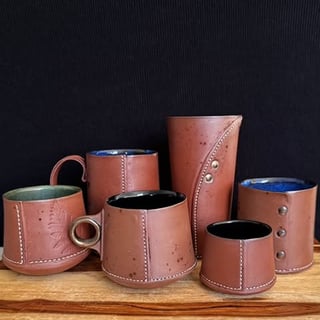
Speaker: a design knowing what it's going to look like. There's more often than not, I'll sit down and hold a mug and kind of just start carving on it. And if it ends up good, then I'll keep using that design for a while. If not, then I'll scrap it and move on to something else. Most of my designs are kind of evolved from designs that I have been doing. And a lot of them right now are kind of mountains and scenery and stuff like that.
Speaker: So that reflects, um, I like to travel a lot and, you know, go hiking and camping and stuff like that. So that's where a lot of that comes from. Yeah. I guess I would say it's always different. When you are like coming up with designs, how, what does that process kind of look like? I guess, I guess kind of along the lines of what I just said, it was, you know, sometimes I think about, I get an idea and I draw it out or write it down and then work on it later.
Speaker: or it just happens in the moment. I just think of something and carve it in the mug right then. Yeah, it's kind of sporadic. Sometimes it's intentional, sometimes it's not. Either way, it's exciting. Sometimes the unintentional designs are more fun than the ones that you've thought about for a while, because it's a surprise. It's always fun to get those out of the kiln, because you're not expecting much out of it.
Speaker: Right. So now the next thing I thought we could talk about would be your glazes. If you had to choose a favorite color glaze, what would that be? Right now, I use a lot of greens, purples and pinks and some blue. So I think that the purple and green, I have this purple and green combination that I use. And I think that's my favorite right now. All of my glazes are commercial glaze. I don't make my own yet. So, um,
Speaker: I don't know if you're familiar with the different, the glaze companies. Like Amaco and like stuff like that, yeah. Yeah, so right now, like the Amaco Celadons, I like those a lot, the blues and the greens, and then the Mako Lavender Mist and Green Tea, I think. Those are my favorites. At the moment, it changes. When you are applying your glazes, how do you try to match it with your designs?
Speaker: I don't know, that kind of comes in the moment too. Sometimes it's quick, like, oh, I know exactly what I'm gonna do with that mug or that design. Other times I have to sit down and think about it. If I don't know, I'll draw it, I'll draw a quick sketch and kind of play around with different glazes that could go on there. But more often than not, I just envision it and do it. And if it turns out cool, if not, try it again.
Speaker: until it works. When you draw it out, how does it kind of help you get your thoughts out? So when you're using commercial glazes, there are so many possibilities. Not only do you have a ton of color options, but when it comes to layering, it's just infinite possibilities. So drawing it helps me get these different ideas out of my head and onto paper. And even though I can't
Speaker: I'm not gonna sit in there and color in the different glazes, but I have an idea of what they're gonna look like. Putting that on paper kind of organizes it in a way where you can take that and apply it and kind of visualize what is gonna work best for that specific design. So now you get some pretty cool, awesome drips. Could you tell me how you were able to get this effect?
Speaker: There's a few different things, so it depends on the type of glaze you're using. Some glazes run more than others. You're firing schedule. I fire everything cone six. If you're using cone five, you're not going to get as much cone six, and then all the way up to cone 10, you're going to get more movement with your glaze. So that between choosing glazes that are going to run, firing them hotter, you can put in a hold in your kiln. So I put in.
Speaker: anywhere from five to 15 minutes, depending on what is going in the kiln, that can help with the movement and also using a flux. So flux goes on the, you can put it anywhere on the glaze, like underneath it or over it, that'll help movement too. So yeah, that's how you get pretty consistent drips and glaze movement. What is this flux that you're talking about?
Speaker: Yeah, so it's Mako Flux. They make two different colors of it. There's Light Flux and Dark Flux. Basically, it makes the glaze run. So you don't want to put it at the bottom of your pots because it'll drip right onto the shelf and stick. I like to put it around the rim or in the middle of the glaze. And it makes the glaze look more fluid and helps it drip down farther. Or if you want to get glazes mixing more together when they're firing, that
Speaker: helps a lot with it too. It's a cool product if you haven't used it yet. What is it called? Flux. Okay. So now what is something you have changed your mind about in the last six months? Yeah. So I was thinking about this, um, not the past six months, but over the past couple of years, I, I did not like when potters or ceramicists use molds like pouring, um, slip into molds. It just seemed like a,
Speaker: It kind of seemed like a shortcut or not like an authentic way of making pottery. Cause when you think about people throwing on the wheel and hand building, you are building that clay from the ground up. Whereas in a mold, it just seems like, Oh, you're, you're kind of cheating. Um, that changed. And I'm going to, I'm going to name drop. Um, when Kurt hammer Lee started, when he built, are you familiar with him? Yeah. Yeah. So when he started doing his molds and
Speaker: making his molds through his engineering software and making his pots that way, like that completely changed my mind. I'm like, okay, I'm sold now. This is awesome. It's great. And honestly, whatever, however way that you want to make pottery, that's, you know, do your thing. That's cool. So it's, yeah, I guess that's what convinced me. And I don't, I guess frown upon it anymore.
Speaker: What do you want people to feel when you see people purchase your pottery? That's kind of tough because I don't think about that too much. And since I sell everything online, or most everything online, I don't see people's immediate reactions when they're picking up and holding my pottery. But I just want them to like it.
Speaker: I think people can, they can feel however they want about it, but you know, as long as they like it, as long as it, I want it to be, I make mostly mugs. I want to make a mug that people are gonna go for every single day or that, you know, your go -to mug. Like that's the one I'm gonna use today. Cause it's comfortable. I like the way that it looks. I like the way that it feels. I like the design on it. So yeah, I guess any, any one of those things,
Speaker: Now, what advice would you give to someone looking to kind of start selling their pottery? Just start. I know it can get. Before I started, I was thinking you think and try to plan your way through it before you get anywhere. But, you know, the best thing to do is just start somewhere. Instagram is a good place to start. It's gotten really inundated with artists and potters on there.
Speaker: But if you have something unique to offer and you get really good at it, then that's the place to start. Start with your marketing, and then you can find out a way to sell it after that. Yeah, I think that's the tried and true answer to that. So could you tell me, what has helped you the most throughout your pottery journey? Consistency. You know, there's the saying that quality is better than quantity, but with pottery, it's a little bit of both.
Speaker: The more you make, the more, if you're a wheel thrower, the more you work on that wheel, the better you're going to get, the better your product's going to get, the more consistent your work is going to be. Um, cause you're practicing constantly. So, um, I think, I think that's the best. What was the question again? It was, uh, what has helped you the most throughout your pottery journey? Oh yeah. Yeah. I think, I think that answers that consistency and, um,
Speaker: You know, not, not giving up when things get tough or when things don't go your way. Cause it's, it's going to go, it's not going to go your way at some point and you just kind of have to get through it. When it doesn't go your way, what would you say to kind of like help people that like when it's they're in their low part and it's not really working out for them? Again, keep going. Just stay consistent, keep making things. If the,
Speaker: There's something particular that's not working out for you, then try something else. Take a break for a little bit. If you're having trouble with the wheel, throwing a certain form, try something else. Try hand building. Find the thing that you're good at and work towards that. And don't get too attached to your work. That's something, as a beginning potter, you want to keep everything. You want to fire everything. You don't want to let it go, but the more
Speaker: you throw stuff away or recycle your clay earlier on, the better you're gonna feel about your end product, because it's gonna be better than what you started with. If you can make it once, you can make it again. I totally agree, because that is exactly what I did, and it helped me a lot. That was some really great advice. So the next thing, one of my last comments will be, so if you had to give advice to potters looking to find their own style, what would that be?
Speaker: their own style, their own unique style. Yeah. Find, find a bunch of people online on social media that you, whose work that you like and, you know, kind of take inspiration from that. I don't, I wouldn't say like, don't go out and copy
Speaker: people's work unless it's for educational purposes, but everyone has to start somewhere. Find a bunch of stuff that you like, try different, those different techniques that those people use, and eventually you'll figure out what you like, you'll figure out what you're good at, and your style will kind of naturally evolve out of that process.
Speaker: So now this will be my last question here as we are wrapping up. What is one thing that you want my audience to kind of take away from this interview today? To take away from this interview. I think now a lot of people, pottery has gotten so popular over the past few years and a lot of people want to know where to start and they want to know how other potters and other artists get so good at what they're doing.
Speaker: And it's just to start somewhere, get out of your head about it. Go take a class, go find someone who has a wheel, go find someone who has clay, or just buy some clay and start making stuff. You don't have to have an entire studio set up. Just start somewhere. The same with the social media. If you want to start selling your work, just set up an Instagram or a website. I use Shopify. Let's see if that's your thing.
Speaker: and start somewhere and you'll, you'll learn along the way. That was some excellent advice. That was really great. That was, I really enjoyed our conversation. Where can my audience go and check out your work? So I'm on Instagram, wild pines pottery. And I also have a Shopify website. It's the same name. It's wildpinespottery .com.
Speaker: We hope you enjoyed this episode of Shaping Your Pottery with Nick Torres. Do you have questions about pottery that you'd like Nick to answer? Send them to us on Instagram at Nick Torres underscore pottery. We'll see you next time.