Transcript
Speaker: Hey, real quick before we get started and get into the episode, if you want to figure out how close you are to discovering your own unique voice, I put together a free little quiz for you to see how close you are to finding your own unique voice. If you would like to take this quiz, go to shapingyourpottery .com forward slash quiz, or you can just go to shapingyourpottery .com and it'll be right there.
Speaker: What is up, shaping nation? On this episode of Shaping Your Pottery, I gotta interview Sam Bregel. In this episode, you're gonna learn how Sam incorporates her love for clothing and how she incorporates it into her own pottery. You'll also learn about why you need to be truthful to yourself in order to truly start finding your voice and making pottery that you truly enjoy. And finally, you're gonna also learn about
Speaker: being selfish in the things that you make and what you want to make because this is what's going to help you discover your voice and help you improve as a potter. I hope you guys enjoy this episode and I'll see you guys in there. If you love pottery and want to take your skills to the next level, you're in the right place. Find your own pottery style right here on Shaping Your Pottery with Nick Torres. Let's get started.
Speaker: Sam, welcome to Shaping Your Pottery and share with me what is something you love besides making pottery.
Speaker: I think this was a tough question for me because I would say my biggest love is pottery. But I think, you know, anything that is like a project is something I love. So whether that's, you know, home repair, gardening, cooking, I really like cooking, which kind of lends itself to making pottery also. Yeah, so projects that use my hands, I think are my biggest love.
Speaker: So you, you enjoy like challenging yourself and like grow in learning with your hands. I do. Yeah. Love that so much. So tell me the story of how you got started with ceramics. The story. Let's see. So my, I went to college at UT for, my intention was to do art education.
Speaker: because I've always enjoyed art, and that seemed like the right avenue to actually make money. And in that program, you have to declare a major. And I had never taken a ceramics class before, but I was in an art history class sitting next to my now best friend, and she was in a pottery class, and she had mentioned that to me and said I should try it out.
Speaker: And then I did, and I think it's one of those things, a story that all of us sort of can relate to is like, you get bitten by the pottery bug and it's like, I want to do this forever. And then it also kind of encompassed all the things I love to do. I like to paint and do all these other art techniques and you can do them all in that medium of clay. And so, and it was functional. So that also,
Speaker: I think was important to me for something to be an art form, but also accessible. And then when I met the grad students, I realized I could go to grad school and then also teach later and prioritize making work. So I kind of fell into it. And luckily my program at UT was pretty well connected in the ceramics community. So I was able to like, you know, make those connections to.
Speaker: you know, kind of keep going in the field. And that was 11 years ago. So it's been kind of a long time. I love that. So after getting your MFA, you decided to attend some residencies. Can you tell me the story on why you decided to attend some residencies? You know, it had a lot to do with deadlines and, you know,
Speaker: I think a lot of people go to graduate school with the intention to teach in higher education. My thesis show was the very last one and all the applications had already been due for all of those things. I also had some health concerns at the end of grad school and I wasn't quite sure what the future of that was going to be. The residency that I did was at District Clay Center.
Speaker: the deadline happened to me much later than all the other ones. And it also allowed me to continue to make work and move to a new place and make some connections and kind of figure it out. And yeah, I think the most important part was that I had a space to keep making after grad school. So can you tell me what is something you learned from your time during these residencies that really helped you and you still use today?
Speaker: I think there were a lot of things I learned, maybe not specifically. It allowed me to take all that information that I was working on during grad school and really put it into practice. It felt like in grad school, a lot of
Speaker: I was doing little bits of things that I hadn't really expanded upon. So having that time to really not be in the academic setting and continue to revisit those ideas was important. Not only that, I also had a lot of teaching opportunities. And a lot of residencies are a work exchange where they might give you a stipend, but you're also working for the center in some way.
Speaker: And so I managed the gallery and the installed shows. And I think that was something I learned. I got a lot of like real world experience, like running a gallery space. And then also teaching, beginning pottery. Districtly had about 400, like I may be taught over 500 people how to throw on the wheel for the first time. In that year I lived there and that was a valuable lesson I
Speaker: was able to take from that. So. Dang, 500 people. That's a lot. It was, you know, pottery is growing in popularity. And this was in District Clay Center, which is in DC. And so a lot of young professionals wanted to try it out. And it was it was it was a lot of people I remember. So you mentioned that you were
Speaker: When you went to your residence, you were still trying to figure things out from your graduate school. Can you give me an example of that? OK, so let's see. I think there are a lot of things and OK, for example, you know the. I found grad school to be very intellectually challenging and intimidating. Like sometimes I was too afraid to do something because I didn't want to.
Speaker: like talk about it in a critique setting. And one of those things was color. Like if I added color to the work, I was afraid it was going to be the wrong color or just, you know, just any kind of, you know, fears of like not really like following
Speaker: my heart and doing the thing I wanted to do. So I think I added a lot of color into the work, which might have also reflected my less stressed lifestyle after grad school. I think the other part of that was I was really focused on form. So I think there's so many different aspects to pottery.
Speaker: that it's hard to explore all of them at one time. And so really focusing on form as an exercise for a while and then later adding in that color, really focusing on that. And so I try really hard to compartmentalize the investigations I'm doing and the explorations. So I think I had worked on form in grad school and then
Speaker: added in those colors and those patterns and textures. How did focusing on form really help you with pushing your pottery further? I think when I say focusing on form, I mean form being probably the only thing I was focusing on. I think it's really easy to get overwhelmed with all the different possibilities. And I think it's easier to manage by just
Speaker: looking at it as like, this is a form. And like, what are the decisions I'm going to make about that? That includes a lot of, you know, drawing silhouettes, looking at other forms, really. Yeah, just just kind of like letting go of all of the other decision making parts of ceramics and just focusing, like focusing on form and then just dipping it in a clear glaze or something. You know, just keeping it that like
Speaker: neutral color, and then that's leaving room for later exploring that. I love that. So shaping nation, it's important to really focus on one thing in time. Maybe it's form, maybe it's color, whatever it is, and just really focus on that one thing. And then when you're ready, you could start expanding even further. I love that so much. And then that doesn't mean you'll never revisit that again, right?
Speaker: we can move on to like maybe for a while I'm just focused on surface and then I'll just focus on handles and I'll come back to those explorations when I feel that I'm ready to evolve a little bit more. But I think it's really important to not feel overwhelmed and debilitated by that.
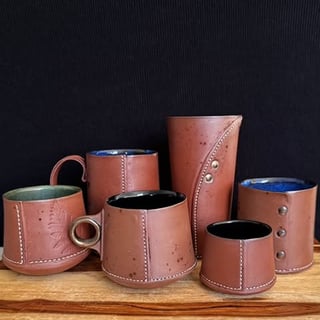
Speaker: for sure, definitely love that. That's some excellent advice right there. So let's talk about your pottery. In one sentence, can you tell me what you make? That was really hard because I think I'm a maximalist where nothing I do is like, and so what I have is, so I like to reclaim the identity. And what I mean by that is like the image or feeling of clothing,
Speaker: textures and patterns, oftentimes from from my own wardrobe. And oftentimes they have negative connotations to me, meaning like, maybe I grew out of something and now I'm thinking of that piece as something that makes me feel like a failure or
Speaker: Maybe there's a photograph of something I'm wearing where I don't enjoy the photograph. And so I'm trying, I know this is not one sentence. So I'm trying to take those and create objects that are nourishing and confident. And so I'm using the vessels as a body to inhabit those. So just kind of spinning those negative feelings into something a little bit more positive.
Speaker: I love that so much, that's really great. So tell me the story, how you started making this pottery that you're making today. Yeah, so that was a maybe, well, from the very beginning, my interests have always been a pattern, and I've always been drawn to porcelain because of that. It's a blank canvas to decorate, it shows details, and I've always been really interested in
Speaker: like hyper feminine aesthetics like florals, laces, you know, a lot of times you'll find on clothing. And but I was always skirting around that never really skirting, like literally, but I had never used like the actual clothing textures in grad school. And
Speaker: I think out of fear of it maybe ending up like looking very cheesy. Like I think there's, I'm not the first person to put lace on pottery. And so it wasn't until I really like took a leap of faith and like I created this, I found this moldable felt where I could sew it into a form and steam and harden it. And then I draped a dress I cut apart onto that and it had a denim texture.
Speaker: And then at the time I was slip casting, so I would slip cast, you know, I made a mold of it. And then it was this like denim picture with this like gold zipper and it's like both really amazing and ugly at the same time. But I unloaded the kiln and I ended up crying because I couldn't believe it actually like worked out. And I think that that was really the moment of like,
Speaker: I needed to keep exploring that and taking clothes that meant a lot to me. And really, we're honest. I think the best kind of work you can make is the work that is true to yourself and honest and vulnerable. And that felt like the most vulnerable piece I had made, which was also very scary. But so yeah, that kind of like set it in motion from there.
Speaker: I love that shaping nation. Sometimes you have to get a little bit vulnerable with yourself and start being truthful to yourself and start making things that you bring you true joy because that's where you're going to start finding your voice. You're going to start making party that you truly enjoy. I love that so much. So as you mentioned, you are inspired by clothes and the construction of clothing. What is it about clothing that inspires you?
Speaker: You know, I think I touched on that a little in the previous question, but a lot of it has to do with, you can't tell right now, but I'm 4 '11", and I have never been able to go to a store and buy something that actually fit me, and that was proportional to me. And I got a sewing machine when I was younger for Christmas at nine years old, and I just started taking apart all of my clothes and sewing them back together, but really trying to understand how
Speaker: those two -dimensional pieces were made. And I think that I've always been fascinated with how how clothing is made, like the process. I don't personally enjoy
Speaker: you know, making things for myself. So I didn't really go into the fashion design path because I didn't want to be the subject of my own pieces. And so I think in pottery, like I mentioned before, it can be anything. So, you know, why not make it like I would make clothing? And that's how it kind of ended up coming together.
Speaker: I love that. So can you give me a simplified explanation on how you create your pottery? Simplification is hard for me to explain, but let's see. So I mentioned that I had slip casted the textures before, but I wasn't quite, I didn't like slip casting as a process. It creates one thing and I can't alter it or change it. And so I ended up finding this process where I flatten
Speaker: the texture, lace, sequins, any kind of low relief texture. And I put coddle boards around that and I pour plaster onto it. And it makes about an inch thick plaster slab. And then when it cures, I pull out the fabric and I have the recess, the negative of the texture. And so I roll the slabs into that and then I cut them out.
Speaker: and attach them onto a thrown piece. Like, usually I'm throwing like tiny bowls, bowl -like shapes for the bottoms of mugs or pitchers, and then I'm attaching slabs onto that. So they're pre -decorated when I'm actually working with them. And then I have a screen printing process as well, where, you know, I'm taking, I take a photograph of a print and break that down into,
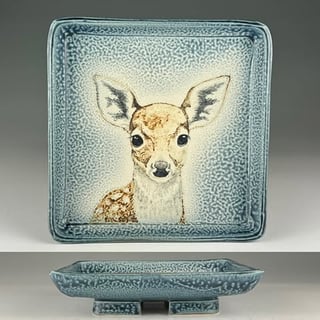
Speaker: different colors. And then I'm screen printing underglaze onto a pre rolled out slab, letting those underglaze layers dry, cutting them out and using those for the work as well. So it's slab built, but I'm building on the wheel too. And I stretch it out from the interior as well. I like when patterns
Speaker: can kind of stretch over volume. And then I trim it like you would any other piece of pottery and add handles as well. So it's like a combo throwing slab building situation. That was a great explanation of that. I love that. Sometimes it's hard to explain. So what is something in pottery that you believe is a waste of time?
Speaker: These questions, man. No, I think a lot of it is a waste of time. It depends on your definition. I think that, you know,
Speaker: There's all these techniques that we can spend a lot of time on, but I think what I tell students is that when they come to me with a crack, it's usually some kind of S -crack on the bottom. I don't recommend trying to fix that. I think just make another one, throw it away. It's going to take you so much longer. It also might not even work. I think it's a waste of time.
Speaker: Depending you know if you had already spent like hours on something sure maybe that Maybe I would try to fix the crack, but I think Fixing things that have gone wrong You could just easily make that again For sure. I absolutely love that shaping nation if you mess up on something sometimes the quickest method is just to simply restart it because you're gonna probably learn more from that anyways, and you're gonna have a lot more relief off your shoulders anyways, I love that you said that
Speaker: And the next one is going to be better, like most likely. For sure, because you already went through that experience. For sure. I love that you said that so much. So let's talk about discovering your voice. You contribute your growth as an artist to the consistent discussions and feedback from your time at university that allows you to process your work. Can you explain this to me how and how this helped you? Yeah, I think it's important to have both equal
Speaker: times in which we're immersed in making and which we're asking ourselves questions and observing. I think those discussions just made me really aware of the decisions I was making. Whether I needed a group of people to do that or if I needed to step outside of myself and really look at it objectively, I think that's the part of it that
Speaker: really investigating the decisions that you're making and why you're making them, and really asking yourself if those are working. And I think the other thing, too, in those group critiques or discussions is there's a lot of feedback that is hard to hear, and there's a lot that is positive. And I think remembering both the positive and the negative is important.
Speaker: and really taking the things that are working and expanding upon those and maybe leaving the things that aren't really serving you. So it's taking an inventory of the things that are working and not working and kind of moving forward with that. And I think it's important to step outside of the making process and really look at things.
Speaker: Definitely agree. Can you tell me what are some of the questions you would ask yourself that helped you with this? I think what are the questions? Well, I think you could maybe you could look at it in a composition way. Like you could, you know, follow the pot all the way around. You know, what are these like lines that are flowing around it? What is the negative space look like?
Speaker: I also think it's important to use the work that you're making and really understand how a handle is supposed to function.
Speaker: And if it isn't feeling right, like adjusting it next time and really identifying what needs to change. Or you could look at it more in the conceptual way where, you know, if my intention was to capture texture and pattern of clothing and it's not really doing that, then I would try to figure out a way in which I can make the object look like my intentions.
Speaker: So I think you can investigate it in lots of different, in the function of it and the aesthetic and also the ideas and the things that you're getting inspiration from, those should be shining through in the final product. Definitely, I love that. Shape Nation, the questions that we ask are going to lead us
Speaker: and get us closer to our voice because they're going to get us actually get us allow us to figure things out. I love that that that used to said that. So what do you think Potter should be focusing on to help them discover their own unique voice? Let's see what to focus on.
Speaker: I think for this, I would say that making a lot of work is going to really benefit you in your journey in pottery. In some ways, pottery kind of works itself out. If you are consistently making, you'll eventually start to identify those things that you really enjoyed making.
Speaker: what I would hope would happen is that you set up things so that you can continue to do that. For example, I enjoy surface and so I'm not really interested in atmospheric firing because I've done so much work in the beginning of the process that I want that step to be easier, the firing. For a long time I wasn't really
Speaker: interested in trimming. And so I found out a way to make things where I didn't have to trim them. And so really, maybe it's about being selfish, like really being selfish about like what type parts of the process you enjoy doing. I don't like to glaze either. So I use a lot of stain porcelain and underglaze and my glazing is kind of minimal. And so all of those, you know, I was giving preference to the things I liked doing.
Speaker: and making sure I was able to continue to do those things really led to my most honest work.
Speaker: Definitely agree. Definitely 100%. So shaping nation, it's important to be selfish in the things that you want with your potter. You don't always have to do all sorts of things. If you don't like glazing, you don't have to glaze. If you don't like trimming, you don't have to trim. Just do the things that you like and enjoy, because that's where it's going to lead you down further to finding your voice. I love that that you said that. And I would add that it is important to know how to do those things. But then you get to choose if you want to do them or not.
Speaker: Definitely, I definitely agree with that. Learn it, but you don't have to actually do it. Love that. So as we are coming to a close here, what is one thing you want to hammer home with my audience today? Yeah, I think I, you know, it's really just be true to yourself and your interests. I think, you know, I've always been interested in the clothing making process and that really shapes a lot of like,
Speaker: what the things I care about and the things I want to make. And I want the work to feel really positive and confident. And so I think as an, yeah, I think being really true to yourself, even if it feels scary is important. And also along with that, you know, I think it's easy to follow trends and, you know,
Speaker: try to form your voice into what you think others would enjoy. But I think it should be you decide what you want to make and then find the people who are going to love that and the market and the right fit for the work. So I think you can achieve that. You just have to find the right people who will also love it.
Speaker: Definitely. You have to be selfish. Like you said earlier, you have to be selfish about that. I love that. So Sam, it was really great sharing with you today. Where can my audience go and learn more about you? Sure. So you can look me up on Instagram at Sam Bregel, all one word, or on my website, which is SamanthaBregel .com. I have a shop there as well, and that'll
Speaker: There's links to upcoming workshops and places where you can buy the work. And yeah, I'd love for you to follow me. It was so great sharing with you today. I hope you have a great recipe day. Thank you. You too. Bye. We hope you enjoyed this episode of Shaping Your Pottery with Nick Torres. Do you have questions about pottery that you'd like Nick to answer? Send them to us on Instagram at Nick Torres underscore pottery. We'll see you next time.