Transcript
Speaker: Hey, real quick before we get started, if you would like to find your own theme for your pottery so your voice really stands out and you're not getting bored with making the same thing over and over again, I put together 53 themes for you guys and it's completely free. All you have to do to get it is just go to shapingyourpottery .com forward slash 53 themes. That's shapingyourpottery .com forward slash 53 themes.
Speaker: What is up, Shaping Nation? This is Nick Torres here. And on this episode of Shaping Your Pottery, I got to interview Carly Slate. Carly makes some really incredible sculptures of buildings, cars, and even recently mail ordered pottery.
Speaker: In this episode, you will learn how Carly makes her pottery and her sculptures and how she turned one of her slip casted cars into an RC car. Finally, you'll also learn about how you could start getting over imposter syndrome and there's so much more. I hope you guys enjoy this episode and I'll see you guys in there.
Speaker: If you love pottery and want to take your skills to the next level, you're in the right place. Find your own pottery style right here on Shaping Your Pottery with Nick Torres. Let's get started. Carly, welcome to Shaping Your Pottery. And share with me, what is something you love besides making pottery? Oh, man, this is going to make me sound pretty basic, but I'm going to go with cats. It's part of my brand now. It's who I am, so cats. Love it.
Speaker: So tell my story how you got started in ceramics. I went to undergrad to Alberta University of the Arts. It was Alberta College of Art and Design when I was there, but it's changed its name. But I went there to be a painter. I really fell in love with painting in high school. Although I told my parents that I was going to go there to major in design so that I'd get a job.
Speaker: I really went there for painting and then I took a ceramics class just kind of on a whim kind of as a joke. I didn't know ceramics was an art form. As a kid I thought that ceramics was stone carving and drawing and like oil painting I guess. I was 17. I took a ceramics class and I remember walking in the studio the first day and
Speaker: just my mind was blown and I remember thinking like people play with clay all day every day like this is a thing and it was just I maybe took a few classes and I was just completely hooked and my whole life just kind of pivoted and since then it's been all clay. I love it. Tell me the story about why you decided to attend a residency at Watershed.
Speaker: So I've been to two residencies at Watershed and both of them were artists invite artists. So I was invited by an artist to be part of a group, kind of. So the first time it was part of a performance, ceramics performance residency. So in grad or an undergrad, I had a full formal wedding ceremony and I married Clay. I put it on wheels and I walked it down the aisle and I had an efficient, efficient, efficient, who was reading the Daniel Rhodes ceramics book.
Speaker: Like as our Bible, and I had a flower girl and a ceramic cake. So I was doing these kind of weird ceramic performances, and I believe it was summer zik -fus? Zik -er -fus? I'm probably pronouncing her name wrong. But she put together a group of ceramic artists from Canada and the U .S. that were doing performance art. And we went down to Watershed and things got real weird.
Speaker: And it was a lot of fun. And then right before COVID, I got invited out there by Hannah Lee Cameron as part of the Ceramic Sculpture Culture Collective Residency. They had a couple of their members that couldn't make it, so they invited me. And that also was a ton of fun. And Watershed is just one of the most magical places on earth. And if you have a chance, go apply. It's amazing. So how did Go Into Watershed help you with growing as an artist?
Speaker: Yeah, I think it's different when I went right after undergrad and then when I went a few years ago. I think right after undergrad, it gave me a lot of confidence. I would have been 22, 23, and I was there with these like real grown up famous artists and it was amazing to be around them and be like, okay, I've been invited to this table. And I think as artists, a lot of us, I struggle with imposter syndrome a lot.
Speaker: And just to be amongst that caliber of people and kind of like making work and alongside them, you're like, okay, I can do this. And I think too, realizing how big the ceramics world is, although we are kind of a small community, but there's so many people all over the world, over the country, North America that love clay, and there's so many different places to go. So I think it just kind of really expanded my mind the first time. And the second time,
Speaker: The people were amazing. We had a ton of fun. We, we partied, we made stuff. Like it was so good. And I think to just, especially once you start teaching, so much of your life becomes teaching and doing a residency reminds you of why you started. It's because you love clay and you love being an artist and just like giving you reset time. So what is something, what is something you learned from this residency, these residencies that you still use today?
Speaker: The first watershed residency, I met a woman whose name I forgot, and I feel like a monster, but I can see her in my mind. She showed me this product, this product. I had it somewhere called Easy Screen Print, and it's a screen printing, flexible screen printing medium that I still use today. There's like lots of little techniques that I kind of learned along the way, but that was one of the first ones where I was like, whoa. And I was using it, I'm using it right now, making my, I'm making my mail mugs over there, and I'm using it for that.
Speaker: So let's talk about your pottery. In one sentence, can you tell me what you make? One sentence. Ooh, that doesn't count. Or that one. What do I make? I mean, I would say, first of all, I don't make pottery. What do I make? I mean, I think my like professional elevator pitch would be that I make work about the precarious nature of the working class. What I would casually say, I make trucks and trains and dumpsters and
Speaker: like just kind of detritus from like the man -made world sorry so you mentioned that you don't make potters tell me about that i say that i make fun shinal wear
Speaker: But it barely functions, but it's fun. I think I have such respect for potters and the skill set that that involves developing and honing that I would never call myself a potter. I'm a ceramicist, I'm a sculptor. Sometimes I make pots because I love pottery and I love being tied into the pottery part of the ceramics community and I want to like hang out with them and show with them. But I don't think that they function terribly well.
Speaker: So I would never kind of take that. I think that title is like earned. So I wouldn't kind of steal that from them. So tell me the story, how you started making the sculptures that you make today. Yeah. I guess it depends kind of which phase of sculpture we're thinking. Like making the buildings or miniatures or what do you... So let's talk about the cars that you make. I love the cars. When did I make my first car?
Speaker: Probably in grad school, I would think. Yeah, actually in grad school I made a train. No, I made a train before that. I worked in construction for 10 years on and off. I grew up in a blue -collar family, so that's always been part of my background and what I'm interested in.
Speaker: And I think it just was kind of natural for me to physically made buildings kind of in the real scale to then make the miniature. And I often think of myself as like putting up like tiny sheets of wood and like putting the roof on a little house. And I think cars to me came out of spending a lot of time in work trucks and thinking about different trucks that represent labor.
Speaker: So semi trucks that bring all of the food and all of our anything we buy that truck that from a port or from a factory somewhere thinking about those like invisible that invisible labor that we kind of maybe don't notice until it stops working. I made a moving truck when I was moving around a lot because that just kind of felt like it embodied where I was at. I guess I use trucks to talk about the people that
Speaker: Working them driving them. So thinking about like the working class and people Doing the labor to keep our world going So you You don't only just make Cars you also turn them into pretty much RC cars. Tell me tell me about that yeah, I always wanted to make a car move but like I
Speaker: I was like, how am I ever going to do that? And I put them on wheels, but that didn't work. And then last year, I was living in Wyoming. I had a good friend, Dave Jones. And he was like, why don't you just put them on RC bodies? And I was like, yeah. So I went and got some RC cars. And I learned all about RC cars and the culture of RC cars and made friends with this guy, who's a big RC car guy. And he gave me a lot of advice. So I got a bunch of 118 scale.
Speaker: I think they're rock crawlers. I haven't learned all my vocab yet and just took the shell off of the car and modified it so that I could put the ceramic body on top of it. I actually showed it in an RC car show here in town last weekend. That is a really cool idea. So you are inspired by the built world around you. Can you tell me how this impacts the way you make your pottery?
Speaker: Yeah, I think that I do a lot of research on how these things are made so that I can make them the same way.
Speaker: Like when I was living in Philly and I was doing a lot of flat roofs, I watched a ton of YouTube videos and researched a bunch on how flat roofs are made so that I could kind of like lay down the shingling correctly and lay down the tar lines correctly. And when I'm making trucks, I'm always researching like, what's this part that I'm sculpting or where's this pipe go? Like I want to understand a bit more about what I'm making and I'll go on Instagram and comment on some semi -truck drivers.
Speaker: I've come to, I've like sent them DMs before and been like, what's that silver thing under the door? What does that do? And they're often really nice and will like tell me all about the different parts on the trucks. So I think about
Speaker: Like how I would make them in real life. When I make a building, I first, I think about, I think to myself that I'm like cribbing out the foundation along the bottom, which is the concrete. And then I think about myself like putting up the walls. And then I think that I'm like installing window. So I guess I, yeah, maybe it's a God complex. I'm not sure, but I just imagined myself as like a giant making these things. I love that. So can you give me a simplified explanation on how you create your pottery?
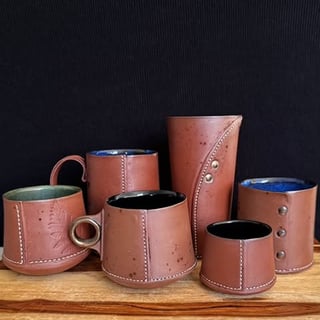
Speaker: I'm going to use pottery to mean sculpture. Yes. Cool. I'd say that it's, well, it depends, but it's either slip cast or it's hand built. So lately I've been doing more slip casting, I think just cause of the pressures. Well, I go through phases, but also the pressures of teaching. I mean, I don't have that as much time in my studio anymore. Or if I want to make multiples of something else, I'll do slip casting. So the mail mugs that I'm working on right now, and those are, do you want to see one? Yeah.
Speaker: These are just this, so they're gonna get a bit nicer. But it's like a bunch of USPS totes stacked up, and then all this tiny mail. So these are slip casts. I've got the molds behind me, and I'm coloring the porcelain to make all the different colored mail, and then I'm stacking it all up. And then I've got those little tiny screen prints, and that's how I'm making all these labels on it. So those are pretty fun. Trucks were slip cast too. I bought...
Speaker: like perfect kind of nice collector models of the trucks i wanted and then i broke them down into pieces and i made molds so to make one of those trucks i got everything here this is just one of the bodies that didn't make it so i think it's like an eight part mold maybe just to make the truck and then there's molds to make the rear view mirrors there's a mold to make the dashboard there's molds to make the steering wheel this also has chairs inside of it that have molds
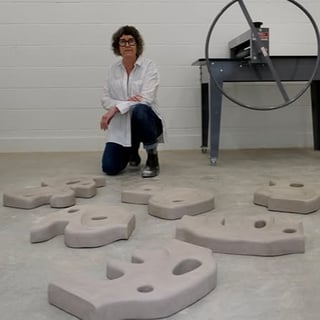
Speaker: So a lot of those are mold made and then my large buildings or kind of my larger vehicles, those are all slab built. How did you come up with the idea for the male mugs that you're making?
Speaker: I think I'm really interested in systems, so the mail is just amazing to me. You put a piece of paper that a breeze can take out in a mailbox, and it can make it across the world. I just think that's amazing. It's a union institution, which I really like. Government owned, I really like. All that kind of aligns with my politics, so I love that. I love their little white vans they drive around in.
Speaker: And I think being Canadian, the American, the USPS just kind of seems like cartoony and cute in their like little white vans. And then they have these, these things, which I totally don't have. But the first time I got one, somebody left it on my porch and I took it in and I felt like such a rebel. And I felt like I was like on an episode of like friends or something and I had my own USPS tote. Yeah. And it just seemed kind of lighthearted and fun and like an homage to that system.
Speaker: I love it. So let's talk about discovering your voice. Can you tell me about the moment when you knew you were heading in the right direction with your pottery? Yeah, I mean, I think I always knew it was the right direction for me, but maybe when I started kind of getting a response that affirmed that. I remember in grad school, I wrote an artist statement for a show that was super informal and personal and kind of like what I really thought and felt
Speaker: And I was worried I'd get a lot of pushback for it or people wouldn't understand because it wasn't like the formal academic writing that I thought an artist statement had to be. And people responded to it so well. And it was for a corner show where I did some corner store buildings. And after everybody came up was telling me all about their corner stores and telling me all about these different things. And it was just this really gratifying moment to be kind of like, okay, I can like be my honest voice and talk about what I want to and like,
Speaker: people connected with it. And that felt like a real reaction. And that's when I was really like, okay, but just let it let my freak flag fly and just get more and more into that. I love that so much shaping nation, if you could be honest about your work and what you're making, then other people are going to notice your honesty and they're going to enjoy it as well. So earlier, you mentioned imposter syndrome was has been a big part and it's kind of kept you I guess from
Speaker: making more moves. Can you tell me how have you dealt with imposter syndrome? Yeah, I think one thing is you realize that everybody has it, which helps. I've talked to a lot of friends who to me are like, so successful and so famous, and they feel the same way. And I'm like, Okay, I think what I've, I know is this solved, but the way that it's getting better for me is
Speaker: reflecting on things that I've done and things that I've accomplished. And I hope one day that I don't need to reflect on external validation, but for now, that's what I have to do. And that works. And I'll kind of remind myself, like, oh, I did this, I did that, like, cool, and like, get the confidence from there. I love that. Shaping Nation, an easy way to kind of overcome imposters is to look at your past work and see how far you have come to what you're making now. I like that a lot.
Speaker: So what was your biggest obstacle when it came to discovering your own unique voice? Hmm. I don't know if it was an obstacle, but I think it's natural that in the beginning you should try everything. So maybe something I see in students a lot, I think, is this rush to find that voice and the rush to kind of grab onto something and stick to it. But I think it's more important in the beginning to spend as much time as you want
Speaker: going these different directions. I for a while was obsessed with throwing pottery on the wheel. That is something you will never see me doing again. But I got really deep into that and it just like didn't really feel right. And I was doing abstract forms and I was doing trying all these different areas and all these different styles until I kind of landed on something that felt right. And I think the other thing is when I look back at
Speaker: all the work I've ever made, it all had the same kind of thread. I still have this piece and it weighs like 10 pounds, but this is the first teapot that I ever made.
Speaker: And it's very much like similar to what I make now. And it's interesting if I look back at all my work, there was this like common thread that you can start to find. And there are these, there will be like shapes that you always come back to or themes or colors that you always come back to. You just need to kind of recognize it. But I keep this around to show myself how far I've come and to kind of be like, huh, even back then I was making trains. I wouldn't make a cow. That's a spout again. I wouldn't make a cow period. And I melted the lid on.
Speaker: But hey, we all start somewhere. But I think first, I think like whatever is your style is inside of you already. And you just kind of need to spend some time excavating it and finding it. Definitely agree. So what is a quick win someone can do to help them start discovering their own unique voice? I think you start looking at a bunch of art and figuring out what you like and then also just as importantly finding out what you don't like.
Speaker: And it can be like, I like representative things. I don't like abstract things. I like bright color things. I don't like dark colored things. I think all of that is important. I also think.
Speaker: I still do it now, not as much, but in the beginning, every new piece I made, I made sure that I tried something new in that piece. So a new technique, or bigger, or smaller, or new colors, like always be trying something new and then deciding. And I think another thing that I did a lot in the beginning was to come up with a new technique or something and take it all the way to the end, take it all the way past that, and then find out where along that line you're happy. So save that size.
Speaker: make things like medium sized, huge, bigger, bigger, bigger and then find out and then look at them, line them up and be like, where am I comfortable on this spectrum? And then you kind of have one thing figured out that you can move forward to. I definitely agree. Shaping Nation, you have to figure out what you like, but you have to figure out what you don't like and apply the things that you like and keep doing those things and also try new things to find out new things that you like. I like that a lot. So what are you doing to evolve your voice even further?
Speaker: I think the latest thing would be the mechanizing of the trucks. So that was a big goal that I always had was to kind of get ceramics to move. So that's pretty exciting for me right now. Making these mail mugs, I've never really sat down and spent this much time attempting to make pottery before. Because again, I'm no potter.
Speaker: So that's fun. And like I said, I want to be friends with the pottery world and hang out with them. So I'm excited to have more conversations with potters. I'm doing a collaborative show of a collaborative male show with I don't know if I can talk about it yet, but a well known
Speaker: Another well -known Trump -Loy guy who makes material that is often used in shipping boxes at a gallery in Tennessee in December. So I'm excited to collaborate and explore there. And then percolating in my head is a project that I've kind of always wanted to do that involves found
Speaker: ceramic souvenirs and stuff and mixing that with souvenirs that I've made and playing with decals and luster and kind of going back and forth between something that is handmade and mass -produced to talk about posing insecurity issues. I'm excited. Thanks for making me sum that up. You're welcome. So as we recover to a close here, what is one thing you want to hammer home with my audience today?
Speaker: I think that a big thing that is important with teaching now and something I wish I hadn't done was I got through all of undergrad without ever having to write an artist statement. And at that time I thought I was like winning.
Speaker: the system and then you realize that for everything you apply to you need an art statement and everybody wants to talk to you about your art and it's very important and it's really scary in the beginning. But what I realized and what I tell students similar to finding your style is the concept for why you make your work is already inside of you and it is intrinsic to you.
Speaker: So you don't need to come up with some BS, my work is about yada, yada, yada. Your work is already inside of you and what it is. And you just need to kind of sit down and dig into it and figure out where it comes from. So that would be my thing. Circling back to earlier, don't lie about it in an artist statement. I find the more honest you are, then the more true to yourself your work is, the more people respond to it. I love those last parting words. Carly, it was so great chatting with you today. Where can my audience go and learn more about you?
Speaker: Like if I'm on Instagram at Carly Slade, C -A -R -O -Y -S -L -A -D -E or www .carlyslade .com, but Instagram kind of has all that stuff there.