Transcript
Speaker: If you love pottery and want to take your skills to the next level, you're in the right place. Find your own pottery style right here on Shaping Your Pottery with Nick Torres. Let's get started. Welcome to Shaping Your Pottery, where we help you find unique ways of making pottery. Today, I am interviewing Kate Huckbruchner. She makes some amazing looking pottery. Her designs are out of this world.
Speaker: You have to really have to go look at her pottery. Kate, welcome to Shaping Pottery and tell me one thing that people might not know about you. Well, one thing people might not know, I think, would be that I work at the Genesee Country Village and Museum. I post about it occasionally on my page, but
Speaker: Recently, I haven't posted as much. So I share it more in my stories than on my actual page. So that means that my day job, I am dressed up like a boy in the 1800s. I wear a cap and overalls, I'm dressed up and I'm making historical pottery on an old fashioned kick wheel. So it's pretty fun, but it's unique. So how did you get started with pottery?
Speaker: So in elementary school, I grew up doing little things, but in college I went to school for art. Didn't know that I was going to end up in ceramics until I had taken a few different courses. I had to take all the basic arts, but I was a drawing concentration. And then I took a pottery class my sophomore year and fell in love with it. And then after that, I studied abroad to get a little bit more experience. And after that,
Speaker: decided to officially switch my concentration to ceramics. So I finished my degree and from there it just kept on rolling. Tell me your experience with your studying abroad.
Speaker: Yeah, so that was a really unique experience. It actually wasn't one that was offered through my school. I really wanted to do an art program. I wanted to do a ceramics program, so we had to kind of search a bit. It was offered through Ohio University, and I was a SUNY Brockport student.
Speaker: I was a New York college student and I found a school that offered a ceramics particular program in Ohio. And so I was one of, I think, probably 14 or 15 students. And I was the oddball out. Everyone else was OU students. So that was pretty cool. But they, you know, welcomed me as their own. We went abroad to Hungary for a month and we lived at the International Ceramics Studio in Kestkamet.
Speaker: and lived and breathed and eat pottery. Well, not literally ate the clay, but you know, it was great. So we traveled around Romania for a week and then we spent the rest of the month in Hungary, just learning how to make plaster molds, how to slip cast. So that was really unique because I didn't have that opportunity at Brockport. We did hand building and throwing, but there was no slip casting in part of our program. So,
Speaker: I got something else that I wouldn't have gotten back at Brockport. And that really influenced the way that I finished out my school when I came back to Brockport. I kind of self taught for the rest of my program and continue to do slip casting. And that helped me kind of get out of my box because I had a really hard time in college. Like I love throwing, but I couldn't, uh,
Speaker: I couldn't alter the pieces. I couldn't decorate them. Like I didn't want to ruin the perfectly formed piece that I made. And it was really hard to do surface decoration. And so when it came to slip casting, I could just slip cast the same piece over and over again and play with decoration and not worry about ruining it. Cause if I, you know, didn't like what I did to the piece, then I would cast another one and try it again. So that was, that was really helpful in my experience and my learning.
Speaker: What was kind of like the biggest takeaway, I guess, from your trip? Well, if I'm talking like not pottery related, just traveling and seeing other countries, experiencing other cultures, that was huge. That was my first time out of the country.
Speaker: other than like a trip to Canada. So it gave me the travel bug and then I just wanted to explore and do more travel. Would you say that kind of helped you like develop your own style of pottery a little bit? For the time, yes. I don't do slip casting anymore. I did keep up with it for, you know, as I mentioned, a few more years through college and then
Speaker: for a time out of college, but my work is completely different now. So it definitely had a role, and especially as I mentioned, like the painting, the surfaces. So I was doing underglaze decorating on my slipcast pieces, and now I'm painting with slip on the dark brown clay. So it still has an influence, but in a totally different way. It got me into the surface decoration.
Speaker: Could you, so now I know you recently, pretty recently, like a year maybe, you started a studio, a pottery studio. Could you tell me the story behind that? I did, yeah. So that was kind of a beautiful, happy thing that was not part of my plan originally. It kind of just, it came to be through just great circumstances. So I had,
Speaker: met my who is now my current studio partner Jennifer Buckley. She is the tea pottery and I met her when I was unemployed about a year out of college and I volunteered at a pottery festival. I met her at the picnic afterwards and we got chatting and then
Speaker: She asked if I needed space to work. And so I was like, yeah, I mean, I don't have a place right now. I'm just kind of doing stuff out of my basement and whatnot. And so she invited me to share some space in her studio. So I'd go hang out there for the summer and make pots and slip cast. And she'd let me fire in her kiln. And so that's how I met her. And then, you know, fast forward, COVID hits, fast forward a little bit more, things were, you know, getting a little bit
Speaker: open again, things were getting better. And so I invited Jennifer over to my place. We sat out on the porch and had a glass of wine and we're just catching up because I hadn't seen her in a bit. And so she currently her studio was in a building called The Hungerford. And it's full of artists, artists, studios, all sorts, not just potters, they've got painters and printmakers and
Speaker: and woodworkers and you name it. So she said, so my daughter told me she noticed that the space on the first floor opened up and she suggested that I move into it. But it's quite large. I don't think I could do it alone.
Speaker: So she's like, oh, well, you should see if, you know, if another artist would be interested. And so she just like posed that out there. It wasn't, you know, it was more just like a, hey, she suggested this. And immediately I was like, okay, tell me more, like, give me more details about this. So we talked more, she got more info from the building owner and we just kept, that was, it was like a seed, the seed was planted. And then we just kind of rolled with it. And then,
Speaker: Gosh, that was maybe, uh, I don't know when that conversation happened. It was probably like May or June or something. And then, um, by December we had opened. So it, we had, uh, kind of we're solidifying things and we were supposed to kind of be in around September or
Speaker: October ish, I think was when the lease was like supposed to start. Uh, and then it took a little bit to kind of get things finished. They had to do some painting and some electrical and plumbing and, and build like built some walls for us and whatnot for the showroom. But then we officially opened, we had a soft opening cause it was still pretty pandemic -y, you know? Um, but so we opened in December of 2020.
Speaker: For those that are listening, I think that's a great lesson because sometimes you have to roll with the punches and just figure out things as you go. Yeah, for sure. It was a risk because obviously we chose to open a space in 2020 during the pandemic when a lot of places had the opposite. They were closing.
Speaker: I think for me, it felt comfortable because it wasn't alone. It was with a partner and she had already been in the studio in the building for 15 or 20 years. So she has a lot of experience and it was going to offer us the opportunity to have a storefront. So for me, I was sharing some of her studio, but I wasn't, I didn't have, you know, a studio rent to pay for and then having to like only sell solely online.
Speaker: or find other avenues to sell, I could sell face -to -face to customers that walked in my doors. So that was a huge shift for me and that was huge. How did you come up with the name East Main Clay?
Speaker: We thought about it for a while. We debated what we wanted to name our store. Being two different potters, I'm kateded ceramics. Jennifer is the tea pottery. We didn't want it to be solely her or solely me. We wanted it to be both of us, to be mutual. And so the Hungerford, the building is located on East Main Street in Rochester.
Speaker: And so we're both potters, we both work with clay and so naturally that just kind of lended itself to east main clay. And it just, one of us mentioned it or I think I came up with it or I thought I did and then she kind of came up with it too. Like we both separately thought of east main clay and then like posed ideas to each other and we're like, hey, that works, like that's great. But that's the one, that's the one right there. Yep, it just fit.
Speaker: So could you tell me three pieces of advice for someone looking to kind of start their own studio? What would you tell them? Yeah, yeah, absolutely.
Speaker: Honestly, just start. You've got to start somewhere. I started literally in my basement. If I scroll back somewhere, I can find a photo of my basement and it was literally just a plastic fold -up table and a bookcase that I got off the side of the road. I had my plaster molds, I had my slip down there, I had my stuff, and I was just making stuff in my basement. Then I would transport the clay, I'd transport the pots.
Speaker: to studios to fire it. I didn't have a legit space. I rented an apartment and so I just had to make do. But I called that my studio and that worked. And then eventually, you know, you take the next thing, you take the next, make the next move. So I would say one, just start somewhere.
Speaker: to accept help. That's been a learning process as I get older because I'm a do -it -yourself achiever. I can figure this out type of deal. Yeah, but you really can't do everything without help.
Speaker: Yeah, accepting help is a huge game changer and it takes a lot of weight off yourself, but you can rely on some other people. So, you know, if that means, you know, accepting some used equipment or just
Speaker: you know, when it comes to sharing some space or, you know, renting a corner of a studio or whatever, just, um, you know, working out the details and, and using what you can in the time period that you're in. Um, I'd say get creative in that sense too. Like I, again, I had to transport my pots. I didn't have a kiln. So I was like, Hey, I'm going to fire this thing. I can't, I don't want to put a kiln in my rental. Um, so I'd have to carefully pack up my pots and transport them to
Speaker: the local community studio down the road or to Jennifer's studio that was on the fourth floor. So I'd have to take it up like an elevator or across town to another studio. So, and then just give yourself grace, like grow as your business grows. You can't, you don't have to do it all. That was, that's kind of was a mantra for me starting off was like, okay, just take a deep breath, grow as you can. And like,
Speaker: You can't do it all. And you don't have to do it all, not right away. It'll come, but it takes time. If you had told me that I would be where I am now, four, even probably three years ago, I'd be like, yeah, you're crazy. So it just, it takes one step at a time. I love that so much, especially that, take the gray spark because that helps so much when you just have to slow down a little bit and just take a breath.
Speaker: Yeah, I think we can put so much stress on ourselves and being a potter. I mean, it's not stressful. The making part of it doesn't have to be stressful. Like, you know, often people say like, oh, pottery is therapy. It's so soothing. And yeah, it can be, but like there's parts of being a potter and having a business that are stressful. And so if you can learn to give yourself grace, that is just super freeing because it's like, okay, as long as it's not time,
Speaker: Uh, like, you know, the clay is going to dry and you have to get something done in a particular stage. Obviously, like the work will be there. The something will be there. The task, the to -do list, it's going to be there. So start somewhere, just get the priority done or something that you can get done and accomplished quickly. Get that done first, and then just move from there and give yourself grace when you can, because we do it because we love it and it should be enjoyable.
Speaker: I agree 100 % with that. So now, the next thing I think we should talk about would be your style of pottery. If you had to choose a favorite glaze color, what color would that be? Gosh, that's always changing. I mean, I have my true ones that I always stick to.
Speaker: And honestly, I have a collection of all my mugs as well. So when I make a new design, I'll keep one for myself. So I'll pick a different one depending on the week or depending on the day. And same with the designs too. The designs of mine, one will be a favorite for a while and then something else will peak.
Speaker: and be my favorite. I really love the blue, but the blue is tricky because it runs. It's like a love -hate relationship. I love the look of it. I hate working with the glaze because it's just annoying. It's just a butthole working with you. Yeah, exactly.
Speaker: And then, you know, I'm trying some new things too. So I'm excited to see where the glazing goes because I was solely using commercial glazes, which they're beautiful, but they are expensive. So I started getting into
Speaker: Mixing glazes and and then doing some combos so certain glazes look really beautiful that are just a mixed recipe other ones I really love the commercials and so I've been playing with layering them because the mixed glazes are kind of flat and then if I put a layer or two of the commercial over top it gives me the depth that I'm going for but gives me less issues because sometimes my commercial glazes would have some pinholing and
Speaker: issues too, so it kind of actually worked out in my favor to work in that direction because it's a little cheaper. Still takes time to layer, but is worth it because I get the depth in the glaze and fewer issues. To control the glaze a little bit better. Yeah, yeah. So could you walk me, you make some really beautiful designs. Could you walk me through how you make your designs? Yeah, so
Speaker: like how I come up with the designs or how I actually like go about and paint them or both. Well, sure. So.
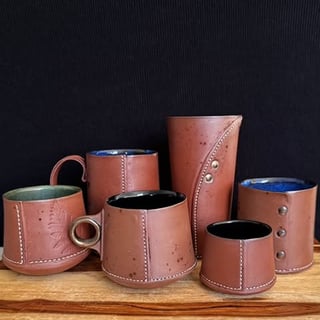
Speaker: I paint with a white slip on the dark chocolate clay. And so I collect that slip as I'm throwing. I will sieve it twice so it's nice and smooth, water it down to the right consistency that I prefer. And then I wait for my pots to be bone dry before I decorate them. Then I'm less likely to smear them. I'll just be able to hold the pot carefully.
Speaker: and paint the decoration on. Most of them are pretty much completely freehand. The very few times I'm, you know, doing something, kind of planning something out, like the sunflowers, I'll just give myself a little sketch circle so I know kind of where those are going to place around the pot. But other than that, everything else is pretty much just freehand.
Speaker: And I have a tried and true favorite paint brush. It's got like the smallest little like curve in the bristles. So it's like, you know, it's old and it's just become that brush and it just has the perfect stroke to it. And I love it. I've got a couple of little squeezy bowels, one with a finer point and another with a larger tip so that I can get the right dots or the right trails that I want for the line work and the dots.
Speaker: So yeah, I paint on the greenware and then they're whisked onto the pots. When it comes to designing them, coming up with the patterns, I have my typical designs. I've got roses, sunflowers, I call them leaf vines. The blue one, I've kind of gone back and forth between that name. I call them tulips or Jennifer's called them anemones.
Speaker: And then I've got my dragonflies. So those are probably my main five. And I, I don't know, the roses and the sunflowers were pretty easy for me to kind of come up with. And then on the green,
Speaker: the vines were just trying to, you know, get away from like, ooh, like bam, floral, like give kind of the guys a mug that might not be so, um, girly. Yeah. That's, that's the word. Yeah. So the vines are a little bit less girly. And then, um, the tulips were kind of inspired by, um, some pots that I designed for that I make at the, the Genesee country village.
Speaker: They've got a similar floral, so I just kind of zhuzhed that one up more and added some more petals and kind of covered the pot with those instead of just the one on a side of the mug.
Speaker: And the dragonflies are special because that was inspired by my fiance's mom, so my future mother -in -law. She loves dragonflies. She's got them all over her house. And so I made a piece for him years ago for her, and that's how the dragonflies were adopted, or how they were inspired.
Speaker: I know this one is kind of a bit weird, but if you, what is an unusual habit or an absurd thing that you love to do? Oh gosh, I was trying to think of something for this earlier and I'm like, I was tracking my brain. I don't know if I've got something.
Speaker: Let me give you an example of one of my weird things. So when I'm like listening to like TV or something and I hear a voice, I will try to and I like that voice. I'll try to mimic that voice. For example, like Optimus Prime, I'll try to mimic that voice. Oh, my gosh, that's hilarious. See, I could not do that. I'm awful at imitations, at accents, you know, any game where you have to try and like, no, I would fail immediately. I'm awful.
Speaker: but I applaud anybody that can because I can't do it. So how has a failure or a parent failure led to future success?
Speaker: I would say, well, so I teach as well. And when it comes to teaching pottery, I tell my students that you're, you're going to fail. But that is part of the learning process and it is, it's, it's how you learn best. One of my favorite things to share and what I've shared a lot lately with school groups, kids that have visited the museum,
Speaker: is that I've seen it on as a quote, it's not like a poster that I've seen. And it says that the master has failed more times than the beginner has ever even tried. And I just I love that because it's so true. But when you see a master,
Speaker: You don't see their failure. You see these beautiful pots that they've created. And you aspire to do that, to be that, to make that. And you just want that to come instantly. And that's not how it works. It takes a lot of patience. It takes a lot of practice. It takes a lot of repetition and a lot of failure. So just getting over that fact and trying again,
Speaker: And then the nice thing with pottery is that you can reuse the clay. So if you fail and you mess up a pot that you're throwing on the wheel, wedge it back up, try again. That's okay. That's the beauty of clay is that it can be reused, recycled, and made into something beautiful. It doesn't have to be the first try. It can be
Speaker: second or the fifth or the tenth, you know, but just recycle and wedge the clay back up and start over. So I think that that's something that's really beautiful about the material that we use is the life that it goes through. I totally agree. Like, like, even if you mess up, you may be like a little bit frustrated, but then you just redo it and try something better.
Speaker: Yeah, absolutely. So now the next thing I thought I'd talk about would be what advice would you give to someone looking to find their own unique style that suits them?
Speaker: I think that it's really important to try a little bit of everything when you're first learning and exploring. That's really crucial to finding your style. You may stumble on it sooner rather than later. You never know.
Speaker: But it comes down to playing until you find something that you enjoy and want to continue doing. So I've worked out with this with a couple of students of mine that wanted to really, you know, come with to develop their voice to develop their style and their work. And I just kind of encourage them to try different surface techniques, try different designs, try different glazes. And
Speaker: So at first, your work is going to look all over the place because nothing is cohesive. Everything is going to be different. But then when you find something that you enjoy, whether that's graffiti, Mishima, the glazing, stamping, inlay, whatever it may be, when you find something that you enjoy, not only just like doing, like you actually enjoy the
Speaker: making part of it, but then you also enjoy the way it looks and it's pleasing. Stick with that for a while. You've got to do that on every piece. So build up a body of work. Then eventually that becomes a style. The body of work will become cohesive because it was all made in the same manner. You might have a mug and a bowl and a vase and a teapot and they're all different shapes, different forms, but if you use the same
Speaker: technique on them, then it's going to look like a family that belongs together. So it's just finding something you enjoy, and then sticking with that for a while. And it can change. Your work can evolve. My designs have evolved over time. My painting, the brush strokes, they look a little bit different. They look more refined, and I'll change things up.
Speaker: But the fact of, you know, whether it's the color or the technique, something needs to kind of tie them together to be cohesive and find your style. I love that so much. That was like some of the best advice I've heard during these interviews. That was great. Thank you. So now this will, as we're wrapping up, this will be most likely my last question. So
Speaker: What is the number one thing that you think potters or just people of starting potters should focus on? Yeah. I would say, and my students would probably like roll their eyes at me for saying this, but perfect your cylinder.
Speaker: For beginners, you've got to perfect your cylinder because everything branches from that. I shouldn't say everything, most everything. Obviously the bowls are a little different, there's different forms, but I believe that most pots start as a basic cylinder with variations and then you're giving the pot shape. So if you don't have your cylinder perfected, anything that you try
Speaker: that's different is gonna be a challenge. So if you can sit down and throw 10 cylinders and then cut them in half, dissect them, look at them, make sure that the walls are even, that the bottom is even, you've got a good floor, everything is straight and compressed and they're perfect. Wedge them back up again. Make them into something beautiful again. Then sit down, make 20 of them. Just keep practicing and make that cylinder
Speaker: perfect cylinder and then everything after that is just going to come easier because you've got the basics down and then you learn how to shape and that's where the beauty of each piece comes in. That is such great because that's literally what I had to do when I first started out. My teacher made us make a 10 inch cylinder and we spent like a month on that for the first time. That was great. So that was my last question. Where can my audience go and check out your work?
Speaker: Yeah, so I have a website ceramics by katydid .com. And then the best place is my Instagram, which is flip reverse that it's katydid underscore ceramics. That's where I post to most often. And really, I try and keep everything linked through there. So Instagram is the place and
Speaker: I have an Etsy I sell occasionally online. My store, if you ever find yourself in Rochester, New York, come by East Main Clay. We hope you enjoyed this episode of Shaping Your Pottery with Nick Torres. Do you have questions about pottery that you'd like Nick to answer? Send them to us on Instagram at Nick Torres underscore pottery. We'll see you next time.