Transcript
Speaker: What is up, Shaping Nation? This is Nick Torres here. And on this episode of Shaping Your Pottery, I got to interview Bianca Groves. Bianca makes some really incredible simplified design pottery. In this episode, you will learn how Bianca makes her minimalistic pottery. You'll also learn about staying active and seeking creativity so that creativity will come back to you.
Speaker: You will also learn about going back to basics and how this is gonna really, really help you with discovering your own voice by simply going back to basics and breaking it step by step down. I'll see you guys in there. If you love pottery and wanna take your skills to the next level, you're in the right place. Find your own pottery style right here on Shaping Your Pottery with Nick Torres. Let's get started.
Speaker: Bianca, welcome to Shaping Your Pottery and share with me, what is something you believe potters should be doing to have success in pottery? Hey Nick, I think the most important thing for potters, for any artist really, is to just keep making work, keep producing, just try to find inspiration anywhere and just work, just consistently.
Speaker: Absolutely agree. It's like that, that consistentness of being able to make really helps you find your voice and helps you become better. Absolutely love that. Can you tell me the story, how you got started with ceramics? Yeah, it's kind of an interesting one. I, I.
Speaker: I was in high school. I went to a school that was really interested in sports and not a lot of art. And I was kind of a bad kid. I got in trouble. I skipped class. I was in ISS, which is in school, that anymore. But I was, I took my first pottery class, I think in 1995 or 96 and.
Speaker: I had this teacher who most students seem to not like, but I feel like I kind of liked her for all of the reasons that all of the other students didn't like her. But anyway, I was getting into trouble in ISS where you would have to sit in a room all day long and do nothing really. And she would come into the ISS room and get me out of the whatever it is, the study hall room.
Speaker: And she would bring me in the clay room and just put me to work. And I loved it. And what she had me do was loading and unloading kilns, scraping shelves, just cleaning, mixing glazes, just regular grunt work, studio grunt work. And I loved it. And we formed a pretty
Speaker: wonderful relationship. And so I kept taking clay classes and I think at the time they only offered two or three different kinds of ceramics. But because I had already taken those classes, she would continue to kind of create like a continuing ceramics class that was just geared towards me and my interests. So that's kind of how it started. I was a bad kid.
Speaker: I love that story, that's a really great story. So you contribute the constant need for seeking out adventure and happiness, and that has helped you grow as an artist. How has this helped you grow as an artist?
Speaker: I think since I was a little kid, I always had a fear of getting bored or not having any fun. And so I would constantly just seek out adventure. I usually lived in the middle of nowhere. Not a lot of neighbors, not a lot of kids to play with. I was kind of, I didn't really have a lot of friends as a little kid. So I would just go out in the woods and in the forest and
Speaker: Play with rocks and bugs and what you can find. And then as I got older, when I got my driver's license, I would just kind of hit the dirt roads and I would go out boring old abandoned buildings that were out in the middle and more. And then I think when I got a little bit older, maybe out of high school, I just kind of drove around the country, sometimes with friends, sometimes on my own.
Speaker: just kind of doing whatever i wanted to do i didn't think i wanted to go to college so i just did whatever i wanted to do really just traveled a lot and then once that kind of started to get kind of boring then that's when i realized okay well i've done all this other stuff the only thing left for me to do is this to go to college so i didn't start going to college seriously until my late 20s but i i think that just just trying to
Speaker: stay active in just my world. I have so many interests, you know, interest in nature and travel and all those things. Just trying to just stay active, I guess. And I think that kind of prevents me from getting bored. I love it. I think that is a really great way to kind of approach pottery because then you're always kind of keeping things a little bit fresh. I like that a lot.
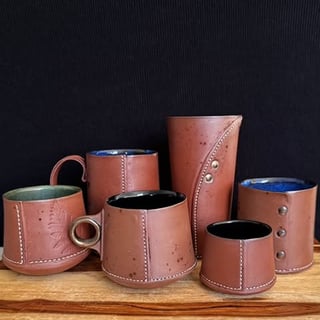
Speaker: So now let's talk about your pottery. In one sentence, can you tell me what you make? Yeah, I make functional pots. Usually just dinnerware, mugs, bowls, plates. I'll make little decorative pieces too, like jars or vases. Just the typical functional pottery on the wheel.
Speaker: So something I really like about your pottery is that it's very minimalistic. And can you tell me the story how you started creating it more, creating pottery that is more minimal?
Speaker: Yeah, I think I started out the way most potters do in, you know, trying to make art pieces, functional pieces, make sculptural pieces. And then in the beginning, kind of you cover all the basics, like forms and shapes, and also glazes, you know, there are so many different places. And I think, you know, in the beginning when you want to do it all, you don't really think about
Speaker: Like honing in on on your own certain style. You just, you just want to get a little bit of everything you want to just explore and educate yourself on all of the stuff. And for me, I was never satisfied.
Speaker: With glazes and I didn't know that it was an option to not use glazes. So I'm just trying to go crazy and find. Some kind of a glaze that really spoke to me and that made me feel like I was making something that I was happy with. And I think I did that for years, not not knowing certain things.
Speaker: And when I became a more serious potter, you know, reading biographies on artists or going to museums or just, you know, studying other potters that I really like, you know, I learned some things that there really aren't really many rules and you don't know that right away.
Speaker: So years and years later, all of a sudden, at this point, I had considered myself maybe semi -professional or working my way into that part. I decided that I hated glazes and maybe not knowing that I still couldn't get away with not using glaze. I had a kiln malfunction where I was doing a bisquiring and the foam sitter kind of melted.
Speaker: And so the kiln went all the way up to its hottest temperature, which was at least cone 10. I don't know how hot it actually got. But so all my, this work just went straight to at least cone 10. And the results, I think I was teaching a class at the time and I have my students in the kiln room and I opened the kiln and I'm horrified. And all of my students are going, no, no, this is great. And so then I had to like check myself a little bit and kind of rethink
Speaker: What my expectations were because my immediate response was, oh, no, everything's. But then I had a student point out saying that, no, this is great. And I'm like, really? Okay. And then, so, you know, I had to inspect that a little bit more. And so it was actually by accident where the minimalism.
Speaker: kind of came into play where I don't need glaze. I fire a porcelain, or you can do it with stone or two, to a hot end of temperature where the clay becomes vitrified. So that's one problem that's solved. My clay is still functional even if it's not glazed. But then also all of these other new questions presented themselves of what can I do with it now? And I think when I was in school,
Speaker: I went to an art school that also really wasn't interested in functional art. It was more of a
Speaker: fine art, painting, photography, sculptural kind of art school, you know, the idea of making teapots and muds wasn't really encouraged. So I had a little bit of a struggle there, but I did learn so much about what did speak to me outside of the ceramics world, like the arts and crafts movement or the Bauhaus genre and a lot of just like post -war artists. And I think that
Speaker: paired with the not being too interested in glazing, something along the way kind of made me put my own spin on how can I make a piece of pottery that looks good and feels good.
Speaker: extremely useful. And I think, not to sound cliche, but the saying form follows function is something I really think about. So, you know, I make pretty basic forms. They're simple. They're not very intricate. But the surfaces, I think, are really what carry the form. But I think when I look at a lot of other potters' work,
Speaker: I love color. I love globs. I love big, weird pots. I can think of a few potters like Lisa Orr. She makes very, very colorful work. And I would never in a million years make my pots in color, but I love her stuff.
Speaker: the way it is. It's gorgeous and I have some in my house and I love it. But from my own work, I need it quiet and simple. And I think that in the beginning it was a little difficult, but I think just the concept of simplicity just kind of going back to your first question of, you know, the more you do, the more you make, the more simplicity kind of presents itself.
Speaker: that answer. Absolutely agree. Absolutely agree. That's really great. Shaping Nation, if you're listening right now, you don't need to be making all these intricate type of pottery. You can really make super simple pottery and still make it look really beautiful. That is some excellent piece of advice right there. I love it. So you are inspired by the need to make beautiful and useful objects, but you are also inspired by anti -capitalism. How does this reflect back into your work?
Speaker: Well, the anti -capitalism is, you know, just like a lot of things like punk rock. It's a frame of mind and it's something that you can take action on. I don't think any of my work at all represents anti -capitalism, but the idea or the act of handmade is something that
Speaker: To me is so important and I think that. Almost anyone, arguably could could say that.
Speaker: when you make something yourself, whether it's a meal or a bookshelf or a mug or your own clothes or the person who purchases those handmade goods. I think that alone is, it's on the mark of supporting anti -capitalism for, I don't know, maybe there might be a better word out there, but to me, I think your lifestyle is improved.
Speaker: When you make something yourself, it's, you know, home -cooked meals to me seem to taste better than going out to a restaurant. I don't care how expensive it is. I'd rather eat a home -cooked meal or, you know, wearing clothes that your mother made for you growing up or you're trying to make or drinking out of handmade cups or eating off of handmade plates or just pulling a book off of a bookshelf that your dad made or something like that. Those are more
Speaker: to me, supportive of the real person. It brings peace of mind and comfort and just kind of like a peacefulness in your home, in your environment. I can go off on the political aspects of it, but that might take a long time.
Speaker: That is very interesting because obviously when you think of anti -capital, you think like not to really sell anything, but the way you're explaining it, I think it makes it like you want people to buy handmade stuff, people that make like that they're making themselves. And I find that very interesting. So can you give me a simplified explanation on how you create your pottery?
Speaker: You mean like, like on my wheel or house. So how do you create your designs onto your pottery? Sure. I think in the beginning when I first learned the process, it was similar to sketching, which funny at the time came really easily to me.
Speaker: Now, I don't sketch at all, but I guess maybe you can consider it on my, on my pots, but I look at references from, like, printmaking or twos in the beginning.
Speaker: When I first learned the inlay technique, I think I tried to recreate mountains. I had lived in Colorado for a really long time in my twenties and then I moved to Washington, D. C.
Speaker: and lived there for a while in my 30s. And there are no mountains in Washington, D .C., but there is a ton of classic Greek classic architecture. And so I would make literal mountains on my on my pots. I think maybe it wasn't intentional. I don't think might have just been like an intuitive, but probably I miss the mountains because I didn't like D .C. very much. But and then that kind of
Speaker: morphed into less literal landscapes and maybe became more geometrical landscaping, kind of taking on what I was seeing every day on the East Coast. And then I think when I, going back to your first question again, the more you make or the more you explore, the more other ideas present themselves to you. And I think that
Speaker: you know things grow into other things like the mountains just kind of morphed into regular lines and now they're back to mountains again and then yeah I don't know it's it's it's really simple sounds like it should be simple but it's not when I when I think about work that I made six months ago to me today it looks totally different where I'm looking at some of my pots right now and when I have a cup that has
Speaker: like 40 dots on it. That was like a year ago. And now I have cups that have like 600 dots on them. So I don't know how to quite answer that. I think I just, you know, keep moving, keep drawing, keep sketching on my pots. And all of a sudden they'll just kind of grow into something else. And then I'll take it to a different level. Sometimes it seems like it happens so quickly. But then other times I feel like, oh my God, I'm out of ideas. I'm never going to come up with a new design. But that never happens. But the fear.
Speaker: I love that, that was really, I like how you just keep on making and that's how you really end up making your designs. So what advice would you give to someone trying to simplify their pottery down, if they're making it a little bit too complicated, how they can simplify it down? Okay, so this kind of reminds me of
Speaker: Before, when I was still a student potter, I wasn't satisfied with what I was making. I knew I was going to continue making, but I didn't like my pots. Either they were too heavy on the bottom or the walls weren't even, or I couldn't make the same thing ten times in a row. I think I started
Speaker: I looked at, is it Gwen Wilson -Piggott and then Edmond de Waal. They're both very simple potters. They make, I mean, very straightforward, just a shape, nothing adorned on it or anything, no fancy glazes. And they're just kind of like still lifes of three -dimensional installations.
Speaker: And so, because I was so dissatisfied with what I was making, it was like an overnight decision. I was going to go completely back to the basics. I was basically going to retrain my brain and basically pretend that I had never made a pot before. I had the tools to know how
Speaker: the basic cylinder and the basic bowl. So that's what I did. I went back and I just started making cylinders, like hundreds of them, just cylinders and cylinders and cylinders, cutting them in half.
Speaker: And then, then that's kind of, you know, just starting from there, not trying to get too far ahead of myself. I see a lot of potters today who it seems like they know how to make the best possible bowl, the best possible cylinder, and then they kind of stop there. And I guess to going back to your question to simplify your work, get, get the basic
Speaker: tools down, try and make it to where you're satisfied with what you're making. And then, I don't know, see who your influences are, read about them, because a lot of the times, like Lucy Rees, one of her biographies, Emmanuel Cooper wrote, there's so many definitions in there and explanations of how she made her work, why she made her work.
Speaker: And I think that just the education part, like the words that you're taking in, however you can apply that to what you're creating in your three -dimensional creations, just take it from there. I'm not sure if that is quite a good answer.
Speaker: I absolutely love that answer about going back to basic shaping nation. If you are getting a little bit overwhelmed with making your pottery, sometimes you just have to go back to basics and really get back into the mindset of trying to improve your pottery a little bit at a time and focusing in on one thing at a time instead of going too far ahead of yourself. I think that is really great advice. Let me add one more thing to that. With going back to the basics, ceramics isn't made up of just one big thing.
Speaker: When, and I'm speaking my, my own functional stuff, it's, it's, you know, the wheel throwing is 1 thing or the hand building the boiling, whatever, you know, that's 1.
Speaker: Tool the shaping the form that's like another tool that, you know, there's all these little steps and then there's there's surface design. There's glazing. There's inlay. There's just regular painting. There's drawing, you know, and then don't even forget the trimming part. I mean, that's you can add another layer of something to your work just trimming alone. So, so, yeah, just break down every little step and try and master every little step.
Speaker: Absolutely agree. I love that advice right there because that allows you to really focus in on one thing and go further and improve your pottery better because you're focusing on one thing at a time. Love that advice. So let's talk about developing your own voice. What struggles would you say you had when you were trying to find your own voice? Well, I think I was completely ignorant of the fact that you could have your own voice. You know, you can look at a painting,
Speaker: And, you know, someone or you can, you can look at it and go for the most part know that it's a van go or, or like a, a gouty building and know that it's a gouty building, something like that. But in pottery, when I.
Speaker: It sounds so funny when I was getting good, I had no idea that ceramics monthly was a thing. I had no idea that enseka was a thing. I had no idea that there were all these potters out there that you could look at this potter's work and
Speaker: Oh yeah, I know who that potter is, or something like that. I had no idea. And I think that goes back to when I was still thinking that I had to make every form possible, I had to use every glaze possible.
Speaker: So I was still just trying to do everything that you can't. So I think that to find your own voice, a lot of it comes from the potters that you really like and admire, or the feeling that you get looking at other artwork.
Speaker: obviously, but you to try and find like you want to make pots that make you feel the way you feel when you look at someone else's pots or someone else's painting or sculpture and if you know obviously don't rip off work but if you can take what they're doing and turn it into your own thing you know that
Speaker: That takes hard work too, but just finding your own voice, you know, just pick out maybe like two or three things that you really like and admire about your own work or about someone else's work or whatever and just keep going. Absolutely agree. Love that advice right there. So something that I really believe with finding your voice is that setting a standard for your pottery. What would you say is your standard with your pottery that you're trying to achieve?
Speaker: I don't know if I understand that question. I don't know. Let's see here. So we'll just skip that one for now. That was a new question. Sorry about that. So as we're coming to a close here, what is one thing that you want to hammer home with my audience today?
Speaker: I think it's, it's the, your first question was the most perfect question. I, I am so fortunate to have so many wonderful creative people in my life. And two different people when I was younger told me.
Speaker: completely different things. One was work first then play. I mean obviously you need to have some kind of a balanced life, but work first then play. Just keep making, making, making, making. And then the other one is what I've already said before too, is the more you seek out creativity, the more creativity will find you. So just never stop. Just always, you know, go on those adventures, whether it's an adventure in your studio or inside your sketchbook or
Speaker: on the open road or something like that. Just always seek out creativity any way you can. Absolutely. Great piece of advice right there to close it out. Bianca, it was really great chatting with you today. Where can my audience go and check out and learn more about you?
Speaker: Currently, I'm on Instagram and that's enough for me. So I'm just Bianca on our groves. It's Bianca with a K and I post all of my information on there, which gallery I'm at or which exhibitions I'm participating in. So Instagram is it for me. Thanks for listening to this episode of Shaping Your Pottery. If you are struggling with finding your own theme for your pottery so that, you know, you are known for something,
Speaker: I put together 53 themes that you can use and you can take. All you have to do is go to shapingyourpottery .com forward slash 53 themes. That's five three themes to get these 53 themes. It's really important for you to find a theme for your pottery so that you're not going to get burnt out. You can have multiple styles with your pottery and you can be known for something. So again, go to shapingyourpottery .com forward slash
Speaker: 53 themes, that's five, three themes to get these 53 themes. Thanks guys, I'll see you guys next time.