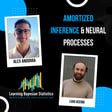
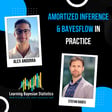
#157 Amortized Inference & BayesFlow in Practice, with Stefan Radev

Support & Resources
→ Support the show on Patreon
→ Bayesian Modeling Course (first 2 lessons free)
Our theme music is « Good Bayesian », by Baba Brinkman (feat MC Lars and Mega Ran). Check out his awesome work
Takeaways:
Q: What is simulation-based inference and what does "sim-to-real" mean?
A: Simulation-based inference (SBI) uses a mechanistic simulator as an epistemic tool: you train a neural network on a large number of labeled simulations and then deploy it on real, unlabeled data. The "sim-to-real" framing captures the key asymmetry -- your network never sees real data during training, only simulations, but it generalizes to real observations at inference time. This is the opposite of the more common "synthetic-for-ML" approach, where fake data is used purely to augment real training data.
Q: What is the amortized inference agent skill and what does it do?
A: It's an open-source AI agent skill, co-developed by Stefan and Alexandre, that teaches an AI coding agent to run a complete, state-of-the-art amortized inference workflow. Because amortized inference is recent enough that it's underrepresented in LLM training data, vanilla agents tend to get it wrong. The skill injects the right methodology: it guides the agent to set up the simulator, choose the right network architecture, run a pilot, train with appropriate diagnostics, and produce an actionable report -- without the user needing to know the details.
Q: What is calibration coverage and why should you never skip it?
A: Calibration coverage tells you whether your posterior uncertainty is honest -- whether your credible intervals actually contain the true parameter at the right frequency. A model can show poor parameter recovery yet still be well-calibrated (because it's falling back on the prior), or it can appear to recover parameters while being poorly calibrated. Running calibration diagnostics both in-sample and out-of-sample is especially revealing for hierarchical models, which often appear to underfit in-sample but generalize much better out-of-sample thanks to shrinkage.
Full takeaways here
Chapters:
00:00:00 How does amortized inference fit into the Bayesian workflow?
00:12:03 What does "sim-to-real" mean in simulation-based inference?
00:15:57 Why is amortized inference particularly suited to psychology and neuroscience?
00:21:51 What is the amortized inference agent skill?
00:39:00 What is calibration coverage and how do you interpret it?
00:41:50 How do you decide what to do next after your first training run?
00:44:53 How do actionable insights make Bayesian workflows more usable?
00:49:08 What are the unique challenges of hierarchical models in amortized inference?
01:00:51 What is the current state of BayesFlow's support for hierarchical models?
01:05:00 What are the main failure modes of amortized inference and how do you handle model misspecification?
Thank you to my Patrons for making this episode possible!
Links from the show