Transcript
Speaker: Welcome to Clued in Mystery. I'm Sarah. And I'm Brooke, and we both love mystery. Brooke. Hi, Sarah. Well, we have such an exciting day today. We are delighted to welcome Peter James, the internationally bestselling author and creator of Detective Superintendent Roy Grace, who happens to be Queen Camilla's favorite fictional detective.
Speaker: Mr. James has sold more than 24 million books worldwide with 21 Sunday Times number one bestsellers. His work has earned numerous awards, including the prestigious Crime Writers Association Diamond Dagger.
Speaker: His Roy Grace novels have been adapted for both television and the stage. And in 2026, he was awarded an OBE for his contributions to literature and charity.
Speaker: Mr. James, we are honored to welcome you to Clued in Mystery. It's great to be here. Thank you for having me on.
Speaker: So let's begin, Peter, by you sharing a little bit about who the authors were that most influenced you when you began writing, and then who inspires you today?
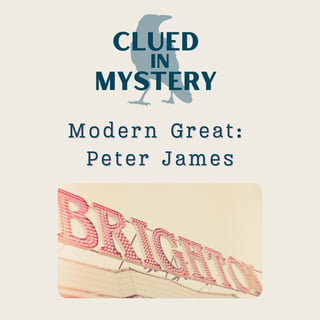
Speaker: Great question. The two big influences in a way were, first is Graham Greene. I read Graham Greene's Brighton Rock. when I 14, I read it for the first time as a kid growing up in Brighton.
Speaker: that That was a book that I think it was a game changer for the the crime genre as much as it was a game changer for my life. Because up until that point, I'd read a lot of the, um really enjoyed the golden age crime writers.
Speaker: and But they tended to have ah a set format, which is you tend to start with a dead body on page one. And the rest of the book is the kind of puzzle to solve it. And then Graham Greene's Brighton Rock, the victim is still alive at the end of chapter one and in peril. It's got one of the best opening lines, I think, in all of crime fiction. Within three hours of arriving in Brighton, Hale knew they meant to murder him.
Speaker: you know, who's hell? is he in Brighton? What really blew me away about that book was that it made me realize within the confines of of a crime novel, a crime thriller, you could actually look at big issues.
Speaker: And the central character in Brighton Rock is a 17-year-old boy gangster called Pinky. He's a killer. He's actually committed murder. And he's a devout Catholic, terrified of eternal damnation.
Speaker: And he's in charge of a bunch of middle-aged up misfit criminals running this gang. And it's is it's a wonderful book. He's so conflicted. and it has, if you haven't read it, i think it has psychologically the darkest ending of any novel I've ever read. When I put that book down at the age of 14, I thought, one day I'm going to try and write a crime novel.
Speaker: set in Brighton. And the other book that was a huge influence on me was, ah um and a writer also, sorry not just the book, Arthur Haley, the American writer.
Speaker: I read Hotel just after it was first published, I think around 1966. And i honestly was utterly, not only just blown away, I was quite despondent because I thought, how can anybody write a book as good as that?
Speaker: And if you don't i don't, do either of you know the book? No, no. Okay, you have a treat. I think it's out of print, but you can get it off secondhand eBay sites or whatever. It's all set in a grand but very tired hotel in New Orleans.
Speaker: And it's got an elderly owner who's reluctant to spend any money. He's got a young, ambitious manager who's trying to bring the hotel up. All the big chains like Hilton are circling like vultures awaiting to pounce. And in the hotel, have a career burglar who is steadily working his way through the room, stealing from them. We've got an elderly British aristocratic couple who've just killed someone in a hit-and-run accident, and they're hiding out in the hotel. And you know that there is a faulty elevator that is going to come down at some point.
Speaker: and take people with it. It's got most tremendous suspense, but more than anything, you really learn how a hotel works. You get inside the heads of the manager, so many different characters, including like the maintenance manager, the elevator operator. And I put that book down when I first time I read it, and I thought, wow, if you want to write a blockbuster, you have to do your research.
Speaker: that That is something that we learned about you when we um when we covered you in a and a bio episode is your attention to research. So that it's interesting to know that that's something that you grasped onto as a really young reader.
Speaker: Yeah, I think, I mean, I i also did have a kind of quite a hard learning curve. And and that my first published books were two very bad spy thrillers.
Speaker: cool ah then I'm only giving you the title so you don't ever read them. Dead Letter Drop and Atom Bomb Angel. And ah they were published in 1981, 1982. And you know it was the most exciting day of my life when I was offered a two book deal. It was the worst day of my life when the first one came out because I restaurant all the bookshops and it wasn't anywhere. And I discovered the publishers. It was a big publisher, Allen.
Speaker: But they'd only printed 1,800 hardback coffees, which 1,500 had gone to libraries. So that's 300 copies for the whole of the UK and Commonwealth. um And neither book sold at all. Well, and I was at a publishing party and I was really despondent and I had too much to drink. And I poured my heart out to a lady called Elizabeth Buchan. So at that time was writing jacket blurb for for Penguin.
Speaker: She's now a very successful author in her own right. And she gave me a sort of pitiful look and she said, Darling, why are you writing spy thrillers? I said, well, I read that there was a shortage. Ian Fleming had died.
Speaker: And she said, and what can you tell the world about spies? ah She said, you know you're up against people like John the Carey who've come out of security services. She said, people who read are intelligent.
Speaker: They don't just want a story. They want to learn something. you know they want to learn but the author's wisdom about life, the subject the author is writing about. You've got to find something that A, interests you passionately, and B, that you can access and research.
Speaker: And I kind of left that party with my kind of tail between my legs thinking, oh, that's probably it, my career's over. And three days later, my damn wife and I, we just bought, just got married, just bought a house, and we got burgled.
Speaker: And it turned out to be the probably the best thing that ever happened in my life. because apart from the fact that bastard took the trousers of my favorite suit to obviously wrap some ornament up in, but two detectives came to take fingerprints and they saw my two books. They saw my two books and he said, all europe you're a writer. If you ever want research help with the police, give me a call.
Speaker: And his name was Mike Harris and he was he was married to a detective called Bernata. And then wife was a lawyer. We became friends with them. And they invited us to barbecue that summer at the house. And 12 of their friends were there, all police officers. There was a homicide detective, a response officer, a traffic officer, a soccer police diver. And just talking to these people, I thought, wow, from a writer's perspective, nobody sees more of human life.
Speaker: in a 30-year career than a police officer. And when they realized I was genuinely interested, not just about to get a story I could sell to the local rag, they started to invite me to spend time with them. and I started writing initially supernatural thrillers and then psychological thrillers, putting police characters in. And they liked the way I portrayed them. I tried to portray them as real people, not just men in sharp suits or men in uniforms or ladies in uniforms, but people who go to deal with a horrendous crime scene then have to go home and bath their kids and put them to bed and read them a story. And and the the impact it has on their life. And over the next, really the next 15 years, I sort of became part of the furniture of Sussex Police. They would phone me up say, we're doing a raid tomorrow, you want to come? And they smuggle me into crime scenes. And that's where how it all really started.
Speaker: Oh, that's fascinating. Well, you also have a background in film and screenwriting. How has that experience influenced the way you approach writing your novels?
Speaker: I think it's been enormously helpful. i I stopped with film and television other than Grace. on television, end of 2004, the last film I was involved with, I ran the company that made Merchant of Venice with Al Pacino. But before that, I had a mixture of film and television. And I think it's been enormously helpful. i mean I'll tell you something really, this sounds crass, but one are there back in the mid-90s, I sold the pilot of a television, a kind of sitcom.
Speaker: about early days of the internet, about a guy who kind of fakes his identity. It never got made, but I'm in the writing room and there's like a show runner and I'm told that we have to have a gag every 14 seconds.
Speaker: And psychology behind that is that 50% of the American television audience at any one time are channel surfing. They hit a gag.
Speaker: By the time they finish laughing, the next gag hits. So they stay. Now, I don't put a gag every 15 lines in a book, but I'm mindful that you have to keep putting a hook in.
Speaker: um Because if you were if you were writing back in Thacker's time or Dickens's time, the there there was no other nothing else that would would take your reader away unless they wanted to go and do a tapestry or something you know now you know when we're writing we've got conscious that somebody could drop my book at any moment and go into a computer game or watch television or listen to a podcast whatever and so i do firmly believe it's in the importance of keeping the reader absolutely turning the pages and not letting them go.
Speaker: So that was one takeaway from television and and film. And the other takeaway, which I think has always stood me in good stead, is that, and and again, it's part of that keeping the reader's attention. You television or movies, when you watch, you jump scene to scene. Somebody's in danger, boom, and you go to them some characters are having lunch. Then you jump back to the person in danger, that kind of thing. And I do that a lot in my writing. that I think that's really helped. me to create suspenseful writing.
Speaker: And I think the third takeaway is you don't tend to get long scenes in movies or television. um I write The way I think most people like to read, certainly I like the way I like to read. You know, i usually read in bed at night and I'm tired.
Speaker: I pick up a book and the next chapter is 53 pages. i think I'll sod that. have that tomorrow. But, oh, it's only one page. I'll read that. Oh, the next chapter is only two and half pages. Next thing it's three in the morning.
Speaker: I'm just talking a little bit more about research. We understand that you spent a day working at a hotel as research for part of your most recent book, Dead in 321.
Speaker: Is that firsthand experience a regular part of your research process? ah Yeah, very much so. I feel it's really important to kind of just not look outside. It's to try and get involved and and really feel what it's like. And the manager of The Grand Hotel in Brighton, which quite a famous hotel, said to me, ah why don't you come and spend a day as a concierge? You know, really get to know a little bit. So I did. i had I was put in full uniform. They have quite a fancy uniform. And I was stood behind the concierge desk. And I've been there about five minutes and somebody came up to me and asked where I could get a lady of the night.
Speaker: This is like 11 in the morning. i i said, well, I can recommend you good restaurants, sir. But, you know, that's... um and then um And then I ah saw this elderly couple struggling with their bags. So I stepped out and I took their bags and I carried them out to their car. I put them in the trunk of the car. And the guy pressed five-pound note in my hand. So I got a five-pound tip.
Speaker: ah And I learned so much stuff about what... how staff in a hotel actually look at, observe the guests. You know, we check into a hotel and you see, ah usually you you see the uniforms, you see that you don't really kind of think too much about the characters, but they're looking at us all the time.
Speaker: And I was talking to a restaurant manager of another hotel and I said, and what what do you notice? He said, well, it said breakfast is interesting. So, cause if you look at breakfast, you've got all the couples and they're sitting at the tables,
Speaker: These days, most of them will be on their phones. A small amount will be reading a newspaper. An even smaller amount will be actually talking to each other. And if they're talking to each other, you'll know one of two things. Either they're newlywed or they're having an affair.
Speaker: but Wow.
Speaker: it was it was ah It was a real opener. And and i work I was behind the scenes in quite a lot of hotels. Another another restaurant manager said to me, said, you know, in the hotel, guests are the ornaments.
Speaker: in a restaurant. I said, seriously? He said, yeah. i said, if you imagine a restaurant, take a nice restaurant, and you fill it with hikers wearing wet kagouls and anoraks, it's going to have one vibe.
Speaker: Fill it with men in sharp suits and women in power dresses, it's going to have another vibe. Fill it with people, young people, coolly dressed, it's going to have a different vibe again.
Speaker: And what the inspiration for Dead in 321 came really from two two things. And the book starts with, as you probably know, would you read the the first paragraph?
Speaker: Oh, that would be wonderful. Yeah, that'd be great. Friday, August the 1st, 2025.
Speaker: tanned man of 40 standing at the front desk of Brighton Seafront's fabled Royal Courtenay Hotel looked pleased with himself, the confident air of someone one who had it all and knew it.
Speaker: Good looks, great hair, expensive suit, nice watch. His arm was draped around a beautiful woman. He had a smile on his face and a bomb in his suitcase.
Speaker: Now the inspiration for that, I mean, what i what I always try and do, not every book, but I like it as a technique is have two completely different storylines. So I've got this guy checking in the hotel with a bomb, and we're going to find out without any spoil that his target is Roy Grace, who's going to be staying at the hotel in a week's time with his wife, Cleo, and an Albanian gangster that Roy has put away, wants him and his wife dead.
Speaker: And then I have a separate storyline, which is an elderly lady who was a permanent resident in this hotel. And I had asked several hotel managers of of grand hotels. I said, know, it must be wonderful to have long stay guests because you've got a guaranteed income for years. And all of them astonished me. They said, no, they're a bloody nuisance. Yeah. I said, really? said, yeah. they And they all said, first thing is it stops us from being able to rent the hotel to a to a corporation for a conference, which which is very lucrative. And secondly, after a few years, they become preparatorial.
Speaker: So they'll they'll go down at cocktail hour, and they'll hold court in the bar. And yeah guests come in, and and they'll go, hey, you know, this hotel, standards have gone right down. It's not what it used to be at all, you know.
Speaker: ha So I thought it would be kind of fun to have this long stay guest called Jean de Baird and her, we learned that her husband died 15 years ago. she found it lonely at home. So she moved into the most expensive suite in the Royal Court and there's never left. And she's got a 50 year old son who's got two failed businesses.
Speaker: and And she's got a daughter who's just been through an acrimonious divorce and not got very much money. And they both watching mummy burning through their inheritance. So they enlist the services of a of a bent lawyer and a struck off doctor to try to hasten mummy's death.
Speaker: But the the the kind of backdrop to the to the to the book was, i and i grew up in Brighton and I'm sure it must have made the news in North America too. In 1984, the IRA tried to murder the Prime Minister Margaret Thatcher by blowing up her suite at the Grand Hotel in Brighton during the Conservative Party conference. And what happened was they sent an operative called Patrick McGee with a bomb,
Speaker: time to go off at 1.30 in the morning. And he checked in a month before the Conservative Party conference and had specifically booked the suite Margaret Thatcher would be staying in. And he planted the bomb behind the panelling in her bathroom.
Speaker: What saved her life was that she was a workaholic and was still up and awake and working at half past one in the morning. But it it killed six people and and very seriously injured a number of others.
Speaker: And the police, as part of their investigation, started going back four weeks in the hotel register, checking on all the guests who'd been there four weeks before. And that the police with eight were making calls and the conversation would go somewhere like this. Hello, or may we speak to Mr. Paul Johnson?
Speaker: Oh, I'm very exalted to him because of his wife speaking. Can I help you? Yes, we'd like to speak to him about when he stayed at the Grand Hotel in September about four weeks ago. oh no, no, he was fishing in Northern Ireland with his mates then.
Speaker: It caused eight divorces.
Speaker: ah Well, speaking of those different storylines and points of view that you um put into a book, Do you write these storylines separately and then knit them together? Or do you write the chapters in the order that the audience eventually finds them in?
Speaker: I pretty much write in in sequence. um I ah do sometimes, a bit like editing a movie, I might think a chapter might work better if I moved it a couple of places forwards, but I but i write in, I guess, real time.
Speaker: um I find that, for me, that's what works best. I've actually got a book on writing coming out the year after next. Oh, that's wonderful. It's kind of mixture of kind of a bit in the vein of Stephen King's on writing, so a little bit of autobiography, but mostly kind of how to write it. It's called Get It's called Write the Damn Book.
Speaker: Oh, that sounds great. But i'm ah I'm I kind of like a mixture of planning and and Spontaneity. I always think I think it's I always like to know the ending of the book I'm going to get to. And I plan the first hundred pages or so in quite a lot of detail, but I love it when something pops in my head that wasn't there 10 seconds ago.
Speaker: i always sort of say if I don't surprise myself, I won't surprise my readers.
Speaker: We also read that you are a quite consistent writer. Do you write daily on a regular schedule? Yeah, once I've started a book, it takes me about seven months from the kind of time I write the first line to the time I write the end. And I have a kind of i have a kind of slightly back-to-front writing day, which started when I was working full time in film and television and writing in my kind of so-called free time. I made my me time to write like six to half eight at night and I'm still, that still sticks in a way. i My best creative time is six o'clock in the evening. i do that six days a week.
Speaker: except if we're going out something for friends, but normally six days a week, and I make a stiff vodka martini, put on music, and I just get in the zone, and I love it.
Speaker: And then I stop about 8.30, have supper with my wife, we watch television afterwards or read, take the dogs out, and then in the morning, i kind of Again, but we have a huge menagerie of animals.
Speaker: So it takes us about an hour to feed all the animals and walk the dogs. And then I usually go for a run. And then by 11, I hunker down and I read what I wrote the night before and edit. And i when i'm right every evening, I try to hit a child over about 1,000 words.
Speaker: And then by the time I've edited it, the next day, it'll become about 1,500.
Speaker: And I do that for for all the roughly seven months each book takes. And then it's about another five months of editing, but slightly less intense. who So um considering those word counts you and your short chapters, you might write a chapter a day.
Speaker: i try to, yeah. i like If I can finish a chapter, it's great. I love kind of going to sleep, trying to think, thinking about what I'm going to writing in the next chapter. Sometimes I'll write two chapters on a really short chapter.
Speaker: um I kind of, I like that. I really do. i just It just, for me, it works. And certainly a lot of my readers tell me they they really like the fact that I make it easy to read the books.
Speaker: ah So Arthur Conan Doyle famously grew tired of Sherlock Holmes and tried to kill him off. After more than two decades of writing Roy Grace, how do you keep the character and the writing fresh?
Speaker: It's a great question. I... e part Part of course is Roy Grace and all his other characters and the police with him are are like a huge soap opera. bra and I've got all their different lives going on, the sort of train crash of their love lives. But I feel very invested in their lives. And I yeah know really enjoy seeing what's happening and surprising myself sometimes. But also, i what i when I've also not done is I haven't,
Speaker: aged Roy Grace a lot. I mean, Ian Rankin, when he wrote Rebus, aged him a year every book. And he had 60 and he had a problem because that's retirement age. I mean, luckily, Scotland raised the retirement age to 65. So he suddenly had four, five more. But I i didn't want to do that the for two reasons. One is I didn't want to age him too quickly. But secondly, when we first meet Roy in the first book, we we learned that his wife, Sandy,
Speaker: who he loved and adored, had vanished off the face of the earth nine years earlier. And he spent nine years looking for her. Doesn't know what happened. yeah Did she get murdered? Did she run off with a lover? Did she get kidnapped? Did she take her own life? And so while she's continued to function for nine years as an effective homicide detective, all his free time has been taken up trying of trying to find her. And i Originally, I was going to set the mystery up in the first book as to what happened.
Speaker: I had to set a two book deal. So was going to set the mystery up in book one and reveal what happened to her in book two. And to my astonishment, happy astonishment, Dead Simple when it came out was an instant global success.
Speaker: And we were inundated with people, readers speculating what might have happened to Sandy. And I thought, you know what, I can keep this going. So as part of the keeping it fresh for 14 books, I kept the mystery of Sandy going. you In the meantime, Roy has fallen in love with Cleo who runs the mortuary. And I am, in each book, started to seed little bits, nuggets of information about Sandy and that maybe she is not quite the perfect wife Roy thinks she was. So I kept a lot of intrigue going that way.
Speaker: Eventually, around about book 14, the tone of the correspondence from readers started changing. And I have one which says, Dear Mr. James, ive I've just worked out that I'm a lot younger than you. and I imagine I'm much fitter than you, which means you're going to die before me. So I hope you've left a secret of what happens to Sandy safely in your public response. Oh.
Speaker: of ah So I kept it first that way. And then also, it's going to be a year of my life to write books. What try always to do is to choose something that I really want to learn about and that I'm interested to write about, whether it's internet romance fraud or the workings of a hotel um <unk> or the next book is set on a cruise ship.
Speaker: So it's always something that I'm keen to learn about myself. And then I think that I can put that across in an enthusiastic way to my readers. So does this mean that you got to take your wife on a cruise for research for this next book? Well, I've done quite a lot of cruises as a guest speaker over the years, which I love doing. It's a great gig.
Speaker: And I was on the Queen Mary back in about 2018, and we got up on the bridge, and I was talking to the captain. And I said, yeah have you ever had a murder on this ship? And he said, no, not on this ship, he said, but you might be interested to know 34 people a year disappear off cruise ships around the world.
Speaker: Wow. I thought, that sounded interesting. Darling, you know, why don't you go on the balcony and have a cigarette? ah
Speaker: You go overboard from a cruise ship in the middle of the night, you ain't coming back. No. and So thought I thought, what a great place. Cleo has been invited ah as a guest speaker to talk about working in a mortuary on on the queen on ah my fictitious cruise ship. And Roy's just gone along for there for that for the holiday.
Speaker: Oh, that will be fun. And of course something happened. Mm-hmm.
Speaker: what so you opened talking about books that were influential on your becoming an author what book do you wish that you could read again for the first time wow that's a great i guess it's probably two one is silence of the lambs which i rate as probably the the best prime through of the last not just the last 50 years, maybe ever. i think it was just an amazing book.
Speaker: And the other is Kurt Vonnegut's Slaughterhouse-Five. had a massive i read that when I went to film school. and i I was just coming up to 22, and I read that book. It hadn't been published that long.
Speaker: And I put it down, and i because I didn't know you couldn't, I ah called up international telephone directory inquirers, And I got his number in Martha's Vineyard. And I called him.
Speaker: And he answered. And he was utterly charming. I said, oh, hi, I'm Peter James. I'm a film student. And i i just read your book. And I think it's amazing. could i yeah know I'd love to buy the rights and make a movie of it.
Speaker: And he was really sweet. said, oh, gee. I said, you know what, Peter? I'm so sorry. I just sold the rights of you. Only a few months back. But I tell you what, you give me your number. And if they don't make the movie, I'm going to call you.
Speaker: That is such a great story. And I'm so happy that he was kind to this young film student. And it made me realize the importance of being kind to kind of, you know, young people and young young writers and young everybody. did I forever loved him. Wow, that's wonderful.
Speaker: Well, we would like to thank both you and your publisher for um generously giving us advanced copies of your latest book, Dead in 321. And the suspense and the tension just are so skillfully done. So how do you how do you create that tension for readers?
Speaker: I think one of the things I love doing is kind of creating a ticking clock. And it's normally an imaginary one, just a scenario where events are coming to climax. But inde in Dead in 3, 2, 1, the clue is in the title, there is actually ticking clock.
Speaker: it's um It's a bomb that's going to go off unless it's kind of defused. So it gave me a really natural ticking clock right throughout the whole book, in and a sense. and And that was really good fun. And I learned quite a lot about d
Speaker: getting into locked phones and how difficult it actually is with you companies like Apple don't give away any any help to the police and it can take some phones it can actually take I think the longest there's one phone it takes would take the police 21 years to get into you so know that was a really big kind of learning curve for me and I had a lot of fun writing the the real I was getting quite sweaty writing the tension scenes myself. So when that happens, I know it's working.
Speaker: It definitely worked. Thank you. So let's end with where can readers find you? Okay. You can find me on my website, which is www.peterjames.com.
Speaker: That's got everything up on there. And I'm on Instagram and Facebook, TikTok. And I have my own sort of little video channel.
Speaker: I used to do Twitter, up but i don't do that anymore. Well, we will add links to all of those places in the show notes. Thank you.
Speaker: Well, Peter, thank you so much for joining us today and spending time sharing about your books and the way you write. It has been a ah real pleasure to have you join us.
Speaker: Thank you. It's been a joy to be with you two. And thank you listeners for joining us today on Clued in Mystery. But until next time, I'm Brooke. And I'm Sarah.
Speaker: And we both love mystery. Clued in Mystery is written and produced by Brooke Peterson and Sarah M. Stephen. Music is by Shane Ivers. If you liked what you heard, please consider telling a friend, leaving a review, or subscribing with your favorite podcast listening app.
Speaker: Visit our website to sign up for our newsletter, The Clued in Chronicle, and get mystery news, podcast updates, and bonus episodes. We're on social media at Clued in Mystery.