Transcript
Speaker: The trainer models were always just like, like they're just so clean. Like it's so hard to just like, you know, man, it defined a brand new way of competing because at that time, you know, training was a new idea. Yeah. a Tinker Hatfield came up with this notion of cross training, born from Bo Jackson. and Bo Jackson is one of my favorite athletes. At that time, he played for the White Sox and he came and spoke in my high school. His sister was a math teacher. that Yeah, man, it went deep.
Speaker: And like to see Bo in my high school, knowing MJ was in the shot at that time. I mean, it was just so much that happened in Chicago where possibilities were like within reach. It was impossible for us to not grow up with confidence and self-belief because we saw it. Like we had our heroes in our community daily. It was magical, man. So that shoe encapsulates a moment of like all things coming true for me in Chicago, seeing heroes that I only saw on television in real life.
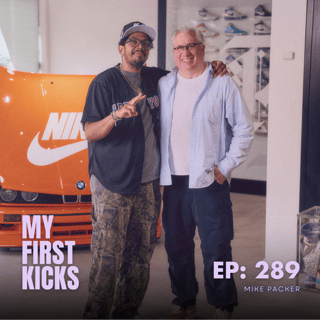
Speaker: What's good everyone. Welcome back to my first kicks the podcast where I use sneakers as a through line to get to know the guests in front of me this week. I'm joined by none other than the special guest, super special guest, Jason Maiden.
Speaker: Welcome to the podcast, man. We talked about this as people don't know this. yeah We ran into each other complex, but we ran into each other at BFF as well. But complex con was like, I was like, i finally got the the courage to come up to you and talk to you and be like, would you please do the podcast? Yeah, and it happened. We're doing it. We're doing it. That's the ah serendipity of intentionality, man. So I appreciate how intentional you've been. And it's dope to be able to support the work you're doing because the stories you tell um help kids who aren't in these rooms see themselves in us. So it's a huge responsibility, man. Man, you you about to make me cry. Let's save that for the middle of the podcast. of
Speaker: But it's ah it's just like a huge honor. Like I think getting to see you speak at BFF and talk about your journey on there, I feel like you know a lot of more people need to hear that. And that's that's what I told you at ConferenceCon, because it's just like, you know your story's super special. And people who are in the your like similar footsteps feel, you know I feel like they're kind of lost at some times, because they're just like, Oh, you know, i don't know what to do. I don't know if I'm going to be the person that I think I should be. And I think, you know, the way you grew up and we'll definitely get into it. I'm not being vague on purpose, but the way you grew up and the hardships you had to deal with and the and the things you've overcome have led you to become such a inspiration to a lot of people. And, I mean, you brought some some fire stuff that you've worked on and, you know, you have such a long-storied career. But we're going to start off with the question that I ask everybody each week. And that question is, what's your first kick? So, is that first pair of sneakers you absolutely needed to have?
Speaker: It had to be...
Speaker: The SE trainers. SE trainers? Yeah, SE trainers. My brother was working at Foot Lock at the time, and I remember him walking home from work, and I saw the striper uniform, and I looked down, and I saw the es SE trainers. I'm like, when did you get those, bro? This isn't the time to buy school clothes. I was so frustrated because he had them.
Speaker: And I was like, man, just the shape and proportion. you know I think that's what stood out to me first beyond the color was the stance of the product with the double sock. Chicago at that time was heavy into polos and like the golf look. Yeah.
Speaker: But here the SC trainer comes out and it's just, it was everything. so that was the first one. That's, I'll be, yo, that's such a classic shoe. And i mean, i love like all the air trainers. I'm a big, ah what's the shoe? the The tennis trainer. Oh, the Agassi joint? Nah, the ones with the strap, the small strap in the front. The Chlorophels. I forgot that. Oh, Air Trainer 3s, maybe? No. No, no, no, no, no. No. Now I'm forgetting.
Speaker: Damn. no down They're going to roast me in the comments for this one because now I'm like, Chlorophels, Medicine Ball. I know all the shoes, the colorways. And I'm like, I don't remember the the the model. Jordan was the model. Help me, what's the model?
Speaker: Air Trainer 1s, there we go, I got them. um And like that the trainer models were always just like, yeah like they're just so clean, like it's so hard to just like. you know Man, it defined a brand new way of competing. Because at that time, you know training was a new idea. yeah a Tinker Hatfield came up with this notion of cross training, born from Bo Jackson. and Bo Jackson's one of my favorite athletes. At that time, he played for the White Sox.
Speaker: And he came and spoke in my high school. His sister was a math teacher. that Yeah, man, it went deep. And like to see Bo in my high school, knowing MJ was in the shot at that time. I mean, it was just so much that happened in Chicago where possibilities were like within reach.
Speaker: It was impossible for us to not grow up with confidence and self-belief because we saw it. like We had our heroes in our community daily. It was magical, man. So that shoe... encapsulates a moment of like all things coming true for me in Chicago seeing heroes that I only saw on television in real life I mean that's that's beautiful to even hear but like what so growing up in Chicago like like high school like Howard what was it what was high school like for you Man, high school was interesting. um you know i'm an I'm a nerd, I'm not ashamed of that. I was a kid who was really good at school, but I also was very social, knew a lot of people.
Speaker: Because of how my brain works, I fit in with multiple groups. So high school in Chicago during the Jordan era was the epitome of style. Like every kid was fly. Everybody got the J's. Everybody had some sense of identity. Everybody had their own way of swagging it out. and We didn't call them Jordans. We call them Mikes. Yeah, I've heard them before. Yeah. On a first name basis with the product. Uh-huh.
Speaker: And everyone knew their history because Chicago is an open air architectural museum. It's a historical museum. If you study, you know, mass migrations of people, the the great migration happened from the south to the north to the Midwest. So a lot of style, a lot of entrepreneurship, a lot of self-awareness was also embedded into our community. And then we have a rich immigrant culture in Chicago. So now you get to see other people's interpretations of Michael from Eastern Europe, you know, from Southern Italy. And you're like, yo, if we all agree that this man is special,
Speaker: then what are we talking about? right He cut across culture. So, man, high school at that time, I would say if you're familiar with 90s movies, it was like house party meets juice meets everything you can imagine merging to that moment. It was phenomenal, man. Shoot. I mean, it's funny you said that because i was thinking about like house parties and I was just like, i was like, do house parties even happen anymore? like and they have kickbacks. But i mean, the question is, do people, can people afford a home? Yes, that's true. Like that's the thing. Basements are a Midwestern thing.
Speaker: And so now I believe that it's important now more than ever for people like me in my position to to create experiences where folks can come together and truly celebrate. Because it was natural for us to do it.
Speaker: But I'm not naive to the fact that people are struggling. And with that, it's on us to build community. Yeah. I'm jumping in real quick to remind y'all, do not forget to like, subscribe, and or leave a comment on this episode if you're watching this on YouTube. And if you're listening to this on Apple or Spotify, wherever you are listening to this, do not forget to rate this podcast five stars and leave a review. It will go a very long way and help me get into these like algorithms that we always talk about. And of course, if you want to support the podcast with your hard earned dollars, $5. That's all I'm requesting on Patreon. Patreon.com slash myfirstkicks. $5, one tier. You get the episode a day early and you also get an extra episode a month.
Speaker: So please tap in with the Patreon. It goes right back into the podcast. But right now, we're going to jump right back into the episode. I mean, community is a huge part of this. And i mean, that's why we love sneakers. Like it's like we can easily it's like this language that we speak and it's like, oh, I know you, you know, facts. um Like, do you have like a moment in high school or like, you know, when you were younger where it was just like that you saw community breathe, like build around you?
Speaker: Man, yeah, so um it's interesting. All the way from like second grade into high school, I was the go-to to draw girls' names in bubble letters. So there's a whole generation of Tanikas and Siobhanes out there with Jason Mayden originals. And then net that translated into me drawing graphic novel characters, drawing, you know, at that time I was really big into early stages of anime and manga, which is normal now, wasn't normal back then. We speaking the same language there too. You dig? Like I'm wearing Gundam ring and I've been on Gundam and Voltron and all that stuff since. Favorite Gundam?
Speaker: Man, Wing. Okay. I'm Golden. I'm like Golden. Golden's fire. yeah Unicorn Gundam. I know I go every year. I was there for the first one. I i went for the 30th, took my kids back, took my pops back. um My undergraduate professor was roommates with Sid Mead, and Sid Mead came and gave sketching demos. If you know who Sid Mead is, he's a futurist. And so he was one of the first people that saw how I drew, how I thought. And he was like, you're a futurist. And so he put me up on understanding how to draw mechs, concept art. And so the the
Speaker: The reputation I built throughout elementary school, high school, and college was that I was really good at visual illustration yeah and narrative. But I also, if I couldn't buy something, I would draw my own version of it. So if I didn't have the Jordan, I would draw my version and people would want to see like, well what did you do to it? How did you improve it? Mm-hmm. Same thing happened with cars. If I couldn't get a car, I would design one and put it on paper. So I never let having the thing be the limitation because belief sometimes is more powerful than actually having it. Like I believe that I can be a part of creating it versus just consuming it. So it gave me a sense of agency that the end result wasn't acquiring the product. the end result was being part of the narrative that created the product. yeah So I approached it very differently than most people. I mean, and I wish more people, you know, really understood that, you know, I think like we, and this is something I learned from BFF too, where I was coming at it from the endpoint standpoint, where it's just like, I know the shoe exists, yeah but I don't know how it actually gets made. And what really opened that up was BFF, Blackfootwear Forum, if you're not familiar. but Shout out, shout out, shout out. And like just hearing how people really like the construction of sneakers and talking to Wilson and getting to talk to you as well. Like that, like, I don't even know how to, i guess, like, where does that even come from? Like where you're just like, oh, now I'm going to start doing this thing. And like hearing you talk about it like that, I'm like, that makes so much sense. I wish more people thought like that too, you know? I mean, we are we all can.
Speaker: It's really important that this generation of young people fall in love with the act of creation. Yes. Creation is sovereignty. Creation is the ability for you to shape your reality based on what you want it to be. I didn't grow up with a lot of money. I didn't grow up with advantages or a last name that meant anything beyond my local community, the church community, you know how my family integrated into society by... being civil servants and so i had to think about myself as a future possibility yeah right and because i cared about creation and putting things into the world that other people can enjoy you learn quickly to separate your ego from outcome because a lot of why we buy these products is because we want to feel a certain way yeah and we want to project something to other people right if you can learn to do that without the object then you're free because no object should make you feel
Speaker: anything other than enamored or feel inspired but if it gets you to feel like you have a sense of worth then you've acquiesced your ability to be in control of your destiny so i knew that just because i couldn't afford this product doesn't mean that i had no value didn't mean i didn't have any worth my creativity was was what i brought to the conversation yeah So over time, I got more confident with sharing my creativity. I got more reinforcement and affirmation from my community. Like, yo, you actually may have a shot at this. Even though people thought I was crazy that I said I wanted to work for Batman. I thought Michael Jordan was Batman. I said this on my death. Well, could have been my deathbed in the hospital as a seven-year-old kid.
Speaker: Over time, they they believed because I believe. So... power of self-belief is infectious. That's why I encourage the kids. If you say you want to have my job, say it with full emphasis. I want you to come take my job. That is important.
Speaker: I'm a steward of this, bro. I'm not the owner of it. Right. Yeah. And when we see our time in this culture as being stewards of it, bro, we can kill the gatekeeping. We can let the youth enjoy it the way they enjoy it on their terms. And we can tell them that they don't have to recreate our vibe in order to fit in. Yeah. Like there's no such thing as monoculture. Exactly. And that's why, I mean, I even get slack for this I always say like, you know, I think sneakers is for everybody. Like it should be. It should be. You know, like we shouldn't be trying to tell people or create hierarchies within something that we love. No, no. We can't. We can't. There's nuance to it, right? And you got to earn the understanding of nuance. But if you got into sneaker culture when I did, it was wasn't even called sneaker culture. It was nerd culture. Yeah, nerd. You were just collecting stuff. Yeah. Baseball cards, comic books, bottle caps, whatever it was. yeah You loved it. You did it. Now it's the cool kids game. And, you know, that to me is foreign because I don't I don't fit into that. I just like what I like. Yeah. I mean, I always promote that. Like, I think everybody has a collector gene. Right. Like a nerd. Something that like i I mean, sneakers is there, but anime is there for me. Like i whenever you wake up and the first thing you think about is something that you're like, man, I remember, ah you know, the SB, the tweet SBs. And you're just like, yeah, you remember? And then you just start thinking about it. Yeah.
Speaker: Bro, you're a nerd. Like, we gotta accept that we we're nerds. and And, you know, nerds were such a... well Us growing up, nerds were such a bad word. yeah We didn't want to be it. So we just suppressed our nerd-dom and just be try to be the cool kid. facts um So, like, now when it's just like, yo, you know, we get to talk about DeJordan 41. I'm over here thinking, like, flashing back to...
Speaker: all 40 previous ah renditions and like wanted to talk about that and like geek out about that. And I think that like we need to accept that that's the funnest part about this because that's what makes us wanna be you know more into this or you know go back. My favorite thing is always being like, like finding something and then you find out a little tidbit about the thing and then it just starts unraveling. You're like, I'm going back into this. Oh wait, what? This was, you know, created about this or like ah when we was at BFF and oh no, when I was at the um the Gathering ah last year and Wilson broke down the 17s. Like I'm not like a huge fan of the 17s,
Speaker: But him breaking down like, oh, the there's the pressure points of yeah when Jordan would step on the shoe and this is why we have these little ridges on the bottom. I'm like, yo, what? And then that really opens up this like world where it's like you get to hear about, you know, what goes into making a shoe, what goes into the craft of like, how does this become a thing that we just wear on an everyday when you're like yo at the at the earliest stages you're just like this is just an idea fact you know and it's just like we made it into a real thing you know and i think humanizing that aspect should be in an everyday thing because then it creates more nerves and will create that curiosity to want to you know draw the thing because we can't get it or you know like
Speaker: A lot of that is like why i love this, why I love sneakers, you know? Yeah, that's the that's the that's the essence of our culture, man. the I mean, I talk about BFF, but I do want to just like really touch on like how important BFF is and to you as well. um And like...
Speaker: like what i feel like more people need to come and see what it's about and and ah the biggest thing that we always hear within sneakers is like we don't have representation at the brands we don't have representation and like when i heard you speak and i see everybody else there i'm like these are people that carved the lanes now we just need more people to actually want to do the jobs to get to that point exactly so can you explain a little bit about that Yeah, BFF, Black Football Forum, founded by, you know, men that I respect, women that I respect in the industry across um NGOs, across academic institutions, across brands.
Speaker: It's a pivotal gathering because to your point, it dispels the myth that we don't exist in this industry. Yeah. But it also demystifies the work that it takes to get to our positions. A lot of people want to skip the work. A lot of people want to get a shortcut, but that's when you get cut short. You can't avoid discipline. You can't avoid consistency. And I explain to a lot of young people, discipline is not breaking a promise to yourself. And greatness isn't doing one thing well. It's doing a small thing well consistently. I've taken very deliberate steps since the age of seven to the age of 45. And I've been very disciplined in what I don't do, what I don't say, where I don't go, who I don't interact with, because I know that I have a vision of myself that I'm trying to get to. I have a vision of where I want to create space and opportunity for other kids who don't have my privileges and advantages. I understand that I've been blessed with an invisible disability being neurodivergent. And I have to represent in a way that gives people hope to realize like this isn't a limiting factor for me. It's a superpower and I've had to embrace it as such.
Speaker: um Coming from a socioeconomically challenged environment, I had unconditional love. So which one is more important, support from your parents and cousins or a bank account that's full but a home that's empty? yeah And so I try to let people know everything that's happening to you should be happening for you. And this industry is about resilience and determination. If you want to get into the industry and just be a professional cool person,
Speaker: Miss me with that. We got enough professional cool guys. We need people with intention. People spend real money on our product. People spend real time pursuing this product. If you do not respect that, if you do not respect the effort that they put into being a part of this, then you missed the point in this game. Yeah. This is a shared economy. This is a shared community. I care just as much about the people I don't know as the people I do know. So anybody that's ever interacted with me on my products or the team's products, I'm grateful because they could have chose to spend their money on anything. They could have chose to spend that time searching for anything on the internet. But for some reason, they're looking at this. They're listening to that. And people's time is precious, man, and temporal. So I appreciate the energy given to me in this brand, in this moment.
Speaker: whether it's good or bad, I'm grateful for the reaction, right? Because throughout antiquity, human beings have always adorned themselves with objects to show their importance. This is the way we adorn ourselves today is through sneakers and jewelry and fashion.
Speaker: But it doesn't mean that your value is wrapped up in that object. You bring life to the object, right? And so that's what fascinates me is to see how people interact with this thing that has no meaning until they put it on. right It's a beautiful, beautiful experience. Yeah. And, you know,
Speaker: instilling many meanings I mean we always talk about like the oh the shoes though it's not about ah the shoes themselves it's about the path the path traveled within the shoes yeah you know like I think there's just so much that you know over the span of 40 years especially with Jordan and your work within Jordan as well is just like Yeah, there's so much that like it's evolved and and created and is so much part of the fabric that more people should really want to be able to add to it. Right. I think if we're all in this and want to see this be become a bigger thing, we need to be additions and not just subtractions. like There's so many people that just take and take and take and take. And even people within our lives that will come in and out of our lives and take something from us as well instead of just adding and making us feel better. you know Unconditional love is such a big thing that I feel you know we all need to experience in order to grow and become you know some something in our lives. you know And so when it comes to even just like unconditionally loving a pair of sneakers yeah and having a story with it that makes you connect with somebody else,
Speaker: that's I mean, it's like, you know, how much more can you like you got to give back to that, you know? That's a percent. it's It's important, man. That's and that's why I overemphasize the idea of stewardship versus ownership. Yeah.
Speaker: Right. I try to explain to people. They'll say, man, you know, how does it feel to chase your dreams? And I stop him and say, I've never chased anything. Anything you're chasing is running away from you. The things that I've achieved in my life have happened because I've been still within my spirit. yeah I haven't had a sense of urgency to try to impress anyone. And I move at a speed that matches my effort. I move at a speed that makes sense for how I see the world. Because the moment you start to live up to somebody else's expectations of you, you have to be careful because they may be lower than the ones you hold for yourself. yeah So with these products, having worked for one of the most driven individuals in the history of this planet, yeah
Speaker: who saw me at the age of 19, saw something in me that I had yet to see in myself. Larry Miller, one of the most prolific operators in business. Howard White, one of the most inspirational people in business.
Speaker: All took the time to talk to this kid that was fragile, that was externally tough, but internally unsure of himself. Because coming from Chicago to Detroit, not having someone that looked like me, being industrial designer, my heroes being comic book characters and historical figures, yeah being neurodivergent, not understanding it at that time, I could have easily gave up on myself. and convinced myself that I wasn't supposed to be where I was at. But these men didn't do that. They pushed me and they told me the same energy that I could use to destroy could be used to create. And so I've poured all of my time into being a steward of the gift they've given me, which is a gift of self-belief.
Speaker: and to let people know it's possible. So this is 40 years of Michael's influence, what he's done. And now it's on us to create the next 40 years. Right. You know, through technology, service experience, but also just mentorship and advocacy. Because if you're in my position and you want to keep everybody your little bro, your little sis, you got the wrong mindset. yeah You have to grow up a group of people to become your peers. So anybody that I've ever mentored, my job is to get them to be my peer because I don't have insecurity about my position because I've earned it.
Speaker: So I don't mind actually helping other people get to their position so they can have that feeling of achievement. Because the more people who can feel like they've ah they've done something that they said they wanted to do as a child, I do believe we'll find more harmony in society. Because you'll have less people coveting something that someone else has. Yeah.
Speaker: And more people who are like, I'm willing to give you something. so when you said people take, people can't take anything from me because I'm willing to give it. Yeah, exactly. So what can you take for from a person who's a steward who doesn't believe they own anything, but everything is being entrusted to them? Right. So only thing that people can take from me is advice and my time if I give it. But if they don't.
Speaker: it's all good yeah it's all good all good i mean i definitely it's funny because like that's something ah that's a leaf i had to turn like you over time you don't really there's no like is that you have to go through steps in order to get to that point yeah and i feel like a lot of people have to go through those steps you know like the i mean you talked about being 19 and talking to these great individuals like what like how did you get the opportunity to get to there Man, I wrote letters.
Speaker: I wrote letters. I called. So fifth grade, I called the, it used to have the the phone number on the back of the It was 503-671-6453. Yeah. That's spelled Nike. I called customer service.
Speaker: I'm on the phone. I'm asking for information about jobs. The person told me the first thing that ever changed my life. And this is why I'm so big on words and vocabulary. He said the word internship. So you need an internship. I had never heard that phrase before. Yeah. So a lot of opportunities for young people are hidden within language.
Speaker: So I urge every young person to read, build your vocabulary, exercise your discernment because you'll be able to see where you're trying to go once you can explain it better. So on the call with this person, he's like, look, you sound like a child. I had a really high pitched voice. So he was a hey, little girl. I'm like, man, i fresh out the hospital three years ago. Now he telling me I can't make it. But he said, you actually need to apply for internship when you get to college.
Speaker: So um after a series of events that had happened throughout high school, I finally settled on going to CCS in Detroit. And I didn't know that you needed to be a junior in college for an internship.
Speaker: All I remember from that combo was you need to be in college yeah to get an internship. So I applied freshman year, got rejected. Applied second year, got rejected. Saved up my chips, flew out to Oregon, because I'm like, I'm go have to be rejected to my face. Walked around campus, and I'm like, I'll least pay for a table or something. I want to come see what I've invested in.
Speaker: And I took a picture of the campus. yeah And um what was fascinating is the angle of the picture. I took the Jordan building was in this picture. um It was the old, you know, campus at that time. So a lot of the buildings. I wish I knew. I've never been there. Only by one time. i was like last year. Oh, man. Yeah, it was it was a totally different experience. And I went back to my dorm room and I put that picture on my ceiling. So every night that I went to sleep, every morning that I woke up it woke up, it was the first and last thing I saw. I gave myself positive affirmations of like, it will happen. it It is happening. It is inevitable. I will be a sneaker designer for Jordan. I will. So when I got my internship, my junior year, it was almost as if reality caught up to my dreams, not my dreams catching up to reality because I saw it so clearly and so vividly.
Speaker: And when I got there, my mission was for people to not know I was an intern. I wanted them to assume I was a full-time employee. yeah So that first day, I'm on campus. um I went to the Jordan building, assuming that the brand was there. was in Jerry Rice.
Speaker: I get on the elevator, and we had just had this long speech from Mr. Knight about the types of shoes that were allowed on campus. No brown shoes. and whole Sneaky company. No brown shoes. Don't wear no dress shoes. And lo and behold, I get on the elevator. I get up to the fourth floor. Elevator door opens. I'm looking at the map. I look down. There are two pairs of beautiful dress shoes. And I'm like, who got the nerve? I look up. It's MJ, Larry Miller.
Speaker: And like anybody, I try to pretend like I didn't see them. So I press the button for the elevator door to close like I was on the wrong floor. But I press the wrong button. So the door is like... opening and like this, mad awkward. MJ sticks his hand through and I tell the story because I swear was like magical. He touches my chest, he's like, are you the intern? And man, my credit score went up, jump shot got better.
Speaker: Like my my car changed outside, like everything, like life, just birds chirping. it I think I probably put 20 and 30 up in the gym that day, man. just just i was just It was just cash from everywhere the court, just water.
Speaker: But what was amazing is he was like, how did you get here? And I didn't understand the question. I'm like, well, I took the elevator. He was like, no. How did you get from the south side of Chicago to here? I heard your story.
Speaker: And in that moment, man, I realized like, I did actually do something that was worthy of of of being remembered. I didn't know at the time that I was the first intern. It didn't dawn on me. i didn't know at the time how difficult it was to get opportunities. I just was pursuing something I felt was right for me.
Speaker: And we talked for a bit and he gave me a bit of advice. And um I left that conversation feeling like, end of the summer, i want to I want to have a job. I have to be here. And and I have the good fortune of working with Wilson on the 17. I did the 17 Mule as an intern, went to production. and Gentry Humphrey,
Speaker: put it into production, sold out. Tate Kerbis, I helped him start at the 18 and I went back to my dorm room at CCS senior year in Detroit and I was designing Jordans in school as a senior college. That's insane. How do you even tell that to like, well, your roommate?
Speaker: Did you even tell your roommate? I did. They were bugging out, man. And a lot of the young people were there at the school at the time have gone on to be prolific in this industry. Folks like Jonathan Johnson Griffin, who's an executive at Google. Omar Bailey, who owns Factory Lab. Shout out, Omar, man. You know, Dwayne Lawrence, who has done a ton of stuff for Clay. I mean, these were all... I was their RA. Oh, yeah? You were just like...
Speaker: I got to go draw. You better get in the rooms now. Yeah. So they would come to the room. I would show them samples and they just like, yo, this is crazy. You actually did it. And at the time I was, this is what I mean. I was so excited to share my experience because I knew they wanted to do it as well. Right.
Speaker: I could have been the other way. I could have been like, man, get away from me. This is mine. I was like, no, I want all of y'all to feel like this is possible because I didn't have an example. So I'm i'm really grateful for those, those young people who,
Speaker: trusted me enough with their journey at that time to be somewhat of a lighthouse to show them a way forward because they've all gone on to be massively successful Ashley Como who's at Jordan like these are all people that came up Cherise Thornhill they came up through CCS and I was fortunate to to be there for them That's amazing. I mean, also like the foresight to actually not just hoard it for yourself. Like I'm i because you talk you the one thing I've really noticed, I mean, with your journey in this story is like you're just taking no like no is not a possible answer.
Speaker: Where where'd you learn that? Like where I mean, you talk about, you know, being the hospital. and I know in in the in the chat at BFF, you do talk about that. Like, is that the moment where you're just like, that's it? I'm i'm making sure I'm achieving my dreams. thousand percent, man. Like when you're that young and you face your own mortality, um you tend not to make excuses for yourself because you understand the urgency and the preciousness of now. Like all you have is right now.
Speaker: And all you have in the now is a chance and a choice. So if I get another chance, I'm choosing to try. I don't really worry about failure because failure to me is a data point that my competition will never get. so if I'm willing to try,
Speaker: There's no failure in that. Now, the only failure is when I don't attempt something because I convinced myself that I'm not good enough or not capable enough. And so any day that I'm alive, thankfully, I'm striving to evolve. I'm striving to practice what I call what we talk about in a lot of my leadership development is practicing resurrection, getting back up.
Speaker: Most people get knocked down and they're afraid because they're more concerned with what people think of being knocked down. i'm more concerned with me leaving you know um gas in the tank i want to use every bit of my potential my talent while i am here to do good in the world i don't want to leave this world what a full tank i don't i want to go as far as i can go help as many people as i can help and show people that You can be driven, but you don't have to be a sucker. You don't have to play people. you don't have to try to harm people. yeah Because lot of my friends, we talk about this. Nice guys don't finish last. We outlast.
Speaker: And if I outlast the cornballs, the takers, the haters, the fakes, then we can be the people that can stand apart and be exemplary and show people how to win, but win in a way that's that's elegant and professional. Yeah. Yo.
Speaker: You speaking straight to me, man. This is is my same exact words. This is the same stuff I say, dude. This is the way like more people need to think like this, man. like Especially within ah like our community. yeah you know ah feel like, yeah, it's just people who are listening, make sure you think you think about it this way because it's like,
Speaker: I'm so like, a I've never been trying to, you know, push people over. Like I'm all, I live by the model of rising tide, lift all boats. Like, you know, and, and it's fine if like, you know, somebody doesn't see that same vision. yeah But like, if I see potential in you, yo, it's just like, it's hard. Like, I'm just going to be like, nah, i want, I want to help. I want to help. I want to help. So it's just like, yeah, man, I mean, we need more people like that. We need this this brain thought, you know, like more. It's a movement happening.
Speaker: I have this theory around the types of wrinkles I want as I get older. And it sounds funny, but if you look at a person's face, you can tell if they smile more or frown more throughout their life. Yeah. just by how they face ages. So I'm like, I want to face with people like that man lived a good life. Look look at how he look at how his face is contoured because he smiled and laughed. You only can do that if you write within. yeah Some people you see them, they're older and they got scowls on their face. No matter how much they say they're okay,
Speaker: What's in the heart comes out eventually in the body. So for me, nah, man, I don't want to age and be out here looking like, you know, just, you know, Salty McGee. I'm just salty. You know what I'm saying? I'm just salty. I'll definitely pass somebody to be like, yeah, I think you've been angry all your life. Angry, bro. You're just born frustrated. Like, how is this possible? You an angry toddler. Angry toddler crazy. Jumping in once again remind y'all that I have merch.
Speaker: I have shirts. If you want to rep the podcast, please hit me up at info at my first kicks or shoot me a DM. The shirts are $40 plus shipping. We'll figure out the shipping part, of course. But I have a box of shirts and i promise you once I get through this batch of shirts, I will have a new merch. So please support me. Support the podcast by copping a shirt.
Speaker: And let's jump back into the episode. So like, you know, your journey within Jordan Brand, I wanted to talk about before we jump into 41, the 40, right? Coming back, yeah you left for a little bit, came back, 40 drops. And it's like, that's such a, the the innovations around that shoe and and just like, can you talk about that, like your approach to that first shoe before jumping into the 41? Yeah, so with everything, um no man is an island, so it's a team approach. You know, I had the good fortune of, um at that time, you know, being in the CDO position and and and what compelled me to come back was being able to to coach and teach. Yeah. And show like, hey, here's what it took to build an Air Jordan during the era of the Tinkers, the Wilsons, the Tates, because I was –
Speaker: I was their apprentice. So I saw it firsthand. I was like Benjamin Banneker. you know so Benjamin Banneker, if you know his history, if you don't, look it up. But I knew I needed to come back and write down what we did because it hadn't been codified. And so teaching them about shape, proportion, light and shadow, how people will lay in bed and turn a shoe at night and look at every single aspect of that product and look at the details like that makes it a Jordan. um And then having the good fortune to work with someone that I've long respected and loved and admired with Leo Chang coming over.
Speaker: And, you know, the team just really wanting to obsess over what we call scoped minimalism and, you know, effortless versatility. It needs to work on the court, off the court. You need to be able to get 40 and go and, you know, go to the to the club and stand the couch and enjoy yourself yeah and pop a bottle, whatever you want to do. um So getting back to the essence of what the brand stands for, taking a team back to Chicago, so right? like they Like the brand...
Speaker: and its DNA and its swag and its tone of voice comes from the shot. So going to you know play basketball at the Bulls practice arena, throwing a party at MJ's crib, taking them to the South side where I grew up volunteering in the community with kids, going to a White Sox game. wow Like really entrenching with the DNA and the fabric and like taking that with them. Yeah, because you can go into a city and be an observer. I'm like, no, man, you have to be a participant in culture. We got enough observers. I'm a participant.
Speaker: yeah I'm fully active. And that helped to birth a shoot at what some people say brought back the feeling. yeah Because Jordan is a feeling. Right, yeah. Right? and i I mean, I will say once I saw that shoot, I was like, yeah, this is – it does, but it brought back that like, that like Christmas opening the 11s type of feel where was just like, oh my God, I need to like try this shoe in every single shape and form. And then also even playing onto, you know, doing callbacks to previous models and stuff like that. I was like, yo, this is the, this is the all around shoe. This is like that, the Spalding that you took to the the bed, to the outside to play inside also. You know, that was the goal, man. It's hard to celebrate, you know, 40 years of a brand that's so well known. And so, you know, you know, the truth doesn't need a strategy. So it's a very honest product. You know, what you see is what you get. It's not no gimmicks, anything. It's it's reverential versus referential. Yeah, because we could have just literally taken the pieces and mashed them up and made it like a spizzike. But we really wanted to show reverence for where we came from to clean the palette. So then we can start a new chapter with the 41. Yeah, that's, I mean, legendary stuff for you, but 41's here. Yeah. You know, uh, thank you for giving me the honor to actually see this in person. Yeah. Um, but what went into your thought, process the thought process behind this shoe?
Speaker: Yeah, similarly to the 40, you know, sat down with Leo, DK, you know, um a lot of the footwear development team, but most importantly sat down with our athletes starting with with with Michael himself. Yeah.
Speaker: And this product in particular, you know, was grounded in the fact that we have to get back to sport performance. Right, yeah. We have to get back to something that's going to be on court and it's going to match today's game. The one thing that people don't understand about, you know, Mr. Jordan is that he is an advocate for the youth. He's he's a huge advocate for the next generation pushing the game further. Like the GOAT debate, he doesn't engage in that because he understands each era has to build on a one before it. Right, yeah. He was really adamant about this being stylistically and from a performance perspective, you know, matching today's game. So we started there and that starts with a series of questions. What is today's game? How are they playing? You know, is it footwork driven? Is it hip rotation driven? Is it explosiveness? Is it propulsion? So that's how we ended up getting to this two notion of a two-way shoe, right? So being propulsive and being, you know, dominant on both sides of the ball. So you have the zoom struggle, you have the zoom X foam, then you have heel zoom back. that allows for you to you know compress and explode, compress and explode, beat your opponent to the spot, get back on defense, shut them down. like There's so many different aspects to MJ's game and the modern game that allows you to dominate in this product.
Speaker: And I think the other part that we obsessed over was modern methodologies of craft. So how can you reduce things but still structural integrity? So that's where you see the 3D print. It adds that level of protection against abrasion. Basketball a very abrasive sport. If you know it, your feet are constantly rubbing. but it's close to the foot and it's at a silhouette height that's more common today, right? Three quarter, kind of low. So for the brand, usually three quarter or a low is the second shoe that we would do. It's a takedown, but we wanted to come out the gate and immediately give people something that they can pull out the box and play in.
Speaker: This are um the side part reminds me of the, is it the, what's the? 21. Yeah, the 21. So like, yeah, speaking of which, like yeah what are you calling back to with this shoe?
Speaker: So I mean, just like with everything we've done throughout the history of the brand, it's inspired by MJ's love of motorsport and some of the cars in his personal collection. I call him Mr. Jordan. I call him Mr. Knight, Mr. Knight. They've changed my life. They've invested in me. So I give him respect. You didn't have to explain. I didn't stop you to be like, Mr. Jordan. Yeah, some people be like, I'll call him Mr. Jordan too if I ever meet him. Yeah, bro. It's like, I mean, they they pay for me to go to grad school. They changed my life. Like, I owe him that respect.
Speaker: i don't ever I don't ever want to get so high up where I don't honor that. But we had the good fortune of being able to study some of the things that he has in his personal collection. And that car stood out because of his craft. It stood out ah because of how it showed and displayed the technology. So a lot of those elements, it's an evolution of the DNA of the brand. Because a lot of our best, like the 11 was automotive inspired. The 14 was automotive inspired. It's just part of who he is and especially now more than ever as he expands his reach into NASCAR so I think I was gonna say like does this double as a NASCAR shoe as well like I don't know should it yeah I mean I think it's sleek enough for it you know we got to see him win a chip uh championship in that one too yeah coming man he's they're dominant they do over there he takes it seriously
Speaker: the like What is the, I guess, the ah the one question that like I'm pretty sure everybody is so curious about? like How do you pitch a brand new, like ah a Jordan signature shoot to Jordan? How do you do that? Yeah, it is a very unique process.
Speaker: Very unique process because... you're you're gonna be full of nerves. So you just have to make space for that. Like, okay, I'm talking to the man about himself. How do you tell a person who has 40 years of experience doing this thing at the highest level, something that's gonna impress them? So how I always start is I usually try to find something that will encourage him to dig deeper. So I bring up facts or new mess up methodologies or new topics that are intriguing that I know he's not familiar with because he's exceptionally intelligent. And he craves information. So if I come to him with something that he's already seen, whether it's a way of making a product or a new cushioning, he'll be like, I kind of kind of seen it. So we have this mindset of first and only. And sometimes that means you have to take risks.
Speaker: And sometimes you have to take big swings that might scare him. It might be like, wait, I would never do that. yeah But it provokes conversation. It provokes thought. So I think... When you have someone that's so intelligent, so driven, and so experienced, and so wise, you have to be willing to provoke new thought, and that's by taking bold swings. So that's step one. What is the bold ambition? right Step two is walking them through the timeline and the steps of engagement. We don't have the luxury of asking for a ton of his time like he's still playing.
Speaker: So each meeting has to be sequentially planned so that we get answers that help us with momentum because it's a 24 month process. 24 months and at the stage of life for him is a lot of time yeah to give us constant feedback. Right. So we have to be deliberate. there's a lot of trust um because we're responsible for telling his story and extending you know his narrative across timelines. And so. It's heavy on question asking, it's heavy on capturing emotion, it's heavy on presenting new science, new technology, but it's also heavy on fun. It's a lot of laughter. yeah Like if you know him, man has a great sense of humor.
Speaker: And he's a very funny person when it comes to like cracking jokes. And so we can't take ourselves too seriously. Like we get in to draw shoes and hang out with athletes, talk about superheroes and sports cars. Yeah.
Speaker: bro What kind of job? You look at yourself, you go back to bed like, that was my day. That's my day. yeah So he understands and appreciates that. um And you know he sits with us and it's okay. like In those moments, it's perfectly fine to be a 12-year-old kid and geek out about something. That gives him enthusiasm to see how much we love it. So it's a lot of trust. And that's why I said I'm a steward, not an owner, because I know that during this era in the brand, I was asked to come back to help steward, but I don't own this brand. I'm a supporting character in Michael Jordan's story. I know how to play my role.
Speaker: I'm honored by playing that role. And so that process is in service of the athlete and the creative has to realize that our job is to help that athlete achieve their childhood dreams. yeah That's a huge responsibility. uh you know speaking of the athlete and the tech you talk about i'm so curious about like what goes but into creating new tech for the next shoe because you know one of the big buzzwords we've seen uh is innovation you know brands aren't innovating anymore um and i've always considered you know when it comes to jordan's it'll be like jordan's the jordan signature line gets the top of the line innovation and then it trickles down to everybody else or
Speaker: Not necessarily everybody else, but you know, it trickles down to whoever can use the, the, in ah the tech as well. yeah Um, but like, I feel like this is the most innovation comes from the top of the line signature shoes. So like, what's the process for that? Especially even with the 41. Yeah, I would say it comes down to a lot of um long lead innovation research that has to have empirical data. And what that means is that if we say it does something, we can prove it with science, quantitatively with math, that yes, it can do it.
Speaker: um The reason why innovation has become normalized is because of access to information. People see so much that something that used to be like shock and awe is just like,
Speaker: It's regular Tuesday. yeah So I think we've been desensitized, right? And we've also conflated the idea of ah an innovation and an invention. So because people can make anything, they can invent something, it does not mean that it's innovated or improved on something.
Speaker: So as ah as a brand, we think about it through the lens of improvement, constant obsession with putting the best product possible with the most modern version of technology, future forward, onto the court, onto the pitch, onto the field. And while Jordan brand has a heritage of not showing that innovation, it's always something you can feel. Yeah, you can definitely feel it. You always feel that first bounce, you feel that fit. And so for us, that's where we're trying to strike the balance of of of the science and style.
Speaker: But it takes years, man. So what you see two years, there was about five years of work, six years of work prior with the Zoom X technology, the foam development, getting the tools made with our partners and our vendors.
Speaker: creating proprietary you know blends of chemicals that then go into making the foam. So it's so many different parts of our industry that people could be a part of, from chemistry to biomechanics to you know machining to 3D modeling. You don't just have to be the designer. yeah You could do so many different things that can create this. Yeah. the the way that it like you know i've always wondered like how does this get tested out so where it can be the top of the top like are you are you supplying it to like the signature athletes currently like tatum and everybody else like do the do they get the first run to to make sure that this is the top of the line ah coming out for this year or is there just like you know you run it out and then put it through the machine and then now you're good to go No, no. So there's there's actual trials with athletes and people and there's controlled trials with machinery like a flex test. I can get a machine to flex something a thousand times all day long. right The hand will fatigue. yeah
Speaker: So mechanical testing is part of it for repetitive motion. But the best feedback is when you get a broad distribution of styles of play. So there's the person who's going wear this casually, may play basketball on Saturdays. yeah They're going to need a very different comfort profile than someone that's 210 that can generate thousands of pounds of pressure to compress this bag and then dunk on someone. right So you need extremes at both ends of that distribution curve. You need the pro athlete. You need the casual athlete. And when you nail that product for them, comfort while you chilling, comfort and propulsion while you hooping, you capture everyone in the middle. yeah Because when you try to go to the middle, you serve no one.
Speaker: So you have to serve extremes. So we do testing with D1 athletes. We do testing with pro athletes. We do testing with casual athletes. We do testing with with children. We do testing with people who are just wearing it for style. And that data and input helps us to make the right adjustments. So it serves the largest cross-section of humanity. Mm-hmm.
Speaker: I mean, that is interesting. You know, I think the the way that like just testing sneakers is is a realm that I've never experienced. Like i've I've always wished to be selected in the Nike testing team. Me too. They never let you run a blacked out shoe. Man, I went 13s. And so that say that's that's the that's the, you know, i got I got to let the consumers get it. Otherwise, they'd be like, man. But yeah, no. I mean, look, the way that like,
Speaker: Look, but I got to say, because like, you know, the 40, building on the 40 and actually like, I think it does, you know, it honors the 40 as well. So it's like an elevated, you definitely get this the next step, right? And so I'm curious, because we talked about the colorways, like, Do you have like some cool throwback colorways that we're going to be seeing like, oh, I mean, I think because i we were talking, I was talking about this shoot with my friends and we were talking about the 23 and how you can print on the 23. And I'm like, and then feeling this and I'm like, oh, you could probably do some cool like 3D stuff on this, on the 41 as well. So like, is there any, you know, creative things that you think you or hope you want to see are coming out? Yeah, I mean, I would just look at each product as a canvas. Look at each product as ah as a vehicle to deliver narrative. And the way it works with, you know, different athletes, their PEs, different key sport moments, you'll see you'll see some fun stuff. But I think the story around the Precious Stones, the story around the colorways and the gems, it starts to tease out a new direction for the brand. Because normally, like you mentioned, the colorways are so attached to specific moments for MJ's journey. We really wanted to say that the jewel is the person wearing it currently, whoever that person is. So when you put these on, it's about your story and it's about the greatness that you achieve in this product.
Speaker: And as you see other athletes, other people experience this product, I think you guys would be excited about how the narrative rolls out. No, yeah. The way that these are, i mean, look, this one this one keeps calling me over here. Yeah, that was. There's like pearl. Yeah. the These are insane. And I even noticed that it like changes colors. Got a little shift. Yeah, man. can get a fit off with that. Yeah, for sure. The way, i mean, the gems, like definitely, can you talk a little bit about that Because like I didn't.
Speaker: I didn't i didn't i didn't know that piece of it of this. yeah Yeah, that's what it was born from, man. you know The different precious stones. And when you think about how precious stones and gems are formulated, you get raw material. Then over time, it you chip away, you polish, you refine it. It's the same thing for people who are on the hero's journey. right you got ah You got this raw material and an athlete with a lot of potential coming from North Carolina in 1984. It took a lot of work, a lot of effort, a lot of you know hardship to be refined, to become Michael Jordan. It's the same thing for any of us. Anything worth doing a life will take some level of sculpting, shaping, discipline, resilience, resistance. And so when we talk about people dropping gems, it's because of life experiences. Nobody wants to listen to someone who's never actually done what they've talked about, right? Mm-hmm. Because people don't care how much you know until they know how much you care. So caring through this product is saying, we know that you are on your journey. We know that you are a work in progress. And one day when you look back on your life, you will be refined. You will be refined through the difficulties you face, but you will be resilient because of those difficulties. And the sum total that is this beautiful expression. Yeah. The person is the gym. that's that's the That's the metaphor here. The athlete, what they've gone through, the wearer, the purchaser, they're the gym. And when they put that foot in that shoe, they get to become more than what society expects. And so that that to me is the exciting part because it's not only is material and color, but it's substance and it's narrative baked into it as well.
Speaker: they they You sold me. I'm about to walk out here with a pair. You got to feel good. Play good. They pay good. No, for real. The way that like, you know Jordan transcends. i mean Jordan, I would say, is the highest bar.
Speaker: great like I think it's one of the mainstays within ah sneaker culture, within performance basketball. like Whenever I go hoop, I always see Jordans. and so you know creating a legacy or being part of the legacy as well like what is i would say or i'm curious about like what's the your defining moment like i mean we we know about defining moments pair but like what is your defining moment within working within the brand Man, my defining moment was being the first designer to work on Doernbecher to fight for that opportunity and to be supported to to work on that opportunity.
Speaker: You know, I don't wish it on anyone to be a kid that ends up in hospital. No. at all. It's not an experience that I would want anyone to have, but being in a position because I was a kid in the hospital who had a dream to work on sneakers for my hero and then to turn around to go and meet with other kids in the hospital and use the vehicle of a sneaker to inspire them.
Speaker: It's like the greatest thing I ever do besides being a husband and a father and raising my own children. But just to see a kid going through rounds of chemo while they're working on this product with us and then to see the end result of them, you know life coming back to their skin, their hair growing out, they're gaining weight and then they come to the celebration and the shoe is done and they're just so vibrant. Like, man, yeah I never can replace that feeling. And I love working with athletes, phenomenal, but man, to see a child feel valued and inspired, it's the highest calling.
Speaker: Man, that's beautiful. I think I would probably cry. I wouldn't even have a... There's there's no... Every time. You're seeing that transition. like Yeah. How do you even... i mean, it's indescribable, bro. I've cried every time I've worked with the Doernbecker kids, and I keep in touch with them still to this day. They're grown the adults, and I still reach out and text them because it's like...
Speaker: It's an important thing when you are asked to be a part of somebody's lowest moment. Yeah. It's not just a job at that point. It's a calling. And if I waste that calling on something that self-grandizing feeds my ego, then, man, I'm missing the point. This was about these kids. And that's why I say that. that that's that's That's what keeps me in this industry is what the looks on their faces and the looks on anyone's face who's able to get that product for the first time that they saved up for and then how they feel when they go back to school after being made fun of and and they got that thing and then for that week it's you're on top of the world oil right there bro yeah that's a blessing to be a part of that that is such like yeah i mean you know we talk about social currency on here and that part of it but I don't know, like having having that moment where you're just seeing somebody you know go through this, it really puts life in perspective. And I mean, even you, you went through you know a traumatic you know ah thing as well. And just, you know like I said, like just being able to be like this person that's just like, I'm not taking no for an answer. Like, I'm going to figure my way in here. like That is something that people definitely need to hear more because I think you know we live in this world where you're going to hear so many no's, but it's like, you shouldn't let that no stop you. No, no is just a delayed yes.
Speaker: That's it. Now, there are no's that are no's. No, yes. You know what I'm saying? Pursuing your passion. Pursuing your passion. Yeah, let's get on the record. Folks may take this and try to spin it. No, yeah. If you try to make something of yourself, like career, you know, there's ways. And also, I mean, I'm also a big believer of this. Don't take no as an answer of like a doctor. Don't want to see you. Definitely find a doctor that will see you. Please. Take care of your health. Yeah.
Speaker: You know, we're towards the end of the podcast. And so I want you to reflect on, you know, the time when you were a kid and he's about to get that that pair of the air trainer SES. Got it right. And, you know, now you're older, you behind your younger self. What would you tell your younger self as he opens that box?
Speaker: I would tell my younger self that the process of acquiring a product is more important than a product itself. Just enjoy the journey. Enjoy the journey. You know, the destination is beyond your control. Just enjoy the journey. You know, it's that feeling of,
Speaker: having a desire, having an aspiration that makes you feel alive. And then if you don't feel satisfied when you get the product, then question the intention behind wanting the product because the satisfaction is in a pursuit.
Speaker: The outcomes are be beyond my control. It could have sold out. you know It didn't have a lot of money. Couldn't have afforded it But when I finally had my hands on it and it was in my size and I was able to wear it, there was a sense of completion, but it was also a sense of, I want this feeling to continue forever. And it wasn't the product. It was just being around that industry, being around that moment. So I would just tell that younger version of myself, just be present. yeah Be present in your own reality. don't Don't get caught up in looking towards tomorrow. Just be present. Be where your feet are planted right now. Yeah, i mean, that's a beautiful. Also, shout out to your son because I do follow you on LinkedIn. Yeah. But he's doing his thing. Yeah, man. Proud of that dude. Yeah, i don't know if you want to shout out. Yeah, yeah, yeah. Shout out Khalil at Replit.
Speaker: You know, he was an intern there as well. And and and it seems like he's going back full time. It's a wonderful company with great founders. Mm-hmm. um So as a parent, like I say, that to me is the greatest feeling in the world, seeing both of my kids achieve their goals. He just graduated from USC. My daughter just entered USC. She wants to be an Imagineer, so she's in the School of Cinematic Arts and Theme Experience. and yeah have Pixar. 100%. Yeah, building theme parks and stuff. So I just feel grateful that you know my wife and I in a position to help steward their dreams because we don't own our kids. They've been entrusted to us by the most high. So my job is to pour into them so that they can go further than than I ever will.
Speaker: Yeah, man. That's beautiful. Let everybody know where to find you. Man, you can find me outside. No, you can find me just my name. Just hit me on Instagram. Just Jason Maiden. Just straightforward. Yeah, make sure you cop the 41 since, you know. Yeah. Don't forget. I don't know where, Jordan23.com? Yeah, everywhere. Everywhere. Make sure you cop. Yeah, anywhere you get your fine sporting equipment. Pull up. Buy two pairs. One for now and one for your future self. You'll thank me later. Exactly. Because these are, they're going to go They're going go. You know where to find me. Who is Hassan on social media? Follow the podcast of My First Kicks pod. Hit up the Patreon. I only got one tier. $5 tier. That's it. $5 a month.
Speaker: You get the episode a day early. ah you Information stuff. I don't know. I try to make it as fun as possible. Be part of the community. Jordan's part of the community. And he's here. um So that could be you. Maybe.
Speaker: um And ah if you want a t-shirt, info MyFirstKicks.com. And I'm going to kick to myself and do the outro. Peace. I hope you enjoyed this week's episode with Jason Maiden. Man, this episode was wild. It's crazy because, you know, in the episode I talk about seeing and Jason Maiden speak for the first time at BFF. And, you know, i really wanted to hone in on how important BFF is to attend and check out and be a part of because it is a pivotal thing that happens every year. By the time this episode drops this week,
Speaker: Next week will be BFF. I will be attending. i will be out there. I'll be having conversations and making sure that I am soaking up as much knowledge about the footwear industry and the people that have paved the way for a lot of us who don't know what it takes to be within the footwear industry and to be a person of color within the footwear industry. It's super important. So last year when I went, I was extremely impacted by The conversation Jason had ah and then the conversation me and him had shortly after his ah panel or the interview or conversation that they had on stage, it was very – it was super inspiring super intriguing. So –
Speaker: When I ran into him at ComplexCon, again, i wanted to i really put my foot forward and was like, I would really love to have you on this podcast. I will you know talk about your journey. And so we did that. We did that with this episode. And I really hope you enjoyed it because it's very, very important to me to just put these stories out there for people who are not familiar or who have been familiar and try to get you know different types of stories out there because it's important to hear a lot of this. It's important to see that, you know this is some people may feel like this is a trode that ah road that hasn't been traveled yet. and
Speaker: Because i you found this podcast and you heard Jason's story, you hear and see what he's been able to work on. You've always hear and see the finished product, but you never really understand the roadmap of how somebody got to that and how somebody was able to be a part of something. And as Jason says in the episode, be a steward of sneakers and This was something that I feel was so important to get across. And his story is so inspiring. So I appreciate you for checking out the episode. And and if you are seriously interested about attending Black Footwear Forum, blackfowe forum go to blackfootwearforum.com and make sure you register and pull up to Detroit. But also, if you are going to Detroit and you want to...
Speaker: you know, link up with me or have a conversation with me, I will be out there. So just shoot me a DM, tell me where you at. I'll pull up on you within ah PLC. And or like we'll talk during in between the breakout sessions or maybe we'll run into each other like the mixers and stuff like that. So make sure you're attending BlackFoolware Forum. If you are interested, of course, ah I also want to say like,
Speaker: Super self-reflection moment on here. ah I never thought I would ever have a chance like this. you know when you When you're building something from literally the ground up, like not a lot of people knew me outside of... ah like Outside of...
Speaker: ah New York for sneakers because like I would make the lines I would go and attend and do stuff and i would have all these conversations and i would just kind of just just do it to pass the time and you know turning it into this medium and seeing how people have gravitated towards it and people you know pulling up on me on a street and stopping me and telling me you know hey I really love the podcast it means a whole lot to me because I never thought you know I'd be sitting across from you know the VP of engineering for Jordan Brand with like,
Speaker: like i i never thought I never thought that would ever be the case. you know when you When you're starting a podcast, you're thinking, like damn, it's hard to get guests, you know especially if you're doing an interview-based podcast. I'd say this a lot. um But you know as you continuously you build your rapport and you show your consistency you show your intention, I think being intentional with the messages and the conversations that you're putting out, you know a lot of people will find that. and and this Well, I don't think it's oversaturated now, but Podcasting is tough. And so, know, I'll see ah recently.
Speaker: um Beyond Kicks ended their podcast and they stopped their recording. And I understand the frustration behind wanting to you know be consistent with something and and kind of have, you know, your love for this to always shine through and you know, when I get to have conversations such like the one you just listened to with Jason Maiden, it's like, that just keeps me going and keeps me wanting to do more and continuously wanting to make sure that this is something that, you know, lasts beyond me and it has a legacy and it and it continues to share the culture in the way that I wanted, like, or the way that I experienced it. Because as much as, like,
Speaker: you know You hear about the the all the negative stuff because that's what's, what's you know oh the the bag oh, this person's bad or you know this person, I'm jaded and this and that. like All that stuff. When you have moments like this, it really knocks you into being so appreciative of the moment you made a line and you made a friend. ah Or just being like, man, I really want to start something that really pushes this forward. And...
Speaker: this is something that I will take with me to the end of days because there is just never been a moment where when I was making this podcast or starting this podcast that I would thought somebody from, you know, Jordan Brand would want to sit down with me, right?
Speaker: For me, the journey was always like, hey, I want to you know, talk to comedians, musicians, you know, anybody that I found... intriguing, that would, you know, make a good story or tell a good story or, you know, have good conversations. And so when I have some of these people who, you know, much like May, who who worked at Hoka works at Hoka, or like, you know, some other people that are within the industry, I always make sure to keep it within the story and the journey and
Speaker: the, of course, professional ah space as well, because as I recently spoke to Nana from Mitchell and Ness, he said, and this stuck with me that you know this podcast or this appearance can be part of somebody's resume. And I cherish that completely because if this is any source of a reference for somebody that can ever get a job within the footwear industry, I i am personally like invested in you as well because that is dope. That is amazing. And whenever...
Speaker: you know Somebody you know gets an idea or or is inspired to really you know push their career forward and it and this podcast helped them, trust me, I am with you because we need to continuously help and push each other to see and be the representation that we've always wanted to see, especially when when we've been collecting and you know spending our hard-earned dollars with the people or the brands that we always wanted. you know, held near and dear to our heart because we're, of course, we're all, especially if you're listening to this and you've been in sneakers for a very long time, we're all emotionally invested into one piece of something from these brands or one piece of something from, you know, streetwear designer or anything that that really signifies like just a moment in time because,
Speaker: You know, we only have so many of those moments that we can still grasp on and hold on to for dear life that that brings us a smile to our face. And when I heard Jason tell his story about the air trainer seas and just that conversation of like looking up at his brother and being like, how'd you get those with like how like.
Speaker: You can tell he was transported back. Or even when we we did the end convo and I hit him with that last question, like he was transported back. And I love that. I love seeing this recollection of memory lane through everybody that listens to this and people that have like the people that participate and listen to this. um It's just so dope to see and hear. And, you know, we're on the road to 300. I am not announcing who the guest is. You'll see. I'll announce that. I will be announcing it when I go to ComplexCon. That's for sure. But...
Speaker: road to 300. is started and it it is started off with a bang. And I've got a ton of episodes just ready to line this one up because 300 is a big one man 300 is a big number. i didn't think I would even make it to 100. So making it to 100 and having Dave Ortiz was insane. Then making it to 200 and having the Kid Mero was also insane. So 300, we got to go with a home run. And I'm hoping this may be left field or you're you know when when the guest gets announced, people are like, I can't believe it. So that's my little tease right there. And, you know, we got to do the Patreon shout out. So we got to do the Patreon shout outs and you can get shouted out on the end of an episode by signing up for Patreon. Patreon.com slash my first kicks. that's it Say it again.
Speaker: Patreon.com slash MyFirstKicks. I haven't gotten a new patron, a Patreon member in a while. So please, if you're watching this and you're on YouTube, sign up. It's only $5. $5. Or if you listen to this, $5. Patreon.com slash MyFirstKicks. So let's start it off. We've got Adam Neustadter. We got Ross Adams. We have Derek Lipkin, Fresh Poetic, jess Jesse, Jesse G, Plox,
Speaker: Derek Hawkins, Jordan Kaiser, who was in the room shooting the photos that you'll see across all my social medias for this episode and another episode in the future. And we have Samia Grandpierre. We got Sean Hates You. We got Brett. We've got M. Dot and A D sneaks shout out to each and every one y'all for supporting the podcast. Like I said, and earlier in the episode, all the money goes back right in to the podcast and it helps me get me in the studio because right now this is all self-funded by your boy.
Speaker: And that's it. Self-funded, no sponsorships, no nothing. I don't know if, I mean, I make it look good, but I always need help. So please help your boy out. Sponsor the podcast by being a Patreon or Patreon member. That money, it helps tremendously.
Speaker: it helps me tremendously