Transcript
Speaker: What is up, everybody? On this episode of Shaping Your Pottery, I got to interview Katie Miller. Katie makes some wonderful pottery. She has been featured in ceramics monthly and a bunch of other ceramic themed stuff. In this episode, you will learn how to make slip transfers, how to go full time in pottery, and Katie's best advice for finding your unique voice.
Speaker: If you love pottery and want to take your skills to the next level, you're in the right place. Find your own pottery style right here on Shaping Your Pottery with Nick Torres. Let's get started. Katie, welcome to Shaping Your Pottery and share with me one thing you believe every potter should do to make some great pottery. Thanks for having me, Nick. So let me see. If I was thinking about one thing,
Speaker: I actually wrote down three. The first thing I think that everyone should do is just take a lot of classes and workshops. It's something that you should never stop learning and you can really pick up a lot of tips and tricks even if you don't think that your style fits the artist. Everyone's got something to share. Second, I think making a lot of work is really important.
Speaker: instead of just thinking about making the work all the time or doing the research, make sure that you're actually actively making. And the last thing is always have something in your damp box. So I think it's really helpful to have something that you can always work on that brings you back into the studio because sometimes starting is the hardest part. But if something is ready to go or needs your attention, it's easier to get back into the studio.
Speaker: I agree, have everything prepared beforehand so that it makes it easier for yourself. So can you tell me the story when you started doing ceramics full -time? Yeah, so before going full -time, I had a lot of art -related jobs throughout high school and college. I worked at museums and community studios, and I worked at a paint -your -own pottery studio for seven years. All that time that I was
Speaker: working these art -related jobs. I was selling my work as a side hustle on the side to make some extra money in college and just to get the work out there and see what that would be like. So I was working at an art museum and I loved the work, but it was starting to ramp up and it was demanding a lot of my time. And I needed to either pour more time into the job
Speaker: or make a big shift and do something different. So after talking with my husband, we decided that we could take the risk of having me try this for a year and see how it goes. I've been selling sort of consistently, so I knew that the work, there was a demand for the work, but I wasn't sure if I could do it full time. So having his support
Speaker: also helped in getting the business started. And then, um, so that, so I started like going full time in 2016. So it's been six years now, um, that had been full time. And yeah, I just tried to do as much as I could, like figuring out like the online platforms and, you know, taking a crash course in
Speaker: business podcasts basically to figure out how to do business and Yeah, just having the time to commit to it really helped Grow it and then also the pressure of like don't mess this up. You have a year to figure it out So during that year, what was the thing that helped you the most? I I like religiously listen to podcasts so I I listen to a lot of business podcasts and that
Speaker: Because my background is, I went to school for ceramics. I went to college and got a ceramics degree and I also got a teaching degree. And then the business side of it seemed very mysterious and it still kind of does. So I'm constantly like trying to figure out like, how do you do this as a one person business? And there's like a ton of free resources out there. So just a lot of podcasts, a lot of like Googling, taking online classes,
Speaker: the amount of time that went into just not making stuff and figuring out how to have a good website, take good photos, do accounting, all that other stuff. Yeah. What would you say is the best piece of advice for someone looking to start going full -time in ceramics? This is a really hard question to answer right now because I think that this year is challenging for a lot of people.
Speaker: And I'm going to say that I don't recommend it for anyone to go full -time right now. If you were like me and somebody said that to me, I would say, well, I'm going to do it anyway. So I'm going to tell you that I don't recommend it right now because I think that we're hitting a lot of the residual parts of the pandemic right now. And the world economy and inflation is something to consider.
Speaker: There's a lot of other things to do right now that might be more stable than for me to say, go ahead and take the leap to be a full -time artist. But if you are going to do it, just do it 100 % and know that it's going to be really hard and there's going to be times that you want to quit. Also have a backup plan. You have to diversify so much and
Speaker: troubleshoot along the way because you never know what's gonna stick and what's not. And one idea you might have doesn't resonate with other people, so make sure that, I started doing murals, I designed t -shirts, I have online classes, I also make pottery. So yeah, there's just a lot of different income streams that you have to consider.
Speaker: So you said like you don't really recommend, what would you recommend doing besides starting a full time business? Oh, um, that's a great question. Cause I meant to answer that. Um, I would say there are a lot of people that are doing this part time and they have a stable job and then they have a part time job and they're making like incredible portfolios of work, even doing it part time.
Speaker: So I think that you can be really intentional with the time that you do want to commit to it without going full full time. Because I don't think that full time can seem like, oh, that's the marker of success, like you're a full -time artist. But really, it depends on the kind of life you want to live. And it's extremely difficult to do. It's so hard. And maybe you just want to have a stable income and a job and then have the energy
Speaker: to do what you want to do part time and like still get your work out into the world and still do sales and still do all that extra stuff. I often like I think this is so crazy but sometimes I think like oh maybe I'll just quit this job like this job I created for myself.
Speaker: And maybe I'll just work for the post office because it's a government job. Love listening to podcasts. I could drive around and deliver packages all day and then also do creative stuff at night or on my days off. Right. You can find that balance between work and life, I guess. Yeah. And like the parts of it that are like really practical is like you need to make enough money to have a living full time.
Speaker: but also have money in savings and also have money for retirement and health insurance and you know, whatever else comes up in life. So yeah, it's - So now that we're kind of on the topic of like managing your time, so how do you manage your time between pottery and then with your family as well? Yeah, so I have two little kids, a three -year -old and a recently turned five -year -old, so they're like a year and a half apart when the little kid's stage of life
Speaker: And they go to daycare. So my studio hours are daycare hours, which are very like focused and I try to do as much as I can because I can't do anything when they're here in the studio. But I also think like when I'm like, I don't want to work like all the time. I, my studio is at home, so like I'm able to,
Speaker: pop out to the studio, load a kiln, but I'm also like during the day I'm able to like throw a load of laundry in and that's really great too. So like that flexibility really works for like what I want in my life. So that part of the job is really great. So now can you share with me how you make your slip transfer designs? Yeah, so I started making the slip transfers when I was doing an artist residency.
Speaker: After graduating from college, I got an artist residency at Belcher Crane Yard Studios. And there were six other residents and myself who were fundraising to go to Encica, the National Clay Conference. And our idea was to have a cup fundraiser. So we were going to make cups that were $25, which at this stage, like saying that we make cups that were $25, seems like we really undercut how much money we were
Speaker: we were trying to make. But the challenge was you have a cup that's $25, you need to make this money for our event to fundraise, and you can make them however you want. So it was an opportunity for me to try something different. I'd been wanting to switch up what I was doing. And I had the book Graphic Clay from Jason Bitch Burnett. And I just dove into Graphic Clay and tried out slip transfers just from reading his book.
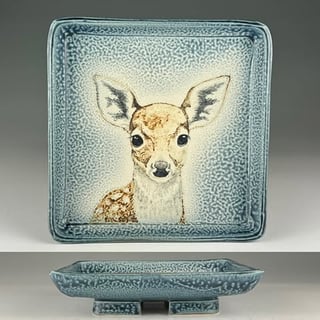
Speaker: Um, and then it's evolved since then. So I started out like hand drawing everything and now I hand draw things and then make, um, screens that then get screen printed onto newsprint and then transferred onto the surface. So it's like a lot of back and forth, but it like fits my, um, love of printmaking and drawing and also ceramics.
Speaker: So how do you get like make come up with your designs? So the designs are some of them are just simply like floral designs. Like I love being outside. We have flower garden walk around and some of like the florals just come from like that basic love of nature. But a lot of the illustrative work comes from little stories that I incorporate into the work. So
Speaker: For example, I do this worm design. Worms are... I love that they're a little bit weird and it's not for everyone. But the reason for the worms is because my little boys love to collect worms during the rain. So we go outside and they pick up all the worms and put them in their buckets. So there's a little narrative story behind it. And I think that some of those narrative stories
Speaker: will resonate with other people. And maybe it's something different. Maybe they don't have kids that are picking up worms. But for instance, I have an assistant who helps me a couple hours a week. And she counts worms for her parents' bait shop. So it's like, everyone's got a weird little connection. And I like that the work could have a story or a narrative to it.
Speaker: So that's where the designs kind of come from. They just come from experiences and from my head and from just making a lot of stuff. A lot of life. So for those that want to get started in slip transfer design, what advice would you give them? Well, I do online workshops, so here's the plug for that. I have some online workshops available on my website. I started doing them during the pandemic. I did Zoom workshops.
Speaker: And then because scheduling is difficult for me right now, I prerecorded them. So I have them on my website. They're available anytime. They're a download so you can learn directly from me if you want. I also, I mentioned already, but I recommend getting the book Graphic Clay. It's way more than just transfers. It's just all about surface design. And Jason did a really great job, like putting that book together. I also really liked the book Handmade Tile by Forest Leach Middleton.
Speaker: So he's also like a leader in transferware. And then I would say just try it. I think a lot of times like we get, we read so much about things and we like want to try things and we look and we spend all this time like not actually just doing it. And really you'll learn the most if you just try it and then troubleshoot from
Speaker: For those that are listening to it, it's better to take action than to just kind of sit and read all the time. So take your action right now. Yes. Yeah, absolutely. And I mean, I'm telling myself to do that too, because there are so many things that I get in my head about and like, well, I don't really know exactly how to do this. I don't want to start.
Speaker: And it's like this, you think of it as like productive procrastination where you're like, well, I'm doing more research and I'm like learning more about it, but really you just need to like do it. Yeah. You get in there. Yeah. So what is one thing you hate to do or see others doing in pottery? I like this question. Um, my pet peeve, a lot of people know this already, but, um, I wrote an article about it. So that's why people know.
Speaker: I wrote an article for Starbucks monthly. My pet peeve is having plate stands in your photos of plates. So like plates are my favorite thing to make. And I hate when galleries or other artists use a plate stand in their photos because you can just cover a brick in craft foam. They make like a sticky craft foam. So you just stick it on your brick and then that will hold your plate up against without seeing it.
Speaker: So it's like it's a small pet peeve. But as far as like what I hate to do in the studio, I hate sanding. I think everyone hates sanding, but I really hate sanding. Yeah, there's just a little details that are so take up so much time, but you have to do it. Oh, it makes such a big difference. I like I can't imagine not doing it, but I hate doing it every time I do it. Yep, that's how I feel about wedging. Yes.
Speaker: So something that I found interesting on your website is that you said, I want to make things with meaning, connection, and stories. Could you explain this some more? Yeah. So I think that that quote kind of plays to the life of ceramics as a material. So ceramics, when we make something out of ceramics, it will last centuries. That's why we keep digging up ceramics, and we have all these shards. So it kind of tells the story of humanity.
Speaker: So like when I'm making things like that legacy of the material is something that I think about and I like the idea that like what I can make connect beyond like this is just my coffee cup that I drink coffee out of every morning. Like I want it to like trigger a memory or I want it to remind people of something or just become like part of like a heirloom piece in their life where they're like
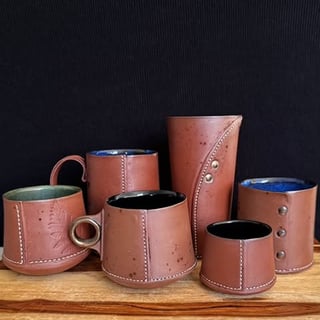
Speaker: This is my favorite mug. We've used it for years. So that's the part of making that really excites me. How does this affect what you are choosing to make? So a lot of what I make is actually tableware stuff. So I do a lot of cups, plates, bowls, and dinnerware types of things, vases, things that you'll find in your house.
Speaker: A lot of times when I'm making things, I'm thinking about like problems I'm solving in my own life or like in my own home. So when it's difficult to find things that are like heavily illustrated because I like a lot of pattern and illustrations, I like, well, I should make something that has all of this on it. So that's oftentimes what I'm trying to problem solve through is like, what do I need in my own home? What do I think other people might
Speaker: I would expect to ask that so soon. When you feel overwhelmed or unfocused, what do you do to get back on track? So two different things. When I feel overwhelmed, I make a lot of lists. So I'm a heavy list maker. I always have a list. I never get through all of it. I'm constantly rewriting the list day to day. This is what I got done. And I love crossing things off the list.
Speaker: helps with feeling overwhelmed and also I did actually do something today. And then when I'm feeling uninspired or unfocused, I think one tool that can be really helpful is just to look back at your own work. And if you have been taking photos of it, it's a great documentation to see what's still grabbing you about the work. What are you excited about?
Speaker: Is there something that could be redone or reworked? Would you do it better now because everyone is constantly practicing and getting better? So I find that really helpful to just go back and be like, I think you can make that again, but better. For those that are listening, it's really good to document your work because then you can really see your progress and then you can actually make more progress as you go along. Yeah, you don't realize the strides you make until you look back.
Speaker: because it happens so slowly that you don't realize it. And then when you look back at, say a year before, you're like, wow, I actually made a lot of progress. So it's a little 1 % and you just won't see until then you look back at it. What advice would you give to someone trying to find their own unique voice with their pottery? So I think that everyone sees the world in a different way, even if we went
Speaker: on the same routes everywhere we went in our world. Like if we drove the same route every single day, you would notice things differently than what I would notice things. And I think it's really important to pay attention to what you're noticing and then bring that into the work if you can. So like, I always use this example, but say you're on your daily drive route, wherever that is, and you always notice a green building on that route.
Speaker: Like why are you always noticing it? And like, what is it about that green building? Does it have to do with like the season, the sky, the texture, the whatever it is, but pay attention to it. Cause we right now, like we consume so many images and we often don't like slow down enough to ask why do we like this? It's easy to say like, oh, I like everything. But like, if you're really specific, that will lead you down a path.
Speaker: much farther. I like that because you're taking inspiration from like things that you actually like and that you notice. I like that a lot. So as we are wrapping up here, what is one thing from this interview you want to hammer home with my audience? I think that there is a lot of ways to get an education. And that being said, like take a lot of workshops, take a lot of classes, travel to different creative retreats with life.
Speaker: listen to podcasts, you know, break the Google machine, just looking for things. So just know that like you should constantly be learning and then you're always going to be improving. And there's a lot of answers out there that you just have to look for. Absolutely wonderful. Katie, where can my audience go and check out your work? So Instagram is like the most updated, of course, always. So Instagram is at Katie Miller ceramics.
Speaker: and it's Katie with a C -C -A -T -I -E. And then my website is katie -miller .com. Thanks for listening to this episode of Shaping Your Pottery. If you would like to learn how to discover your voice, I put together a free six step guide that will help you discover your voice and so that you can make your pottery stand out. Go to shapingyourpottery .com forward slash voice to get this free guide.