Transcript
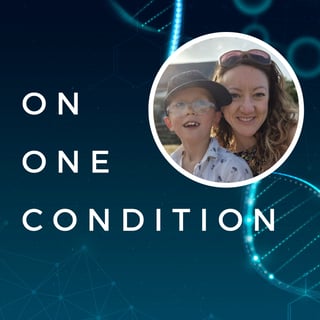
Speaker: Hi, I'm Sylvain Bertolo and you're listening to On One Condition, a podcast to raise ah awareness about health conditions by listening to people who leave them every day. My guest today is Andrew Longnecker and we're going to talk about peroxisome biogenesis disorder, also known as PBD.
Speaker: Hi Andrew, thanks for joining me on the podcast. How are you doing? I'm great. Thanks so much for having me. It's an absolute pleasure. We're going to talk about something that's very important to you, not only your son Diego, but also what you're doing to help the PBD community.
Speaker: But before that, I love asking this question to my guest. What song did you choose and why? Yeah, I've got a bit of a different tack on this one than some of your other episodes. The song I chose was Un Poco Loco from the movie Coco for a few reasons. One, we just love that movie. My wife is from Mexico. We're raising our kids, including Diego, to have a sense of Mexican heritage. And I think the movie just deals elegantly with issues of death. And we love Day of the Dead. And it's just really a beautiful work of art.
Speaker: The song also, I think, discusses uniqueness in a you know playful way, obviously. And look, in the rare disease space, we need to celebrate what makes us unique.
Speaker: And then the other level that where connects with me is, look, what we're doing is we're trying to help kids with this super rare disorder and ah focus on not just paroxysm biogenesis disorders, but an entire organelle. And what what can we do to to help patients for dysfunction through an entire organelle And I think that requires a certain level of craziness. So, know, look, this song is for every researcher, family, funder, partner we work with. Look, is's just a little crazy enough to fight for something the world hasn't figured out yet.
Speaker: Nice. I like that. I love that song. i love Coco as well. So you have my yeah seal of approval, although you did not need that. Right. Well, so I think it's probably best to start from the beginning and wherever that the journey with PBD started for you and your son, Diego. So would you like to share a bit more about that?
Speaker: Yeah, so my son Diego, who's now eight years old, he was born normally and it developed normally until the age at which he was starting to learn how to walk.
Speaker: And he was our firstborn son, and we weren't really quite sure what goes into that. And it just seemed like it was difficult for him to learn, put one step out the other, have his balance. And were kind of concerned, but It didn't really press the issue too much. And then i remember a distinct moment, a neighbor of ours brought her daughter over around the same age as Diego. And she was also learning how to walk at the same time. And she had pulled up to a couch cruising. It's what it's called, where you you're learning how to walk and you hold on to something while you while you take steps. And I immediately came over to her and and put my hands out to catch her if she would fall.
Speaker: And our neighbor was like, what what are you doing? I said, well, I'm im protecting her case she falls. And our neighbor goes, you don't need to do that. She's fine. And of course, we had to do that with Diego. And kind of in that moment, I realized like, oh, things are not fine here. And so we started long diagnostic odyssey, seeing a pediatrician and neurologist and a geneticist and lots of pushing from us to to get an answer. And i finally got a whole genome sequencing done.
Speaker: ah that said my son has a Zellweger spectrum disorder, which is a peroxome biogenesis disorder. It's a spectrum disorder, so there's severe cases and milder cases, but canonically known as being very, very severe. Many patients live a few years, and it affects every organ system in the body.
Speaker: Peroxasomes are an organelle in every cell in your body, and so when they don't work, every cell in your body doesn't work as it should, and you can imagine all the different things that can happen when your peroxomes and your cells don't work. And so a lot of patients don't live very long, have issues with muscles and brain and heart, and liver, and runs a gamut.
Speaker: And so Diego is now eight. He's fortunately got a milder case, but really been touched by the patient community. and it's really changed how we think about the world and rare disease and and changed my own career as we've ah really dived in to see how we can help further science and develop treatments for for this really devastating disease.
Speaker: Yeah. And we'll get to the work you're doing in a bit, but I'd like to stay on Diego's diagnosis journey or when you got that diagnosis, what was your reaction?
Speaker: And did you have a lot accessible? Like, were you able to tell what Diego's future might be like? Yeah. i remember I was at work and I got the call from the doctor.
Speaker: geneticist said, we think it's this. Doesn't quite match his clinical symptoms, but just come in tomorrow. Let's talk about it. Whatever you do, just don't Google this.
Speaker: And I immediately got off the phone and obviously immediately Googled it. yeah And it was terrifying. i remember the first link that came up was a like a bereavement page for children who've whove died from from the disease.
Speaker: And that's a heck of a way to get introduced to this disease. Yeah. And i came home kind of in a daze, immediately left work, came home and had to wait for my wife to come home. and I remember breaking the news to her of like, this is what the doctor said and this is what we think it is. And our whole world changed.
Speaker: The challenge with this disease is it can be very severe, but it's also very rare. And so when we met with physicians, they basically said, we have no idea what the future will look like. Diego seems to be doing pretty well.
Speaker: but but he has this thing and we don't have any idea what the future is going to look like. So good luck. And there's no treatments available. by the way, there's no treatments available either. That's basically the story.
Speaker: yeah It was a, it was a shock. It was lots of processing, lots of, you know, Maria's family flew in from Mexico to just like immediately spend the weekend a week with us to, to help us work through it. And it was just, it was just so interesting. Like,
Speaker: you know Diego was a happy boy and yeah had trouble learning how to walk, but otherwise was right in front of me and and you know doing pretty well, and despite you getting this traumatic news. And so it was a really hard thing to to deal with.
Speaker: Yeah, can I imagine? Yeah. So how did Diego's symptoms evolve? Because so far you've talked about difficulty walking, but from what you shared about the root cause of PBD, the paroxysome, as you said, is in in every cell. So how does it impact him?
Speaker: As far as we can tell, he has been essentially stable from you know that time of diagnosis, the challenge with learning how to walk is it really creates more burden on your balance.
Speaker: And when you're crawling, you're on all fours and you don't need as much balance to get around. And I think his balance while he was crawling was probably just as it is today, except it's just a much easier way to to move around.
Speaker: And you know when he's eight years old, he can't crawl crawl around the school. And so what he uses now is a walker. And he's great in that. He flies around often dangerously, like raises his feet up and pretends he's Superman as he's like flying down in his in his walker. So he has a lot of fun with it. We we we try to help him not have too much fun with it because it can be a little dangerous sometimes. But yeah, he is in his local school. he's eight years old, went to start a third grade this past week, and he's he's doing great.
Speaker: His main issues are balance. And he's a walker to get around and he has some hearing loss. So he uses ah hearing aids, but that's been stable. And it's been really been a blessing that he's appears to be on the milder spectrum of this disease. He's been stable. There's been no issues. and We're really grateful. He's an amazing kid. There are things he needs adaptive assistance with, you know, he plays adaptive basketball and sled hockey. And every winter we go adaptive skiing and,
Speaker: For Diego, it's just, this is what I do. And in order to do this, i need maybe a extra piece of equipment, but otherwise i'm going to go do it. It's really awesome. I mean, we just we feel incredibly blessed that he can do these things. He's got a good attitude around it.
Speaker: And he's just an awesome little kid. We feel so blessed that he has got a good attitude about it and makes the most of it. Yeah, that sounds amazing.
Speaker: He does a lot more sports than I did at his age, so good on him. He loves sports. i you know when he When he was really little, he was really into superheroes like Captain America and Spider-Man and Black Panther. I know they'll help around the game, but as he's gotten older, i think you know his now his superheroes are like Lionel Messi and LeBron James, and you know he will go to school, and if he's wearing his Messi jersey, he needs to wear the pants, he needs wear the socks, he even needs to like mimic as much as he can Messi's tattoos. And so that morning, he will like draw on his left arm the the recreation of Messi's tattoos and and you know washable marker. And it's really awesome to me that he can find inspiration from these larger-than-life physical figures, which I think provides really great platform for him to push himself as he he works hard. He goes to physical therapy every day and he's constantly trying to get stronger. And i mean, he's training every day to to get stronger and to work on his balance. And I think he sees those similarities with these sports superstars that really brings some inspiration and allows him to role play. And it's it's really it's really fun.
Speaker: Amazing. So you got the diagnosis, then you got involved with the PPD community, as far as I understand. What was the journey for you?
Speaker: Yeah. So after we got the diagnosis, realized there's no treatments available, we immediately, well, maybe not immediately, we we really took some time to like just grieve the future we thought And just to come to terms to the diagnosis, ah that took a little time. And once we came out of that, we decided, right, let's do something about it. And so connected with the various patient communities that existed around the disease, of which there a few. I joined the board of a patient community that really does a lot of great patient work.
Speaker: And then we also started our nonprofit really to help connect researchers and develop the science around this disease. and started reading a bunch of research papers, cold calling scientists, which was hard. I don't have a scientific background. I was trained as an engineer and had been doing business since university and had to learn how to read a science paper and had to learn why we so use yeast to study peroxisomes.
Speaker: My first question was, why are all these research papers around yeast? Who cares about yeast? And I realized until later, like, oh, this is the way to like understand how paroxysm is working and all this stuff. But it took me a while. And we just started connecting with researchers and just really dove in headfirst. We built ah animal models to help slide a disease, to help cell lines, to to work with researchers and help to understand it.
Speaker: And really did what we could to try and help develop treatments for paroxysm biogenesis disorders. you know After doing this for your nights and weekends for a couple of years, just realized there's a really much much bigger issue at play.
Speaker: it's not just that Diego's rare genetic disorder is poorly understood. It's the entire paroxysm is poorly understood. It gets several orders of magnitude less funding than other organelles like the mitochondria, if you remember from high school biology. And I just came to the realization like, wow, of course, this rare disease is is not well understood. The part of the body that it impacts is not well understood and critically underfunded.
Speaker: And really interestingly, just in the past few years, the peroxone has been implicated in lots of common diseases, cancer and neurodegeneration and Alzheimer's and obesity, diabetes, and even aging itself, where I became convinced, man, 50 years from now, pharmaceutical companies are going to have medicines that target the peroxone to treat a bunch of diseases that can treat millions of patients.
Speaker: gosh, there really should be an organization that helps catalyze this and helps compress that 50 years into five or 10. wait, like, why don't we do that? And so I quit my job and started doing this full time about a year ago and really building an ecosystem around the peroxisome, making it an exciting place for reachers to work, making it a fundable asset class for biopharma and venture capital, create more awareness around the peroxisome, and do what we can to help catalyze and play our role in and the broader opportunity for helping the world realize that the peroxym is important.
Speaker: It can be used to treat disease, including my son's disease, and do what we can to catalyze a ah field. It's a big problem, but it's something that like obviously is very close to home for me, Diego, but I think this can help a lot of people and very passionate about the space for for both of those reasons.
Speaker: That sounds incredible. And I don't know if it's a ar relevant question or not, but did you have that drive before Diego to, I'm going to say, change the world because you're going to, you're trying to change the world for a community.
Speaker: Did you have that in you or is it something that came with Diego? Yeah, it's it's funny you mentioned that because I've always been startup oriented. And I really love a hard problem and like working with amazing people to like solve a hard problem. And that has driven me throughout my career. and the one question i've always asked myself, and I've worked with some incredible founders and CEOs who've been just so passionate about, I'm going to develop this enterprise SaaS product to help these companies. And they just live it and breathe it. And I always ask myself, like man, never...
Speaker: i'm never never going to feel that passionate about this thing. yeah And I wonder how they do it and how they got so passionate about it. And suddenly you like this happened. right And now I'm like, oh, I get it now. right like i I wake up early every day to like work on this and I'm just thinking about it all the time. And it's opened my eyes to really the the entrepreneurial journey as a founder of just living and breathing something and caring so deeply and being able to bring others along with you on that dream and on that vision, it's opened my eyes to to something that I was not ever sure was possible for me.
Speaker: Things happen and the world opened up an opportunity and and now I'm living it. you know It's a hard problem. It's an important problem. But for me, it's you know there's a silver lining that I really think we can make a big difference here. And I really,
Speaker: its it's ah opportunity to be grateful for a passion that means a lot to me. Yeah. Yeah. And what's the reaction from the scientific community? Are they welcoming your your drive to explore the paroxysm? And do they align with your goals to to to learn about it and and how it could help multiple communities? Yeah.
Speaker: The reception from scientists has been extraordinary. Just extremely welcoming, particularly from a you know a dad who has no scientific training.
Speaker: i got an incredible percentage of my cold emails get answered, and my cold calls get answered. The scientists have been so gracious and generous with their time.
Speaker: And I think I've really recognized this opportunity. There's a general acknowledgement that they like, yeah, this has, this has been a forgotten organelle. It's hidden. It's much more important than we've given it credit for. There's really all lot opportunity here.
Speaker: We just need to unlock capital and ah infrastructure to be able to unlock it. It's been a really wonderful experience. I was a little, I was worried at first that I would just get dismissed or not taken seriously. And the reception has been really great. i I do think it's really important to be able to speak the language and all the blood, sweat, and tears I put into going through those research papers and like not, you know being able to know enough to be dangerous and ask the right questions has been really critical. These scientists are much smarter than me, but being able to like be in that conversation, have that conversation on a kind of eye to eye level is is just hugely important. okay
Speaker: and But yeah, it's been a really wonderful reception and, you know really grateful for the scientific community for, for their like welcoming me with open arms for sure. Yeah, it's really interesting because especially in the rare disease community, so the wider rare disease community, I hear a lot more about science being driven by patients or parents of patients like you.
Speaker: What I find fascinating is that it's not that the the scientists don't know necessarily what to do. I guess those scientists were not just waiting for you to call them to find something to do, but it feels like they need a goal and they need something to work towards.
Speaker: Is that a fair assessment? I think it's a lot. For the peroxome, as an example, The peroxome is misunderstood, understudied, underappreciated.
Speaker: And that's throughout all levels of the broader community. As an example, when a researcher submits a research project that says, I'm going to look at the peroxome and look at this, the reviewer who may be at the NIH or you know the European funding agency may say, huh, peroxasome, I don't hear about that as much as mitochondria. This is probably not that not as interesting as this other project I'm looking about the mitochondria.
Speaker: then that researcher who really wants to do this doesn't get funded. And so what the researcher do next time? Maybe I'll do a mitochondria project, right? And this is not just true for proxenoms. There are other parts of medicine and science that either are forgotten just for historical artifact reasons or almost branding or just random chances where one field has gotten hot and another one gets left behind, not because of the science reasons, but because of word of mouth and hype and just lots of reasons. And so It's a vicious cycle because the researchers, if it's not hot area, then they're less likely to submit more research proposals. And if they're less likely to submit more research proposals, their postdocs and their trainees are less likely to study it, which means that the next generation of researchers aren't going to do it. And so you have to kind of break that cycle and start your own virtuous circle where, okay, you catalyze,
Speaker: but You put more funding, you get the research done, you convince the NIH and other funding agencies that this is important. And so when they look at that next review, they'll maybe take pay more attention to it or have a a view that like, oh, we want to further this and sponsor this. So it's really like a, you know, it's an ecosystem building problem. And so each individual scientist is acting in their own rational means.
Speaker: Everyone's operating in the system. And so how do you influence the system? to change the way that a particular mechanism or part of science or organelle like the paroxysm is viewed. And it's a hard problem.
Speaker: It's a thorny problem. It's a complex problem, but I think it's a problem that's solvable. You just got to put in the effort and make people aware and do all the things that you need to do to build an ecosystem.
Speaker: So it's a case of not only focusing on the science, but also on who will review the science and making them understand that this is important to do because it impacts a lot of people.
Speaker: I'm glad you shared that. I'm pretty sure others may be in the same situation where it's not just a one stakeholder discussion. You need to go and and raise awareness about it with with many different people.
Speaker: Yes, exactly. And some of these are Seems small, like the mitochondria in high school, I remember very clearly it being quote unquote, the powerhouse of the cell. It's got a, the branding team around the mitochondria is really wonderful. It actually traced, there was like a Scientific American article back in the 50s or something that like, name of this article was was the powerhouse of the cell. and And just this one article that had a really nice tagline, whoever came up with this, you know, Mad Men style, was really impressive. yeah you know, it didn't alone start a a big movement in mitochondria research, but it definitely helped.
Speaker: And compared to peroxone, I didn't even learn about it high school. In fact, you don't learn about the peroxone until maybe like advanced PhD level stuff. It's just, it's been hard to study. It's, it's just hasn't been paid much attention to. It was discovered a hundred years later than mitochondria. It's just, so it's just kind of behind.
Speaker: Yeah. I mean, silly things like ah taglines and just being stuck in your brain matters. And so we're trying to change minds and and outlook on this. Yeah, but you know it's ah it's a multidisciplinary problem for sure.
Speaker: And I can attest for what you said, because I studied human physiology and it was all about the mitochondria and not much about the peroxisome.
Speaker: So yeah, unfortunately. So from what you do with the PBD group or living with Diego, anything that you want to share that you think could help others in the rare disease community?
Speaker: Yeah, I think with a a rare disease diagnosis is a big moment. You're kind of thrust into a community. It's wonderful. We we love...
Speaker: the PBD community. we love the rare disease community. They're incredibly be supportive, really an amazing group of people. We wish we weren't in it, i.e. we weren't dealing with this problem. But now that we are, you know we feel a ah moral and ethical obligation to to to be involved.
Speaker: But that looks like different to everyone. you know We've taken that as, oh, let's start a nonprofit to help catalyze a research accelerator and biotech incubator around an organelle and the paroxysm. But that'll look different for for other people. For some, it's the one-to-one, patient-to-patient support groups. For others, it's just taking care of your kid because these diseases can be challenging.
Speaker: Whatever that looks like for you is what you should be doing. and think it's a different story for everyone, but the beautiful thing about the community is that can expand or contract as your interest and capabilities and journey changes. And it's a really wonderful part of the rare disease community is that there's lots of seats available for you to sit and they're different. And however you choose to show up, whether it's for your kid or for yourself or whoever you're caregiving for, or it's getting involved in the research or it's you know fundraising for 5K or what have you, or bake sale,
Speaker: The community needs all of that. And so however you decide to show up, you know you're welcome. and it's And it's a really empowering and and great community for that. Nice.
Speaker: Where are you in your research then? Are you at a point where you understand the, i say you as a general term, obviously the peroxisome better? What's the gap between where you are and and being able to have an impact on PBD itself?
Speaker: Yeah, that's a good question. I think there's lot of really great research advancements through studying animal models. For those that don't know, you can induce a mutation. So if a patient has a mutation in gene X, you can take a worm or a mouse or a a fish.
Speaker: who and it surprisingly have very pretty similar genome. They probably have that gene X. And in fact, that gene X probably looks pretty similar and and in humans. It's incredible how close we're related to what appears to be very different species. And you can make that exact same change. And then it says, well, what happens? And maybe the fish doesn't swim as fast, or maybe the fly gets disoriented when it eats certain kind of food, or maybe the mouse...
Speaker: grows smaller or has like seizure-like behavior. And you can really understand, okay, well, let's induce this mutation. We can understand the trajectory of the disease, what it impacts. And you can do a lot of things with a mouse that you you know can't do with a human for ethical reasons, obviously. And so that advancement in proximate biogenesis disorders, being able to use those animal models to study it better is like hugely valuable.
Speaker: And then you can start putting drugs in those animals and see if it fixes the problem. the first And so We're starting to do that, and we're seeing some really great results, and it's really encouraging across different genes for peroxone biogenesis orders, and it's that's really encouraging.
Speaker: The challenge, of course, is even though those animals do have high overlap with humans in terms of the genome, they're not the same. They're different. And so what works in a mouse may not work in a human.
Speaker: And so there's still, you know, the clinical trials and all that come into play. And then, you know, from the broader peroxysome standpoint, we're building tools to better understand the peroxysome. You know, there's lots of tools for different areas of science that just don't exist yet for the peroxysome. So let's build those tools and provide them to scientists so they can better eat more easily and quickly and cheaply study peroxysomes.
Speaker: And then, you know, it seems like every week there's coming out to a new paper that's like, whoa, peroxysomes also do this. And wow, there's implications on this other disease. And I think... We're at the stage where these connections are being made and they're stronger.
Speaker: the next step there is, okay, then what do we do about that? For those you know connections to cancer, Alzheimer's, whatever, how do we utilize a proxome to treat that? And that's really that next phase.
Speaker: But drug development is tough. It's a long journey. I'm really excited where we're at in the community now. I think there's an incredible amount of potential.
Speaker: We just need to put forth the effort and the funding and get the community together to to to make this forward. I think it's a really exciting time. That's awesome. I've got a scientific brain and I love like hearing you explain this in words that are easy to understand because I know those things can be very, very complex.
Speaker: and It's great to hear how it sounds like it's a lot of progress already, which is amazing. You talked about clinical trials. Is that something you've started looking into already? Do you know what that looks like for you?
Speaker: Yeah, we haven't. There's no active clinical trials, but we're putting forth the work that needs to be done to get them ready. There's just how you design a clinical trial is so important.
Speaker: What are you measuring? Which patients you choose? You you can have a medicine that works, but if you choose the wrong patients because their exact mutation doesn't fit the medicine, or perhaps there are different stages of disease. And so in one stage, you can see an impact, but another stage you can't. If you muddle that,
Speaker: the clinical trial will look like a failure because it didn't have the exact impact. Even though the drug works, maybe you just measured the wrong thing or chose the wrong people. And so for a rare disease, that is particularly challenging. You know, for heart disease, you've got a tons of patients to choose from, and you can maybe segment those patient populations easier. And if it doesn't work, okay, try it again.
Speaker: problem with rare disease is, you know, you've got a lot more limited shots on goal, And so making sure those design is well done is so, so important. Oh, actually that's one, maybe one callback to what you can do in rare disease community. Enroll in your natural history study for your disease. The more data that the disease groups have, the better they can design clinical trials, the more they know they they know about the disease. And without that data, it's really, really hard to make a difference. So
Speaker: you know, maybe a a vouching for a way to get involved in your rare disease community is get involved with natural history studies, provide clinical data. It's really, really invaluable for enabling medicines to be developed.
Speaker: And so we're at that stage now. When we have something to take to the clinic, but what does that design look like? What are we measuring and why? What patients are we selecting and how? They're non-trivial and critically important problems that we're preparing for.
Speaker: Yeah. At least you're you're starting from the patient point of view. What I see in in the clinical trial community is that sometimes clinical trials can fail because they don't really understand the patient's perspective that well.
Speaker: So hopefully that will give you a better head start on that and good shout about the natural history studies because they are very important.
Speaker: It's incredible. I know I've said that word many times, but really, really awesome to hear all the progress that's being made and wish you best of luck. I have one last question for you, which you can answer for yourself or for Diego, you you choose.
Speaker: What's your or Diego's happy place, a place where you feel at peace? Yeah, it's such a great question. I have a specific time and location and it's my parents' house in South Florida in the evening.
Speaker: My parents are retired. And so every day they make a cocktail, they put out a charcuterie spread, and they go in the pool. And it's my family, the four of us, my parents and my sister's family and Diego's cousins. There's 10 of us in the pool drinking a cocktail, yeah the adults obviously. eating charcuterie and sun's setting and the light hits the water. And my parents have like little pool waterfall and it's just so idyllic. And we put a light vest on Diego and he can stay there all day. And he's just laughing and playing with his cousins and the adults are having fun. And it's just such a nice time. It's very much my happy place. It's at peace. Everything seems right with the world. And we're with, I'm with family.
Speaker: And Diego's with his family. And it's really, really wonderful. I'll message you privately afterwards to get your parents' address. Yes, invite any time.
Speaker: That sounds my like my kind of happy place. a love it. Well, thank you so much, Andrew. I really appreciate you taking some time out of, I'm sure, what is a very busy day. To be on the podcast, I'm sure the PBD and the broader paroxysm disorders community is very grateful for what you do.
Speaker: Thank you so much. Appreciate you having me on.