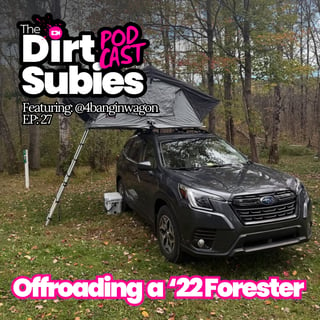
Transcript
Speaker: Welcome to this week's episode of the Dirt Subies podcast. We have a fantastic guest for you. My friend John jumped on the microphone to talk a little bit about his Forester and some of his off-road adventures. Before we jump into that, make sure that if you haven't already checked out the Subie & You podcast, go give it a listen. It's on Spotify, Apple Podcasts, pretty much wherever you listen to podcasts. There's a ton of good episodes over there that you can binge for probably the next couple of days. Let's go ahead and get into this episode. Could you tell us who you are and then where people can find you online?
Speaker: Well, I am John Schaversky. pretty much do a Facebook page, which is Subaru Off-Road Adventures and an Instagram page. It's the same thing, Subaru Off-Road Adventures. My YouTube is is the same also, but it doesn't really have any following yet. I just really started it.
Speaker: Well, let's see if we can change that. Yeah, I know, right? I used to do a lot of stuff on on YouTube for fishing because I used to do a lot of fishing tours and tournaments and stuff like that. but Nice. Since I got into the offer and thing, I really don't do a whole lot of fishing as much as I used to. But the Facebook has definitely been blowing up in the last couple weeks because I've been posting a whole lot more on there. so I mean, I know you own an SG, correct?
Speaker: Yeah. Okay. Is that the only... No, I have 21 also, 21 Forrester also. Nice. Well, what trim package is that? The premium, I think. Okay, nice. So you got the fog lights?
Speaker: Oh, yeah, yeah. Heck yeah. Yeah, the fog lights, to the sunroof, power windows, you know. Yeah, let's go, man. Now, do you off-road in both of them or just the SG? So I started off off-roading in the 21. We put all the rock sliders on it, the Ironman lift on it, the skid plates, all that fun stuff. And then we realized that the CVT just wasn't really what is cracked up to be for off-roading.
Speaker: That's when I got the SG and started building that one for strictly pretty much off-road. I mean, we drive it day to day. we keep the 21 for all the fun, the fun grocery getting stuff. Are you currently in the market for a lift kit for your Subaru?
Speaker: Or have you put a crappy Amazon or eBay lift kit on it and realized maybe you shouldn't have done that? Well, if you're in the market for that or skid plates, ditch light brackets, molly panels, any kind of other off-road Subaru stuff, make sure that you check out today's sponsor, Anderson Design & Fabrication. They are offering you guys a 5% off deal. If you use code DIRTSUBIES at checkout, all you gotta do is go to their website, awdadventure.com, use that code DIRTSUBIES when you check out and you will get 5% off. And I can't speak highly enough of their stuff. You guys know that I've been running their products for over 10 years at this point and have just absolutely beat the crap out of them. I've got their lift kit on my Forester currently, and I will probably never use another lift kit brand ever. Their stuff is just solid. So it means a lot to me the fact that Patrick was willing to do me a favor and sponsor the podcast and giving you guys a way to make purchasing a quality lift kit more affordable. So go over there, get whatever you need, use that code and make sure in the notes section you tell him thank you because he doesn't need to discount any of his products. He's literally killing it. But again, it's just a favor that he's doing for us. And
Speaker: I really appreciate Patrick. The SG, I think is just such a good platform. um Is, was there any, did you do some research ahead of time before buying it? And, you know, is that what caused you to do it or is it something that just came up for sale?
Speaker: Well, actually one of my buddies had one and he's been offering his for years. And he was like, man, if you're going to get another one, you need to get an SG because there's so many different models of parts that fit it. You know, you can put Outback stuff on it. You can put um WRX stuff on it. You know, pretty much everything fits on that for some reason.
Speaker: Yeah. Was that Brant? Yep. Yeah. Okay. So I just interviewed Brant. His episode is going to come out on Wednesday. And it's funny in the, I don't remember cause you know, it's like two and a half hours worth of us just blabbing.
Speaker: I can't remember. I don't remember exactly what he said, but he mentioned you. And yeah, so I'm glad that you're going to be your, your episodes basically going to follow his up. So he's talking, he's talking tire tires too.
Speaker: Um, or often just a little bit. I was hoping we could actually talk about tires. So yeah yeah like it sounds like you've run a bunch. Let me ask you about tires in a second, but first, can you tell me about, um, kind of what the overall, you know, 30,000 foot view of your mods are on that SG? Basically it's got the rally tech full lift kit on it, the overload springs and the two inch spacers. It's got the primitive, um, skid plates.
Speaker: It's got the, um, ah differential out of Baja so it puts makes the um VTD transmission okay the center diff the center diff okay and then it's yeah yeah yeah and then it's got the torque locker in the rear and of course the yeah yeah that made a world a difference dude same It's like that that thing will go places it's never gone before.
Speaker: Yeah. you put that And even with that center, if, you know, it makes a world of difference too. You know, and then just the basic little thing of roof rack, tube bumpers, you know, did the tube bumpers on the front rear with the swing out, spare tire carrier, and rock sliders that are just welded right to the subframe. Heck yeah.
Speaker: Does your Subaru's engine bay look like crap? Mine definitely does or did. I recently, in the last couple of years, purchased a full set of engine bay caps for my daily driver and then I purchased some other ones for my Forester from Mele Design Firm. They have full sets or you can buy just the oil cap if you want to just dress that up. But they're billet aluminum. They're small batch. So again, not every broccoli head with a WRX is going to have these. and they look pretty sick.
Speaker: I'm using the Wrinkle Red powder coat, but they have them in all sorts of other colors that you can choose from. And if you use code DIRTSUBIES at checkout, you'll get 10% off pretty much anything in the store.
Speaker: And that would really help us out to continue making these episodes for you. And it would help out a small business. Mele Design Firm is the epitome of a small business. Mitch over there is absolutely grinding and crushing it. And I can't say thank you enough for his willingness to sponsor what we're doing over here. So go check that out and let's get back into this freaking heater of an episode. With the lift kit, I know you've got overload springs on there. Did you start with those or did you initially just do a lift and then put the springs on at a different different time?
Speaker: um I actually did everything all at once. It actually had the the one inch extra lift lifts overload springs on. So it would give it like three and a half inches of clearance. But um they were just the springs and the lift was just too much. It was just killing the struts.
Speaker: Yeah. and the CVTs. Or the CVTs, yeah. The CVs. and I knew what you mean. The CVs, yeah. no Yeah, yeah, yeah. The axles. The axles are getting eaten up. so Yeah. Yeah, I got you. Did you blow through a bunch of axles before coming down a little bit? No, I actually changed it before the axles started getting bad. Okay. I was watching the boots, and the boots were starting to wear on themselves where they rubbing because the axles had so much of a drop on them. Pushed.
Speaker: Yeah, yeah. So the bottoms of the boots were just wearing out, and I was like, ah. I gotta to get rid of these. I mean, I know it's a half inch or almost an inch of extra travel or suspension lift. I wanna keep my CVs intact. and I don't need a break.
Speaker: Yeah, especially when you're you know you're already, you know you've got the torque lock or you've got the center diff, that BTD in there. It makes it a little easier to chew stuff up. Yeah, yeah. I broke my first axle the first time with Brent the other day in Uhari, and we were out there, and I was spinning, just spinning on a rock, you know trying to get the tires to kind of heat up a little bit to get traction. Oh, yeah. And it slid off that rock and just whacked this. Boom.
Speaker: Snapped an axle. Yeah. That's actually the ah same way that I blew up the only CV axle that I've ever damaged in a lifted Subaru. Same exact thing.
Speaker: Ton of wheel spin and then finally it contacted the ground and you know that shock load that gets put on it. that I think within a few months it started clicking. Right.
Speaker: Yeah, mine just sheared right off. I mean, mine was just sheared off, and on the inside of where the um that axle went into the hub, it was actually broke inside of there, too. Got that Bluetooth axle.
Speaker: Yeah. But luckily, I mean, I had a spare, and you know it only yeah took probably 30 minutes to change it, so it wasn't a bad deal. Okay. And you guys get down out there, man. I've seen a bunch of Brant's videos. Oh, yeah. Dude, you are. He's crazy. I've never wielded anything quite like what you guys have out there. i mean, we get we got some wild trails, but...
Speaker: man after seeing some of the stuff you guys do i'm like i don't know if i could hang yeah well that's what i thought too when i started driving with a brett you know he was yeah he'd be out there and be like oh yeah we can do it i'm like you sure sure enough you know you could do it you could do it yeah watch him do it and i'm like okay you did it i can do it i'm in the same car you know you know Your suspension is still going to give you almost the same capability, you know yeah in my opinion. but is The off-road stuff, is is your experience with it, um did it start with the Subaru, or have you done other off-roading in the past and other types of vehicles? No, it pretty much started with the Subaru.
Speaker: I've just always been an an outdoorsy kind of person, you know, and yeah we went. It was funny because we went to New York. We go to there to New York all the time and we I had a Ford Edge at the time and we came back and there was a snowstorm and it was only two wheel drive and we almost didn't make it home.
Speaker: And when I got home, I'm like, that's it. I'm trading this car in for a Subaru and that's how we got stuck on the Subarus. You know, it only takes one bad snowstorm or getting caught in one snowstorm to be convinced that maybe symmetrical all wheel drive is, is the right move here. That's how I got into it, man. Going up and down the mountain to go snowboarding.
Speaker: and everybody drove Subarus. I thought, okay, Subarus seem to get up here way easier than the dudes in 4x4s. So that's what I'm gonna buy. I'm gonna buy a Subaru. And it's it's all been downhill from there. Right. Well, and the funny thing is like the South doesn't really have a whole lot of Subarus. I mean, it's not like the Fords and the Chevys and the yeah Kias and stuff. There's a ton of those here. the suit There's only like one dealer in columbia where i'm at and then i got to go like a two hour drive to like charlotte or someplace for another subaru dealership so they're not really popular here but well hopefully that keeps the purchase prices a little more reasonable right right yeah but the only downside is it's hard to find parts you know exactly break something i can go to like a pull apart and you know pull parts that i need but they're you know yeah that older model they're just hard to come by
Speaker: Oh, absolutely. Yeah. Even out here, they're getting harder and harder to, to get your hands on unless they're just completely hammered or they've been just absolutely stripped. yeah any Anytime I go to, anytime I go to a pull apart, I'll find one and I'll take off everything that I could possibly think I'll ever need. If I don't need it, then be like, I'll need it someday. And you'll save so much money over eBay pricing.
Speaker: yeah Right, yeah. I want to ask you about two things. um Number one, a your bumper. Dude, that thing is sick. Did you fabricate that or... um I had one of my buddies up the road do it. okay um But then after he did it, I was like, I could have totally made that myself.
Speaker: So, of course, went and bought a welder and a tube bender and, you know, yeah all that kind of fun stuff. So, it's now I'm always adding extra stuff to it. but I got you. What kind of welder did you get? Just a little um um little MIG robo weld or something. Okay. Okay.
Speaker: Yeah, I i just went off Amazon. Oh, OK. Yeah, yeah. Yeah, i'd I'd never welded a day in my life. And, you know, once I started breaking cars off road, I was like, man, I probably should pick this skill up, you know. ah you Yep, yep. Can't be a city boy forever. Yep. it' and it's really not it's really not that hard. I mean, I thought it was going to be hard too, but when you have that wire fed, you know, welders, they're just so easy. Once you get the heat down, you're good to go. Exactly. Settings are everything. Are you know you running gas or you doing flux core? No, just Flux Core. Okay. Yeah, Flux Core is dirty, but it's the easiest.
Speaker: I mean, you know, it's point and shoot. And, you know, nothing a little, you know, flapper disc won't take care of. Right, exactly. That's what I always say. said it might not be pretty, but it's going to be strong. Exactly. Yeah, I want to get better at us at stick.
Speaker: ah But, man, that's like a whole other beast, you know, getting everything. I tried that that at first, and I just couldn't. I couldn't get it. was always sticking the rod, getting stuck right to whatever I was welding. I was like nonstop.
Speaker: Yeah. Yeah. That's the one where the settings really make or break it. It's important with flux core and MIG, but stick welding, it's like your rod choice makes a huge difference. And then, you know, your temperature is just absolutely vital. Cause yeah, same thing was happening to me the first time I ever tried. I was just sticking it to the,
Speaker: to the stupid plate. And then I had a bunch of like, you know, stupid slug welds where it wasn't even penetrating. was like, man, what the heck? Everybody makes it look so easy. Right? Yeah. Yeah. These people get out here and they're doing like, you know, insane stuff overhead or, you know, on their back underneath some heavy equipment, welding something up with stick. i'm like, or one handed just crushing it. Like, yeah.
Speaker: But, you know, it's like anything. I guess it's guess it's all practice. But your your tire setup on the car currently, what are you running in that regard? Right now, it's got 215, 70, still on the stock wheels.
Speaker: Okay. With those Delanante DX Bandits. yes dude those things look look wild yeah i mean it's funny because they're almost they're like a cross between mud train and a i don't even know what else like a highway tire but train and all train yeah it's like it's a hybrid yeah yeah yeah but it's made for um cuvs is what it said when i bought it you know it's got the the lighter softer little softer sidewalls so it makes it a little more pliable it's a really nice ride
Speaker: Okay. um They're just noisy, you know, like an empty going down the interstate and they just roar. I'm very familiar. Now, is that the only tire you've run on that car or have you had other stuff on there? It sounds like you've done a lot of testing.
Speaker: Yeah, that's the only one i run on that one. But on my the 21 Forester, I've run the Wild Peak ATs and the um the Continental Cross Terrain, I think is what they're called. That sounds right. um Maxxis Razors.
Speaker: Oh, okay. Now, those Maxxis Razors, there's a few different versions of that tire. I know there's an MT that I'm pretty familiar with. Were you running the MTs? No, was running the ATs. Okay. okay how did yeah How did those do? or Is that a good tire? They they they do really well. They're fairly fairly quiet on the road. They definitely make more noise than wild the Wild Peaks do.
Speaker: Wild Peaks are a real quiet, nice tire. But the the Razors, I think, have definitely a good good traction. They're a little narrower, though, than most tires. They have a real narrow like tread casing, but yeah yeah the sidewall's a little wider.
Speaker: okay um okay So when you let air them down, they flatten out really nice. but Okay. They definitely throw mud pretty well. They're really good all-terrain, you know, all-around tire.
Speaker: Which what ah Falcons are you or did you have on that? Was it the AT3Ws or the AT Trail? the AT Trail. Now, ah how did those hold up for you in terms of the sidewalls and things like that? Did you ever take them anywhere where the sidewalls were vulnerable? or Um, I had met you hurry a couple of times in the rocks out there and they seem to do okay. I didn't okay ever have any trouble with them. Okay. Right. But I, and like I said, I don't, I don't really run those lot off road. I'll usually put the, um, the Maxis on when I go like crazy off road, cause cause I have more tread and it's facing is a little wider.
Speaker: Okay. Oh man, you're out here with multiple tire setups. I love that. it's Well, they're just, they're, they're expensive. You know, you don't want to wear out a good set of off-road tires driving every day.
Speaker: Yeah, and they do wear out faster. You know, the bigger the tread voids get, the faster they wear out, man. It's like, dude. Less contact with the road. Yeah, exactly. 100%. Yeah. Yeah, like mud. I don't even want to know how many thousands of dollars I've spent on mud terrains, but they do not last nearly as long as, you know, a good set of, you know, Continentals or something like that that are just all seasons on a regular car.
Speaker: You just buzz right through them man. Well, yeah, the mud terrain without being a softer rubber compound on most of them, you know, it's going to definitely wear out more because it's giving you that extra grip and wet conditions. Absolutely. Yeah. And I mean, I know everything has different compounds, but that's typical is for them to be a lot softer and they always get way less pliable in the cold. i It's rare that I've found up a mud terrain that's a compound that kind of retains some of that pliability in the cold. They just turn into little hockey pucks. Yeah. Right. Yeah. I guess that's why they don't, they don't recommend mud drains for snow tires. Yeah, exactly. Yeah. For good reason. Um, while we're on the topic, what, um, you know, I, I saw your comment on that video that I put out, uh, what, what would be some of your top tire picks for somebody that's just getting into this? I mean, truthfully, I mean, I love the razors. I mean, the razors are, I think a a perfect mixture of, you know, street and off-road,
Speaker: You know, a lot of the tires like the the Wild Peak AT Trail is more of a, I think it's more of a glorified off-road tire. You know, it's more like 80% pavement, 20% on the trail kind of thing.
Speaker: Where the Razor, I think, is more like a 50-50 mix. Yeah, if if I'm not mistaken, um this might be a little bit of an over-exaggeration, but I think it's, I think they literally took like a, um, all season and just remolded it. So in terms of carcass thickness and all that type of thing, i I think it's very, very similar to an all season, maybe with a little extra reinforcement, but, um, yeah, well, it is a big tire also. So that so it's gotta be a softer compound so it can handle the snow.
Speaker: Yeah. and those are, um, you know, I, I'm always telling people like, Hey, you can't, you can't depend on these as a dedicated snow tire, but, If you're out somewhere and you get caught in something, you're not going to just be sliding sideways into a guardrail. Like on a summer tire. Man, I had 2018 WRX that I bought, and this was years ago. And those all come with Dunlop Sport Max tires, which are and honestly, they're not bad tires at all. But I got caught in a freak snowstorm about 30 minutes from my house. And I thought I was going to total the car.
Speaker: I legitimately was worried that I was going to total the car and have to call my insurance be like, hey, I just totaled a car that I literally just bought. I made it home. But man, I'm telling you, that thing just wanted to slide sideways at the even the most...
Speaker: basic grade on the road i was like man this is not good so so i parked that car after uh after that happened so you probably didn't know about airing the tires down back then oh i i did absolutely i just uh didn't have any mean could have got out and aired them down but um even if i had aired those tires down they were so low profile i had nothing to work with i would have yeah would have uh before i actually got anywhere that was useful but they just got so just like rock solid it was bad news well then the tread on there's not usually any any tread spacing where it'll actually throw any of the snow out anyway exactly literally they're done yeah yeah literally nothing there that's uh that's beneficial for that but it was crazy there was no snow in the forecast it was like a
Speaker: late fall day and then boom got hit i was like oh my gosh we got we got to get home before this gets crazy because we might have to get this thing towed you know call for a ride and leave it parked subarus um you know yeah are these the only two that you've owned no i um actually have a 99 outback also okay um that i use i use it basically just as like the junkyard car or the I'm going fishing. I'll throw all my stuff in the back of the car and drive that. But, um, I've had that one. i got an 06 Outback also.
Speaker: oh dude. Yeah. You got me beat. I've had a few, a a few Subarus. What year did you buy the first one? And was, is it the, uh, SK that was your first Forester or first Subaru? Uh, the, the 99 Outback was my first one. and I got that in,
Speaker: like 2000, I think. Really? Yeah. So, so you're not, maybe not quite the original owner, but almost. No, no, no, actually, you know, I think it was probably 2010. I got it. Cause I was just thinking it was a 99. So I'd have to be older than that. Cause I got it with like, it had like a hundred and 130,000 miles on it when I got it. Okay.
Speaker: Um, and the check engine light was on and all kinds of stuff. And the guy's like, well, I'll give you a good deal. Cause I can't figure out what's on with this check engine light. So, Yeah. and it I got it home and it ended up being, it's just, um I think the center diff solenoid is locked.
Speaker: Duty C. Yeah. So it's stuck in like all wheel drive all the time. You go around the corner and it's like, yes. Yeah. So I just put a, I just put a fuse in it. So it takes, it puts it in four wheel drive. Front wheel. And I drive it like that all the time, unless I'm on the dirt, then I'll just flick this.
Speaker: fuse back in and then it's an all-wheel drive and heck i've been driving it ever since and it's been that is awesome uh kind of uh tips would you have for some i mean it sounds like you've had the thing for a while and it's still still running um you just basic maintenance or any any specific yeah i mean that's pretty much with that car it's just been basic maintenance changing the oil you know keeping on top of the, you know, make sure the radiator fluid's full and changing the tires and basic, just basic stuff. And it's just been running forever. Yeah. It's, I mean, I know newer stuff has a lot more failure points with all the electronics. Um, but man, older nineties Subarus, it's literally, as long as you don't beat the thing half to death, if you just do basic maintenance, it's like, that's all they need. You know, it's a very hands-off ownership experience. Yeah.
Speaker: Yeah, it is. I mean, really, you keep brake pads on it, air in the tires, and oil in it, and it run forever. Exactly. i had and I mean, I know they had the head gasket issues way back then, but a lot of those, they all got done pretty early on.
Speaker: Um, yeah. but Um, and this one's got the 99 has a dual overhead cam. Um, and then my O seven's got the single, which is yeah so much easier to work on than the dual overhead cam one.
Speaker: And I think they made the same power, if not maybe a couple extra ponies with the, with the single overhead cam. Yeah. I don't remember. I was looking at that the other day and I don't remember which, which way it was. If it was this dual overhead was more or the single overhead was more.
Speaker: yeah All I know is I like the single head for doing timer belts and water pumps. and It's so much easier. do Even the head gasket wasn't that bad on it. yeah yeah the They switched on the Outbacks. I think it was 2000 when they switched over to single overhead cam. Outback and Legacy, they started doing...
Speaker: um the i can't remember all the engine codes i think it's maybe like the phase two ej25 or something but um yeah single overhead cam hand it over like if i mean my favorite subaru of all time is like the second gen legacies i just think they look good so like what your 99 outback is based off of but man yeah i I wish they were single overhead cam because like you said, you know, I can do a timing belt in one of those and like two hours, start to finish, you know, get everything pulled out, swapped over, set the timings easy, you know.
Speaker: Oh, yeah. Yeah. Very straightforward. We're about four cams to try to get lined up and to stay lined up is such a nightmare. Yeah. Yeah, man. What, uh, what kind of stuff have you done on your car? So it sounds like you've done head gaskets, timing stuff. Um, is that, uh, something that you've ever done professionally or just kind of out of necessity on these things? No, this, it's just when I got into the off road and I just started doing all that stuff when I bought the SG, um, the guy's like, well, the, it's leaking oil and um, head gaskets blown.
Speaker: I'm like, you sure it's blown? He goes, yeah, because when I started up, it leaks coolant and it's leaking oil when it sets. And I'm like, okay, well, I drove it. I looked at it. I didn't see anything. It wasn't overheating.
Speaker: And the guy's like, well, give me a thousand bucks and you can take it home with you. I'm like, okay. So a thousand bucks I got at home. I drove it for almost a year without changing the head gasket. And only time it would leak from the head gasket is when you start it.
Speaker: It was leaking out of the back of the motor, but right underneath the, um, the coolant transfer from the motor to the, um, that tube tube in the back of the motor there.
Speaker: Okay. was leaking crossover pipe. Yeah. Yeah. Okay. On the back under that. Um, but it would only leaked till warmed up. Soon as it warmed up, it stopped leaking. Huh? So I drove it for, I said, about a year. And then I was like, you know what?
Speaker: It's winter time. I'm not doing a lot of driving. I'm going to pull the motor out. I got on YouTube, watched the video, how to do it. I'm like, Oh, this is a piece of cake. Pulled the motor out on a weekend, pulled the timing belt, took the heads that had them, had the head shaved and brought it back and put a new head gasket in it. And it's been good to go.
Speaker: Heck yeah. Yeah. The oil leak, the oil leak, this is the funniest part. The oil leak was just the oil filter was loose. ah I love it.
Speaker: I got home and I was like going to loosen it and I was like, it almost spun off. I was like, yeah holy crap. No wonder why i was leaking oil. Yeah, man. And those have that, there's like an oil cooler on that, on that. Mine doesn't have, no, mine didn't have an oil cooler on it. Really?
Speaker: Okay. Yeah. Okay. Mine's on six. It's one the things I'm thinking about upgrading it. Okay. Yeah. Yeah, i i ended up with a coolant leak one day from that and spent a bunch of time pulling everything out on the trail because I started getting all the crazy smoke. I was like, what is going on here? and Sure enough, one of those little lines wiggled themselves loose and started spraying coolant on the manifold. I was like, dude, could could you have done this in the driveway? Right.
Speaker: And then you can't see where it is because everything's wet. Exactly. It's not like you just pinpoint it. Yeah. Fan kicks on and then everything's everywhere. Yeah.
Speaker: Yeah. What is, what's maybe the craziest either like trail repair you've had to do or issue that's come up on the trail? I know you talked about that, uh, CV axle issue. Is that maybe one of the craziest things?
Speaker: Um, no, actually the craziest one I think I had was I was on a trail and I was on the way home from the trail and I was stopped at a stoplight and there was like smoke coming out from me under the motor. And I was like, where's the smoke coming from?
Speaker: The one of the cam seals actually came out or turned sideways just a little bit on the camshaft and it was spewing oil out of the top of the cam. So I had to pull that.
Speaker: off on the side of the road and tap it back in straight until I can get it home um to put a new one in it. that Was that front or rear cam seal? That was the front one. Okay, okay. we're Dude, umm how hard was it get to that? okay It wasn't hard. it was It was on the driver's side, so you just take the timer belt cover off of that one side and um yeah I could see it. So, of course, I had to pull the rear or the the AC belt off and the yeah power steering pump belt off and the front thing off and then pull the cover off to get the the stuff off there. But man, that's impressive that you found it though.
Speaker: Oh, I know. I mean, I was like, i'm and I'm glad it didn't leak a whole lot more because it could have been real bad, you know? Yeah. Yeah, spin a rod or spin a bearing and bend a rod, you know. It doesn't take a whole lot of oil starvation to roast an engine. Yeah, especially on the cam seal. I mean, that's a lot of oil going on that bushing right there.
Speaker: Yeah, absolutely. Yeah, definitely. It wouldn't take long to overheat that and melt it. Yeah. Your... um You mentioned your tire size a second ago. I should have asked you this then, but did you have any issues with the tires wanting to contact the spring purchase in the rear when you installed those? Yes.
Speaker: Okay. did you that's why That's why I kind of stuck with the 215s because they're a little narrower. Okay. But I did put one-inch hub spacers on them also. Perfect. Okay. Just to kind of bring them off yeah off the spring purchase a little bit.
Speaker: Yeah. That's kind of another reason I didn't want to go Some, a lot of people are like, Oh, bigger tires, but bigger tires on there. But yeah I like my little skinnies. Yeah. I mean, they seem to be working.
Speaker: Yeah. The, um, the fronts, I'm guessing you probably didn't have to do a whole lot of hammering or anything like that to fit them in the front. No, just a little bit where the pinch welds go down along that bottom corner down there on the on the backside.
Speaker: Yeah, right. Besides that, didn't really have to do much because the fenders were all cut off from the bumper anyway. Perfect. Yeah, that's that spot where they meet. It like comes down near where the mud flaps would be.
Speaker: Right, yeah. Okay. Yeah, I just had to hammer that in just a little bit. Okay. Now, I think you said you have a ah tire carrier on the car, right? Yeah.
Speaker: yeah did Yeah. I got a swing out. Okay. Swing out. Yeah. Did you basically just buy one or make one? No, it's made onto the, um, the two bumper that's on there. Nice.
Speaker: The two bumper just kind of wraps around the back. And then I put a, um, basically like a piece of angle and then you bolt, put around a bolt through the top of it, through the bumper itself. And then the, the hint, the tire just swings out off that. Okay. Awesome. Awesome.
Speaker: And it's got a gas can holder or water can holder on the other side of it. so Nice. Yeah. little Jerry can action. Yep. Yep. Dude. Jerry can on one side the spare tire on the other. Well, and the funny thing is I was carrying gas on it for the longest time.
Speaker: Okay. Everywhere we went, we never needed fuel for anything. I mean, the car yeah gets great fuel economy. So, you know, you get 200 miles or 300 miles to a mile so tank of gas. You don't really need to carry extra fuel with you.
Speaker: So I just have a water so jerry can that holds just water. So when we camp and stuff, we have all our water on the back. Yeah. For camping, dude, so I'll take the Subaru all day. It's not nearly as capable as, as the Jeep, but you know, what good is it if it's out of gas? And it's a lot more comfortable too.
Speaker: I mean, I think the ride is just lost so much more comfortable. Yeah. Even in the SG, um you know, I mean, independent suspension has its has its drawbacks. But I mean, that's that's ah one of the biggest selling points of it it. It's just easy on the body, you know. You know, let's say you get to the trail and um man know it's going to be different every single time. But is there kind of an air pressure that you start with when you get somewhere?
Speaker: I have the little pressure um relief valve thingies that are set to 20. We started off at 22 normally, but if it's wet, we'll go down to like 20. I haven't really ever tried under 20, but I'm only running, you know, the two 15 seventies on a 16 inch rim. So I mean, it's got a pretty decent sidewall, but you know, it's not like, you know, somebody running thirties on there that they can run down 10. Exactly.
Speaker: Yeah. That's, that's the hard thing. Cause I have thirty five s on on the, jeep and that's a completely different game like if i really need to i can run open valve cores you know on that because it's such a light like you know unibody four by four um but yeah on the subaru you kind of have to do a little bit more experimentation you know depending on what you're getting into but i know i know it's probably way different out there but you guys get into any snow Very rarely.
Speaker: but We might get snow once every five years. So we yeah we don't get ah we don't get a whole lot of snow, but we do have wet, wet, slick red clay and sand. all about this. Brant was telling me about the silt you guys get out there. How does that differ from the majority of of stuff that people might be used to wheeling in? It's just it's just weird. it's the The clay is like, you can go from one place that has like slick peanut butter. You swear it's peanut butter you know and it and grease mixed together. i mean It sticks to your tires, it packs in everything, and it is just super slick. You can't hardly even even stand on it sometimes. It's like ice. But then you go down the trail 50 feet or so, and then it turns into sand.
Speaker: So then you get that sand mixing with that clay, and it's just... just a nightmare. It packs on everything and when it dries, it's like cement. Yeah. That does not sound like, that sounds like the worst mix ever.
Speaker: yeah yeah It's fun to drive in, but as boy, it's a, it doesn't matter what kind of tread you got. It just gets packed in there and just stays packed in it. Yeah. That's, that's something that I've found because I, we don't get a lot of clay out here in most of the, most of the region that I'm in, but anytime I've been in it, it's,
Speaker: Very humbling, I guess would be a way to say it. It's almost like driving on ice. Yeah. Oh, definitely. and And it's super hard to evacuate it from the tires. It's not like yeah irregular mud where you know you just get ah get your RPMs up and kick it out. it does not work like that it just it loves sticking to the sticking to the tires yeah well ah ah one cool thing though is when it gets dry it's like pavement you know it dries out real hard and it's real nice but there's this sweet spot um that is like right after it gets wet and it starts drying it starts to get really really tacky and
Speaker: it just like sticks to the ground. So your tires stay traction, you know, keep getting traction. Yeah. um So you can climb like this weekend. I did some trails that I would have never tried when it was wet or dry, but since it was this tacky stuff, it was just like the traction was just perfect. Yeah. I've i've not done nearly enough wheeling in anything like that. You kind of have to go down to central Oregon to get into that.
Speaker: But even then, I don't think it's even remotely close to what you guys have. Obviously these aren't four by fours. I've been absolutely shocked at what I can get them to do. The new four or any of the new Subarus with the CVTs definitely don't seem like they have quite as much like that low end grunt to get up to get up to steep hills.
Speaker: I mean, I haven't found anything like the off camber and the three wheel action and the off road or they all the off roadie, like off camber stuff that they can't do because the way the traction control works on that thing.
Speaker: on This weekend when we went out wheeling, there was um a guy with his new Crosstrek. And the only thing he was really having trouble with is just getting up the really steep hills because it just didn't have, you know, the I don't know if it was the torque converter or the cvt was slipping or what but it would just it would get like halfway up and then it would just stall and it would just be like i'm not going up there and you know versus other things that would kind of spin the tires i would be spinning and his would just be like bur and you'd have to wheel back and forth and you'd have to rock it a little bit to get it to go and then it would finally decide to go up it but
Speaker: That's kind of why I got out of doing it with the 21 Forrester. It just didn't seem like it had the the steep hill gearing that it needs. I don't think I've ever seen anything technical, like any technical documentation, but...
Speaker: i'm I'm pretty sure that they've built things into those CBTs to like fail safes to keep them from overheating themselves. Because I talk to people all the time with that same issue. It's like the moment that you know on ah any kind of incline and they're trying to you know push the car, it's like the CBT just cuts out. It's like it won't deliver any power.
Speaker: Which kind of frustrating, but it's probably less frustrating than, you know, spending seven grand on a new CBT. Yeah. Yeah. Well, I mean, the wildernesses are supposed to have a little lower gear ratio. um So they're supposed to be able to get up a little bit more. I guess if you can get that turbo to spool up and get the tires to break free, it might go further than some of the ones that without the turbo.
Speaker: Well, even the lower gear ratio, I know, i know the Outback wilderness, I think is 444, which that'll do a lot. I've been shocked. Yeah. Just, you know, the difference that that'll make and, and the turbo obviously. Yeah. And I think, I think that's what really helps is that turbo spooling up and just forcing those tires to kind of break free a little bit. What other, what other kind of Subarus have you, um, like when you, when you guys go out, is it usually just a couple of you or do you ever get out with large groups of people?
Speaker: Um, every now and then we have a couple of big group rides. Um, we have the one event called all wheel drive fast. It's at you hurry. And it's usually like Hondas and Subarus all get together to do that.
Speaker: Um, and that's pretty, usually a pretty big, there's usually about 50 people that come out to that event. It's quite crazy when you get all those guys out on the trail, you know, Subarus and Hondas together, just out there, just having a good time. Yeah. jeeps And everybody else like giving you crap cause you're blocking their trail. Yeah, that is what it is. ye ah Do you see any specific CUVs out there that really kind of stand above the rest in terms of capability?
Speaker: i don't, not really. i mean, when the Hondas go out with us, you know, they have their new, I don't know what that new Honda they have is called. It almost looks like a new Blazer.
Speaker: Oh, okay. Yeah. But I mean, that one seems to do pretty well, but it's just, I don't think anything really compares to the all wheel drive system of the Subaru. I mean, if I think if they got that CBT issue or the torque converter issue fixed, that Subaru could do so much more than, you know, with the.
Speaker: than anybody else. Yeah. I don't know. you know, I'm not an engineer, but I would love to see Subaru do something for us that, um, takes the CBT. Cause I mean, I get it, you know, they're trying to meet fuel economy requirements. They're trying to do all these things. Um, and so they're kind of limited on, on what they can really put out to the public. Um, Um, but man, I would love to see them do something like give us a, you know, second set of gears, man. Give us a, give us a low range, low range, you know, yeah low range in there would be interesting.
Speaker: Well, we'd break a lot less axles because you'd be able to crawl instead of having to go Mach 3 up through a boulder field or whatever. Yeah. i just I just don't think there's just really a big enough... I mean, I know there's quite a few people that are into the Subaru off-roading, but I just don't think there's enough enough of a following of off-roading Subarus for Subaru as a company to be like, you know what, we're going to do it back to have like the manual... Or not the manual, but the...
Speaker: the four e you know transmission or um even a manual transmission i mean i know they made the low ranges in australia and stuff yeah yeah if um if they gave us just one model with a low range yeah i mean i don't know how many of them that could sell it would have to do like a limited quantity of like okay we're gonna make 500 but you know how much are they gonna have to charge it for that Yeah. they' You know that they be using old technology. It shouldn't cost as much, you know? Yeah.
Speaker: Yeah. The thing that's, that's funny you know, there is a large community of us that, that wheel these things, but when you look at it in the grand scheme, you're right. You know, all of us, you know, we're all kind of connected and we all know each other, but when you look at the big picture of, you know, the, i mean, I don't know what they're doing for sales numbers. Let's just say it's 500,000 units a year or something like that.
Speaker: Out of that, the number of people who would have bought a different car that was more money just because it had low range, it's probably pretty slim, you know, little unfortunate, but, but, you know, they're, they're, they're looking at numbers. It's like, does it make sense? Is this going to keep our company afloat or is it going to tank us? You know, so it's kind of a, kind of a bummer. It's like the electric.
Speaker: Yeah. totally the All the electric cars are doing, you know, what's that going to do? I mean, is it going to, is it going to tank them because they're trying to put all this money into electric? Yeah. Yeah, um man, what's your opinion on all that stuff? i I don't have any intention of ever owning an electric car. Like, they don't appeal to me at all. No.
Speaker: And it's funny, too, because they have all these with the electric cars that make the rear the the noise that a real car makes. yeah Why are you going to buy an electric car so you can have a car that sounds like a real car? Yeah. Yeah.
Speaker: I want electric, but I want to hear the noise of a real motor. Yeah. yeah so Yeah. If you're a city dweller, I mean, I guess the whole thing makes sense, but I just...
Speaker: maybe I'm a little bit of a conspiracy theorist, but I just kind of feel like, Oh, that's one more thing they can control. Like, Oh, right. yeah You, you missed a car payment. We're shutting your vehicle off. Or, Oh, you said something on social media that we didn't think was sensitive. So we're going to shut your car down on the middle of the freeway. Cause a wreck. Yeah, exactly. Exactly. Yeah. Yeah. We're just going to stick the accelerator and, and,
Speaker: You know, you can pray that you make it out of that alive. You know, if you want to make fun of, you want to make fun of my electric Ferrari. I'm going to kill you in it. Yeah, exactly. I know you did that the show the other day with about all the different tires and oh yeah sizes and stuff. I don't know. This is a big thing with everybody. you know, you should go wider and you go taller, skinnier, it's wide.
Speaker: Yeah. um And I've been watching a ton of videos on, you know, what's a better off road tire, you know skinny or wide. But of course, all these guys are doing these tire tests for, you know, these big, you know, big trucks, big VH, you know, big 30, 40 inch tires. Yeah, absolutely. You know, we're just driving little Subarus with like 150 horsepower and exactly that much power.
Speaker: So that's why i was kind of thinking, you know, in my opinion, so far everything I've been looking at is skinnier tire. I think it's just kind of a better option for like say the Subaru all wheel drive cars, because it's, you know, when, when you're at lower air pressure, it gives you a longer kind of a tank track tread pattern. Okay.
Speaker: um Which I think would be better, better for, you know, us with lower power, you know, give you and yeah less weight, but that's kind of one of the things that I've been kind of playing with just because, you know, everybody's like,
Speaker: Oh, I want to get bigger tires and bigger tires and bigger tires. And, You know, when you're bigger tires, you're also putting a lot more stress on your CV axles. as You're putting a lot more stress on everything. Brakes, you know, wheel bearings. A bigger tire weighs more. Yeah.
Speaker: Well, and yeah it's funny you say that because I run a 235-75-15 on my Forester, but I tell people all the time, don't run this. This is probably not what you should run. You should try to stay close to stock. If you can size down in your wheel size and get more sidewall with the same diameter, you can do that. That's the best approach. yeah But man, you're right. There are people that are just like, well, I'm going to cut the car enough to where I could put 33s on my Outback. It's like, well, let me know how that goes. Right. you're going to be less capable on the trails, you know, because people just think bigger tires, more capable. And ah that is absolutely not true.
Speaker: You know, like you're probably going to outwheel somebody on, on your tire setup versus somebody that's, you know, running something substantially bigger without a turbo and without a low gear, like all day, like no comparison.
Speaker: Well, that's mean. Brent, we're, we always talked about tires. Cause when I was getting tires, I was like, Hey, what, what are you running? And he's like 29.2 or something, just a little bit.
Speaker: you know, a little bigger. And, um, yeah he's like, but I wouldn't go anything bigger than a 29, you know, just because, you know, yeah, it's kind of that happy medium. It's not, you're not going to lose a lot of power with that bigger tire and you're still going to have some ground clearance over that little 27 inch tire that comes on the car. He and I actually talked about that when I, when I interviewed him and yeah, I think you're spot on because it's such a, such a counterintuitive thing with,
Speaker: you know Like you said, everybody that's online that's talking about this stuff, they're all in Rubicons, FJ40s, or f um'm not FJ40s, but FJ80s, all sorts of 4x4s. That's a completely different world.
Speaker: you know So people will come into the Subaru community and say all the wrong stuff and people are like, oh yeah, this is what I need to do. Yeah, I mean, bigger isn't always better. I mean, it's yeah it's skill. you know If you keep a smaller tire on there, you have to pick a better line. It makes you a better driver. you know These guys with these big 40s, they don't have to pick a line. They just yeah pile over whatever they want to pile over. Exactly. It's a completely different driving experience when I'm out in the Jeep.
Speaker: That thing is is literally point and shoot in the same areas where i have to struggle through with the Forester. um And the amount of craziness that you have to get into to make it a challenge on something that's 35s, 37s and up is just like, what are we even doing? Yeah. Like, let's, let's take the foresters out. Let's go camp in. Let's let's do something that's challenging, but also not, you know, four foot boulders and, and, you know, rock walls that are going to, you know, kill somebody.
Speaker: Yeah, i think I think if they had a low range, we'd probably try more of the rock walls and two cliffs and stuff. but It would be almost like driving a side-by-side. Obviously, you're not yeah going to have the same amount of of travel just because of the way that those are are built, and they're built with the intention of going off-road. But, I mean, literally, you could do all sorts of wild stuff if they just give us some way. I mean, I don't even know how you would do it because, you know, the – The front diff is integrated into the transmission and that doesn't really make it make sense to just do a regular transfer case like you would on a four by four, but come on Subaru. I know you, you guys got Japanese people working for you guys are wizards.
Speaker: she You could do it. What I was almost thinking, and I don't know if it could be done or if it's already been done is having a um limited slip front differential.
Speaker: Hmm. you know, the the same one that you take out of the back, you know, it comes in the SJs, take that same one put it in the front. If that would, that would probably give you a lot more traction on the front of those things.
Speaker: Oh, probably. i but i i just i don't know how it works because you'd have to split the transmission case open. And that gives me the willies. Yeah. I'm telling you, man, that scares the heck out of me. I've never opened that. that's how i felt when I was doing the center diff. I was like, yeah you know, taking that back end off. i was Yeah, that tail shaft. Yeah. i was like, this is scary.
Speaker: But taking the one off the junkyard first, you know, so I knew what I was for. There you go. Yeah. Now that whole thing, was that done out of necessity or was it an upgrade that you were just wanting to do? did You didn't blow the old one It was just an upgrade. Brent okay did it. So I was like, I'm going to do it too. Cause I seen what his, I seen what he was doing at the time. I was just wheeling with him in the 21 forester and he was going through so many different crazy things. And I was like, I got to get one of those. And then when I got it, I asked for his park list. I was like, all right, what you do?
Speaker: I got to find all this stuff to put on mine. He's a smart dude. Um, yeah yeah we talked for a long time, yet a couple of weeks ago and, um, yeah, he's like a very intuitive, like very intellectual person. And I was, I could kind of tell that just from, you know, seeing his, uh, input on, on Instagram and then even in some of the Facebook groups.
Speaker: So I was a little intimidated to talk to him, but, uh, yeah it was good he put it out but he's a great guy though dude we he yeah camp all the time and hang out and you know he's down to earth everything's cool but you're right he is very very intelligent on everything off-roading yeah and a lot of other things too but yeah right what he's telling me he's like a geologist i was like oh you're the first geologist i've interviewed Right. That's a crazy line of work to be in. I love it.
Speaker: So I know you guys kind of go out to URE a little bit. What are some of the other places that you like to get out and wheel? is there Are there other options kind of in your general area? Yeah, we have Gulch's Off-Road Park.
Speaker: which is like probably two hours from my house in Columbia. And then we have Lake Houser, which is probably two hours up towards Charlotte, North Carolina. Those are like the places that are real close. But i mean, if we want to do a five hour drive, we can go to Windrock, you know, and yeah and really get into some crazy stuff at Windrock. Windrock is crazy.
Speaker: Yeah. We took the 21 Forester up there like two years ago and it was just insane. I was like, I can't believe we're driving this on the trails. I think I dented the center, the center diff skid plate, got a big dent in it. Front motor mount skid plate, got a big dent in it. I was like, yep, I'm buying something different. I can't be driving this on this kind of stuff. Yeah. A $35,000 Forester, you probably, you know, little, uh,
Speaker: A little intimidating to take that out knowing you're going to beat the dog piss out of every body panel and all the undercarriage. Yeah, because it's so rocky. I mean, everything's like rock ledges and mud and just slick craziness. So when I was talking to Brandt, I... I totally had like the biggest brain fart. I was trying to think of what that place was called because there's a, there's a guy on YouTube. His name is Dex J's. He's a, he just wrecks old Jeeps or like he has a wrecking yard where he, he takes old Jeeps and kind of saves them, but parts them out and puts them on, you know, other cars or just sells them online. And, And he did a trail run to Windrock. And I was like, that looks absolutely crazy. Cause it had that same clay, like silt stuff that we were talking about in URE. And he was sitting there, I think on like 37s or 40s or something, flat ground, just spinning the tires, all four tires, just spinning. What in the what in the world? Like how you supposed to wheel in this? yeah Like you said, it's like ice. Yeah. Yeah, I think they were maybe still at full air pressure at that point. You'd have to dump a lot to to make that work. But, you know, just getting out of the car to spot somebody sounds like a a dangerous game, you know? Yeah. Slip, and that's definitely happened to me in the snow out here. We...
Speaker: We don't get a lot of snow in town most of the time, but up in the hills, it's, you know, all you got to do is drive up it and get into it. And we get kind of heavier snow in certain regions.
Speaker: And man, once that stuff packs down and you get out into it, it's not hard at all to like slip and twist an ankle out in the middle of nowhere. Yeah. yeah I mean, I grew up, I grew up in New York, so we had that lake effect snow. So yeah, I know, I know how that is. It's just super, super nasty. Yeah. Yeah.
Speaker: Uh, when did you leave New York? Oh, like 92, I think. Okay. Okay. Were you like, what, what part of New York were you in? Like upstate?
Speaker: Yeah. Right outside of Buffalo. Okay. Dude, what the heck? What, uh, did you, i mean, I'm not going to ask how old you are, but what, uh, caused you to leave the area? Oh, it was just, it was just time to go. I needed a fresh start doing something else.
Speaker: Yeah. I know that feeling. Yep. Yep. Yeah. I mean, it's just, you know, when it's time to go, it's time to go. You know, you just, you just have that feeling that you need to get a, get a fresh start and start over. so Yeah.
Speaker: Yeah. Pack up and let's roll. That's what I did, man. I've lived in other countries and lived in different parts of the, you know, the States and, you know, a lot of people it's like they, they never leave like a five mile radius where they were born. Right. You know, it's, well, that's, that I mean, when I lived there, it was like that. I went to school in the same little town, you know, I was raised there, went through, you know, graduated high school and probably stayed there two years after high school. And it was like, yeah, there's too much trouble. You know, I got gotta, I gotta find something else to do with my life.
Speaker: it was just a small town. There was nothing there, you know, nothing to work for, you know, no, you know, Now you go there and there's a Walmart and there's everything else in that town, but it's still the same little town. When I moved overseas, I remember that, you know, i was living over there and all these experiences, it felt like I was on a different planet kind of, and doing all these different things, seeing all these different cultures and all this stuff. And I come back and everybody's doing the same thing, like still smoking weed in their mom's basement, still, you know,
Speaker: do literally no aspiration to do anything kind of weird. Cause I felt like I'd lived this whole other life and these people had never stopped living whatever, you know, childish high school style life they they were into. So, You go back and you have flashbacks. You're like, did I really ever leave? What year is it? Exactly. Your camping setup.
Speaker: It sounds like that's what you do a lot of is you just outdoor stuff like fishing, camping, that type of stuff. And and I think that's where these cars really excel is is a mode of transportation to get you to a specific activity, even if it involves a little bit off-roading. Is there any specific stuff that you've kind of added to your collection that helps you?
Speaker: You know, i don't know if you're camping out of the car or your tent camping or what you're doing, but what's all that look like for you? Um, well, so we do like, before I got into the off-roading thing, we do, we used to do a ton of kayak camping.
Speaker: So we would basically haul up hook the kayaks in the big four kayak trailer to the back of the car. go wherever we're going to go, unload the kayaks, float down the river, you know four or five miles, two, three days, set up camp, you know fish, hang out, come back you know the end of the weekend or whatnot, and then come back. So it was it was definitely a good thing to have ah a good, capable car to tow you know yeah four kayaks down the down some dirt roads out in the middle of nowhere to get to these awesome fishing spots.
Speaker: Yeah. And, uh, we all hammock camp. So it makes it kind of nice. not You know, if we were about one around the rivers, you know, rivers always go fluctuate. So you never know what they're going to do. That's why we hammock camp because of that. I'm good. Do you just string them up there on the, on the trees or do you have something where you, uh, put one end up on something that's on the car?
Speaker: We have two different, normally we just hang them from the trees, but our trailer that hauls the kayaks actually has a rack off the back that you can extend out. And then it's got a V on that. So you can hang two kayaks from the trailer when the kayaks are on the ground or hang two hammocks on that okay on the That's awesome. So that when you don't have trees, it makes it nice. And then are there other accessories or like different things that you, like solar panels, anything like that, refrigerators, anything that you take?
Speaker: When we car camp, we actually use an EcoFlow, one of the EcoFlow think is what it is. It's the bigger EcoFlow. And that'll run our cooler, you know, our electric cooler and whatever else we need to run pretty much two, three days. It does have, we do have solar panels for it also. If we go camping for like a week or so, we'll take the solar panels, just set them on the roof of the car hook them up to the EcoFlow and that'll keep that.
Speaker: topped off to you know keep the cooler running. Oh, heck yeah. Okay. yeah i don't I honestly don't do a lot of camping or overlanding, which is really bad, but i'm I'm just always so busy that it's like, man, I don't have time to take a whole week off, you know that type of thing. But I'd love to do more of that type of stuff. Okay, what did you get? she Did she just bring you a beer?
Speaker: No, no. oh No, that's just Orange Crush. Oh, okay. I was going to say, oh, dude, your wife brought you a beer? That's sick. That was actually when my son brought me it. Oh, even better, is dude. do it yeah What a gangster. I love that.
Speaker: yeah That's awesome. um Now, how many people are you are you still taking the four kayaks out when you're when you're taking the Subarus? um Well, most of the time we just take three.
Speaker: ah um Unless my son's girlfriend decides she wants to go to, then we'll take all four. Okay. um And we have the Hobie pedal drive kayaks, so it makes it real nice. nice. and you know When you're fishing off the kayak, you're hands free. You know what makes it super easy to go. Okay.
Speaker: And is do you ever just roof rack kayaks out to wherever you're going or do you always trailer them? No, we always trailer them. They're they're like 130 pounds a piece, so it's it's hard to lift that big 12-foot kayak up on the roof of a car. Okay. but then It's easier. Like say, you just back the trailer down to the water, slide them off into the water, and they're good to go.
Speaker: Boom. There you go. Yeah. yeah That's awesome. love that. All your camping gear and everything just sits in the front, you know, front of the trailer. Okay. you know dry bags have been probably our our best investment um know the the big 50 or 60 liter dry bags you can just put you know your all your everything you're in there and you're you know your sleeping bags in your hammock and everything just goes in there just plop it on the back of the the back of the kayak and go okay right on man and we don't we even use that same setup for like just overlanding just because you can You know, you take your bag out and your clothes and everything is in a dry bag. You just throw it under the hammock if it rains or snows or does whatever, you know, it everything stays dry. We had one time that was just insane. We were out camping and we parked down in this little reservoir that never floods.
Speaker: And my buddy took his Subaru down there and that night. They must open up both dams on both rivers and then flood in that whole area. We came back out and I was like, dude, if your car's underwater, don't try to start it.
Speaker: Just leave it there. We'll come and get it in the morning. Right. Yeah. And sure enough, he goes over there, opens up the door. There's water all the way up in the seats. And he tries to crank it up. And I'm like, dude, I told you not to try to fire that up. It ain't going to start the, you know, the computers underwater.
Speaker: Yeah, dude. New engine time. I mean, luckily, luckily the water wasn't up high enough to get in the air box. Oh, okay. So we got, we got lucky with that. Um, it was just high enough to just barely touch the bottom of the seats inside, but it did get the computer.
Speaker: Um, so the next morning we basically went back, I went to the junkyard, pulled a new computer out of another car, took it out there, plugged it in, fired right up. What kind of car was this we alback okay okay this? Outback.
Speaker: Okay, okay. Yeah, they put our ECUs in literally the worst spot ever. That's first thing I did with mine is I moved my ECU from under the seat to behind the glove box. Same. there's ah There's two little bolts back there that'll bolt right up behind the glove box. I did a video for it, I think. Okay. I don't remember where I did that, but I'm showing you how to replace that or gonna move that box, the ECU up behind the glove box. I just stuffed mine up there with some Velcro. I've never looked for other screw holes. I'll have to check that out.
Speaker: Yeah, if you take the glove box out, there's two little two little screw holes right there that fits right on. No kidding. Okay. Yeah. It's like it was almost meant to be there. Right. And then somebody over there was like, i know, let's put it on the floor so that their car won't start. it and Right. Literally the worst possible spot. They, they, I, they couldn't have picked a worse spot to put a, put an easy. Well, they're probably like, nobody's, nobody's ever going to go into water this high. You know, it's like, yeah, they don't know how to work.
Speaker: Yeah, give us a bad idea and we'll see if we can see if we can top it, you know? you know um I've never picked anybody's brain about towing in a Subaru. Are you typically pulling that kayak trailer? Is that in the SG or the the the newer Forester? Which car are you doing that in? The 21 and the 99 Outback.
Speaker: I tow it with both. okay The SG, I just never put a trailer hitch on it. Okay. Because it's mainly for off-road. How hard is it to get up get set up for towing in Subaru?
Speaker: Oh, it's not hard. I mean, you can get a trailer hitch really cheap, and it's real easy to put on there. um I've installed both of mine by myself, so it wasn't. Okay. Wasn't a big deal at all. It took probably an hour to put them on.
Speaker: I think both of them have to drop the exhaust in order to put them on. but That makes sense because they got it that spot that goes up over the... Yeah, and it bolts right to the subframe on the bottom. Okay.
Speaker: What about um the wiring for them? is that Is the harness issue hard at all? or No, actually both of them had a wire harness pigtail already in behind the brake light.
Speaker: Oh, okay. It was a plug back there. already just plugged the wiring kit right into it. No kidding. Yeah. Hmm. Okay. Yeah, because I've never had a need to tow anything, but I know there's tons of people out there doing it. How do the cars handle it? Like, do you ever feel like they're struggling or they want overheat? I've never had either one of them overeat.
Speaker: um I can definitely tell that the car is struggling and not driving it. You can't tell, but when you look at the gas mileage, it's definitely, yeah it goes from 26 miles to the gallon to 18. Yeah. a whole more. It's not like the kayak trailers.
Speaker: Yeah. It's not like the kayak trailer is heavy. I mean, it's the trailer is probably ah hundred pounds. Each kayak's a hundred pounds. So, you know, you're pulling 500 pounds behind you, you wouldn't think it would be that bad. But yeah, yeah this it's always, you know, the seat you can watch the tack and it's always going up and down with CVT. Is the trailer wide enough to where it adds any wind resistance or anything? or Um, it's the same width as the car and it doesn't set up any higher than the roof of the car does. So, okay. In the SG, what kind of fuel economy do you, if you pay attention to it at all? Um, since that's kind of your main off-roading rig, what do you see in that? Yeah. I mean, I usually get about 200 miles to a tank of gas, but I usually don't go below like a quarter of a tank, you know, I'll get like 200, 200 miles. And then it's like at a quarter of a tank and I'm like, I gotta put gas in it. Yeah. So,
Speaker: i don't ever I don't ever like running a blow a quarter of a time. Me neither because you never know what kind of stuff's hiding in there waiting to just get sucked up through the strainer. I don't like that weird feeling of what if I run out of gas, you know?
Speaker: Right, yep. Even if I'm in town, that's like a a big no thanks having to hike out and get a gas can. No, I'm not doing that. I mean, we did we did the Georgia Traverse in the 21 Forester, and it you know it goes from South Carolina through all the whole state of Georgia, and then it's all dirt roads. I mean, it's dirt roads, forest roads, logging trails.
Speaker: don't remember how many miles it was, but... i didn't I think I did take a two-gallon gas cane with me on that adventure just because I didn't know where the gas stations were going to be. Yeah, yeah. no You're out in the middle of nowhere in the mountains of Georgia. You know, it's like yeah you might not see a gas station for three days.
Speaker: Yeah. Oh. But, I mean, it wasn't. I mean, there was some areas where you're going through a dirt road and then it comes out on pavement for like four miles and there's a gas station right there. So yess it was really easy to get gas.
Speaker: I still don't like that feeling of running out of gas. Some people in my family will drive their cars until the gas light's on and then be like, oh, the gas light's been on for three days. i think should probably get gas. yeah You should have got gas like a week ago, dude. Right, exactly. The gas light isn't a...
Speaker: suggestion it's a warning so you're going be out of gas soon what kind of tips do you have for people that you know because there are a lot of people that are listening to this that haven't yet lifted their car or ever taken it off road do you have any kind of tips for people to get started whether it's some of the first mods they should install or even driving technique and expectations that they can have with the cars Yeah, I mean, i always tell people the first thing they need to do if they plan on doing any off-roading is getting the skid plates put on.
Speaker: I mean, lifts are nice and everything else is nice to have, but if you don't have the skid plates, that's the first thing that's going to hit a rock. And then you're gonna be stranded with all this cool equipment on your car yeah with no motor, you know? So I always tell them first things first, put a skid plate on it. You know, the motor skid plate, the transmission skid plate, the rear diff.
Speaker: I mean, it's a pretty beefy style thing, but if. Yeah. Let it eat rocks. Those things don't care. Yeah. Yeah. But I mean, i put them on there anyway, but I always tell them, I'm like, do the the transmission and the motor skid plate first. That, you know, even before you put tires on it, a lift on it, everything else can, you know, kind of last without it. But after the skid plate, I would say probably tires going up maybe one size on the tires.
Speaker: even before a lift, just because your tires are your second most, you know, important part off-roading, you know, you got to have good contact with the ground. And that's another one of those things that's like, you got to decide what kind of tires you want. You want your mud terrains, your all terrains, your rugged terrains, you know, depending on if you're driving off-road once a year or off-road every weekend. So that'll be another determining factor on what tires you want to get. And then i always tell people, I mean, if you're going to go plan on doing any off-road and at least go up one size, you know, if you're in a 60, go up to, a you know,
Speaker: A 65, maybe a 70 series. Stay with the same width. I don't really like to go any wider than what they come with. And then, of course, do the suspension after the tires. And then you can worry about, like, the rock sliders, the fog lights, the roof racks, or the all that stuff. And then of course the fun stuff inside the car is one of the things that nobody ever talks about is a first aid kit.
Speaker: You know, you definitely want to get a first aid kit in your car and make sure you have a first aid kit in there. And then, you know, your basic, your basic tools, get a set of sockets, you know, your metric, because Subarus run all metric. So you can get a metric set of stock a sockets and wrenches. And then of course, start after that, start doing the fun stuff, you know, your air compressor, your tire gauges.
Speaker: Yeah. I mean, I guess your tire gauges are probably kind of up there too in your importance, but because you want to be able to deflate your tires when you're off-road. Finding your happy, happy place with your tires is the big thing. You know, 25 pounds is probably a good place to start for pretty much any tire. But, you know, if you're running a little 50 or 60 series tire, you don't really want to go below, you know, 25 pounds.
Speaker: Yeah, im I'm glad you mentioned the the first aid kit because I always tell people first aid kit, fire extinguisher. forgot about the fire extinguisher. unless, I mean, because we're literally out in the middle of nowhere.
Speaker: Like the fire department's not coming. They're not coming. yeah bake You can't even get a hold of them. They're not coming to tourniquet your leg that you just, you know, mangled. They're not coming to put out a stupid fire that you caused because you didn't. put a fuel line on all the way or whatever happened, you know, right. Everything ends with you when you're out on the trail, that you got to be able to manage it.
Speaker: That is something that, um, I would like to learn more about is like actual first aid, not just like, Oh, here's a bandaid or, Oh, here's something to stop bleeding. But, um, do you have any experience in that type of stuff at all?
Speaker: I really don't. Um, We do a couple of courses. I meant to do it last year. Georgia Bushcraft has a thing like that and they go over. Okay. It's a whole bushcraft event, but they have people out there that will go over like forest first aid, you know, what kind of things you can get out of the forest to help first aid, you know, do first aid for like splints and. Oh, that's, I never thought of that.
Speaker: You know, medicine and all that fun stuff, but. That's one of the things I think we're going to do this year is we're going to take a couple of those courses just because there is so many more of us going off road and we are starting to do a lot more crazy off roading things that it probably wouldn't hurt to have some real first aid knowledge.
Speaker: I mean, I have everything in the car that I need for first aid, you know, the first aid kit, the tourniquet, you know, the blankets, all that fun stuff. But yeah, having the knowledge how to use all that is probably more important than having it.
Speaker: Absolutely, yeah. It's just like anything. You can have all this fancy equipment, but if you don't know how to use it, it's just it's not doing any good. Right. Yeah, i I definitely need to learn more about that stuff. I'm usually very cautious.
Speaker: you know i I appreciate my body more than anybody else, and so i'm very careful with it, but... it doesn't matter man you never know what is gonna happen you know you get out of the car and step on a slick rock and the next thing you know your head's bashing against the door and now you're bleeding all over the place exactly or now you got some crazy compound fracture because your foot wedged in between two rocks you got a compound tib fib fracture you ever experienced or seen any injuries out on the trails or anything Fortunately, no. good I'm glad i have not we have not had any any yeah people injuries besides you know like getting slapped in the face with a stick or something. yeah so nothing Nothing major.
Speaker: yeah I've had my fair share of busted knuckles you know working on stuff out on the trails. yeah yeah I'm in the same boat. man I always take all the precautions. like Put a wheel under the car if you got to climb under it.
Speaker: you know Whatever. like We're not trying to get crushed out here under some stupid rig just to go wheeling. you know Yeah. Well, and that's actually kind of another thing that I don't think a whole lot of people talk about is if you're going out wheeling, you need to go with somebody, you know, I mean, I'm, I'm really bad at doing this myself, going out by myself, but if, especially if you're getting into it and you're new, you definitely should always have somebody else with you. Um, even if it's just a passenger, i mean, it's always good to have two cars, but if you can't have two cars, at least have two people in the car.
Speaker: So if something does happen, you have somebody else to help. Yeah. Or go call for help. Yeah. Yeah. Yeah. I think that's one of the most important things. Like if I'm just having a conversation with somebody in person, that's usually what I tell them.
Speaker: If you're going to go do this, there's tons of off-road groups just about everywhere in the country, you know, and yeah, we drive Subarus and you might not find the right group right away, but the amount of knowledge that I picked up, um, just within one wheeling trip going out, like, cause now I wheel with a bunch of like old dudes are all like grandpas and stuff and the stuff they've seen. It's like within one wheeling trip out with these guys, you know, they're all farmers and stuff. They're like, man, I've seen everything. I've done everything.
Speaker: And I just learned it a ton, like within one six hour period out on the trail with these dudes and, It's like I would have had to watch a ton of YouTube videos, a bunch of trial and error when it's like, oh, if you just get around the right people, you just start to sort of absorb that information and it comes up naturally, you know? Yeah, yeah, for sure.
Speaker: Well, and it's funny because I'm like the oldest, me and my wife are like the oldest people in our wheeling groups that we go with. Nice. You know, it's like everybody else we wheel with are like in their 20s and 30s and, you know, we're not. Yeah.
Speaker: Yeah, yeah. Well, me neither, man. I'm i'm getting, i look a lot younger than I am, but I'm i'm in the old man camp now. You're hanging out with younger people all the time. You feel younger and it keeps you younger Oh, yeah.
Speaker: Yeah. Well, a lot of that stuff starts between the ears, man. you The aging process really starts to kick people in the butt when their mindset shifts, when they start to like accept like, oh, I guess I am 65. I shouldn't be working out anymore. No, no, no, no. You need to work out harder right now. because your body will slow down when you let it.
Speaker: Yeah. Oh, I can tell, can tell mine's been slowing down and I need to, was telling the wife the other day, like, I need to start going and exercising going for walks in the morning or something, you know, just to just give me back to where I was. I mean, used to do like professional mountain bike racing and downhill and BMX and all that stuff when I was in my thirties and,
Speaker: 20 years later, I'm not doing it anymore and I need to be. I still have all my stuff. You know, i still got my mountain bikes and all my stuff, but I'm just... Dude, you were doing that stuff in your 30s? Oh, yeah. Dude, that's... Yeah, I was... ah man, i I grew up snowboarding and skateboarding. And I remember people always telling me like, oh, you guys are crazy. You guys don't care about your body, blah, blah, blah. And I was like, have you seen mountain bikers? Those guys don't give a fudge about their bodies. Right. Yeah. You guys are i mean um guys are animals. when i was When I was doing that, man, I was i was traveling to like Vermont and Pennsylvania and Florida. Like every weekend I was going somewhere to do, you know, mountain biking.
Speaker: it was it was a lot of fun. I mean, it was i think that's where I got in my my um fetish for tires and always yeah tires because she was mountain biking, man, you always were going through tires and trying to figure out what tire is the most efficient, what gives you the best traction at high speed, what's less rolling resistance. And it's I got probably 8,000 tires sitting under the house from my mountain biking days. to like, well, I was like, are you going to get rid of those? I'm like, well, I think might get back into riding.
Speaker: How did you first get into that? Like, I got to hear some stories, man. I had no idea you were into this stuff. um Well, mountain biking, when I left New York, we went to West Virginia.
Speaker: And port I lived in West, I lived in West Virginia for like five years. What part of West Virginia? Um, like Clarksburg and Morgantown. Okay. I was born in Huntington, which now the ghetto. Right. Yeah. It's funny how places like that change. Right. Yeah. Okay. Sorry. I didn't mean to interrupt. i was just curious. No, but you're fine. Yeah. But um yeah, so I went there and I got a part-time job at a bike shop and I started riding, you know, riding my bicycle back and forth to work every day. And my boss was like, Hey, why don't you start going riding with me? And I started riding with him and he got me into the mountain bike cross country stuff. And
Speaker: Then I started competing and it was just just crazy from there. um And then when we moved to South Carolina, I kept competing. But then I started doing some different things. I started doing some downhill and some dual slalom. So downhill is absolutely absurd. I don't know what the slalom stuff is, though. Can you slolu the tell people about this stuff? slalom is almost like it's it's a downhill, but there it was just two of you. you start like It's almost like a BMX race. Two of you starting to gate.
Speaker: And you go down and you zigzag between the flags all the way down to the bottom of the hill. And, of course, it's like dual elimination. You know, you just keep going to get the last one going. Okay. That makes sense.
Speaker: Yeah. And I did that and I picked up a ton of sponsors. And, I mean, I had, you know, Specialized was sponsoring me for a couple of years. you know No way, dude. his And I had, I had SRAM or SCRAM. Yes.
Speaker: scram, shifters. Okay. i Doing all my shifters and derailleurs and brakes and all that stuff on my bikes. It was a lot of fun. And then I got into doing a BMX to try to help my dual slalom because I was doing really well on slalom. But all the guys were like, you need to do BMX because it'll help you with your handling skills and your flow and all that. So I got into the BMX thing for like four or five years.
Speaker: And ended up going to all the way, like, number one in the region for my age category. That's so sick. And then i I got hurt. I freaking crashed one time really bad and knocked myself, like, silly and yeah took a break. And then I got into kayak fishing after that. And then I spent doing the...
Speaker: been doing the kayak fishing since then and I even picked up a couple sponsors doing kayak fishing so that was uh it's been kind of cool the off-roading hasn't off-roading I haven't been able to pick up as many sponsors but the times have changed a lot more now too though yeah um Everything it would absolutely, what like you said, it's changed a lot. It's not like it used to be at all, man.
Speaker: Yeah. I mean, back in the 90s, it was it was so much so much easier to pick up sponsors. There wasn't social media you know as much. So it was like all about presenting yourself at all these events and just going everywhere and doing things and showing yourself. That's how you got.
Speaker: the sponsorship now it's all about how many followers you have to see how many, know, if you can get sponsored or not. Yeah. I still keep up with skateboarding a little bit. Cause that's like, that's kind of like my first love is skateboarding. Right. And, um, you know I'll see, it's like, all you have to do is be an influencer and you know, there'll be these, these people that they're not even, they're not even like an eighth of the raw talent of the people that I've You know, watched as a kid, you know, 20 years ago, but here they are, they're sponsored and they're making substantially more money than, than the pros when I was a kid. And it's just cause like you said, it's that follower count like, Oh, I've got, you know, 800,000 people that will buy whatever I tell them to buy.
Speaker: And I get it. I mean, it's advertising and sponsorships. It's all about making money, but I miss, I miss the nineties. We'll just say that. Yeah. Yeah. Yeah. ninety s We're sick.
Speaker: Yep. That's, we did so much stuff back in the nineties that kids nowadays would never even understand. yeah There's nothing to prove that we did it or didn't do it. You know, because the greatest thing nobody had phones. Nobody had. I mean, if you had a like a Super 8 camera, those old VX, um whatever those were that we used to film with, like, yeah, you might have some footage somewhere, but it was all physical. There was nothing digital, you know, right. physical tapes and you'd have to sit there and like edit like real tape you're like oh dude and then you wear the tape out trying to edit it it's completely different i miss the ninety s as you can tell from all the crap behind me i don't see an atari back there
Speaker: You know what? This is going to sound bad, but I never played an Atari. We had one when I was a kid that we inherited from somebody, but it was broken, so I never got to play it. I was i was never really into video games growing up either. i mean, I was always outside, you know, yeah exploring, playing in the woods, riding my bike, trying to do crazy things that you shouldn't be doing. Get you arrested now, right? Right, yeah, yeah. It was actually the same for me. I did i didn't play video games really. i I played them sparingly as a kid, but I couldn't afford them.
Speaker: So it wasn't until I got older that I was like, oh, I got to buy. And I don't even play any of them. I just i just own them because like, oh, this is the stuff I wanted as a kid. yeah right yep The mountain biking stuff. Can you give me an idea of like some of the average speeds of the stuff you were doing with downhill?
Speaker: Oh, I have no clue because a lot of a lot of the downhill stuff that we did back then wasn't like it is now. Now they're just shooting you down these slopes where you're hitting like 50, 60, 70 mile an hour.
Speaker: Most of our downhill stuff was like real technical through the woods. I mean you'd be lucky if you hit like 30 because you're always zipping through trees and single track and... moguls and jumps and all kinds of crazy stuff. yeah It was more of a technical sport than a speed sport. Now it's all big air and you know tricks. Back then it was about keeping on the ground and pedaling. you know yeah Nobody wanted to see a double backflip. They wanted to see a three second time on a four mile downhill. yeah Yeah, I watch some of those pro downhill videos now, and I'm just like, you have to be on drugs right now. There's no way you're doing this completely sound mind. Like, no way. Well, I mean, yeah but the bikes the bikes have like 12 inches of travel. It's basically like a dirt bike with no motor. That's true. That is true. know, it's...
Speaker: back when I was in it, you'd be lucky if you had three inches of front and rear wheel travel. Yeah. That that's a good point. Yeah. Everything's progressed. It just gets crazier and crazier, you know, with any of the extreme sports, even snowboarding, you know, it's like the technology improves. And then everybody, it's like, when you see somebody do something, it like breaks this barrier in your mind. Like, okay, I saw this person do this.
Speaker: So I know it's possible. And then it just snowballs, man. People are like doing crazier stuff every season. And, uh, Well, that's that's what happens when me and Brent go out off-roading. It's like, he'll be like, I can go up this hill and he'll try and try and try it. And I'll be like, all right, well, he he did it. I guess I got to do it now to yeah
Speaker: too. What can I do? Yeah. yeah Are there any mods on your Forester that you want to do that you think would make it more capable? I really don't think there's anything else that you could really do to it. I mean, I think I've done everything that's you know, possibly done besides, you know, putting better stretching springs on it, you know, but besides that, I don't think there's really anything else you could do.
Speaker: Um, maybe go with a smaller size to go to 15 inch rim, um, and a 75 series tire might help improve a little bit cause you run a little lower lower pressure.
Speaker: Let me ask you about the coilover thing. I see talk online about, Oh, the only right way to lift us, you know, lift anything is with long travel coilovers, blah, blah, blah, blah. blah Um, I disagree with that pretty heavily, but Brandt, you know, he's doing these long distance, you know, 24 hour things, uh, where you, you kind of need that extra fluid capacity. It makes a lot of sense in those cases.
Speaker: But in terms of actual technical capability, since you guys are ah pretty much same car, same setup almost, are there situations where you feel like if you had long travel coilovers, you'd be substantially more capable?
Speaker: I don't know. It might help for... In some situations where you have that extra wheel droop to give you a little more traction on areas where you're really way off camber.
Speaker: Yeah. I could see how that would might help with that. Um, and like I said, there's been some places that we've gone where I followed the exact same line he has in not been able to make it up the hill. And i mean, there's a lot of variances. It could be the suspension. It could have been the tires, you know, it could have been the momentum, but um I can see how a longer travel with droop would definitely help a little bit on some situations because you're you know you're getting more more suspension travel, so you're getting more contact with the ground.
Speaker: I know I just talked to him and I should have all this stuff fresh in my mind. I know he had to do a little bit of modification because, what you know, with the Suburis, you've got like you're limited to what kind of travel you can get anyways because of the control arm. Right, yeah, because the Druf will hit the subframe, yeah. Exactly. i can't I know he's running STI control arms up front, but, yeah, I just i have such a hard time, like, telling people to spend that extra $4,000 on, you know, coilover. Right. The other downside to those are they're nicer shocks, but that also means you have to take more time to rebuild them. So you're going to have to spend, know, you spend that four grand, they're a nicer ride, but now you've got to spend a weekend taking them all apart and rebuilding them every year. If you know how. So many thousand miles, right? Yes. Versus just a contained unit, like a factory strut, that there's nothing you can do to it unless you break it.
Speaker: You know, you break it, then you replace it. And for some people, it's the right thing. For some people, they do need it. They are, you know, using the car for what would actually, you know, benefit that extra money spent. Yeah, like what Brent's doing, since he's doing those 24-hour races, that suspension is definitely for what he needs. I mean, he needs a suspension that he can tune. I mean, he's he's going on a trip that has...
Speaker: a lot of little washboard stuff he can tune that suspension to be faster if he's going somewhere that has a lot of big dips and drops he can slow it down you know to make it um more supple on the big hits but yeah that's that's what's nice about that suspension and you can change the spring rate on a stock suspension yeah i can change the spring rate by putting different springs in it but that's a lot of work Yeah. A lot of work and a lot of extra money.
Speaker: Yeah. Yeah. He and I talked a little bit about that because I felt like he would probably be one of the best people to answer some of those questions. And, know, he was saying, yeah, you know, most, most of the time people don't even, their car doesn't weigh enough if they're doing stiffer spring rate to even get the compression to take advantage of long travel. Cause these are such light unibody cars.
Speaker: And that was a thought that I'd never really, that hadn't occurred to me. But yeah, i think it's funny that you guys are literally same same platform, almost the same setup, but that's like the the one major difference that you guys have.
Speaker: So I thought that would be interesting to hear your take on it. It's one of those things with, like said, the struts in his tires. Like I said, he's got a 15 inch rim and I got a 16 inch rim. And I know that extra you know half inch tire sidewall makes a difference too. But hey, so um on your and your Forester, you've got a transmission cooler in that? You know, I don't. Not yet. that Yeah, I just installed one um a while back, and it actually helps dramatically.
Speaker: Okay. over you know Because I have the ScanGage tool in there. yeah ScanGage 2? Yep, the ScanGage 2, yeah. So I have that set up to where it'll actually tell you you know your coolant temperature, your transmission temperature, whatever else you want it to tell you.
Speaker: yeah But um since I put that in there, the transmission temperature has gone down like dramatically with a with the transmission cooler mounted on the front of the radiator. okay um i transmit because was it The transmission usually stays about the same temperature as the radiator because the radiator is what cools the coolant.
Speaker: Yeah. So after putting that, um, transmission cooler on there, it stays like 50 degrees cooler than no kidding water temperature.
Speaker: No, that's so awesome. And then I put a fan on it also because it gets really hot here in the summer, you know, it's a hundred degrees like every day. Yeah. Um, so with the, with that transmission cooler on there and that fan on the front of the transmission cooler, it, like said, it'll, it'll stay 50 degrees cooler than the Coolant. Yeah. And the engine coolant.
Speaker: How did you plumb yours? Did you just go directly into the return line or? Yeah. So basically I went from the, it went in the transmission fluid goes into the radiator.
Speaker: And then when the, when the line comes out of the radiator, I ran that into the cooler in the front and then from the cooler back into the transmission. Oh, okay. Okay. And um did you use like a Hayden cooler? i don't remember which one it was, but it's the um this the plate cooler with the stack plates.
Speaker: Yeah. um Versus the the the cheaper coolers that just have like the hose that just runs through the fins. Yeah. That's what I used. I put one on my Jeep because it needed it like real bad. Right. Yeah.
Speaker: My 21 Forester has the regular cheap cooler in it, the one with just hose that just runs through the fins. Yeah. Because the cooler that comes in the 21 Forester is just a bean can. It's just a little can that the coolant runs into from the radiator, goes through that can, and then the transmission goes through that same can.
Speaker: And it was almost know all it would all the time. It doesn't sound like there would really be any radiation happening from that and no capacity. Well, I guess it's just liquid to liquid yeah transfer. You know, it goes from the, and it's on the back of the motor. So it's even staying hot back there.
Speaker: Yeah. So that's why I ran the the cooler on the front of that. But I did that one before I did the 07 or the SG. Yeah. Um, and then after doing some research on coolers, I realized that the stack plate one is a lot more efficient than just a tube cooler.
Speaker: Um, tube cooler, they said is more efficient as far as coolant goes through it easier. Cause it's just that even flow of the tube. That makes sense. Um, but it doesn't transfer as much heat out as the stack plate where it has to go through every single one of those little bitty fins. It's not, it's not that big. I but just, it's big enough to fit in front of the regular radiator on one side of the cross beam that runs it down the center. Yeah, that's actually on my list of things to do. i am I've only ever gotten a transmission light on that thing once. As soon as that happened, I was like, man I probably ought to think about doing this. But i yeah I don't beat on it as hard anymore now that I've got something that's four-wheel drive. But I figure, what the heck? why It's got bigger tires anyway. Yeah.
Speaker: Yeah. And, and they're not expensive to buy. so I mean, that's, you know, i think that one was like 50 bucks yeah for that cooler that I got. So it's, then you got to get the hose of course, but that's another 20 bucks maybe. Yeah.
Speaker: Maybe. It's well worth the, well worth the investment to get that transmission cooler on there if you're going off road and When I've seen i've seen different people talk about the just the exponential increase in damage that takes place as the temperature gets past you know the operating capacity of that fluid.
Speaker: And man, it breaks down real quick once you start to exceed that. And your transmission, it doesn't take a whole lot to nuke it. Yeah, especially with the CVTs. I'm really surprised they haven't put better coolers on the CVTs. Because even the Wildernesses, um my buddy's got Wilderness, and his CVT cooler was like a little bitty...
Speaker: like square one inch by like three inches or four inches on the front of his transmission or on front of his radiator and i was like what is that i mean that thing is teeny yeah and his his temperatures kept getting up there to like 250 and 260 a couple times when he was off road and he's like i gotta do something i'm like get this cooler that i have and put a fan on it, you know, with the switch. And then when the temperature would up to like 220, you just kick that fan on and it'll yeah blow all that hot air right out of there.
Speaker: Yeah. Well, he put it on there and he said, it's been working fantastic. So it's night and day. The difference is literally night and day. Um, yeah you know, cause the, you I hate to talk about Jeeps so much, but that's, that's the car that needs the most love because it's a Jeep and they're junk. Right. Yeah. And ah the transmission that's in it is actually a ah Japanese transmission. It's an Asin Warner. And they are notorious once you exceed like 31 inch tires.
Speaker: They're notorious for boiling transmission fluid. And actually they push it out. Like the the ATF makes its way out of the transmission right onto the exhaust manifold. And yeah, I put that transmission cooler on it with a fan.
Speaker: And... On the highway, i used to used to literally boil fluid all the you know all the time. And even without flicking the fan on, not a single problem. Even just that extra capacity with a little bit of passive radiation.
Speaker: literally change the game. and now when I'm on the trails, boom, just flick it on and don't even have to think about it. yeah But yeah, stuff like that. I, I love mods like that, that help the car keep up with the stupid stuff we're doing. Yeah.
Speaker: right yeah yeah and i think i think a lot of people just don't realize you know when they're putting bigger tires on their car or heavier tires on their car or roof tents or anything that makes it more heavier than it was from the factory and you're trying to go off-road and up these big hills and these big drops and stuff and yeah they don't realize that that's stressing that transmission and they don't even think about putting And they don't have a warning, mean, a temperature gauge for the transmission, like an oil temp gauge, you know, a coolant temp gauge, but not a transmission temp gauge in these cars until it's too late. know, all of a sudden you're like, the light pops on and you're like, oh crap, I'm at 290 degrees.
Speaker: I already tried it. Sorry. you know Yeah, we were me and Brant were talking about that exact same thing. It's like there's there's literally no gauge for the for the coolant anymore.
Speaker: it's It's just your go visit the dealership and spend $15,000 light now. you know like That's what it is. Not, Oh, I'm noticing an increase in temperature. Maybe I should stop now while I've still got a few degrees to spare before I kill something, you know, I just, man, I think technology is cool. I think advancements are cool, but it's, it almost seems counterintuitive in a lot of cases with some of the stuff they're trying to do. It's like, you're making things worse by trying to give us all this weird technology and trying to make everything, you know, fancy. It's like,
Speaker: man, just at this point, I want a carburetor. Right. They're just trying to make every, they're making everything, they're making the cars and everything smarter to make us dumber. Basically, you know, we don't have to learn nothing anymore because the car tells you everything except, you know? Yeah.
Speaker: Yeah. With, with OBD two back in 96, it's like we started driving cars that had computers in them. Now we're driving computers that also happened to have some wheels on them, you know? And right.
Speaker: You gotta, you know, have a, have a master's degree to figure out how to diagnose half the stuff that's that's going on with them. And just, i don't know. It's, it irritates the heck out of me. The the newest car I own is my O six SG. You know, I just give me the old stuff, way less stuff to break way more, you know, longevity minded when it comes to the engineering, but dude, it kills me, man. Like give me my temperature gauge. Yeah. Right. I mean, all cars should have a temperature gauge for the for the transmission, the coolant, the oil.
Speaker: You know, i mean, if you want to be really fancy, you can put a temperature gauge in the tires, you know, but yeah, was gauges that we can use that are beneficial that actually help us keep the car up to date. You know, yeah it's wise.
Speaker: Don't give us gauges that we have no idea what they're for. Yeah. Yeah. you gave us star link, but now we don't have a temperature gauge. Like what is this? Like, Oh, we have on star. Yeah. yeah What did dude, what a fiasco, man. I love Subaru, but, um, it's, I think 2014 was kind of, no, I'm going to say 2009, man.
Speaker: nine man That was kind of like the end of Subaru's heyday in my book, man, that, they really changed kind of everything they were doing, but that is what it is.
Speaker: Um, are there any other mods like the transmission cooler that are maybe, that kind of fly under the radar? Cause nobody ever sees that and it's, it's not like a showy thing, but it makes a huge difference. Are there other things like that that you've done or that you think would be helpful? Um, um maybe the, um, breather valves on the transmission yeah and the hoses from the breathers on the top of the transmission and the top of the rear diff.
Speaker: Yep. You know, up out of that water zone. So if you're going through a lot of water, you throw about sucking water into the diff and the transmission breather. Yeah. No one talks about it. No one sees them if you've done them or if you've done them right. Talking to Brent about that. And I was telling him, you know, there's that spot in the front diff where you've got that dipstick.
Speaker: And it sounds really stupid, but I literally, anytime I'm going somewhere where I know I'm gonna get into something silly, dude, I just put a condom over that thing with a rubber band and call it good. Right. Like I know it sounds really stupid, but it works.
Speaker: Right. Well, and that dipstick is never that tight anyway. Never. I mean, that transmission dipstick is like just barely sitting in there with a little bit of O-ring. Exactly. O-ring. The one that pulled it out.
Speaker: They're flat by the time they've they're five years old. Right. yep I pulled it out and I was going to put an O-ring. i replaced the bottom one and I was going to put another one on the top just to see if i could put another one on there because have like an O-ring kit.
Speaker: And I was like, yeah I could put two O-rings in there and I could never find one that fit perfect. And I was thinking the same thing. I was like, man, if you ever got into deep water, I bet you would go right in there. And that makes perfect sense just to put a little, a little, um, condom or any, you sort a little rubber boot over that. A balloon is a more family friendly idea, but I, as wild as it sounds like the condoms that are actually made for, you know, durability.
Speaker: I guess you could buy a pack of the finger condoms, you know, a little smaller, they might fit on there a little better. Yeah. Yeah. I just figured like, okay, they're made to expand pretty, like, you know, they, they're supposed to be able to, you know, put your whole arm in them if you had to, but. Right. Yeah. So far that, that hasn't let me down. I mean, I don't leave them on there longterm cause you know, that stuff breaks down over time, but, uh, it's, it's definitely worked, but yeah, stupid little things like that. They don't get talked about. Nobody sees them. It's never the star of the show when somebody's talking about their mods. It's never, oh, I've got this...
Speaker: brass fitting that I put on my rear diff and it keeps water out of it. You know, nobody sees that just dumps into the rear tire, you know, spare tire well, and that's where it lives, you know?
Speaker: Yeah. And I don't know how much really, how much air would really go in and out of that breather tube. I mean, I don't know. You think that that fluid would, you know, expand and to make that much air go in and out of there. But I mean, they put it on there for a reason, so it must yeah suck something in there.
Speaker: yeah So that's why I was like, well, let's put a tube on it anyway, just to be safe. Go from there. And I'll check it every now and then to see if there's any like condensation in the hose or anything, because I used clear hose, and I never see anything in it. so Okay. Okay.
Speaker: Now, how did you route yours? Did you route it up into the spare tire well? Yeah. um I actually ran mine up along the side of the gas tube where the gas tank is. It ran right up along the side of the gas tube.
Speaker: But in my 21 Forrester, I ran it up into the spare tire well. Okay. That's what I did. I just cut two little slits in one of those plugs, popped it in, and... Yeah. Worked just fine. Actually, i might have even taken a drill bit to it. I don't remember. But yeah, it's just one of those cheap like $8 mods. I was like, I've already got the diff out. I'm doing the torque locker.
Speaker: Should be fine. Shouldn't be too bad at all. You know, so far she's held up. The only other thing I did inside inside of my car is I took the I took the back seat out. not okay Not the part you sit on, but the back rest. Yes, I took I took it out and then made everything level, like took all the foam and everything. Yeah. Yeah. yeah And just put a piece of um thin, thin plywood across all that with a carpet. So it gave me okay like four inches of more space in the back of the car and everything's level.
Speaker: Okay. um Then put cargo nets in between where the seat back was going to be. So that way you could put like stuff in there, storage in there. In the MOLLE panels on the, both those were windows. And what do you keep on the MOLLE panels back there?
Speaker: um I got a snatch rope or a snatch rope, tree, tree line, tree strap.
Speaker: oh Yep. um One of the snatch block pulleys. And um an axe, a machete, and the and the winch safety blanket.
Speaker: I love having the molly panels so that I have a spot for like stuff that I need right now. Right. Boom. Right there. It's up out of the floor.
Speaker: It's up out of my bags. It's right there. where That's where my fire extinguisher lives. It's like, boom, I can grab it. I got to put out a fire or, you know, hit Bigfoot over the head with it, whatever, we're yeah we're good.
Speaker: Yeah. my ah My fire extinguishers are on both sides of where the back seat was. i basically bolted the fire extinguisher mounts to the wheel well strut towers. Oh, yeah. Some self-tappers? Yeah.
Speaker: Perfect. So when you open either door the passenger or the driver's back door, you got a fire extinguisher on both sides. Awesome. Okay. And then... I got another MOLLE panel bolted to the door on the inside right above the handle.
Speaker: So when you open the passenger back door, the first aid kit's right there. So as soon as you open the door, it's like the first aid bag is right there. And on the other side, it's another MOLLE panel that has... um A flashlight, a knife, and a tourniquet.
Speaker: Okay. So it's the important stuff that you need to grab in emergencies are right there as soon as you open the doors. They're right there in your face. Okay. Just like with anything, you know, like what we were saying earlier, you can have all this stuff.
Speaker: But if you don't know how to use it and you don't know where it's at, why do you even have it? yeah right If I need to stop the bleeding, I need to stop it right now, not in 10 minutes when I finally dig it out of this stupid bag covered up with extra socks and and a recovery rope. Right. Yeah. Yeah. Cause our first aid kits forever were like just under the front seat. And then one day we're like trying to get to it and it's like, I can't get it out. You know, it's stuck. Yeah. And it's like, well, there an emergency, you'd really be stuck cause you'd be panicking trying to get it out. So I decided no fine motor skills. Yep.
Speaker: Put it in a, in like a medic bag and that bag is like said, hooked right to the side. So I just opened the door and you just pull it and it just comes right off. That's awesome. Yeah. Yeah. I'm glad you brought up the first aid thing. That's because I don't even talk about that hardly at all. So yeah. I say it's first aid kits probably the most important thing you can keep in your car, you know, yes and hopefully you never need it, but I would, yeah it's just like carrying a gun. I would rather have it and never need it than need it, not have it. You're speaking my language, man. Okay. the Um, I could talk your ear off all night, but it's the last thing I'll bug you about, but recovery.
Speaker: what are you carrying for recovery equipment? I know you, you mentioned like tree saver, the winch, uh, blanket, all that type of stuff. Um, so like, what are you carrying and are there any technique tips specifically as it relates to recovering Subarus? So my Subaru's got the hidden winch on the front that we put on there. Um, and that's,
Speaker: It makes a big difference. But I tell all the people that they're going, they don't really need to have a winch to go off road. um Recovery boards are definitely really important to have. I haven't needed them ever for myself. I've needed them for other people. But the recovery boards, um snatch block, and even you can get those little portable come alongs are really nice to have.
Speaker: Because I mean, most of the time when you're stuck, you're only stuck because you're in a hole. Just a little bit. Yeah. Yeah, if you get a, um you know, that little hand winch, um you can pull yourself out of that spot and before you can get traction again, and then you're good to go.
Speaker: And they're only, as you know, 50, 50, 60 bucks for a little hand recovery winch like that. So, yeah, I mean, those are the basically the things that I always tell people to carry is just have those couple items.
Speaker: And even just having, if you don't have a winch, but even having a winch rope, you can make it into, A winch. I seen a video on this the other day. A guy took a winch rope, hooked it around a tree, then hooked it to his rim.
Speaker: So when he gave a gas, the rim basically spun, which pulled him forward just enough to get out of that hole to get back on the trail. That is crazy. Some MacGyver stuff. Most people are going have no idea what MacGyver is, but that's okay. Right, right. Yeah, yeah. But I mean, I was thinking about that. I was like, well, basically it's a winch. I mean, if that tire is spinning and you hook a rope around it and then you go around the tread, it's going to pull you or it's going to make the tire that's not spinning spin to get you out of that hole or what you're stuck in.
Speaker: i was like, well, that's always a ah good tip to have in the back of my head in case, you know, I'm ever out and somebody needs to get towed out then have a winch with them. You've got bumpers and that type of thing, but if you're trying to recover another Subaru, where are you usually trying to pull from on on the Subaru? Yeah.
Speaker: Normally, if I can, I like to get to the two bottom hooks on the bottom of the car that are on the subframe. yeah If I can hook a rope to both of those and then hook something to the middle of that rope, like the winch line the middle of it to pull it out, yeah I think that definitely separates the weight on but to both sides of the car so it's not putting as much load on just that one eye hook that they give you on most of the cars. I don't know if I really trust that one screw and eye hook to pull a car out. I don't trust him as far as I could throw you, man. I would rather have two two attachment points. I mean, if if stuff is really bad and you really need to hook something really hard, you could always hook around the A-arms or around the rims. I mean, to that fact, you know I've seen a bunch of people just tie a strap around the rim itself and pull it with the wheel.
Speaker: Hmm. Okay. Cause I mean, the wheel takes a lot of load all the time anyway, as long as you're not snatching it. I mean, if you're just pulling it on a winch and he's like on a cliff or something, kinda off camber, you just wrap it around that wheel and just winch it up slow.
Speaker: It's not gonna do any damage to it. Yeah. I'm glad you mentioned the, um, Those eyelets, I've seen photo of photos of them actually having been pulled and completely separated from that crash bar. like it's just you know it's a little It's a little threaded thing, and yeah, it looks beefy, but they're not.
Speaker: The bolt itself is beefy, but you have to look at what it's screwed into. I mean, it's it's just screwed into a piece of tin. Yeah. Yeah, a glorified piece of Reynolds rap.
Speaker: Yeah, man. Oh, dude. Winching's different than snatching, too, though. I mean, if you're you know if you're hooking a big rubber band to a car and you're hitting it at like 20 mile an hour trying to yeah yank it.
Speaker: it's ah It's a different story. Yeah. You know, winching, you're going real slow. And I would rather use the winch any day over trying to snatch somebody out of something. Yeah. um But as a last resort, I guess you have to do what you have to do to get somebody out of a situation. but Yeah.
Speaker: No, um um I actually fully agree with you, man. The shock load that gets delivered through, you know, dynamic recovery is just... way different than a very controlled slow pull from a winch totally totally different much safer especially on these cars because they're already pushing their luck you know yeah and i think i think a lot of people just don't realize too when they buy these recovery ropes like the the kinetic ropes right yeah they don't ever buy the kinetic rope that is for the weight of their car Yeah, they're made for Rubicon. Right. I'm going to get this 50,000 pound kinetic rope and it's it's never going to do anything for your car.
Speaker: You know, he' like, I'm going to pull out a big truck. I'm like, it doesn't matter. You have to have, you know, a recovery rope that's meant for the weight of your vehicle that's doing the recovery. Exactly. i think um UVT recovery products are perfect for our cars.
Speaker: Like, yeah, a lot of it might be a little under, but a lot of those K&Ms, I mean, they're pretty beefy, like some of the K&Ms. Dude, that's kind of what a lot of us should be buying, you know? And I didn't know i didn't know any of this stuff when I first started, but what...
Speaker: winch do you have on that on that car um mine's a 4500 pound okay okay Um, it's a UTV winch. Yeah. Same. Because I mean, if you, yeah, I mean, if you think about it, the Forester itself is only, I think it's 3,700 pounds is what the weight on those are.
Speaker: Yeah. So, I mean, I know a lot of people are like, well, you need like two and a half times the, the capacity of the winch to your vehicle. But if you use a snatch block and you deliver the load, know, 50, 50, you,
Speaker: fifty fifty you you're eight pulling 8,000 pounds on a 3000 pound car. You know, it's yeah exactly. Yeah. Well, and you're they're not nearly as big and heavy either. You know, I don't like to put a lot of heavy stuff on my car. I don't want to put a, you know, 200 pound winch on the front of my Forester, you know, and drive it on the road all squatty on the front. Yeah. Well, and the other thing is, you know, with 4x4s, you really are capable of getting them stuck in stuff that would require an exponential amount of of pulling force versus what the car weighs. But with a Subaru, oh man, I got stuck in a little ditch. I just need to get pulled out. And if it's real bad, I'll put a snatch block on it. I'm running a Harbor Freight. 4,500 pounds UTV winch like that's it right yeah I mean it's it's done fine I used it I used it um yesterday when I was out fishing a guy got his Tacoma stuck in a mud hole out by where we were fishing I was getting ready to leave and he's like well I'll call somebody I'm like I got a winch on the front of the forest I'll pull you out and he's like you ain't gonna be able to pull me out with that I'm like all right watch me watch And it pulled him right out. I mean, he was only stuck in his axle. His rear axle was just touching a little bit, but it yeah pulled him right out. So he was like, wow, i was really surprised that that thing did that. I told you. Supers will surprise you. Yep. Absolutely. Okay. And then your snorkel. You've got a snorkel on that thing?
Speaker: Yeah. It's a Progero. Progero. Snorkel. However they, um just whatever it's called. It really, I mean, it fit. Like, almost perfect. I mean, the air box was just ahead of where the snorkel went through the, um, the fender by like three inches.
Speaker: So I had to take some of that, um, flexible flexi flexi-pipe that you get for like um plumbing or whatever for like yeah mobile or um campers. yeah And I just put that in there. I had to squish it so it was kind of like oval like that.
Speaker: okay oh So it fit in behind the fender well. but And then I just folded it back to the stock air box. It's nice and tight. That actually keeps the air temperature down in that box a lot, too.
Speaker: Most of the time when the air temperature on the outside is or under the hood is a lot hotter than outside, of course. So yeah, I think my air temperature stays like 10 degrees cooler with the snorkel than it would without it. I get people asking me that all the time. they' like, you got a snorkel. You go in water all the way up to your windshield where you need a snorkel. I'm like, no, not very often. Every now and then we'll go into it like a creek crossing or a puddle where water will go over the hood. Yeah. It'll splash over the hood where it would have probably got into the airbox. But yeah, ah because that's the only downside. i mean, it's an upside and a downside to the factory airboxes and all the Supers. At least they put them in the front behind that where it goes over the radiator. So it is getting cold air from outside of the radiator, but it also gets anything that goes through the radiator, you know.
Speaker: Yeah. galing the water going through the radiators going right into the airbox yeah and everybody when they when they buy a subaru the first thing they think they got to do is drive thirty miles an hour through a mud puddle And it never, it never ends good. Even if it's just, you know, they get a little bit of water into the, uh, you know, into the intake and foul up the mass airflow sensor. Well, now your car is going to die and now you're stuck in this stupid water. Right. And I use the, um, the K and air filter.
Speaker: Oh yeah. Um, in my box because, A paper filter, when it gets wet, it falls apart and it basically turns into a big sponge. Where we're with the K&N filters, they're cloth with wire and oil.
Speaker: So water really has a harder time getting through it. And if it does get wet, you just take it out and shake it out and then it's dry. Yeah. Um, it's doesn't, it probably doesn't, he, Brent says it doesn't clean the air as much as a paper filter would, which I get.
Speaker: um but if you keep it clean, the ah you know, the can and un filter clean and keep it oiled all the time, it should definitely catch quite a bit of the dust and the crap. But yeah, I, I've run them before. I think I have one out in the garage right now. and i think I have one in my daily.
Speaker: um I've heard people, I, Dude, everything when it comes to cars is so opinionated. It's like... Right, it is. one One person will say, this is the best thing you could ever do. Another person will say, well, this is a horrible idea and here's why. Just like with just like with tires, one person will say, best tire ever is the BFG K02. The other person will say, worst, loudest tire I've ever owned. i If I could give zero stars, I would.
Speaker: Right. Or... always ah Always a hot topic. Well, dude, I've eaten up your whole night, man. That's all right. It's not like I have anything else going on, know? You got to work tomorrow?
Speaker: No, no.