Transcript
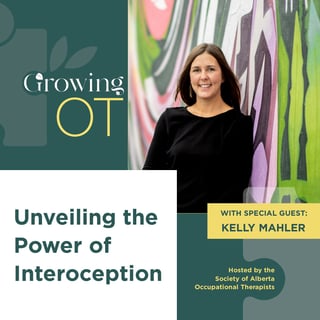
Speaker: Welcome to Growing OT, the podcast that is developed and produced by the Society of Alberta Occupational Therapists. I'm your host, Clare O'Byrne, and my guest today is Kelly Marler, an award-winning occupational therapist, author, and internationally recognized expert on interoception.
Speaker: Through her clinical work, her research and education, she has helped transform the way families, therapists and educators understand the connection between a person's unique inter-reception experience and their regulation, self-awareness and well-being.
Speaker: She has authored 12 resources, including the interoception curriculum, which has been used in over 30 countries worldwide. And her most recent book entitled Connecting My Body Signals was co-authored by her daughter, Madeline.
Speaker: Kelly has been on the Growing OT podcast before, which explored the foundation of interoception, and we learned how she came to love this topic. If you haven't listened to that episode, it's a great place to start.
Speaker: Since then, Kelly has continued to lead and expand this work globally, and she continues to be a leading voice in neurodiversity affirming and trauma-informed practice.
Speaker: I'm so pleased to welcome Kelly Marler to the podcast. Welcome, Kelly, and thank you for being here again. Yes, thank you so much for having me back, Clary. I'm really excited for this conversation.
Speaker: So Kelly, you have published many papers and you've been a principal investigator on a variety of research projects relating to interoception, trauma and neurodiversity.
Speaker: Can you tell us about how these topics are actually connected to each other? Well, if you have three days, I can start to tell you about this. Let's try to summarize it. Our bodies are miraculous machines, right? And they're designed to do so many different things to protect us. And one of those things is when we experience trauma or we chronically feel unsafe, our bodies are designed to take our interceptive system offline. There's lots of different terms out there thrown around.
Speaker: in different professions, like we might hear someone might be dissociated from their body or disconnected from their body or they're masking or they're suppressing. There's a lot of different words out there that kind of dance around the same concept of We we tend to, and this is an automatic unconscious experience, but you know those inner feels, those interceptive feels are suppressed or shut off or disconnected because it feels awful to chronically feel under attack and feel unsafe. I think like if I want to say that in a nutshell, like I mean, it's so much more complicated than that, but I think it's really important for us all to think about it as occupational therapy practitioners that it's If we have a client that has experienced trauma, maybe that's early life trauma, maybe that's an acute trauma that just recently happened, or maybe they're neurodivergent and have experienced neurodivergent trauma their whole lives. I think it's just important for us to hold in mind that most likely they will have some effect on their interoceptive system of of that connection with their body, of that relationship with their inner feels and how their body kind of like shows up and gives them information about what it needs in the world.
Speaker: Thank you. That makes so much sense to be delving into it, into that level of detail, just to uncover exactly what's going on and where that's coming from.
Speaker: So what does it mean for you to approach interoception and somebody's inner experience actually from a neurodiversity affirming lens Again, how many days do you have? Like, I mean, these are amazing questions. I feel, I think this is true for any client, whether and they're neurodivergent or not, but it requires such deep curiosity on our part as a therapist, which I think that is our wheelhouse as occupational therapy practitioners. We are designed by nature to be so widely trained, to have so many different experiences. areas of curiosity and interception work to me is a privilege to be a part of with my clients and to be on this journey with them, to help them to connect or reconnect to their bodies, to discover their own unique inner feels. Because what I love about interception, obviously I love a lot of things, but it is scientifically showing us that every single person's body is different. So we can no longer like, you know,
Speaker: like i And I don't want to generalize to everyone. Like this is something that I did before and i and it was unconscious. I didn't know, but kind of made assumptions about my clients and how their bodies were feeling or, you know, what could have been happening with them. And now I'm really shifting to this place of how do I get more curious and really learn it.
Speaker: what their inner experience is all about. And I really think that fits so beautifully into neurodiversity, right? Because it celebrates differences. And you know not only, I don't want to be toxic in my positivity, it's not just celebrating it, but it embraces that we're all so different. And so if we adopt that in our practice, then it automatically drives curiosity because we need to be on this journey to try to understand each client in front of us.
Speaker: Absolutely. And coming from a place of curiosity means you are less likely to make those assumptions or rely on those assumptions to guide your practice.
Speaker: Absolutely. And I think it's human nature to make assumptions. Our bodies are wired to be as efficient as possible. And so I still, to this day, find myself overriding and checking and having a deeply reflective practice and really challenge myself to try to realize when those assumptions are coming up. And I'm assuming that I kind of understand what's going on with someone instead of asking or instead of really trying to get to that deep curiosity. Yeah.
Speaker: Absolutely. And so do you think then if you are obviously trying to remain curious and you're trying to approach a client through this affirming lens, does it actually change how we approach goal setting and how we think about success for a client too? Absolutely.
Speaker: I mean, I don't want to speak for everyone out there because you might already be doing this outside of interoception work or maybe within interoception work, but each client's goals might be different than what we think they should be. And that curiosity, you know, is like really finding out what's meaningful to them. And something that I have been really reflecting on the last few years is this concept that, you know, I was trained as an occupational therapist like 25 plus years ago, right?
Speaker: And a core feature of my training was that we help our clients be independent and You know, and that in and of itself, especially in the disability space, is kind of an ableist notion. And that's really hard for me to say out loud because I have wrote a lot of goals for my clients to be independent in a lot of different things and a lot of different ah occupations.
Speaker: And I think they my friend Bryden Carlson-Giving, who's an autistic occupational therapist, he said like there's just something so beautiful about being interdependent on someone and to rely on someone and trust someone so much that they can help you to achieve your goal or to participate in an occupation. So I don't think like there's just so, so much, I think, exciting stuff happening in our field. And I think it is all like really grounded in that curiosity. And, and we're always such a client centered field. And what that means, I think is just that definition is just growing and how we show up as therapists.
Speaker: You kind of answered this, but I was going on to sort of think about the fact that you've been now kind of immersed in this world of interoception and neurodiversity and trauma for many years now. And how has your thinking about these topics changed over those years?
Speaker: Oh my goodness. It changes every day. i' must do. Yes. i think that one of the things that has become so clearly evident, I think one of the biggest and most important parts of the interception work that we're offering is believing our clients, believing whatever they tell us about their bodies. So many of my clients have not had that experience many times in their lives. They might from a very young age be showing signs. Let's just do an easy example. Maybe environmental noise is painful to their body. And from a very young age, they've been showing signs of that. Maybe they're covering their ears. Maybe they're having meltdowns in loud spaces. And people come in from a very loving place, like rarely intentional for other people to come in. And they try to offer comfort by saying something like, oh, you're fine. Yeah.
Speaker: Or, oh, it's not that loud in here. Or, you know, like, it's going to be okay. And what that does is it sends a message accidentally, because I've said these things, but accidentally. And it's saying, I don't believe your inner experience.
Speaker: I don't believe that this can possibly be that painful to your body. You know, i don't believe that it can be this bad. And so if that is your experience as you move and grow and mature in the world, you start to doubt your own body, right? Like maybe my body is wrong. All these other people are saying like, I shouldn't be feeling this way or there's no way I could be feeling that way. And so when we're doing this interception where I didn't realize, like we always have had this kind of rule that we talk about in the trainings that anytime like we're doing something playful and someone shares something about the way their body feels, like
Speaker: you know Maybe they're holding an ice pack and they tell us something like, oh, my hands feel hot and burning. We're going to believe them. Even if it's something that it's different than what we expect or maybe they push the ice pack away and we are really attuned and watching what they're doing with their body. Maybe they don't have access to mouth words and we're like, oh, like, okay, I see you like pushing this away. Like, okay, we don't have to do that. So however we show up in that belief, I think is so key to this interception work. And we hear this time and time again from clients that can tell us that it is this experience that
Speaker: they haven't really had before or many opportunities for before that like, oh, like when I tell you something, like even if I'm trying to be silly at first, like I had a client that, you know, he would give me all these like toilet answers. Like my hands feel like slimy poop, right? Like, and I believed him. I showed up. I think I was being silly, but that's fine. but yeah Anyways, like I just think the power of belief is like so deeply therapeutic for so many people.
Speaker: You know, as I'm listening to you, I'm thinking not only as myself as an occupational therapist, but also in my parenting journey. My kids are teenagers now, but I think about possibly when they were younger and I wasn't tuned into this type of work necessarily.
Speaker: I probably did dismiss things that they were experiencing. um Is that something other therapists have told you too, if they shared that with you?
Speaker: Yeah. that On in a personal level, it's impacted their life too. Yes. I've heard this from so many people that they start catching themselves because these statements are not malicious. You know, they're not intentionally, they're not intentional to like be derailing someone's inner experience, but they do. They're very dismissive if you really look at them through an interoception lens and you know i i want to share with you in my parenting journey as well, like I didn't know a lot about interception when my kids were really young. And I was dismissing their inner feels quite frequently from a place of love. And I just wanted them to feel better, right? I just wanted them to be comforted. and I realized, oh, man, like it shows up like so often still today in my conversations that catch myself.
Speaker: Thank you. i want to know what excites you most about where this field is heading? um A lot of things. Well, since this is a podcast for occupational therapy practitioners, I can be a little bit biased and speak to my people here. i love how our field is really embracing interoception. Like interoception is very popular in many fields right now. And I personally feel that our field has the capacity and the training to really move this body of understanding and work forward. And meaning like, how do we best support the interoceptive experience in our clients? I think we are learning about that every day from our clients and what they're telling us. We don't have all the answers yet. Another huge question in the field, in the interoception field is how do you best assess interoception? And nobody can agree about that. There's not a single person out there that it knows the answer to that question. And I get curious about that. And it's kind of fun to think about that because how do we assess something that's so deeply individual? There's no way we can say, oh, that's a typical, quote unquote, typical interceptive experience. And this is not. i don't think that a standardized measure in that sense is ever going to be
Speaker: affirming, to be honest. i like My assessment tool is still not great yet, but it is just this qualitative tool to seek to understand someone's inner experience. right But I know that we are under such pressure and this is changing out there. you know i know standardized tests are kind of under a lens right now. like Are these really affirming? And you know I know that's a different topic for a different podcast. podcast. Anyways, that's what gets me excited about this because we don't have nearly all the answers about interception. And i love how this field is colliding. Like it's a lot of science that's constantly coming out, like research. I can't even keep up with interception research now. But then also all of the lived experience, like people now sharing their stories, sharing their bodily experiences, sharing what it's like what happened to them when they experienced trauma and what happened to their interoceptive experience. So I think that it's a really exciting kind of conversation that's happening out there.
Speaker: Yeah, that's really exciting. It's really interesting what you're saying about the assessment of it. And that makes so much sense to me that something so deeply personal would be difficult to be standardized. And in maybe some ways, what would be the point of standardizing it too? Because it's not about the standard. It's about the individual, right? But yeah, that's really fascinating. I'm just wondering, obviously you do lots of trainings and you have so many resources through your website. And, you know, when clinicians have started to learn more about these topics, whether it's through free resources or workshops or whatever, have you noticed or have you received feedback about the shifts in their practice that they have made and have found?
Speaker: I have had some very emotional conversations with just OTPs that I've never even met before and just saying things, a range of things. But a lot of people saying that interoception has helped them come back to the reason of why they became an occupational therapy practitioner to begin with. I think this shift is happening even if you're not someone that's using interception approaches, but we kind of, our profession kind of swung to that medical model and that kind of shocked me. Like when I went to OT school, I was still in a very holistic program and it was very mental health based. I got out there and was very shocked. at what occupational therapy actually looked like. And I was like, this is not what I signed up for, right? I don't want to sit in a room with a child and teach them how to form the letter A over and over again. Like that is not like, I want to make meaningful change with my clients, right? And so I've heard from so many occupational therapists, occupational therapy assistants,
Speaker: that this is just like something that is giving them purpose and meaning. Again, it's helping them to get back to the why of they became an occupational therapist. So that's kind of cool. I think also a lot of people have interest, like they learning about interoception, but they don't know what to do about it yet with their clients. We've done a couple of studies that have answered like a lot, like we just did a recent study we surveyed internationally.
Speaker: occupational therapy practitioners and asking them, like, do you know about interception? And 100% of them said yes. and We asked them, do you see interception like showing up like and impacting occupations in your clients? 100% of them said yes. And then we asked, are you using interception based assessments in your practice? And it dropped to like only 25% people. And then we asked, are you using interception-based interventions? And it was, again, about 25%. So I think our field, like we know about interception, we know it exists, we see it showing up and impacting occupations, but we don't know yet what to do about it. So I've heard a lot of therapists coming up and sharing, like, you know, it was really hard for me to write a curriculum, like an interception curriculum that goes against every bone in my OT body because it's You know, we never do anything the same way twice, right? But yeah i had a really great mentor say, like, if you don't try to challenge yourself, like she said, I guarantee you you have patterns in what you do with your clients. If you can start to like kind of put those patterns together into a resource, it will help other people get started. And so that's where the interception curriculum kind of was born and as like I was kind of like trying my best to like put together this like loose framework for people to follow. And people, therapists have shared like just how helpful that has been to have this like little recipe to follow. But then, you know, it's kind of like cooking. Like you follow a recipe one time and then you can make it your own like once you get the hang of it, right? Like I just want people to throw that curriculum book in the trash can and do do their own thing. So yeah, I have heard so many things, so much excitement out there from therapists.
Speaker: Yeah, that's really interesting because I think I concur with those people in the sense that, yeah, I know what interoception is and i can talk about the concept of it, but you're right.
Speaker: The whole, well, what do we do about it and how do we include that in in practice, whatever practice people are doing. um And I love the idea of the inter interoception curriculum being like a starting kind of maybe pathway or framework that, like you said, is you understand more about it and you get more confident in how you use it, I guess, with clients that actually you don't need to use that at all. But I love that it's that sort of a starting thing. And so that was going to be what I wanted to ask you next actually was if a therapist, a clinician is really curious about this and they want to delve into it more and start to incorporate it into that work, where should they really start with with that journey?
Speaker: Well, it's probably gonna be different for everyone and how they like to learn. But was like, there's so many free resources on my website. Like, you know, I think starting with free stuff, or maybe do a Google search, you don't have to learn about interception from me. There's lots of people out there talking about it now. But we have a lot of free tools and resources on our website. So if it's something that speaks to you, think it fits in your practice, then you know, of course, we have the paid resources like we talked about with the interception curriculum, which is that framework to like, it's a three kind of part process to follow when trying to nurture interoceptive awareness with our clients. Yeah, but I think there's not a shortage now of information. When I first started talking about interoception, if you searched interoception, you were just going to find a bunch of journal articles like research and neuroscience. And now I feel like there's a lot more practical information. That's where I poured my heart And so I wanted to bring that neuroscience over to that practical application. And I know I'm not alone now in that work, which is cool.
Speaker: Yeah, and that's amazing is bringing the theory into, because we don't do our daily jobs just based on theory all the time, right? You know, it's very dynamic process.
Speaker: What strikes me about you, Kelly, is this curiosity that you've mentioned actually, and it seems like it's a commitment to lifelong learning because you're always delving into something. So what I want to know is what keeps you motivated to pursue and continue this work and keep learning every day?
Speaker: Honestly, my clients and the community. And what I mean by the community is like, you know, all of the therapists and the parents and the people that are like in my social media communities, in my newsletters, like people are are messaging us on the daily, sharing their experiences, you know, sharing what happened when they started to...
Speaker: do interception work, whether that was there was a barrier and how do I overcome this or this was a win for me. So that just like motivates me and it it gets me like like super charged up to keep learning. And interception like is so vast and broad and and we keep bringing different topics into it and connecting it with all different types of things like, you know, toileting is one of our biggest topics. I never thought that I would hear about people's toileting journeys, much as that has been a surprising part of this whole thing. I know a lot about pee and poop and a lot. And like people have been so, so like honest and generous with their stories. And i mean, the amount of like, you know, that we've learned from just the community is is really amazing. you know, it feels like such a privilege. I would say i am a lifelong learner. So thank you for seeing me for that because it is something I love learning. I love going down deep attention tunnels. That's probably the ADHD in me. I love to learn about something new and just lose hours of a day and flow really learning. so
Speaker: It's great. I love that. You know, I'm just thinking as well, with all the work that you are doing on this too, tell your kind of go-to regulation type activities or routines that you follow when you're sort of tuning into your own interoceptive needs and awareness. I would love to know something personal about, yeah, how you honor that.
Speaker: Yeah, it's a good question. And I have to say that it has been really hard for me to honor something that I have needed. So I spend a lot of time in meetings on Zoom or doing work on my laptop and I realized that without a lot of movement, my body doesn't feel good. So I got myself a standing desk and a walking pad.
Speaker: And so in the privacy, like when I'm not on, like, or someone can't see me, I feel okay doing it. Like I can work on an evaluation report as I'm walking. And that is something about the rhythmic, input that is so regulating to my body. i think it's also maybe a little bit of the movement. But then I realized about myself that then I would get on to like a meeting with someone and I would turn my walking pad off because I was afraid to meet my body's needs, yeah you know, based on what someone else would think about me. You know, is that professional to do that? You know, all these things. And so I have in the last year, you know, people have like started noticing
Speaker: Kelly's walking during this meeting. So I'm really trying to have more courage to honor my body's needs, which is hard because I feel like I'm a product of compliance. I was conditioned to ignore what my body needed to please other people or to fit into certain norms. And my body needs a lot of movement. My body needs a lot of rhythmic proprioceptive input. And that's something that I've learned and about my body through my own interoception journey. And I am really trying, I want to say too, like I'm not on my treadmill right now during a podcast because I've also learned that if I have to do a lot of talking and it's not like a super back and forth meeting type of conversation, then that's not a match for my body. So I've learned a lot about my, where I can't do it if I'm doing like a three hour presentation, you will not find me walking. That's just right plus for my body.
Speaker: yeah so Oh, that's so interesting and actually really profound that you bring up the point about um not only the tuning in to your body's needs and noticing that, but then actually honoring it and giving it what it needs for you to understand. continue doing this type of work that you're doing that you know it's a fast pace you're very busy you're involved in lots of different things you probably have to switch your attention and so it's just really good to hear that you have been able to um incorporate that and give yourself permission to do it
Speaker: two think I want to ask you one more thing as well, because I know that you recently have a book about noticing body signals that you co-wrote with your daughter, but I'm very curious as to how that came about.
Speaker: yeah Oh my goodness. It's probably one of the most highlights of my career, i would say, is writing something with my daughter. Yeah. And honestly, I dont i can't like pinpoint a moment, but she has always – and we have this cutest video. I actually have it like on my social media and website. And from a very young age, like she is such a deep thinker. And she would just come home from school and like you know she has this like sense of justice and And, you know, when that was violated, which it happened a lot, she was very upset. Like she would see a kid having a really hard time in her classroom and get in trouble for the way they were feeling instead of getting supported. And she would just be really upset about that. Or she had a situation that this video is all about where... She took a quiz about her own emotions and she failed it. She got questions marked wrong because the teacher told her that the way she said she would feel was wrong. Like that was so violating to her sense of justice. And so she's always been kind of on this path.
Speaker: And she had to do a project in middle school for a class. And she announced to the teacher that she was going to write a kid's book. And it was really cute because the teacher emailed me and she's like, is this really true? Are you guys writing a kid's book? And I'm like, I guess we are. So that's kind of where it started. And we took it some time to really come up with the idea. And so it's a kids book series, actually. It's three books. We have two out.
Speaker: And it follows the structure of the interception curriculum. So the interception curriculum has three parts. So you know you start by noticing body signals. And then you learn, what do these body signals mean for me? You connect the body signals to the meaning. And then finally, the third part is you learn to regulate your body signals, like what unique things, like a walking pad, bring comfort to your body. And so that's the journey we've been on together.
Speaker: oh my goodness. I absolutely love that. How amazing. i mean, what a great role model you are for that for her. I love it. So when will the third book be out then? Because the second just came out, right? The second just came out. Yeah. So Probably. I mean, it takes us a good half a year. We were just in the final stages of writing it, but then the illustration phase takes a really long time, but it's super fun. My daughter Maddie loves designing the outfits for the characters. And she had like in the very beginning, she had so much fun even designing the characters. you know, and bringing them to life. And we really wanted to have a diverse group of characters where a kid can really maybe find something in common with one of or more of the characters. And we've been getting so many cute emails from kids out there and their parents or therapists that are reading the book together. And they're just adorable how they're connecting with the characters and what they like about a character where They wanted to know, like, we have kind of background characters. We got a question, it like, do they have names? And we were like, no, we never gave them names, but you go ahead. And so this child sent us all of the names that he gave them. Like, it was really cute. So it's just been a really, really fun thing to kind of watch it evolve.
Speaker: That's beautiful. I'm sure there's use for them in so many different areas, different clinical areas as clinicians, but even as parents as well. um to just have that in the library and have that available for everybody because it really is something universal, right? It's not just about this niche area of practice. It actually could be throughout all areas of practice, whether it's mental health, physical, and all ages.
Speaker: All ages, and in fact, I'll have to say what surprised Maddie and me the most was we were getting emails from adults. One person said that their friend has a daughter and they had the book laying on their coffee table and she was over at their house. And so she picked it up and started reading it. And she's like, I had a lot of epiphanies about my own body.
Speaker: And she's like, I learned so much about my body signals. So we hear from so many adults that the book is helpful for them too. which is something that we didn't expect that deeply, but that's been really neat. So yeah, it does apply to a lot of different settings. There's lots of parents using it but also they're using it the schools, clinics, like you said, and it it is an all age kind of thing. We hear that from adults in general, like when they're doing interception work with kids, that they're having their own learning lessons about their own bodies.
Speaker: journey where people are learning together. Kelly, you know what, it's been such a pleasure to talk to you today. I know that the listeners are going to be inspired to learn more about the area of practice or to continue developing this area of practice for themselves and also as individuals. I am personally inspired by your lifelong learning and that curiosity. I really resonate and I think it will resonate with so many people. I'm really appreciative that you were able to join us today on Growing OT. It's been really good to learn from you.
Speaker: Thanks for having me. It was a real pleasure. Kelly will be providing an online workshop on October 15th and 16th, 2026, along with Chloe Rothschild, entitled Five Keys to Supporting Behavior Regulation. You can find out more on the SAOT website, saot.ca, and the link to register will be in the show notes too.
Speaker: For more information about interoception and the resources Kelly has, you can visit her website, www.kelly-mala.com. There is a wealth of information on there.
Speaker: Thank you all for listening. See you next time.