Transcript
Speaker: Hello and welcome to Pod for the People.
Speaker: I'm your host, Dr. Tammy Gouveia.
Speaker: Each week I invite everyday Americans, community activists, and status quo disruptors to share stories about the power of connection and finding the courage to heal our political divisions.
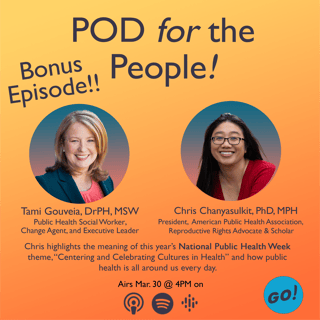
Speaker: So I'm here with Dr. Chris Chanosukit, and I'm so excited to have this conversation with you.
Speaker: You are the current president of the American Public Health Association, elected library trustee of the public libraries of Brookline.
Speaker: You're also a Brookline Town Meeting member, a Brookline Community Emergency Response Team member, as well as a Brookline Medical Reserve Corps member.
Speaker: I'm so excited to talk about libraries, emergency preparedness and response, to talk about health equity, and to talk about your work with public health as the president.
Speaker: So welcome and thank you for being here.
Speaker: Thank you.
Speaker: I'm really honored and touched to be here with you because you're
Speaker: when I see all the things that you've done and then now that you're doing this, I am pretty blown away by it all.
Speaker: And I was always kind of was a dream or something I always thought of is I would love to do something like this, but I didn't really know what this is.
Speaker: And then when I, you told me about it and I read your description, I was like that this is exactly this and you're doing it.
Speaker: So this is great.
Speaker: I'll just have to subscribe and listen.
Speaker: Oh, great.
Speaker: I'm super excited.
Speaker: Well, great.
Speaker: And maybe we can have you as a recurring guest.
Speaker: I never thought that I would be hosting a podcast or writing a newsletter blog, but here I am.
Speaker: I feel like there's just a lot for us to talk about.
Speaker: And I met so many wonderful people, both throughout my career, but also running for statewide office.
Speaker: And there's such a rich diversity of perspectives in our state and people doing
Speaker: really phenomenal, very local work to make sure that their community is thriving, to make sure their neighbors have opportunities and access to resources so that they can take care of their families and really live a fulfilling life.
Speaker: So I feel like just given the vitriol at the national level and just the sheer chaos, that people need to feel a little bit more grounded and connected and understand what
Speaker: the times in history where we've really invested in each other, we've really turned to each other, and we've invested in the common good.
Speaker: So I'm excited to hear of all the ways that you are kind of bringing things together.
Speaker: But I'd love to first start with, do you remember the first time we met or how we started to get to know each other?
Speaker: I think it was a number of years ago.
Speaker: It wasn't as recent as some of the other folks that I'll have on this podcast.
Speaker: I'm going to say, oh my gosh, you just said I could be a recurring guest.
Speaker: I'm super honored because I'm kind of like a fangirl.
Speaker: I'm just going to admit it right now.
Speaker: You're pretty kick-ass.
Speaker: I remember years ago, I met you and I think I was doing my PhD at the time and I was part of a Disparities Action Network Coalition called the DAN and
Speaker: We were doing lots of advocacy at the state house.
Speaker: And it was a coalition, including with the American Heart Association, but also Tobacco-Free Mass.
Speaker: And you were the executive director of Tobacco-Free Mass.
Speaker: And I was like, wow, she is a smart, kind, strong advocate.
Speaker: And wow, she's leading a whole organization trying to champion health for my whole state.
Speaker: So I'm a big fan and I'm super excited to get the opportunity.
Speaker: I think also just to divulge, even though we're shooting this podcast, I feel like I'm having my coffee with you this morning.
Speaker: Yeah, me too.
Speaker: Together with a girlfriend that I don't often get to know, but I very much admire.
Speaker: So hopefully I can do this again because it's a true honor, but also just really fun and kind of, you know, you're living out your fangirls dreams here.
Speaker: Yeah, well, you're very kind.
Speaker: You're very sweet because I've been watching you and your career and have been in awe.
Speaker: And you are the president of the American Public Health Association.
Speaker: Like, that's unbelievable.
Speaker: It's just such an honor.
Speaker: And it's an honor to know who the president is.
Speaker: It's such a stellar organization that has a really strong reputation, a really rich history, and so many moving pieces, so many moving parts.
Speaker: What made you decide to run to become the president?
Speaker: What has that experience been like?
Speaker: And now that you're a couple months in officially, what does that feel like?
Speaker: pinch me.
Speaker: I still think I'm dreaming.
Speaker: It's totally, I think it's honestly the craziest thing.
Speaker: And I say this, but it's an all truth.
Speaker: It's a dream that I actually never dreamed of come true.
Speaker: I would never have imagined.
Speaker: I joined APHA years ago as a student member, and I've seen and met
Speaker: some APHA presidents, and I would never have assumed that I could ever be one of these amazing people.
Speaker: And I had the honor and the opportunity to volunteer and do different leadership positions.
Speaker: And I got elected to the executive board.
Speaker: Then at one point, I chaired the executive board.
Speaker: And then, you know, your term's over.
Speaker: But I love, I mean, I can't even begin to tell you, I love the work that I do, whether it's an APHA,
Speaker: or Planned Parenthood or other places and spaces, because the people that I work with, those boards, those groups, my fellow volunteers, they actually become a part of my family.
Speaker: And I was really sad when I thought, oh, my board term is ending.
Speaker: I won't get to see my family on a regular basis.
Speaker: Even though, yes, I know you can still see people without an agenda.
Speaker: I get that.
Speaker: And I still do very much keep in touch with lots of folks who are not on the board with me now.
Speaker: I just didn't think I could.
Speaker: I mean, truly, I am...
Speaker: I believe the youngest APHA president in its 150 years of history.
Speaker: I'm a mom to three young kids.
Speaker: I'm just, there's so much about me that I was sure I would never win.
Speaker: But I had a couple of close friends and I think it's the same with you.
Speaker: When you meet some great people who believe in you, perhaps maybe more than you believe in yourself and they say, hey, you should run and just do it.
Speaker: And so two very close friends called me and they had a meeting with me, a formal meeting and they said,
Speaker: So I said, you're crazy.
Speaker: I can't do this.
Speaker: But they said, why not?
Speaker: Long story short, I recently had had just before that a really pretty traumatic situation where I should honestly be dead right now or be suffering some very severe neurological deficits.
Speaker: Yeah.
Speaker: Still, but amazingly I'm alive and I've had a couple of brain surgeries and things like that.
Speaker: And facing that and recognizing I might never wake up and see my kids or my family or just anything again and living many weeks in a neuro ICU that I've decided is probably the scariest thing in my life.
Speaker: So even though I was afraid when I ran for the executive board or afraid when I ran for town meeting or library trustee,
Speaker: I wasn't as afraid in running for APHA president when I was asked to do so because it's not as scary as brain surgery.
Speaker: So I,
Speaker: said, well, let's see.
Speaker: So I did the application and then was like, I'm sure the nominations committee won't even let me get on the ballot.
Speaker: And when I found out I was on the ballot, I was like, no, this can't be real.
Speaker: And then I ran and I actually decided I'm just, you know, again, it's not as scary as brain surgery.
Speaker: I'm going to run.
Speaker: I'm going to be who I am.
Speaker: I can't change who I am.
Speaker: The things that I've done are the things that I want to do.
Speaker: It's Chris Chaniasulka.
Speaker: You get what you get.
Speaker: Yeah.
Speaker: Try to make it a fun family event.
Speaker: and really enjoy the process.
Speaker: I made some wonderful new friends and I deepened other friendships.
Speaker: And then no lie, I was sure I was losing.
Speaker: Like I was, you know, like even probably after the results were announced, I was like, you know, whatever, this has been fine.
Speaker: And when I found out I won, I was, I just started crying.
Speaker: Of course.
Speaker: Yeah.
Speaker: That's so wonderful.
Speaker: It's like, you just,
Speaker: It's scary.
Speaker: And I have run and lost things and run and won, things like that.
Speaker: But at this point, I was ready.
Speaker: And I knew because I told other folks, you can't win if you don't run.
Speaker: And I very much felt like you have to practice what you preach.
Speaker: Yeah, amazing.
Speaker: Well, there's so much in your story that resonates with me as a candidate and resonates with just some of my life history.
Speaker: I've had some traumatic, hard things happen in my life, not nearly as scary and traumatizing as what you experienced, for sure.
Speaker: But just when you've gone through hard things and you've come over to the other side of
Speaker: whether it's a health issue or a change in relationship or disruption in your family that's traumatizing in some other way, doing some of these things that seem unimaginable prior to, it's just, okay, if I lose, I've had worse things happen to me in my life than losing a campaign.
Speaker: It doesn't define who I am.
Speaker: It doesn't define who you are, Chris, right?
Speaker: But it's hard for a lot of people to sort of understand what makes some of us candidates and elected officials tick and what really drives us.
Speaker: And the other thing that really resonated with me that you said is making new friends and deepening relationships.
Speaker: That's exactly what I said on Sunday.
Speaker: I had a gathering here at my house.
Speaker: It's exactly.
Speaker: And I'm sorry, I couldn't take it.
Speaker: No, no, it's okay.
Speaker: No, no, you're a busy mom with three little kids and you get a lot that you're working on and a lot of things going on.
Speaker: But just wanted to share just since we're two girlfriends having coffee that, yeah, those are my experiences as well.
Speaker: And that's like my big takeaway from
Speaker: From running for office.
Speaker: The other thing I will say for anybody who's listening who has teenagers, when I was first running for office over four years ago, I was standing in the rain outside of one of the voting precincts at just to like say hi to voters and introduce myself.
Speaker: And someone said, how are you running for office?
Speaker: Like, what?
Speaker: aren't you scared?
Speaker: And isn't it hard?
Speaker: And aren't people mean to you?
Speaker: And I'm like, listen, I have teenagers, you just learn to let a lot of things roll off your back.
Speaker: I just try to make my kids laugh every day, try to make my kids know that I care about them.
Speaker: I feel like it's the same thing with everyday people that I meet.
Speaker: I just want them to know that
Speaker: I care about people.
Speaker: That's why I've been called to public health and social work.
Speaker: So that leads me to my next question, which is what drove you to public health, to work on health disparities and to get your PhD in political science?
Speaker: What compels you?
Speaker: Yeah, so it's really interesting.
Speaker: And I shared this, especially when I lecture and meet with students who are thinking about careers is I am, especially since we're on a podcast and you can't really see me, I'm Asian American, I'm Thai Chinese, first generation immigrant.
Speaker: And so like many of us, I think in some ways, my parents had the hopes and dreams that I would become a doctor, a surgeon, and I would literally save lives.
Speaker: So I think from before I was born, that was what I was supposed to do and be.
Speaker: And my parents had these plans.
Speaker: I was going to go to medical school.
Speaker: And when I was in college, I was to double major in biology and then right away go to medical school.
Speaker: But
Speaker: I am very squeamish.
Speaker: If anyone knows me, even my kids know that if they need a bandaid, they should actually really go to dad instead.
Speaker: Squeamish.
Speaker: It's terrible.
Speaker: So it just, you know, it was very hard.
Speaker: I will not even talk about the...
Speaker: stress isn't even the right word of telling your parents when you are in college that no, you don't want to go to medical school.
Speaker: It isn't right for you.
Speaker: And how do you figure that out?
Speaker: So that's another podcast for another day.
Speaker: But I finished college.
Speaker: I was double major also in biology, but I also liked art history.
Speaker: And then I took some time out and did an AmeriCorps fellowship.
Speaker: AmeriCorps sort of like Peace Corps, but in America.
Speaker: And I worked with
Speaker: local nonprofits in the greater Boston area.
Speaker: And that's where I really sort of fell into community service and public service and local nonprofits.
Speaker: And I think that's where I didn't get the words for health inequities or social determinants of health and all that.
Speaker: But I got the living examples of it when I was working in the neighborhoods and the nonprofits and with different folks.
Speaker: And then after that, I was like, wow, let me think about this.
Speaker: And I had a professor who suggested I went and got my MPH.
Speaker: And sort of that's kind of when I realized public health will allow me to do these things and help folks live hopefully healthier lives.
Speaker: But I don't have to be in the thick of it doing surgery.
Speaker: you are saving lives every single day and probably saving more lives because it's not a one-on-one.
Speaker: Well, population health.
Speaker: I mean, you're, you're making an impact.
Speaker: Let's put it that way.
Speaker: And it's okay.
Speaker: I have one, I have one sibling, my little sister.
Speaker: I love her dearly and I am very thankful for her.
Speaker: And she does literally on a daily basis, save lives.
Speaker: She's an orthopedic surgeon.
Speaker: So I think my parents are okay now.
Speaker: They're whole now, right?
Speaker: Yeah.
Speaker: I got a PhD and that kind of helped.
Speaker: But in general, I think it was my sister being an MD that made a difference, who buried another MD.
Speaker: So that was good.
Speaker: Yeah.
Speaker: I mean, that's a lot of pressure, right?
Speaker: We need Asian Americans and Indian Americans in...
Speaker: social work and in public health, of course, and in teaching and all kinds of other fields so that we can address disparities that impact our young people in all sectors of society.
Speaker: So I appreciate your courage in going against what your parents had hoped.
Speaker: And I met your parents when you were still president-elect of APHA the last night before you were sworn in.
Speaker: And they were lovely.
Speaker: And it was just wonderful to be your guest at the APHA Conference Executive Board dinner.
Speaker: So thank you for that.
Speaker: The other thing I love seeing, since people can't see, that behind you, you have your Boston University.
Speaker: diploma.
Speaker: And I also went to Boston University for my master's in public health.
Speaker: So we also have that overlapping and connection as well.
Speaker: So I too love books, but I've never run for library trustee.
Speaker: I've never volunteered with my library, but I do have two books that I've checked out from my library and I'm very excited to have the library at the local level.
Speaker: And oftentimes when I walk into the library, I'm just blown away by the
Speaker: the fact that we have this resource that's available.
Speaker: And there are some libraries now that are renting out not only laptops or technical devices, but bikes and other resources and materials.
Speaker: And of course, we know CDs and movies and
Speaker: ebooks.
Speaker: We'd love to hear what drew you to run for library trustee and some of the work that you're also doing with the United for Libraries board.
Speaker: I'd love to hear that work.
Speaker: So I have loved libraries since I was very, very little.
Speaker: When I was a young kid living in Maryland, I was basically home alone a lot.
Speaker: My sister is actually seven years younger than me.
Speaker: So really my days were, if I wasn't in school, I was at home just reading.
Speaker: And typically it was the Babysitter's Club and Sweet Valley High and all these, like Nancy Drews.
Speaker: I just, I loved those, but you couldn't afford them.
Speaker: So we'd go to the library and get them all for free.
Speaker: I have always, and I still actually have my old library card from when I was a little kid.
Speaker: I will not like give it up.
Speaker: I've just always been someone who really loved it.
Speaker: I loved reading, but I loved reading for fun.
Speaker: And so for, I would say a lot of my time, I really enjoyed mysteries.
Speaker: And for a very long time, it was essentially cozy mysteries.
Speaker: Kind of like murder she wrote type mysteries, if you can think about it.
Speaker: Where again, it's not gory.
Speaker: So I was a town meeting member.
Speaker: I actually just finished my last term as a town meeting member this past year.
Speaker: So I had been a town meeting member from 2009 to 2020.
Speaker: During that time, I really got an inside look at what it's like to be in the town legislature and to help vote on budgets, to work with constituents, to try to create programming that's responsive to the community and to really be a part of it.
Speaker: And then I had learned that
Speaker: As in many other cities and towns, we have a library board, but they're elected.
Speaker: And the library board essentially in our town in Brookline is 12 folks who do a lot of the organization and management of the budget, but also look at programming and everything, but really do it from sort of a higher level.
Speaker: We only, for example, manage one staff person, quote, which is the executive director.
Speaker: But I just, I love libraries.
Speaker: And again, similar to running for APHA president, a few friends pulled me aside and said, I think you should run for library trustee.
Speaker: We'd really like you to do so.
Speaker: And I thought, what?
Speaker: Because at that point, all I did was really just, I was a library user.
Speaker: Aside from doing it myself and going there to write my PhD dissertation to having little kids and bringing them to story times and just checking out books myself.
Speaker: I was like, what?
Speaker: I could never do that because a library trustee is a townwide office.
Speaker: And that's different from running for a town meeting member where you're just in your precinct or your district.
Speaker: And I was like, oh, my gosh, talk about door knocking.
Speaker: I mean, Brookline right now has about 69,000 residents.
Speaker: I was like, I don't know how much door knocking I can do.
Speaker: But I gave it my all.
Speaker: It was not pretty.
Speaker: It's hard.
Speaker: Like you said, folks, I think running in particular locally can be really hard.
Speaker: I mean, not saying it's not hard.
Speaker: Absolutely.
Speaker: National, like they're all hard.
Speaker: Local has its own flavor, though, of hard.
Speaker: It really does.
Speaker: So kudos to you on so many levels.
Speaker: It was hard for me.
Speaker: I won't lie.
Speaker: I did some good crying in a car one day after a campaign event.
Speaker: cried at home.
Speaker: Not every person you meet is nice.
Speaker: And it was interesting because I was like, I'm just trying to run to volunteer for you as one of 12 people in the library.
Speaker: Why are you yelling at me and so mean?
Speaker: I just, I couldn't really get that.
Speaker: But in any case, I won and I'm still a library trustee years later.
Speaker: And I truly love that.
Speaker: I think mainly because I want to do whatever I can to support our libraries.
Speaker: And we have all, I think people have known it and felt it, but I think not so much until the pandemic when they realized, oh my goodness, libraries, like that is open and free to everyone.
Speaker: And what can we do to make them more open?
Speaker: So our libraries, like you said, in Brookline and many across the nation and the state,
Speaker: turn to laptop lending.
Speaker: And we even have Wi-Fi hotspots that we lended because unfortunately in this nation, in this city, town, everywhere, we still have a great digital divide.
Speaker: And that has huge health ramifications.
Speaker: As everyone knows now, all of a sudden you were only allowed to see your doctor online and things like that.
Speaker: Or most of your vaccine appointments need to be made online and things like that.
Speaker: So our libraries really turn to that space.
Speaker: Our libraries, even for my kids, love it because you can borrow Nintendo Switches.
Speaker: and PS5.
Speaker: Cool.
Speaker: Tools and gym memberships.
Speaker: Yes, the tools and passes to museums that cost money.
Speaker: I mean, just all of that.
Speaker: It's amazing.
Speaker: And I just, I really love it.
Speaker: And so I said, you know, I want to be a part of this.
Speaker: And it has been
Speaker: really meaningful, not only because I got to know quite a number of my other fellow library trustee boards, but also the incredible staff and directors at our library.
Speaker: I mean, they are really the heart and soul.
Speaker: People are the most important asset, I always think, but truly in your library, it's the staff and librarians there that
Speaker: that make it what it is.
Speaker: Because I mean, for a lot of folks, libraries, they think of as books, but for many places, the library is the cool place to go to physically when it's hot in the summer and warm when it's cold and wet.
Speaker: And for many folks, I think of the library as really the living room for many people.
Speaker: Yeah.
Speaker: And so I just, I love it.
Speaker: And then I ended up
Speaker: joining or being elected to the United for Libraries Board, which is a division of the American Library Association.
Speaker: And there I am just so thankful to be a very small part of many large efforts to combat this horrible situation of book banning and censorship.
Speaker: Yeah.
Speaker: It is...
Speaker: It is very dangerous.
Speaker: And it's actually related to a lot of my public health efforts, which is all about combating misinformation and disinformation and making sure people have health literacy and access to evidence-based research and information.
Speaker: So for me, it kind of pulled everything together while also, I mean, who doesn't just love the library?
Speaker: Like you said, you love just going in.
Speaker: Well, information is power, right?
Speaker: And access to information really helps democratize access to knowledge and access to that kind of power where you have the information that you need to get access to a vaccine appointment or get access to books that are gender affirming or reflect the diversity of our population.
Speaker: So I really appreciate the fact that you lifted up the work that you're doing around disinformation and the book banning effort and just
Speaker: how in some communities across the country and maybe even here in Massachusetts, I think some of our librarians have been verbally attacked for some of the books and materials that are available to our very diverse population.
Speaker: So I just appreciate the work that you all are doing in that space.
Speaker: Can you talk a little bit about what those conversations have been like at the national level and what work you are doing to try to combat this?
Speaker: There's a lot that is happening and it's different in different places, but, you know, I don't take it for granted because it also even happens here in Massachusetts.
Speaker: You know, for example, we've seen protesters at a drag queen story hour, for example, or people wanting to get rid of LGBTQ books in a library, for example, or books where you can get information on reproduction and reproductive rights, right?
Speaker: This isn't just a national thing.
Speaker: It happens here locally, even in Massachusetts.
Speaker: Absolutely.
Speaker: For all of you listeners.
Speaker: And it is really terrifying to think that at one point, my children, myself, our children could go into a library and really not have full access to information and to end up with a perhaps really biased curated set of information.
Speaker: Right.
Speaker: I feel like that's very dangerous.
Speaker: Absolutely very dangerous.
Speaker: Yeah.
Speaker: There's a lot that we're doing, trying to have programs and webinars for not only library patrons and library trustees and library staff, but just folks in general to really be aware of what's going on, to be aware of...
Speaker: what is allowed and not allowed and what policies libraries have and or can have if they want to develop appropriate policies so that their intellectual freedom isn't hampered in any way.
Speaker: And then also we've been trying to do a lot of convenings where
Speaker: library staff and other folks and librarians can get together and share situations and things that have happened to them in the hopes and how did they react to help others oh that's helpful yeah people really need to learn like how did you deal with this because it's really new and
Speaker: evolving in so many ways.
Speaker: So there's a lot of that.
Speaker: So we have, it's called Lib Learn X. We have a conference coming up soon with the American Library Association, the end of January.
Speaker: And then we also like APHA have a yearly annual conference.
Speaker: So the next ALA big conference will be in Chicago in June of this year.
Speaker: And so a lot of that will look at censorship, book banning and intellectual freedom.
Speaker: And they'll have a whole host of different things like that, as well as even authors and others who come to speak.
Speaker: Because again, then you're looking at quieting, banning the voices of people as well.
Speaker: Yeah, that's amazing.
Speaker: And I want to pick up one other thing about libraries before I ask the next question that jumps off of this, which is, so I grew up in the city of Lowell.
Speaker: I think you do know that.
Speaker: And as not long after I left, there was a big discussion about moving the high school from the downtown location to
Speaker: almost the very edge of the city that on the end that abuts the town of Tewksbury.
Speaker: And it had a much more suburban feel.
Speaker: And I remember the librarians talking about the fact that the students were there at seven o'clock in the morning, accessing the computers and the internet to finish their homework before they went to school.
Speaker: And it's in walking distance.
Speaker: It's like basically the same block.
Speaker: And what access to information and access to resources would ultimately mean for educational disparities and really driving those disparities even widening the gap even more.
Speaker: Luckily, the school is staying downtown, but we don't see those same level of need in a lot of the suburban communities across the state.
Speaker: But for a lot of our
Speaker: lower income youth, immigrant families, and families of color, those libraries are a lifeline.
Speaker: They're not a nice to have, it's a need to have.
Speaker: So just wanted to see what you thought about that.
Speaker: Completely.
Speaker: And Brookline, which is thought of as a progressive, liberal, more affluent town, if you go to any one of our libraries,
Speaker: within 30 minutes of when the library opens, I guarantee you will see people standing outside waiting for our libraries to open because it's the same thing.
Speaker: It's the same thing.
Speaker: And then in the pandemic, our library director and our staff were so smart and incredible as they put signs outside with the library Wi-Fi and password all the way out to the borders so that people knew how close you could be before you could get access to Wi-Fi because they knew that people needed it, right?
Speaker: Like you could sit outside maybe on the lawn or whatever on a bench and still get it.
Speaker: And we don't turn it off at night either.
Speaker: Yeah.
Speaker: Because we realize that these are services that people direly need.
Speaker: Yeah.
Speaker: These are real, like you said, they're a lifeline.
Speaker: And it's not just, while it definitely affects communities of color, immigrants, older adults, people should be aware because we do see it.
Speaker: It's really everyone.
Speaker: Everywhere.
Speaker: Yep.
Speaker: It's interesting.
Speaker: I was talking to somebody.
Speaker: Not that long ago, who either is a library trustee or might even be.
Speaker: I think they were a library trustee and they were talking about how the townspeople were pushing for them to turn the Wi-Fi off overnight.
Speaker: so that people couldn't access it.
Speaker: So I really see our library staff and our library trustees really on the forefront in many ways of addressing disparities and access to information, which leads to health disparities, because there are some folks who have very different kind of work hours.
Speaker: And so the only time they might be able to access that Wi-Fi to fill out a job application or fill out
Speaker: other forms that they need or get access to healthcare services or other services, it might be in those off hours.
Speaker: So just really appreciating that.
Speaker: And you're seeing in your work bringing in your different worlds between public health and library work.
Speaker: And you talked a little bit already about health disparities, but as it relates to library related work.
Speaker: So we'd love to hear what's happening in that space and really integrating the two fields of library science and public health science.
Speaker: So I am not, I don't have a master's in library science in any way, and there are far more smarter folks than I, but I have come to be aware of, so there's just this whole research and arm and world and community that looks at public libraries, libraries, and health.
Speaker: And the incredible range of services that they provide, whether it was during the pandemic in vaccine, being a vaccine distribution site or, you know, giving out the rapid antigen tests or any, you know, number of things, libraries have become such a place for delivering and offering community health services.
Speaker: And in many places, that's where you can sign up for SNAP, food stamps, for example, or
Speaker: Some places even have spaces set aside in libraries where you can meet with social workers and others to get this kind of service.
Speaker: And it's so key.
Speaker: And summer meals, summer meals too.
Speaker: A lot of times there are summer meal sites.
Speaker: Meals, tutoring, just sort of really, I love to think of them as one-stop shops in many places.
Speaker: That's where it is.
Speaker: But it's not, it is libraries.
Speaker: I am, you know, I am a strong library advocate just as I am a public health advocate.
Speaker: But I guess I want, and hopefully people will realize this at the end of my year as APHA president, is that everyone and everything is really public health.
Speaker: If you're a librarian,
Speaker: You are also in many ways a public health practitioner.
Speaker: You're sharing knowledge and information that helps people hopefully live healthier, happier lives.
Speaker: You know, if you work in transportation, you are a huge part of health.
Speaker: Oh my gosh, if you ever need
Speaker: another speaker, Chris Dempsey, who- Oh yeah, of course.
Speaker: Yeah, I know Chris.
Speaker: Yeah.
Speaker: Super climate change slash transportation advocate.
Speaker: Yes.
Speaker: And he's always just a hit with my students when we talk about that connection, because I think while students and you and I, and maybe others do, not everyone really sees that connection between cars, buses, bike lanes, zoning, and actual community health.
Speaker: Absolutely.
Speaker: Yeah.
Speaker: No, that's great.
Speaker: I love that suggestion.
Speaker: What are your priorities as American Public Health Association?
Speaker: Because I completely agree with you that everything is public health.
Speaker: When I was first running for state rep, someone said to me, why are you leaving public health to go into the legislature?
Speaker: And I'm like, no, no, no, no.
Speaker: The legislature is where I will be
Speaker: engaging in my public health practice.
Speaker: So I talked to some foundation folks when I was campaigning who were doing some interesting work around the digital divide.
Speaker: And it wasn't only about providing the hardware or the software or the laptops.
Speaker: It was also about
Speaker: providing the training and providing the Wi-Fi hotspots and making sure people knew how to log in and to keep themselves safe online as well, because there are so many scams and so many fraudsters and you want to make sure you have a firewall and all those other things.
Speaker: Is that also work that you all have been thinking about and working on and partnering with foundations maybe or local resources, or is that just a little too far afield, the work that you all have?
Speaker: I was a member of the board of the Brookline Community Foundation.
Speaker: Of course you were.
Speaker: Especially the peak and the many surges during the pandemic.
Speaker: And that was something that I know in our Brookline Community Foundation, as many others were really concerned about in particular, because we look at
Speaker: helping those who live in our public housing sites.
Speaker: We have a Brookline Housing Authority, our public housing sites.
Speaker: And for some of those places, it wasn't even a matter of giving them laptops or access or the services and support for that.
Speaker: But some of the buildings need renovation and rehab so that you can actually have internet in the actual buildings for folks.
Speaker: Yeah.
Speaker: That was a real concern for us at the Community Foundation and then also just in the town in general.
Speaker: A lot of us throughout the town are there to help it.
Speaker: But it's also similarly something, for example, that our Brookline Senior Center works on is to make sure older adults have access to the internet and that they can safely use it.
Speaker: And because there are some terrible scams out there.
Speaker: And how do you be safe about it?
Speaker: it's important not just for older adults, those in public housing, but in general for everyone.
Speaker: Children are using the internet these days and there's many dangers on getting scammed or even other more worrisome things too.
Speaker: So there's a whole bunch related within that problem of the digital divide that I think we as a nation would be best able to tackle if we decided that
Speaker: you know, the internet should be a public good and then safeguards around that so that everyone has access to it safely.
Speaker: Yeah, I love that you said that intranet should be a public good.
Speaker: I completely agree.
Speaker: There are things that are just so fundamental that every person needs access to, just like we need food and water and shelter and clothing.
Speaker: We need work that's meaningful and that pays a living wage.
Speaker: We need health care, but we also need access to these resources so that we can
Speaker: stay connected to society because it's not always in person.
Speaker: We know that we've seen that through the pandemic and we don't know what issues in the future might come our way in terms of other viruses and disease and climate change, quite frankly, and other challenges.
Speaker: disruptions to us being able to be in person because if we have some of the extreme heat that we've had or some of the extreme weather conditions, it does make it hard to be able to get out there.
Speaker: So having access to those resources is critical.
Speaker: Before we turn to what your work is as the president of the American Public Health Association and what your priorities are, I'd love for you to chat a little bit about the work that you do with the community emergency response team and the medical response team.
Speaker: And you were sharing an interesting and heartwarming story and also concerning story of something that happened, I think, over the holiday weekend.
Speaker: So I'd love to hear you talk a little bit about that.
Speaker: First, I have to say CERT, which is Community Emergency Response Team or MRC, Medical Reserve Corps.
Speaker: Those are programs that are in many cities and towns across the nation.
Speaker: And you can be a CERT or an MRC member, or you can be both like I am.
Speaker: And for me, I did it because I was really just, I love learning.
Speaker: I'm kind of like this person who I think would be in school forever if I could.
Speaker: But I got to learn a lot of really important actionable skills to help keep myself and my family and my community safe.
Speaker: For example, you'll get trained in CPR, in
Speaker: whole host of emergency preparedness.
Speaker: I remember even one night I got to learn how to direct traffic in town.
Speaker: If, for example, the power went out and your police and fire were busy with another crisis, MRC and CERT members could get activated to, for example, go out and help with that.
Speaker: So I did that and it was this great training through the health department and the police department.
Speaker: And there are a number of us, I think there's maybe well over 200 MRC CERT members right now, for example, in my town of Brookline.
Speaker: But then once I got into it, I realized I just love this feeling of being a part of something that's bigger than myself and helping.
Speaker: And so as an MRC CERT member over the years, I've been able to volunteer, for example, at flu clinics.
Speaker: So again, I'm not a doctor or a nurse, so I can't give flu shots, for example.
Speaker: But as you know, from just going to your own doctor, you need other folks there who help register you, for example, sign you in, direct traffic to where to go.
Speaker: park or whatever.
Speaker: So I got to do a lot of volunteerism in that space.
Speaker: But then there are other things that happen throughout the year.
Speaker: For example, you could have an ice storm.
Speaker: You could have some other crisis in town.
Speaker: That requires the need for more volunteers.
Speaker: And for example, you know, our police and fire may already be very busy.
Speaker: They're understaffed as it is.
Speaker: And so trained, certified MRC and CERT members can get activated.
Speaker: So this past few years weekend, one of our public housing sites for the Brookline Housing Authority had a pipe burst and the power went out.
Speaker: And we were...
Speaker: It's cold.
Speaker: It's December, January in Boston.
Speaker: It's cold.
Speaker: And you have this huge, tall, nine-story building in Coolidge Corner that now has no power.
Speaker: And most of the residents who live there have disabilities or are older adults or both.
Speaker: And so...
Speaker: I was just thankful to be a part of one, but we had over apparently 30 MRC and CERT volunteers who, together with the police and the fire department and the emergency preparedness team at the health department, was able to volunteer over the long weekend and
Speaker: at the housing site to come out and help the residents in recovery efforts, whether it was doing wellness checks, going door to door, physically eating residents because they have no power.
Speaker: Or one of the things I did was, for example, the food industry,
Speaker: in their fridge and freezer was spoiled because it had been maybe, you know, 48 hours without power.
Speaker: And it's, as you know, as a public health person or just as a person, it's not safe to eat spoiled food.
Speaker: That will have a whole bunch of other problems.
Speaker: So myself and others, for example, literally had to go in and help the residents take all the food out of their freezer and fridge and get rid of it so that they wouldn't eat possibly spoiled food and get sick.
Speaker: And we had another CERT volunteer who was able to, who owned a restaurant and donated food physically for the residents.
Speaker: The food pantry in town connected with those residents to allow them to visit the food pantry again and get stop and shop gift certificates.
Speaker: And it happened to be that housing site was literally across the street from our public library in Coach Corner.
Speaker: And that public library is normally closed on New Year's Day and the day after.
Speaker: But our amazing staff and director, Amanda Hurst, our director, opened it.
Speaker: Wow.
Speaker: So that way the residents who had to leave their homes, which were without power and water logged, could have a warm space to be.
Speaker: So I just, I saw it.
Speaker: And, you know, together as an MRC cert, working with fire police and the health department, we don't know what, I don't know what anyone's
Speaker: political affiliation is.
Speaker: We're just here as folks trying to help out someone else.
Speaker: And for me, I just need to keep remembering that when push comes to shove, everyone's there for each other.
Speaker: And to try to understand that what I might see in the news, what I might see that's happening in Congress, that's not me, that's not you, and that's not our neighbor's.
Speaker: And how do we get back to that?
Speaker: Because I didn't ever hear anyone talk about political affiliation at all.
Speaker: I saw people being like, how are you doing?
Speaker: What can I do to help?
Speaker: That's what we saw.
Speaker: So I think, and if anything, I recommend you and everyone else listening, go out and become an MRC CERT member.
Speaker: I find the training to be super exciting.
Speaker: Who doesn't need to know CPR, first aid and all that.
Speaker: And then not only do I feel stronger and more confident just on my own, I have three kids, but also I am ready to help my community when I can.
Speaker: And so I recommend everyone go out and volunteer.
Speaker: And then you get a t-shirt and a hard hat and a vest.
Speaker: And it's so cool.
Speaker: Yeah.
Speaker: I mean, I've never heard of this 25 years in public health, and I've never heard of this in my local community.
Speaker: So I am going to check it out and see if we have an MRC cert.
Speaker: I know that we have phenomenal local
Speaker: emergency response team.
Speaker: But beyond that, like, I don't know about how average everyday folks get tapped in.
Speaker: So I will be checking it out.
Speaker: Do you know, just with your public health hat on, even maybe your APHA president hat on,
Speaker: How many communities across the country have this?
Speaker: Is this a standard thing?
Speaker: I don't have numbers off the top of my head, but we have them.
Speaker: For example, in Brookline, we are one of a region.
Speaker: We're in region 4B.
Speaker: gotcha we have them and they're out there they're a huge part of they a lot of times for example during different surges our mrc cert members were activated and people volunteered for example to literally sit in some spots at churches and places to distribute rapid antigen tests for example or at one point we had in town
Speaker: You couldn't use the water for a bit.
Speaker: So people were, obviously that's a concern.
Speaker: And so they were activated to distribute bottled water.
Speaker: So there are different things.
Speaker: Or for example, if someone's gone missing, an older adult is missing at night and you need groups...
Speaker: You know, searching and volunteer groups, they'll activate certain MRC members and say, hey, we have this older adult they're missing in this area.
Speaker: Can we get groups of folks together?
Speaker: They'll provide us with flashlights and the information and we'll go out safely in Teams to help search.
Speaker: So there's just a lot of really great things.
Speaker: And the people that you meet are all really nice and fascinating.
Speaker: And, you know, they're like nice, great people because they're just there volunteering their time wanting to help others.
Speaker: Yeah, rolling up their sleeves to help complete strangers get through a really tough situation.
Speaker: And I think it's that kind of turning to each other and really working together that
Speaker: We need more of.
Speaker: I think you even said this.
Speaker: It makes you feel really good that you're giving back and it provides that opportunity where you can use your skills and your commitment to other people.
Speaker: So I appreciate that work.
Speaker: And where are things now for the residents?
Speaker: Are they all back in the home and safe and secure and everything's okay?
Speaker: Or...
Speaker: A number of the residents got their power restored much earlier than we thought, which was phenomenal and very thankful for that.
Speaker: Again, more work is being done.
Speaker: And in general, that whole building needs to be renovated.
Speaker: And they're trying to renovate it, I believe, floor by floor because the conditions were not great.
Speaker: Everyone needs to live in a safe and healthy space.
Speaker: But I was really heartened to know that our food pantry was able to connect with those residents.
Speaker: Because normally you can only visit a food pantry a certain number of times a month, but they were allowing them since all of their food in their fridge literally got tossed.
Speaker: The super frozen food in their freezer was soft as soft.
Speaker: And no one finds like...
Speaker: thawed old fish, for example.
Speaker: And so they were able to visit their food pantry, stop and shop in our town.
Speaker: Amazing.
Speaker: Very philanthropic.
Speaker: They were able to get them some gift cards so that people could get food.
Speaker: And what was really, people were knowing that they were going to be out for the break and have family and friends.
Speaker: So they bought more food.
Speaker: because they weren't just kidding me.
Speaker: So it's really hard to know that you had to get rid of that.
Speaker: So it's great to see the community come together for things like this.
Speaker: And I think people need to hear more about it because I think our news is so much of the sadness and anger and vitriol.
Speaker: And I see it on that local level.
Speaker: And I know that we are better than that.
Speaker: We are doing it, but people don't hear about it, I think.
Speaker: There is this move towards what's called solutions journalism.
Speaker: And it's journalists who are committed to writing about the places and the ways that we are solving some big problems and small problems and coming together because so oftentimes the news is focused on the most
Speaker: shocking or traumatizing or just things that will get a clickbait or get attention.
Speaker: And it's, it's filled with problems and we're not always putting forth or journalists are not always putting forth in media because there's a profit margin to be made and there's a focus.
Speaker: is not always putting forth those, those solutions and those good stories that are happening in the ways that we are, we are working together.
Speaker: Your story about all.
Speaker: Well, that's part of why I'm doing this, right?
Speaker: Yeah.
Speaker: I could see you being like Tiziana Deering and having your own NPR show.
Speaker: So I'm excited.
Speaker: I love that.
Speaker: Yes.
Speaker: I got to put that out into the, out into the universe.
Speaker: So thank you.
Speaker: I appreciate that.
Speaker: You're so sweet.
Speaker: But this whole thing of food getting spoiled because of a power outage makes me think a lot about climate change.
Speaker: It makes me think a lot about energy independence and makes me think a lot about who's able to afford solar panels and heat pumps and being able to be energy independent, at least where we are right now without... We have some...
Speaker: from the federal government and the state government to support this move to green energy sources.
Speaker: But I think a lot about
Speaker: energy justice.
Speaker: We talk a lot about climate justice, but energy justice is a different component of it.
Speaker: And the story you just shared really highlights what it would mean.
Speaker: So if I were still living in the city of Lowell like I was 14 years ago, and my power went out, and I lost all the food in my fridge, I wouldn't have necessarily have known as a single parent where to turn to
Speaker: to get support if it was just me and my four other neighbors that were living in this multi-unit housing.
Speaker: And we possibly wouldn't have necessarily gotten the same access, you know?
Speaker: So it just makes me think a lot about the work that lays ahead for all of us when it comes to
Speaker: making sure that we are connected and supported, especially in those situations where we live in New England, there are going to be power outages, there are going to be floods, there are going to be major snowstorms, there are going to be heat waves.
Speaker: So I appreciate you highlighting how you all helped in that conversation.
Speaker: situation with food going bad and getting, first of all, protecting the health and safety of the residents and pulling all of the food out and tossing it for folks and then getting their restocking and replenishing.
Speaker: I love that you like said that
Speaker: hey, I'm a single mom living in Lowell.
Speaker: And if everything in my fridge just went bad, I guess I just would be hungry, right?
Speaker: Because you might not have known about it.
Speaker: And it's not that I love that, but I love that you're aware of that.
Speaker: And so I guess one thing I want to lift up is
Speaker: That's why I'm always like, I want you to not just be lieutenant governor, but governor.
Speaker: And just I want a million Tammies out there who know and understand this making the laws and regulations and policies because it's about helping everyone and lifting all boats.
Speaker: Right.
Speaker: Yeah.
Speaker: Yeah.
Speaker: Like you said, hey, energy justice.
Speaker: I think everyone would in some ways maybe love a Tesla or whatever.
Speaker: But who can afford that, right?
Speaker: And then also in Brookline, where are you going to park it?
Speaker: Or I would love to bike more.
Speaker: I want all of my kids to bike more.
Speaker: But in many places and spaces, it's not feasible or not safe.
Speaker: It's not safe, yeah.
Speaker: I've had two folks who I know have
Speaker: who were hit while biking and died.
Speaker: Right.
Speaker: And so, and I'm not saying I don't support biking.
Speaker: I do, but we need to set systems up to care for each other and our neighbors.
Speaker: And we obviously know that that isn't happening in solely the private sector without any public sector involvement, whether it's support policies or,
Speaker: incentives.
Speaker: So we need to figure out, like, how can we do these things, not just to lift up any certain population, but to recognize that as a whole, a global society, our earth depends on it.
Speaker: Yeah.
Speaker: Because what we do here affects parts and other places in the world and vice versa.
Speaker: And we need to really see that.
Speaker: And I think a lot of times folks aren't aware of it, but the more that they can contribute and do these, what may be little things in their town, makes them be a part of a bigger solution.
Speaker: Yeah, absolutely.
Speaker: Well, I appreciate you highlighting that.
Speaker: And
Speaker: In Massachusetts, we had the, when we're recording this, it's the day after Inauguration Day for our state-level folks who are in the Massachusetts legislature.
Speaker: And it's always exciting to watch and know that a new class of folks is getting sworn in.
Speaker: There's definitely, you know, some more representatives of color who are coming in, more women, really getting us to that place where we're having much more representation of what our very, very, very diverse state looks like.
Speaker: So that's exciting to have folks bring in those experiences because it does matter for the laws that get made.
Speaker: we do, we're just, it's human nature.
Speaker: You're going to, your area of expertise and your own personal experiences are oftentimes what drives us to take some action.
Speaker: And if you haven't struggled financially, if you haven't lived in a body that's a person of color or female body, um, or someone who's queer, then you're not going to know what those experiences are like.
Speaker: And you may not bring forth policies that would help
Speaker: make sure that every person in our state is connected and has opportunities.
Speaker: So you have a national perspective, though, right?
Speaker: I mean, you were on the executive board for the American Public Health Association, and now you're the president.
Speaker: Are there things that you've learned from having a little bit more of that national perspective?
Speaker: that give you a different appreciation than maybe you would have otherwise, and also the library work that you do that's also at the national level.
Speaker: And I'm sure you're involved in other things that I'm not aware of that perhaps are also at a much bigger perch, but just would love to hear what your take is on sort of the national landscape and then hear what your priorities are as president.
Speaker: I do recognize that there is struggles and problems here at our local, our state level.
Speaker: And I don't take those for granted.
Speaker: I understand that these are severe issues with true ramifications for people's life and death.
Speaker: But at the same time, when I sort of step out of it and look at it from sort of more of a national viewpoint,
Speaker: There are other places and spaces which are facing much more dire consequences, whether it is dealing with book banning, censorship.
Speaker: They don't have Medicaid expansion.
Speaker: So folks there literally not have access to health care.
Speaker: insurance or healthcare or doctors, or maybe they're in a place where they might have access in the sense of they have health insurance, but there are physically no clinics anywhere that they could get to unless they had a car and gasoline and money and time and can drive six hours.
Speaker: So in those perspectives, it makes me humble to know that I am thankful and fortunate to be here where I am in Massachusetts.
Speaker: being able to do the things that I can do, but it makes me think we need to work harder, not only here in Massachusetts, because a lot of times the things that we do here in Massachusetts ends up being an example for us nationally.
Speaker: So for example, people look at the Affordable Care Act.
Speaker: Well, the Affordable Care Act, a lot of that was modeled, as you know, Dr. Guaiba, on
Speaker: Massachusetts health care and Governor Romney's work in that space, right?
Speaker: So we need to look and think, what do we do here?
Speaker: And how can that be an example and help in other places?
Speaker: There are spaces in Massachusetts where they have banned the sale or giving away of the plastic bags.
Speaker: And then that...
Speaker: sort of trickled and rolled across the nation.
Speaker: So like we can't stop the work we're doing now and rest on our goals.
Speaker: But then also, yes, we're fortunate, but we need to be out there helping our neighbors and friends all across the nation.
Speaker: And honestly, all across the globe.
Speaker: Yeah.
Speaker: Because what we do here affects many other countries.
Speaker: We're in a global society.
Speaker: People travel, birds migrate, all these things happen.
Speaker: So yeah,
Speaker: I wanted to take what I've learned here locally, but also nationally, and I wanted to figure out what can I do this year to really get our nation and our folks back to a healthier, happier space and place.
Speaker: Because I think as a nation, we are, like you said, in many places, divided, traumatized from this, we're still in a pandemic,
Speaker: And then the long-term ramifications of the pandemic and the long COVID and the social isolation and just everything else.
Speaker: So I said, I need to figure out what am I going to do?
Speaker: What's going to be my call to action for folks, especially as I go out across the nation.
Speaker: I think in a couple of weeks I'm heading to Alaska and I've never been.
Speaker: I'm so excited.
Speaker: Amazing.
Speaker: Wow.
Speaker: Yeah.
Speaker: I recently went to Boise, Idaho.
Speaker: I had never been to Boise before.
Speaker: The folks there were so incredibly nice.
Speaker: Like I just, to this day, I'm like, I see a potato and I'm happy.
Speaker: Yeah.
Speaker: But I said, well, what can I do?
Speaker: So I had to figure out what would be my call to action because each president gets to kind of do their call to action in their year.
Speaker: And I like things in threes.
Speaker: It's easier for me to remember.
Speaker: I have three kids.
Speaker: So I, this is what I'm asking people to do.
Speaker: And I'm really excited because we have a nation's health newspaper at APHA, which is online.
Speaker: And I literally just got it.
Speaker: And my first column is in there.
Speaker: And your picture.
Speaker: I'd never had a column in a newspaper before.
Speaker: I was like, Oh my God, do I frame this?
Speaker: Like I could cry.
Speaker: Like, I can't believe it because I'm not a writer.
Speaker: There are authors.
Speaker: I'm in library spaces.
Speaker: There are actual authors that I don't write.
Speaker: So I worked hard on it.
Speaker: It was very exciting.
Speaker: But I got to write about my efforts.
Speaker: And what I want to do are these three things.
Speaker: I want us to, one, as a nation, as folks, but also as public health practitioners, to get back to play for health.
Speaker: And that can mean a number of things.
Speaker: But I think as a nation, people have worked more than 24-7, if that's possible.
Speaker: Yeah.
Speaker: Public health and emergency response and medical fields and just everyone.
Speaker: I mean, the Instacart grocery delivery, like everyone has been working nonstop in this pandemic, which we are still in.
Speaker: And there is no time for play and play.
Speaker: It doesn't necessarily mean you have to go out and play basketball.
Speaker: I am not good at that.
Speaker: But it could be, you know, taking a walk with your pup.
Speaker: It could be taking a walk on your own.
Speaker: It could be, and I've said it before and I still need to try it.
Speaker: It could be trying what I've heard about is pickleball.
Speaker: I don't know how to play.
Speaker: I've heard it's fun.
Speaker: And a great way to also get to know others and be with other folks.
Speaker: So the play could be on your own.
Speaker: It could be with others and that would build community, but allow you to rest, to recharge and to do something else.
Speaker: Because right now, I mean, and you just look at,
Speaker: minimum wage and the lack of living wages, people are overworked.
Speaker: Absolutely.
Speaker: I think people need to take a moment, however that play looks to them.
Speaker: Then the second, of course, builds upon my health literacy and literacy and library love, which is to read for health.
Speaker: Because I think
Speaker: We need to go back to our libraries and our librarians who are these amazing resources and public health practitioners who can all show us how do you discern real evidence-based research from fake news?
Speaker: What's misinformation information?
Speaker: I truly believe we are still in this pandemic right now because of misinformation, disinformation, and we need to get back to where people can read and be critical thinkers.
Speaker: But also it kind of ties with my play for health because I love reading just for fun.
Speaker: So I want people, you know, tell me what you're reading.
Speaker: What should I read?
Speaker: What should be read for fun, for enjoyment?
Speaker: And it can be part of play for health.
Speaker: The library has great free.
Speaker: You can also buy Audible, but the library has Hoopla, which is a free audio book.
Speaker: app.
Speaker: And you can also just download books and listen to them and go for your walk and have your play and read for health.
Speaker: And then the third thing, which I think you probably know better than anyone else here, is I want, as a community, all of us to vote for health and to recognize that- Oh, I love it.
Speaker: Health is on the ballot.
Speaker: Many of other smarter people than I have said it, and I just jump on it, I believe it, is your health is on the ballot.
Speaker: And it's up and down the ballot.
Speaker: It's not just voting, which we should at your presidential elections every four years, but it's voting all the time.
Speaker: And I think people kind of saw it.
Speaker: And I think people know it, but unfortunately I think people are forgetting that, for example, in the pandemic, it was who you voted for your school committee or your health board or all these things.
Speaker: Like they determined whether or not kids would go to school, whether or not kids would mask at school, whether or not people would be vaccinated, whether library, literally who you voted for your library trustees helped determine if your libraries would open and in what way during the pandemic.
Speaker: Absolutely.
Speaker: People need to understand that you need to vote in all those elections and that they all matter.
Speaker: So those are sort of my three main priorities, because I think that if we can, as a society, get back to doing those things, we can be a healthier, but then also happier society.
Speaker: Like we really just need to get back to basics.
Speaker: I love these.
Speaker: These are
Speaker: These are perfect.
Speaker: And they're so simple, right?
Speaker: Play, read, vote.
Speaker: I love it.
Speaker: I can't wait to see how this gets operationalized, how this gets really put into practice and how...
Speaker: I'm curious, maybe you've already thought about this, but how can we partner?
Speaker: And by we, I don't mean we other public health folks, but we, the people, how can we partner in creating more opportunities for play, creating more spaces for reading and more time for reading and create the mindset that we need to vote in all elections?
Speaker: Because we know those municipal elections, that's when a lot of people drop off.
Speaker: They don't show up to vote.
Speaker: at the same level that we pay attention at the presidential level.
Speaker: So that's the call to action is play, read, vote.
Speaker: How can other folks partner with APHA and with you to get this message out about these calls to action?
Speaker: You're the best.
Speaker: So I'm ready for you to take over radio shows and everything else.
Speaker: So, yeah.
Speaker: So first off, I'm, you know, I get it.
Speaker: Working mom, I have three kids and now two puppies.
Speaker: I'm not asking you or any particular person to go out there and solve all these things, do these three things and get everyone in your town and city doing it.
Speaker: Like, I get it.
Speaker: Just start off for me by doing it if you can for yourself.
Speaker: Yeah.
Speaker: And then if you can, maybe join a book club or find another friend and read a book with them.
Speaker: Call a neighbor, go for a walk.
Speaker: And or if it's there's a local election coming up, let people know that you're voting.
Speaker: Ask them if they need help getting to vote.
Speaker: Maybe you can drive them or walk them there.
Speaker: Volunteer with your local League of Women Voters, for example.
Speaker: There's a ton of nonpartisan groups that are just looking at information sharing.
Speaker: And you can also, of course, always volunteer at your libraries.
Speaker: There's all these places and spaces in which you can do these things.
Speaker: Go to your park, go for a walk, say hello to a neighbor.
Speaker: What I thought was amazing in Boise is wherever I went, people just said hello to me, even if they were complete strangers.
Speaker: And I would be walking with someone else who I did know.
Speaker: And I'd be like, do you know them?
Speaker: And he'd be like, oh, no, I'd never met them before.
Speaker: I'm like, well, they're just unusually friendly everywhere here.
Speaker: Mm hmm.
Speaker: Now, once you are able to do these things and they're kind of part of your DNA and you're going with it, then yeah, I would love it if you could take it further.
Speaker: I would love it if you could volunteer, be more civically engaged, whether it is taking groups, organizing a group that does...
Speaker: a book sale for the library, or maybe you are taking a leadership role in one of these amazing nonprofits, the League of Women Voters, Mothers Out Front, the Mass Association.
Speaker: Maybe you really dig into the memberships in that and you take a leading role in that.
Speaker: That would be great too.
Speaker: And you're already voting.
Speaker: Or maybe...
Speaker: you take it even further and you all be like Tammy and you run for office, right?
Speaker: Like that would be incredible.
Speaker: That's what I wanna see.
Speaker: I wanna see so many people run for office that it's not the same people who are in office forever only because that's not good for society.
Speaker: We want community responsive programming and policies that will meet the needs of our changing demographics.
Speaker: And then also, I think that if more people are running, it creates more interest and excitement in the races and gets people out there.
Speaker: So we need to do that.
Speaker: So yeah, start small, which you can do for yourself.
Speaker: You know, I get it.
Speaker: Times are tough.
Speaker: I'm not asking you to solve the world today.
Speaker: Try those things for yourself.
Speaker: Play, read, vote for health.
Speaker: But then if you're able to do more and
Speaker: lift that up even more, go.
Speaker: The sky is the limit.
Speaker: And then feel free to share those things, you know, hashtag play for health, hashtag read for health, hashtag vote for health, and share it on all forms of social media with me and APHA.
Speaker: That's great.
Speaker: I want to see what else other people are doing.
Speaker: I'm always learning every day so much more.
Speaker: Like I always say, you know, I don't know what I don't know, but I'm learning so much.
Speaker: There are things that are happening in other places and spaces that I hear about and I'm like, we should totally do that too.
Speaker: Or this place should connect with this other area and like just really learn their best practices.
Speaker: And how do you figure it out?
Speaker: And people want to share, but a lot of times I think they don't know.
Speaker: So yeah, definitely.
Speaker: That's great.
Speaker: And, and so you're doing this,
Speaker: nationwide tour right so you Idaho Alaska where else are you going yeah so right now I have I think maybe Arizona after that and then I think it's Georgia North Dakota I haven't had all the travel finalized but I get an updated spreadsheet every often but I am I'm ready to go because I am learning so much about the amazing things that are being done in other places and
Speaker: And also able to share what I hear from other places and spaces, hopefully make more connections, lift up what they do as well.
Speaker: Because I think there's a lot of good that's happening out there and people need to know about it.
Speaker: And then also, you know, how, how can we mimic it, do it, be it right.
Speaker: Imitations, flattery and all that.
Speaker: Like, I know what that saying is and terrible.
Speaker: No, I don't know what that saying is either.
Speaker: It's like, or plagiarism is, I don't know.
Speaker: Something like that.
Speaker: I don't know.
Speaker: I'm not good with those.
Speaker: Anything else that you would want folks to know about or me to know about or anything I didn't ask you that I should have?
Speaker: No, I just, I'm really excited about,
Speaker: For what lies ahead in this year, I think we're at a real turning point where people are, I mean, we're still in the pandemic, but I think people have learned some, unfortunately, really hard lessons in this pandemic.
Speaker: that are going to stay with us.
Speaker: And I hope that people take that learning and put it into practice and not, I just, I really want us to realize that we're at a point where we can make real positive changes and that we need to make a new normal.
Speaker: I, it really irks me when people say, oh, I want everything to go back to normal.
Speaker: The pandemic's over.
Speaker: Let's go back to normal.
Speaker: I'm like, no, no.
Speaker: We need better than that.
Speaker: Yeah.
Speaker: Normal was bad.
Speaker: Normal wasn't working for everyone.
Speaker: Normal isn't healthy.
Speaker: So I guess I feel like we have this opportunity.
Speaker: Don't squander it.
Speaker: Let us be better than we are.
Speaker: It's something that, oh, I think I have this one right.
Speaker: It's like, if you shoot for the moon, then you might be amongst the stars.
Speaker: Like that's what we need to do.
Speaker: Yeah.
Speaker: That's a great way to end.
Speaker: I love it.
Speaker: Thank you for listening to Pod for the People, where we share everyday stories about health, dignity, and opportunity for our collective well-being.
Speaker: You can check us out at TammyGovea.com and subscribe to my newsletter, Doctor's Orders, at TammyGovea.substack.com.
Speaker: I invite you to learn more about how we can work together to build a thriving future for everyone.