Transcript
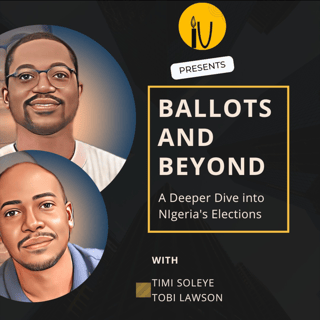
Speaker: This is Ballots and Beyond, a deeper dive into Nigeria's elections with Timi Sholea and Toby Lawson.
Speaker: Good day.
Speaker: This is Timi Sholea.
Speaker: I'm here with my co-host Toby Lawson.
Speaker: This is Ballots and Beyond.
Speaker: And it's a limited edition podcast focused on the upcoming federal and gubernatorial, primarily the presidential elections that are happening later this month of February 2023.
Speaker: Frankly, at this point later this week, what we're trying to focus on is an issue based nonpartisan discussion.
Speaker: of the pressing issues that are facing Nigeria and looking with an expert guest on each episode or an expert couple of guests at one particular issue that we hope that Nigerians are considering before they cast their ballots.
Speaker: So we have today Mr. Chris Ogumudede who is a foreign policy expert, particularly focusing on Nigerian West African foreign policy.
Speaker: the self-described curtain raiser as it comes to this election.
Speaker: We'll put a link in the show notes to his election newsletter.
Speaker: Thank you so much for taking the time.
Speaker: We're very grateful to have you.
Speaker: Thank you so much.
Speaker: It's a pleasure to be back on the program.
Speaker: Thank you so much, Chris.
Speaker: It's great to have you, always.
Speaker: For me, I would say perhaps after NCAS, the 2020,
Speaker: We sort of started seeing this trend, especially after the tragic way that whole episode unfolded of, you know, get your PVC.
Speaker: We are going to make our voices count this time around.
Speaker: No longer can we be pushed around by politicians and we need to have a say, you know.
Speaker: And we sort of seen how that has translated into a very high registered number of voters who are also likely...
Speaker: young, reflecting perhaps for the first time the demography of the country itself.
Speaker: But I remember that you and I had a conversation around that point.
Speaker: And one thing we always talk about is that really political participations go beyond simply just casting your votes or elections.
Speaker: you know, in two or three years, do you see us as having learned the lesson?
Speaker: Like, do you see that people are ready to really, really participate deeply in the political process beyond, oh yeah, we want to choose the next president?
Speaker: No, unfortunately.
Speaker: I hate to be so direct about it, but I simply have to look at the prevailing evidence.
Speaker: For one, look at the candidates who were drawn.
Speaker: I mean, you have
Speaker: former governor of Lagos, who, by the way, has been on the political scene for nothing less than three decades, right?
Speaker: Who was a senator literally 30 years ago.
Speaker: That's Ashwajibola Tinubu I'm referring to, for those who might not know.
Speaker: Then on the PDP side, Tinubu is the ABC candidates.
Speaker: On the PDP side, you have a guy who quite literally ran for president 30 years ago, Atiku Agubaka, who was a former vice president, who has basically been on the ballot in every single election we've had since 1999, since Nigeria went back to democracy.
Speaker: Then you have Peter, the supposedly third party, supposedly young, by the way, 61 years old.
Speaker: I'm not sure how that qualifies as young.
Speaker: Also a former governor, a billionaire.
Speaker: who was in APGA, then went to PDP, now he's in the Labour Party, you know, so much for the counter-establishmentarian cred that he supposedly has, you know, you look at the country and then you have Kwan Kwa So and the NNPP,
Speaker: Again, a former governor, a former minister of defense, a former senator.
Speaker: You look at the four main candidates.
Speaker: Obviously, there are other candidates, but I'll choose to focus on these guys because they stand to my mind the best chances of winning.
Speaker: You look at them and what's new about them?
Speaker: What's refreshing about them?
Speaker: What's particularly out of the blue, out of the ordinary?
Speaker: Nothing, as far as I'm concerned.
Speaker: And you look at the way these people rose to become the nominees of their parties, you know.
Speaker: The APC primary was essentially a coronation.
Speaker: It wasn't competitive in any way.
Speaker: Many long believed, myself included, that it was Synovus to lose.
Speaker: And that's exactly what happened.
Speaker: There was no pretense that this was a competition in any way.
Speaker: You know, if you are the more cynical type, you say it was a selection rather than an election.
Speaker: You look at the PDP, you see the way our people emerged, and that also spoke for itself.
Speaker: You look at the way even Peter O.D.
Speaker: emerged in the Labour Party.
Speaker: You know, this is basically a makeshift political party as far as being a competitive force.
Speaker: I don't mean that it didn't exist before.
Speaker: It came, of course it did.
Speaker: But you look at his emergence and you look at the fact that this is a party that is very much a special purpose vehicle for Peter O.D.
Speaker: 's presidential date.
Speaker: So you look at all of this and the way that the presidential primaries themselves were conducted,
Speaker: where the party elites essentially made the rules and bent them as they saw fit.
Speaker: It's a little difficult to tell me that we've learned all of the supposed lessons that we spoke about because I remember after the NSAIDs protests, people talked about so many things.
Speaker: People came up with even the idea of a youth party, you know, getting registered, you know, joining civic associations, making sure that you attend party meetings,
Speaker: This, that, and the other thing.
Speaker: And there's little evidence that any of that happened in the consistent way that it was supposed to.
Speaker: So I look at all of that and it's impossible for me to come to any conclusion that Nigerians have simply done the tried and tested thing, which is pay attention to politics every quadrennial cycle whenever the elections are on.
Speaker: And then after the elections, everybody goes back.
Speaker: You know, people say, oh, I'm trying to take a break from politics and things like that.
Speaker: That tells you about the mindset of people.
Speaker: So I have to say, no, no lessons were learned.
Speaker: So I'm going to say that do you really feel that the record voter registration we have is a conversion of NSARS and political activism or political consciousness amongst the population, particularly amongst young people, into people ready to vote?
Speaker: That's actually a really good question that I've been thinking about for some time.
Speaker: I remember I came across a thread by some fellow on Twitter.
Speaker: I forget his name now, but he is an American guy who wrote this very bizarre thread, but one that contained arguments I'd seen elsewhere.
Speaker: Essentially, the gist of it was that the George Floyd protests in the U.S. triggered a wave of activism across the world that caught on in Nigeria as well that sort of
Speaker: morphed into answers that Peter O.B.
Speaker: is now benefiting from.
Speaker: In fact, that was, I believe, the core of the first tweet in the thread, that if Peter O.B.
Speaker: wins the election, it would be a demonstration of George Floyd morphing into answers morphing into Peter O.B.
Speaker: 's Should It Happen Successful Bid.
Speaker: And, you know, I thought it was strange because there are several genealogies of many things in there that aren't quite as neat as it is, as the writer implied.
Speaker: That said, I do think that NSAIDs and 2020 in particular triggered something among Nigerians.
Speaker: And I hesitate to limit it to NSAIDs because I believe NSAIDs was in many ways an expression of several disaffections.
Speaker: So let's not forget that NSAID happened again in 2020.
Speaker: What was the big global event of 2020?
Speaker: A pandemic.
Speaker: In Nigeria, it also meant lots of strikes.
Speaker: Lots of university students were at home.
Speaker: It also meant that this happened in the milieu of a weak economy.
Speaker: The year before, Buhari had closed the borders.
Speaker: That had devastating effects on Nigerians, right?
Speaker: During the pandemic, we remember how initial pledges by state government, or certainly Lagos and a number of others, to distribute food and other commodities around communities, you know, didn't really happen.
Speaker: And then we later learned that, you know, it was all hidden by, I guess, political elites to be used during the campaign.
Speaker: So, NSAID was an expression of many different things.
Speaker: It just morphed into a single large event that was easily recognizable.
Speaker: You know, end SARS as the hashtag went.
Speaker: It was a demonstration of Nigerians' frustration.
Speaker: Young Nigerians, especially many of the people who I say were at home, right?
Speaker: And had so much time on their hands and little else to do.
Speaker: So, NSARS, especially the way it ended with that horrific shooting.
Speaker: I've tweeted so many times about this and even wrote things to that effect saying that NSARS awoke a kind of civic uprising in Nigeria that, frankly, I hadn't seen since the years of the anti-Abacha, the pro-democracy movement in the 1990s.
Speaker: For those of us who remember that time,
Speaker: It was something where Nigerians felt they had no choice, at least those who actively participated, they had no choice but to get involved in.
Speaker: So the fact that the protests in 2020 ended that way did not deter many Nigerians from thinking they had to participate meaningfully.
Speaker: However, when we look at the elections that came up after that, so to my mind, there was, in fact, the Undo gubernatorial race was in the middle of NSAS, as I recall.
Speaker: Then the following year, there were a number of off-cycle House of Reps and Senate elections.
Speaker: There was one in Lagos.
Speaker: There was a House of Reps in Abia.
Speaker: There was the Anambra election.
Speaker: You look at these races, the turnout was paltry, you know, in fact, as I recall.
Speaker: Turnouts in the ABIA legislative race I'm referring to was less than 5%.
Speaker: It was 10% in Anambra.
Speaker: It was less than, I believe, 15%.
Speaker: I may be wrong in precise terms on the number.
Speaker: But these are not iconic elections.
Speaker: There's a big difference, I think, in the Nigerian political consciousness between what you do in a small legislative thing and who your president is.
Speaker: But for better or worse, we've never really bought into that idea of the promise of Nigeria as like a multi-tiered governmental system.
Speaker: No one cares who their local government, Germany is, but everyone places everything at the door of the president.
Speaker: Yeah, that's correct.
Speaker: And you said iconic.
Speaker: And I think that symbolizes the plague I'm describing.
Speaker: The fact that we think everything begins and ends with the presidency pretty much encapsulates what I'm trying to talk about.
Speaker: That every Nigerian, not literally everyone, but you know what I mean, everyone assumes that governance and government specifically begins and ends with the presidency.
Speaker: At the same time, we are seeing in real terms how the ability of Abuja to govern this country, to do the things the federal government can do or should be doing, is diminishing by the day.
Speaker: And yet, here we are, believing in this one-size-fits-all approach towards multi-tier governance.
Speaker: That's unsustainable.
Speaker: I mean, the federal government cannot even raise taxes efficiently, for goodness sake.
Speaker: You know, the Nigeria's territorial borders protecting lives and property, the core duties of the state, Abuja cannot do.
Speaker: Yet here we are remaining trapped.
Speaker: And don't get me wrong.
Speaker: I was actually going to tweet something about this yesterday that I saw this SBM thread talking about relative interest in the presidential race versus the others.
Speaker: And my response to that would be it's simply a response to the incentive structure.
Speaker: The media, the political class, the chartering classes, everyone focuses on the presidential race.
Speaker: So Nigerians are being primed to think that is the only race that matters.
Speaker: But in reality, when it does settle, when we go back to our daily lives after the cycle of election, then we remember, oh, you know, we should have good local government.
Speaker: Oh, we should have good state government.
Speaker: Well, maybe if we didn't focus so much on the presidential race, perhaps we might have a better framework
Speaker: for how governance should be handled at that level.
Speaker: So I understand the argument.
Speaker: I'm simply saying that in itself is the problem.
Speaker: This all brings up something in my head, which is how much then can we say, I don't imagine this is just true of Nigeria.
Speaker: So how much political participation depends on elite participation?
Speaker: So why I'm saying that, you raised the ongoing fight, for example,
Speaker: So I imagine that if it were just the public that is complaining.
Speaker: So, for example, on this whole demonetization issue, if the governors are somewhat aligned with the presidency, Nigerians will feel powerless.
Speaker: But the entire reason this whole thing looks like, OK, at least maybe it's not all hopeless for the average person who might lose their money or not have access to their money in the bank.
Speaker: is the fact that some other powerful group is standing up and saying, oh, we don't accept this.
Speaker: So my question would be, is there a path for participation at the levels that these decisions get made, especially at the party level, for the average folks?
Speaker: Or are they disenfranchised by design?
Speaker: given the way we have designed the party system, the way it works in reality, how money it is, and, you know, all the myriad other factors?
Speaker: I guess I would say a bit of both, in that folks aren't totally disenfranchised, in the sense that
Speaker: Many of these governors are opposed to the quote-unquote currency redesign, largely for self-interested reasons.
Speaker: After all, there are political figures, there are politicians, the governors.
Speaker: Many of them are quite literally running for re-election, or for those who are not.
Speaker: Many are seeking other offices in the Senate and whatnot.
Speaker: And they are responding to an incentive created in the political system, right?
Speaker: Political figures, political elites especially, respond to incentives, expressions of preferences.
Speaker: interests and ideas.
Speaker: So in that sense, folks are totally disenfranchised in that their preferences, their ideas, their disagreements can be expressed by those who represent them.
Speaker: Now, the motivations might vary across the board, but in that sense,
Speaker: There is a feedback mechanism that is being looped into the political system vis-a-vis the governors.
Speaker: I mean, I remember seeing the video that Kaduna State Governor Erufi put up saying to the people in his state that, look, whatever currencies you have, whatever notes you have will still be
Speaker: You know, it's still legal tender.
Speaker: You can use them.
Speaker: You know, so in that sense, people can feel that their voice is being heard.
Speaker: At the same time, you also have to look at the distribution of power because that's fundamental to any analysis of political economy.
Speaker: You have to look at who has what ability to get their way.
Speaker: and to convince others who don't agree with them to side with them or to impose their will on a system.
Speaker: And when you think of it from that prison, it's quite clear that with the way the political system is designed in Nigeria, power overwhelmingly is in the hands of the states, you know.
Speaker: And that speaks to what I've written about many times about the different mediating institutions in society.
Speaker: It comes from the Tokyo idea about how states and citizens, I should say, are interacting elements in the society.
Speaker: And there usually is an intermediary set of intermediary forces that regulate or at least inform that interaction.
Speaker: Now, in some societies, it could be religious institutions, it could be monarchical systems, there are holy fathers in Nigeria, it could be civic organizations, it could be guilds, it could be a range of things.
Speaker: And we have those in Nigeria, too.
Speaker: But you have to look at guilds.
Speaker: Guild sounds nidido.
Speaker: That's why I was like, ah, guilds, okay.
Speaker: When I say guilds, I wouldn't think of them in the 15th century.
Speaker: But professional associations.
Speaker: Right, right.
Speaker: But you have to look at the way they are hinged to the political system.
Speaker: Many of the people who make up membership of these are essentially political entrepreneurs.
Speaker: who earn their bread through associations with people in government or if not quite people in government people with links to the government so that inherently shuts out those who are not part of them so they are exclusionary by design so what i always found strange is like civil society organization speaks for the people you know when you look at it you know it's the same 10 people who've been on the board for 50 years and they command the conversation and then they get
Speaker: some concession that's supposed to be on behalf of all of us, right?
Speaker: But really is extraordinarily narrow.
Speaker: Yeah, and again, that also speaks to something I've often written about, about how, quote-unquote, civil society groups in the capitalized sense are themselves an interest group.
Speaker: And I think people often forget that.
Speaker: So you will often see tweets like, why is nobody talking about X, Y, Z?
Speaker: Why is nobody saying anything?
Speaker: And my answer to that is that, well, certainly in Nigeria, civil society groups have been co-opted.
Speaker: They are quite literally funded by political figures, by people in power,
Speaker: or by foreign governments.
Speaker: That creates an incentive structure of its own.
Speaker: Their participation within the political space is to the extent that those who fund them want them to.
Speaker: This is not a conspiracy theory of any kind.
Speaker: That's simply power at work.
Speaker: So civil society in the big C and S sense is very much an interested party in itself.
Speaker: They are not this altruistic entity that many people seem to have believed that they are.
Speaker: There never has been a time
Speaker: in nigeria where civil society in that organized sense has been and i can't think of many societies where they have been every person who participates in politics does so for an interest that's why it's those who get organized who tend to win out it's that simple okay so i mean the vibe i'm getting from you now chris is that nothing has changed and possibly nothing will change wow
Speaker: I hate to be so McAvoy about it, but let's even strictly focus on the president's vote.
Speaker: It's hard to look at the four main candidates and even hope that anything will be remotely different.
Speaker: For the reasons I stated earlier in the call, these guys are quite literally from the past.
Speaker: I mean, you have a guy who ran for president 30 years ago as one of the candidates.
Speaker: What can you expect from these fellows?
Speaker: You have a guy who there seems to be no argument on anything about his biography.
Speaker: What can you expect from that?
Speaker: So fair enough there, right?
Speaker: But on the other hand, a country in Nigeria's straits, political, security, and certainly economic, you wouldn't really want a novice, right?
Speaker: Like, this is not a situation in which you would want someone who this was their first tilted political life in the country.
Speaker: Like, that wouldn't make any sense, right?
Speaker: So it's easy to say that, oh, political experience means you're part of the corrupt morass or morass or the system, etc.
Speaker: But I have to be honest, I don't think that an outsider would necessarily benefit Nigeria right now.
Speaker: So one of my, I guess, unpopular opinions is that
Speaker: experience, quote unquote, in political leadership is actually quite overrated, especially at the presidential level.
Speaker: It misunderstands the purpose of presidential systems and presidential leadership and how they function.
Speaker: No president ever governs by themselves.
Speaker: That's why you have a cabinet.
Speaker: That's why the civil service exists.
Speaker: That's why there is a legislature.
Speaker: That's why there is a judiciary.
Speaker: You know, that's why there are all sorts of kitchen cabinets.
Speaker: So experience can actually be a very inhibiting factor.
Speaker: And I would suggest that there are a number of examples, let's even stick within the continent.
Speaker: You look to Kenya, for instance, look at their president.
Speaker: A guy who was a lawmaker, he was a minister, he was a deputy president, he's now the president, he can't seem to get his left from his right.
Speaker: And that's fundamentally because he has no ideas of what to do.
Speaker: So we tend to conflict experience, quote-unquote, with actually knowing what the hell you are doing.
Speaker: And they are not synonymous.
Speaker: There are lots of people who are, quote, experienced, who don't know what they are doing, who have no ideas.
Speaker: But it's like anything in business, right?
Speaker: Like, it's not everybody who works in the gas and power industry that I think...
Speaker: I'm saying that I think is competent, right?
Speaker: But when I'm looking, I sort the wheat from the chaff from a pool of people with experience.
Speaker: To begin with, business and government, again, that's one point I think we must always make clear.
Speaker: Business and government are fundamentally unlike one another.
Speaker: They are not to be compared.
Speaker: A country is not a business.
Speaker: In fact, one of my pet peeves is when I hear political leaders, especially executive ones, say, oh, as the CEO, I always say that a candidate who runs for office and describes themselves as the CEO, I'm less likely to vote for you because it tells me you don't understand what government is.
Speaker: I'm going to push back a little here, right?
Speaker: Because that's actually kind of how I feel.
Speaker: Like, I don't think I would make a good thing for power, right?
Speaker: You know what I'm saying?
Speaker: I only understand it from the business side of things.
Speaker: There's a political element, right?
Speaker: So the pool of people that should be selected for those kind of positions should be the pool of people that have been in that line or that track.
Speaker: So if you don't want someone who thinks of the country as, oh, I'm going to be the CEO of Nigeria, if you're not going to pick from people who have commercial achievements and you're not going to pick from people who have political achievements, then what's the pool of people?
Speaker: Like what's left?
Speaker: Yeah, I think you've created a false binary here.
Speaker: There is not a single country or any nation that was formed on the idea of a business.
Speaker: Have you read Ola and Trey's book?
Speaker: Nigeria is a business.
Speaker: It's the Royal Niger Company.
Speaker: Nigeria was formed as a business.
Speaker: Yeah, I mean, and is that exactly what we want?
Speaker: So I will begin by saying I don't think that the colonial creation called Nigeria is exactly what we should aspire to.
Speaker: So if that wasn't clear, I don't think I will say so, that the colonial entity designed as Nigeria is nothing to write home about.
Speaker: So that, if anything, that demonstrates my point.
Speaker: that this is why we need a little more than commercial interest and commercial aspirations.
Speaker: People draw up nations on ideas, vision, and profit-making is just not one of them, not in the collective sense that every person can buy into.
Speaker: No, that's not how that works.
Speaker: But going back to what I was saying, politics and governance, especially if you choose to do it in the democratic sense,
Speaker: This necessarily excludes the kind of standard operating procedure that business operates on.
Speaker: You know, when a part of a country is not performing, what are you going to excise it?
Speaker: Are you going to eliminate those citizens?
Speaker: This is why that comparison only goes so far.
Speaker: This is why when a country is being thought of as this entity to be governed, you have to consider the ways that a C-suite is different to a cabinet, for instance.
Speaker: You have to consider the constituent parts in democratic governance.
Speaker: that don't quite exist in business.
Speaker: You have to consider the distribution of power, the way it exists, and the limitations of them that don't quite exist in business.
Speaker: So, you know, people like to throw around this idea of, oh, you know, if you run a business, you can run a country.
Speaker: But the similarities are very few and far between.
Speaker: So, Michael,
Speaker: from stairs, like, you know, he very much has this idea that whoever comes in should really not even be thinking about politics or any policy, etc.
Speaker: They should just view Nigeria at the present juncture as a business on the brink of bankruptcy.
Speaker: But you've posited the idea that these people who have been aspiring for this position and various positions for so long are
Speaker: Almost because, again, as you say, it might be a strong argument, but I'm taking away what I'm listening to, right?
Speaker: That almost because they've been looking to be in political power for so long, the implication is that it's almost disqualifying.
Speaker: The person who wants it too much shouldn't have it.
Speaker: Whereas, like, I kind of want someone who has been thinking about politics since the 1980s to be the president of Nigeria at a particularly precarious times.
Speaker: No, so that's not my position.
Speaker: You mischaracterized my position, but I won't dwell too much on that.
Speaker: So I'll pick on the point you made about you want somebody who has been thinking about politics from the 80s.
Speaker: Fine, I'll give you that.
Speaker: What is the evidence then that the people who have been trotted out in front of Nigerians have been thinking about politics since then or how to govern the country?
Speaker: It's very thin because for one thing, they are all coming up with ideas from the past.
Speaker: The ideas they are proposing have little in common with the Nigeria that exists today.
Speaker: Many of them are proposing ideas for the Nigeria they want.
Speaker: And of course, in some ways, that is political leadership, right?
Speaker: Especially, as I said, you have to come up with a vision, but you also have to think about
Speaker: what's feasible you know one of my favorite quotes is by mike tyson everyone has a plan until they get punched in the mouth so yes you can come up with this vision you can write all these manifestos by the way i think the pop-up about manifestos is frankly useless because manifestos are rarely written by the candidates and you know they don't mean anything but you know that's a digression you have to think about the way you are going to realize these things in four years because four years is not a long time you come in let's say 2023 and
Speaker: There likely won't be any real business of government until the next budget comes in in 2024.
Speaker: Before you know it, you are midway through your term.
Speaker: Before you know it, you're in the third year, you started to think about re-election.
Speaker: You also have contending forces in the legislature, among the governors.
Speaker: You must think about the way you are going to reconcile all of these things.
Speaker: You can do that in a corporation.
Speaker: In a country where people are elected on different platforms, on different planks, they have different incentives, you are not going to browbeat everyone into agreeing with you.
Speaker: So this is what I mean by how, you know, trying to think of the country as a company is simply dead on arrival.
Speaker: It's a very naive way, in my view.
Speaker: I think we agree there, right?
Speaker: I do generally think that we agree there, but it's really, it's not a company.
Speaker: That quotation from Mike Tyson is actually excellent because it leads into what I'm hoping to get your own particular expertise and perspective on, right?
Speaker: Everyone has a plan until they get punched in the mouth.
Speaker: And this is a question that we've asked almost, we've asked every guest actually, which is like,
Speaker: Considering the state of Nigeria, particularly considering the state of Nigeria's fiscal and public finances, right, which is why anyone would want this job in the first place, because it's not just getting punched in the face.
Speaker: You can see how terrible it's going to be.
Speaker: So unless you just want to be president.
Speaker: Like, I wouldn't take the job as the quote-unquote CEO.
Speaker: If this was a company and I was being offered the job as CEO, I'd be like, oh, no, thank you.
Speaker: This company is bankrupt, right?
Speaker: And tilting a little bit towards your own particular and vast expertise, like this punch in the mouth, the border closure, our relations with West Africa and with the wider world, what's going to face the new president when they get in, in terms of just the unpleasant foreign policy morass that they're going to see?
Speaker: Oh, it's going to be a baptism of fire.
Speaker: I don't know how to be any more clear about this.
Speaker: And I would hope that the main four candidates know this, because if they don't, they are going to be in a world of trouble.
Speaker: Do you think that they are anticipating the level of loss of prestige and significance that Nigeria is going to face on the foreign policy landscape?
Speaker: You want me to be honest?
Speaker: I don't think they do.
Speaker: I don't.
Speaker: And much of this comes from discussions with their advisors and things like that.
Speaker: And the things they say, you know, to begin with, you have to listen to the way they talk about Nigeria.
Speaker: So I will start with Peter, who runs off to Harvard and to Oxford.
Speaker: And he talks so much about, oh, increasing diaspora investment in Nigeria and foreign investment in Nigeria and all of these things.
Speaker: And I'm thinking to myself,
Speaker: Do you know the perception of Nigeria out there, even among Nigerians in the diaspora?
Speaker: Like, let's not even go too far.
Speaker: Look at this currency we designed.
Speaker: How many Nigerians in the diaspora do you think will send Naira funds into Nigerian bank accounts after everything they've just seen?
Speaker: You know, trying to get things paid for is a nightmare.
Speaker: This diaspora investment he kept talking about, where is it going to come from?
Speaker: Let's even begin from the fact that the diaspora remittances into Nigeria stands at what, 25 billion and he once spoke about doubling it.
Speaker: That will go up to 50 billion.
Speaker: Where is that going to come from?
Speaker: And let's look at where diaspora investments tend to crowd around.
Speaker: It's mostly around daily expenses, school fees, paying for rent, buying daily commodities.
Speaker: It's not going into investments.
Speaker: Yeah, you listen to Bola Tinobu as well.
Speaker: I hear this thing about foreign investment, foreign investment.
Speaker: Do people know how battered Nigeria's image has been over the last eight years?
Speaker: Do they think there is any rush to come to Nigeria to invest anything?
Speaker: Have they seen
Speaker: the insecurity figures.
Speaker: One estimate by the Council of Foreign Relations security tracker said that 10,000 people were killed in Nigeria.
Speaker: That's the image of Nigeria out there.
Speaker: The image of Nigeria out there is of a country whose leaders don't know how to get their act together.
Speaker: This benevolence they expect or assume exists even among the Nigerian diaspora and failing to detect it.
Speaker: So a lot of these candidates running for president have this very romantic vision of, many of them think of the Nigerians they once knew when they were young men.
Speaker: You know, Nigeria in the 80s and 90s, where, you know, Nigerian soldiers went to Liberia, Syria alone, Ekomon.
Speaker: Just listen to Nigerians of his 13 age talk about when Moutala Mohammed and when Obasanjo went go on.
Speaker: That day has long gone.
Speaker: In fact, my latest newsletter talked about that, about how even 20 years ago, let me not go too far.
Speaker: 20 years ago, when the African Union was created, Obasanjo was central to that effort.
Speaker: Look at Nigeria today.
Speaker: Events around us.
Speaker: We can't even dictate.
Speaker: We can't even influence.
Speaker: We have essentially been checkmated by France in our own backyard.
Speaker: You know, of course, it makes sense.
Speaker: We're surrounded by French-speaking countries, surrounded by Cameroon, Niger, Benin, you know, the Chad.
Speaker: You know, these are all French vassal states, you know, and Nigeria has failed to demonstrate leadership over time.
Speaker: So where is this reckoning that, you know, Obi and Atiku and Tinubu and all these people are talking about?
Speaker: I know they all love to run off to Chatham House and all these places to speak to people who don't have to think about the burdens of Nigeria in that way.
Speaker: But if they want to be president, they have to.
Speaker: There is no benevolence coming.
Speaker: What's likely to come to Nigeria is an IMF haircut.
Speaker: That's likely.
Speaker: At this point, the Ghanaians have gone there, the Kenyans have gone there.
Speaker: Even the South Africans took out an IMF loan three years ago.
Speaker: The Egyptians have gone.
Speaker: Half of the continent is in the throes of an IMF loan.
Speaker: So I don't know that Nigeria will be any different.
Speaker: This world that people who want to be leaders of Nigeria are thinking about that we can hold our shoulders, please.
Speaker: That was true maybe 30 years ago.
Speaker: It does not.
Speaker: No one reckons with Nigeria in that way anymore.
Speaker: Nigeria can barely get its act internally together, let alone the outside world.
Speaker: So, as I say, it's going to be a baptism of fire.
Speaker: It's going to be very unpretty.
Speaker: We've been warned by every entity out there.
Speaker: I remember the former Assistant Secretary of State for African Affairs saying,
Speaker: When he said there will be no known forgiveness, he said this about three, perhaps four years ago.
Speaker: And, you know, I stuck to that when he said it, because the evidence is being borne out.
Speaker: Whatever sense of benevolence existed for African countries during the debt forgiveness rounds of the 2000s does not exist today.
Speaker: Everybody wants their money back.
Speaker: And now that we're in the throes of great power competition between the West on one side and Russia and China, everyone is joking and countries like Nigeria are just going to be canon for that.
Speaker: It's just that simple.
Speaker: You really think that the inability of Nigeria to pay will not be a factor in terms of looking realistically as to whether they get their money back?
Speaker: Well, to that, I would say we simply have to look at what's happened in the past.
Speaker: That means a massive... In Nigeria, we've experienced these things.
Speaker: Virtually every African country experienced this in the 80s and 90s.
Speaker: So there is a template.
Speaker: Everything I'm saying is not from the ether.
Speaker: There is quite literally a template.
Speaker: Not just then, but now, actually.
Speaker: It's like the aftermath of the first Buhari, right?
Speaker: He leaves and then suddenly there's this massive structural adjustment program.
Speaker: Right.
Speaker: Isn't it like deja vu to an extent?
Speaker: Yes.
Speaker: And so what I'm wondering, in a kind of diplomatic way, particularly because you're such a West African policy and diplomacy expert, what changes about our position in West Africa?
Speaker: Like, you know, in regional security, in the fact that the president is probably not going to be as
Speaker: hostile to people on the east and west or as friendly to the people north, right?
Speaker: Because when people talk about border closures, they didn't close the northern borders.
Speaker: They seem to have closed the eastern and western ones.
Speaker: Well, what changes in terms of even energy security?
Speaker: I'm thinking about Alps.
Speaker: I'm thinking about the West African gas pipeline.
Speaker: Like, what's Nigeria's new place?
Speaker: Of course, it will be diminished, but it already has been.
Speaker: So what's Nigeria's new place and what can be thought about or done about it in May?
Speaker: To begin with, Nigeria must recalibrate its expectations.
Speaker: You know, gone are those days of thinking of Nigeria as the hegemon, as it were, you know, to use a very international relations term.
Speaker: Nigeria, sure, it's still the economic heavyweight in the sense that roughly 70% of gross domestic product in West Africa comes from Nigeria.
Speaker: But you also have to look at Nigeria's means of projecting power.
Speaker: You know, when you think in international relations terms,
Speaker: All the power in the world and all the influence in the world means nothing if you can't project it.
Speaker: And you have to look at what means does Nigeria have of projecting power and influence.
Speaker: For goodness sake, it can't even protect its borders.
Speaker: So how can it project influence anywhere else beyond the place like the Republic and Togo,
Speaker: Togo is often jokingly referred to as the 37th state.
Speaker: So it's kind of an outlier.
Speaker: And the rest of the region, despite the fact that Nigeria houses ECOWAS, puts up about 40% of its budget, Nigeria cannot meaningfully bring together the rest of its regional partners to do anything.
Speaker: So we must scale back our ambition.
Speaker: It is quite simple.
Speaker: Nigeria cannot continue to think of itself in that way of, oh, we're going to bring Niger together.
Speaker: At best,
Speaker: It has to be by committee.
Speaker: We cannot be ordering anyone around.
Speaker: We simply don't have the means of doing so.
Speaker: In many ways, many of these countries actually help Nigeria.
Speaker: Look, I'll be very frank with you.
Speaker: But for Cameroonian, Nigerian, and Chadian soldiers, the Northeast would probably have been overrun even more.
Speaker: but for those guys.
Speaker: And Nigeria has been fleeced.
Speaker: Certainly when Idris Debi was president of Chad, he took advantage of the fact that his troops were doing so much of what Nigerian troops were unable to do that he made all sorts of demands from us and, you know, ran all the way laughing to the bank.
Speaker: So that tells you of Nigeria's diminished influence.
Speaker: So when it comes to energy security, for instance,
Speaker: For one thing, we've got to get that gas flaring thing under control.
Speaker: But how that's going to be reconciled with the political interest, that favor gas flaring remains to be seen.
Speaker: How this pipeline between Nigeria, Niger, and Algeria that's being proposed, how Nigeria is going to significantly benefit from that, given its own inabilities to fund it, you know, its own environmental and ecological difficulties.
Speaker: The fact that no one is going to underwrite such a thing, knowing Nigeria's death profile.
Speaker: These are the things I do not see any evidence that... There you're being naive, right?
Speaker: That pipeline would be extractive.
Speaker: Because the whole point is to get to Algeria and then be able to service Europe.
Speaker: So it's one of those classic things.
Speaker: Of course, people would fund it because it's not a viable pipeline, particularly domestically.
Speaker: It's nothing you're doing between a Jakarta and Kano that makes any sense to spend $7 billion.
Speaker: But if you talk about it getting to Algeria, right, it's energy security for Europe.
Speaker: And that becomes a drop in the ocean.
Speaker: From a diplomatic point of view, right?
Speaker: It doesn't make any domestic sense and it's not really helping anything for the country.
Speaker: Like if I'm the Prime Minister of Italy, putting a billion euro aside for that pipeline is really not a big deal.
Speaker: Yeah, but the Nigerian president is not the Prime Minister of Italy.
Speaker: So what are we talking about?
Speaker: No, I agree.
Speaker: I agree.
Speaker: I'm just saying we're trying to look a little bit diplomatically, which involves not just how we look at the world, but how they look at us.
Speaker: Right.
Speaker: You know, like Nigeria is like a fertile ground for extraction at the moment, but not for investment.
Speaker: That's kind of like the thesis that I have.
Speaker: And I have this thesis in my own business, too, which is I'm like, well, if we can extract value, true.
Speaker: But then if we're supposed to invest, please, I know someone else you can put your money.
Speaker: And this is where, again, to pick it back to my point, this is where thinking of countries as a business ultimately falls flat on its face.
Speaker: If that is the way you are thinking of a country of 200 million people, then the country is going nowhere.
Speaker: Because if it's purely about a profit motivation, you can already see the existential tensions there.
Speaker: between, yes, for its fertile ground for extraction, for Europe, for Europe's energy security, especially now that the U.S. is coming down hard with that inflation reduction that's only going to deepen Europe's competitive edge, or desire, rather, competitive desire to want to get above and beyond.
Speaker: So they are going to turn to African countries.
Speaker: The question then becomes...
Speaker: What are you as the Nigerian president going to do about it?
Speaker: And if your idea is, oh, well, let's just throw up our hands and extract what we can, then, yeah, you are going to have more problems.
Speaker: So this, again, speaks to why you can't see a country as a business.
Speaker: Considering that you have diagnosed a particular problem, what is your prescription?
Speaker: My prescription, and this is a very unpopular view in this Davos and COP world, but African countries like Nigeria, especially ones that are energy producers, have got to ditch this just transition nonsense that, you know, Western liberals are throwing at them.
Speaker: It is going to bankrupt African countries, period.
Speaker: All the evidence is staring us in the face.
Speaker: We cannot do it.
Speaker: We are not there yet.
Speaker: So anything that is going to make Nigerian African countries
Speaker: a mere provider of energy security for Europe, they should not do.
Speaker: All the coal products, all the mines that Europe is telling us to ditch, they are going back to.
Speaker: Need I remind everybody?
Speaker: They are flaring up again.
Speaker: Germany is doing it.
Speaker: France is doing it.
Speaker: The Netherlands is doing it.
Speaker: So if we continue to sit there and think of our own energy security and energy prosperity from the prism of Europe, we will die poor.
Speaker: It is that simple.
Speaker: I cannot miss words about it.
Speaker: So Nigeria and other African countries must continue to pursue the kind of
Speaker: energy security policy that I think Nigeria's NDC contributions, for instance, are quite good.
Speaker: I said so at COP27 last year that, you know, our NDC contributions were quite decent relative to the scale of ambition that everyone was coming down on African countries.
Speaker: I thought they made sense, but we are going to have to do much more about getting the funding for the kinds of climate adaptation and mitigation ideas that we say we want to do.
Speaker: And much of that funding will only come from the one place the West is telling us we should stop doing business with China.
Speaker: You know, everyone is saying, oh, the Chinese are bankrupting this, that, and the other thing.
Speaker: Well, so are the Europeans.
Speaker: And
Speaker: It's up to Nigeria and other African countries to think very strategically about what is going to benefit the Nigerian population.
Speaker: The 200 million Nigerian population, the overwhelming majority of which is energy poor, I should add.
Speaker: Most places in Nigeria don't quite have the electricity and energy mix they need for consumption as well as commercial use.
Speaker: So if we continue to think that
Speaker: Looking at our energy and security policy from the prism of Europe, a potential profit margin is the road to prosperity.
Speaker: No, it's a road to poverty.
Speaker: It's that simple.
Speaker: So Nigerians are going to the polls in just a couple of days.
Speaker: I know we've talked about the difficulty of the job, the near impossibility of the task.
Speaker: I don't know why anybody would want it, to be honest.
Speaker: But, I mean, for the sake of arguments,
Speaker: Right.
Speaker: If you are in the room on May 30 or May 31, when a new president has been sworn in and you are to advise, you know, on all the issues that are on the president's desk, if you are to advise where it relates to your expertise, your line of work, foreign policy, diplomacy and the like.
Speaker: What would you advise the new president to do first, you know, practically?
Speaker: And secondly, going to the polls for Nigerians, what qualities would you say, not person, right?
Speaker: Let me be specific about what are the qualities of leadership that you think people should start paying attention to?
Speaker: It might not necessarily matter in this election, in for future election, in how they choose their leaders.
Speaker: Yeah, for me, I'll start with the second one.
Speaker: It's a very simple one for me, and it's one I've been repeating ad nauseum for a while, but since this particular campaign started.
Speaker: And it is that Nigerians must begin to elect or at least think about people who value the sanctity of life.
Speaker: I don't mean it in the way the U.S. pro-lifers think about it.
Speaker: No, what I mean is that leaders who you disagree with them, the penalty is your life.
Speaker: We've had too many leaders like that.
Speaker: We've had quite little military dictators who govern that way.
Speaker: We've had state governors who govern that way, legislators.
Speaker: Nigeria needs fewer people who think like that and more people who are able to see democratic governance as a give and take.
Speaker: Lives have become so cheap in this country, more so in the last eight years with kidnappings, killings.
Speaker: We've become so desensitized.
Speaker: We have no sense of
Speaker: the value of every human life.
Speaker: And, you know, so who actually understand that your being as a human is not contingent on anything but the fact that you are worthy of having your humanity respected
Speaker: One thing you often hear in return to what I said is, well, we just need a benevolent dictator.
Speaker: Does it matter if some lives are spared here and there, if the country is moving forward?
Speaker: To that, I often say, any person who does not respect your human rights likely will not respect your property rights.
Speaker: You can't have it both ways.
Speaker: You can't have your cake and eat it.
Speaker: A state that is powerful enough to give you everything can take away everything.
Speaker: When I say this, for people who know my political views, they often sound surprised.
Speaker: I'm a socialist.
Speaker: How are you a socialist?
Speaker: I often return.
Speaker: I'm very much an anarchist socialist.
Speaker: I'm very much an anti-state socialist.
Speaker: I do not want an all-powerful Nigerian state, for instance.
Speaker: I do not.
Speaker: And because the framework of the Nigerian state is fundamentally one of extraction and killing, so until we are able to fashion out a new compact for Nigerians where the price for disagreements is not that I'm killed or I'm detained or have all my belongings taken from me.
Speaker: Well, we are going to have to elect people who can at least start that conversation until we are able to arrive there.
Speaker: So that's what I would say.
Speaker: We need to think about electing more people.
Speaker: In fact, we do not think we need to elect more people who understand the value of lives and can appreciate why
Speaker: It is important in a democratic system like ours that the price for disagreement is in death or punishment.
Speaker: So that's that.
Speaker: To your first question, the first thing that the Nigerian president on May 30th should prioritize, I would simply say it's our debt profile.
Speaker: We must get all of our creditors around the table and start to have conversations with them about what is feasible and what is not.
Speaker: Because, look, any person who knows my political views can tell that I'm a third worldist.
Speaker: I very much disagree with the conventional wisdom that is, you know, characterizing these debates, you know, about how, you know, sacrifices are there.
Speaker: We need an IMF loan.
Speaker: But I recognize power.
Speaker: And I recognize that with the way things are, there's little we can do.
Speaker: So first of all, the next Nigerian president must have a cabinet from day one.
Speaker: We must not do that nonsense that we did over the Buhari presidency twice, I might add, of going six months with the skeletal government.
Speaker: That is simply on our own.
Speaker: But that's part of what we're trying to do, right?
Speaker: There should be some resources and some issues that these are the things you should have been thinking about before you ran.
Speaker: Not that you get there and then you are entirely surprised, for instance, by Nigeria's budget deficit or fiscal situation or the security situation in the country.
Speaker: You said something, and I'm going to touch a little bit on it because it hints at something that Toby mentioned to me that was surprising to me.
Speaker: I live in a very Lagos-grievable, right?
Speaker: This question of civil rights and the idea of state violence.
Speaker: You know, Mayani Jones of the BBC just released a report
Speaker: talking about how much security in the North has improved.
Speaker: Toby was making the point, which is that he says that it has improved, but at a cost, and that the cost seems to be the rampant increase of violence.
Speaker: And Libby George in the Thomson Reuters, the mass forced abortions against Boko Haram rescuers, etc.
Speaker: Has the level of illiberality and state violence markedly increased under the last government?
Speaker: Again, is that something that the next government has to really address?
Speaker: Or will we kind of let them all get away with it?
Speaker: If it's true.
Speaker: I actually honestly don't know if it's true.
Speaker: I just know that the country seems less safe.
Speaker: Well, I would say the country is less safe because, as I said, all the numbers bear it out, at least.
Speaker: As for, you know, I haven't read this piece by my end.
Speaker: As for the idea that security has improved in the Northeast, I would say only someone who's never been there would say that, to be honest.
Speaker: She was just there.
Speaker: She was just there with the World Food Program, right?
Speaker: Well documented.
Speaker: So it wasn't like an abstract thing.
Speaker: She did seem to feel that, and she has been going, that it was better.
Speaker: Okay.
Speaker: Or do you think the report is not credible?
Speaker: Okay, here's what I will say.
Speaker: You know, the Northeast has a political economy of its own, right?
Speaker: Where people with all sorts of interests and incentives... And, you know, when I say these things, people often make it seem like I'm casting aspersions or it's some kind of conspiratorial argument.
Speaker: But no, you simply have to think about the interests people have, right?
Speaker: You simply have to think about the frameworks people use.
Speaker: When a BBC reporter goes to the Northeast, for goodness sake, they're in hotels, they go around with convoys, the people they speak to, you know, that whole... And they were actually moving around in helicopters.
Speaker: Exactly.
Speaker: Like, this whole thing, it's a controlled environment.
Speaker: Of course, you are going to see what you want to see or what certain people who can... You know, this can all be manufactured is what I'm trying to say.
Speaker: Like, the consent for you to believe that things are better when you don't live in a place can easily be manufactured when you don't know the context.
Speaker: I mean, OK, I'll give an example.
Speaker: When I was in the diplomatic world, we'd go around parts of Nigeria and the West Africa region, whether to meet war victims or parts of, let's say, Mali or wherever, blighted by extremist violence.
Speaker: We'd go there, we'd meet troops, they'd tell us everything was going perfectly and this and that and the other thing.
Speaker: Then we'd go to UNICEF.
Speaker: We'll go to UNDP.
Speaker: They too will tell us the things that this can all be manufactured.
Speaker: All these things.
Speaker: I've done that work for more than a decade.
Speaker: I know how all of these things, you know, when people because people have reports to write, people have development funds to collect.
Speaker: People have donor funds to get.
Speaker: And when I say this, I'm not suggesting, because someone might hear this now, oh, did you hear what he said?
Speaker: I am not suggesting that there is a conspiracy to lie to anybody.
Speaker: No.
Speaker: What I am saying, though, is that in a context with which
Speaker: Few facts are meant to get out.
Speaker: Like, by the way, need I remind you that the Nigerian army cracks down on reporters who attempt to do any real reporting of the situation in the Northeast.
Speaker: So the idea that because a BBC reporter went in helicopters, in a bulletproof vest, you know, went to a few places in Borno, next thing what they say is a true representation of the, that just sounds to me as laughable.
Speaker: I'm sorry.
Speaker: I was trying to pursue an idea you brought up, which is this idea of illiberalism and state violence, right?
Speaker: Do you really think that there has been a substantial uptick there?
Speaker: I think about the things I can think about, particularly the defiance of habeas corpus court orders.
Speaker: But then you hear stories about impunity of the police around the streets.
Speaker: and SARS didn't come from nowhere.
Speaker: Has there been an uptick in state-sponsored violence in a way that should impact how people vote and should impact how the next person comes in and decides to govern?
Speaker: I haven't seen the full spectrum of the numbers.
Speaker: of, let's say, extrajudicial killings by the police or military forces, to say definitively that it increased, that's part of the thing.
Speaker: I think that framing of decrease and increase is a flaw in and of itself.
Speaker: I think that's the wrong way to view the issue, I think.
Speaker: Rather, what I will say is, has it become normalized?
Speaker: I think that's a much more, and even that's imperfect in its own way, but it's a much more effective way of diagnosing what the problem is.
Speaker: And I would say unquestionably so.
Speaker: To begin with, you have a president who quite literally told the NBA, the United Association of the country's lawyers, that national security is more important than the rule of law.
Speaker: This is the president, a former military dictator, I should point out.
Speaker: said that um as you pointed out the president and his administration have repeatedly defied court orders including one last week by the way by the supreme court you had the president illegally remove the chief justice three weeks before he runs for re-election you've had the zakzaki protests that shot dead in broad daylight by the brigade of guards
Speaker: you had answers you had the zaria massacre in 2015 i can go on and on i will be here till tomorrow so to me increase or decrease cheapens the discourse in my view it makes it seem as though the lives that have been brutally taken are mere statistics and that's not how to think about this instead what we have is a state where the head of it the head of state has essentially normalized
Speaker: The idea that the security forces can just slaughter any persons or individual they deem as a threat.
Speaker: And if there is a more pernicious idea to the notion of citizenship and its relationship with the state, I have yet to hear it.
Speaker: I mean, thank you so much, Chris.
Speaker: It's been exhilarating, as always.
Speaker: For me, I guess my final word will be for Nigerians who might listen and intend to cast their votes.
Speaker: cast a vote for the person you believe will make your life better in the next four years.
Speaker: I'm generally not one who tends to want to give people advice on things like this or anything because I feel people are smart enough to know what's best for them.
Speaker: And, you know, I'm not one of those who tends to infantilize people that they need to be sensitized and all these things.
Speaker: People will make their own decisions.
Speaker: But if you intend to vote, vote for somebody who you think can make
Speaker: your material conditions within the next four years better.
Speaker: And as I say, somebody who does not believe the price for disagreeing with them is that you pay for it with your life or something else.
Speaker: And beyond that,
Speaker: I can only hope for the quote-unquote peaceful election, whatever that looks like.
Speaker: I can only hope that whoever Nigerians select as the president and other offices, things can look much better than they have in the last eight years.
Speaker: Because if there is a possibility that things could get worse, I don't want to imagine what that looks like.
Speaker: So I can only hope that whoever it is Nigerians select can, however,
Speaker: they deem best as long as it's within the parameters of a democratic system they try to get this country out of the mess it's in because we are going to need a lot of help this is Ballots and Beyond and our guest today has been Christopher Ogumodedi and it's been a fantastic conversation thank you so much for listening and we'll see you guys on the next episode