Transcript
Speaker: Welcome to Philosophy on the Fringes, a podcast that explores the philosophical dimensions of the strange and the mundane.
Speaker: We're your hosts, Megan Fritz and Frank Cabrera.
Speaker: On today's episode, we're talking about alchemy.
Speaker: Is alchemy more like magic or science?
Speaker: What was the philosopher's stone?
Speaker: And does the spirit of alchemy persist into the modern world?
Speaker: Welcome back to Philosophy on the Fringes.
Speaker: Thanks for joining us for episode 11.
Speaker: Today, we're going to be talking about alchemy.
Speaker: So alchemy, definitely a fringe topic in philosophy.
Speaker: We don't need to litigate that issue.
Speaker: At least right now.
Speaker: Yeah, well, we're hoping to make alchemy great again.
Speaker: But Megan, so question, what interested you about this topic in the first place?
Speaker: So I have my answer to this question, but I was wondering why you wanted to talk about this.
Speaker: Yeah, I was the one who suggested this episode and Frank and I were just talking about this.
Speaker: I actually cannot remember why I initially, it came up somehow.
Speaker: We were reading something or listening to something.
Speaker: Someone brought up alchemy and I was like, oh, we should do an episode on that.
Speaker: But I find alchemy interesting.
Speaker: I mean, the history of alchemy is interesting in itself, but I find, I guess we'll get into this more in the episode, but my main interest is going to be
Speaker: And I guess what you would call like the contemporary or modern day parallels to the kind of alchemical community.
Speaker: Yeah, right.
Speaker: Which I guess still exists in some form today.
Speaker: So yeah, alchemy, super, super interesting.
Speaker: Why I am interested in it, I guess, primarily from the standpoint of the history and philosophy of science.
Speaker: So that's my primary area of research, history and philosophy of science.
Speaker: But I've been interested in alchemy for a long time.
Speaker: In fact, I searched my Facebook posts the other day because I remember in 2010, when I first became a philosophy major, that I made some funny Facebook statuses about how I wanted to find the philosopher's stone.
Speaker: So my interest in philosophy and my interest in alchemy really go hand in hand.
Speaker: If you ever ran for public office, someone would absolutely just take that soundbite.
Speaker: I've been interested in alchemy for a long time.
Speaker: Yeah.
Speaker: And that would be like a headline.
Speaker: Yeah.
Speaker: So just, you know.
Speaker: Yes, I can't run for office.
Speaker: Yeah.
Speaker: I guess we should start off by saying what, for the totally uninitiated, what is alchemy, Frank?
Speaker: Well, I guess the word alchemy.
Speaker: The most simple definition you can give, and then we'll come back.
Speaker: Before getting into definitions, like what is what does alchemy mean to you?
Speaker: I'm gonna throw the question back out of you.
Speaker: What does alchemy mean to you, Megan?
Speaker: I mean, when I I guess we've done a lot of research for this episode.
Speaker: But prior to that, if someone was like, what's alchemy?
Speaker: I would have been like, oh, it's where it's like a pseudoscientific pursuit of trying to turn, you know, things that aren't gold into gold.
Speaker: Right.
Speaker: And that's really all I knew about it.
Speaker: Yeah, I think the word sort of connotes kind of like a medieval wizards like sitting in their cellar with their old dusty books and their beakers trying to like create these magical substances.
Speaker: And that's largely the fault of tabletop games, unfortunately.
Speaker: But it continues with shows like Game of Thrones when Cersei has those guys make the wildfire.
Speaker: That's right.
Speaker: We would call those guys alchemists.
Speaker: They're kind of these medieval chemists who are creating these magical substances.
Speaker: Yeah.
Speaker: Yeah.
Speaker: So that's sort of what the word suggests.
Speaker: I think this still has this kind of connotation.
Speaker: But as Megan suggested, right, there is some truth to this description.
Speaker: So the alchemists historically were trying to turn base metals like lead into noble metals like gold and silver.
Speaker: This is part of the history of alchemy.
Speaker: But as historians of science, historians,
Speaker: historians of alchemy today would tell you this really wasn't a pseudoscientific pursuit.
Speaker: I mean, from the standpoint of present-day science, we know that you can't turn lead into gold via chemical methods.
Speaker: So strictly speaking, you can turn a lead atom into a gold atom by using a particle accelerator or something, smashing atoms together.
Speaker: Maybe you can turn base metals into gold that
Speaker: Yeah, if a universe is coming into existence, you can make gold.
Speaker: But otherwise, it's pretty hard.
Speaker: Yeah, it's hard to do.
Speaker: It's an element.
Speaker: It's an element.
Speaker: That's what the alchemist got wrong, right?
Speaker: Gold is an element.
Speaker: It's not a compound.
Speaker: It's not a mixture, right?
Speaker: But we're already jumping ahead of ourselves.
Speaker: Sorry.
Speaker: Yeah.
Speaker: So the alchemists, they were trying to turn lead into gold, but they had a bunch of other sort of goals in mind.
Speaker: And that was one thing they were trying to do.
Speaker: Another thing they were trying to do was create new medicines, right?
Speaker: Create perfumes and dyes and other stuff like that.
Speaker: So, and this points to the really important fact that
Speaker: that really up until very, very recently, alchemy, the word alchemy and the word chemistry were used pretty much interchangeably.
Speaker: So pretty much until the 18th century, these two words were used interchangeably.
Speaker: So I guess I should say what I've been reading here, right?
Speaker: This is the thing we often
Speaker: What have I been reading here?
Speaker: Well, I recently read a book called The Secrets of Alchemy by the historian of science Lawrence Principe.
Speaker: So he has a PhD in chemistry and a PhD in history of science.
Speaker: And he's at Johns Hopkins right now.
Speaker: And he really defends the view that alchemy, properly viewed, is an important part of the history of science.
Speaker: And you read this specifically for the podcast.
Speaker: Oh, yeah, I read this.
Speaker: I want our listeners to think that we're just like more interesting.
Speaker: Yeah, yeah.
Speaker: So I read it for the podcast, but I have been interested in this sort of thing for a while, thinking about alchemy from the standpoint of the history of science.
Speaker: So I think a proper starting definition is that, you know, alchemy is part of the history of chemistry itself.
Speaker: And one of their goals was to create, to turn, led into goal.
Speaker: But they had other goals in mind too.
Speaker: If we read the works of alchemists, we'd see that they were engaged in a lot of practical experimentation.
Speaker: So one thing about, I guess, the lore of alchemy or maybe just like the vibes of alchemy is that it kind of has not a good reputation.
Speaker: I don't know if that's the right term.
Speaker: But like when you think of an alchemist or when an alchemist is portrayed in like
Speaker: a video game or a tabletop game or TV show or a young adult book, like often they're evil.
Speaker: Yeah, I think that's true also of the Game of Thrones show.
Speaker: It's like the alchemists are kind of hunched over, right?
Speaker: They're kind of seedy characters.
Speaker: They're very seedy.
Speaker: They're hiding out in the shadows.
Speaker: They're very secretive.
Speaker: And the implication is that they do this, they do their work, they do their conjuring, you know, with dark magic.
Speaker: Right.
Speaker: So this idea that alchemy has a bad reputation, this goes all the way back to the Middle Ages and even further.
Speaker: So, for instance, we were looking at Dante's Inferno the other day, right?
Speaker: Yeah.
Speaker: And where were the alchemists?
Speaker: The alchemists were in the, it was the seventh?
Speaker: It was the eighth.
Speaker: They were like really, really far at the bottom.
Speaker: With the deceivers.
Speaker: Yeah.
Speaker: with the deceivers and the counterfeiters, right?
Speaker: And so Dante puts the alchemist there, and that tells us a lot about Alchemy's reputation, is that it was often viewed as a kind of charlatry, a kind of fraud.
Speaker: And yeah, that's a reputation that was around when it was being practiced at Alchemy.
Speaker: It's an earned reputation, right?
Speaker: I mean, a lot of these people were charlatans, were trying to, as far as we know, they were probably, a lot of them were trying to see people because from what we read in the book, it seems like people did travel to see alchemists doing their work.
Speaker: And based on the fact that alchemy didn't immediately die off after that, we have to think some of them probably saw something and probably what they saw was deception.
Speaker: Right, right.
Speaker: There were a lot of frauds and charlatans running around saying like, hey, look, I've turned this lead into gold when really they had just dyed the lead a gold color or something like that.
Speaker: But I think I would want to resist the idea that like alchemy was inherently a kind of charlatan tree.
Speaker: because the alchemists had good reason to think that turning lead into gold was possible.
Speaker: There was some theory behind their idea here.
Speaker: So I think we should talk about some misconceptions of alchemy.
Speaker: We sort of both suggested this already, that alchemy is a kind of magic, like the philosopher's stone, that thing that I wanted to find in 2010 when I became a philosophy major.
Speaker: I think until you explore what alchemy was historically, I think the idea is that's a kind of magical object.
Speaker: And you can think of the Harry Potter book.
Speaker: In the United Kingdom, it's called Harry Potter and the Philosopher's Stone.
Speaker: They changed that to Harry Potter and the Sorcerer's Stone in America, which precisely...
Speaker: illustrates the point.
Speaker: But the philosopher's stone was not supposed to be this sort of magical item.
Speaker: It was supposed to be this sort of thing that you could synthesize in the lab.
Speaker: And going back to this idea of why they thought turning lead into gold was possible, well, they were just applying the best theories of matter they had at the time.
Speaker: So take this idea that is very, very common up until the rise of atomism and the scientific revolution, this idea that there are four elements, stone, air, fire, and water.
Speaker: So this is a common view.
Speaker: Aristotle endorses this view.
Speaker: You can find this view espoused in Plato's Timaeus.
Speaker: So if you think that everything is at bottom composed of some primary elements,
Speaker: constituents, whatever those happen to be, then, you know, in principle, it should be possible to turn lead into gold.
Speaker: At bottom, they're all the same substance, or there's maybe a few of them.
Speaker: There's a kind of monism or restricted pluralism with respect to the fundamental things.
Speaker: And so, yeah, it should be in principle possible to turn the one into the other, if they're at the end of the day, the same sort of thing.
Speaker: Okay, so let me just pause here because I kind of want to situate ourselves historically just for the listener's sake.
Speaker: So these theories of the physical world, you know, the elemental theories or whatever, those are very like, those like connote a really specific time in history.
Speaker: But alchemy spans a lot, like what, like millennia?
Speaker: Yeah, so most of the, you know, the Western intellectual tradition, and that includes like the Islamic world as well.
Speaker: So Principe, in his book, The Secrets of Alchemy, he divides up the history of alchemy into three periods.
Speaker: So we have the Greco-Roman period, where a lot of the alchemists are running around in Alexandria.
Speaker: So this is like, you know, the 3rd century AD to like the 8th or 9th century AD.
Speaker: Then you have the Arabic period.
Speaker: These are overlapping periods.
Speaker: You have the Arabic period where this sort of Greco-Roman science is transported into the Arabic world.
Speaker: That's like the 8th to the 15th century.
Speaker: And then the alchemy is transported into the Latin West in the high Middle Ages, like 12th century.
Speaker: And this persists.
Speaker: I think this is one point I want to stress.
Speaker: This persists up until like the 18th century.
Speaker: There are preeminent chemists.
Speaker: still trying to turn lead into gold in like the early 18th century and in some cases the mid 18th century.
Speaker: So, you know, the founding of the United States is 1776.
Speaker: They were still trying to turn lead into gold not too long before that.
Speaker: So this idea persisted for a very long time.
Speaker: And that's really after the popular downfall of these Aristotelian natural categories.
Speaker: You still see alchemy being practiced.
Speaker: So that's interesting that it kind of outlasted its supposed scientific base.
Speaker: Yeah, because even though a lot of Aristotelian matter theories were overturned,
Speaker: you still had this fundamental idea that these substances that we interact with in the world, you know, copper, lead, tin, gold, silver, that these are all compounds, that they are, they are, they can be decomposed and recomposed into different things.
Speaker: So for instance, you know, you had the atomism or corpuscularianism being very popular.
Speaker: during the scientific revolution, the idea of atoms and stuff.
Speaker: So the atomic view still lends itself well to alchemy.
Speaker: And in fact, we haven't mentioned this yet, very, very prominent figures in the scientific revolution, like Robert Boyle and Isaac Newton, they were super into alchemy.
Speaker: So we have Newton's manuscripts.
Speaker: He's rewrote like a million words on alchemy.
Speaker: Robert Boyle, one of the fathers of chemistry,
Speaker: He tried to find the philosopher's stone for like 40 years.
Speaker: So this just illustrates the point that Principe stresses, and with which I am very sympathetic, that alchemy properly viewed as just a part of the history of chemistry.
Speaker: And really there was no distinction up until the late early modern period.
Speaker: So I have a question about the actual process.
Speaker: So you were saying that, look, if you accept this Aristotelian view of matter where you have like the four elements and you think in terms of like kind of balancing these elements in order for a substance to like be perfected, then maybe it makes sense that we can kind of perfect things.
Speaker: metals, you know, by which I guess they thought like the perfect metal was gold, right?
Speaker: Gold was the perfect metal.
Speaker: We can perfect it if we just balance it right.
Speaker: You know, use different like chemical or use like heat and pressure, I guess, to get the balance exactly right.
Speaker: So it's in this perfect state.
Speaker: So that's really interesting.
Speaker: And I can see how that would make sense.
Speaker: But there's a couple, I guess there are some lingering questions that like a filthy modernist like myself might have with this process.
Speaker: The first one is like, why think that gold is the perfect metal?
Speaker: You know, we like it best maybe.
Speaker: But why think that it's more perfect in this like absolute way, this more objective way than some other metal?
Speaker: Yeah.
Speaker: And the second is like, why think of gold primarily as a metal instead of some other category like rock or something like that?
Speaker: I don't know, like, you know, you dig it out of the ground.
Speaker: So your question is interesting because it does it does point at a difference between how the alchemists view their practice and how like a modern chemist would view their practice.
Speaker: So yeah, they really did think that like gold was a more perfect metal than lead.
Speaker: Like they took, this was not just figurative language.
Speaker: They took this very seriously.
Speaker: So if there's like a great chain of being, then gold is higher up on that chain than lead is.
Speaker: But why?
Speaker: Yeah, I guess, like, I'm not really sure, but here's an idea.
Speaker: So all the seven classical metals, so we have
Speaker: Tin, copper, gold, lead, mercury, silver, iron.
Speaker: I think that's all seven.
Speaker: So they were all associated with a planet.
Speaker: So gold was associated with, what do you think?
Speaker: The sun.
Speaker: The sun, right.
Speaker: Which I recently learned was considered a planet.
Speaker: Right.
Speaker: So it was considered a planet from the geocentric, Earth-centered worldview.
Speaker: Yeah.
Speaker: So I'm guessing it has something to do with that, right?
Speaker: Gold has associated with the sun.
Speaker: And it's just like the coolest one, right?
Speaker: It's the most valuable.
Speaker: It's the most beautiful.
Speaker: It's the thing that resists corruption and corrosion.
Speaker: It's the coolest one.
Speaker: Yeah, right.
Speaker: It's the best one.
Speaker: It's the best, right?
Speaker: It's the best.
Speaker: So your question was like, what was your question again?
Speaker: I forgot.
Speaker: Why was gold?
Speaker: Why did they?
Speaker: I don't want to say assume.
Speaker: I don't want to assume they assumed.
Speaker: What were their reasons for thinking that gold rather than, say, silver or iron?
Speaker: Yeah, I guess it's cool.
Speaker: It's cool properties, right?
Speaker: Like it's it's it's Mercury has cool properties.
Speaker: It beads up.
Speaker: And there's no.
Speaker: Yeah, I don't know.
Speaker: You have to take it up with them.
Speaker: But I something like that.
Speaker: It's economic value.
Speaker: The fact that it looks good in jewelry.
Speaker: Maybe that I don't.
Speaker: mean silver has like antimicrobial properties can actually heal wounds in some contexts i'm well they thought gold could do that too they thought gold could heal as well yeah yeah so then my second question is like well gold it does occupy this category of being a metal but it also occupies other categories like being a stone or rock or whatever so could uh were there alchemists who thought that if we perfected other stones that they would turn into gold
Speaker: Yeah, I'm not sure.
Speaker: I would guess probably.
Speaker: There was a lot of different views on this sort of stuff.
Speaker: So I think this is a good question because it points to the fact that there were a variety of different views on this sort of thing.
Speaker: There were different schools about how to construct the Philosopher's Stone and what it could do.
Speaker: So, just to give you an example, some people thought that the flosser's stone would be constructed purely through mineral stuff.
Speaker: So, you know, other metals, other minerals.
Speaker: You get the right minerals together, heat it up in the right sort of way, it'll become the flosser's stone.
Speaker: Other people thought that animal products like maybe eggs or something or plants could factor into the recipe for the flosser's stone.
Speaker: So there was a variety of different views about this sort of thing.
Speaker: So just for the sake of our listeners, the Philosopher's Stone is supposed to be something that you, that the alchemist can figure out how to make that will expedite the gold transmutation process.
Speaker: Yeah, you combine it with the base metal and it will, through some natural law, turn into gold.
Speaker: So this is one common misconception that I think we've already addressed.
Speaker: That alchemy was not supposed to be a kind of magical thing.
Speaker: It was all supposed to be natural.
Speaker: They had a theory of matter.
Speaker: They had a natural theory about how the flosser stone worked and these ideas about the mechanism by which the lead would turn into gold.
Speaker: So just to give you another example of what that mechanism might look like.
Speaker: So mercury, for instance, that's a base metal for them.
Speaker: That's going to be a cold and wet metal.
Speaker: It's cold and wet.
Speaker: You have the four elements and they're associated with various qualities, hot, dry, wet and cold.
Speaker: Mercury is really cold and wet.
Speaker: And we're just talking about vibes.
Speaker: Yeah.
Speaker: Well, I think they thought these were real qualities.
Speaker: I mean, they thought mercury was always cold and always wet.
Speaker: It's kind of an abstract idea.
Speaker: I mean, yeah.
Speaker: So it's like a disposition maybe.
Speaker: Yeah.
Speaker: The fundamental quality of it is cold and wet.
Speaker: And how that relates to the cold and wet in the ordinary sense.
Speaker: In the individual instances of mercury, that's up in the air.
Speaker: That's a good question.
Speaker: Got it.
Speaker: But gold was hot and dry.
Speaker: Gold's hot and dry.
Speaker: Mercury's cold and wet.
Speaker: So the philosopher's stone maybe is a substance that's like super concentrated with hot and dry.
Speaker: And you combine that super concentrated hot dry thing.
Speaker: with the cold, wet mercury or the cold, wet lead or whatever, it'll become hot, dry gold.
Speaker: So they had ideas about how this worked.
Speaker: It wasn't magic.
Speaker: So we already mentioned that one criticism of the alchemists was that they're just engaged in fraud.
Speaker: So that was one criticism.
Speaker: There were other criticisms though.
Speaker: So another criticism of alchemy was that even if they could, you know, succeed in making the lead look really, really, really like gold, like the lead would have all the properties that gold has, there's still this question of whether really at bottom it is gold.
Speaker: When you peer inside its deep essence, is that really gold?
Speaker: Is artificially created gold?
Speaker: Is alchemical gold the same thing as naturally occurring gold?
Speaker: And some philosophers and other thinkers, they criticize alchemy precisely on these grounds.
Speaker: So the philosopher Avicenna, who lived during the Middle Ages, a very prominent physician and philosopher in the Islamic world, he raised this critique of alchemy.
Speaker: He said that art cannot imitate nature in this sort of way.
Speaker: So alchemical gold, even if you make it, like any of it that looks exactly like gold, like you test it in all the ways and has all the same properties, there might still be some deep essence, some deep way in which it's not gold.
Speaker: And so we shouldn't care about it.
Speaker: Only God can make gold, he thought.
Speaker: I actually don't think that this is a crazy critique.
Speaker: And I think that there's, yeah, so I think that there's a lot of weight to what I take to be going on at the bottom of this critique of alchemy, which is that like origins matter.
Speaker: And we think that for a lot of different things, right?
Speaker: So there's on this philosopher, Michael Sandel, who talks about the ethics of human genetic enhancement.
Speaker: And one of the things that comes up is like, well, if we could, you know, if we got to the point in our scientific abilities where we could like enhance human abilities along some spectrum, like, you know, you could give someone a talent, like the talent to sing or skateboard really well or do something such that they develop a real mind for math.
Speaker: Is that should we like view those people the same as we view Olympic athletes now?
Speaker: Yeah.
Speaker: Yeah.
Speaker: You know, this is kind of this is also the debate we have about like steroid use and stuff.
Speaker: There's something unnatural about that, even though they're doing, you know, this really insane athletic stuff.
Speaker: They're using steroids.
Speaker: There's something unnatural about what's allowing them to do that.
Speaker: And I think, you know, even when we think about all this AI generated stuff like AI art, you know, AI can generate paintings that if you went and stuck it in a famous art museum, people would probably walk by it and look and not be like, oh, that thing is made by like a,
Speaker: LLM or something like that, right?
Speaker: But we think that the origins matter.
Speaker: It matters that it was made by a human and not an AI.
Speaker: It matters that this talent was cultivated over many years rather than just programmed into someone five minutes ago.
Speaker: For some reason, we really have this intuition and it's, but it is hard to explain where that's coming from, I guess.
Speaker: And maybe the idea would be like,
Speaker: There's something about gold that its natural occurrence is rare, and that's part of what imparts its value, which is a central part of its essence.
Speaker: If we take that away, then in a real sense, it's not gold.
Speaker: Yeah, good.
Speaker: I think that you also see this kind of natural versus artificial thing come up in discussions of alternative medicine or stuff like that.
Speaker: Oh, for sure.
Speaker: GMOs, genetically modified organisms, right?
Speaker: So how does that play out there?
Speaker: I don't know.
Speaker: I think that all invocations of natural artificial distinction are good ones.
Speaker: Obviously, it can run amok.
Speaker: In the GMO discussion, I mean, it's hard to kind of get a grip on what's going on there because some people just seem opposed to GMOs just intrinsically and then some people think like they're harmful and...
Speaker: You know, like there's a lot of data that like, well, like all of our food is genetically modified to some extent.
Speaker: They think like, you know, if you genetically modify the seed, that's like, I don't know, that's worse than just like finding an apple out in the wild for some reason.
Speaker: So, yeah, I mean, the natural artificial distinction obviously sometimes carries no weight.
Speaker: When does it carry no weight?
Speaker: Well, arguably when like the value of the thing or the good it does for us doesn't depend on its origin or its history of development.
Speaker: so is that the case for gold well i mean it's the case for gold's value yeah for sure i don't know about its essence well its essence is according to the chemists right atomic number 70. yeah yeah yeah but yeah but i like this like this uh this point about it's being valuable because it's rare this is precisely the grounds on which rulers were suspicious of alchemy so alchemy throughout its history at various points was banned so in the roman empire
Speaker: Diocletian, the 3rd century Roman emperor.
Speaker: He was trying to stabilize the currency and if alchemy works or even if it doesn't work, even if it creates things that are just very similar to gold, that's going to mess with the currency.
Speaker: So this occurred a lot throughout history.
Speaker: People were worried about
Speaker: the effects on the economy if gold making was possible through alchemical means.
Speaker: In fact, one Islamic theologian argued that God in his infinite wisdom created a finite amount of this stuff for a good reason to have a, you know, because we have a stable economy.
Speaker: Wait, who argued that?
Speaker: Ibn Khaldun.
Speaker: I love that.
Speaker: So he, yeah, he thought God created a finite amount of the noble metals for a good reason.
Speaker: Don't mess with that.
Speaker: That's kind of messing with God's
Speaker: You're like, I'm of the God school of economics, and I'm saying the alchemists need to stop.
Speaker: Yeah.
Speaker: So one other common misconception about alchemy is that it was a kind of inherently spiritual activity.
Speaker: And the reason why people think this, I mean, there's some reason why people think this.
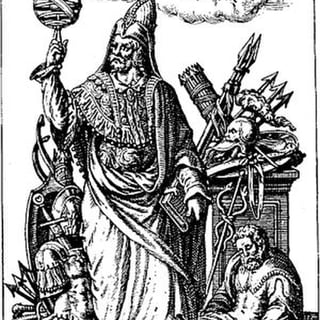
Speaker: So one reason is that a lot of alchemists consider the founder of their discipline to be this mythical figure called Hermes Trismegistus, the thrice great Hermes, which is kind of amalgamation of the Greek god Hermes and the Egyptian god Thoth.
Speaker: So this is a kind of mythical figure.
Speaker: There's a lot of writings that are attributed to Hermes.
Speaker: He's called the Hermetic Corpus.
Speaker: So his writings, whoever this person was, it's likely a variety of different people throughout the ages.
Speaker: But the writings are very mystical, very spiritual and all of that.
Speaker: So that's one reason.
Speaker: The alchemists also wrote in this very strange style, this kind of rhapsodic, esoteric style where they use code names for a lot of things.
Speaker: So they might call Gold the rooster because the rooster is associated with the sun and Gold is associated with the sun.
Speaker: Or when they're talking about heating something up, they might say deliver it to Vulcan, Vulcan, the god of fire.
Speaker: So they talked in this really high-flown way.
Speaker: And so, yeah, there's this idea that alchemy is an inherently spiritual thing.
Speaker: And this interpretation was further cemented in the 19th century during the kind of occult spiritualist revival in Victorian England and in America.
Speaker: That makes the writing sound really dumb.
Speaker: Like it was just full of this stuff that like your freshman creative writing professor would make you take out.
Speaker: Yeah.
Speaker: Yeah, well, they were trying to, we can talk a bit more about this later.
Speaker: Like, why did they write this way?
Speaker: There's a lot of reasons.
Speaker: And I think there's something cool about why they did this.
Speaker: So, but anyway, so in the 19th century, there was this revival, this spiritualist revival, which is probably a reaction to the Enlightenment.
Speaker: And yeah, you have people being really into seances, being really into ghosts.
Speaker: Mary Todd Lincoln, for instance, was doing seances in the White House.
Speaker: Nancy Reagan, too.
Speaker: Oh, really?
Speaker: Yeah, yeah, I think so.
Speaker: So maybe it persisted to the modern day.
Speaker: And yeah, and alchemy got wrapped up in this whole sort of thing.
Speaker: And so some of the people that were really into this stuff, they interpreted alchemy as a kind of spiritual thing.
Speaker: So perhaps the most famous alchemy
Speaker: person who interpreted alchemy this way is Carl Hume.
Speaker: So he wrote that alchemy does not deal at all, or for the most part at least, with chemical experiments, but probably with something like psychic processes expressed in pseudo-chemical language.
Speaker: Other people into the spiritualist stuff, they thought that alchemy, the real goal of alchemy was self-transformation, moral improvement, all this stuff about turning lead into gold is kind of just an analogy or maybe sort of reflective of its true
Speaker: essence.
Speaker: So needless to say, this does not comport very well with the actual history of alchemy.
Speaker: So you're just making that up.
Speaker: He's making it up.
Speaker: Yeah.
Speaker: But it was influential.
Speaker: His view of alchemy was influential.
Speaker: And you can find people today that still think of alchemy in this way.
Speaker: It's primarily the sort of spiritual thing about our self-transformation.
Speaker: So, yeah, that's one way in which alchemy survives into the present day.
Speaker: So just like we need to perfect metals to turn or like the perfection of metals turns them into gold.
Speaker: We too have like a there's like a perfected version of ourselves.
Speaker: Yeah.
Speaker: And like alchemy has a spiritual dimension of like the perfection of the individual.
Speaker: Yeah, exactly.
Speaker: This is a very common view.
Speaker: Still common today, I think.
Speaker: Yeah, so one of the things I said I was really interested in talking about on this episode has to do with this, the more spiritualistic interpretations of alchemy, because I think there's something really, there's a trait of alchemy that that interpretation brings out, which is that alchemy really at bottom is like an extremely optimistic kind of pursuit.
Speaker: Yeah.
Speaker: There's a perfect, everything has a potential perfection.
Speaker: And that potential perfection can be reached naturally with just, you know, just through like, kind of comporting with nature or bringing things into alignment with nature in the right way.
Speaker: Something can become perfected, be it, you know, metal or persons.
Speaker: just gotta find the right balance you just gotta find the right balance and i think that that's so interesting in part because it allows us to see that that the the spirit of alchemy really hasn't left us balance is it's all about balance yes you were talking about like the the natural medicine stuff and natural medicine is all kind of based on um this really optimistic view of like
Speaker: disease and the body's ability to heal, you know, namely that kind of no matter what, like discomfort or ailment or whatever someone has, like that must indicate an imbalance.
Speaker: You know, there's endless sort of like influencers and stuff across social media platforms that their whole account is devoted to like seed cycling, which is where you like eat, you know, women eat different kinds of seeds depending on what point in their cycle they're at.
Speaker: And that's supposed to balance your hormones and make
Speaker: you know, make everything better, you age backwards and you feel amazing, you have energy, you lose weight, blah, blah, blah.
Speaker: And you can see the connection here to like the four humors, theory of internal well-being, of medicine.
Speaker: This was a theory of
Speaker: This is the reigning medical theory to like the 19th century, right?
Speaker: The human body, there's four substances in it.
Speaker: Let me see if I can remember them.
Speaker: So it's blood, black bile, phlegm, and yellow bile.
Speaker: Right, exactly.
Speaker: And so, you know, when you're sick, you have an excess of one or the other, right?
Speaker: So if you have a cold, right, you have phlegm, you have too much phlegm in you.
Speaker: And phlegm is cold and wet, right?
Speaker: So our
Speaker: Our idea that you get sick from a cold when you go out in the cold, which is not true.
Speaker: Right.
Speaker: That is a survival of the four humorous theory.
Speaker: Yeah.
Speaker: And you can see this in the sort of natural medicine ideology, which often involves lots and lots of supplements.
Speaker: You know, if you're feeling such and such way, maybe you're low on such and such nutrient.
Speaker: And so you need to take these supplements, which, you know, much more often than not, people actually are not low.
Speaker: And all these nutrients, I'm also going to get a lot of crap from my family about this episode, I anticipate.
Speaker: I love you all if you're listening.
Speaker: So, but in any case, I see this as kind of being contiguous, not just in those little details, but also in the broader outlook with alchemy, which, like I was saying at bottom, is very optimistic.
Speaker: There's no room for like chronic conditions that can only be like, you know, where maybe the best we can hope for is like pain mitigation through drugs.
Speaker: Like, no, you're curable.
Speaker: You're perfectible.
Speaker: You just have to find the way to like balance your nature in the right way.
Speaker: And interestingly, I think that there's another version of this kind of contemporary attitude of alchemy, this like over-optimism, I guess I would call it, which I think I told you about this, Frank.
Speaker: You probably read about it too because it's been all over.
Speaker: But the rise of what's being called biohacking.
Speaker: Yeah.
Speaker: Yeah.
Speaker: This is like a Silicon Valley millionaire, billionaire thing.
Speaker: Yeah, that really scary looking guy that I see on Twitter all the time.
Speaker: Yeah, Brian Johnson.
Speaker: Brian, I guess he now calls himself Zero.
Speaker: The zero formerly known as Brian Johnson, who is a multi multi-millionaire.
Speaker: He sold some kind of payment system to eBay and made like $800 million.
Speaker: And now he spends his millions just biohacking, which is where you go to extreme measures and spend extreme amounts of money to try to bring your body into peak physical perfection.
Speaker: And his goal is, as he has stated, to age backwards.
Speaker: He thinks he'll live to be over 200 years old and blah, blah, blah, all this other stuff.
Speaker: And so apart from just kind of the humorousness of how terrible his life sounds with his regimen and he's not the only biohacker out there.
Speaker: There's dozens of them that have been in the news lately.
Speaker: But again, I think it's kind of this manifestation of, you know, there's nothing that we can't fix through the right amount of devotion to just like perfecting the physical, even, you know, age and death.
Speaker: Yeah.
Speaker: This is a good time to mention another misconception about alchemy.
Speaker: It's kind of related.
Speaker: It's that a lot of people think that the alchemists were trying to find the elixir of life.
Speaker: So you might think, well, yeah, of course this is alchemy.
Speaker: They're trying to find the elixir of immortality.
Speaker: But this is an idea that is associated with
Speaker: the Western alchemical tradition mistakenly.
Speaker: So according to Lawrence Principe, a guy that wrote The Secrets of Alchemy, the search for the elixir of immortality, he calls that a uniquely Chinese goal.
Speaker: So the Chinese alchemists were also trying to do similar sorts of things, and they were specifically trying to find the elixir of immortality, not the medieval European alchemists.
Speaker: So I just thought I'd mention that.
Speaker: But anyway, I mean, it does seem like, you know, something that does fit very well with the history of alchemy, this point about the elixir immortality notwithstanding.
Speaker: They were trying to, you know, improve people's lives, extend their lives and that sort of thing.
Speaker: If only you find the right trick, you can do it.
Speaker: You can reach perfection as long as you just get the key.
Speaker: You figure out exactly where the imbalance is and you correct that.
Speaker: Yeah.
Speaker: So I see that.
Speaker: I mean, obviously, we don't have people really calling themselves alchemists anymore.
Speaker: But to me, at least the spirit of alchemy is very much with us.
Speaker: Yeah, definitely.
Speaker: Yeah, so this business about perfection is something that was part of the broader mindset during the heyday of alchemy, which I should mention corresponded with the scientific revolution.
Speaker: So the heyday of alchemy is during the scientific revolution.
Speaker: So this idea that alchemy is like anti-scientific seems to be bogus.
Speaker: But this idea that there's perfection to be had, this is something that I think the modern chemists wouldn't really make sense to them.
Speaker: The idea that wed can be perfected to become gold doesn't really make much sense.
Speaker: And not even because it's too optimistic, but because the idea of perfecting something, that's an idea that doesn't denote anything in chemistry.
Speaker: Yeah, at least in the way in which it did for the alchemist.
Speaker: There was an objective fact of the matter about perfection.
Speaker: Like perfection was out there in the world.
Speaker: It wasn't a projection of the human mind.
Speaker: And so, too, for these ideas about like analogies and metaphors.
Speaker: So I said earlier that the seven classical metals were each associated with a planet.
Speaker: And that wasn't just a kind of like easy way to remember them or a projection or just a fun, nice way of thinking about it.
Speaker: Like they thought this was true, right?
Speaker: That there was in a deep sense, gold is connected to the sun.
Speaker: In a deep sense, silver is connected to the moon.
Speaker: Gold means sun.
Speaker: Silver means moon in this deep, objective way.
Speaker: These ideas of meaning and analogy, those are out there in the world.
Speaker: They're not a projection of the human mind.
Speaker: And this is also a kind of idea that I think is, you know, it's kind of been lost in the modern world, I think.
Speaker: What do you think, Megan?
Speaker: I think in some sense it hasn't been lost, but in some sense it has.
Speaker: I mean, I think for the average person, I mean, you see, you know, things like people are very superstitious still, or maybe you don't want to call it superstitious, but like they think, you know, things are omens or whatever of other things.
Speaker: Mm-hmm.
Speaker: Maybe if you push them on it, they'll say, oh, it's just in my mind or something like that.
Speaker: It's just like how I understand the world.
Speaker: I'm not saying like it's actually fact about the world that, you know, because I saw three black cats today, that means something bad's going to happen or whatever.
Speaker: But so, yeah, so in that sense, it's out of the realm of things I think people would really admit to accepting.
Speaker: But I think it's still in the realm of like ways people tend to think about a lot of stuff.
Speaker: It's certainly not out of I mean, religious frameworks still very much accept this kind of teleological.
Speaker: I mean, it goes beyond teleology, right?
Speaker: It's really more of like typological realism.
Speaker: The world is saturated with meaning and not a projection of the human mind.
Speaker: That's a really key part of the alchemical, like, broader horizon that distinguishes it from, like, modern chemistry.
Speaker: So maybe one reason why we can't really consider alchemy as just proto-chemistry, because that would just, that would kind of mischaracterize it a little bit.
Speaker: Yeah, yeah.
Speaker: So we'll call it like typological realism or something like that.
Speaker: The world is thick with meaning in the subjective sense.
Speaker: Yeah.
Speaker: So I think it's probably out of the realm of things that people would, you know, it's not like a way we talk anymore.
Speaker: But I do think, at least in some circumstances, it's part of how we experience the world.
Speaker: If you're, you know, on a hike on some, you know, you go off the off the trail and you're just like hiking by yourself and you come up on this clearing that looks out over a cliff and to a view that looks like it's like from a postcard.
Speaker: I mean, you know, there's there's a part of you that can't help feeling like that was like that that's there to be seen.
Speaker: Yeah.
Speaker: Yeah, the alchemists felt that way about, so obviously in medieval Europe, pretty much everyone is Christian, right?
Speaker: So they felt this sort of way about things like the Philosopher's Stone, right?
Speaker: They connected the Philosopher's Stone to like, you know, the redemption provided by Christ.
Speaker: Yeah.
Speaker: The stone redeems the lead.
Speaker: The lead becomes gold in the same way that Christ redeems the world.
Speaker: And again, that wasn't just sort of a fun way of thinking about it.
Speaker: They really thought that there was some connection between alchemy and the philosopher's stone and Christianity.
Speaker: And in fact, some people went so far as to say that you can prove the truth of Christianity by means of alchemy.
Speaker: Like, look at alchemy.
Speaker: Like, the philosopher's stone turns lead into gold.
Speaker: Like, obviously, Christianity is true.
Speaker: Some people argue this way.
Speaker: And I guess this a similar story could be told about the the Islamic alchemical tradition as well.
Speaker: Yeah.
Speaker: Right.
Speaker: OK.
Speaker: So I want to go back to the way in which the alchemists wrote their texts.
Speaker: Right.
Speaker: So you were you were criticizing or poking fun a little bit.
Speaker: at their really florid language.
Speaker: So why do they write this way?
Speaker: This is an interesting sort of puzzle.
Speaker: If you read a contemporary textbook, they're not going to talk about delivering something to Vulcan or whatever.
Speaker: They're just going to say, heat it up.
Speaker: They're not going to call Gold the rooster or whatever.
Speaker: They're just going to call it Gold.
Speaker: So why do they write this way?
Speaker: Why do they write in this kind of coded language?
Speaker: And there's a number of reasons why.
Speaker: There is some logic to this.
Speaker: So one reason why is maybe just to protect their trade secrets.
Speaker: So if you really thought you did discover the Philosopher's Stone, you don't want everyone to know that because then they're going to be able to compete with you.
Speaker: Maybe you only want the knowledge to be available to those who are worthy of receiving it.
Speaker: There's a lot of prejudice against alchemists.
Speaker: Maybe that's important to be secretive.
Speaker: But one reason why they did this is that it was just kind of fun.
Speaker: at least Principe argues this in The Secrets of Alchemy, that the idea of learned play, writing in code and trying to figure out the secret meanings of things, this is a characteristic of early modern intellectual and public culture.
Speaker: It was common for periodicals or newspapers at the time to publish a kind of image that contains secret meanings and people would write in what they thought the meanings were.
Speaker: And so this is just a really fun thing to do.
Speaker: Why write in really dry, boring, technical language when you can write in florid language that references Greek mythology and all that stuff?
Speaker: It's a lot more fun.
Speaker: It makes science and practical experimentation, which would maybe be otherwise kind of boring, really fun and exciting.
Speaker: Yeah, well, okay.
Speaker: First to clarify, I was not making fun of the fact they wrote esoterically.
Speaker: I was more making fun of the fact that it seemed a little simplistic.
Speaker: Like, send it up to Vulcan means heat it up.
Speaker: Yeah, so- They could be a little more creative.
Speaker: Yeah, so in some cases, it's pretty clear, like, what they meant, right?
Speaker: So Saturn means lead.
Speaker: If you write Saturn, you mean lead.
Speaker: Yeah.
Speaker: Yeah, so-
Speaker: And I guess that I find the other explanations of why they wrote this way kind of unconvincing for those reasons.
Speaker: Like, well, if these, you know, sayings are so widely known, then it's not going to do a really good job keeping like your trade secrets.
Speaker: If you're trying to keep someone from thinking you're an alchemist, probably don't talk about setting something up to Vulcan.
Speaker: So yeah, but they wrote this way because it was fun.
Speaker: And I mean, you know, because I talked about this book a lot, but there's a really interesting book called Philosophy Between the Lines by Arthur Melzer.
Speaker: And the subtitle is The Lost History of Esoteric Writing.
Speaker: And Melzer makes what I take to be like a really good case that esoteric writing or what I would define not as kind of these like heavy handed allegories or whatever, but like
Speaker: indirect writing to convey something that can't be conveyed well directly, that esoteric writing in that sense of esoteric was really common, not even unexpected, something that people kind of expected from people who were writing about mysterious or difficult or complicated things.
Speaker: Just because, I guess the assumption was there are a lot of things out there that are too big for straightforward language.
Speaker: So I guess it kind of makes sense just to convey like the importance of what the alchemist takes herself or himself to be doing that they would, you know, write in this kind of cryptic language to convey like, you know, yeah, I'm doing like chemistry or whatever, but it's not, you know, it's not mere, it's not like I'm just like cooking dinner.
Speaker: Like I'm making something extremely important.
Speaker: Yeah, good.
Speaker: I'm glad you mentioned that because that's another reason why they sort of wrote this way, why there's all these references to the Greek mythology.
Speaker: It's because they want to ennoble and elevate the craft.
Speaker: So alchemy is interesting because it is theoretical.
Speaker: There are applied theories of matter, but it's also very practical.
Speaker: You got to get your hands dirty.
Speaker: And, you know, practical things where you get your hands dirty, those were kind of viewed as a little lower class.
Speaker: The philosophers, a lot of philosophers were not doing that sort of thing.
Speaker: Natural philosophers were not doing that sort of thing for the most part.
Speaker: That was associated with manual labor and all of that.
Speaker: So I think this is a way for the alchemists, Principe argues this, like I said, my view on this is very influenced by this book.
Speaker: They wanted to ennoble the craft, and so they wrote in this sort of way to show it.
Speaker: It's not just mere cooking, right?
Speaker: It's not just mere chemistry.
Speaker: It's not just mere alchemy.
Speaker: It's this really, really noble art.
Speaker: It's the hermetic art, going back to Hermes Trismegistus.
Speaker: Yeah, and I would think not only just ennoble the art, but also connect it to people from hundreds and hundreds of years ago who are trying to do the same thing.
Speaker: Yeah, exactly.
Speaker: All right, Megan.
Speaker: So we've talked about a lot of different things.
Speaker: What have we learned here?
Speaker: What have you learned?
Speaker: What's your takeaway?
Speaker: The inside joke is that Frank asked me this question a lot.
Speaker: Like sometimes after like we watch a movie or a TV show, he'll just ask me what I learn and I never have a good answer.
Speaker: But I have an answer to this question.
Speaker: What have I learned?
Speaker: So in doing like the research and the prep and stuff for this podcast, I really I mean, I didn't know too much about alchemy before, but it really struck me how.
Speaker: Long it's been around.
Speaker: It's multifaceted, but there's a definite, you know, thing that alchemy is that has run through all of the different histories and cultures doing alchemy.
Speaker: So like how long it's been around, how multicultural it is, and the fact that I think it's still with us.
Speaker: Like it just seems like this aspect of human experience that manifests itself in some way or another across all peoples and cultures.
Speaker: And that's been really interesting for me.
Speaker: Yeah, even if we're not trying to turn lead into gold anymore, although I'm sure there are still some people out there trying to do that, you know, old school alchemists in their secret laboratories trying to turn lead into gold.
Speaker: Their mom's basement.
Speaker: Yeah, the spirit of alchemy, as you so eloquently put it, is still with us.
Speaker: Yeah.
Speaker: What have I learned?
Speaker: Yeah, what have you learned, Frank?
Speaker: I've learned that the alchemists should be taken a lot more seriously in the history of science and the history of our intellectual tradition.
Speaker: So they like they and in fact, I think, put it a little boldly, I think they really do embody the spirit of the scientific revolution in a lot of ways.
Speaker: So I think this is not just hyperbole.
Speaker: So so when we think about the scientific revolution, like what was so distinctive about it?
Speaker: Well, a lot's been written about this, but, you know, there's a lot of key markers.
Speaker: that the alchemists embody.
Speaker: So, for instance, combining theory with practical experimentation, not just sort of experimenting blindly and not just sitting in your armchair theorizing about the fundamental nature of matter, but applying theories of matter to try to tinker with things.
Speaker: The alchemists had this as
Speaker: one of their goals.
Speaker: They were constantly trying to break things down, to analyze things into their constitutive components and then reassemble them.
Speaker: If you break something down, right, if you break down lead into its constitutive components, maybe you can combine those together in the right way to make goal.
Speaker: So analysis followed by synthesis is a very sort of modern way of doing things.
Speaker: Descartes, for instance, in his Discourse on Method, key figure in the scientific revolution, he lists as his second rule for
Speaker: doing good science as simplifying things, breaking things down into their simpler components, breaking down complex problems.
Speaker: So the alchemists did this.
Speaker: There were attempts to classify different metals and substances.
Speaker: There were rudimentary attempts to quantify things, try to quantify the amount of cold or hot or wet or dry in a substance.
Speaker: And I think primarily like they had as their goal, manipulation and control of nature.
Speaker: Francis Bacon lists this as the most important fact about knowledge, that it can be used to benefit humankind and help relieve the human condition.
Speaker: So we think we look to science to do that sort of thing.
Speaker: And that's what the alchemists were up to.
Speaker: They were trying to create new medicines, among other things.
Speaker: So I do really do think it embodies the spirit of the scientific revolution, not least because a lot of key figures in the scientific revolution were alchemists, were engaged in alchemy.
Speaker: Newton was poring over alchemical texts.
Speaker: He wrote a commentary on Hermes Trismegistus' emerald tablet, this kind of mystical foundational text in alchemy.
Speaker: He thought this was important enough to write a commentary on.
Speaker: So I do think the alchemists were, they are part of the
Speaker: the history of the scientific revolution, and they embody its spirit in many ways, including criticizing the schools, the Aristotelian schools and the universities.
Speaker: Alchemy stood outside the university.
Speaker: There was no alchemy department in the medieval university.
Speaker: They were kind of outsiders in the same way that people like Galileo thought they were outsiders.
Speaker: So that's what my fundamental takeaway would be when it at least comes to the history of alchemy viewed as a kind of academic pursuit.
Speaker: It really does embody
Speaker: You know, the spirit of science.
Speaker: Wow, that was a lot longer answer than mine was.
Speaker: Whoa, what else have you learned?
Speaker: I don't know.
Speaker: No, I guess you just learn more than I did.
Speaker: Oh, well, yeah.
Speaker: All right, so that is all the time we have for today's episode.
Speaker: Join us for episode 12 when we wildly switch gears because we are going to be tackling the topic of American football.
Speaker: I just came up with that just now.
Speaker: Very good.